Attorney General William Barr on Monday said President Trump had consulted the Department of Justice before ordering an airstrike that killed Iran’s top military general earlier this month. The comments came after growing questions about what led to the Jan. 3 airstrike that took out Gen. Qassem Soleimani, head of the Islamic Revolutionary Guard Corps’ elite Quds Force. Democrats have criticized Trump’s decision to conduct an airstrike,
claiming he did not properly notify Congress in advance and warning
about the risk of escalating violence in the region. Barr said that Soleimani was a “legitimate military target” and the strike was a “legitimate act of self-defense.” “The Department of Justice
was consulted and frankly I don’t think it was a close call,” the
attorney general said. “I believe the president clearly had the
authority to act as he did on numerous different bases.” During an appearance on Fox News’ ‘The Ingraham Angle,’ Trump said the airstrike that killed Soleimani was a deterrence to an imminent threat from Iran that involved planned attacks on four U.S. embassies. Asked
specifically what was targeted, Trump responded: “We will tell you that
probably it was going to be the embassy in Baghdad.” But the
scale of the supposed threat was called into question Sunday after
Defense Secretary Mark Esper said he hadn’t seen hard evidence that four
American embassies were under possible threat. “I didn’t see one
with regard to four embassies,” Esper told reporters. Asked whether he
thought Trump had embellished the threat he said: “I don’t believe so.” As
the debate over the threat level continued Monday, Trump went on the
defensive, blasting the “Fake News Media and their Democrat Partners”
for trying to determine whether a future attack by Soleimani was
“imminent,” and whether the Trump administration was in agreement over
the airstrike. “The answer to both is a strong YES., but it doesn’t really matter because of his horrible past!” Trump tweeted. Speaking to reporters outside Air Force One later Monday, Trump referred to Soleimani as the “number one terrorist in the world” and “a very bad person” who “killed lots of Americans, killed a lot of people.” “When
Democrats try to defend him, it’s a disgrace to our country. They can’t
do that,” Trump said. “And let me tell you, it’s not working
politically very well for them. We killed the number one terrorist in
the world, Soleimani, and it should have been done 20 years ago.” Separately,
a senior State Department official told Fox News, “We still have
concerns about Iranian proxy groups in the region... The United States
has made clear that we plan on being disproportional in our response to
Iranian aggression. That hopefully... will result in the deterrence
that we’re looking for.” Fox News’ Rich Edson, Joshua Nelson and The Associated Press contributed to this report.
Just
as soon as the House concluded votes on Friday and most lawmakers
rushed to the airport, garage or Union Station, House Speaker Nancy Pelosi (D-CA) signaled that House Judiciary Committee Chairman Jerry Nadler (D-NY)
should be ready in the coming days to summon to the floor the measure
to appoint impeachment managers and send the articles of impeachment to
the Senate. Pelosi did not give a concrete day or time as to when this would happen. The Speaker says she will talk to Democrats at the weekly caucus meeting Tuesday “on how we proceed further.”
The expectation on Capitol Hill is that the House will vote to send the
articles of impeachment across the Capitol on Tuesday or Wednesday. So, here’s what you need to know about what happens next: Tuesday
is a pivotal day. The House Democratic Caucus huddles in the morning.
It’s possible the Speaker could announce her plan immediately after the
caucus meeting and the debate/vote could happen that same day. It’s also
possible the House may not tangle with the measure until later in the
week. But Tuesday is the earliest anything will now come to the floor. Here's what needs to happen mechanically – regardless of when Pelosi pulls the trigger.
The
articles are usually tucked into cherry wood or cedar boxes and
escorted across the Capitol with a procession led by House Sergeant at
Arms Paul Irving and Senate Sergeant at Arms Michael Stenger.
Pelosi
decides when to put the measure on the floor. One story unto itself
will be the announcement of the impeachment managers. Who are they?
Where are they from? How many? Is it a large group or a finite group?
Republicans tapped 13 white men as impeachment managers for President
Clinton’s 1999 trial. Pelosi is likely to select a smaller and more
diverse group to represent the House before the Senate. The House
then has a short ten-minute debate on sending the impeachment measure
plus the managers to the Senate. This will require a simple majority
vote. Once the House approves that measure, the articles are ready to be
walked across the Capitol to the Senate. This is where things get tricky: Even
if the House approves the articles, it’s unclear when exactly the
articles of impeachment are actually packed up and physically walked
from the House side of the Capitol, through Statuary Hall, through the
Capitol Rotunda, by the “mini-Rotunda,” paraded through the Ohio Clock
Corridor and deposited in the Senate. The articles are usually tucked
into cherry wood or cedar boxes and escorted across the Capitol with a
procession led by House Sergeant at Arms Paul Irving and Senate Sergeant
at Arms Michael Stenger. This process could happen within an hour or
two of the House voting to send the articles to the Senate – or,
potentially days, later. The “when” is a big question here. Then, it’s the Senate’s turn to wrestle with impeachment. The Senate adopted a set of 26 rules in 1986 to handle impeachments. Senate
Impeachment Rule I states that once the House votes to appoint managers
“The Secretary of the Senate shall immediately inform the House of
Representatives that the Senate is ready to receive the managers for the
purpose of exhibiting such articles of impeachment.” This means
that the Senate must approve a resolution, indicating it is prepared to
receive the House’s articles. The Senate can’t get the articles until it
acts. The House cannot send the articles across the Capitol until the
Senate says it’s ready. The Senate then usually sets a time/date to receive the articles in that resolution. Senate
Impeachment Rule II says “When the managers of an impeachment shall be
introduced at the bar of the Senate and shall signify that they are
ready to exhibit articles of impeachment against any person, the
Presiding Officer of the Senate shall direct the Sergeant at Arms to
make proclamation, who shall, after making proclamation, repeat the
following words, viz: ‘All persons are commanded to keep silence, on
pain of imprisonment, while the House of Representatives is exhibiting
to the Senate of the United States articles of impeachment
against_______ ______’; after which the articles shall be exhibited, and
then the Presiding Officer of the Senate shall inform the managers that
the Senate will take proper order on the subject of the impeachment, of
which due notice shall be given to the House of Representatives.” In
other words, the Senate gets the articles. Senate Sergeant at Arms
Michael Stenger announces the “exhibition of the articles.” The articles
are read before the Senate and the impeachment managers are recognized. At that point, the Senate trial is technically underway. This is the first step in the Senate trial. But….. Even at that stage, we may be at least a few days if not a week away from getting into the meat of the trial. For
instance, the Senate dealt with the “mechanics” of receiving the
impeachment articles from the House on January 7 and 8, 1999. But then,
the Senate took until January 14, 1999 to start the trial in earnest. In
this case, the Senate may need time to prepare itself to put on the
trial. The impeachment managers may need time to prepare the
prosecution. The President must also decide on his defense team. That
team must also be prepared to go. In short, you just don’t get on the floor and wing it. This is the second step in the trial. It’s where U.S. Chief Justice John Roberts swears-in senators as jurors. That’s
why even if the House sends the articles to the Senate Tuesday or
Wednesday, it’s possible the Senate doesn’t even get to the first step
in the process - and certainly the substance of the trial - for a few
days. In fact, with the Martin Luther King holiday scheduled for Monday, January 20, it’s entirely possible nothing happens until January 21 or beyond. Somewhere
in this process, the Senate may conduct a debate and vote on how to
handle the trial. This is the framework which Senate Majority Leader
Mitch McConnell (R-KY) has spoken about. This would dictate how much
time the Senate allocates for House managers to present their case, how
much time the President’s team gets to defend him, how much time
senators have to submit questions (usually in writing, through the Chief
Justice) and, if and when there will be any witnesses. McConnell has
advocated following the Clinton trial model. That provided for each side
to have 24 total hours to make their cases. Senators had a total of 16
hours to pose questions and get responses. It’s also possible that the
Senate could have votes on summoning/rejecting witnesses down the line. The
Senate voted 100-0 in 1999 to approve the Senate trial rules. This
time, McConnell has suggested he may just try to lock-in the Clinton
trial rules with a simple majority – which is the Leader’s right. If the Senate fails to agree to any “special rules,” ala the Clinton model, then Senate Impeachment Rule III kicks in: “Upon such articles being presented to the Senate, the Senate shall, at 1 o’clock after
noon of the day (Sunday excepted) following such presentation, or
sooner if ordered by the Senate, proceed to the consideration of such
articles and shall continue in session from day to day (Sundays
excepted) after the trial shall commence (unless otherwise ordered by
the Senate) until final judgment shall be rendered, and so much longer
as may, in its judgment, be needful. Before proceeding to the
consideration of the articles of impeachment, the Presiding Officer
shall administer the oath herein after provided to the Members of the
Senate then present and to the other Members of the Senate as they shall
appear, whose duty it shall be to take the same.” In other words, the Senate meets six days a week at 1 pm ET for
a trial. No ifs, ands or buts about it. This is sure to make the five
Democratic senators running for President very unhappy, especially on
the precipice of the Iowa Caucuses and New Hampshire primary. The reason
for a 1 pm start time? The
Senate can still conduct other business on legislation or nominations in
the morning. Also, the Chief Justice needs to preside – but could have
other duties across the street at the Supreme Court. The Senate
met for 22 total trial sessions (including two dates for the opening
phases) between January 7, 1999 and February 12, 1999. Those meetings
consumed 104 hours and 22 minutes. The Supreme Court met for oral
arguments on two days the Senate conducted a trial. On those days, the
Senate didn’t convene for the trial until the afternoon.\ In
1999, the Senate rejected an effort by Sen. Robert Byrd (D-WV) to
dismiss the charges. A motion to dismiss could be in order here,
requiring a simple majority vote. At the end of the trial, it takes 67 votes to convict and remove the President from office.
A couple of things to note:
Senate Impeachment Rule X states that “The person impeached shall then
be called to appear and answer the articles of impeachment against him.
If he appears, or any person for him, the appearance shall be recorded,
stating particularly if by himself, or by agent or attorney, naming the
person appearing and the capacity in which he appears. If he does not
appear, either personally or by agent or attorney, the same shall be
recorded.” So, it’s possible (possible) the President could be called to
appear at the trial.
There
are multiple schools of thought as to how long a trial may last. The
conventional wisdom is that it’s wrapped up by the end of the month. But
a bona fide trial – adhering to the Clinton model – could consume weeks
and run deep into February, if not March. And regardless, how soon it
wraps up is predicated on when the trial actually begins.
The Trump administration has “reached out to the North Koreans”
to ask them to resume diplomacy since the two sides broke off talks
last October, White House national security adviser Robert O’Brien told
Axios Sunday. "We've reached out to the North Koreans and let them
know that we would like to continue the negotiations in Stockholm that
were last undertaken in early October,” he told the news service. O’Brien
expressed cautious optimism North Korea’s leader Kim Jong-un hasn't yet
delivered his promised "Christmas gift" — something many analysts
expected would be a nuclear weapons test, Axios reported. President
Trump is hoping to build on inroads he’s made to restart the talks and
reach an agreement with the North, the report said. Trump recently sent a
birthday message to Kim, but the North Koreans have
already said Trump's courtship will not change their policy. To
date, Trump's diplomacy has yielded little results besides giving Kim
more time to expand his nuclear arsenal, according to analysts tracking
North Korea's supply of nuclear warheads.
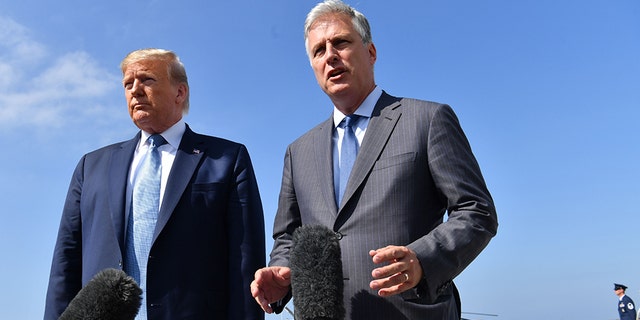
US President Donald Trump(L)speaks next to new national security
advisor Robert O'Brien on September 18, 2019 at Los Angeles
International Airport in Los Angeles, California. (Photo by Nicholas
Kamm / AFP via Getty Images)
John Bolton, O'Brien's predecessor as national
security adviser, recently told Axios the administration is bluffing
about stopping North Korea's nuclear ambitions and should prepare to
make a public admission its policy failed badly.
O'Brien said
he remains hopeful about Kim's decision — so far — to refrain from
launching a nuclear test during the Christmas and New Year timeframe.
Kim
"promised to send a Christmas present. The president suggested he send
him a vase. We didn't get a vase or any other sort of Christmas gift.
That appears to be positive," O’Brien told Axios. "All
we know is we were told we were going to get a Christmas gift and the
Christmas gift didn't come. And so I think that was an encouraging sign.
But, again, that doesn't mean we won't see some sort of test in the
future," O'Brien added.
Videos emerged online Monday that purportedly show Iranian police and
security forces firing live ammunition to disperse demonstrators
protesting against the Islamic Republic after the country mistakenly
downed a Ukrainian airline plane shortly after takeoff from Tehran. There
was no immediate report in Iranian state-run media on the incident near
Azadi, or Freedom, Square in Tehran, but, if true, could be seen as an
act of defiance against President Trump who warned the regime against
the use of deadly force. Trump
late Sunday tweeted in Farsi that a combination of protests and
sanctions have "choked off" Iran and said Tehran will be forced to the
negotiation table. Trump
insisted that he "couldn’t care less" if the regime negotiates, but he
appeared to lay down non-negotiable issues that included the development
of nuclear weapons and the use of deadly force against protesters. "Don't kill your protesters," he tweeted. Videos
were sent to the New York-based Center for Human Rights in Iran and
later verified by The Associated Press. They show a crowd of
demonstrators fleeing as a tear gas canister landed among them. People
cough and sputter while trying to escape the fumes, with one woman
calling out in Farsi: “They fired tear gas at people! Azadi Square.
Death to the dictator!” Another video shows a woman being carried
away in the aftermath as a blood trail can be seen on the ground. Those
around her cry out that she has been shot by live ammunition in the leg. “Oh my God, she’s bleeding nonstop!” one person shouts. Another shouts: “Bandage it!” Photos and video after the incident show pools of blood on the sidewalk. Hossein
Rahimi, the head of the Tehran police, said in a statement seen by
Reuters that police "absolutely did not shoot" due to orders to show
restraint. The
tweet in Farsi appears to be an attempt by Trump to speak directly to
the Iranian people. Tehran has experienced upheaval after the missile
strike on a Ukrainian airline flight out of the country's capital that
the country called a mistake. Still, the mishap was seen as an
international display of military ineptitude. Many of the country’s protesters chanted "death to the Dictator," referring to Supreme Leader Ayatollah Ali Khamenei. Trump,
who says he is not interested in ousting the Iranian regime, reinstated
economic sanctions on Iran after withdrawing from the nuke deal. He
said it gave Tehran too many economic benefits without doing enough to
prevent Iran from eventually developing a nuclear weapon. Brigadier
General Amir Ali Hajizadeh, the head of the Revolutionary Guard's
aerospace division, said his unit accepts "full responsibility.” Iranian
officials had earlier denied that it had shot down the jet. Alam Saleh, an Iran expert, told the Wall Street Journal that the state’s legitimacy has been “severely challenged by the people.” Trump,
hours earlier, again warned Tehran not to kill protesters, saying,
“Thousands have already been killed or imprisoned by you, and the World
is watching. More importantly, the USA is watching." Karen Pierce, British ambassador to the United Nations, echoed Trump's message to Iran. "The
important thing is that... the Iranian government needs to listen to
its people and it needs to de-escalate the current situation... that's
in their hands," Pierce said Sunday on "America's News HQ." Fox News' Yael Halon and the Associated Press contributed to this report
DUBAI,
United Arab Emirates (AP) — Iran’s security forces deployed in large
numbers across the capital on Sunday, expecting more protests after its
Revolutionary Guard admitted to accidentally shooting down a passenger
plane at a time of soaring tensions with the United States.
Riot
police in black uniforms and helmets massed in Vali-e Asr Square,
Tehran University and other landmarks as calls circulated for protests
later in the day. Revolutionary Guard members patrolled the city on
motorbikes and plainclothes security men were also out in force. People
looked down as they walked briskly past the police, hoping not to draw
attention to themselves.
The
plane crash early Wednesday killed all 176 people on board, mostly
Iranians and Iranian-Canadians. After initially pointing to a technical
failure and insisting the armed forces were not to blame, authorities on
Saturday finally admitted to accidentally shooting it down in the face of mounting evidence and accusations by Western leaders.
Iran
downed the Ukrainian flight as it braced for retaliation after firing
ballistic missiles at two bases in Iraq housing U.S. forces. The
ballistic missile attack, which caused no casualties, was a response to
the killing of Gen. Qassem Soleimani, Iran’s top general, in a U.S.
airstrike in Baghdad.
Iranians
have expressed anger over the downing of the plane and the misleading
explanations from senior officials in the wake of the tragedy. They are
also mourning the dead, among whom were a large number of young people
with promising futures who were studying abroad.
“Even
talking about it makes my heart beat faster and makes me sad,” said
Zahra Razeghi, a Tehran resident. “I feel ashamed when I think about
their families.”
“The
denial and covering up the truth over the past three days greatly added
to the suffering and pain of the families, and me,” she added.
Another
individual, who only identified himself as Saeed, said the largely
state-run media had concealed the cause of the crash for “political
reasons.”
“Later developments changed the game and they had to tell the truth,” he said.
Hundreds
of students gathered at Tehran’s Shahid Beheshti University on Sunday
to mourn the victims and protest against authorities for concealing the
cause of the crash, the semi-official ISNA news agency reported. They
later dispersed peacefully.
A
candlelight ceremony late Saturday in Tehran turned into a protest,
with hundreds of people chanting against the country’s leaders —
including Supreme Leader Ayatollah Ali Khamenei — and police dispersing
them with tear gas. Protests were also held in the city of Isfahan and
elsewhere.
Police
briefly detained the British ambassador to Iran, Rob Macaire, who said
he went with the intention of attending the vigil and did not know it
would turn into a protest.
“Can
confirm I wasn’t taking part in any demonstrations!” he tweeted. “Went
to an event advertised as a vigil for victims of #PS752 tragedy. Normal
to want to pay respects — some of victims were British. I left after 5
mins, when some started chanting.”
He said he was arrested 30 minutes after leaving the area.
Britain said its envoy was detained “without grounds or explanation” and in “flagrant violation of international law.”
“The
Iranian government is at a cross-roads moment. It can continue its
march towards pariah status with all the political and economic
isolation that entails, or take steps to deescalate tensions and engage
in a diplomatic path forwards,” Foreign Secretary Dominic Raab said in a
statement.
Iran’s
Deputy Foreign Minister Abbas Araghchi later tweeted that Macaire was
arrested “as an unknown foreigner in an illegal gathering.”
Araghchi
said when police informed him that a man was arrested who claimed to be
the British ambassador he didn’t believe them. But he said that once he
spoke to Macaire by phone he realized it was him, and that the
ambassador was freed 15 minutes later.
Alaeddin
Boroujerdi, a member of Iran’s parliamentary committee on national
security and foreign policy, nevertheless accused the ambassador of
organizing protests and called for his expulsion.
Dozens
of hard-liners later gathered outside the British Embassy, chanting
“Death to England” and calling for the ambassador to be expelled and for
the closure of the embassy. Police stood guard outside the facility.
Iranian
media meanwhile focused on the admission of responsibility for the
crash, with several newspapers calling for those responsible to
apologize and resign.
The
hardline daily Vatan-e Emrouz bore the front-page headline, “A sky full
of sadness,” while the Hamshahri daily went with “Shame,” and the IRAN
daily said “Unforgivable.”
Mehdi Karroubi, an opposition activist under house arrest, lashed out at Khamenei himself.
“You,
as the commander in chief of the armed forces, are directly responsible
for this,” he said in a statement. “If you were aware and you let
military and security authorities deceive people, then there is no doubt
you lack the attributes of constitutional leadership.”
Criticism of the supreme leader is punishable by up to two years in prison.
Tensions
with the United States eased after the ballistic missile attack, when
President Donald Trump declined to respond and welcomed Iran’s apparent
decision to stand down.
The
emir of Qatar, Sheikh Tamim bin Hamad Al Thani, traveled to Iran for
talks with senior officials. Qatar hosts a large U.S. military base and
shares an offshore gas field with Iran. It has often served as a
mediator between the two countries, which have no diplomatic relations.
Syria’s
Prime Minister Imad Khamis was also leading a high-level delegation to
Iran, which includes the defense and foreign ministers. Syrian state
media described it as an “important visit” in light of recent events,
without elaborating. Iran is a key ally of Syrian President Bashar Assad
in his country’s civil war, and Soleimani had mobilized militias and
coordinated military aid.
Pakistan’s Foreign Minister Shah Mahmood Qureshi was also traveling to Iran, with plans to visit Saudi Arabia the following day.
Sen. Lindsey Graham, R-S.C., called the War Powers Act "unconstitutional" during an interview Saturday on "Justice with Judge Jeanine," and claimed Sens. Mike Lee, R-Utah, and Rand Paul, R-Ky., are wrong to support curbing President Trump's military authority. "Congress
has the power to declare war. That doesn't mean the commander in chief
can't use military force to protect the country without Congress,"
Graham told Jeanine Pirro. "We've had military engagements hundreds of
times. What the president did is he took out [Gen. Qassem] Soleimani who
was planning another attack against American forces in Iraq who were
lawfully present. He has all the authority he needs to protect troops in
the field." "The War Powers Act is blatantly unconstitutional,"
he added. "You cannot have 535 commanders in chief. Can you imagine what
our nation would look like if Bernie Sanders, Elizabeth Warren and Rand
Paul, and AOC [Alexandria Ocasio-Cortez]... that we couldn't defend the
nation unless they all agree? That would be impossible." The House of Representatives voted in favor of the War Powers Resolution, also known as the War Powers Act, on Thursday, in an attempt to limit President Trump’s military action toward Iran. The
resolution passed, 224-194, mostly along party lines, but both parties
had some defectors: eight Democrats voted against the measure and three
Republicans voted in favor of it. Independent Rep. Justin Amash, who
left the Republican Party last year, also voted in favor of the measure. Graham on Saturday also criticized Paul and Lee for opposing the drone strike that killed the Iranian earlier this month and said they are out of their depth on the issue. "I
like them both and if I had an eye problem I would call Rand Paul. He's
a great eye doctor but I would not ask him for commander in chief
advice," he said. "Mike Lee's a great guy. But all I can tell you is
that they're so wrong. Their foreign policy is more like Bernie Sanders
-- less like Ronald Reagan, less like Donald Trump." "A commander
in chief can use force to protect the nation, without 535 people
signing on to it," Graham added. "I said this when [Barack] Obama
was president. I said it when [Bill] Clinton was president. If you don't
like what the commander in chief is doing, as a member of Congress,
cut off funding. We have the power of the purse but we cannot make
military decisions." Fox News Andrew O'Reilly contributed to this report
The ex bartender thinks everything should be free, even the Democrat party dues :-)
Rep. Alexandria Ocasio-Cortez insisted
she's a "proud" Democrat despite protesting a Democratic Party arm and
withholding $250,000 in "dues" aimed at retaining the House majority. “I’m
a Democrat, I’m proud to be on this team. I’m proud to be part of the
Democratic majority,” Ocasio-Cortez told Fox News in an interview Friday
amid criticism she should quit the party and become an independent if
she won't be a "team player." As evidence that she's willing to
work for the party, Ocasio-Cortez pointed to the more than $300,000
she’s raised directly for progressive Democrats, including incumbents in
swing districts. That effort, she said, is for "preserving and
expanding the Democratic majority." Fox News reported Friday that
the New York Democrat has been catching heat for failing to pay her
$250,000 in dues to the Democratic Congressional Campaign Committee
(DCCC) in protest of a policy that she says "blacklists" vendors for
working with insurgent primary challengers, such as herself. “I
don't see the sense in giving a quarter-million dollars to an
organization that has clearly told people like me that we're not
welcome," Ocasio-Cortez said in defending her decision. The youngest
female ever elected to Congress also took issue with the amount of
money the DCCC wanted her to pay from her campaign coffers. “It’s
pretty nuts -- $250,000 for a freshman member. Can you imagine being 30
years old and getting a bill for $250,000? I still have $20,000 in
student loan debt," she said. All House Democrats are assigned
"dues" to pay to the DCCC to help the party win elections and retain the
majority. Amounts range from $1 million for Speaker Nancy Pelosi to
$150,000 for newer members or less prolific fundraisers. Republicans
have a similar system. Ocasio-Cortez said she respects people who do pay up and that she's not trying to shut down the DCCC. But
she takes issue with a party arm that "want(s) to take my money, but
push me out, or push candidates like me out" who are challenging the
establishment. Ocasio-Cortez, with her nationwide stardom, is expected to raise more than $5 million in 2019 for her reelection campaign. Instead
of cutting a check to the Democratic Party, she is building her own
grassroots fundraising network to finance progressive candidates by
soliciting online donations directly for them. She argues her
actions are aimed at improving the party by lessening the influence of
big corporations and lobbyists and giving other upstart candidates
a real shot. “This is a place that should be for everyone,”
Ocasio-Cortez said outside the Capitol complex on Friday. “It should be
for working people. It should be for everyday people who aren’t
connected to big money.” In her latest move to challenge the
Democratic Party establishment, Ocasio-Cortez on Saturday launched a new
PAC to raise money for political newcomers and took a swipe at the DCCC
in doing so. “When progressive, working-class candidates look at
running for office, organizations like the DCCC dissuade them," the
announcement said. "We need voices that will lift up those candidates,
not shoot them down. That's why we're founding the Courage to Change
PAC." Galling to some in the Democratic Party is that two of the
candidates she’s financed so far are challengers to sitting Democratic
members of Congress: Reps. Dan Lipinski of Illinois and Henry Cuellar of
Texas. Traditionally, members of Congress don't actively work to unseat
their party colleagues. “I would hope in the spirit of teamwork
that we don't see any further incursions with other members," said Rep.
Gregory Meeks, D-N.Y. "I would hope at least it stops there." But Ocasio-Cortez signaled she's not letting up. Two outside groups that are ideologically aligned with Ocasio-Cortez -- Brand New Congress and Justice Democrats
– have already endorsed many more primary challengers. They are hoping
to topple Reps. Lacy Clay of Missouri, Eliot Engel of New York, Joyce
Beatty of Ohio, Richard Neal of Massachusetts and more. Ocasio-Cortez
said there's a “distinct possibility” she'll be backing more primary
challengers, though she said of the two groups: “I don’t anticipate our
endorsements will overlap 100 percent." Because the majority of
congressional districts are drawn to be solidly Democratic or solidly
Republican, the one chance for competition comes in a primary race, she
said. "Seventy percent of Americans live in a safe blue seat, or a
safe red seat, which means the only choice that they have realistically
is in their primary election," she said. "The idea that we should take
democracy away from people is one that I fundamentally disagree with.” By
pressing for more primaries nationwide, Ocasio-Cortez said she
understands that she’ll be at risk for Democratic challengers, too. "I'm comfortable with that," she said. “I want to earn my seat every two years. I want to earn the right to have this job.” Some
Democrats have complained that AOC is not a team player and her efforts
to “purify” the caucus could cost Democrats the House majority by
ousting moderate Democrats in swing districts. Ocasio-Cortez recently
grumbled that the Democratic Party can “be too big of a tent” if she and former Vice President Joe Biden are considered the same party. A CNN opinion columnist this week even said Ocasio-Cortez should try ditching the party altogether. Asked
if she’s considering becoming an independent like Sen. Bernie Sanders
-- whom she backs for president -- or whether the Democratic Party still
serves her, Ocasio-Cortez said: “Being a Democrat, it is a service. It
does serve me." "I
think I’m an independent thinker within the Democratic Party for sure. I
do things that are unusual and unorthodox," AOC added. Being an
independent voice is important when so many people are "sick "of the two
parties and special interests controlling government, she said. “Washington
is so much about Republican versus Democrat," Ocasio-Cortez said. "We
don’t realize that some of the largest plurality of voters in America
are neither." She added: "They identify as independent. It doesn’t
mean that they are moderate. It doesn’t mean that they are half
Democrat and half Republican. It means that they think a lot of the
system is BS.”
Iran’s only female Olympic medalist
has reportedly defected, posting a goodbye letter to Iran on Saturday,
calling out the government's "hypocrisy" as she announced she had
permanently left the country. "Should I start with hello, goodbye, or condolences?" Taekwondo athlete, Kimia Alizadeh, 21, posted on her Instagram in Farsi, Agence France-Presse reported. Alizadeh
did not disclose where she was going, but Iran's ISNA news agency
reported she had gone to the Netherlands, according to AFP. The Iranian
report quoted Alizadeh's coach as saying the athlete was injured and did
not show up for trials ahead of the 2020 Summer Olympics in Tokyo. The
Olympian's announcement came just a day after Iranian officials
admitted to downing a Ukrainian passenger plane, killing 176 people
minutes after takeoff from Tehran’s international airport early
Wednesday due to “human error,” thinking it was a military aircraft. She
accused the Iranian government of “lying” and “injustice” toward
Iranian athletes, adding all she wants is "Taekwondo, security and a
happy and healthy life," according to AFP. Alizadeh won a bronze medal in Taekwondo at the 2016 Olympics in Rio de Janeiro. She
said she wore everything the government asked her to wear, referring to
the head covering all Iranian female athletes must wear, and wrote she
"repeated everything they told me to say...None of us matter to them."
Kimia Alizadeh Zenoorin of Iran celebrates after defeating
Nikita Glasnovic of Sweden during a women's Bronze Medal Taekwondo
contest at the 2016 Summer Olympics, Aug. 18, 2016 in Rio de Janeiro,
Brazil. (Getty Images)
Iranian parliamentarian Abdolkarim Hosseinzadeh
decried "incompetent officials,” saying the country had allowed “human
capital to flee,” AFP reported. He
compared Alizadeh to Alireza Firouzja, an Iranian chess prodigy who now
lives in France after becoming a grandmaster at age 14. In a Twitter message, U.S. State Department spokeswoman Morgan Ortagus hailed Alizadeh's decision. #KimiaAlizadeh,
Iran's only female Olympic medalist, has rejected the regime's
oppression of women," Ortagus wrote. "She has defected for a life of
security, happiness, and freedom. #Iran will continue to lose more
strong women unless it learns to empower and support them." ISNA reported Alizadeh plans to try to compete in the 2020 Olympics in Tokyo but wouldn't represent Iran. Alizadeh promised the Iranian people she would always remain a “child of Iran.”