Florida's
Supreme Court has sided with Republican Gov. Ron DeSantis by ruling
that some convicted felons should be required to pay off any fines or
fees before they can regain their right to vote. The court released an advisory opinion
Thursday affirming the language used by DeSantis in response to
Amendment 4, a change to the state's constitution in 2018 to
restore voting rights to nearly 1.4 million ex-felons. Before the
amendment, voting rights had been revoked for anyone convicted of a
felony in Florida. The governor wanted clarification from the
court over certain language added to the law, which said that rights
would be restored “upon completion of all terms of sentence including
parole or probation."
"The Governor asks whether the phrase 'all terms of
sentence' encompasses legal financial obligations (LFOs)—fines,
restitution, costs, and fees ordered by the sentencing court," the
opinion said. The court responded: "We answer in the affirmative,
concluding that 'all terms of sentence' encompasses not just durational
periods but also all LFOs imposed in conjunction with an adjudication of
guilt." DeSantis said Thursday he was "pleased" with the court's decision. "I
am pleased that @FLCourts confirms that Amendment 4 requires fines,
fees & restitution be paid to victims before their voting rights may
be restored," he wrote on Twitter. "Voting is a privilege that should
not be taken lightly, and I am obligated to faithfully implement
Amendment 4 as it is defined." Kathy Rundle, state attorney for
the 11th Judicial Circuit of Florida, said she was "terribly
disappointed" in the ruling, arguing it was a roadblock for what "the
majority of Floridians voted for in 2018." "We need to be working on a responsible and accessible path forward on restoring rights, not making it harder," she wrote. Presidential candidate Bernie Sanders has long advocated for restoring voting rights for felons who have completed their prison sentences. "In
my state, what we do is separate. You’re paying a price, you committed a
crime, you’re in jail. That's bad," Sanders said. "But you’re still
living in American society and you have a right to vote. I believe in
that, yes, I do.”
House Oversight Committee Republicans on Thursday sent a series of interrogatories directly to the Foreign Intelligence Surveillance Court (FISC),
Fox News has learned, in a major new intervention that highlights the
secret court's growing credibility crisis following Department of
Justice Inspector General (DOJ IG) Michael Horowitz's damning report
earlier this year. In a letter to FISC Presiding Judge James Boasberg, obtained by Fox News,
House Oversight Committee ranking member Rep. Jim Jordan, R-Ohio, and
Rep. Mark Meadows, R-N.C., demanded to know whether the FISC feels it
"bears any responsibility" for the surveillance of former Trump aide
Carter Page, the details of whatever "disciplinary action" the FISC
intends to pursue against attorneys who knowingly deceived the court,
and the timing of when the FISC learned of the first "indication" that
materials in the Page warrant application were false or incomplete. Additionally,
Jordan and Meadows asked the FISC to explain whether it "conducted any
internal review to examine the accuracy or validity of information
contained in the FBI's surveillance applications for Carter Page," and
if so, to explain the steps taken. Further, the Republicans asked
whether the FISC would review FBI filings "in other matters" to ensure
that they were completed accurately. In December, the FISC ordered the FBI
to review previous applications involving ex-FBI attorney Kevin
Clinesmith, whom Horowitz found to have doctored an email from the CIA
to make it seem as though Page's interactions with Russians were
suspicious. However, the FISC left out other key players seemingly
implicated in FISA misconduct by Horowitz's report, including FBI agent Joe Pientka, who quietly relocated to
San Francisco in recent months without explanation, according to an
update on a bureau site that was eventually edited to remove reference
to his name. Pientka was one of the agents responsible for following established procedures to verify dozens
of inaccurate or unsubstantiated facts in the Page FISA warrant
application, but he failed to do so, according to Horowitz's report. Jordan
and Meadows also took aim at the FISC's selection of David Kris -- a
former Obama administration lawyer who has appeared on "The Rachel
Maddow Show" and written extensively in support of the FBI's surveillance practices on the blog Lawfare --
to oversee the FBI's surveillance reforms. Kris, the Republicans wrote,
"has seemingly prejudged the FBI's conduct with respect to Carter
Page," including by writing articles that preemptively defended the Page
warrant applications. Even after Horowitz's report, Jordan and
Meadows noted, Kris said that the FBI's errors were the result of
sloppiness and not deliberate bias -- a conclusion Horowitz did not
draw. The oversight panel asked the FISC to specify "all
candidates" considered alongside Kris for the role of FBI watchdog, as
well as whether the FISC had reviewed Kris' previous accusatory
statements about Page or his dismissive thoughts on the now-vindicated 2018 memo produced
by House Intelligence Committee ranking member Devin Nunes, R-Calif.,
which asserted a series of surveillance abuses by the FBI against Page. "If not, please explain why not," the Republicans wrote. Earlier this week, Kris alerted the FISC
that the FBI's proposals for reform were "insufficient" and must be
dramatically "expanded" -- even declaring that FBI Director Christopher
Wray needs to discuss the importance of accuracy and transparency before
the FISC every time he "visits a field office in 2020." The unclassified findings were a stark rebuke to Wray, who had filed assurances to
the FISC last week that the agency was implementing new procedures and
training programs to assure that the FBI presents accurate and thorough
information when it seeks secret warrants from FISC judges. At the same
time, Wray acknowledged the FBI's "unacceptable" failures as it pursued
FISA warrants to surveil members of the Trump team. Kris'
submission was something of an unexpected redemptive moment for
Republicans who have long called for more accountability in how the
bureau obtains surveillance warrants, and who have questioned Kris'
suitability. "You can’t make this up!" President Trump tweeted on
Sunday. "David Kris, a highly controversial former DOJ official, was
just appointed by the FISA Court to oversee reforms to the FBI’s
surveillance procedures. Zero credibility. THE SWAMP!” "It’s hard
to imagine a worse person the FISC could have chosen outside [James]
Comey, [Andy] McCabe, or [Adam] Schiff,” Nunes said this weekend.
Speaking to Fox News contributor Sara Carter, Nunes
added: “It’s a ridiculous choice. The FBI lied to the FISC, and to help
make sure that doesn’t happen again, the FISC chose an FBI apologist
who denied and defended those lies. The FISC is setting its own
credibility on fire.” The
Oversight Committee Republicans broadly asked the FISC to "explain what
specific steps the FISC will take to better protect the civil liberties
of American citizens who are not represented in ex parte proceedings
for electronic surveillance [i.e., those in which the defendant is not
represented]" -- a topic that Kris broached in his most recent
submission to the FISC. The FBI's "focus on specific forms,
checklists and technology, while appropriate, should not be allowed to
eclipse the more basic need to improve cooperation between the FBI and
DOJ attorneys," Kris told the FISC earlier this week, noting that the
FBI and DOJ have historically not always worked well together. "A
key method of improving organizational culture is through improved tone
at the top, particularly in a hierarchical organization such as the
FBI," Kris said, noting that Wray's public statements on the matter,
while positive, have not gone far enough. "Director Wray and other FBI
leaders, as well as relevant leaders at the Department of Justice,
should include discussions of compliance not only in one or two
messages, but in virtually every significant communication with the
workforce for the foreseeable future." Indeed, the FISC "should
require the FBI and DOJ to document and report on the nature and extent
of this communication; such a requirement to document and report
communication may encourage the FBI and DOJ to conduct more of it," he
said. Every time Wray "visits a field office in 2020," Kris wrote, he
should stress the importance of accuracy in FISA applications. Top-down
culture changes require "ongoing" and sustained efforts, not simply a
handful of organizational reforms, Kris emphasized. Separately,
Kris urged the FISC to hold more hearings and involve field agents in
those hearings when possible, both to increase accountability and break
down communication barriers. However, Kris noted that the bureau needs
to be cautious when it implements major changes involving field agents,
given its tarnished credibility. In the meantime, the FISC has
some new homework: The Oversight Committee Republicans set a 5:00 p.m.
EST deadline on Jan. 30 for the FISC to respond to their questions.
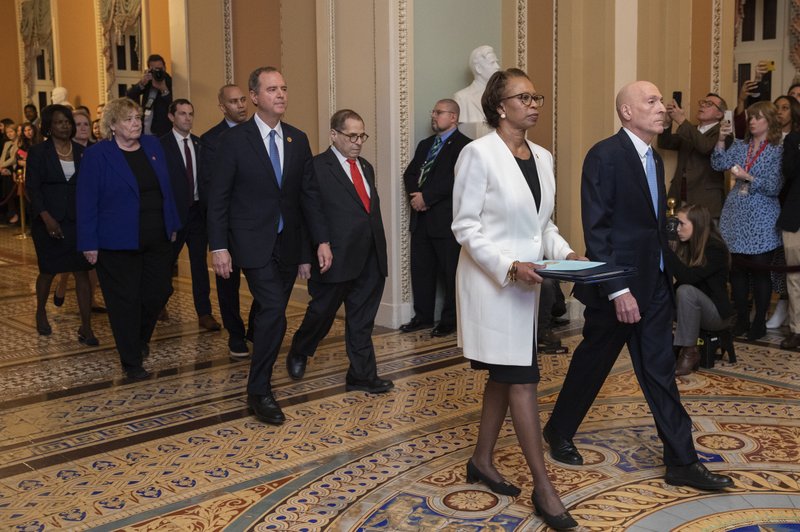
WASHINGTON (AP) — In a dramatic procession across the U.S. Capitol, House Democrats carried the formal articles of impeachment
against President Donald Trump to the Senate, setting the stage for
only the third trial to remove a president in American history.
Trump complained anew Wednesday that it was all a “hoax,” even as fresh details emerged about his efforts in Ukraine.
The
ceremonial pomp and protocol by the lawmakers prosecuting the case
against Trump moved the impeachment out of Speaker Nancy Pelosi’s
Democratic-run House to the Republican-majority Senate, where the
president’s team is mounting a defense aiming for swift acquittal.
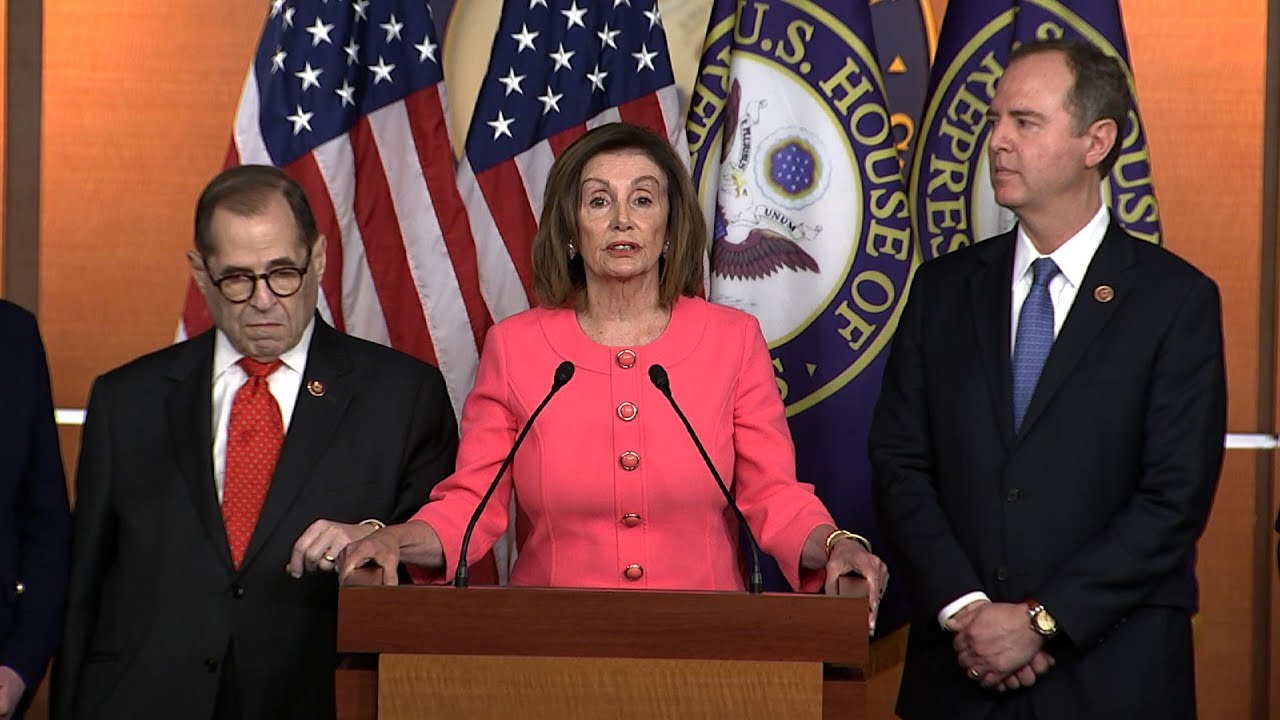
“Today
we will make history,″ Pelosi said as she signed the documents, using
multiple pens to hand out and mark the moment. “This president will be
held accountable.”
Moments
later the prosecutors walked solemnly through the stately hall, filing
into the Senate back row as the clerk of the House announced the
arrival: “The House has passed House Resolution 798, a resolution
appointing and authorizing managers of the impeachment trial of Donald
John Trump, president of United States.”
The
Senate will transform itself into an impeachment court at noon
Thursday. The Constitution calls for Chief Justice John Roberts to
preside at the trial, administering the oath to senators who will serve
as jurors and swear to deliver “impartial justice.”
The trial will play out before a deeply divided nation at the start of this election year as Trump seeks a second term and voters review his presidency. Three senators are running for the Democratic nomination.
Senate
Majority Leader Mitch McConnell pledged to have the Senate “rise above
the petty factionalism” and “factional fervor and serve the long-term,
best interests of our nation.″ He called it “a difficult time for our
country.”
Technically,
the House was simply notifying the Senate of its delivery of the
articles, with a more formal presentation Thursday. Opening arguments
are to begin next Tuesday after the Martin Luther King Jr. holiday.
Earlier
Wednesday, the House voted 228-193, almost entirely along party lines,
ending a weeks-long delay to deliver the charges with a tally reflecting
the nation’s split.
The
House impeached Trump last month alleging he abused his presidential
power by pressuring Ukraine to investigate Democratic rival Joe Biden,
using military aid to the country as leverage. Trump was also charged
with obstructing Congress’ ensuing probe.
“This
is what an impeachment is about,″ Pelosi said before the vote. “The
president violated his oath of office, undermined our national security,
jeopardized the integrity of our elections.”
Trump’s
political campaign dismissed the House effort as “just a failed attempt
to politically damage President Trump leading up to his reelection.”
The
top Republican in the House, Kevin McCarthy of California, said
Americans will look back on this “sad saga” that tried to remove the
president from office with the “weakest case.”
The
president’s team expects acquittal with a Senate trial lasting no more
than two weeks, according to senior administration officials
unauthorized to discuss the matter and granted anonymity.
That’s
far shorter than the impeachment trial of President Bill Clinton, in
1999, or the first one, of President Andrew Johnson, in 1868.
As
McConnell sets the rules for the trial, Trump has given mixed messages
about whether he prefers lengthy or swift proceeding, and senators are
under pressure with the emerging new evidence to call more witnesses for
testimony.
The
seven-member prosecution team was led by the chairmen of the House
impeachment proceedings, Reps. Adam Schiff of the Intelligence Committee
and Jerrold Nadler of the Judiciary Committee, two of Pelosi’s top
lieutenants.
“President Trump gravely abused the power of his office,” Nadler said. “He did all this for his personal political gain.”
Ahead
of Wednesday’s session, Schiff released new records from Lev Parnas, an
associate of Trump lawyer Rudy Giuliani, about the Ukraine strategy,
including an exchange with another man about surveilling later-fired
Ambassador Marie Yovanovitch.
Schiff
said the new evidence should bring more pressure on McConnell, who is
reluctant to allow witnesses to testify and prefers swift acquittal. The
White House has instructed officials not to comply with House subpoenas
for testimony and documents.
“The
challenge is to get a fair trial,” Schiff said in an interview with The
Associated Press. “It shouldn’t be a challenge — if the senators are
really going to live up to their oath to be impartial, they’ll want a
fair trial. That’s obviously not where Mitch McConnell is coming from.”
The
managers are a diverse group with legal, law enforcement and military
experience, including Hakeem Jeffries of New York, Sylvia Garcia of
Texas, Val Demings of Florida, Jason Crow of Colorado and Zoe Lofgren of
California.
Two
are freshmen lawmakers — Crow a former Army Ranger who served in Iraq
and Afghanistan, Garcia a former judge in Houston. Demings is the former
police chief of Orlando and Jeffries is a lawyer and member of party
leadership. Lofgren has the rare credential of having worked on the
congressional staff investigation of President Richard Nixon’s
impeachment — he resigned before the full House voted on the charges —
and then being an elected lawmaker during Bill Clinton’s.
For
the roll call, all but one Democrat, Rep. Collin Peterson of Minnesota,
voted to transmit the articles. All Republicans voted against. One
former Republican-turned-independent, Rep. Justin Amash of Michigan,
joined Democrats.
McConnell
faces competing interests from his party for more witnesses, from
centrists who are siding with Democrats on the need to hear testimony
and conservatives mounting Trump’s defense.
Senate
Republicans signaled they would reject the idea of simply voting to
dismiss the articles of impeachment against Trump, as Trump himself has
suggested. McConnell agreed he does not have the votes to do that.
Republican
Sen. Susan Collins of Maine is leading an effort among some
Republicans, including Mitt Romney of Utah, Lisa Murkowski of Alaska and
Lamar Alexander of Tennessee, to consider Senate witnesses. She told
reporters she was satisfied the rules will allow votes on that.
Romney
said he wants to hear from John Bolton, the former national security
adviser at the White House, who others have said raised alarms about the
alternative foreign policy toward Ukraine being run by Giuliani.
Those
or any four senators could force an outcome. Republicans control the
chamber, 53-47, and are all but certain to acquit Trump. But it takes
just 51 votes during the trial to approve rules or call witnesses. It
also would take only 51 senators to vote to dismiss the charges against
Trump.
Sen.
Rand Paul of Kentucky and other Republicans want to subpoena Biden and
his son, Hunter, who served on the board of a gas company in Ukraine,
Burisma, while his father was vice president.
McConnell
prefers to model Trump’s trial partly on the process used for Clinton’s
impeachment trial in 1999, which considered witnesses later.
McConnell
is hesitant to call new witnesses who would prolong the trial and put
vulnerable senators who are up for reelection in 2020 in a bind with
tough choices. At the same time, he wants to give those same senators
ample room to show voters they are listening.
___
Associated
Press writers Zeke Miller, Alan Fram, Matthew Daly, Andrew Taylor, Mary
Clare Jalonick, Laurie Kellman, and Padmananda Rama contributed to this
report.
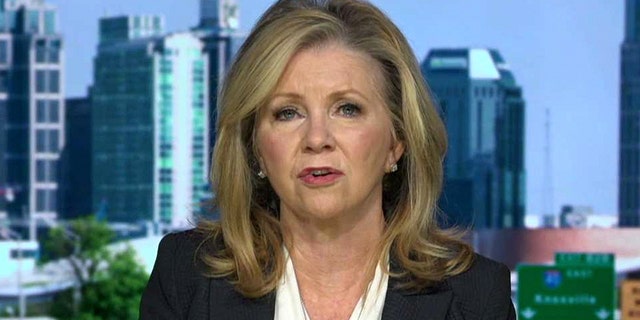
Sen. Marsha Blackburn, R-Tenn., said Wednesday that the four Democratic senators running for president should recuse themselves from being jurors in President Trump's upcoming impeachment trial in the Senate. “Tomorrow,
one hundred United States senators will be sworn in to serve in the
impeachment trial of President Donald Trump. Four of those senators must
recuse themselves for their unparalleled political interest in seeing
this president removed from office,” Blackburn said in a statement,
speaking of Sen. Michael Bennet, D-Colo., Sen. Amy Klobuchar, D. Minn., Sen. Bernie Sanders, I-Vt., and Sen. Elizabeth Warren, D-Mass. She added the presidential candidates shouldn’t be allowed to “sit in judgment of the very president" they want to replace. “To
participate in this trial would be a failure of the oath they took to
be an ‘impartial justice according to the Constitution and laws,'" she
said. "Their presidential ambitions prohibit their ability to view this
trial through an objective lens.”
U.S. Sen. Marsha Blackburn, R-Tenn.
Her office cited an objection that was lodged against
an Ohio senator who was next in line to become president if former
President Andrew Johnson was removed during his impeachment trial in
1868. Johnson was ultimately acquitted. Last month, however, Senate Majority Leader Mitch McConnell, R-Ky., said he has no intention of being an “impartial juror.” “I’m not impartial about this at all,” he told reporters in December. “This is a political process.” McConnell also told Sean Hannity last month that he plans to be in complete coordination with the White House during the trial. “There
will be no difference between the president’s position and our position
as to how to handle this to the extent that we can,” he said. McConnell said this week he expects the trial to start next Tuesday.
House Speaker Nancy Pelosi
drew criticism Wednesday for handing out commemorative pens -- with her
name on them -- after signing a resolution to transmit two articles of impeachment against President Trump to the Senate for trial. To critics, the tone of the event seemed celebratory -- a far cry from December, when Pelosi wore black
and insisted on the House floor it was a “solemn” day before the
Democrat-controlled body voted to impeach the president on abuse of
power and obstruction of Congress allegations. Later, she even cut short two rounds of cheers from Democrats when the articles were adopted. “Nancy
Pelosi’s souvenir pens served up on silver platters to sign the sham
articles of impeachment,” White House press secretary Stephanie Grisham
tweeted in response. “She was so somber as she gave them away to people
like prizes.” “You
know what you hand out pens for? Accomplishments. Like, say, signing a
historic trade deal with China,” Republican National Committee
spokeswoman Elizabeth Harrington added, referencing Trump -- who on the
same day as Pelosi's impeachment signing entered a landmark trade
agreement with Chinese Vice Premier Liu He in the East Room of the White
House. Trump maintains the House impeachment effort -- based on
accusations that he pressured Ukraine to launch an investigation into
his political rival, former Vice President Joe Biden, and his son,
Hunter, in exchange for U.S. military aid -- is a “hoax” and claims he
is a victim of a political “witch hunt” led by Pelosi. He is the third
president in U.S. history to be impeached. “So it's fitting that
Democrats are handing out pens for their sole accomplishment:
impeachment. Democrats have done NOTHING for the American people,”
Harrington added. Before the signing Wednesday, aides set out two
small trays containing more than two dozen black pens emblazoned with
Pelosi's signature. She entered the room and sat at a table with the
documents and pens before her. House prosecutors and the committee
chairmen who had worked on Trump's impeachment were standing around her.
Pelosi picked up each pen, signed a bit, and handed each one to a
lawmaker. Sometimes, she was smiling. “Embarrassing spectacle -
Pelosi using sterling silver platters and handing out ceremonial pens to
everyone in sight, made it ridiculously theatrical and so tacky and
clownish. What goofballs,” Mark Simone, a conservative radio host,
tweeted. “Impeachment is so “Prayerful” that Pelosi was handing
out pens in celebration. Pathetic,” Benny Johnson, chief creative
officer for Turning Point USA, added. At a Dec. 5
news conference, Pelosi had shot back at a reporter who accused her of
hating Trump, saying that she, as a woman raised in a Catholic home,
actually prays for the president. “This is about the Constitution
of the United States and the facts that lead to the president’s
violation of his oath of office. And as a Catholic I resent your using
the word 'hate' in a sentence that addresses me. I don’t hate anyone. I
was raised in a way that is full, a heart full of love, and always pray
for the president. And I still pray for the president. I pray for the
president all the time. So don’t mess with me when it comes to words
like that,” Pelosi exclaimed. In a letter
sent to Pelosi the day before the Dec. 18 impeachment vote, Trump
questioned whether she was sincere about her faith and alleged she was
waging a war on American democracy in her decision to launch the
House-led impeachment inquiry back in September.
The pens that House Speaker Nancy Pelosi of Calif., will use to
sign the resolution to transmit the two articles of impeachment against
President Trump to the Senate for trial. (AP Photo/Susan Walsh)
“Even worse than offending the Founding Fathers, you
are offending Americans of faith by continually saying “I pray for the
President,” when you know this statement is not true, unless it is meant
in a negative sense,” Trump countered.
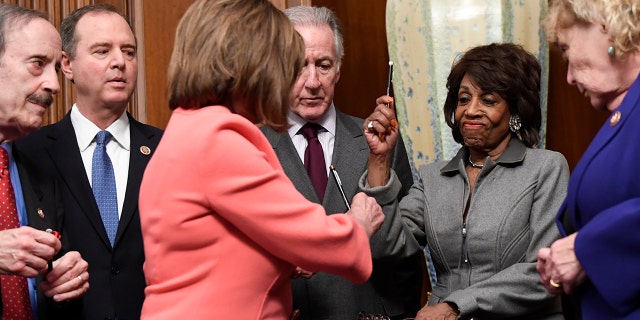
House Financial Services Committee Chairwoman Maxine Waters,
D-Calif., second from right, reacts after getting a pen from House
Speaker Nancy Pelosi of Calif., after she signed the resolution to
transmit the two articles of impeachment against President Trump to the
Senate for trial on Capitol Hill. (Associated Press)
Pelosi’s signature Wednesday sent the articles to the Senate for trial, which is expected to open Thursday. After
the House vote, Pelosi withheld the articles for about four weeks from
the Senate in an effort to pressure Senate Republicans to commit to
seeing additional documents and testimony as part of trial proceedings.
That promise never came, but Senate Majority Leader Mitch McConnell,
R-Ky., told reporters Tuesday he was considering allowing both sides –
Democrats and Republicans – to call additional witnesses. The Associated Press contributed to this report.
President Trump’s personal lawyer Rudy Giuliani said Wednesday that dismissal of the articles of impeachment against
the president should be allowed under the Senate's trial rules because
the allegations don’t amount to high crimes and misdemeanors. The
articles “fall on their face” as impeachable offenses, Giuliani wrote in
an op-ed for War Room: Impeachment, a website run by former White House
adviser Steve Bannon. Giuliani argued that the impeachment articles should be given the same scrutiny as charges in a criminal trial. “Thus
an impeachment, like an indictment, must be tested by a motion to
dismiss if it fails to allege an impeachable offense,” he wrote. If
the articles don’t amount to an impeachable offense “it is not only an
abuse of power but an unconstitutional violation of separation of
powers," he added. The 75-year-old former mayor of New York City
claimed that the “abuse of power” charge -- over President Trump’s July
phone call with Ukrainian President Volodymyr Zelensky in which Trump
allegedly asked for an investigation into the Bidens and withheld
military aid on that condition -- was a “conversation without threat,
pressure, inducement or quid pro quo.” In November, U.S.
Ambassador Gordon Sondland implicated top White House officials in a
"potential quid pro quo" over the withheld military aid to Ukraine
during testimony in the House’s impeachment inquiry, saying “everyone
was in the loop.” He testified, however, that he never heard Trump tie
the aid to investigating the Bidens. Sondland's testimony also
contradicted a previous statement attributed to him, in which he
allegedly said the Trump-Ukraine discussion involved no quid pro quo. The
House also charged Trump with “obstruction of Congress” in the second
article for blocking witnesses and documents during inquiries by House
committees. Giuliani claimed Democrats used “sparse factual
allegations” for the charges, saying it arguably violated executive and
attorney-client privilege, among others. He also claimed neither article is a crime or misdemeanor. “It
would be a mockery of justice to have a trial on charges that are
insufficient to result in anything other than an acquittal," he wrote. He
added that the House of Representatives has “trashed” the separation of
powers by not giving Trump fair treatment during their inquiry. “Failure to dismiss would give credence to this entirely illegitimate process,” he wrote, and would set a bad precedent for future “partisan majorities.”
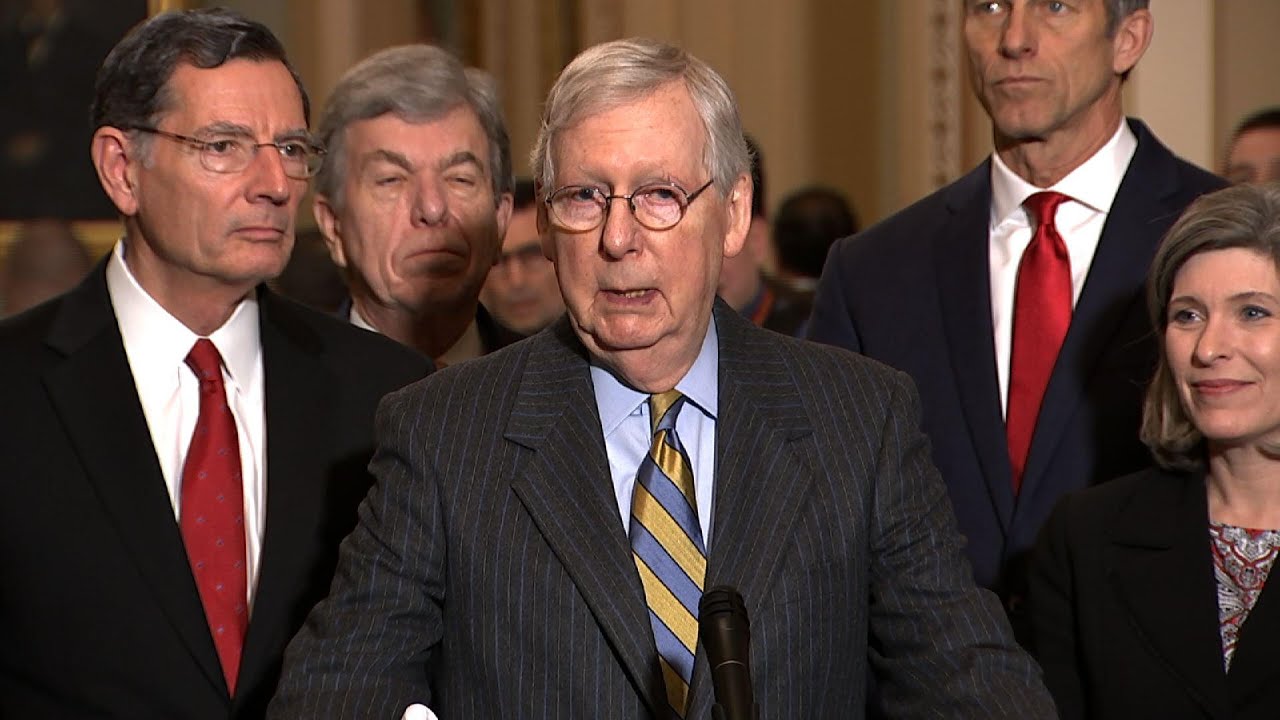
Senate
Majority Leader Mitch McConnell, R-Ky., accompanied by Sen. Joni Ernst
R-Iowa, and other senators, speaks outside of the Senate chamber, on
Capitol Hill in Washington, Tuesday, Jan. 14, 2020. (AP Photo/Jose Luis
Magana)
WASHINGTON
(AP) — Republicans controlling the Senate are taking advantage of
delays in President Donald Trump’s impeachment trial to speed up a vote
on a modified North American trade pact.
Thursday’s
expected vote promises sweeping bipartisan support for legislation
implementing the terms of the United States-Mexico-Canada Agreement. It
would replace the 25-year-old North American Free Trade Agreement, which
Trump and many lawmakers blames for shipping U.S. manufacturing jobs to
Mexico.
Senate Majority Leader Mitch McConnell, R-Ky., announced the vote at his weekly news conference Tuesday.
The
Senate vote would follow a sweeping vote in the Democratic-controlled
House last month and would send the legislation to Trump for his
signature. House Speaker Nancy Pelosi played a central role in modifying
the pact further to assuage allies in organized labor, such as AFL-CIO
President Richard Trumka.
The
agreement is projected to have only a modest impact on the economy. But
it gives lawmakers from both parties the chance to support an agreement
sought by farmers, ranchers and business owners anxious to move past
the months of trade tensions that have complicated spending and hiring
decisions.
Trump
made tearing up NAFTA a hallmark of his presidential run in 2016 as he
tried to win over working-class voters in states such as Michigan, Ohio,
Wisconsin and Pennsylvania.
The
new pact contains provisions designed to nudge manufacturing back to
the United States. For example, it requires that 40% to 45% of cars
eventually be made in countries that pay autoworkers at least $16 an
hour — that is, in the United States and Canada and not in Mexico.
WASHINGTON (AP) — The House is set to vote to send the articles of impeachment
against President Donald Trump to the Senate for a landmark trial on
whether the charges of abuse of power and obstruction of Congress are
grounds for removal.
Speaker
Nancy Pelosi announced the next steps Tuesday after meeting privately
with House Democrats at the Capitol, ending her blockade a month after
they voted to impeach Trump.
After the midday Wednesday vote, House managers named to prosecute the
case will walk the articles across the Capitol in a dramatic procession
that evening.
It will be only the third presidential impeachment trial in American history, a serious moment coming amid the backdrop of a politically divided nation and an election year.
“The
President and the Senators will be held accountable,” Pelosi said in a
statement. “The American people deserve the truth, and the Constitution
demands a trial.”
The
Senate is expected to transform into an impeachment court as early as
Thursday. The Constitution calls for the chief justice to preside over
senators, who serve as jurors, to swear an oath to deliver “impartial
justice.″
Senate
Majority Leader Mitch McConnell said Tuesday the chief justice would
open the trial this week, but that the significant proceedings would
launch next Tuesday, after the Martin Luther King Jr. holiday.
Trump was impeached by the Democratic-led House last month
on charges of abuse of power over pushing Ukraine to investigate
Democratic rival Joe Biden as the president withheld aid from the
country, and obstructing Congress’ ensuing probe.
McConnell
met behind closed doors Tuesday with GOP senators who are under
pressure from Democrats to call new witnesses and testimony. He urged
them to hold together on the next steps, according to a person
unauthorized to discuss the private session and granted anonymity.
Late
Tuesday, House investigators announced they were turning over a “trove”
of new records of phone calls, text messages and other information from
Lev Parnas, an associate of Trump lawyer Rudy Giuliani. Intelligence
Committee Chairman Adam Schiff said the information shows Trump’s effort
’’to coerce Ukraine into helping the President’s reelection campaign.”
He said this and other new testimony must be included in the Senate
trial.
McConnell,
who is negotiating rules for the trial proceedings, he said all 53 GOP
senators are on board with his plan to start the session and consider
the issue of witnesses later.
Senate
Republicans also signaled they would reject the idea of simply voting
to dismiss the articles of impeachment against Trump, as the president
has suggested. McConnell agreed he does not have the votes to do that.
“There
is little or no sentiment in the Republican conference for a motion to
dismiss,” McConnell said. ’’Our members feel we have an obligation to
listen to the arguments.”
In
fact, a mounting number of senators say they want to ensure the ground
rules include the possibility of calling new witnesses.
Sen.
Susan Collins of Maine is leading an effort among some Republicans,
including Mitt Romney of Utah and Lisa Murkowski of Alaska for witness
votes.
“My position is that there should be a vote on whether or not witnesses should be called,” Collins said.
Romney
said he wants to hear from John Bolton, the former national security
adviser at the White House, who others have said raised alarms about the
alternative foreign policy toward Ukraine being run by Trump’s personal
lawyer Rudy Giuliani.
Democrats
have been pushing Republicans, who have a slim Senate majority, to
consider new testimony, arguing that fresh information has emerged
during Pelosi’s monthlong delay in transmitting the charges.
“We
want the truth,” Senate Minority Leader Chuck Schumer said Tuesday as
the chamber opened. He said that in other presidential impeachment
trials the Senate called witnesses. “Do Senate Republicans want to break
the lengthy historical precedent?”
Republicans
control the chamber, 53-47, and are all but certain to acquit Trump. It
takes just 51 votes during the impeachment trial to approve rules or
call witnesses. Just four GOP senators could form a majority with
Democrats to insist on new testimony. It also would take only 51
senators to vote to dismiss the charges against Trump.
At
the private GOP lunch, Sen. Rand Paul of Kentucky warned that if
witnesses are allowed, defense witnesses could also be called. He and
other Republicans want to subpoena Biden and his son, Hunter, who served
on the board of a gas company in Ukraine, Burisma, while his father was
vice president.
“I look forward to forcing votes to call Hunter Biden and many more,” tweeted Paul, an ally of the president, late Monday.
McConnell
is drafting an organizing resolution that will outline the steps ahead.
Approving it will be among their first votes of the trial, likely next
Tuesday.
He
prefers to model Trump’s trial partly on the process used for
then-President Bill Clinton’s trial in 1999. It, too, contained motions
for dismissal or calling new witnesses.
“Fifty-one senators will decide who to call,” McConnell said.
McConnell
is hesitant to call new witnesses who would prolong the trial and put
vulnerable senators who are up for reelection in 2020 in a bind with
tough choices. At the same time, he wants to give those same senators
ample room to show voters they are listening to demands for a fair
trial.
Most
Republicans now appear willing to go along with McConnell’s plan to
start the trial first then consider witnesses later, rather than
upfront, as Democrats want.
Even
if senators are able to vote to call new witnesses, it is not at all
clear there would be majorities to subpoena Bolton or the others.
“I’ve
been working to make sure that we will have a process that we can take a
vote on whether or not we need additional information, and yes, that
would include witnesses,” Murkowski told reporters.
McConnell
opened the Senate on Tuesday scoffing at what he called the “bizarro
world” of Pelosi’s impeachment strategy that delayed transmitting the
charges for weeks.
“Do
these sound like leaders who really believe we are in a constitutional
crisis, one that requires the most severe remedy?” McConnell asked. He
rejected Pelosi’s recent suggestions that whatever the Senate verdict,
Trump will be “impeached forever.”
“It will fall to the Senate to end it with seriousness and sobriety,” he said.
Pelosi has yet to announce House managers to prosecute the case in the Senate.
Schiff
is expected to lead the team. He gave the caucus a presentation on
Tuesday about the transmittal of the articles and the Senate trial,
according to two people who were in the room.
House Judiciary Committee Chairman Jerrold Nadler is also widely expected to be an impeachment manager.
The Senate chaplain opened the day’s session with an apparent nod to what’s ahead.
“Teach
our lawmakers to disagree with respect, civility and humility,”
Chaplain Barry Black, a retired rear admiral of the Navy, said in
prayer. Help them to remember, he prayed, that “patriots reside on both
sides of the aisle.”
___
Associated Press writers Matthew Daly, Andrew Taylor and Padmananda Rama contributed to this report.