Gov. Kay Ivey warned Alabamans on Wednesday that they can expect to see her with one of her arms in a sling following a Tuesday night fall. The governor said in a statement that she expects no disruption of her work schedule after tripping over her dog Missy and fracturing one of her shoulders, Birmingham's FOX6 reported. “Alabama’s
First Dog Missy is such a fun and active friend to have at home, and
she is fiercely protective,” Ivey wrote. “Last night, she
unintentionally tripped me up, and I hit my shoulder. You’ll see me in a
sling, but this won’t slow me down a bit! I’ll keep you posted on the
recovery, but most importantly, Missy is also doing just fine!” It wasn’t clear from the statement or from local news reports whether the governor’s left or right shoulder was injured. The
governor is expected to deliver the annual State of the State address
next Tuesday, FOX6 reported. On Wednesday, Ivey congratulated President
Trump after he signed the USMCA trade agreement. "What an exciting
day for our country as @POTUS officially signs #USMCA!" the governor
wrote. "Alabama is grateful for the hard work & leadership of
@realDonaldTrump & all involved for bringing this monumental deal to
fruition. Thank you for supporting the American people!" Ivey,
75, a Republican, became Alabama’s governor in April 2017 following the
resignation of her predecessor, Robert Bentley. She was then elected
outright in November 2018.
Alabama Gov. Kay Ivey speaks to the media in Montgomery, Ala., Nov. 17, 2017. (Associated Press)
Earlier
this month Ivey announced she had received a positive report from her
doctor following radiation treatment for a cancerous spot found on one
of her lungs, according to AL.com. In November 2018, Ivey’s 14-year-old Chow mix, named Bear, died after a struggle with some health issues, AL.com reported. Ivey had adopted that dog from a local veterinarian after it was struck by a car, the report said.
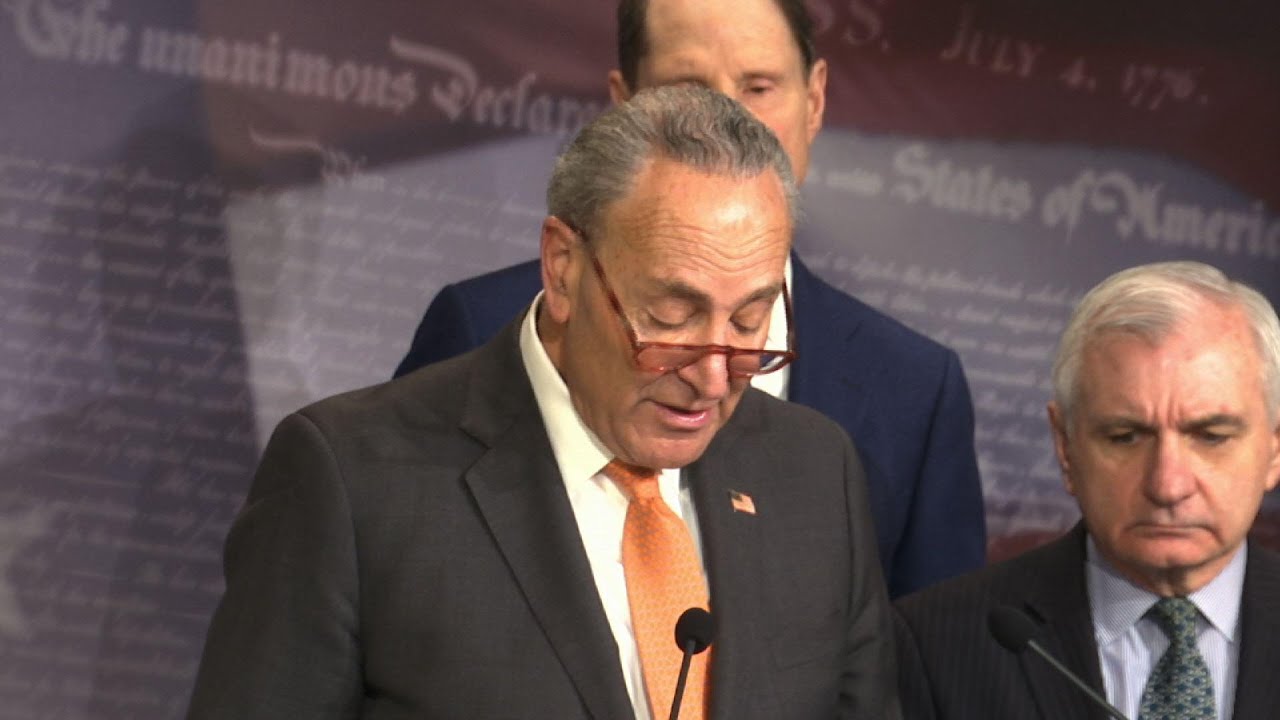
Chief Justice of the United States John Roberts
blocked Kentucky Republican Sen. Rand Paul from posing a question
during the Senate impeachment trial Wednesday that would have named the
alleged whistleblower at the center of the case, Fox News is told -- and
Paul may try to force the issue during the question-and-answer session
that begins Thursday afternoon. Roberts, for now, has ball
control because he actually receives the questions in note cards from
senators, then reads the question aloud in the Senate chamber to be
answered by either House Democratic managers or Trump's defense team.
But, Fox News has learned Roberts may soon lose his grip on the
proceedings amid a torrent of criticism both inside and outside the
Senate. The Federalist co-founder Sean Davis condemned what he
called Roberts' "arbitrary and unilateral censorship of senators and
Senate business," and reported that
Roberts had initially sought to block even general questions of the
intelligence community whistleblower. When Republicans threatened a vote
rebuking Roberts on the record, Davis reported, Roberts backed down and
decided only to prohibit mentioning the whistleblower's name. A reporter for Roll Call observed that during a break in the trial Wednesday, Paul was fuming. "I don't want to have to stand up to try and fight for recognition," Paul shouted, according to reporter Niels Lesniewski, who noted that Paul's complaint was "audible from the galleries above the chamber." "If I have to fight for recognition, I will," Paul said. Asked by Fox News whether Paul, who has long raised concerns about possible
intelligence community overreach, would press the issue during the
upcoming question period, a spokesman for the senator told Fox News
only, "tbd" -- short for "to be determined." Last year, Paul was vocal about wanting testimony from the whistleblower on the record.
"If I have to fight for recognition, I will." — Kentucky GOP Rep. Rand Paul
Roberts,
under the Constitution, presides over the impeachment trial. But the
precise contours of his authority are not clearly established, and
remain up for debate; Democrats have even said they will attempt a
long-shot motion to give Roberts the unprecedented power to approve or
reject witnesses, for example. Federal law protects
whistleblowers only from retaliation in the workplace, and does not
ensure their anonymity; and Republicans have disputed whether this
particular whistleblower would even qualify for those limited
protections, saying his complaint concerns a policy dispute and does not
allege criminal or civil wrongdoing by the president. Republicans have sought more information on the whistleblower ever since the intelligence community's internal watchdog found several indicators that
the person might have a political bias. Fox News has previously
reported the whistleblower is a registered Democrat and had a prior work history with a senior Democrat running for president. The whistleblower's attorney, Mark Zaid, openly admitted
back in 2017 that a "coup" had started against the president from
within the administration, and that CNN's coverage would play a "key
role" in the effort. He also openly solicited intelligence community members
to help impeach and "get rid" of Trump, years before Trump's call with
Urkaine's leader that triggered the current impeachment proceedings. Additionally, Zaid acknowledged that
the whistleblower had contact with a prominent Democratic presidential
contender, amid reporters that he had served closely with Joe Biden when
he was vice president. Trump's alleged pressure on Ukraine to
investigate Biden is at the center of the current probe. Conspicuously,
Democrats' lead House impeachment manager Rep. Adam Schiff, D-Calif.,
has made public inconsistent statements concerning the House
Intelligence Committee's contacts with the whistleblower. Schiff first denied that his panel had such contact, then reversed course and admitted that members of the committee had spoken to the whistleblower. It
could be, Republicans have asserted, that the whistleblower coordinated
his complaint with Schiff's panel for partisan reasons -- a disclosure
that, if true, would likely undermine the credibility of the impeachment
proceedings and possibly expose Schiff to his own "abuse of power"
allegations. Thus far, the impeachment effort has arguably been elevated
in importance from normal partisan bickering in part by the gravitas
afforded to the supposedly well-meaning whistleblower at the center of
the case. On Wednesday, Schiff again denied knowing the identity
of the whistleblower, even as Republicans accused him of deliberately
lying. Schiff repeatedly shut down GOP questions during the House
impeachment proceedings concerning White House leaks -- even though
doing so at one point seemingly demonstrated that Schiff likely knew the
whistleblower's identity. “Lietenant Colonel Vindman, did you
discuss the July 25 phone call [between Trump and Ukraine's president]
with anyone outside the White House on July 25 or the 26 and if so, with
whom?” Republican California Rep. Devin Nunes asked last year. “Yes.
I did,” Vindman, who has also claimed not to know the whistleblower's
identity, responded. He said he had spoken to Deputy Assistant Secretary
George Kent but, before he could mention the other person, Schiff
intervened and urgently blocked the questioning. “We
need to protect the whistle-blower," Schiff interjected. "Please stop. I
want to make sure that there is no effort to out the whistle-blower
through these proceedings. If the witness has a good faith belief that
this may reveal the identity of the whistle-blower, that is not the
purpose that we’re here for. I want to advise the witness accordingly.” Roberts has mostly stayed out of the spotlight in the trial. In the first day of the proceedings, Roberts admonished both sides
for misconduct in the chamber, saying their rhetoric had gotten too
heated. That warning reportedly came after a "stunned" Republican Sen.
Susan Collins passed a note to Roberts, following Democrats' claims that a vote against their witness resolution would amount to a "coverup." Wednesday's
lengthy question-and-answer session contained other notable moments,
including another spirited constitutional argument by liberal Harvard
Law Professor Alan Dershowitz. Multiple media outlets, including
CNN, mischaracterized Dershowitz throughout the day as saying that
presidents can do "anything" as long as they can argue it's in the
"public interest." In fact, Dershowitz maintained that criminal or
criminal-like conduct is impeachable, regardless of its motivation. Instead,
Dershowitz asserted the Senate should not be in the business of
removing presidents based on nebulous and unconstitutional "abuse of
power" charges that the framers expressly rejected. It would be a
standard Democrats would not want applied to their own presidents, he
argued. To demonstrate that point, Dershowitz made thinly veiled
references to President Obama's refusal to send lethal military aid to
Ukraine, as well as his failed, unenforced "red line" warning for Syria
not to use chemical weapons. Obama was also caught on a hot microphone promising Russia's president he would have "more flexibility" on missile defense issues after the 2012 election. "Let's
consider a hypothetical," Dershowitz said. "Let's assume that President
Obama had been told by his advisors that it really is important to send
lethal weapons to the Ukraine. But then he gets a call from his
pollster and his political adviser, who says we know it's in the
national interest to send lethal weapons to the Ukraine, but we're
telling you that the left-wing of your party is really going to give you
a hard time if you start selling lethal weapons and potentially get
into a lethal war with Russia. Would anybody here suggest that is
impeachable?" He
continued: "Or let's assume President Obama said, 'I promise to bomb
Syria if they had chemical weapons. But I'm now told by my pollster that
bombing Syria would hurt my electoral chances.' Simply not impeachable
at all." It would be difficult if not impossible, Dershowitz said,
to determine that a president has acted with corrupt "motive," given
that countless presidents inevitably consider both the national interest
and their personal political gain when making decisions. Rarely do
presidents act with purely corrupt or purely noble motives, he said.
Often, he went on, presidents want to help themselves but in doing so
believe they are also helping the country. There were signs
Dershowitz's argument was making headway among moderate swing-vote GOP
senators. Maine Republican Sen. Susan Collins was reportedly "clearly
unhappy" with Democrats' explanation as to why they had not charged
actual crimes in the articles of impeachment, and was shaking her head
while they answered her question on the topic by claiming their
allegations were "akin" to criminal conduct, Roll Call's Todd Ruger reported. When
House Democratic impeachment manager Jerry Nadler, D-N.Y., claimed "all
scholars" except for Dershowitz agreed that impeachment didn't have to
involve crimes or criminal-like conduct, there were audible groans from
the GOP side of the chamber. Dershowitz rose, turned to Nadler, and said he was simply ignorant of the facts. "By
the way, the congressman was just completely wrong when he said I'm the
only scholar who supports this position," Dershowitz said. "In the 19th
century, which is much closer in time [to the founding of the country
and the drafting of the Constitution,] Dean [Theodore] Dwight of the
Columbia Law School wrote that 'the weight of authority,' by which he
meant the weight of scholarly and judicial authority, this is in 1867,
is in favor of requiring a crime. Justice [Benjamin Robbins] Curtis came
to the same conclusion." Dershowitz reiterated that the "abuse of
power" charge was vague and indeterminate, and was precisely the kind
of article of impeachment that the framers wanted to reject -- as
evidenced by their explicit repudiation of the charge of
"maladministration,' which he said is synonymous with "abuse" or
"misconduct" in office. He then took a shot at fellow Harvard Law
School professor Laurence Tribe for being a partisan hack, and warned
that scholars often have partisan biases, too. Dershowitz noted that he
voted for Hillary Clinton and would be making the same argument if she
were on trial. Later, Dershowitz deployed another hypothetical to
argue that Democrats' impeachment was itself, somewhat ironically, a
partisan proceeding. "Let’s assume hypothetically that the
president was in his second term and he said to himself, you know, Joe
Biden is running for president," Dershowitz said. "I really should now
be concerned about whether his son is corrupt,
because he’s not only a candidate ... but he could be the President of
the United States, and if he’s the president of the United States and he
has a corrupt son, the fact that he’s announced his candidacy is a very
good reason for upping the interest in his son." Dershowitz
continued: "If he wasn’t running for president, he’s a has-been. He is
the former vice president of the United States. Okay, big deal. But if
he’s running for president, that’s an enormous big deal. So the
difference the House managers would make is whether the president’s in
his first term or his second term, whether he’s running for reelection
or not running for reelection. I think they would have to concede that
if he was not running for reelection, this would not be a corrupt
motive, or it would be a mixed motive, but leaning on the side of
national interest. If he is running for reelection, suddenly that turns
it into an impeachable offense!” Schiff rose to claim that
Republicans surely would have impeached Obama if he sought to tie
financial aid to a foreign country to secure a probe into Romney; he did
not address Dershowitz's argument that such an impeachment, too, would
be improper. A string of newly resurfaced video clips of former national security adviser John Bolton spurred Trump and his supporters Wednesday to highlight what they described as Bolton's serious credibility questions amid the Senate impeachment trial, as the president tweeted, "GAME OVER!" In
his tweet, Trump linked to an interview of Bolton in August 2019 where
he discusses Ukraine policy. In the Radio Free Europe/Radio Liberty
interview clip, Bolton made no mention of any illicit quid pro quo, and
acknowledged, as Republicans have claimed, that combating "corruption"
in Ukraine was a "high priority" for the Trump administration. Bolton
also called Trump's communications with Ukrainian President Volodymyr
Zelensky "warm and cordial," without mentioning any misconduct. It
seemingly contradicted reported assertions in Bolton's forthcoming book
that Trump explicitly told him he wanted to tie military aid to Ukraine
to an investigation into Joe and Hunter Biden. (Zelensky has said his communications with Trump involved no pressure for any investigation.) Fox
News later identified clips of Schiff, D-Calif., now the lead House
impeachment manager, in which he says Bolton had a distinct "lack of
credibility" and was prone to "conspiracy theories." This week, Schiff
said Bolton needed to testify in the impeachment trial as an important and believable witness. "This
is someone who's likely to exaggerate the dangerous impulses of the
president toward belligerence, his proclivity to act without thinking,
and his love of conspiracy theories," Schiff told MSNBC's Rachel Maddow
on March 22, 2018, when Trump named Bolton national security adviser. "And
I'll, you know, just add one data point to what you were talking about
earlier, John Bolton once suggested on Fox News that the Russian hack of
the DNC [Democratic National Committee] was a false flag operation that
had been conducted by the Obama administration," he said. "So, you add
that kind of thinking to [former U.S. attorney] Joe diGenova and you
have another big dose of unreality in the White House." Schiff
made similar arguments back in May 2005, saying in an interview with
CNN's "Crossfire" that Bolton was "more focused on the next job than
doing well at the last job" when he was up for nomination as ambassador
to the United Nations under then-President George W. Bush. "And
particularly given the history, where we've had the politicizing of
intelligence over WMD [weapons of mass destruction], why we would pick
someone who the very same issue has been raised repeatedly, and that is
John Bolton's politicization of the intelligence he got on Cuba and
other issues, why we would want someone with that lack of credibility, I
can't understand," Schiff had said. Bolton himself had admitted in the past that he would be more than willing to lie if he felt it was in the nation's best interest. “If I had to say something I knew was false to protect American national security, I would do it," Bolton said in an interview with Fox Business in 2010. But, speaking to CNN on Monday, Schiff took a different approach -- calling Bolton essential to the "search for truth." "I
think for the senators, and I'm just not talking about the four that
have been so much the focus of attention, for every senator, Democrat
and Republican, I don't know how you can explain that you wanted a
search for the truth in this trial and say you don't want to hear from a
witness who had a direct conversation about the central allegation in
the articles of impeachment," Schiff said on CNN's "New Day." Seemingly
responding to charges of hypocrisy, Schiff remarked on the Senate floor
late Wednesday: "I'm no fan of John Bolton, but I like him a little
more now than I used to." Whether
or not the Senate will vote to call Bolton as a witness -- or whether he
will legally be able to testify -- remain open questions. Republicans
have suggested that Schiff himself should testify. Any
witness resolution would likely require four Republican defections in
the Senate, because in the event of a 50-50 tie, Chief Justice of the
United States John Roberts is highly likely to abstain rather than
assert his debatable power to cast a tie-breaking vote. The witness question will be decided later this week, after the question-and-answer session of the trial wraps up. Republicans, who have a 53-47 majority in the chamber, have suggested to Fox News that
they would amend any witness resolution that subpoenas Bolton to also
require the appearance of several additional witnesses favorable to the
Trump administration -- likely killing support in the Senate for the
whole witness package altogether. In the meantime, concerns over
Bolton potentially divulging classified information, as well as
violating the legal principle of executive privilege, have emerged. On
Wednesday, the White House revealed
it had told Bolton not to publish his upcoming tell-all book about his
time in the Trump administration until classified material is removed
from the manuscript. “Under federal law and the nondisclosure
agreements your client signed as a condition for gaining access to
classified information, the manuscript may not be published or otherwise
disclosed without the deletion of this classified information,” Ellen
J. Knight, a National Security Council (NSC) aide, wrote in a letter to
Bolton attorney Charles J. Cooper last week, which was obtained by Fox
News. Bolton’s book has disrupted Trump’s impeachment trial. The
New York Times reported that Bolton's draft manuscript includes a claim
that Trump explicitly linked a hold on military aid to Ukraine to an
investigation of Joe and Hunter Biden -- a central part of the case
against Trump. The
letter from the NSC was transmitted to Bolton’s attorney on Jan 23. The
New York Times article about the manuscript came out on Sunday, Jan. 26
-- three days after the letter was transmitted. That indicates that the
NSC had already made the determination that there was top secret
information in Bolton’s manuscript before anything became public. Earlier
in the day, CNN reported that the letter amounted to a threat against
Bolton. But sources told Fox News this was not a “threat,” saying the
letter merely points out that there is top secret information contained
in the manuscript that cannot be released to the public. Fox News' Chad Pergram and Sally Persons contributed to this report.
WASHINGTON
(AP) — President Donald Trump’s impeachment trial is shifting to
questions from senators, a pivotal juncture as Republicans lack the
votes to block witnesses and face a potential setback in their hope of
ending the trial with a quick acquittal.
After
Trump’s defense team rested Tuesday with a plea to “end now,” Senate
Majority Leader Mitch McConnell privately told senators he doesn’t yet
have the votes to brush back Democratic demands for witnesses now that
revelations from John Bolton, the former national security adviser, have
roiled the trial.
Bolton
writes in a forthcoming book that Trump told him he wanted to withhold
military aid from Ukraine until it helped with investigations into
Democratic rival Joe Biden. That assertion, if true, would undercut a
key defense argument and go to the heart of one of the two articles of
impeachment against the president.
“I think Bolton probably has something to offer us,” said Sen. Lisa Murkowski, R-Alaska.
Not
in Trump’s view. “Why didn’t John Bolton complain about this ‘nonsense’
a long time ago, when he was very publicly terminated,” Trump tweeted
shortly after midnight. “He said, not that it matters, NOTHING!”
The
uncertainty about witnesses arises days before crucial votes on the
issue. In a Senate split 53-47 in favor of Republicans, at least four
GOP senators must join all Democrats to reach the 51 votes required to
call witnesses, decide whom to call or do nearly anything else in the
trial. Several Republicans apparently are ready to join Democrats in
calling witnesses.
The
two days set aside for questions, Wednesday and Thursday, also allow
each side more time to win over any undecided senators pondering the
witness issue. In the meantime, all will have the opportunity to grill
both the House Democrats prosecuting the case and the president’s
defense team.
Held
to submitting written questions to be read by Chief Justice John
Roberts, senators are expected to dig into the big themes of the trial —
among them whether what Trump did or may have done rises to the level
of “high crimes and misdemeanors” — as well as pointed and partisan
attacks on each side’s case.
Trump faces charges
from Democrats that he abused his power like no other president,
jeopardizing U.S.-Ukraine relations by using the military aid as
leverage while the vulnerable ally battled Russia. Democrats say Trump
then obstructed their probe in a way that threatens the nation’s
three-branch system of checks and balances.
The
president’s legal team tried to lock up its case Tuesday and convince
GOP senators that the president was right to ask Ukraine for
investigations of Biden and his son Hunter and was well within his power
to block the aid. They said he was not bound to abide by the
congressional investigation.
Sen. Lindsey Graham, R-S.C., Tuesday called on former national security adviser John Bolton to hold a press conference to expand on a New York Times bombshell report that
claimed Bolton wrote in his upcoming book that President Trump
explicitly tied $391 million in Ukrainian military aid to investigating
the Bidens. “John, you’ve kind of thrown the country into a ditch
here,” Graham told Fox News' Martha MacCallum. “Just come forward and
say what’s on your mind, hold a news conference and we’ll consider what
you’ve got to say if you think it’s that important." Graham said from his point of view, he believes he has all the evidence he needs in Trump's impeachment trial, which he said he was optimistic would wrap up with an acquittal before the State of the Union next Tuesday. He added that even if what Bolton said Trump did was true it wouldn’t be an impeachable offense. The
White House’s plans for a speedy trial without witnesses were thrown
into doubt this week after the Times' report, which renewed calls from
Democrats to subpoena Bolton who has said he is willing to be a witness. Some
moderate Republicans have said they might be open to hearing his
testimony in the wake of the report and House Speaker Mitch McConnell
reportedly said he didn't have the votes as of Tuesday to dismiss
calling witnesses. Graham said he blames House Democrats for not pursuing a Bolton subpoena in the courts. Lead
House impeachment manager Rep. Adam Schiff explained Democrats decided
not to go through the courts to compel Bolton’s testimony because he
believes it would be used as a stall tactic. “If you argue that,
well, the House needed to go through endless months or even years of
litigation before bringing about an impeachment, you effectively nullify
the impeachment clause,” Schiff said earlier this month. “You allow the
president of the United States — by delay, by playing rope-a-dope in
the courts — to defeat the power of the impeachment clause.” Graham added that he would be open to calling Joe and Hunter Biden and the whistleblower as witnesses. “It’s a partisan, political exercise,” he said of Trump’s impeachment, “that needs to die this week.” Fox News' Marisa Schultz contributed to this report.
Former federal prosecutor Robert Ray, a member of President Trump’s impeachment legal
defense team, said the defense team did what they set out to do in
their arguments that wrapped up Tuesday and said it is time to trust in
the judgment of the senators. “The task at hand is to have a trial
to determine whether or not it’s appropriate to remove the president
from office. Period. End of story,” he told Laura Ingraham.
“Once you’ve made that argument…I think it’s time to sit down…and put
your faith and trust in [the senators] and respect and abide by their
wisdom.” Ray
said he thought they would know by Friday “after a very, very long day
of debate” whether or not witnesses will be called. It was reported
earlier that Senate Majority Leader Mitch McConnell said he didn’t have
the votes to block witnesses. The New York Times reported on Sunday that in his upcoming book former national security adviser John Bolton said Trump explicitly conditioned $391 million in military aid to Ukraine to investigating the Bidens. “I
imagine for many senators how the questioning goes and the answers that
are given over the next two days may have some bearing" on potential
witnesses, Ray said. “It’s obviously their judgment to make.” He
added that during former President Andrew Johnson’s impeachment they
“intently focused on the question: 'Why would we want to remove a
president from office when there’s an election coming up' and as a
result of that Ulysses Grant was elected president.”
With several Democrats openly floating the possibility
they might vote to acquit President Trump, congressional Republicans
are planning an aggressive "Plan B" strategy in the event some
Republicans break off and demand additional witnesses in the president's
impeachment trial, Fox News has learned. Senate Majority Leader Mitch McConnell, R-Ky., privately said early
Tuesday that he wasn't sure there were enough Republican votes to
block more witnesses, given that some moderates in the GOP's 53-47
Senate majority were wavering. Any witness resolution would likely
require four Republican defections in the Senate, because in the event
of a 50-50 tie, Chief Justice of the United States John Roberts is
highly likely to abstain rather than assert his debatable power to cast a tiebreaking vote. Late
Tuesday night, a Senate leadership source told Fox News that
Republicans were specifically assessing the viability of two alternative
options. One plan is to amend any resolution calling for a particular witness to also include a package of witnesses that
assuredly wouldn't win enough support in the Senate. For example, if
the Democrats seek to call former National Security Advisor John Bolton, Republicans might subpoena Hunter Biden over his lucrative board position in Ukraine, and Rep. Adam Schiff, D-Calif., over his inconsistent statements concerning his panel's contacts with the whistleblower at the center of the impeachment probe. "After listening to the Dems’ 20+ hours of argument and the rebuttal arguments from @realDonaldTrump,
I’ve got lots of questions for the Dems," tweeted Missouri GOP Sen.
Josh Hawley on Tuesday. "Like this one: Why did Schiff lie about his
contact with the 'whistleblower'? More to come!" The "package
deal" proposal could afford moderate Republicans the political cover of
supporting more witnesses in theory, while ultimately rejecting a
witness package they deem flawed. Even if a witness package passed, the
resolution could be written such that the witness phase of the trial
ends immediately if a key witness, such as Hunter Biden, defies
his subpoena. The Federalist senior editor and Fox News contributor Mollie Hemingway observed
that in the House impeachment proceedings, Democrats allowed themselves
to call significantly more witnesses than they afforded to their
Republican colleagues -- raising the possibility Republicans could
reasonably insist on an equally favorable "ratio" in the Senate trial
when putting together a prospective package of witnesses. A lopsided ratio in favor of the GOP also could lead some Democrats to oppose a witness package. Another
option, the congressional leadership source told Fox News, is for
the White House to assert executive privilege to block witnesses,
including Bolton. The administration could head to court to obtain an
emergency injunction against his testimony, citing national security
concerns. Trump has said he is concerned about his former top advisor
potentially spilling national security secrets, and the legal principle
of executive privilege has long shielded executive branch deliberations
from disclosure. That might end up in a court battle, and could
prove dicey if Bolton opts to go rogue and defy the White House's
assertion of privilege as it makes its way through the courts. Meanwhile, Politico reported on Tuesday
that Democrats were apparently divided over whether to remove Trump
from office on the charges of obstruction of Congress and abuse of power
-- neither of which is a defined federal crime. Moderate Democratic
Sens. Joe Manchin, Doug Jones, and Kyrsten Sinema were all weighing
votes to acquit Trump on at least one of the two articles of
impeachment, the outlet reported. “I know it’s hard to believe
that. But I really am [undecided]. But I have not made a final decision.
Every day, I hear something, I think ‘this is compelling, that’s
compelling,’” Manchin said. “Everyone’s struggling a little bit.” That news came shortly after a disputed Los Angeles Times report that California Sen. Dianne Feinstein was considering a vote to acquit the president. Feinstein later said she was "misunderstood." GOP senators were similarly all over the map on Tuesday as Trump’s defense team called Bolton’s new manuscript “inadmissible” and warned against opening the door to new wild-card information in the ongoing trial. Trump
told Bolton in August, according to an excerpt of Bolton's forthcoming
book reviewed by The New York Times Times, "that he wanted to continue
freezing $391 million in security assistance to Ukraine until officials
there helped with investigations into Democrats including the Bidens."
Republicans and liberal law professor Alan Dershowitz have countered that, even if true, the allegations do not rise to the level of an impeachable offense. The White House has also argued that Bolton may have leaked the manuscript to improve sales of his book, which went live for pre-orders on Amazon just hours after the Times report broke. "Why
didn’t John Bolton complain about this “nonsense” a long time ago, when
he was very publicly terminated," Trump tweeted late Tuesday. "He said,
not that it matters, NOTHING!" And, Republicans have reiterated, it would be legitimate for Trump to probe the Bidens' possible corruption for public policy reasons, given that Joe Biden openly boasted about successfully removing the Ukrainian prosecutor investigating the company where his son Hunter obtained a lucrative board position
with no relevant experience. Biden was overseeing Ukraine policy when
his son got the job at the Ukrainian company, which raised red flags at the time in the Obama administration. Nevertheless,
several Republicans have indicated they would be interested in hearing
what Bolton has to say, at least in some capacity, and they left the
door open on Hunter Biden. Louisiana GOP Sen. Bill Cassidy, for his part, raised questions even as he denied widespread reports
saying that he wanted to call more witnesses. Cassidy insisted that he
wanted to wait until the end of the written question period of the trial
to decide on witnesses. That less-than-strenuous denial led Sean
Davis, the co-founder of The Federalist, to argue that Cassidy was
issuing a "Romney-esque non-denial," especially for a Republican in a
deep-red, pro-Trump state. Meanwhile, Sen. James Lankford,
R-Okla., called for Bolton’s unpublished manuscript to be made available
for senators to read in a classified Sensitive Compartmented
Information Facility (SCIF) to understand what Bolton was alleging. His
proposal got an ally in influential Sen. Lindsey Graham, R-S.C., who
called the idea a “reasonable solution.” Some senators suggested
that Bolton just spill the beans in a news conference on the sidelines
of the impeachment trial -- a proposal that could lead to legal
questions concerning both executive privilege and classified
information. Bolton's manuscript is currently in a
"pre-publication review" at the National Security Council, which
functions as the White House's national security forum. Such a review is
standard for any former government official who held security
clearances and publicly writes or speaks publicly about their official
work. The review focuses on ferreting out any classified or
sensitive material in advance of publication and could take from days to
months. “The
Wall Street Journal has called for John to just come forward -- just
tell the public what you know,” Sen. Ron Johnson, R-Wis., said. “I think
that actually [would] be a smart thing. I’d encourage John to do that
without involving the trial.” Separately, Harvard Law School
Professor Alan Dershowitz, who delivered a spirited
constitutional defense of the president on Monday night in the
impeachment trial, took aim at Elizabeth Warren after she said she
couldn't follow Dershowitz's argument. "He is a criminal law
professor who stood in the well of the Senate and talked about how law
never inquires into intent and that we should not be using the
president's intent as part of understanding impeachment," Warren said
Monday. "Criminal law is all about intent. Mens rea is the heart of
criminal law. That's the very basis of it. So it makes his whole
presentation just nonsensical. I truly could not follow it." Dershowitz
replied on Twitter that Warren, who formerly taught at Harvard Law
School, "doesn't understand the law" and had "willfully
mischaracterized" his argument. “If Warren knew anything about
criminal law she would understand the distinction between motives –
which are not elements of crime—and intent, which is. It’s the
responsibility of presidential candidates to have a better understanding
of the law,” Dershowitz said. On Monday, flatly turned
toward House impeachment managers and declared they had picked
"dangerous" and "wrong" charges against the president -- noting that
neither "abuse of power" nor "obstruction of Congress" was remotely
close to an impeachable offense as the framers had intended. In a
dramatic primetime moment, the liberal constitutional law
scholar reiterated that although he voted for Hillary Clinton, he could
not find constitutional justification for the impeachment of a president
for non-criminal conduct, or conduct that was not at least "akin" to
defined criminal conduct. "I'm
sorry, House managers, you just picked the wrong criteria. You picked
the most dangerous possible criteria to serve as a precedent for how we
supervise and oversee future presidents," Dershowitz told the House
Democrats, including head House impeachment manager Rep. Adam Schiff,
D-Calif. He said that "all future presidents who serve with
opposing legislative majorities" now face the "realistic threat" of
enduring "vague charges of abuse or obstruction," and added that a "long
list" of presidents have previously been accused of "abuse of power" in
various contexts without being formally impeached. The list
included George Washington, who refused to turn over documents related
to the Jay Treaty; John Adams, who signed and enforced the so-called
"Alien and Sedition Acts"; Thomas Jefferson, who flat-out purchased
Louisiana without any kind of congressional authorization whatosever;
John Tyler, who notoriously used and abused the veto power; James Polk,
who allegedly disregarded the Constitution and usurped the role of
Congress; and Abraham Lincoln, who suspended habeas corpus during the
Civil War. Ronald Reagan, George H.W. Bush, and others would also
probably face impeachment using the Democrats' rules, Dershowitz said. "Abuse
of power," he argued, has been a "promiscuously deployed" and "vague"
term throughout history. It should remain a merely "political weapon"
fit for "campaign rhetoric," Dershowitz said, as it has no standard
definition nor meaningful constitutional relevance. Dershowitz
then said he was "nonpartisan" in his application of the Constitution,
and would make the same arguments against such an "unconstitutional
impeachment" if Hillary Clinton were on trial -- passing what he called
the "shoe on the other foot" test. "Purely non-criminal conduct
such as abuse of power and obstruction of Congress are outside the range
of impeachable offenses," Dershowitz said. Trump's lawyers
wrapped up their opening arguments early on Tuesday. Starting on
Wednesday, Democrats and Republicans will alternate in posing their
questions to the House Democratic impeachment managers and Trump's legal
team. Questions will be in writing, submitted to Roberts and read
aloud. Senators do not pose the questions themselves. They must sign the
questions, which may come from a group of senators or an individual
senator. Fox News is told to expect between 10 and 12 questions
per side before a recess. There is no time clock as to how long counsel
for both sides has to respond, but Roberts said Tuesday that based on
the 1999 impeachment trial precedent, both sides should try to limit
their responses to five minutes. At the same time, Roberts noted
according to the Congressional Record from 1999, everyone laughed at
that suggestion. Senators laughed on the floor again Tuesday when
Roberts hinted at the unofficial time restriction. There can be no
challenge of given answers by counsel for either side. After
written questions are over, the Senate will consider whether to hear
additional documents and evidence. A final vote on the two articles of
impeachment will follow, with a highly improbable two-thirds vote needed
to convict and remove the president. If, as expected, the Senate does not meet that threshold, Trump will have been formally acquitted. Fox News' Marisa Schultz, Chad Pergram, and Fox Business' Hillary Vaughn, contributed to this report.
BEIJING
(AP) — China’s death toll from a new viral disease that is causing
mounting global concern rose by 25 to at least 106 on Tuesday as the
United States and other governments prepared to fly their citizens out
of the locked-down city at center of the outbreak.
The
total includes the first death in Beijing, the Chinese capital, and 24
more fatalities in Hubei province, where the first illnesses from the
newly identified coronavirus occurred in December.
Asian stock markets tumbled for a second day, dragged down by worries about the virus’s global economic impact.
The
U.S. Consulate in the central Chinese city of Wuhan, where authorities
cut off most access Jan. 22 in an effort to contain the disease, was
preparing to fly its diplomats and some other Americans out of the city
on Wednesday. Japan and South Korea said they would send planes to Wuhan
this week to evacuate their citizens. France, Mongolia and other
governments also planned evacuations.
China’s
increasingly drastic containment efforts began with the suspension of
plane, train and bus links to Wuhan, a city of 11 million people. That
lockdown has expanded to 17 cities with more than 50 million people in
the most far-reaching disease-control measures ever imposed.
China
extended the Lunar New Year holiday by three days to Sunday to reduce
the risk of infection by keeping offices and factories nationwide closed
and the public at home. Authorities in Shanghai, a global business
center and home to 25 million people, extended the holiday in that city
by an additional week to Feb. 9.
U.S.
health officials expanded their recommendation for people to avoid
non-essential travel to any part of China, rather than just Wuhan and
other areas most affected by the outbreak.
Mongolia
closed its vast border with China and North Korea said it was
strengthening quarantine measures. Hong Kong and Malaysia are barring
visitors from Hubei. Chinese travel agencies were ordered to cancel
group tours nationwide.
There
were 1,771 new cases confirmed in China on Monday, raising the national
total to 4,515, according to the National Health Commission. It said
976 people were in serious condition.
The
government has sent 6,000 extra medical workers to Wuhan from across
China, including 1,800 who were due to arrive Tuesday, a commission
official, Jiao Yahui, said at a news conference.
A
baby boy was delivered by surgery in Wuhan after his 27-year-old mother
was hospitalized as a “highly suspected” virus case, state TV reported.
The mother, who has a fever and cough, was 37 weeks pregnant, or two
weeks less than a standard full term.
Doctors wore protective masks and clothing for the delivery Friday at Union Hospital.
“It
was unlikely for her to be able to give natural birth,” said the
hospital’s deputy director of obstetrics, Zhao Yin. “After the baby was
born, the mother would suffer less pressure in her lungs and she could
get better treatment.”
Also
Tuesday, the Education Ministry canceled English proficiency and other
tests for students to apply to foreign universities. The ministry said
the new semester for public schools and universities following Lunar New
Year was postponed until further notice.
The
Hong Kong government announced some government offices would remain
closed until at least Monday and non-essential public employees were
allowed to work from home.
Chinese financial markets were closed for the holiday, but stock indexes in Tokyo, Seoul and Sydney all declined.
Beijing’s
official response has “vastly improved” since the 2002-03 SARS
outbreak, which also originated in China, but “fears of a global
contagion are not put to bed,” said Vishnu Varathan at Mizuho Bank in
Singapore.
Airlines,
resorts and other companies that rely on travel and tourism suffered
steep losses. Prices of gold and bonds rose as traders moved money into
safe haven holdings.
The
Shanghai Stock Exchange, one of the world’s busiest, announced it was
postponing the resumption of trading after the holiday by three days to
Monday.
Scientists
are concerned about the new virus because it is closely related to
other diseases including SARS, which killed nearly 800 people.
So
far, the new coronavirus doesn’t seem to spread as easily among people
as SARS or influenza. Most of the cases that spread between people were
of family members and health workers who had contact with patients. That
suggests the new virus isn’t well adapted to infect people.
China
has reported eight cases in Hong Kong and five in Macao, and more than
45 cases have been confirmed elsewhere in the world. Almost all involve
mainland Chinese tourists or people who visited Wuhan.
On
Tuesday, Taiwan said two 70-year-old tourists from Wuhan had been
confirmed to have the disease, raising its total to seven cases.
Thailand reported six members of a family from Hubei were new cases,
raising its total to 14.
Germany
confirmed its first case late Monday. Infections also have been
confirmed in the United States, Japan, South Korea, Vietnam, Singapore,
Malaysia, Nepal, France, Canada, Australia and Sri Lanka.
The
five American cases — two in southern California and one each in
Washington state, Chicago and Arizona — are people who had recently
arrived from central China. Health officials said they had no evidence
the virus was spreading in the United States and they believe the risk
to Americans remains low.
During
the SARS outbreak, Chinese authorities were criticized for reacting
slowly and failing to disclose information. The government has responded
more aggressively to the latest outbreak.
Wuhan
is building two hospitals, one with 1,500 beds and another with 1,000,
for the growing number of patients. The first is scheduled to be
finished next week.
The
coronavirus family includes the common cold but also more severe
illnesses such as SARS and Middle East Respiratory Syndrome. The new
virus causes cold- and flu-like symptoms, including cough and fever, and
in more severe cases, shortness of breath and pneumonia.
The
virus is thought to have spread to people from wild animals sold at a
Wuhan market. China on Sunday banned trade in wild animals and urged
people to stop eating meat from them.
Former
CIA analyst and ex-National Security Council staffer Fred Fleitz spoke
out about his longtime friend, former Trump National Security Adviser
John Bolton, telling "The Ingraham Angle" in an exclusive interview
Monday that the ex-official should withdraw his forthcoming book until
after the election. Host Laura Ingraham noted Fleitz served under
Bolton twice in government office and has known him for 30 years. She
added that Bolton has appeared on her show multiple times. "John is an old friend and I didn't take any pleasure in writing this piece today," Fleitz said of a column he published on FoxNews.com that called for Bolton to withdraw his manuscript. He said he takes Bolton and his staff at their word that they did not leak the book's manuscript The New York Times exclusively reported the manuscript included a claim
that Trump explicitly linked a hold on Ukraine aid to an investigation
of Joe and Hunter Biden. Trump told Bolton in August, according to a
transcript of Bolton's forthcoming book reviewed by the Times, "that he
wanted to continue freezing $391 million in security assistance to
Ukraine until officials there helped with investigations into Democrats
including the Bidens." Fleitz
said presidents of both parties should be able to confide in their
national security advisors and that the best confidants are the ones who
give the officeholder peace of mind that their ideas and musings will
not appear in the press or in books. He reiterated that he
believes Bolton didn't leak anything to the Times, but warned that if
some rumored sourcing is true, the people involved should be punished. "[S]ending
something so sensitive to the White House during impeachment hearing
and all the bureaucrats [could] review -- I'm afraid it was an
invitation for a leak. There is a report now that there are many paper
copies made at the National Security Council. If that is true, heads
should roll at the NSC," he said, adding that the Bolton team should
have been more judicious than to send his book draft to the NSC in the
first place, if they had. Later in the interview, Ingraham joked
that a previous political critic of Bolton's, Sen. Charles Schumer,
D-N.Y., appeared to want the ex-Bush administration ambassador to be put
on the "Mount Rushmore of heroes in the modern political age," in the
host's words. "There
seems to be a giant cover-up among so many of the leading people in the
White House," Schumer said. "If it was ever even a shred of logic left
to not hear witnesses and review the documents, Mr. Bolton's book just
erased it." In his FoxNews.com column, Fleitz wrote that executive
privilege exists for people exactly like Bolton -- in sensitive
positions and in close collaboration with presidents on national
security matters where privacy is necessary. He also pointed to
former Secretary of Defense Robert Gates, who delayed the publication of
his book that Fleitz said "detailed the incompetence of Joe Biden and
the Obama [NSC] staff" for several years so as not to affect the 2012
presidential election. "There will be a time for Bolton to speak out without appearing to try to tip a presidential election," Fleitz wrote. Fox News' Gregg Re and Gillian Turner contributed to this report.


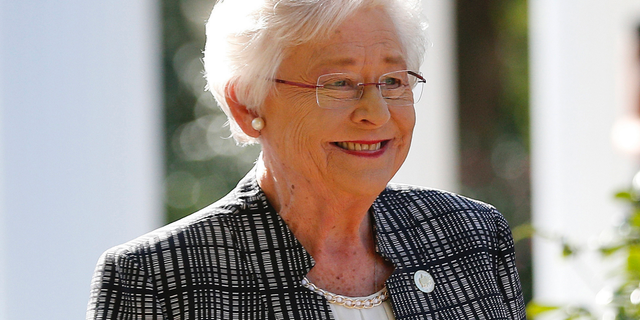 Alabama Gov. Kay Ivey speaks to the media in Montgomery, Ala., Nov. 17, 2017. (Associated Press)