Presumptuous Politics

Monday, February 3, 2020

The best and worst of Super Bowl ads


NEW YORK (AP) — During advertising’s biggest night, Super Bowl Sunday, marketers battled it out to bolster their brands and promote new products. Advertisers paid up to $5.6 million for 30 seconds, and almost 100 million people tune into the big game.
This year, Hyundai and Jeep scored with whimsical humor by poking fun at Boston accents and reuniting the “Groundhog Day” cast, Punxsutawney Phil included. Google struck heartstrings with a quiet message about aging and remembrance. Cheetos and Doritos both played off exaggerated dancing to good effect.
But Pop Tarts and a Hard Rock action-movie commercial failed to connect with viewers.
BEST
The automaker released its ad early, but it still drew fans during the game. Boston-affiliated celebrities including actor Chris Evans, John Krasinski, Saturday Night Live alum Rachel Dratch and former Boston Red Sox player David Ortiz discussed a Hyundai feature that lets car owners park remotely with exaggerated accents that make “Smart Park” sound like “smaht pahk.”
Super Bowl Sunday was on Groundhog Day, so someone had to do it. Fiat Chrysler painstakingly recreated the 1993 movie “Groundhog Day,” including the town square and other locales, with original actors Bill Murray, Brian Doyle Murray and Stephen Tobolowsky. The twist: instead of a Chevrolet truck, Murray uses a Jeep Gladiator truck. FCA Group marketing chief Olivier Francois said the ad worked to demonstrate the versatility of the Jeep truck since Murray does something different every day.
Google’s 90-second ad stood out by not using humor or celebrities. It features a man reminiscing about his wife, using the Google Assistant feature to pull up old photos of her and past vacations. The ad is set to an instrumental version of “Say Something” by Great Big World. “It’s so hard to write earnestly and not make it cheesy,” said Julia Neumann, executive creative director at ad agency TBWA(backslash)Chiat(backslash)Day in New York. “This was really, really well done.”
Cheetos used nostalgia effectively, appropriating the 30 year old MC Hammer classic “U Can’t Touch This” — still an earworm after all these years. The snack-food ad features a man with bright orange Cheetos dust on his hands who uses it as an excuse not to move furniture and perform office tasks. Hammer himself — “Hammer pants” and all — also kept popping up to utter his iconic catchphrase.
The brand added a silly danceoff to “Old Town Road,” the smash hit of the summer by Lil Nas X. In the Western-themed ad, Lil Nas faced off with grizzled character actor Sam Elliott with silly, sometimes CGI-enhanced dances moves at the “Cool Ranch.” Billy Cyrus, who features in the song’s remix, also made a cameo.
Planters teased its Super Bowl ad nearly two weeks before the game, releasing a teaser that showed its Mr. Peanut mascot seemingly being killed. The “death” of Mr. Peanut went viral on Twitter. But when Kobe Bryant was killed in a helicopter crash, the marketing stunt suddenly seemed insensitive, so Planters paused its pre-game advertising. The actual Super Bowl ad was relatively inoffensive, with a baby Mr. Peanut appearing at the funeral. “Baby Nut” comparisons to “Baby Yoda” and “Baby Groot” sprung up online.
WORST
Avocados from Mexico have carved out a niche with humorous ads featuring avocados, but they may have veered a little too far into “random” territory with this effort featuring a home shopping network with fake products such as a baby carrier-like device for avocados. “I thought the Avocados from Mexico spot felt like a random and gratuitous use of celebrity,” said Steve Merino, chief creative officer of Aloysius, Butler & Clark in Wilmington, Delaware. “Not only did it not make sense to have Molly Ringwald as your spokesperson, it was also a bit of a distraction.”
Kellogg’s went for quirky but ended up with a bland spot that isn’t likely to be remembered. In a pseudo infomercial, Jonathan Van Ness of “Queer Eye” describes the new Pop Tarts pretzel snack. The idea is that Pop Tarts adds pizazz to pretzels, but the ad itself failed to have much spark.
Winona Ryder went back to Winona, Minnesota — which she is named after — to create a website for the town. But nothing much happened in the ad, which shows Ryder in a snowdrift on her laptop being confronted by a “Fargo”-like cop. There’s a more involved marketing campaign with Ryder, but the Super Bowl ad didn’t communicate much.
HARD ROCK INTERNATIONAL
Hard Rock International went all in on its first Super Bowl ad, maybe too much so. It enlisted Michael Bay for a frenetic commercial showing a frenzied heist caper involving Jennifer Lopez, Alex Rodriguez, DJ Khaled, Pitbull, and Steven Van Zandt — but some found it hard to follow.

John Kerry, in now-deleted expletive-laced tweet, addresses report he was overheard planning 2020 run


Former Secretary of State John Kerry was reportedly overheard in a hotel restaurant Sunday warning of the very real "possibility of Bernie Sanders taking down the Democratic Party -- down whole," according to an NBC News report that sent shockwaves through an already-fractured liberal constituency bracing for a potentially historic Sanders win in Monday's pivotal Iowa caucuses.
Kerry, in the Renaissance Savery Hotel in Des Moines, Iowa, on the eve of the caucus vote, also reportedly remarked that "maybe I'm f---ing deluding myself here," but that he could conceivably launch a run for president now that donors "have the reality of Bernie" surging in the polls.
Kerry, who is in town as a Joe Biden surrogate, added that donors such as venture capitalist Doug Hickey would have to "raise a couple of million," and that he would need to leave the board of Bank of America and stop giving paid speeches.
Immediately after the report broke, Kerry fired off a tweet with an uncharacteristic expletive, as he didn't outright deny that he had been overheard by the reporter saying Sanders posed an existential threat to the Democratic Party.
He did deny saying he could run or was running for president.
"As I told the reporter, I am absolutely not running for President," Kerry wrote on Twitter. "Any report otherwise is f---ing (or categorically) false. I’ve been proud to campaign with my good friend Joe Biden, who is going to win the nomination, beat Trump, and make an outstanding president."

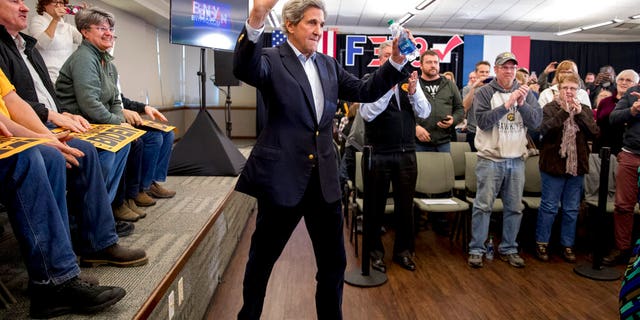
Former Secretary of State John Kerry arrives at a campaign stop for Democratic presidential candidate former Vice President Joe Biden at the South Slope Community Center, Saturday, Feb. 1, 2020, in North Liberty, Iowa. (AP Photo/Andrew Harnik)

Kerry then quickly deleted the tweet and reposted it without the profanity.
He separately told NBC News:  "This is a complete and total misinterpretation based on overhearing only one side of a phone conversation. A friend who watches too much cable called me wondering whether I’d ever jump into the race late in the game if Democrats were choosing an unelectable nominee. I listed all the reasons I could not possibly do that and would not -- and will not under any circumstances -- do that."
Incredulous commentators and reporters faulted Kerry for the blunder, even as they recognized that his apparent panic was emblematic of the state of the establishment Democratic Party.
"I don't know who needs to hear this, but the lobby of the Renaissance Savery in Des Moines the day before the Iowa caucuses is *not* the place to have private conversations," said Brianne Pfannenstiel, a reporter with the Des Moines Register.
Meanwhile, in an exclusive interview with Fox News' Sean Hannity during the Super Bowl LIV pregame show, President Trump asserted that the Democratic National Committee (DNC) was "rigging the election again" against "crazy Bernie,' after the DNC announced it would change debate rules in a way that would help Mike Bloomberg appear on stage.
Trump also warned that the left-wing of the Democratic Party is insurgent, and would soon unseat establishment figures. Sanders is backed by prominent far-left-wing Democrats including Reps. Alexandria Ocasio-Cortez, D-N.Y., and Rashida Tlaib, D-Mich.
"I think she's a very confused, very nervous woman," Trump said, referring to House Speaker Nancy Pelosi, D-Calif, who reluctantly announced impeachment proceedings last year after months of resisting the progressive wing of her party.
"I don't think she wanted to do this," Trump continued, concerning impeachment. "I think she really knew what was going to happen, and her worst nightmare has happened. I don't think she's gonna be there too long, either. I think that the radical left -- and she's sorta radical left too, by the way -- but I think the radical left is gonna take over."
At the same time, Trump made clear he had no love for more established Democratic insiders, either, remarking that former New York City Mayor Michael Bloomberg is quite short.
"You know, now he wants a box for the debates to stand on," Trump said. "OK, it’s OK, there’s nothing wrong. You can be short. Why should he get a box to stand on, OK? He wants a box for the debates. Why should he be entitled to that? Really. Does that mean everyone else gets a box? ... I would love to run against Bloomberg."

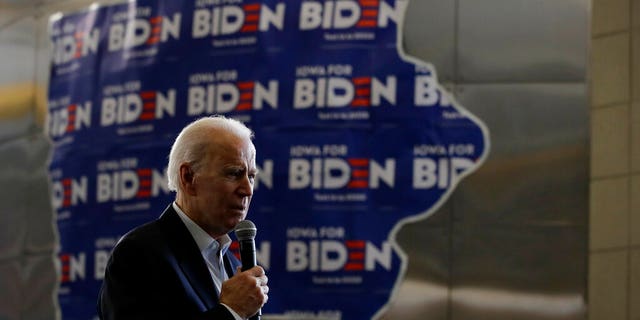
Democratic presidential candidate former Vice President Joe Biden speaks during a campaign event Sunday, Feb. 2, 2020, in Dubuque, Iowa. (AP Photo/Marcio Jose Sanchez)

As the drama unfolded, Democratic presidential candidates hustled across the state on Sunday trying to fire up voters and make one last appeal to those struggling to make a final decision about their choice in the crowded field.
Campaigns and voters acknowledged a palpable sense of unpredictability and anxiety as Democrats begin choosing which candidate to send on to a November face-off with Trump.
The Democratic race is unusually large and jumbled heading into Monday’s caucus, with four candidates locked in a fight for victory in Iowa and others still in position to pull off surprisingly strong finishes. Many voters say they're still weighing which White House hopeful they'll support.
“This is going to go right down to the last second,” said Symone Sanders, a senior adviser to the Biden campaign.
Polls show Biden in a tight race in Iowa with Sanders and Elizabeth Warren of Massachusetts, as well as former South Bend, Indiana, Mayor Pete Buttigieg. Minnesota Sen. Amy Klobuchar and tech entrepreneur Andrew Yang are also competing aggressively in the state.

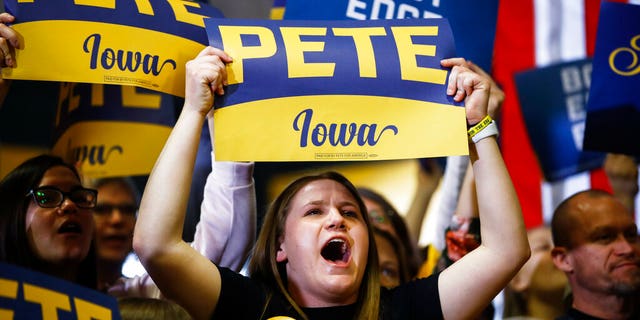
Attendees cheer as Democratic presidential candidate former South Bend, Ind., Mayor Pete Buttigieg speaks during a campaign event at Northwest Junior High, Sunday, Feb. 2, 2020, in Coralville, Iowa. (AP Photo/Matt Rourke)

Many campaigns were looking to a final weekend poll to provide some measure of clarity. But late Saturday night, CNN and The Des Moines Register opted not to release the survey because of worries the results may have been compromised.
New caucus rules have also left the campaigns working in overdrive to set expectations. For the first time, the Iowa Democratic Party will release three sets of results: who voters align with at the start of the night; who they pick after voters supporting nonviable candidates get to make a second choice; and the number of state delegate equivalents each candidate gets.
The new rules were mandated by the Democratic National Committee as part of a package of changes sought by Sanders following his loss to Hillary Clinton in the 2016 presidential primaries. The revisions were designed to make the caucus system more transparent and to make sure that even the lowest-performing candidates get credit for all the votes they receive.
But party officials in Iowa and at the DNC have privately expressed concerns that but multiple campaigns will spin the results in their favor, potentially creating chaos on caucus night.
Fox News' Andrew O'Reilly and The Associated Press contributed to this report.

Iowa caucuses: Who is ahead in the polls heading into Monday


The Democratic race is unusually large heading into Monday’s Iowa caucuses, with four presidential candidates locked in a fight for victory in Iowa and others still in a position to pull off surprisingly strong finishes.
Many campaigns were looking to final weekend polls to provide some measure of clarity.
Polls show former Vice President Joe Biden in a tight race in Iowa with Sens. Bernie Sanders of Vermont and Elizabeth Warren of Massachusetts, as well as Pete Buttigieg, former mayor of South Bend, Ind.
Minnesota Sen. Amy Klobuchar and entrepreneur Andrew Yang also are competing aggressively in the state.
An Emerson College poll released Sunday night found Sanders leading with 28 percent support, Biden at 21 percent, Buttigieg at 15 percent, Warren at 14 percent and Klobuchar at 11 percent.
A CBS News poll had Biden and Sanders holding the lead with 25 percent each, Buttigieg with 21 percent, Warren at 16 percent and Klobuchar at 5 percent.
Late Saturday, a final CNN and Des Moines Register poll opted not to release their survey because of concerns that the results may have been compromised.
For the first time, the Iowa Democratic Party will release three sets of results: who voters align with at the start of the night, who they pick after voters supporting nonviable candidates get to make a second choice, and the number of state delegate equivalents each candidate gets.
The new rules were mandated by the Democratic National Committee (DNC) as part of a package of changes sought by Sanders following his loss to Hillary Clinton in the 2016 presidential primaries. The revisions were designed to make the caucus system more transparent and to make sure that even the lowest-performing candidates get credit for all the votes they receive. But party officials in Iowa and at the DNC have privately expressed concerns that multiple campaigns will spin the results in their favor, potentially creating chaos on caucus night.
The Associated Press contributed to this report.

Roberts, the Senate establish a new precedent during Trump’s impeachment trial


So much of politics is scripted.
So much of what we’ve seen over the past week or so in the Senate trial of President Trump was not.
The outcome of President Trump’s trial was settled long ago. Try 1787. That’s when the Founders finished the Constitution, asserting in Article I, Section 3 that it would take “two-thirds” of the Senate to convict and remove someone from office.
It was clear long ago that the contemporary Senate wouldn’t have anything close to 67 votes to bounce President Trump from office. But how everyone navigated the trial waters was mostly unscripted.
Take the issue of witnesses. It was far from clear last week if the Senate would summon witnesses. It would come down to less than a handful of votes. Sens. Susan Collins (R-ME) and Mitt Romney (R-UT) were well documented in their support for witnesses. Republicans now hold a 53-47 edge in the Senate. So the attrition of Collins and Romney likely brought the vote tally on the witness gateway to just 51. In play were Sens. Lamar Alexander (R-TN) and Lisa Murkowski (R-AK). But it was thought that Collins and Romney may constitute the entire universe of GOPers willing to open the door to witnesses.
The gateway vote on witnesses could have presented the Senate with a rabbit warren of options for what would happen next in the trial. If the Senate agreed to the witness gateway, would that just be it? Would the Senate only support the concept of witnesses – but vote to reject various slates of witnesses or individual witnesses? That’s why the gateway vote last week was so important. Democrats obviously pushed for witnesses – most significantly, former National Security Advisor John Bolton. Many Republicans thought they’d like to hear from former Vice President Joe Biden and his son Hunter Biden. But the gateway vote on witnesses was like opening a parliamentary wormhole. If the Senate approved the motion to theoretically call witnesses, then senators never truly knew where’d they come out on the other side. \
Would this extend the trial for weeks? Months? So much for a quick acquittal for the President, pushed by many of the President’s loyalists. Sure, some GOPers thought it would be amusing if not politically helpful to drag the Bidens into the Senate to testify. But in the minds of Mr. Trump’s Senate supporters, was testimony from the Bidens more important than clearing the chief executive expeditiously? The same with the idea of calling the whistleblower. Lots of Republicans liked to talk a good game about hearing from and exposing the name of the whistleblower. But to what political end? Incinerating national security law? Annihilating whistleblower statutes which many senators worked so hard to pass over the years? Exposing persons who work undercover in the national security community?
The idea of voting to have the whistleblower testify was never going to happen. But it was sure a good way for some Republicans to gin up their base and call into question what lead impeachment manager and House Intelligence Committee Chairman Adam Schiff (D-CA) or his staff allegedly knew about the whistleblower.
One more vote in favor of witnesses would present the Senate with a tie on the gateway vote. By rule, tie votes in the Senate lose. Would Chief Justice John Roberts vote to break the tie? Senate impeachment rules note that the role of the Vice President – who is eligible to break other ties in the Senate – “devolved” in an impeachment trial. So there would be no role or possibility of the Vice President breaking a tie. In President Andrew Johnson’s impeachment trial in 1868, Chief Justice Salmon P. Chase broke two of three ties in the Senate. Could Roberts break a tie in this instance and prolong the trial, forcing witnesses?
Unclear. And, in real time, senators were looking at what an elongated trial may mean. President Trump’s counsel Jay Sekulow argued that calling witnesses would “take a long time” and may consume Senate business “for months.”
Schiff disputed this, suggesting they could call and depose witnesses in a week.
That’s a nod to what the Senate did in 2018 when Christine Blasey Ford came forward to raise questions about the conduct of Supreme Court Justice Brett Kavanaugh during his confirmation process. After much debate and negotiation, the Senate postponed a confirmation vote on Kavanaugh until the FBI completed a probe of Blasey Ford’s allegation. The supposition was that if Republican senators were willing to pause Kavanaugh’s confirmation for a week, then surely they could take a week to hear from witnesses in President Trump’s impeachment trial.
It was also a red herring that calling witnesses would devour all Senate business. If the Senate voted to call witnesses, it’s likely the trial would go dark on the floor for a week or two. Maybe just meet in trial session for a few minutes each day as the Senate took the depositions offstage. Senate impeachment rules don’t require the trial to meet until 1 pm et each day. So it’s possible the Senate could still debate and vote on legislation and nominations either before or after the trial sessions during this period.
But, it turns out, the Senate lacked the votes to swing open the gateway to the possibility of witnesses. Lamar Alexander announced his opposition to the witness option. Lisa Murkowski followed suit the next day. The Senate wouldn’t call witnesses.
That left the Senate with but a handful of unanswered questions: When would the Senate finish the trial? Would any Republicans vote to remove Mr. Trump? Would any Democrats vote to acquit the President?
We now have an answer to the first question. The Senate will vote sometime after 4 pm et Wednesday on both articles of impeachment: abuse of power and obstruction of Congress. It’s unclear if we will know how everyone will vote until just before the Senate takes those roll call tallies. But Friday afternoon – once the Senate knew the math on the witness question, there wasn’t an obvious answer to how it got from point A to point C.
Many Republican senators and the White House wanted to conclude the trial Friday night or in the wee hours of Saturday morning. On Capitol Hill, when you have the votes, you move, regardless of the hour. You don’t tempt fate. There’s a reason why the Senate voted on the first version of Obamacare before dawn on Christmas Eve morning in 2009. You never know when some new allegation may come tumbling in over the transom to alter the calculus.
But, here was the problem. The Senate had heard nothing but arguments from the impeachment managers and Mr. Trump’s defense counsel for weeks now on the floor. Would the Senate suddenly just call votes on the articles of impeachment without allowing senators to actually speak and debate on the floor the guilt or innocence of the President?
So, Senate Majority Leader Mitch McConnell (R-KY) held off on the witness gateway vote until late Friday afternoon. It was only then that he could secure an agreement between GOPers and Democrats on how to finish the trial. It wouldn’t wrap over the weekend. Things would extend through late Wednesday – punctuated by President Trump’s State of the Union speech in the middle.
Some GOPers wanted the President cleared before the Tuesday address. But Democrats noted that President Clinton presented a State of the Union message during his impeachment trial in 1999.
There was naturally some grumbling from those close to the President.
“It’s a terrible thing,” said one source familiar with Mr. Trump’s thinking. “(Republican) senators should have stayed in on Saturday. They got rolled.”
But McConnell was hamstrung on having the votes to finish the trial immediately.
“It was the best deal McConnell could get,” said one Republican source. “The Administration is pleased that this is the best the Republican Senate could do to shorten the process.”
White House Director of Legislative Affairs Eric Ueland put a different spin on things. Ueland thought having State of the Union one night – followed by the trial verdicts – would boost Mr. Trump.
“It’s a strong, one-two punch to have the State of the Union with a clear vision, clear agenda and clear focus for 2020 followed immediately by acquittal on this fake articles of impeachment the next day,” said Ueland.
And even though it was a moot point by the weekend, we finally got some clarity as to if John Roberts could break a tie in the Senate trial.
A book of 44 “standing rules” govern Senate practice. But what is more voluminous is a catalogue for thousands of Senate “precedents.” In fact, the Senate conducts much of its business based on precedent. So on Friday night, Senate Minority Leader Chuck Schumer (D-NY) posed a parliamentary inquiry to Roberts as to whether he could break ties in an impeachment trial. Roberts answered Schumer from the dais.
“I think it would be inappropriate for me, an unelected official from a different branch of government, to assert the power to change that result so that the motion would succeed,” declared Roberts.
And with that, Roberts and the Senate established a new precedent.
We already know the outcome of President Trump’s impeachment trial. And now we know if there is ever another impeachment trial, the Chief Justice can’t break ties because of the precedent established in Mr. Trump’s tribunal by Roberts.

Sunday, February 2, 2020

Mitt Romney Fake Republican Cartoons


Matt Gaetz slams Don Lemon: 'He is like CNN's professional eye-roller'


CNN's Don Lemon lost journalistic credibility when he laughed on camera in reaction to a guest's derisive comments about supporters of President Trump, a Republican congressman said last week.
During an appearance on Fox Business' "Trish Regan: Primetime," U.S. Rep. Matt Gaetz, R-Fla., unloaded on Lemon, the host of "CNN Tonight."
“He is like CNN’s professional eye-roller who always wants to gasp himself out of breath at everything he sees from the president,” Gaetz, a close ally of Trump, told Regan.
“He is like CNN’s professional eye-roller who always wants to gasp himself out of breath at everything he sees from the president.”
— U.S. Rep. Matt Gaetz, R-Fla.
But on Saturday, Gaetz doubled down in a Twitter message, referring to Lemon as "a hack," and "not a journalist."
"The Left and the mainstream media have contempt not just for President Trump, not just for his allies in Congress, but also for the American people who support President @realDonaldTrump," Gaetz wrote in a retweet of a clip from his "Primetime" appearance.
Lemon had been roundly criticized for falling into hysterical laughter Jan.25 when a panelist on his show mocked Secretary of State Mike Pompeo for claiming an NPR reporter couldn’t find Ukraine on a map before calling Trump’s base of supporters the “credulous boomer rube demo.”
While talking about a statement Pompeo put out Jan. 25 that suggested NPR reporter Mary Louise Kelly misidentified Bangladesh for Ukraine on a blank map, former GOP strategist Rick Wilson said Pompeo "also knows deep within his heart that Donald Trump couldn't find Ukraine on a map if you had the letter U and a picture of an actual, physical crane next to it."
Lemon started to laugh while Wilson continued.

'Defined by ignorance'

"He knows that this is, you know, an administration defined by ignorance of the world. And so that's partly him playing to the base and playing to their audience. You know, the credulous boomer rube demo that backs Donald Trump."
Lemon continued laughing uncontrollably as Wilson said in a mocking Southern accent: "Donald Trump's the smart one -- and y'all elitists are dumb!'"
"You elitists with your geography and your maps and your spelling!'" New York Times columnist and CNN contributor Wajahat Ali added.
Lemon addressed the issue on his show Tuesday, saying he didn’t catch everything that Wilson had said and he was not laughing at Trump supporters.
“Ask anyone who knows me, they'll tell you -- I don't believe in belittling people, belittling anyone for who they are, what they believe, or where they're from," he said. "During an interview on Saturday night, one of my guests said something that made me laugh. And while in the moment, I found that joke humorous. And I didn't catch everything that was said."
He added that journalists aren't perfect. "When we get it wrong, we say we got it wrong, we apologize, and we move on."
Wilson also addressed the backlash, tweeting last week that his wife and kids have started to received death threats, but he didn't apologize for what he said.

Gaetz's alternative view

In his "Primetime" appearance, Gaetz made his case for why he believes more Americans support President Trump rather than share the view of Lemon and his panelists.
"Donald Trump isn't just leading a campaign," Gaetz told Regan, "he is presiding over a political movement. That's why we've only gained strength leading into 2020 and why this impeachment sham is only intensifying our support for our transformational president. Because in real America we see things happening that will impact our lives -- a better trade deal in our hemisphere, actually standing up to China. President Trump functionally ending our involvemnet in the Syrian civil war and not starting any new 'forever wars.'
"These elements of an American nationalist economic agenda, paired with a realistic view of the world where we kill the terrorists and actually come home to bring the resources to our country? That is going to fuel a tranformational victory in 2020.
"And you know what? After the Democrats have impeached Trump and he comes back and wins anyway? Oh, wait till we get a load of Donald Trump in his second term. I think we're going to be even more transformative."

Pompeo, in Kazakhstan, warns of China’s growing reach


NUR-SULTAN, Kazakhstan (AP) — U.S. Secretary of State Mike Pompeo on Sunday pressed Kazakhstan to be wary of Chinese investment and influence, urging the Central Asian nation and others to join calls demanding an end to China’s repression of minorities.
Bringing a message similar to the one he has delivered repeatedly to other countries, Pompeo told senior Kazakh officials that the attractiveness of Chinese investment comes with a cost to sovereignty and may hurt, instead of help, the country’s long-term development.
“We fully support Kazakhstan’s freedom to choose to do business with whichever country it wants, but I am confident that countries get the best outcomes when they partner with American companies,” he said. “You get fair deals. You get job creation. You get transparency in contracts. You get companies that care about the environment and you get an unsurpassed commitment to quality work.”
Pompeo began his brief visit to the country by meeting with ethnic Kazakhs whose families have gone missing or been detained in China’s widespread crackdown on Muslims and other ethnic and religious minorities in its western Xinjiang region.
“The protection of basic human rights defines the soul of a nation,” he said, thanking Kazakhstan for taking in those fleeing persecution. “The United States urges all countries to join us in pressing for immediate end to this repression. We ask simply for them to provide safe refuge and asylum for those seeking to flee China. To protect dignity, just do what’s right.”
Pompeo also congratulated Kazakhstan on its repatriation of Islamic State fighters from Iraq and Syria. Kazakhstan has taken back nearly 600 fighters and family members detained in areas formerly controlled by the group.
“I have and will continue to commend the Kazakhstani government for its leadership in repatriating foreign terrorists fighters and their families from Iraq and Syria,” he said. “I hope this commitment to justice will inspire other nations to do the same.”
However, Kazakhstan has some under some criticism for pressuring an activist who had campaigned for the release of ethnic Kazakhs in China. Threatened with a long prison sentence, the man signed an admission of guilt for inciting ethnic tensions.
In addition, Pompeo was urging senior officials in the Central Asian nation to continue reforms that would allow greater U.S. investment in the country.
At a news conference with Foreign Minister Mukhtar Tleuberdi, Pompeo praised Kazakhstan for its efforts to counter the spread of a new virus from China. He said the United States is helping the country with expertise from the Centers for Disease Control and Prevention and providing laboratory equipment.
Kazakhstan’s “quick action to stop the spread of the virus has been incredibly impressive,” he said.
Kazakhstan is among the growing list of countries that have suspended travel links with China.
___
This story corrects the spelling of the foreign minister’s last name to Tleuberdi.

Sanders calls for unity, but his supporters have other ideas


CEDAR RAPIDS, Iowa (AP) — When Bernie Sanders addresses throngs of supporters who gather at his rallies, the divisions that plague the Democratic Party can feel far away. The Vermont senator speaks of building a “mutliracial, mutli-generational movement” that will cut through economic divides, catapult him into the White House and transform the nation.
Some of the highest-profile surrogates campaigning on his behalf are less sanguine.
Speaking at a concert for Sanders on Friday night, Rep. Rashida Tlaib, D-Mich., led sustained booing from the stage at the mention of Hillary Clinton, his rival in the 2016 primary. Rep. Alexandria Ocasio-Cortez, a New York Democrat who has campaigned for Sanders across Iowa, says the Democratic establishment should conform to the progressive movement, not the other way around. “We aren’t pushing the party left, we are bringing the party home,” she says.
Then there’s filmmaker Michael Moore, who fires up Sanders crowds by bashing “corporate Democrats” and suggesting that the party’s own leadership may swoop in and steal the 2020 nomination from Sanders in a way that some of the senator’s supporters believe it did in 2016.
Such episodes demonstrate the tension at the heart of Sanders’ campaign as he shows signs of strength heading into Monday’s caucuses. While the self-described democratic socialist has never backed away from his call for political revolution, the visions of unity he also articulates are sometimes at odds with the rhetoric espoused by his supporters. The dynamic is playing out at a precarious time for the Democratic Party, which will have to unite to unseat President Donald Trump.
“The Sanders supporters are demanding that everybody unite behind Bernie, but if they want Democrats to unite behind Bernie they have to be ready to unite behind the moderate Democrats,” said Democratic strategist Brad Bannon. “And they’ve not yet shown that they will do that. They’ve not shown that, if things don’t go their way, they won’t just stay home in November.”
Sanders is bunched near the top of many polls in Iowa with progressive rival Elizabeth Warren and with former Vice President Joe Biden and Pete Buttigieg, the former Mayor of South Bend, Indiana, who represent the moderate wing of the party, along with Minnesota Sen. Amy Klobuchar. If he were to win the caucuses and also notch a victory in New Hampshire, which holds its primary on Feb. 11, Sanders will face growing pressure to show his campaign will be open to all factions of the party.
Conversely, a series of losses would amplify calls on Sanders to ensure that his supporters rally behind the ultimate nominee. He insisted on Saturday that he would do just that.
“Let me say this so there’s no misunderstanding,” he told a rally in Indianola, Iowa. “If we do not win, we will support the winner and I know that every other candidate will do the same.”
Sanders has earnestly tried to quell intra-party division in other ways, too, describing many of his fellow Democratic presidential rivals as his longtime friends who are “good people.” But, often in the same breath, he gleefully fans the flames, calling his campaign the political and corporate establishment’s “worst nightmare.”
Sanders’ problem is he may only be able to achieve true unity by compromising on what many supporters see as his greatest strength: consistency over his decades in political office — even on positions that bucked this own party.
“For young people in particular, there’s an authenticity and a level of trust that is hard to garner from some of the other candidates,” said Evan Weber, political director for the Sunrise Movement, a youth-led activist group supporting the sweeping “Green New Deal” to combat climate change which has endorsed Sanders’ presidential bid. “His record is being consistent and relentless in demanding what he thought was just and was right for decades.”
But what some see as unwavering commitment to core ideals, others see as hostile.
“I just think he’s too angry,” said Paula Peeper, a 76-year-old retired office worker from Waterloo, Iowa, “especially when he says he’s the one to unite the party.”
Peeper, attending a rally Saturday for Buttigieg, said Sanders risks alienating voters in the closing stretch, especially when they see him leading in some Iowa polls, giving undecided voters reason to think harder about his rivals.
“It’s not helpful for Bernie to be fighting,” she said. “I think Biden, Pete and Klobuchar could be the beneficiaries of it.”
Melissa Dunlevy, 34, was a stalwart Sanders supporter and campaign volunteer in 2016, but now plans to support Buttigieg, thinking he could do a better job attracting Republicans and independents needed to beat Trump.
“I’m passionate about every single thing Bernie says, I’m 100 percent there,” Dunlevy said. “But it’s just another giant extreme, it’s another thing that’s so partisan, it’s another thing that divides us.”
___
Associated Press writers Thomas Beaumont and Julie Pace in n Waterloo, Iowa, contributed to this report.

Amy Klobuchar helped jail teen for life, but case was flawed


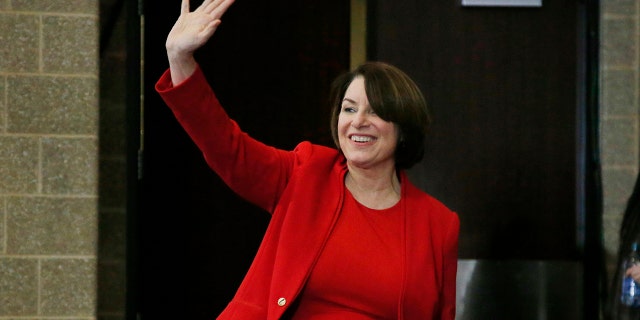
MINNEAPOLIS — It was a prime-time moment for Amy Klobuchar.
Standing in the glare of television lights at a Democratic presidential debate last fall, she was asked about her years as a top Minnesota prosecutor and allegations she was not committed to racial justice.
“That’s not my record,” she said, staring into the camera.
Yes, she was tough on crime, Klobuchar said, but the African-American community was angry about losing kids to gun violence. And she responded.
She told a story that she has cited throughout her political career, including during her 2006 campaign for the U.S. Senate: An 11-year-old girl was killed by a stray bullet while doing homework at her dining room table in 2002. And Klobuchar’s office put Tyesha Edwards’ killer -- a black teen -- behind bars for life.
But what if Myon Burrell is innocent?
An Associated Press investigation into the 17-year-old case uncovered new evidence and myriad inconsistencies, raising questions about whether he was railroaded by police.

Conflicting accounts

The AP reviewed more than a thousand pages of police records, court transcripts and interrogation tapes, and interviewed dozens of inmates, witnesses, family members, former gang leaders, lawyers and criminal justice experts.

The case of Myon Burrell, convicted in the murder of Tyesha Edwards, an 11-year-old girl pierced in the heart by a stray bullet in 2002 while doing homework at her family's dining room table, has drawn a growing number of legal experts, community leaders and civil rights activists who are worried that he may have been wrongly convicted. He is seen Oct. 23, 2019, in Stillwater, Minn. (Associated Press)

The case relied heavily on a teen rival of Burrell’s who gave conflicting accounts when identifying the shooter, who was largely obscured behind a wall 120 feet away.
With no other eyewitnesses, police turned to multiple jailhouse snitches. Some have since recanted, saying they were coached or coerced. Others were given reduced time, raising questions about their credibility. And the lead homicide detective offered “major dollars” for names, even if it was hearsay.
There was no gun, fingerprints, or DNA. Alibis were never seriously pursued. Key evidence has gone missing or was never obtained, including a convenience store surveillance tape that Burrell and others say would have cleared him.
Burrell, now 33, has maintained his innocence, rejecting all plea deals.
His co-defendants, meanwhile, have admitted their part in Tyesha’s death. Burrell, they say, was not even there.
For years, one of them -- Ike Tyson -- has insisted he was actually the triggerman. Police and prosecutors refused to believe him, pointing to the contradictory accounts in the early days of the investigation. Now, he swears he was just trying to get the police off his back.
“I already shot an innocent girl,” said Tyson, who is serving a 45-year sentence. “Now an innocent guy -- at the time he was a kid -- is locked up for something he didn’t do. So, it’s like I’m carrying two burdens.”
“I already shot an innocent girl. Now an innocent guy -- at the time he was a kid -- is locked up for something he didn’t do. So, it’s like I’m carrying two burdens.”
— Ike Tyson

Difficult timing

Asked for comment on the case, a Klobuchar campaign spokesperson said Burrell was tried and convicted of Tyesha’s murder twice, and the second trial occurred when Klobuchar was no longer the Hennepin County Attorney. If there was new evidence, she said, it should be immediately reviewed by the court.
Questions about the case come at a difficult time, as Klobuchar and other presidential hopefuls, including Joe Biden and Michael Bloomberg, face scrutiny for their records on racial justice in the 1990s and early 2000s.
Black and brown communities were being decimated by the war on drugs, and the since-discredited “super-predator” theory prevailed, predicting that droves of poor, fatherless young men devoid of moral conscience would wreak havoc in their neighborhoods.
Democrats joined Republicans in supporting harsher policing and tougher sentencing, leading to the highest incarceration rates in the nation’s history.
Some politicians have tried to distance themselves from the period’s perceived excesses. In January, for instance, Klobuchar returned a $1,000 campaign donation from Linda Fairstein, who prosecuted New York’s infamous Central Park Five, four black teens and one Hispanic who were later exonerated in the rape of a white jogger in 1989.
While campaigning to be the top prosecutor in Minnesota’s most populous county in 1998, Klobuchar advocated for harsher penalties for juvenile offenders.

While campaigning to be the top prosecutor in Minnesota’s most populous county in 1998, Amy Klobuchar advocated for harsher penalties for juvenile offenders. The Democratic presidential candidate is seen Jan. 25, 2020, in Bettendorf, Iowa. (Associated Press)

In Minnesota, allegations of gang affiliation or motive played on the fears of mostly white jurors and led to harsher sentences.
“If you were young and black, and your case was tied to gangs or drugs, it was an especially scary time,” said Mary Moriarty, a public defender in Minnesota’s Hennepin County for nearly three decades. “I do firmly believe that there were people convicted of crimes that they did not do.’
She said that the murder Burrell went down for was problematic from the start.
“In the case of Myon Burrell -- where you had a really high-profile shooting of an innocent girl and you put a lot of pressure on the system to get someone to be responsible for that -- I think a lot of corners were probably cut.”
“In the case of Myon Burrell ...  I think a lot of corners were probably cut.”
— Mary Moriarty, Hennepin County public defender
In Minneapolis, soaring homicides had briefly earned the city the grim nickname “Murderapolis.” By the time Klobuchar took office in 1999, crime rates had started to drop. But tensions remained high. Tyesha’s death set off an uproar.
Police pulled out all stops, deploying more than 40 officers and gang task force members.
Despite the lack of physical evidence, they all but wrapped up their case against Burrell in four days.
Ike Tyson, 21, and Hans Williams, 23, were easy. Several people saw them roll by in their car minutes before the attack, and a 911 tip from one of their girlfriends helped seal the deal.
Burrell, then 16, was arrested only after a tip from an often-used jailhouse informant. During his lengthy legal process, Burrell hired and fired six attorneys as they failed to cross-examine witnesses, pursue alibis or challenge glaring irregularities in the investigation.
In the end, his sentence stuck: Natural life in prison.
The Minneapolis police declined to comment for this story. Hennepin County Attorney Mike Freeman’s office said it’s confident the correct person was convicted but it’s always open to reviewing new evidence.
Assistant County Attorney Jean Burdorf, the only prosecutor left who was directly involved in the case, insists that Burrell received justice. “I’ll tell you what I’ve told a lot of people over the years. I have a lot of confidence in Minnesota's justice system,” she said.
“Certainly, he's been through the court process, and his conviction has remained intact.”

Changing stories

For years, many caught up in Burrell’s case have insisted police got the wrong person. Some say they initially lied to protect themselves or their friends. Others say they told police what they wanted to hear to get deals on their own sentences or to punish a rival.
Even though some have changed their stories more than once, they insist they are now telling the truth because they have nothing to gain.
Burrell’s co-defendants were members of the Tyson Mob and the Vice Lords. They say drugs and guns were a way of life in their rough neighborhood. But the shooting wasn’t gang warfare as police claimed, they insisted -- it was personal.
Tyson said he and Williams were driving in south Minneapolis when they spotted a group of guys hanging out. Among them was 17-year-old Timmy Oliver, a member of the rival Gangster Disciples, who had menacingly waved a gun at them weeks earlier.
The pair slowed down, scowled at Oliver, then continued on. They picked up an unidentified acquaintance, got a gun and headed back. Tyson said it was his idea, and the intention was to scare Oliver, not to kill him.
The three parked a block away, with Williams waiting in the driver’s seat for a quick getaway. Tyson and the third man jumped out, cutting through an alley and ducking between houses. Shielded by a wall, Tyson said he could clearly see Oliver standing in the yard across the street with his back turned.
He said he fired off eight rounds, the last few as he was running backward toward the car. It wasn’t until later that evening that he learned one of his bullets killed Tyesha in the house next door.
“There was only one weapon, one set of shells,” said Tyson. “I’m the one that did this. I did this.”
Soon after the shooting, he was telling friends, his attorney, fellow inmates and even a prison guard that Burrell was not at the scene, court records show. But he said his lawyer told him he’d never see the outside of a prison unless he implicated the youth. Eventually he buckled, but only after being promised his plea would not be used against Burrell.
Tyson doesn’t want to name the other man who was with him, saying he doesn’t want to pull in a person who was only peripherally involved.
The getaway driver, Hans Williams, did identify a third man -- by his full name and in a photo lineup. Police initially said they didn’t want to “muddy up the case” with an unverified name, later that they didn’t believe him. They made no real effort to follow up. After getting a denial from the suspect in 2005, the chief homicide detective “permanently checked” out their recorded conversation and gave it to the Hennepin County Attorney’s Office. It has since gone missing.
The gun was never recovered and officers said prints on the magazine and the car were not sufficient for identification. Ballistic tests on Tyson’s jacket were not carried out to verify claims that he was the triggerman.
The killing of Tyesha Edwards topped television news that night.
That’s how a prison inmate first heard about it. Desperate to get money or time cut off his own sentence, he quickly reached out to Oliver, a friend and fellow gang member. Minutes later, the often-used informant gave the cops Burrell’s name, helping steer their investigation, the AP found.
Oliver, who had his own troubles with the law, didn’t go to police that day, as he promised. He said one of the bullets had pierced his pants, so he threw them away and went to buy a new pair.
But three days later, he was picked up by officers following another, unrelated shooting. Police now had their sole eyewitness in custody, interviewing him for more than eight hours. Though mandated by law, the interrogation was never recorded. Police later said they “made a mistake.”
Well after midnight, Oliver signed a statement saying he saw Burrell standing across the street in an open lot between two houses, shooting until he emptied his weapon. Later, Oliver’s story would change. He said his diminutive, 5-foot-3 rival was firing from behind a 5-foot wall, 120 feet away, but that his hooded face was still clearly recognizable.
Oliver’s best friend, Antoine Williams, said when the gunfire stopped, he ran to his side.
“I asked Timmy at the time, ‘Who, who did the shooting?’” Antoine Williams recalled in a recorded interview with a private investigator hired by one of Burrell’s attorneys. “He said, ‘I couldn’t see where it was coming from.’”
He later asked Oliver -- who died in a shooting in 2003 -- why he lied to police.
Oliver told him, “They threatened him, kinda put it like, ‘It was your fault because you were there. You were the intended target,’” Antoine Williams said.
With a new trial date approaching and their key witness, Oliver, gone to the grave, the police turned to informants in the jails and prisons. Some were offered generous sentence reductions, cash and other deals for those willing to come forward with a story about what happened in the shooting, even if it wasn’t true, inmates said.
There were at least seven jailhouse informants, two of whom had coughed up information in more than a dozen other cases. Another went by 29 different aliases.
Terry Arrington, a member of a rival gang, was among those who talked.
He said he was approached by four officers and the prosecutor at a federal correctional facility where he faced 19 years in prison and was told he could knock that down to three if he was willing to cooperate.
He said he knew nothing about the case: “They basically brought me through what to say. Before I went before the grand jury, they brought me in a room and said … ‘When you get in, hit on this, hit on this.’ I was still young and I had fresh kids that I was trying to get home to, so I did what they asked.”
He got his deal, but now lives with that burden.
“Like, I don’t wish jail on nobody,” he said, now back in prison at Rush City correctional facility on other charges. “Even though we was enemies ... that’s still a man ... So it really bothers me right now.”
He says at least three other men who were locked up with him in the same unit also cut deals with police. One other has recanted.
As far as Arrington knows, “everybody told a lie to get time cut.”

Distrust of police

Like many young black men in his neighborhood, Burrell’s distrust of police came early. He was 12 when a drug addict drew a switchblade, slashing his sister in the hand and drawing blood. His mom called the police, but they assumed the boy was the assailant, threw him up against a sharp fence before hauling him to the station in cuffs. Only then did they realize they had the wrong person.
Soon after, he was caught selling drugs and hanging out with the wrong crowd. Worried he might end up in jail, like his dad and oldest brother, his mother packed up the family and moved to Bemidji, a small city 3 1/2 hours away. But the 13-year-old struggled to fit in and found himself coming back to the Twin Cities often.
In 2002, the family traveled to Minneapolis to spend Thanksgiving with his grandmother.
Less than 24 hours later, Tyesha was dead and police were desperate to find her killer.
They decided early on it was Burrell, though he had not had any serious brushes with the law.
In a video taken by police hours before his arrest, chief homicide detective Richard Zimmerman is seen talking to a man brought to the station following another shooting. The officer says he is ready to pay “major dollars” for information about Tyesha’s murder -- even if it’s just street chatter.
“Hearsay is still worth something to me,” Zimmerman tells the man, offering $500 a name. “Sometimes ... you get hearsay here, hearsay there. Sometimes it’s like a jigsaw puzzle, things come together, you know what I mean?”
The man gave up three names, but Zimmerman paid for just one: Burrell’s.
The afternoon of the shooting, Burrell said, he was playing video games with a group at his friend’s house. Hungry, they decided to walk to Portland Market on 38th Street. When they didn’t see anything they liked, they continued on to Cup Foods, just a few hundred yards from Tyesha’s house.
During his nearly three-hour interrogation, Burrell identified two people he saw at Cup Foods -- Latosha Evans and his friend, Donnell Jones.
Police never followed up. But Evans and Jones told the AP they were with Burrell at Cup Foods, either as shots were fired or immediately after, when sirens were blaring.
Though the store itself was under police surveillance because of allegations of drug dealing and weapons sales, it appears officers never recovered video surveillance tapes.
Evans remembers worrying that Burrell would get caught up in a police sweep and told him he better leave.
“I’d hate to you get blamed for this,’” she remembers telling him. “I hugged him and he went his way.”

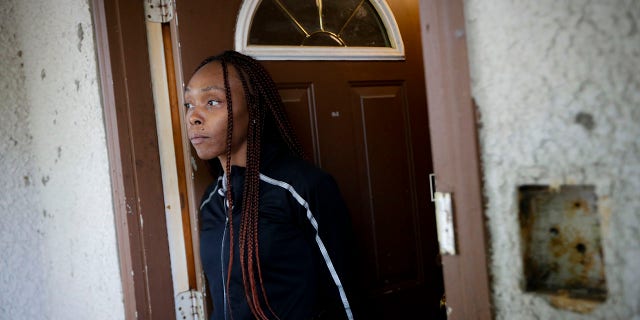
Latosha Evans, a friend of Myon Burrell who says she was with the Burrell the evening Tyesha Edwards was shot and killed at home in 2002, stands in her doorway, Wednesday, Oct. 23, 2019, in Minneapolis. (Associated Press)

Burrell was picked up four days later. He was not in a gang database, and had never been tied to a serious crime.
During the interrogation, he never asked for an attorney, but he did ask for his mother 13 times. Each time he was told, “no, not now,” though she was in a room next door.
A police officer told him that he was a huge disappointment to his mother, and that she had told officers she thought he was capable of the shooting.
“Are you kidding?” Burrell responded. “That’s a lie. ... That’s not truthful. ... I don’t believe that.”
Meanwhile, officers told his mother, falsely, that they had several eyewitnesses saying Burrell was the one and only shooter. Sinking into tears, she asked again and again to see him. “Not yet,” they said.
One month later, the day before Burrell’s indictment, his mother was driving back to Bemidji after a prison visit. She swerved off the road, crashing into a tree. The car burst into flames, killing her.
Klobuchar denied Burrell’s request to go to his mother’s funeral. He was, she said, a threat to society.
Burrell has spent most of his life in prison. He says he believes authorities knew that he was innocent all along: “They just didn’t feel like my life was worth living.”
If he had told police he was there, but had been an unwilling participant, as officers seemed to want, his nightmare might have been over by now. But he says he wants justice not just for himself, but for Tyesha. He could never admit to a crime he didn’t commit, he says.
“That’s something I struggle with to this day, you know. I coulda been home,” said Burrell. “At least I can look in the mirror and I can still be proud of who I see looking back.”
Associated Press writer Margie Mason contributed to this report.

CPAC declares Mitt Romney 'NOT invited' after Senate impeachment witness vote


The Conservative Political Action Conference (CPAC) made clear on Friday that Sen. Mitt Romney, R-Utah, who formerly won the event's straw poll in 2012, would not be welcome at the conference in February -- an apparent response to the senator's refusal to follow his party in the ongoing Senate impeachment trial of President Trump.
"The 'extreme conservative' and Junior Senator from the great state of Utah, @SenatorRomney is formally NOT invited to #CPAC2020," tweeted Matt Schlapp, who leads the organization behind CPAC.
Schlapp later told Fox News that each year, CPAC "formally disinvite[s] someone who has been particularly egregious."
"Mitt Romney deserved this [because] his Senate tenure is a waste and his vote was the latest outrage," he added.
Romney has angered some conservatives as one of the few Republicans who is openly critical of President Trump. The backlash seemed to intensify as Romney split from other Senate Republicans in calling for additional witnesses and evidence in Trump's impeachment trial.
Romney's office did not immediately responded to Fox News' request for comment.
It's unclear whether the Utah senator intended to speak at or visit CPAC, which serves as an annual gathering for conservative leaders and activists. Romney previously spoke at CPAC and served as the Republican Party's 2012 presidential nominee. Since Trump's election, he's become a symbol of the intraparty divide over Trump and the direction he's taking the party.
Before the House voted to impeach Trump, Romney derided the president's "brazen" requests for foreign nations to investigate former Vice President Joe Biden. "By all appearances, the President’s brazen and unprecedented appeal to China and to Ukraine to investigate Joe Biden is wrong and appalling," he said.
As senators deliberated impeachment, Romney said that he'd like to hear from former National Security Advisor John Bolton, who reportedly claimed that Trump explicitly conditioned Ukrainian aid on the nation's willingess to investigate the Bidens. On Friday, the Utah senator joined just one other Republican -- Sen. Susan Collins, R-Maine -- in favoring a motion to consider new witnesses and evidence. The final vote was 51-49 against the motion.
Romney's position drew mixed reactions from Republican leaders. Former New Hampshire Governor John Sununu, who previously served as a top adviser during Romney's 2012 run, panned Romney earlier this week.
“It’s disappointing because I think Mitt Romney is clearly letting his personal dislike of the president influence him more than trying to deal with [what] this country needs,” Sununu told "America's Newsroom." While appearing on "Cavuto Live" Saturday, former South Carolina Rep. Trey Gowdy seemed less critical. While Gowdy said he was "disappointed" in Romney, he would give Romney an opportunity to explain his decision.
Gowdy also praised Sen. Mike Lee, R-Utah, for defending Romney amid intense criticism of his colleague. "Mitt Romney is a good friend and an excellent Senator. We have disagreed about a lot in this trial," Lee tweeted on Friday.
"But he has my respect for the thoughtfulness, integrity, and guts he has shown throughout this process. Utah and the Senate are lucky to have him."
Fox News' Marisa Schultz and Talia Kaplan contributed to this report.

CartoonDems