DAYTONA
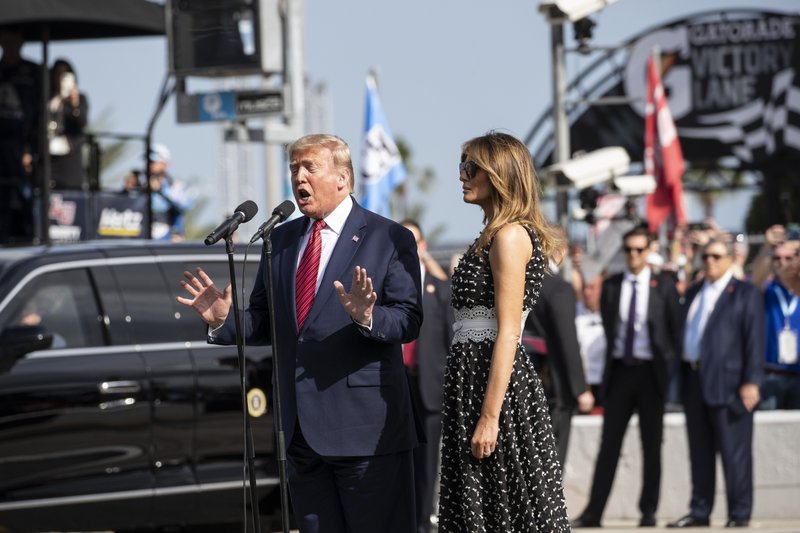
BEACH, Fla. (AP) — President Donald Trump gave an election-year embrace
to NASCAR and its fans Sunday when he became the second president ever
to attend the Daytona 500. The presidential motorcade took to the track
to join in a warm-up lap after he had told the crowd that the racers and
their teams were competing “for pure American glory.”
Following
a recitation of the opening command, “Gentleman, start your engines,″
Trump got into his black limousine for a ceremonial spin around Daytona
International Speedway. He had joked moments earlier in a Fox interview
that while as president, he was not allowed to drive his own car, ” I’m
going to hop into one of these cars and I’m going to get into this race
if possible. I love the idea.’’
Given
the honor of grand marshal for the race, Trump gave thousands of fans a
flyover of Air Force One and then rode onto the track in the
presidential motorcade as the audience roared with delight. The
motorcade took roughly a quarter lap before pulling aside in an infield
staging area.
Asked
what it was about NASCAR that he most enjoyed, the president said, ``I
think it’s really the bravery of these people. ... it takes great
courage.’’
President George W. Bush appeared at the race during his reelection year.
“For
500 heart-pounding miles these fierce competitors will chase the
checkered flag ... and make their play for pure American glory, and
that’s what it is, pure American glory,’’ Trump said before the race.
He
said the Daytona 500 was ``a legendary display of roaring engines,
soaring spirits and the American skill, speed and power that we’ve been
hearing about for so many years. The tens of thousands of patriots here
today have come for the fast cars and the world-class motorsports. But
NASCAR fans never forget that no matter who wins the race, what matters
most is God, family and country.’’
Trump’s
reelection campaign planned to run an ad during the Fox broadcast of
the race and fly an aerial banner near the speedway. About 100,000
people were expected to attend this year’s race while millions more
watched on television. About 9 million people took in last year’s race
on television.
Trump tweeted Sunday morning: “Getting ready to go to the Daytona 500. Will be GREAT!”
Trump
left at about 3:40 p.m. and returned to Washington. The race was
postponed after two lengthy rain delays totaling more than three hours.
The race will now begin at 4 p.m. Monday.
After
his return Sunday evening to Washington, Trump will embark later this
coming week on a Western state swing that will take him to rallies in
Phoenix, Las Vegas and Colorado Springs, Colorado. His Western trip
begins Tuesday in California, where he’ll attend a fundraiser in Beverly
Hills.
The trip
is another demonstration of Trump’s willingness to campaign not just in
conservative strongholds but in states that lean Democratic,
particularly Colorado, where Republican Sen. Cory Gardner faces a tough
reelection battle. Arizona is expected to be a key swing state in the
presidential election with its growing population of Hispanic voters.
CARSON
CITY, Nev. (AP) — With the Nevada caucuses less than a week away,
Democratic presidential candidates campaigning this weekend were fixated
on a rival who wasn’t contesting the state.
Bernie
Sanders, Joe Biden, Amy Klobuchar, Elizabeth Warren and Pete Buttigieg
all targeted billionaire Mike Bloomberg, accusing him of buying his way
into the election and making clear they were eager to take him on in a
debate.
“He
thinks he can buy this election,” Sanders said of the former New York
mayor at a Sunday rally in Carson City, Nevada. “Well, I’ve got news for
Mr. Bloomberg — the American people are sick and tired of billionaires
buying elections!”
Their
attacks are a sign of how seriously the field is starting to take
Bloomberg as he gains traction in the race and is on the cusp of
qualifying for Wednesday’s Democratic debate in Las Vegas. Bloomberg has
bypassed the traditional early voting states including Nevada, focusing
instead on the 14 states that vote in the Super Tuesday primary on
March 3. He has spent more than $417 million of his own
multibillion-dollar fortune on advertising nationwide, an unprecedented
sum for any candidate in a primary.
The
focus on Bloomberg comes amid anxiety among many establishment-aligned
Democrats over the early strength of Sanders, who won last week’s New
Hampshire primary and essentially tied for first place in Iowa with Pete
Buttigieg, the former mayor of South Bend, Indiana. Sanders is hoping
to notch a victory in Nevada on Saturday as moderates struggle to unite
behind a candidate who could serve as a counter to the Vermont senator,
who has long identified as a democratic socialist.
The
hundreds of millions of dollars that Bloomberg has pumped into the
Super Tuesday states has only heightened the sense of uncertainty
surrounding the Democratic race.
At
Sanders’ rally, the crowded cheered as the Vermont senator joked that
Bloomberg is “struggling, he’s down to his last $60 billion” and derided
him for skipping the early primary states.
It
marked an escalation of the salvo Sanders launched Saturday against the
former mayor, when he ticked off a litany of conservative positions
Bloomberg has taken in the past, including opposing a minimum wage hike
and his opposition to a number of Barack Obama’s policies while
president. On Saturday, Sanders suggested the former mayor’s past
conservatism and controversial comments make him a weak candidate
against President Donald Trump, charging that Bloomberg, “with all his
money, will not create the kind of excitement and energy we need” to
beat Trump.
And
on Sunday, he was joined by the current mayor of New York, Bill de
Blasio, who just this week endorsed Sanders. De Blasio introduced
Sanders with an attack of his own on his predecessor, telling the crowd,
“I’m sorry to report to you the chief proponent of stop and frisk is
now running for president.”
Klobuchar,
speaking on CBS’ “Face the Nation,” accused Bloomberg of avoiding
scrutiny by blanketing the airwaves and sidestepping debates or tough
televised interviews.
“I
think he cannot hide behind the airwaves and the money,” she said. “I
think he has to come on the shows. And I personally think he should be
on the debate stage.”
Klobuchar
said she’s raised $12 million since her better-than-expected finish in
third place in New Hampshire. She’s maintained her campaign through a
series of strong debate performances and argued that Bloomberg being on
stage with his rivals would level the playing field.
“I’m never going to beat him on the airwaves, but I can beat him on the debate stage,” she said.
Biden,
speaking on NBC’s “Meet the Press,” suggested that Bloomberg will face
increased scrutiny as the race continues, pointing to his record on
issues relating to race.
“$60 billion can buy you a lot of advertising, but it can’t erase your record,” he said.
Biden
knocked Bloomberg’s past support of stop-and-frisk policing policies
and his comments suggesting cracking down on racist mortgage lending
practices, known as “redlining,” contributed to the financial crisis, as
well as his 2008 refusal to endorse Barack Obama for president.
Bloomberg has been airing ads that tie him closely to Obama on issues
like gun control and climate change.
When
asked on MSNBC about whether Bloomberg shares the values of the
Democratic Party, Warren also went after the former mayor over his
comments on redlining, declaring that “anyone who is out there trying to
blame African Americans for the financial crash of 2008...is not
someone who should be representing our party.”
Buttigieg
likened Bloomberg to Trump when asked about reports that Bloomberg made
sexist comments towards women and fostered a culture of sexism at his
company.
“I think he’s going to have to answer for that and speak to it,” Buttigieg said.
He
later added: “Look, this is a time where voters are looking for a
president who can lead us out of the days when it was just commonplace
or accepted to have these kinds of sexist and discriminatory attitudes.
Right now, this is our chance to do something different.”
But
even as the front-running candidates kept one eye on their Super
Tuesday showdown with Bloomberg, they also focused on the more immediate
task of winning over minority voters, who will play a pivotal role in
the contests in Nevada and South Carolina.
Biden
reminded older parishioners at the First African Methodist Episcopal
Church in North Las Vegas of 1960s television footage of black
protesters in Birmingham, Alabama, being attacked by police dogs and
sprayed with fire hoses on the orders of city official Bull Connor.
Biden
said today’s racists are not “Bull Connors, not out in overalls.
They’re wearing fine suits, and they’re living in the White House.”
The
former vice president is relying on his strength among black voters and
an explicit appeal to Latinos and other minorities to deliver him a
strong showing in the coming contests after posting disappointing
finishes in Iowa and New Hampshire, which both feature electorates that
are whiter on average than the national population.
Biden
has been hammering home the need for any Democratic candidate to appeal
to voters of color. On Sunday, he told black lawmakers and other
political figures at the Nevada Black Legislative Caucus’s Black History
Month observance that “the black community has in its power to
determine who the next president of the United States is going to be.”
Nevada
and South Carolina are also a key test for Buttigieg and Klobuchar, who
have thus far ridden on momentum from stronger-than-expected finishes
in Iowa and New Hampshire, respectively, but have both faced questions
about their appeal to minority voters.
On
Sunday, when asked to name a mistake he had made as mayor, Buttigieg
acknowledged that he failed to recognize the pain that his decisions
made, particularly for communities of color.
“I
was laser-focused on making sure we did the right thing legally ... I
didn’t always hear the voices who were talking about the story behind
the story,” Buttigieg said. “I was a data guy.”
Later
that day, at a luncheon for the Nevada Legislative Black Caucus,
Buttigieg said he was proud of his work with black leaders in his city
to deliver affordable housing and improve the black unemployment rate,
but he said he was “humbled by the work left to do.”
___
Jaffe
reported from Washington. Associated Press writers Jonathan Cooper and
Bill Barrow in Las Vegas contributed to this report.
LAS
VEGAS (AP) — A growing number of Democratic lawmakers, union officials,
state leaders and party strategists agree that Bernie Sanders is a
risky nominee to put up against President Donald Trump. There’s less
agreement about whether — and how — to stop him.
Critics
of the Vermont senator, who has long identified as a democratic
socialist, are further than they’ve ever been from unifying behind a
moderate alternative. None of the viable centrists in the race is eager
to exit the campaign to clear a path for a candidate to become a clear
counter to Sanders. And Sanders is looking to Saturday’s Nevada caucuses
to post another win that would further his status as an early
front-runner.
With
fear and frustration rising in the party’s establishment wing, a
high-stakes math problem is emerging. It could be impossible to blunt
Sanders as long as a trio of moderate candidates — former South Bend,
Indiana, Mayor Pete Buttigieg, former Vice President Joe Biden and
Minnesota Sen. Amy Klobuchar — stay in the race. And with former New
York Mayor Mike Bloomberg pumping hundreds of millions of dollars into
the swath of states that vote on Super Tuesday, March 3, the effort to
stop Sanders will become even more challenging when the campaign goes
national next month.
“You
see this tremendous angst in the party — ‘What are we going to do?’”
said Terry McAuliffe, a former Virginia governor who was also chairman
of the Democratic National Committee. “We need to unify as fast as we
can.”
The dynamic is complicated because each of the major moderate candidates has glaring vulnerabilities.
Biden
began the campaign as a front-runner, but the aura around his operation
took a hit after a fourth-place finish in Iowa gave way to a
fifth-place finish in New Hampshire. Buttigieg has proved to be the most
effective centrist in raising money from the party’s traditional
high-dollar donors, which puts him in a strong position to compete in an
expensive national contest. But the 38-year-old faces linger questions
about his experience and his ability to win support from black and
Latino voters, a challenge that could come into greater focus if
Buttigieg loses badly in Nevada and South Carolina.
Kloubchar
is newly emboldened after a third-place finish in New Hampshire, but
she too has little support among minority voters and has largely run a
bare-bones campaign operation.
“When
you have three or four candidates in that same lane, math becomes a
problem,” said Harold Schaitberger, general president of the
International Association of Firefighters and a Biden loyalist, who
admits being “disappointed” by Biden’s bad performances and Sanders’
rise.
Though the opening contests of the primary have only begun, time may quickly run out for a moderate alternative to emerge.
By
the end of Super Tuesday, more than one third of all delegates will be
awarded. Should Sanders build a significant delegate lead — and his
strength in California alone makes that possible — it would be very
difficult for any other candidate to catch him in the slew of
state-by-state elections that follow based on the way delegates are
apportioned.
“We
have a lot of good candidates, but in general we’re incredibly
frustrated that the field hasn’t winnowed,” said Robert Wolf, a major
fundraiser for Barack Obama, who said he has donated money this cycle to
more than a dozen Democrats. Sanders is not one of them.
The
situation is similar to the Republican primary in 2016, when several
anti-Trump alternatives divided their party’s moderate vote and allowed
Trump to become the nominee despite failing to win a majority of the
vote in early primary contests.
There
is no significant movement in the works to stop Sanders. And so long as
there are a half-dozen viable candidates in the race, it may not matter
if there were.
Sanders’
team expects his Democratic critics and their allies to intensify their
attacks in the coming weeks, although they suggest time may be on their
side with Super Tuesday just two weeks away. If Sanders comes out of
Super Tuesday with a 100-delegate lead, which is possible based on his
popularity in California alone, they believe it would be virtually
impossible for anyone to catch up before the party’s national convention
in July.
Sanders
was showing new signs of confidence as he campaigned over the weekend
in Nevada ahead of the state’s caucuses next Saturday. Rallying
supporters in Carson City on Sunday, he declared he could win Nevada,
then California and the Democratic nomination and highlighted attempts
from his rivals in both parties to stop him.
“I’ve
been attacked by the media establishment, I’ve been attacked by the
corporate establishment, I’ve been attacked by the Republican
establishment, I’ve been attacked by the Democratic establishment, and
they’re nervous,” Sanders said.
Sanders
told The Associated Press last week that he was ramping up his outreach
to other lawmakers and party officials who have been skeptical of his
White House bid, although he offered no details. The senator has also
agreed to host at least two fundraisers for the Democratic National
Committee, which he had previously resisted.
Asked about the response he was getting to the establishment outreach, Sanders said: “I think we’re going to do just fine.”
Yet
as Sanders’ strength grows in the early voting states, there is no
evidence that his standing is improving among the party’s skeptical
political class. Several elected officials in recent days have raised
concerns about his ability to beat Trump and his impact on other
Democrats running for election this fall.
The competition for endorsements helps tell the story of the moderate muddle.
Since
Biden’s underwhelming finish in Iowa, Sanders hasn’t received a single
congressional endorsement. Buttigieg and Klobuchar, who have shown some
strength on the campaign trail, have earned just one congressional
endorsement each.
Over
that same time, at least seven congressional endorsements have gone to
Bloomberg, a 78-year-old former Republican who is threatening to become a
top-tier candidate even after skipping all four February primary
contests.
Steve
Shurtleff, a Biden backer and the speaker of the New Hampshire House of
Representatives, believes Buttigieg and Klobuchar are the new leaders
in the party’s moderate wing, while Bloomberg is making a case.
As
for Sanders, Shurtleff noted that most New Hampshire voters supported
somebody else. Indeed, Sanders won last week’s primary with just 26% of
the vote, a low bar made possible because his moderate alternatives
split up the rest of the electorate.
“It’s very crowded in that lane,” Shurtleff said. “It’s really kind of a conundrum.”
Just don’t ask any of Sanders’ rivals to step aside.
An
energized Klobuchar said in an interview that her third-place finish in
New Hampshire left her “as scrappy as I was when I started.”
She
shrugged off any concerns about moderates dividing the vote. And she
highlighted her strengths in Nevada, where she and Biden earned the
endorsement of the state’s largest newspaper and may benefit from the
success of female candidates. Both of the state’s U.S. senators are
women and the state legislature is majority female.
“I don’t think it’s as simple as two lanes,” she said in an interview. “Everyone brings something else to this.”
___
Fram
reported from Washington. Associated Press writers Lisa Mascaro in
Washington and Nicholas Riccardi in Carson City, Nevada, contributed to
this report.
Both State Department-chartered flights carrying Americans from the coronavirus-infected Diamond
Princess cruise ship arrived in the U.S overnight. The first plane
touched down at Travis Air Force Base in California just before
11:30 p.m. local time. The second flight landed at Lackland Air Force
Base in Texas roughly 2 1/2 hours later. Hundreds of American passengers who had been quarantined on the cruise ship left Japan Monday
on two planes en route to the United States -- with 14 of the
passengers infected and isolated in a "specialized containment area."
It's not clear which flight the infected were on. "During the
evacuation process, after passengers had disembarked the ship and
initiated transport to the airport, U.S. officials received notice that
14 passengers, who had been tested 2-3 days earlier, had tested positive
for COVID-19. These individuals were moved in the most expeditious and
safe manner to a specialized containment area on the evacuation aircraft
to isolate them in accordance with standard protocols," the U.S.
Department of State said in a release. "After
consultation with [Health and Human Services] HHS officials, including
experts from the HHS Office of the Assistant Secretary for Preparedness
and Response, the State Department made the decision to allow the 14
individuals, who were in isolation, separated from other passengers, and
continued to be asymptomatic, to remain on the aircraft to complete the
evacuation process," it added. The 46 Americans who tested
positive on the cruise ship were told to remain in Japan to be treated
for the virus that has killed an estimated 1,765 people and infected
more than 70,000 globally, according to Princess Cruise media relations.
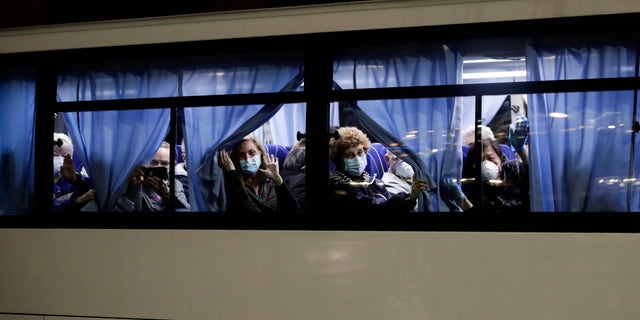
Buses had transported U.S passengers -- with the assistance of Japanese
troops -- from the ship to Haneda Airport in Tokyo.
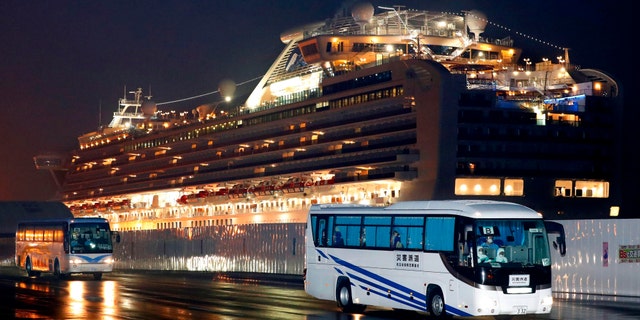
Buses carrying passengers from the quarantined Diamond Princess
cruise ship leaving a port in Yokohama on Monday. (AP Photo/Jae C. Hong)
Health officials said they screened all passengers
prior to boarding the flights and no symptomatic or infected travelers
were allowed onboard. So far, 355 people have tested positive for the virus on the Diamond Princess after doctors found 67 new cases Sunday.
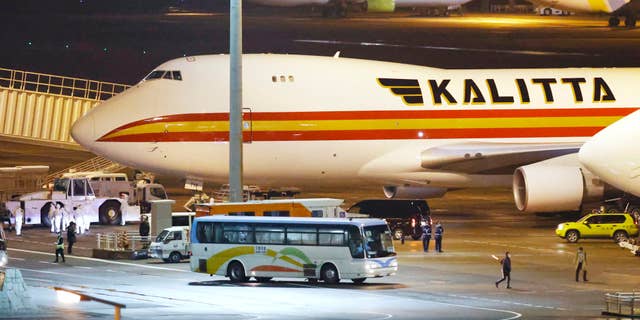
An airplane chartered by the U.S. government taking off at Haneda
Airport in Tokyo with U.S. passengers who were aboard the quarantined
cruise ship. (Sadayuki Goto/Kyodo News via AP)
About 380 Americans and family members were on the
ship when it was quarantined on Feb. 5. It's unclear exactly how many
U.S. citizens have tested positive for the virus other than the 46
reportedly infected. "All
travelers on these flights were screened for symptoms prior to
departure and will be subject to [the] Centers for Disease Control (CDC)
screening, health observation, and monitoring requirements. Only those
who were asymptomatic were allowed to board the flights," a State
Department spokesperson said.
A bus carrying U.S. passengers who were aboard the quarantined
cruise ship the Diamond Princess arriving at Haneda Airport in Tokyo.
(Sadayuki Goto/Kyodo News via AP)
Passengers were quarantined for 14 days on the ship,
which is considered the virus's incubation period. They are expected to
be quarantined for 14 additional days upon arrival at either base. The
bases in California and Texas were selected to ensure facilities were
available immediately to treat their medical needs, according to the
U.S. Embassy in Toyko.
Buses carrying U.S. passengers who were aboard the quarantined
cruise ship the Diamond Princess, seen in the background. (Jun
Hirata/Kyodo News via AP)
The chartered flights were the only opportunities for passengers to fly to the U.S until March 4, embassy officials said. The remaining passengers are expected to depart the ship this coming Wednesday. Fox News' Vicki Choi and Rich Edson contributed to this report.
PORTLAND,
Ore. (AP) — The Bureau of Land Management has announced plans to fund
11,000 miles (17,703 kilometers) of strategic fuel breaks in Idaho,
Oregon, Washington, California, Nevada and Utah in an effort to help
control wildfires.
The
fuel breaks are intended to prop up fire mitigation efforts and help
protect firefighters, communities and natural resources, The Oregonian reported Saturday.
According
to the BLM, wildfires are becoming bigger and more frequent across the
Great Basin states. Between 2009 and 2018, more than 13.5 million acres
of BLM land burned in the project area.
“Recovering
from the devastating effects of wildfires can take decades in the
rugged, high-desert climate of the Great Basin. These tools will help
firefighters contain fires when they break out,” said acting Assistant
Secretary of the Interior for Land and Minerals Management Casey Hammond
in a news release. “That’s why creating fuel breaks is incredibly
important to the entire basin, the people who live in these communities,
and our wildland firefighters.”
Fuel
breaks are intended to break up fire fuels by creating breaks in
vegetation that slow a blaze’s progress. By implementing them
strategically, they help firefighters control the spread of fire, and
can protect homes and resources.
Some scientists debate the effectiveness of fuel breaks, raising questions about whether these efforts are worth funding.
But
the BLM reports that assessments of more than 1,200 fuel breaks found
that 78% of them helped control wildfire and 84% helped change fire
behavior. According to the news release, “the BLM has extensively
documented that fuel breaks, and other types of fuel treatments, are
effective.”
Jennifer
Jones, a spokeswoman for the BLM, said the program will help streamline
the implementation process by reducing or eliminating the need for
environmental analysis.
The timeline for implementation and the location of fuel breaks will depend on what offices develop plans and apply for funding.
Because BLM offices have not requested funds, said Jones, the BLM can’t provide a figure for what the plan will cost.
“Costs
will depend on how many fuel breaks are actually constructed, what
types of fuel breaks are constructed, where they are constructed,
whether they are constructed by employees or contractors,” Jones said.
The public can comment on the plan for the next 30 days, after which the BLM will make final decisions.
BEIJING
(AP) — A recent speech by Chinese President Xi Jinping that has been
published by state media indicates for the first time that he was
leading the response to a new virus outbreak from early on in the
crisis.
The
publication of the Feb. 3 speech was an apparent attempt to demonstrate
that the Communist Party leadership had acted decisively from the
beginning, but also opens Xi up to criticism over why the public was not
alerted sooner.
In
the speech, Xi said he gave instructions on fighting the virus on Jan. 7
and ordered the shutdown that began on Jan. 23 of cities at the
epicenter of the outbreak. His remarks were published by state media
late Saturday.
“On
Jan. 22, in light of the epidemic’s rapid spread and the challenges of
prevention and control, I made a clear request that Hubei province
implement comprehensive and stringent controls over the outflow of
people,” Xi told a meeting of the party’s standing committee, its top
body.
The number
of new cases in mainland China fell for a third straight day, China’s
National Health Commission reported Sunday. The 2,009 new cases in the
previous 24-hour period brought the total to 68,500.
Commission
spokesman Mi Feng said the percentage of severe cases has dropped to
7.2% of the total from a peak of 15.9% on Jan. 27. The proportion is
higher in Wuhan, the Hubei city where the outbreak started, but has
fallen to 21.6% from a peak of 32.4% on Jan. 28.
“The national efforts against the epidemic have shown results,” Mi said at the commission’s daily media briefing.
China
reported 142 more deaths, almost all in Hubei, raising the mainland
China death toll to 1,665. Another 9,419 people have recovered from
COVID-19, a disease caused by a new coronavirus, and have been
discharged from hospitals.
Four people have died outside of mainland China, as the virus has spread to more than two dozen countries.
Japanese
Prime Minister Shinzo Abe convened an experts meeting to discuss
measures to contain the virus in his country, where one person has died
and more than a dozen cases emerged in the past few days without any
obvious link to China.
“The situation surrounding this virus is changing by the minute,” Abe said.
About
400 Americans on a quarantined cruise ship in Japan were awaiting
charter flights home, as Japan announced another 70 infections had been
confirmed on the Diamond Princess. Canada, Hong Kong and Italy said they
were planning similar flights.
Xi’s
role was muted in the early days of the epidemic, which has grown into
one of the biggest political challenges of his seven-year tenure.
The
disclosure of his speech indicates top leaders knew about the
outbreak’s potential severity weeks before such dangers were made known
to the public. It was not until late January that officials said the
virus can spread between humans and public alarm began to rise.
Zhang
Lifan, a commentator in Beijing, said it’s not clear why the speech was
published now. One message could be that local authorities should take
responsibility for failing to take effective measures after Xi gave
instructions in early January. Alternatively, it may mean that Xi, as
the top leader, is willing to take responsibility because he was aware
of the situation, Zhang said.
Trust
in the government’s approach to outbreaks remains fractured after the
SARS epidemic of 2002 and 2003, which was covered up for months.
Authorities
in Hubei and Wuhan faced public fury over their initial handling of the
epidemic. Wuhan on Jan. 23 became the first city to impose an
unprecedented halt on outbound transportation, a measure since expanded
to other cities with a combined population of more than 60 million.
The
anger reached a peak earlier this month following the death of Li
Wenliang, a young doctor who was reprimanded by local police for trying
to spread a warning about the virus. He ended up dying of the disease
himself.
In apparent response, the Communist Party’s top officials in Hubei and Wuhan were dismissed and replaced last week.
Even
as authorities have pledged transparency through the current outbreak,
citizen journalists who challenged the official narrative with video
reports from Wuhan have disappeared and are believed to be detained.
The
fall in new cases follows a spike of more than 15,000 on Thursday, when
Hubei began to include cases that had been diagnosed by a doctor but
not yet confirmed by laboratory tests.
Overwhelmed
by the number of suspected cases, the province has not been able to
test every person exhibiting symptoms. The clinical diagnosis is based
on doctors’ analyses and lung imaging and is intended to allow probable
cases to be treated as confirmed ones without the need to wait for a lab
result.
About
400 Americans aboard the cruise ship docked at Yokohama, near Tokyo,
were told to decide whether to stay or take chartered aircraft arranged
by the U.S. government to fly them home, where they would face another
14-day quarantine. Those going were to begin leaving the ship Sunday
night. People with symptoms were to be banned from the flights.
About
255 Canadians and 330 Hong Kong residents are on board the ship or
undergoing treatment in Japanese hospitals. There are 35 Italians, of
which 25 are crew members, including the captain. The 70 new cases on
the Diamond Princess raised the number of infected to 355.
American
passenger Matthew Smith told The Associated Press that he and his wife
were not taking the flights, because the 14-day quarantine for the ship
is set to end on Wednesday. The evacuees will be taken to Travis Air
Force Base in California, with some continuing to Lackland Air Force
Base in Texas.
Malaysia
said it would not allow any more passengers from another cruise ship to
transit the country after an 83-year-old American woman from the MS
Westerdam tested positive for the virus.
She
was among 145 passengers who flew from Cambodia to Malaysia on Friday.
Her husband also had symptoms but tested negative for the virus. The
Westerdam was turned away from four ports around Asia before Cambodia
allowed it to dock in Sihanoukville late last week.
Malaysian
Deputy Prime Minister Wan Azizah Wan Ismail said that her country would
bar cruise ships that came from or transit any Chinese ports from
docking.
Cambodia said earlier that all 1,455 passengers on the Holland America-operated ship had tested negative for the virus.
___
Associated
Press writer Ken Moritsugu and researcher Henry Hou in Beijing and
writers Yuri Kageyama and Mari Yamaguchi in Tokyo, Eileen Ng in Kuala
Lumpur, Malaysia, Sopheng Cheang in Phnom Penh, Cambodia, Frances
D’Emilio in Rome and Rob Gillies in Toronto contributed to this report.
JERUSALEM
(AP) — U.S. Secretary of State Mike Pompeo on Thursday said he is
“outraged” by the U.N.’s publication of a list of companies accused of
violating Palestinian human rights by operating in Israel’s West Bank
settlements.
In a
statement, Pompeo said the list supports a Palestinian-led boycott
movement and “delegitimizes” Israel. He urged other countries to join
the U.S. in rejecting the effort.
“The
United States has long opposed the creation or release of this
database,” Pompeo said. “Its publication only confirms the unrelenting
anti-Israel bias so prevalent at the United Nations.”
The
database, released Wednesday after years of delays, listed 112
companies that the U.N. human rights office said are complicit in rights
violations by bolstering Israeli settlements in the occupied West Bank
and Israeli-annexed east Jerusalem.
The
list is dominated by Israeli companies, including major banks,
construction companies, supermarkets and gas stations. But it also
includes a number of global brands, including American firms Airbnb,
General Mills and Motorola Solutions.
The
Palestinians seek the West Bank and east Jerusalem — captured by Israel
in the 1967 Mideast war — as parts of an independent state, and the
vast majority of the world considers Israeli settlements to be illegal.
President
Donald Trump, however, has taken a more lenient position, tolerating
continued Israeli settlement construction and releasing a Mideast plan
last month that envisions giving Israel permanent control over all of
its settlements.
The
U.N. list does not impose any penalties on the companies or accuse them
of acting illegally. Instead, it appears to be aimed at pressuring them
into changing their business practices by drawing negative attention to
their ties to a contentious Israeli policy.
Israel denounced the list and accused the U.N. rights office of collaborating with the boycott movement in compiling the names.
The
BDS movement promotes boycotts, sanctions and divestment against Israel
in a nonviolent campaign that it says is aimed at defending Palestinian
rights.
Israel
says the movement seeks the country’s destruction and accuses it of
anti-Semitism — a charge that BDS leaders vociferously reject.
President
Donald Trump, accompanied by first lady Melania Trump, steps off Air
Force One at the Palm Beach International Airport, Friday, Feb. 14,
2020, in West Palm Beach, Fla. (AP Photo/Alex Brandon)
PALM
BEACH, Fla. (AP) — President Donald Trump mixed reelection business
with pleasure during a weekend stop at his Mar-a-Lago resort in Florida,
attending a fundraiser on Saturday evening expected to raise $10
million for his campaign and the Republican National Committee.
The
event was believed to be his most expensive fundraiser ever, with
invitations going to donors who gave $580,600 per couple, according to
The Washington Post, which obtained an invitation to the event at the
Palm Beach estate of billionaire investor Nelson Peltz.
Pro-Trump groups have been shattering fundraising records on the path toward a goal of raising $1 billion this election cycle.
Advocacy
groups that have sought campaign finance reform said the Supreme Court
paved the way for such fundraising hauls by striking down in 2014 the
limit on the total amount of money an individual could give to all
political party committees in a two-year election cycle.
“The
ability of Trump to raise these astronomical amounts of influence money
from billionaires and multimillionaires is a direct result of the
Supreme Court’s utter failure to understand the nation’s campaign
finance laws or the implications of its decision,” said Democracy 21
President Fred Wertheimer in an op-ed published in Medium.
In
that 5-4 decision the Supreme Court found that limits on the total
amount of money donors can give to all candidates, committees and
political parties were unconstitutional.
Sen.
Bernie Sanders has criticized some of his fellow Democratic
presidential candidates for accepting campaign donations from the
extremely wealthy, questioning whether those who accept the donations
would stand up to those who provide them if the situation called for it.