FILE
- In this May 4, 2018, file photo, a man walks past a branch of HSBC
bank in Hong Kong. Europe's biggest bank has reported that its net
profit fell 53% in 2019 to $6 billion. London-based HSBC, whose profit
is mainly from Asia, said it plans to revamp its U.S. and European
business and shed $100 billion in assets to improve its profitability.
(AP Photo/Kin Cheung, File)
HSBC
bank said Tuesday it will shed some 35,000 jobs as part of a deep
overhaul to focus on faster-growing markets in Asia and better cope with
a slew of global uncertainties.
The
interim chief executive, Noel Quinn, said the number of people employed
by the bank would fall from 235,000 to 200,000 in the next three years.
But he said that some of the reductions would come from attrition as
opposed to outright cuts.
Quinn
said his team is already carrying out his plans. The restructure
involves “consolidating” of some parts of the business and “reorganising
the global functions and head office.’’
In August, the company announced 4,700 job cuts from a workforce of 238,000 at the time.
The
bank, which is headquartered in London but makes most of its money in
Asia, reported that its net profit fell 53% in 2019 to $6 billion.
It said that it plans to revamp its U.S. and European business and shed $100 billion in assets to improve its profitability.
The
bank said the virus outbreak that began in China has caused a
“significant disruption” for its staff, suppliers and customers,
especially in the Chinese mainland and in Hong Kong.
“Depending
on how the situation develops, there is the potential for any
associated economic slowdown to impact our expected credit losses in
Hong Kong and mainland China,” the bank said in a statement. “Longer
term, it is also possible that we may see revenue reductions from lower
lending and transaction volumes, and further credit losses stemming from
disruption to customer supply chains. We continue to monitor the
situation closely,” it said.
HSBC’s revenue rose 5.9% in 2019 to $55.4 billion.
The
sharp drop in 2019 profit reflected slower economic activity but also a
$7.3 billion write-down for HSBC’s Global Banking and Markets and
Commercial Banking divisions in Europe. Pretax profit fell 33%, to $13.3
billion. HSBC reported $12.6 billion in net profit in 2018.
HSBC said months’ long protests in Hong Kong also weighed on the local economy and caused disruptions to the bank’s business.
The
bank has been carrying out a corporate overhaul designed to boost
profitability by focusing on high-growth markets in Asia while shedding
businesses and workers in other countries.
“Our
immediate aims are to increase returns, create the capacity to invest
in the future, and build a platform for sustainable growth,” the bank’s
group CEO, Noel Quinn, said in the statement.
The
bank said it would shrink its sales and trading and equity research in
Europe and shift resources to Asia. In the U.S., HSBC plans to grow its
international-client corporate banking business.
The
restructuring is expected to cost $6 billion, with another $1.2 billion
for asset sales, mainly in 2020 and 2021, the bank said.
WASHINGTON (AP) — Karen Pence has no shortage of projects.
The
wife of Vice President Mike Pence promotes the healing power of art
therapy and help for military spouses. She’s into honeybees and supports
sister cities. She’s a watercolorist who designs the family’s annual
Christmas card and teaches art at a religious elementary school.
Now,
she’s beginning to campaign on her own to help win a second term for
President Donald Trump and her husband. And with first lady Melania
Trump largely avoiding the political scene, the campaign sees Mrs. Pence
as an asset in one of the areas where they most need help — with
suburban woman.
“I
just feel like I want to do my part,” Mrs. Pence told The Associated
Press in an interview shortly before she took a solo trip home to
Indianapolis to add the Trump-Pence ticket to the ballot for the state’s
Republican presidential primary in May. Mike Pence is a former Indiana
governor.
“This
is so exciting for me,” she told supporters at the Indiana Statehouse.
“Under the leadership of President Trump and Vice President Pence — I
have to put his name in there, too — we are getting things done.”
Her
pitch includes highlighting economic gains under Trump, including
historically low unemployment, along with tax cuts, the creation of
“opportunity zones” to lure investment to low-income neighborhoods
across the U.S., deregulation and trade policy.
Mrs. Pence told AP she sees her role as “telling the story. Promises made, promises kept.”
Over
the past several months, she’s told that story at a “Latinos for Trump”
event in Las Vegas and a “Women for Trump” gathering in St. Paul,
Minnesota. Trump narrowly lost Nevada and Minnesota in 2016.
The
day after the Indiana stop, she flew to New Hampshire to help rev up
Trump supporters before the president arrived a few days later for a
campaign rally on the eve of the state’s first-in-the-nation
presidential primary.
“Whatever
you’re doing, we need you to do more, and whatever you’re giving, we
need you to give more,” she told the crowd at a Nashua hotel. “We need
four more years of President Donald Trump.”
Karen
Pence is no stranger to the campaign trail. Mike Pence represented
Indiana in the U.S. House for six terms before he was elected governor
and later joined Trump’s ticket.
But
the 63-year-old mother of three did little campaigning for Trump after
he brought Mike Pence onto the ticket. An evangelical Christian, she was
said to have been turned off by Trump’s past personal behavior,
including hearing him talk on a years-old audiotape that surfaced before
the November 2016 election about grabbing women by their private parts.
Aides say Mrs. Pence supports Trump, and that claims suggesting otherwise are false.
Mike
Pence, meanwhile, is seen as harboring ambitions to succeed Trump as
the GOP presidential nominee in 2024, and having his wife, who is also
one of his closest advisers, publicly advocate for him could aid in such
efforts. It could help boost her profile, too.
“The
only time that she gets much attention nationally is in reference to
her husband and their relationship,” said Tammy Vigil, a Boston
University communications professor who studies women as political
communicators. “She could definitely improve her image by being active
and going on her own.”
Mrs.
Pence drew some criticism last year after she resumed teaching art
part-time at a Christian school that bars lesbian and gay students and
teachers. She had taught at the Northern Virginia school when Mike Pence
was a member of Congress. Her husband pushed back against the critics
by saying that “attacking Christian education” was offensive.
The Trump campaign calls Mrs. Pence a “tremendous asset.”
“She
knows how to appeal to key conservative and suburban voters, relates
closely to the Midwestern voting bloc that Republicans need to win the
race, and is eager to explain why the president and vice president
deserve reelection,” said campaign spokesman Jon Thompson.
Mrs.
Pence is also deeply involved in another campaign, one to help educate
military spouses about resources to help them cope with lengthy
deployments, frequent moves or other issues specific to their
experiences.
She
and Leah Esper, the wife of Defense Secretary Mark Esper, have begun
monthly visits to military bases to meet with spouses. Their first stop
was North Carolina’s Camp Lejeune in January.
“I
think for them to see both of us, it was really special,” Karen Pence
told AP in her second-floor office in the Eisenhower Executive Office
Building on the White House grounds.
She
has personal experience with military spouse issues. Her son, Michael,
is a Marine Corps pilot. His wife, Sarah, accompanied Mike and Karen
Pence on a recent trip to Israel and Rome.
Karen Pence is carrying out her myriad responsibilities with a slightly updated image.
Below-the-shoulder
locks have replaced the tight bob and bangs she sported at the dawn of
the administration. She’s noticeably thinner, too, with credit going to
an exercise regimen that includes using weights and pulleys, along with
apps to aid calorie counting.
She hasn’t cut anything out of her diet. “I just have cut back,” she said.
So
exactly how many pounds did Karen Pence drop from her 5-foot-2 frame?
She said only that it took her six months to a year to shed it.
“I would say that I’ve kept 10 off,” she added. “Let’s put it that way.”
___
Associated Press writer Tom Davies in Indianapolis contributed to this report.
Let’s start with Operation Ajax. It
was 1953. The United States, working with British intelligence,
overthrew democratically-elected Iranian Prime Minister Mohammad
Mosaddegh in favor of Mohammad Reza Pahlavi, the “Shah of Iran.” The
CIA-engineered coupe d’état marked the first time the U.S. used covert
means to undercut the leadership of another country. U.S. intelligence
services dubbed the mission “Operation Ajax.” It should surprise no one that the American encroachment had a lot to do with oil. Toppling Pahlavi came back to bite the U.S. during the 1979 Revolution in Iran.
Iranians ran the Shah off, seized the U.S. Embassy in Tehran and took
52 Americans hostage for 444 days. Things haven’t gone well for the U.S.
with Iran since. The
expression “the enemy of my enemy is my friend” comes to mind as the
U.S. backed Iraq in a lengthy war it waged with Iran in the 1980s. The
U.S. and other western nations sent significant monetary support to
Baghdad to fuel the fight against Iran. The west also dispatched guns,
helicopters and missiles. U.S. intelligence services helped bolster Iraq
track Iranian troops. President Reagan boasted that the U.S. “would do whatever was necessary to prevent Iraq from losing” to Iran. Tensions
between the U.S. and Iran escalated in 1987 and 1988. The U.S. began
reflagging Kuwaiti tankers navigating the Persian Gulf and Straits of
Hormuz. The U.S. Navy
escorted the ships to protect them from attacks by Iranian forces. The
U.S. skirmished with the Iranian military on several occasions – leading
to the deployment of the U.S.S. Vincennes in the spring of 1988. That
July, the Vincennes mistook the flight of a passenger jet for an Iranian
F-14 Tomcat. As a result, the Vincennes fired two missiles at the
airliner, killing nearly 300 passengers and crew on board. The
U.S. has been involved in formal wars in the Persian Gulf and nearby
neighborhoods since 1991. It started with Congressional authorization
for the Gulf War. Congress approved a broader “Authorization for Use of
Military Force” (AUMF) in 2001, shortly after 9/11. That measure
greenlighted the deployment of U.S. military personnel to Afghanistan
and elsewhere to wage “the war on terror.” Then came a 2002
Congressional blessing for the 2003 war in Iraq. The U.S. is still
fighting in Iraq and Afghanistan – and all over the world - as a result
of the 2001 and 2002 AUMFs. But Congress has never specifically
authorized any attack against Iran. Things got murkier earlier this
winter when President Trump ordered a strike to kill Iranian General Qassem Soleimani – in Iraq. Sen.
Tim Kaine, D-Va., has tried for years to revamp the 2001 and 2002
authorizations which the administrations of Presidents George W. Bush, Barack Obama and Donald Trump
used to rationalize military intervention in a host of locales. Kaine
and lawmakers from both parties contend the old authorizations are
outmoded. Concern about the calcified authorizations grew after Trump
called in the Soleimani strike. After that operation, Sen. Mike Lee,
R-Utah, trashed the administration for delivering what he characterized
as the “worst” briefing he’d witnessed since coming to Washington. “They
were in the process of telling us that we need to be good little boys
and girls and run along and not debate this in public,” excoriated Lee.
“I find that absolutely insane. I think it’s unacceptable.” Lee
pressed Trump Administration officials for what they would see as a
circumstance where they would have to ask Congress for a war declaration
or an AUMF for Iran. “’I’m sure we can think of something,’” one of the briefers told inquisitive lawmakers, according to Lee. Over
time, various administration officials and President Trump said the
U.S. was justified in killing Soleimani because he posed an imminent
threat. Late last week, House Foreign Affairs Committee Chairman Eliot
Engel, D-N.Y., blasted the administration for sending a report to
Congress accounting for the legal justifications for knocking off
Soleimani. But Engel said “the administration’s explanation in this
report makes no mention of any imminent threat.” Engel called the Trump
Administration’s accounting of the episode “spurious” and asked Secretary of State Mike Pompeo to testify on Feb. 28 “about war powers.” As
this unfolded, Kaine and others prepared a war powers resolution
regarding Iran. Kaine’s measure would specifically limit potential U.S.
military engagement in Iran to a month – unless Congress expressly signs
off on additional fighting. The Senate approved the package late last
week 55-45. All 47 Senate Democrats voted aye, joined by eight GOP
senators: Sens. Susan Collins, R-Maine, Rand Paul, R-Ky., Jerry Moran,
R-Kan., Lisa Murkowski, R-Ark., Bill Cassidy, R-La., Todd Young, R-Ind.,
Lamar Alexander, R-Tenn., and Lee. “Clearly the resolution is
not ready for prime time,” chastised Senate Majority Leader Mitch
McConnell, R-Ky., describing it as “deeply flawed on a number of
levels.” Sen. Marco Rubio, R-Fla., said proponents of Kaine’s plan
hoped to curb a war scenario with Iran. But Rubio believed adoption of
the measure “potentially increases the chances of war.” Rubio said he didn’t question the motives of Kaine and other senators who supported the resolution. “The
problem is that their intentions and how this will be perceived,” said
Rubio. He said that Iran would interpret the resolution as hemming in
President Trump at a time of anxiety in the region. Florida’s senior
senator worried about the Senate undercutting the chief executive. Still,
the Senate adopted Kaine’s resolution, which some characterized as a
bipartisan rebuke of the president. The measure now goes to the House.
Lawmakers there likely will approve the package as well. “Congress
has a role to play,” said House Speaker Nancy Pelosi, D-Calif., when it
comes to war and peace. “We want to do it in a way that does not
eliminate the power of declaring war from the Congress of the United
States.” But neither the House nor Senate have two-thirds to override a potential veto by the president. Even
so, supporters of the plan note that President Trump has said
repeatedly he wants to end U.S. involvement in “endless wars.” Shortly
after the Senate closed the war powers vote, Senate Minority Leader
Chuck Schumer, D-N.Y., said the resolution showed that “no president can
sidestep Congress.” He added that presidents “cannot plunge the United
States into an endless conflict in the Middle East.” The U.S. is
technically not engaged in hostilities with Iran. But the United States
and Iran have waged a sort of “cold” war against one another since
Operation Ajax. By the same token, the U.S. has fought in the Middle
East, Iraq and Afghanistan for decades. It’s unfurled Congressional
justifications for doing so which date back years. The circumvention of
Congress continues. And, despite the vote, presidents can still plunge
“the United States into an endless conflict in the Middle East.” The
U.S. is already there. Things aren’t changing any time soon. This
is ironic. At the Constitutional Convention in Philadelphia in 1787,
the Founders ultimately decided to award the power “to declare war” to
Congress. The thinking was that it should be hard to get into war – but
easier to make peace. But here, the opposite appears to be true.
Harvard Law Professor Alan Dershowitz said Sunday he has proof that former President Barack Obama "personally asked" the FBI to investigate someone "on behalf of George Soros," the liberal billionaire megadonor. Dershowitz's claim came soon after Attorney General Bill Barr openly asked President Trump to stop tweeting about ongoing Justice Department matters, saying it made it "impossible"
to do his job. Barr, who also maintained that Trump never personally
intervened in a criminal matter, was hit last week by a letter from
former DOJ officials organized by a leftwing group demanding his resignation. "There
was a lot of White House control of the Justice Department during the
Kennedy administration and I don't think we saw very many liberal
professors arguing against that," Dershowitz said in an interview with
Breitbart News that aired Sunday on SiriusXM. "I have some information
as well about the Obama administration – which will be disclosed in a
lawsuit at some point, but I'm not prepared to disclose it now – about
how President Obama personally asked the FBI to investigate somebody on
behalf of George Soros, who was a close ally of his." He did not say
specifically who the target might have been. Dershowitz
added: "We've seen this kind of White House influence on the Justice
Department virtually in every Justice Department. The difference: This
president is much more overt about it, he tweets about it. President
Obama whispered to the Justice Department about it. And, I don't think
these 1,000 former Justice Department officials would pass the shoe-on-the-other-foot test. Maybe some of them would, but a good many of them wouldn't." Constitutionally,
Dershowitz said, the president "could make a decision to really control
the Justice Department" and decide specifically whom to prosecute
and not to prosecute. The former member of Trump's impeachment defense
team clarified, however, that it wouldn't be a good move. "He
shouldn't do it; it hasn't been done since Thomas Jefferson," Dershowitz
said. "Thomas Jefferson did do it. We've seen this throughout our
history." Pressed
on the claim that Obama pressed for an FBI probe, Dershowitz
responded: "That's going to come out in a lawsuit in the near future,
yeah. That is not unusual. People whisper to presidents all the time;
presidents whisper to the Justice Department all the time. It's very
common; it's wrong, whoever does it -- but it's common, and we shouldn't
think it's unique to any particular president. I have in my possession
the actual 302 [witness report] form which documents this issue and it
will at the right time come out, but I'm not free to disclose it now
because it's a case that's not yet been filed." Many Democrats, meanwhile, have floated the idea
of impeaching Barr. The Washington Post ran an op-ed slamming Barr for
acting as Trump's "wingman" -- even though former Attorney General Eric
Holder explicitly identified himself as Obama's "wingman."
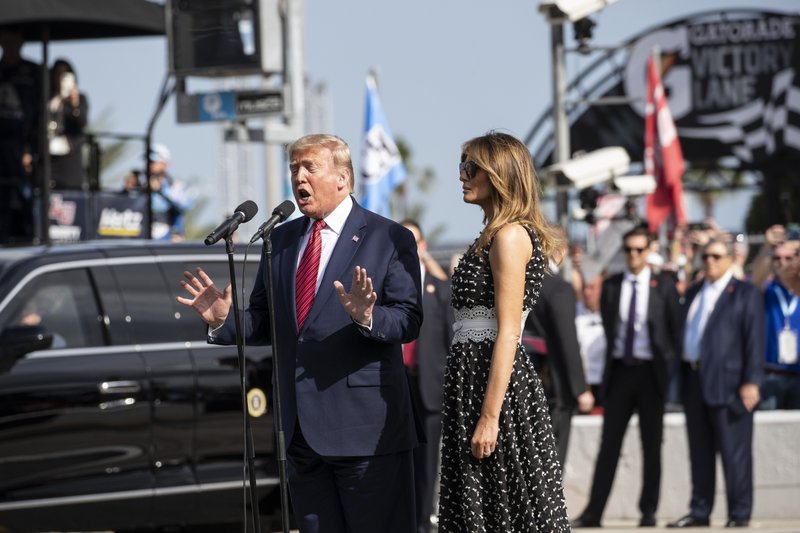
DAYTONA
BEACH, Fla. (AP) — President Donald Trump gave an election-year embrace
to NASCAR and its fans Sunday when he became the second president ever
to attend the Daytona 500. The presidential motorcade took to the track
to join in a warm-up lap after he had told the crowd that the racers and
their teams were competing “for pure American glory.”
Following
a recitation of the opening command, “Gentleman, start your engines,″
Trump got into his black limousine for a ceremonial spin around Daytona
International Speedway. He had joked moments earlier in a Fox interview
that while as president, he was not allowed to drive his own car, ” I’m
going to hop into one of these cars and I’m going to get into this race
if possible. I love the idea.’’
Given
the honor of grand marshal for the race, Trump gave thousands of fans a
flyover of Air Force One and then rode onto the track in the
presidential motorcade as the audience roared with delight. The
motorcade took roughly a quarter lap before pulling aside in an infield
staging area.
Asked
what it was about NASCAR that he most enjoyed, the president said, ``I
think it’s really the bravery of these people. ... it takes great
courage.’’
President George W. Bush appeared at the race during his reelection year.
“For
500 heart-pounding miles these fierce competitors will chase the
checkered flag ... and make their play for pure American glory, and
that’s what it is, pure American glory,’’ Trump said before the race.
He
said the Daytona 500 was ``a legendary display of roaring engines,
soaring spirits and the American skill, speed and power that we’ve been
hearing about for so many years. The tens of thousands of patriots here
today have come for the fast cars and the world-class motorsports. But
NASCAR fans never forget that no matter who wins the race, what matters
most is God, family and country.’’
Trump’s
reelection campaign planned to run an ad during the Fox broadcast of
the race and fly an aerial banner near the speedway. About 100,000
people were expected to attend this year’s race while millions more
watched on television. About 9 million people took in last year’s race
on television.
Trump tweeted Sunday morning: “Getting ready to go to the Daytona 500. Will be GREAT!”
Trump
left at about 3:40 p.m. and returned to Washington. The race was
postponed after two lengthy rain delays totaling more than three hours.
The race will now begin at 4 p.m. Monday.
After
his return Sunday evening to Washington, Trump will embark later this
coming week on a Western state swing that will take him to rallies in
Phoenix, Las Vegas and Colorado Springs, Colorado. His Western trip
begins Tuesday in California, where he’ll attend a fundraiser in Beverly
Hills.
The trip
is another demonstration of Trump’s willingness to campaign not just in
conservative strongholds but in states that lean Democratic,
particularly Colorado, where Republican Sen. Cory Gardner faces a tough
reelection battle. Arizona is expected to be a key swing state in the
presidential election with its growing population of Hispanic voters.
CARSON
CITY, Nev. (AP) — With the Nevada caucuses less than a week away,
Democratic presidential candidates campaigning this weekend were fixated
on a rival who wasn’t contesting the state.
Bernie
Sanders, Joe Biden, Amy Klobuchar, Elizabeth Warren and Pete Buttigieg
all targeted billionaire Mike Bloomberg, accusing him of buying his way
into the election and making clear they were eager to take him on in a
debate.
“He
thinks he can buy this election,” Sanders said of the former New York
mayor at a Sunday rally in Carson City, Nevada. “Well, I’ve got news for
Mr. Bloomberg — the American people are sick and tired of billionaires
buying elections!”
Their
attacks are a sign of how seriously the field is starting to take
Bloomberg as he gains traction in the race and is on the cusp of
qualifying for Wednesday’s Democratic debate in Las Vegas. Bloomberg has
bypassed the traditional early voting states including Nevada, focusing
instead on the 14 states that vote in the Super Tuesday primary on
March 3. He has spent more than $417 million of his own
multibillion-dollar fortune on advertising nationwide, an unprecedented
sum for any candidate in a primary.
The
focus on Bloomberg comes amid anxiety among many establishment-aligned
Democrats over the early strength of Sanders, who won last week’s New
Hampshire primary and essentially tied for first place in Iowa with Pete
Buttigieg, the former mayor of South Bend, Indiana. Sanders is hoping
to notch a victory in Nevada on Saturday as moderates struggle to unite
behind a candidate who could serve as a counter to the Vermont senator,
who has long identified as a democratic socialist.
The
hundreds of millions of dollars that Bloomberg has pumped into the
Super Tuesday states has only heightened the sense of uncertainty
surrounding the Democratic race.
At
Sanders’ rally, the crowded cheered as the Vermont senator joked that
Bloomberg is “struggling, he’s down to his last $60 billion” and derided
him for skipping the early primary states.
It
marked an escalation of the salvo Sanders launched Saturday against the
former mayor, when he ticked off a litany of conservative positions
Bloomberg has taken in the past, including opposing a minimum wage hike
and his opposition to a number of Barack Obama’s policies while
president. On Saturday, Sanders suggested the former mayor’s past
conservatism and controversial comments make him a weak candidate
against President Donald Trump, charging that Bloomberg, “with all his
money, will not create the kind of excitement and energy we need” to
beat Trump.
And
on Sunday, he was joined by the current mayor of New York, Bill de
Blasio, who just this week endorsed Sanders. De Blasio introduced
Sanders with an attack of his own on his predecessor, telling the crowd,
“I’m sorry to report to you the chief proponent of stop and frisk is
now running for president.”
Klobuchar,
speaking on CBS’ “Face the Nation,” accused Bloomberg of avoiding
scrutiny by blanketing the airwaves and sidestepping debates or tough
televised interviews.
“I
think he cannot hide behind the airwaves and the money,” she said. “I
think he has to come on the shows. And I personally think he should be
on the debate stage.”
Klobuchar
said she’s raised $12 million since her better-than-expected finish in
third place in New Hampshire. She’s maintained her campaign through a
series of strong debate performances and argued that Bloomberg being on
stage with his rivals would level the playing field.
“I’m never going to beat him on the airwaves, but I can beat him on the debate stage,” she said.
Biden,
speaking on NBC’s “Meet the Press,” suggested that Bloomberg will face
increased scrutiny as the race continues, pointing to his record on
issues relating to race.
“$60 billion can buy you a lot of advertising, but it can’t erase your record,” he said.
Biden
knocked Bloomberg’s past support of stop-and-frisk policing policies
and his comments suggesting cracking down on racist mortgage lending
practices, known as “redlining,” contributed to the financial crisis, as
well as his 2008 refusal to endorse Barack Obama for president.
Bloomberg has been airing ads that tie him closely to Obama on issues
like gun control and climate change.
When
asked on MSNBC about whether Bloomberg shares the values of the
Democratic Party, Warren also went after the former mayor over his
comments on redlining, declaring that “anyone who is out there trying to
blame African Americans for the financial crash of 2008...is not
someone who should be representing our party.”
Buttigieg
likened Bloomberg to Trump when asked about reports that Bloomberg made
sexist comments towards women and fostered a culture of sexism at his
company.
“I think he’s going to have to answer for that and speak to it,” Buttigieg said.
He
later added: “Look, this is a time where voters are looking for a
president who can lead us out of the days when it was just commonplace
or accepted to have these kinds of sexist and discriminatory attitudes.
Right now, this is our chance to do something different.”
But
even as the front-running candidates kept one eye on their Super
Tuesday showdown with Bloomberg, they also focused on the more immediate
task of winning over minority voters, who will play a pivotal role in
the contests in Nevada and South Carolina.
Biden
reminded older parishioners at the First African Methodist Episcopal
Church in North Las Vegas of 1960s television footage of black
protesters in Birmingham, Alabama, being attacked by police dogs and
sprayed with fire hoses on the orders of city official Bull Connor.
Biden
said today’s racists are not “Bull Connors, not out in overalls.
They’re wearing fine suits, and they’re living in the White House.”
The
former vice president is relying on his strength among black voters and
an explicit appeal to Latinos and other minorities to deliver him a
strong showing in the coming contests after posting disappointing
finishes in Iowa and New Hampshire, which both feature electorates that
are whiter on average than the national population.
Biden
has been hammering home the need for any Democratic candidate to appeal
to voters of color. On Sunday, he told black lawmakers and other
political figures at the Nevada Black Legislative Caucus’s Black History
Month observance that “the black community has in its power to
determine who the next president of the United States is going to be.”
Nevada
and South Carolina are also a key test for Buttigieg and Klobuchar, who
have thus far ridden on momentum from stronger-than-expected finishes
in Iowa and New Hampshire, respectively, but have both faced questions
about their appeal to minority voters.
On
Sunday, when asked to name a mistake he had made as mayor, Buttigieg
acknowledged that he failed to recognize the pain that his decisions
made, particularly for communities of color.
“I
was laser-focused on making sure we did the right thing legally ... I
didn’t always hear the voices who were talking about the story behind
the story,” Buttigieg said. “I was a data guy.”
Later
that day, at a luncheon for the Nevada Legislative Black Caucus,
Buttigieg said he was proud of his work with black leaders in his city
to deliver affordable housing and improve the black unemployment rate,
but he said he was “humbled by the work left to do.”
___
Jaffe
reported from Washington. Associated Press writers Jonathan Cooper and
Bill Barrow in Las Vegas contributed to this report.
LAS
VEGAS (AP) — A growing number of Democratic lawmakers, union officials,
state leaders and party strategists agree that Bernie Sanders is a
risky nominee to put up against President Donald Trump. There’s less
agreement about whether — and how — to stop him.
Critics
of the Vermont senator, who has long identified as a democratic
socialist, are further than they’ve ever been from unifying behind a
moderate alternative. None of the viable centrists in the race is eager
to exit the campaign to clear a path for a candidate to become a clear
counter to Sanders. And Sanders is looking to Saturday’s Nevada caucuses
to post another win that would further his status as an early
front-runner.
With
fear and frustration rising in the party’s establishment wing, a
high-stakes math problem is emerging. It could be impossible to blunt
Sanders as long as a trio of moderate candidates — former South Bend,
Indiana, Mayor Pete Buttigieg, former Vice President Joe Biden and
Minnesota Sen. Amy Klobuchar — stay in the race. And with former New
York Mayor Mike Bloomberg pumping hundreds of millions of dollars into
the swath of states that vote on Super Tuesday, March 3, the effort to
stop Sanders will become even more challenging when the campaign goes
national next month.
“You
see this tremendous angst in the party — ‘What are we going to do?’”
said Terry McAuliffe, a former Virginia governor who was also chairman
of the Democratic National Committee. “We need to unify as fast as we
can.”
The dynamic is complicated because each of the major moderate candidates has glaring vulnerabilities.
Biden
began the campaign as a front-runner, but the aura around his operation
took a hit after a fourth-place finish in Iowa gave way to a
fifth-place finish in New Hampshire. Buttigieg has proved to be the most
effective centrist in raising money from the party’s traditional
high-dollar donors, which puts him in a strong position to compete in an
expensive national contest. But the 38-year-old faces linger questions
about his experience and his ability to win support from black and
Latino voters, a challenge that could come into greater focus if
Buttigieg loses badly in Nevada and South Carolina.
Kloubchar
is newly emboldened after a third-place finish in New Hampshire, but
she too has little support among minority voters and has largely run a
bare-bones campaign operation.
“When
you have three or four candidates in that same lane, math becomes a
problem,” said Harold Schaitberger, general president of the
International Association of Firefighters and a Biden loyalist, who
admits being “disappointed” by Biden’s bad performances and Sanders’
rise.
Though the opening contests of the primary have only begun, time may quickly run out for a moderate alternative to emerge.
By
the end of Super Tuesday, more than one third of all delegates will be
awarded. Should Sanders build a significant delegate lead — and his
strength in California alone makes that possible — it would be very
difficult for any other candidate to catch him in the slew of
state-by-state elections that follow based on the way delegates are
apportioned.
“We
have a lot of good candidates, but in general we’re incredibly
frustrated that the field hasn’t winnowed,” said Robert Wolf, a major
fundraiser for Barack Obama, who said he has donated money this cycle to
more than a dozen Democrats. Sanders is not one of them.
The
situation is similar to the Republican primary in 2016, when several
anti-Trump alternatives divided their party’s moderate vote and allowed
Trump to become the nominee despite failing to win a majority of the
vote in early primary contests.
There
is no significant movement in the works to stop Sanders. And so long as
there are a half-dozen viable candidates in the race, it may not matter
if there were.
Sanders’
team expects his Democratic critics and their allies to intensify their
attacks in the coming weeks, although they suggest time may be on their
side with Super Tuesday just two weeks away. If Sanders comes out of
Super Tuesday with a 100-delegate lead, which is possible based on his
popularity in California alone, they believe it would be virtually
impossible for anyone to catch up before the party’s national convention
in July.
Sanders
was showing new signs of confidence as he campaigned over the weekend
in Nevada ahead of the state’s caucuses next Saturday. Rallying
supporters in Carson City on Sunday, he declared he could win Nevada,
then California and the Democratic nomination and highlighted attempts
from his rivals in both parties to stop him.
“I’ve
been attacked by the media establishment, I’ve been attacked by the
corporate establishment, I’ve been attacked by the Republican
establishment, I’ve been attacked by the Democratic establishment, and
they’re nervous,” Sanders said.
Sanders
told The Associated Press last week that he was ramping up his outreach
to other lawmakers and party officials who have been skeptical of his
White House bid, although he offered no details. The senator has also
agreed to host at least two fundraisers for the Democratic National
Committee, which he had previously resisted.
Asked about the response he was getting to the establishment outreach, Sanders said: “I think we’re going to do just fine.”
Yet
as Sanders’ strength grows in the early voting states, there is no
evidence that his standing is improving among the party’s skeptical
political class. Several elected officials in recent days have raised
concerns about his ability to beat Trump and his impact on other
Democrats running for election this fall.
The competition for endorsements helps tell the story of the moderate muddle.
Since
Biden’s underwhelming finish in Iowa, Sanders hasn’t received a single
congressional endorsement. Buttigieg and Klobuchar, who have shown some
strength on the campaign trail, have earned just one congressional
endorsement each.
Over
that same time, at least seven congressional endorsements have gone to
Bloomberg, a 78-year-old former Republican who is threatening to become a
top-tier candidate even after skipping all four February primary
contests.
Steve
Shurtleff, a Biden backer and the speaker of the New Hampshire House of
Representatives, believes Buttigieg and Klobuchar are the new leaders
in the party’s moderate wing, while Bloomberg is making a case.
As
for Sanders, Shurtleff noted that most New Hampshire voters supported
somebody else. Indeed, Sanders won last week’s primary with just 26% of
the vote, a low bar made possible because his moderate alternatives
split up the rest of the electorate.
“It’s very crowded in that lane,” Shurtleff said. “It’s really kind of a conundrum.”
Just don’t ask any of Sanders’ rivals to step aside.
An
energized Klobuchar said in an interview that her third-place finish in
New Hampshire left her “as scrappy as I was when I started.”
She
shrugged off any concerns about moderates dividing the vote. And she
highlighted her strengths in Nevada, where she and Biden earned the
endorsement of the state’s largest newspaper and may benefit from the
success of female candidates. Both of the state’s U.S. senators are
women and the state legislature is majority female.
“I don’t think it’s as simple as two lanes,” she said in an interview. “Everyone brings something else to this.”
___
Fram
reported from Washington. Associated Press writers Lisa Mascaro in
Washington and Nicholas Riccardi in Carson City, Nevada, contributed to
this report.
Both State Department-chartered flights carrying Americans from the coronavirus-infected Diamond
Princess cruise ship arrived in the U.S overnight. The first plane
touched down at Travis Air Force Base in California just before
11:30 p.m. local time. The second flight landed at Lackland Air Force
Base in Texas roughly 2 1/2 hours later. Hundreds of American passengers who had been quarantined on the cruise ship left Japan Monday
on two planes en route to the United States -- with 14 of the
passengers infected and isolated in a "specialized containment area."
It's not clear which flight the infected were on. "During the
evacuation process, after passengers had disembarked the ship and
initiated transport to the airport, U.S. officials received notice that
14 passengers, who had been tested 2-3 days earlier, had tested positive
for COVID-19. These individuals were moved in the most expeditious and
safe manner to a specialized containment area on the evacuation aircraft
to isolate them in accordance with standard protocols," the U.S.
Department of State said in a release. "After
consultation with [Health and Human Services] HHS officials, including
experts from the HHS Office of the Assistant Secretary for Preparedness
and Response, the State Department made the decision to allow the 14
individuals, who were in isolation, separated from other passengers, and
continued to be asymptomatic, to remain on the aircraft to complete the
evacuation process," it added. The 46 Americans who tested
positive on the cruise ship were told to remain in Japan to be treated
for the virus that has killed an estimated 1,765 people and infected
more than 70,000 globally, according to Princess Cruise media relations.
Buses had transported U.S passengers -- with the assistance of Japanese
troops -- from the ship to Haneda Airport in Tokyo.
Buses carrying passengers from the quarantined Diamond Princess
cruise ship leaving a port in Yokohama on Monday. (AP Photo/Jae C. Hong)
Health officials said they screened all passengers
prior to boarding the flights and no symptomatic or infected travelers
were allowed onboard. So far, 355 people have tested positive for the virus on the Diamond Princess after doctors found 67 new cases Sunday.
An airplane chartered by the U.S. government taking off at Haneda
Airport in Tokyo with U.S. passengers who were aboard the quarantined
cruise ship. (Sadayuki Goto/Kyodo News via AP)
About 380 Americans and family members were on the
ship when it was quarantined on Feb. 5. It's unclear exactly how many
U.S. citizens have tested positive for the virus other than the 46
reportedly infected. "All
travelers on these flights were screened for symptoms prior to
departure and will be subject to [the] Centers for Disease Control (CDC)
screening, health observation, and monitoring requirements. Only those
who were asymptomatic were allowed to board the flights," a State
Department spokesperson said.
A bus carrying U.S. passengers who were aboard the quarantined
cruise ship the Diamond Princess arriving at Haneda Airport in Tokyo.
(Sadayuki Goto/Kyodo News via AP)
Passengers were quarantined for 14 days on the ship,
which is considered the virus's incubation period. They are expected to
be quarantined for 14 additional days upon arrival at either base. The
bases in California and Texas were selected to ensure facilities were
available immediately to treat their medical needs, according to the
U.S. Embassy in Toyko.
Buses carrying U.S. passengers who were aboard the quarantined
cruise ship the Diamond Princess, seen in the background. (Jun
Hirata/Kyodo News via AP)
The chartered flights were the only opportunities for passengers to fly to the U.S until March 4, embassy officials said. The remaining passengers are expected to depart the ship this coming Wednesday. Fox News' Vicki Choi and Rich Edson contributed to this report.