Presumptuous Politics

Thursday, March 12, 2020

CNN's Don Lemon, Kasich have heated exchange over Trump's coronavirus address


CNN anchor Don Lemon had a "total meltdown" according to critics on Wednesday night after a guest on his show told him that President Trump's coronavirus address from the Oval Office was "fine."
Lemon, who has repeatedly insisted that he is 'not a partisan,' had on former 2016 presidential candidate-turned-CNN contributor John Kasich to discuss the latest developments in the Trump administration's handling of the coronavirus outbreak. The anchor accused Trump of "misrepresenting" the travel ban that was set on Europe after the White House offered clarification on what was affected.
"Look, I watched the address tonight and I thought it was fine. He did fine," Kasich said. "I'm glad he did the address tonight and I think that was important."
Kasich urged the president to "stick to the script" and said governors will have a major role in combatting the virus.
However, none of that apparently sat well with the CNN anchor.
"I don't know if he stuck to the script or not, but whatever script he read was wrong because they had to clarify it several times," Lemon complained. "And I've just got to say if the president came out to calm people's fears, he didn't do a good job of it because he had to come back and clarify it several times! And this has been going on long enough for them to get it straight! We need straight, accurate information from this president and this administration and we're not getting it!"
His tirade continued, "And I don't understand why you're tip-toeing around it. He came out, gave an address that's usually- that happens very rarely he doesn't get it right?!"
"First of all, he read it," Kasich responded. "And somebody- I don't want to get into that."
"Why not?! That's why you're here!" Lemon exclaimed. "To talk about the president's address!"
"Can I finish?" the former Ohio governor attempted to complete his thought.
"No, no you can't, John!" the anchor shouted. "Because we're here to talk about the president- I don't want you to go on and deflect and talk about something else because we're here to talk about the president's address. And you said that someone else wrote it- he's the president! Even if someone else wrote it, it should be right!"
Kasich, a longtime critic of the president, defended the Trump administration, telling Lemon they were attempting to address the "confusion out there."
"Now there's more confusion, John!" Lemon shot back.
After engaging in another fiery exchange, Kasich reiterated his belief that Trump's address was "fine."
"I thought it was fine. You can disagree with me. I thought it was fine," Kasich told his colleague. "I thought he had the right tone and he no longer played with 'We're going to blame Democrats'... I hope he's trying to move forward because he understands the seriousness of this situation. Now the fact that they clarified- it isn't unusual in a speech for somebody to clarify something, OK? But I don't think that the tone he showed tonight takes away from some clarification. I think he set a serious tone. That's what I wanted out of him for a long time. And I think we got it."
After Lemon claimed he tried "cutting Trump a break" at the top of his show, Kasich then pressed Lemon on what he thought was so "terrible" about the clarification."
"I never said I thought it was terrible. I'm telling you we're in the middle of a pandemic right now," Lemon said. "We're in the middle of a pandemic and everytime this president comes out, he gives inaccurate information. So I don't understand why he would even come out and do it at all if he is going to confuse the American people even more! You don't understand that? You're a governor! I'm surprised you don't understand that!"
Lemon shook his head after Kasich insisted that "98 percent" of Trump's address "was good."
"I think I made my case here. If the president is going to come out and confuse people more, then don't say anything," Lemon concluded.
The CNN anchor was widely panned on social media.
"I'm surprised actually shocked. Don Lemon has lost his mind," game show icon Chuck Woolery declared.

Andy Puzder: Trump coronavirus response will protect America’s economy, workers and businesses


Showing strong and effective leadership when we need it most, President Trump addressed the nation Wednesday night and unveiled a two-pronged program of health and economic actions to deal with the coronavirus pandemic.
The president’s action plan should win bipartisan support to respond to the most serious health and humanitarian crisis our nation has faced in my nearly seven decades.
“We are all in this together,” the president correctly said. “We must put politics aside, stop the partisanship.” He called on America to fight the pandemic “together as one nation and one family.”
We can only hope that those on both sides of the political aisle will heed his call to respond as one nation and one people, as our leaders have done so often in our past when facing a crisis.
While the coronavirus pandemic is a medical crisis, President Trump pointed out that it “is not a financial crisis.”
That’s a crucial point we should all remember. This pandemic is unlike the savings and loan crisis of the late 1970s, the tech bubble in the late 1990s, or the real estate bubble of 2007. Our nation’s economic fundamentals are strong.
There is no underlying economic fault that must be corrected before our economy can recover. As the president noted, “our banks and financial institutions are fully capitalized and incredibly strong.”
Unemployment is consistently at 50-year lows and we have 1 million more job openings than people unemployed. The Atlanta Federal Reserve’s GDPNow forecasting model is projecting 3.1 percent gross domestic product growth for the first quarter of this year, with only three weeks left in the quarter.
When the coronavirus pandemic subsides – and it will – our economy and the financial markets will come roaring back.

More from Opinion

Nonetheless, whether a reaction or an overreaction, the stock market’s recent decline has dramatically demonstrated that there will be economic pain in the interim. Protecting American workers has always been the president’s top priority and he made clear Wednesday night that it remains so.
To ease that pain for American workers, the president promised to take “unprecedented” action to financially protect the workers who must stay home and miss work because they are ill, quarantined or caring for others infected with the coronavirus. And he called on Congress to take legislative action to extend that relief.
In addition, President Trump said he has instructed the Small Business Administration to provide capital to communities impacted by the virus by extending low-interest loans to help small businesses overcome the disruptions that are occurring and will occur as we address this virus.
The president asked Congress to expand the funds available for this program for small businesses by an additional $50 billion. This is a major expansion and its benefits should reverberate across the economy.
The $50 billion will be instrumental in helping small businesses stay in business and retain their employees as they deal with the temporary disruptions the coronavirus is causing. This is a good investment in the businesses and jobs that drive our economy.
Using his emergency authority, President Trump said he is also instructing the Treasury Department to defer income tax payments currently due April 15 without interest or penalties for individuals and businesses negatively impacted by the coronavirus. This will provide our economy with an additional $200 billion in liquidity.
Finally, the president called on Congress to grant Americans immediate payroll tax relief that he hopes Congress will consider “very strongly.”
In 2009, under President Barack Obama, Congress authorized a 2 percent payroll tax cut. It sounded like President Trump wanted a larger cut. This would put additional money in the pockets of American workers while we deal with this crisis.
In a broader economic context, the President is suspending all travel from Europe (with the exception of the United Kingdom) to the U.S. While necessary to limit the spread of the disease caused by the coronavirus, there will be some negative economic implications (cargo from Europe will be allowed into the U.S., although people transporting cargo will not).
On the positive side, the coronavirus appears to be on the decline in China and South Korea. The Trump administration is reevaluating the restrictions and warnings currently in place with respect to those nations and will consider the possibility of an “early opening.”
That could reopen essential supply chains and help China fulfill its obligation to purchase $200 billion in U.S. goods under the Phase One trade deal with China.
Americans should take heart. As President Trump stated, “no nation is more prepared or more resilient than the United States.” We have a highly qualified team headed by Vice President Mike Pence that is organizing our fight against the coronavirus and we have a president who is “marshaling the full power of the federal government and the private sector to protect the American people.”
The coronavirus knows no party lines. It is indiscriminate. As a unified nation, we can address this virus effectively and aggressively. The president is doing everything within his powers and has issued a call to action to Congress.
It is up to our congressional leaders to respond. Honestly, I hope – and, in my heart of hearts, I believe – that they will.

Coronavirus news appears to increase as outbreak spreads


The night of March 11, 2020, may be remembered as the point where the coronavirus outbreak reached a new level of seriousness in the U.S.
In a span of just two hours, Americans heard a stunning series of announcements as the spread of the virus – also known as COVID-19 -- continued.
Around 9 p.m. ET, President Trump told the nation from the Oval Office that he was calling for a temporary halt on air travel to the U.S. from Europe, excluding flights from Britain and those carrying cargo, in a bid to contain the spread of the virus.
"The virus will not have a chance against us. No nation is more prepared, or more resilient," Trump said.
"The virus will not have a chance against us. No nation is more prepared, or more resilient."
— President Trump
Around 10 p.m. actor Tom Hanks revealed he and wife Rita Wilson had tested positive for the virus while in Australia.
Around the same time, the NBA announced it was suspending its basketball season until further notice, after a Utah Jazz player tested positive.
Then around 11 p.m., New York Gov. Andrew Cuomo announced the postponement of New York City’s St. Patrick’s Day Parade – a tradition older than America itself.
The four announcements came on the same day the World Health Organization declared the outbreak a pandemic and as confirmed U.S. cases topped the 1,200 mark – and as the nation grappled with a problem for which no clear end was immediately in sight.
All around the U.S., public gatherings such as conventions, conferences and concerts -- even TV shows with live audiences – were being called off or scaled back.
March Madness? The college basketball games will be played with only “essential staff and limited family attendance,” NCAA President Mark Emmert said Wednesday, according to the Indianapolis Star.
Public tours of the White House and U.S. Capitol? Those were temporarily halted as well -- “in an abundance of caution,” the White House said on its phone line for visitor information, the Washington Examiner reported.
As of early Thursday, more than 110 nations had reported at least one case of the novel coronavirus, Time magazine reported.
More than 126,000 cases have been reported worldwide, including more than 68,000 recoveries, according to reports. The global death toll stood early Thursday at more than 4,600.

Wednesday, March 11, 2020

Biden Townhall Cartoons


Coronavirus cases in US exceed 1,000, as Michigan sees its first cases


The total amount of coronavirus cases in the U.S. surpassed 1,000 on Tuesday night, with the virus officially being reported in all but 12 states.
Various events have been canceled throughout the country as health officials warn about attending large-scale gatherings. At least 28 deaths have been reported.
"We would like the country to realize that as a nation, we can't be doing the kinds of things we were doing a few months ago," Dr. Anthony Fauci, a top official at the National Institute of Allergy and Infectious Diseases said during a White House press briefing.

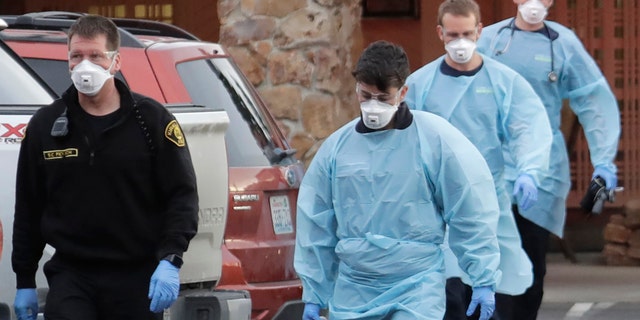
Kirkland Fire and Rescue ambulance workers walk back to a vehicle after a patient was loaded into an ambulance, Tuesday, March 10, 2020, at the Life Care Center in Kirkland, Wash., near Seattle.  (AP Photo/Ted S. Warren)

He referenced guidelines by the White House advising people to clean their hands regularly and avoid handshakes. You should also start making habits like covering coughs and sneezes and refraining from touching your face. The CDC is advising those over 60 with underlying health conditions to avoid crowded places, unnecessary travel, and to stock up on supplies.
Gov. Gretchen Whitmer, D-Mich., announced the state's first cases on Tuesday night and declared a state of emergency "to harness our resources across state government to slow the spread of the virus."
One case is an adult female from Oakland County with recent international travel and the other is an adult male from Wayne County with recent domestic travel.
"It's crucial that all Michiganders continue to take preventative measures to lower their risk, and to share this information with their friends, family, and co-workers," she added.

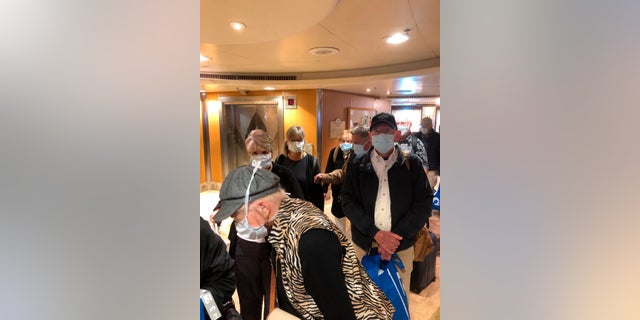
This photo provided by Laurie Miller shows passengers as they get ready to disembark the Grand Princess in Oakland, Calif., Tuesday, March 10, 2020. California Gov. Gavin Newsom urged the state's nearly 40 million residents to avoid sporting events, concerts and large gatherings to prevent the spread of the coronavirus and adamantly warned the elderly to stay away from cruise ships as he pondered measures to restrict cruise travel off the California coast. (Laurie Miller via AP)

The patient from Wayne county is currently under isolation and officials recommend residents continue to practice prevention measures to slow the spread of COVID-19.
Local health departments are working to identify anyone who had come into close contact with those cases.
The spread of COVID-19 has quickened in the U.S. in recent days. Over 100 new cases have been announced on average per day since Saturday. More than 100 people have tested positive New York, California and Washington State
“Although we keep coming in and saying -- appropriately -- that as a nation the risk is relatively low, there are parts of the country right now that are having community spread in which the risk there is clearly a bit more than that,” Fauci added, referring to those three states.
Gov. Andrew Cuomo, D-N.Y., sent the National Guard and announced a one-mile "containment zone" for the city of New Rochelle on Tuesday in an effort to contain the spread of the virus.
“New Rochelle at this point is probably the largest cluster in the U.S. of these cases,” he said. “It’s a significant issue for us.”
Symptoms of the coronavirus -- fever, cough, and shortness of breath -- may appear between two to 14 days due to its reported incubation period.

US Treasury likely to push back April 15 tax filing deadline, Report


The Trump administration is likely to extend the April 15 tax deadline as part of an effort to mitigate the effects of the novel coronavirus on U.S. households and businesses, according to an administration official and another person familiar with the matter.
Neither the decision to extend the deadline nor the mechanics of how such an extension might work are yet final.
Normally, individuals must pay their prior year’s taxes by April 15 or face penalties and interest charges. People can already get extensions through mid-October to file their returns as long as they have paid on time by mid-April. This decision would go further than that.
Extending the tax filing deadline would effectively act as a bridge loan for individuals and businesses facing disruptions from the virus. Treasury officials are still considering how far the filing deadline may be pushed back and who would be eligible for the extension, according to the person familiar with the discussions.
Officials believe they have the legal authority to waive penalties on late tax payments if they move back the filing date and are exploring whether they have the ability to waive the interest under an emergency disaster declaration.
Extending the deadline would also have temporary implications for the federal budget and borrowing. The Treasury depends on estimates of federal revenues to ensure it has enough cash to keep paying the government’s bills on time.
Delaying tax payments could force the Treasury to borrow more in the near-term. April is the largest month for federal tax payments; last year, Treasury collected $333 billion in individual income taxes that month.
Earlier Tuesday, House Democrats asked the IRS whether the government should consider pushing back the April 15 deadline, mentioning the government’s existing authority to extend deadlines and waive penalties. The IRS often extends filing deadlines in affected areas after natural disasters, and the tax code specifically authorizes the Treasury to grant delays following presidentially declared disasters.
Besides the main April 15 deadline for individuals, there are also other tax deadlines for estimated payments and other types of taxpayers.
The Internal Revenue Service and the White House didn’t respond to requests for comment.
Although the IRS has largely been operating normally, many taxpayer interactions do occur face-to-face, including at clinics for low-income taxpayers and assistance centers run by the IRS. Taxpayers also often meet in person with tax practitioners.
As of the end of February, the IRS had received 59 million returns, or less than half the total it expects to get during the full filing season.
President Trump this week outlined a slate of policy options the administration is considering to help cushion the U.S. economy from the effects of the widening epidemic, including a payroll tax cut, paid sick leave expansion and emergency lending for small businesses. While some of the major initiatives would require legislation, officials have said they are also weighing proposals that could be done through administrative action.
Mr. Trump met with Senate Republicans to discuss the proposals Tuesday, and Treasury Secretary Steven Mnuchin began negotiations with House Speaker Nancy Pelosi (D., Calif.) over a stimulus package. The House is aiming to vote on something before it leaves Washington on Thursday, likely a measure aimed at helping workers, a congressional aide said.
Among the other ideas Republicans are discussing, according to a person in the meeting, are expanding a tax credit for family-leave programs that Congress created in 2017; fixing an error in the 2017 law that affects retailers and restaurants; and delaying estimated tax payments.
Write to Kate Davidson at kate.davidson@wsj.com, Richard Rubin at richard.rubin@wsj.com and Andrew Restuccia at Andrew.Restuccia@wsj.com

Brit Hume warns Biden's gaffes suggest former VP 'is losing his memory and is getting senile'


Fox News senior political analyst Brit Hume told "Tucker Carlson Tonight" Tuesday that a series of slip-ups by former Vice President Joe Biden during his campaign for the Democratic nomination suggest that the 77-year-old former senator, "like so many people his age, is losing his memory and is getting senile."
"I don't think there's any doubt about this," Hume said. "I have traces of this myself. I know what it feels like. Sometimes you're confused, sometimes you can't remember, 'What are you supposed to do the next morning?' -- and I'm not running for president and it's probably a good thing I'm not."
Hume added that Biden's recent performance on the campaign trail is different from his long history of gaffes: "If you've known him long enough, you kind of get used to that and you think they're kind of funny and they're just part of who he is and they're kind of harmless ...
"More recently, however, he's begun to forget things," Hume added. "He didn't know what state he's in, he couldn't remember where he was when he met the Parkland [Florida] students, when he said he was in the White House."
Hume also commended on the now-viral confrontation between Biden and a Michigan auto plant worker over the Second Amendment Tuesday, saying that also showed a different, more troubling side of the Democratic frontrunner.
"I’ve known him a long time, and he can sometimes work himself up into kind of a passion in speeches and so on when he was arguing about issues and so on in a debate," Hume said. "But I don’t remember him exploding at voters like he did in this incident today, and hurling profanity the way he did, telling the guy he was ‘full of spit,’ except he didn’t say ‘spit’. That’s something new."
Hume warned that Democratic voters and officials distracted by the effort to prevent Sen. Bernie Sanders, I-Vt., from gaining the nomination may have overlooked Biden's difficulties up until now, but will find them impossible to ignore soon.
"I think that over time, the danger for him [Biden] and for his party is that he may say something that’s so outlandish and so suggestive that his cognitive faculties have failed him, that Democratic voters are going to say, ‘Oh, my Lord, what have we got here?’" Hume said, adding: "... Under the pressures of a campaign, who knows what will happen?"

Biden's 'Joe-mentum' grows as Dem front-runner sweeps Midwest contests, eyes Sanders knockout


History didn’t repeat itself in Michigan for Bernie Sanders.
And because of that, the populist U.S. senator from Vermont had an extremely disappointing evening on "Super Tuesday II" -- and now faces daunting delegate math that leaves him slipping swiftly out of reach of the Democratic presidential nomination.
Just four years ago, it was in Michigan where Sanders pulled off a historic upset over eventual nominee Hillary Clinton. At the time, the victory kept his White House bid alive.
Fast forward four years later and Sanders – down in the public opinion polls by double digits once again in the Great Lake State – was convincingly defeated by former Vice President Joe Biden.
Four years ago Sanders nearly topped Clinton in Missouri. This time around he lost the state by a nearly 2-to-1 margin to Biden. And the former vice president trounced Sanders in Mississippi and won in Idaho as well.
Sanders – who won a landslide victory in the 2016 Washington state caucuses – was neck and neck with Biden in the state’s 2020 primary with just over two-thirds of the vote counted. Biden initially had the slight edge in Idaho – with more than three-quarters of the vote counted -- and was eventually declared the winner.
Sanders was up in North Dakota’s caucuses, where only 14 delegates were up for grabs.

Undisputed front-runner

Biden’s blockbuster performance boosted his lead in the all-important race for presidential convention delegates and further cemented his status as the undisputed front-runner for the Democratic nomination. And Biden's strong performance presented Sanders with a difficult choice to make on whether to continue his White House bid.
In a remarkable and uncharacteristic move, Sanders opted not to deliver a primary night address, passing on the opportunity to speak to a national audience.
Biden, speaking near his national campaign headquarters in Philadelphia on Tuesday night after canceling a rally in Cleveland due to coronavirus concerns – and after an ugly clash with an auto worker in Michigan earlier in the day -- reached out to Sanders and his legions of supporters with an olive branch.
“I want to thank Bernie Sanders and his supporters for their tireless energy and their passion. We share a common goal and together we’ll defeat Donald Trump. We’ll defeat him together,” Biden said.
“I want to thank Bernie Sanders and his supporters for their tireless energy and their passion. We share a common goal and together we’ll defeat Donald Trump. We’ll defeat him together.”
— Joe Biden
And Biden spotlighted how many of his former rivals, as well as much of the Democratic Party’s establishment, have coalesced around his campaign in the week and a half since his landslide victory in the South Carolina primary – which was followed three days later by his sweeping victories the first Super Tuesday, March 3.
“In just the past week, so many of my incredibly capable competitors have endorsed me. Mayor Pete Buttigieg, Amy Klobuchar, Beto O’Rourke, Mike Bloomberg, Cory Booker and Kamala Harris,” Biden noted. “Together we’re bringing this party together. That’s what we have to do.”
Sanders flew home to Burlington, Vt., after also canceling a primary night campaign rally in Cleveland due to coronavirus concerns. Huddling with his advisers, the senator now faces a primary calendar that doesn’t get any easier.
The four major states that hold primaries next week – Florida, Illinois, Ohio, and Arizona – were states that Sanders lost to Clinton four years ago.

Coalition comes together

Sanders spent most of his time the past week stumping in Michigan. But there and in the other larger states that held contests Tuesday, Sanders wasn’t able to expand on his base. Biden – meanwhile – once again assembled a large coalition of votes – solidly winning among African-Americans, women and suburban voters.
A Fox News voter analysis in Michigan indicated Biden topped Sanders by more than 20 points among white voters without a college degree. Sanders cleaned up with white working class voters in the primary four years ago. That foreshadowed Clinton’s narrow loss to Donald Trump in the November 2016 general election in Michigan. Trump’s victory with working-class white voters in the state, as well as similar narrow wins in two other crucial Rust Belt states – Pennsylvania and Wisconsin – propelled him to the White House.
“The entire electability argument of the Sanders campaign has been that he can, one, win a broad coalition, and two, he can grow turnout. Based on actual vote totals to date, he has not been able to do either. Joe Biden has,” said Mo Elleithee, the founding executive director of Georgetown University's Institute of Politics and Public Service and a Fox News contributor.
“And that is the story of this primary season so far. We saw that in South Carolina, we saw it on Super Tuesday, and we saw it again tonight. And it’s given Biden a near insurmountable lead in delegates,” added Elleithee, a senior spokesman for Hillary Clinton’s 2008 presidential campaign who later served as communications director for the Democratic National Committee.

Tuesday, March 10, 2020

Bernie Sanders Communist Cartoons


Sanders fights for another rust belt upset to regain momentum against Biden

78 years
Underscoring what’s at stake for his White House bid when Michigan and five other states hold Democratic presidential nomination contests on Tuesday, Sen. Bernie Sanders emphasizes that “this is a very, very important day in Michigan.”
Speaking in front of more than 10,000 people at a rally at the University of Michigan in Ann Arbor, the populist senator from Vermont on Sunday spotlighted that Michigan’s “the most important state” to hold a contest on March 10, which is being dubbed ‘mini Super Tuesday’ or ‘Super Tuesday 2.0.’

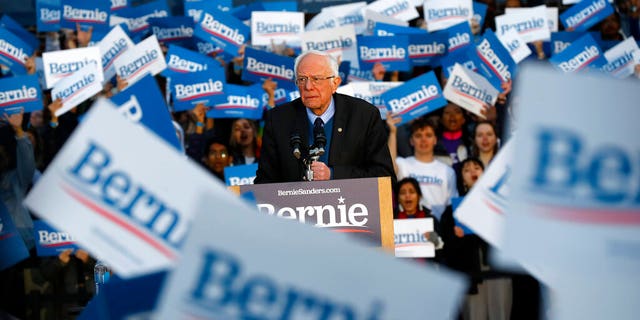
Democratic presidential candidate U.S. Sen. Bernie Sanders, I-Vt., speaks during a campaign rally at the University of Michigan in Ann Arbor, Mich., Sunday, March 8, 2020. (AP Photo/Paul Sancya)

With 125 pledged delegates at stake, Michigan is the biggest prize among the six states holding contests on Tuesday. The others are Missouri, Mississippi, Washington state, Idaho and North Dakota.
Sanders, a populist senator who’s making his second-straight presidential run, defeated eventual nominee Hillary Clinton in 2016's primary in Michigan, in what was considered a major upset victory. That foreshadowed Clinton’s narrow loss to Donald Trump in the November 2016 general election in Michigan. Trump’s victory with working-class white voters in the state, as well as similar narrow wins in two other crucial Rust Belt states – Pennsylvania and Wisconsin – propelled him to the White House.
The pre-Michigan primary polls in 2016 got it all wrong – as they indicated Clinton with a double-digit lead over Sanders.
“The 2016 Michigan Democratic primary is considered to be the biggest polling miss of that cycle. Polls released in the week before the state primary showed Hillary Clinton with anywhere from a 10 to 27 point lead," noted Monmouth University pollster Patrick Murray.
Fast forward four years and former Vice President Joe Biden’s now the clear front-runner in Michigan with the final polls released on primary eve indicating the former vice president with a double-digit lead over Sanders.
But Sanders is holding out hope for a repeat performance that would stave off elimination and instead boost the senator back into a massive battle with Biden for the nomination.
An optimistic Sanders predicted on Fox News Sunday “I think we're gonna do well on Tuesday, and we're gonna beat Biden.”
While a loss would be considered a setback, Sanders doesn’t see such a prospect as fatal.
“I certainly would not consider dropping out,” he stressed.
Sanders was the front-runner for the Democratic nomination after winning the Feb. 11 New Hampshire primary and then shellacking the field a week and a half later at the Nevada caucuses. But thanks to his landslide victory in South Carolina a week and a half ago – and a strong performance during last week’s Super Tuesday when he swept 10 of the 14 states holding primaries on Super Tuesday and took the lead over Sanders in the all-important race for Democratic nomination convention delegates – Biden’s moved closer to locking up the nomination.
Because of its general election political symbolism and the large delegate cache, Michigan’s capturing the lion’s share of media attention among this week’s round of contests.
Biden - very cognizant of the polling debacle in 2016 – stressed on Monday that “I’m kind of superstitious, I see all these polls...I remember Hillary was up by 23 points...I don’t take anything for granted.”
Biden, with an eye on November’s general election, emphasized during a rally Monday in Flint that “Michigan is an important contest not just for the Democratic primary, because the outcome of Michigan in November may determine who the next person United States is going to be.”
The former vice president’s enjoyed a tidal wave of endorsements from current and former members of Congress and governors the past 10 days - as the party establishment and other moderates all coalesced around Biden to prevent Sanders – a self-described democratic socialist – from becoming the party’s standard-bearer in November’s general election.
And many of his former rivals for the Democratic presidential nomination have endorsed his White House bid. Two of those one-time rivals – Sens. Cory Booker of New Jersey and Kamala Harris of California – joined Biden on the campaign trail in Michigan on Monday after backing him just in the past 24 hours.
Sanders, fighting for survival, has increased his jabs at Biden in the wake of Super Tuesday.
At a Fox News town hall on primary eve in Detroit, Sanders charged that Biden had "bailed out the crooks on Wall Street who nearly destroyed our economy 12 years ago."
But he failed to mention that $700 billion rescue plan also had the support of then-presidential candidates Barack Obama and John McCain.
A day earlier in Ann Arbor, Sanders slammed the former vice president  - saying “here we are a few days before a major primary here in Michigan. And we are taking on, in this campaign, not just Joe Biden….We're taking on the 60 billionaires who are funding his campaign.
Biden, in a much more comfortable position, has refrained from blasting Sanders. Instead, on Monday he gently jabbed his rival, saying “we’re not looking for a revolution.” The push for a political revolution has long been a staple of Sanders stump speech.
But the former vice president’s aiming for what he hopes will a be a near knockout punch to Sanders.
Democratic strategist Michael Ceraso – a veteran of the 2016 Sanders campaign and the 2020 White House bid by former South Bend, Indiana Mayor Pete Buttigieg – stressed that a Biden victory in Michigan coupled with likely wins in Missouri and Mississippi will “put a huge hurdle in front of Sanders to get the delegates he needs to win.”

CartoonDems