WASHINGTON
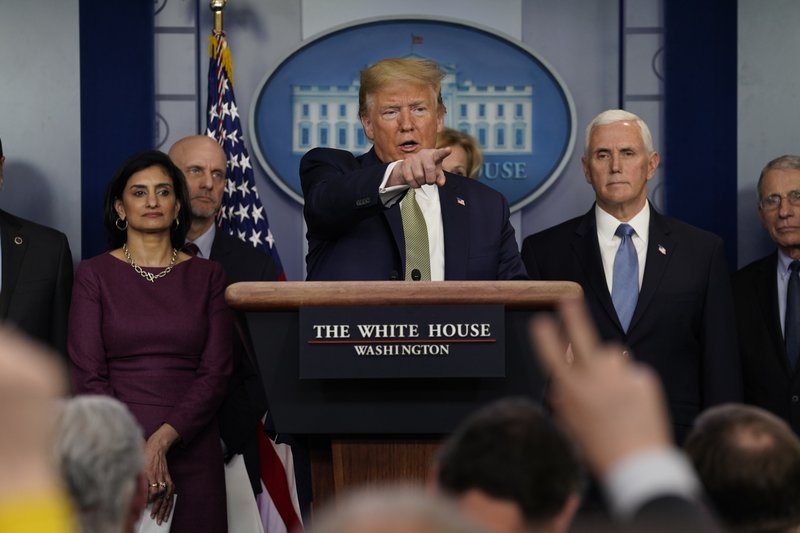
(AP) — In a massive federal effort, President Donald Trump asked
Congress to speed emergency checks to Americans, enlisted the military
for MASH-like hospitals and implored ordinary people — particularly
socially active millennials — to do their part by staying home to stop
the spread of the coronavirus.
His
proposed economic package alone could approach $1 trillion, a rescue
initiative not seen since the Great Recession. Trump wants checks sent
to the public within two weeks and is urging Congress to pass the
eye-popping stimulus package in a matter of days.
As
analysts warn the country is surely entering a recession, the
government is grappling with an enormous political undertaking with
echoes of the 2008 financial crisis.
At the Capitol on Tuesday, Senate Majority Leader Mitch McConnell vowed the Senate would not adjourn until the work was done.
“Obviously, we need to act,” McConnell said. “We’re not leaving town until we have constructed and passed another bill.”
But first, McConnell said, the Senate will vote on a House-passed package
of sick pay, emergency food and free testing, putting it back on track
for Trump’s signature — despite Republican objections. “Gag, and vote
for it anyway,” he advised colleagues.
It was a signal of what the GOP leader called the “herculean” task ahead.
Senators gathered at an otherwise shut-down Capitol as Americans across the country were implored to heed advice and avoid crowds.
Young adults, in particular, are being urged to quit going out because
even seemingly healthy people can be spreading the virus that causes the
COVID-19 illness.
Even
so, presidential primary elections unfolded in Florida, Illinois and
Arizona. Ohio’s was called off hours before the polls were set to open.
After
a savage drop at the start of the week, the stock market rose as Trump
and aides sketched out elements of the economic rescue package at a
briefing. Economists doubted that would be enough to stop millions of
jobs losses, even if in the short term.
Bigger
than the $700 billion 2008 bank bailout or the nearly $800 billion 2009
recovery act, the White House proposal aims to provide a massive tax
cut for wage-earners, $50 billion for the airline industry and $250
billion for small businesses. Two people familiar with he package
described it to The Associated Press on the condition of anonymity
because they weren’t authorized to speak publicly.
The
amount that would be sent out in checks Americans is not yet disclosed.
The White House said it liked GOP Sen. Mitt Romney’s idea for $1,000
checks, though not necessarily at that sum and not for wealthier people.
“This is a
very unique situation,” said Treasury Secretary Steve Mnuchin, exiting a
private briefing of Senate Republicans. “We’ve put a proposal on that
table that would attract a trillion dollars into the economy.”
One GOP leader, Sen. John Thune of South Dakota, told reporters afterward it “could be” up to $1 trillion.
Senate
Democrats produced their own $750 billion proposal, which includes $400
billion to shore up hospitals and other emergency operations in
response to the global pandemic and $350 billion to bolster the safety
net with unemployment checks and other aid to Americans.
“The
aid has to be workers first,” said Senate Minority Leader Chuck
Schumer, not what happened in 2008, when the big banks took precedence.
Schumer also said it’s time to call out the National Guard to provide
security as communities reel from the crisis.
The
slow-moving Congress is being asked to approve the far-reaching
economic rescue as it tries to rise to the occasion of these fast times.
A roster of America’s big and small industries — airlines, hotels, retailers and even casinos — lined up for hoped-for aid.
For
most people, the new coronavirus causes only mild or moderate symptoms,
such as fever and cough. For some, especially older adults and people
with existing health problems, it can cause more severe illness,
including pneumonia.
The
vast majority of people recover from the new virus. According to the
World Health Organization, people with mild illness recover in about two
weeks, while those with more severe illness may take three to six weeks
to recover.
Still,
health officials are urging Americans to stay home to prevent an
onslaught of cases that could overwhelm hospitals as happened in Italy,
among the countries hardest hit.
As
Congress considered aid, the Pentagon on Tuesday said it would provide 5
million respirator masks and 2,000 specialized ventilators to federal
health authorities. And Medicare was immediately expanding coverage for
telemedicine nationwide to help seniors with health problems stay home
to avoid infection.
More
than two dozen Senate Democrats urged Trump to invoke the Korean
War-era Defense Production Act to increase production of masks,
ventilators and respirators, as well as expand hospital capacity to
combat the coronavirus. Federal officials said the administration is
working with the Army Corps of Engineers to see about erecting temporary
hospitals, as is done in the military, to handle an expected surge of
cases.
Schumer compared the government response needed to a wartime mobilization.
House
Speaker Nancy Pelosi, who marshaled the earlier package through a
bipartisan vote last week, fielded a call from Mnuchin on Tuesday
morning and another from Federal Reserve Chairman Jerome Powell in the
afternoon, encouraged by the Fed chairman’s perspective that Congress
could think big with interest rates at nearly zero.
In
the call with Mnuchin, she and Rep. Peter DeFazio, D-Ore., chairman of
the House Transportation committee, “emphasized that protecting workers’
paychecks and benefits was their top priority, and that immediate
action was needed,” said Pelosi spokesman Drew Hammill on Twitter.
The debate is sure to revive the sharp divisions over the costly bank bailout and economic recovery of the Obama and Bush eras.
Much
about the proposed checks is not known, such as whether the amount
would vary by the income of the recipient or whether everyone would get
the same sum. Mnuchin said “it’s clear we don’t need to send people who
make $1 million a year checks, OK?”
Economists
from both parties endorsed mailing checks of at least $1,000 to all
American households as the quickest way to offset the sharp slowdown in
economic activity.
“We
need to pay people to stay at home,” said Heidi Shierholz, a senior
policy analyst at the Economic Policy Institute, a liberal think-tank.
The group predicted that without a huge stimulus package, the U.S.
economy could lose three million jobs by this summer.
Still,
some GOP senators were skeptical about the massive aid on the table.
“I’m going to be very leery of doing something like in 2008,” said
Indiana Republican Sen. Mike Braun.
“Right
now, the plan around here is basically to just to start shoveling money
out of a helicopter,” said Sen. Ben Sasse, R-Neb. “This is a bad idea. …
We don’t need a policy where Washington, D.C., handpicks winners and
losers.”
Despite
federal guidelines against so many people gathering, senators had no
choice but to convene. Legislating cannot be done from home.
But
late Tuesday, another lawmaker, Sen. Cory Gardner, R-Colo., announced
he would self-quarantine after contact with a constituent who later
tested positive for coronavirus.
___
Associated
Press writers Andrew Taylor, Matthew Daly, Martin Crutsinger, Colleen
Long, Chris Rugaber, Mary Clare Jalonick and Kevin Freking in Washington
contributed to this report.
___
The
Associated Press receives support for health and science coverage from
the Howard Hughes Medical Institute’s Department of Science Education.
The AP is solely responsible for all content.
Cook County, Illinois
State’s Attorney Kim Foxx prevailed in Tuesday’s Democratic primary,
where she faced several challengers who had focused on the controversy
surrounding her handling of the Jussie Smollett case. Foxx
drew national attention over Smollett's case, which began with a hate
crime investigation, turned into charges against Smollett for an alleged
hoax, and ended with Foxx dismissing the case altogether, drawing the
ire of local police. “This
win is about all of us. I’ve spent the last four years working to
reform a system that is not representative of the communities it serves -
I’m ready to continue this work,” Foxx said. The three Democrats
who challenged Foxx made her handling of the Jussie Smollett case --
which is now before a special prosecutor-- central to the campaign. Foxx
abruptly dropped charges last year against the “Empire” actor, who was
accused of staging a racist, anti-gay attack. Questions loom about
whether she acted improperly for speaking to a Smollett relative and
aide to former first lady Michelle Obama before the charges were
dismissed. Foxx had said that she had recused herself from the
case due to those contacts, but her office continued to handle it
instead of turning it over to a special prosecutor. A spokesperson later
explained that Foxx only meant that she was recusing herself in the
“colloquial” sense, and that she herself would not be involved. Text
messages later revealed that Foxx still gave her opinion on the matter
to a deputy – saying Smollett was overcharged -- in the weeks before
Smollett’s charges were dropped. A special prosecutor reinstated the charges, which Foxx called political. Foxx
fended off challenges from Bill Conway, Donna More, and Bob Fioretti,
with Conway placing a distant second despite his family pouring millions
into his campaign. About
$10.5 million of the roughly $11.5 million he’s raised, comes from his
father William Conway, co-founder of Carlyle Group, a Washington,
D.C.-based investment firm. By comparison, Foxx has raised nearly $3.5
million. Cook County is heavily Democratic, so Tuesday’s nominee
is likely the winner in November. In the GOP primary, Patrick O’Brien, a
former assistant state’s attorney, defeated Christopher Pfannkuche, a
prosecutor who has worked for several different agencies including the
state’s attorney office. The Associated Press contributed to this report.
Fox News has learned that the Department of Homeland Security (DHS) is considering a plan that would turn away asylum seekers and anyone who has crossed the southern border illegally, in light of the novel coronavirus (COVID-19) outbreak. The idea
is currently being developed by DHS staff, but there is still more work
to do to be done, before it's presented to President Trump for a final
decision. A DHS spokesperson told Fox News that the president has
the authority to do whatever is necessary to protect the American public
from this potentially deadly disease. “President Trump is 100
percent committed to protecting the American people from coronavirus and
all options are in the table," the official said. Trump
has long been a strong proponent of stronger border security and has
favored a targeted approach to limiting illegal immigration. The
U.S. Immigration and Customs Enforcement (ICE) falls under DHS and would
be subject to carry out the directive if it were approved. This news comes after the European Union (EU) chose to close the bloc's borders to most foreigners, on Tuesday. The ban
is expected to last for at least 30 days, with citizens of the United
Kingdom, Norway, Liechtenstein, and Switzerland likely being exempt.
Joe Biden
swept another round of delegate-rich contests Tuesday – winning in
Florida, Illinois and Arizona – further cementing the former vice
president as the dominant front-runner in the race for the Democratic
presidential nomination over Bernie Sanders as the coronavirus threat scrambles the primary calendar for the foreseeable future. Florida
and Illinois will award a hefty 219 and 155 pledged delegates,
respectively, while Arizona is worth 67 delegates. Together, the
contests are likely to only add to the pressure on Sanders to reconsider
his presence in the race. Last
week, Sanders vowed to press on after a string of defeats, signaling
he wants to continue to pressure Biden to embrace more progressive
policies.
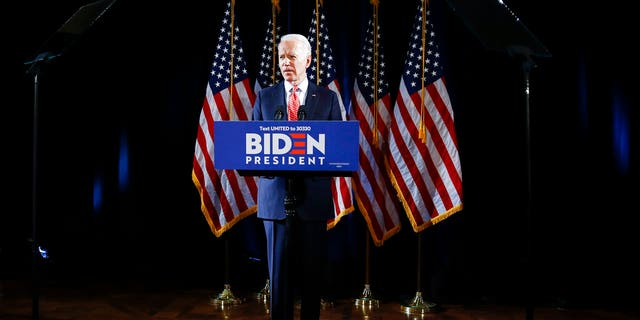
Democratic presidential candidate former Vice President Joe Biden
speaks about the coronavirus Thursday, March 12, 2020, in Wilmington,
Del. (AP Photo/Matt Rourke)
"Our campaign has had a very good night," Biden told
supporters in Wilmington, Delaware, before the Arizona race was called.
"We've moved closer to securing the Democratic Party's nomination for
president. And we're doing it by building a broad coalition that we need
to win in November, with strong support from the African-American
community, the Latino community, high school-aged people, educated
people ... labor, teachers, suburban women, veterans, firefighters and
so many more." Once again, he extended an olive branch to Sanders
in a nudge to convince him to step aside, though as recently as their
debate on Sunday, Sanders showed little inclination to accept. "Senator Sanders
and I may disagree on tactics, but we share a common vision for the
need to provide affordable health care for all Americans, reducing
income inequality hat has risen so drastically, to tackling the
existential threat of our time, climate change," he said. "Senator
Sanders and his supporters have brought a remarkable passion and
tenacity to all of these issues. ... Together, they have shifted the
fundamental conversation in this country. So let me say, especially to
the young voters who have been inspired by Senator Sanders. I hear you." Earlier
in the evening, Sanders gave an online address as well focused on the
pandemic, providing a detailed list of proposals to address the medical
and economic issues caused by the novel coronavirus. Sanders said his proposals would cost "at least $2 trillion" and would include monthly $2,000 checks to American households.
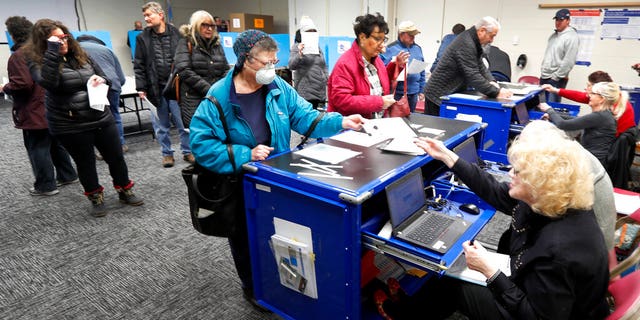
Chicago residents line up for early voting at the Roden Library
Monday, March 16, 2020, in Chicago. (AP Photo/Charles Rex Arbogast)
In Florida, a key swing state in the general election, Sanders was walloped. Biden
was ahead in the state by a massive margin of 61.5 percent to 22.7
percent, with 82 percent of precincts reporting. The rout was somewhat
expected, with the state's sizable Cuban- and Venezuelan-American
population largely resistant to Sanders' democratic socialist politics
and many voters angered after he defended former Cuban dictator Fidel
Castro's literacy programs. Twenty percent of Democratic primary
voters in the Florida primary were Hispanic -– a group that typically
has been a strength for Sanders. Six-in-ten voted for Biden, who
received approximately two-thirds of the vote among Puerto Ricans and
almost six-in-ten among Cubans, according to the Fox News Voter Analysis. Despite
ongoing concerns about the coronavirus, seniors made up more than
one-third of the electorate in Florida – the highest portion in any
primary surveyed this year, the Fox News Voter Analysis showed. Biden
easily won voters over the age of 65, with almost eight-in-ten
supporting him. Electability continued to play a factor in Biden's favor.
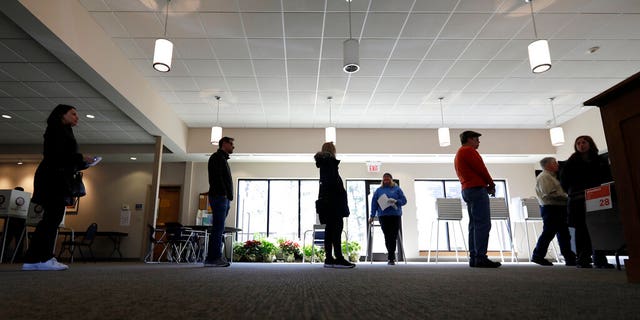
Evanston residents line up for voting at Trinity Lutheran Church
in Evanston, Ill., Tuesday, March 17, 2020. Some polling places in
Evanston have been moved in an effort to reduce exposure of senior
citizens to the COVID-19 coronavirus.(AP Photo/Nam Y. Huh)
Across all states voting on Tuesday, voters said they
believed Biden was better positioned to win in November. Roughly 83
percent of voters in Arizona, Florida, and Illinois felt Biden could
beat President Trump, while only about 62 percent of voters in those
states had the same confidence in Sanders, according to Fox News Voter
Analysis. Meanwhile, Trump easily clinched the Republican
presidential nomination with wins in the Illinois and Florida Republican
primaries, officially dashing the hopes of any of the extreme long-shot
candidates who challenged him in that primary. A total of 441
delegates was at stake in the Democratic primary on Tuesday, and the big
question was whether the coronavirus would affect turnout at the polls.
Some early indications were that turnout in Florida actually may have been higher than 2016 figures. Biden is
moving closer to securing the Democratic presidential nomination but
had faced the possibility of a setback if the older voters who tend to
support him didn't show up. Sanders, meanwhile, couldn't afford to lose
support from young voters who have been his most loyal supporters. In
the end, Biden did not appear to suffer any measurable loss of support. Problems
related to the virus scare still reportedly popped up across the
country, including in Florida, the biggest delegate prize of the
evening. In Okaloosa County on the Panhandle, two dozen poll workers dropped out, leaving supervisors scrambling to find replacements. Millions
of voters have already participated in some form of early voting. But
there were some signs on Tuesday that voters — and poll workers — were
staying home. In
Burbank, a small community southwest of Chicago, most of the voting
stations stood empty at 8 a.m., the Associated Press reported. Only 17
people had voted, a pace that officials said was unusually slow. In
Palm Beach County, Florida, 800 volunteer poll workers backed out on
Monday and just 100 new volunteers offered to take their place. In
Illinois, there was a push to relocate about 50 Chicago-area polling
places after locations canceled at the last minute and said they would
not be available for use on Tuesday.
Harold Goodman waits in line to vote in the presidential primary
election at the Supervisor of Elections office, Tuesday, March 17, 2020,
in Delray Beach, Fla. This polling station was made available after
some precincts in Palm Beach County were unable to open after poll
workers did not report to work. (AP Photo/Lynne Sladky)
This may be the last batch of primaries for weeks --
at least of primaries featuring in-person voting -- should states
holding upcoming contests continue to push them off. Leaders in
Ohio called off their primary just hours before polls were set to open
as the federal government urged Americans not to gather in groups of 10
or more and asked older people to stay home. The state's Democratic
Party said it was weighing options for challenging that move, which was
pushed by the Republican governor. Georgia has delayed its primary
from March 24 to May 19, and Louisiana from April 4 to June 20.
Additionally, Maryland has moved its April 28 primary to June 2, and
Kentucky has pushed its primary from May 19 to June 23. The Democratic National Committee (DNC) has reportedly warned that states that delay their primaries past June 9 could face a hefty delegate penalty -- angering some commentators who call the ultimatum reckless given the threat posed by coronavirus. “The
right to vote is the foundation of our democracy, and we must do
everything we can to protect and expand that right instead of bringing
our democratic process to a halt,” DNC chairman Tom Perez said in a
statement. He is urging states to expand options like voting by mail in
upcoming contests.
Sylka Edmondson talks with a senior citizen at the Lakefront
Community Center, an Ohio polling center, Tuesday, March 17, 2020, in
Euclid, Ohio. Ohio called off its presidential primary just hours before
polls were set to open there and in three other states, an 11th-hour
decision the governor said was necessary to prevent further fueling the
coronavirus pandemic that has paralyzed the nation. Edmondson was
handing out food to senior citizens. (AP Photo/Tony Dejak)
The tumult surrounding the virus has left the primary
campaign in a state of suspended animation, but Sanders currently faces
an increasingly tough path to the nomination. The coronavirus outbreak
and its impact on the primary calendar could only amplify calls for
Sanders to drop out of the race. About half of the delegates in
the Democratic primary have already been awarded and, with Biden looking
at another big night Tuesday, he will pad an already large and perhaps
insurmountable lead. Biden's
quest for his party's nomination now seems within reach. He needs less
than half of the remaining delegates to become the nominee. Fox News' Victoria Balara, Kimberly Anderson, Paul Steinhauser, and The Associated Press contributed to this report.
BANGKOK
(AP) — With borders slamming shut, schools and businesses closing and
increasingly drastic restrictions on movement in place, tens of millions
of people were hunkered down Tuesday, heeding government calls to
isolate themselves and slow the spread of the new coronavirus.
From Southeast Asia to Europe to the Americas, people found their lives upended by lockdowns and social distancing.
Shoppers
in Malaysia stood in long lines to stock up at picked-over
supermarkets. Commuters in the Philippines waited in huge traffic jams
at checkpoints set up to take their temperatures before entering the
capital city. Officials in seven San Francisco Bay Area counties issued a
sweeping shelter-in-place mandate, ordering millions of residents to
stay at home and go outside only for food, medicine and outings that are
absolutely essential.
The
cancellations of treasured holidays and community events continued to
build, with Thailand saying it was calling off its water festival in
April and the organizers of the so-called “most exciting two minutes in
sports”— the Kentucky Derby — reportedly prepared to announce the delay
the horse race for the first time since World War II.
Fresh
moves to contain the virus came even as Wuhan, the central Chinese city
where the virus was first detected late last year and which has been
under lockdown for weeks, reported just one new case on Tuesday.
The
fronts in the battle have clearly shifted outside China, with its
caseload now outnumbered by those outside its borders. And Spain is now
the fourth-most infected country, surpassing South Korea, where new
cases have been subsiding.
With
the number of cases worldwide topping 181,000, a surge of patients in
Madrid’s hospitals fueled worries across Europe of what lies ahead.
Pleas went out to funnel masks and ventilators to places struggling with
soaring caseloads.
“There
is no easy or quick way out of this extremely difficult situation,”
Mark Rutte, the prime minister of the Netherlands, said in the first
televised speech by a Dutch premier since 1973.
The
virus causes only mild or moderate symptoms, such as fever and cough,
for most people, but severe illness is more likely in the elderly and
people with existing health problems. More than 79,000 people have
recovered from the illness.
Nevertheless
a growing sense of crisis has roiled financial markets. Shares reversed
early losses in Asia on Tuesday after the U.S. stock market plunged to
its worst day in more than three decades and huge swaths of many
economies came to a standstill as businesses and travel shut down due to
the outbreak.
Only
China, Italy and Iran have more infections than Spain, where the number
increased by roughly 20%, to 9,191 and fatalities rose to 309,
according to the Spanish Health Ministry. It switched to a new reporting
system, so the actual number may be higher.
A
somber Rutte told viewers “a large part” of the Netherlands’ 17 million
people are likely to contract the virus. So far, 1,413 people have
tested positive and 24 have died. The government closed schools,
restaurants and bars and banned gatherings of more than 100 people.
Countries
from Canada to Switzerland, Russia and Malaysia announced sharp new
restrictions on the movement of people across their borders.
“We
have a window of time at the moment to slow the spread of the virus,”
said Ulrike Demmer, a spokeswoman for Germany’s government, which
reversed its earlier insistence that border controls would not work. It
imposed new limits on crossings with France, Austria, Switzerland,
Denmark and Luxembourg, after German infections increased by more than
1,000 over 24 hours.
Malaysia
banned foreign travel and is allowing only essential services to stay
open. France allowed people to leave home only to buy food, go to work,
or do other essential tasks, restrictions President Emmanuel Macron said
were heightened because people hadn’t complied with earlier guidelines
and “we are at war.”
India
shut down the Taj Mahal to visitors. Most schools and entertainment
facilities were already closed across India, the world’s second-most
populous country with 1.3 billion people.
The
first confirmed cases of COVID-19 were reported in Somalia, which has
one of Africa’s weakest health systems after nearly three decades of
conflict.
As
the pandemic expanded its reach, China and South Korea were trying to
hold their hard-fought gains. China is quarantining new arrivals, who in
recent days have accounted for an increasing number of cases, and South
Korea starting Thursday will increase screenings of all overseas
arrivals.
Infections
have continued to slow in South Korea’s worst-hit city of Daegu. But
there’s concern over a steady rise of infections in the Seoul
metropolitan area, where new clusters have emerged.
Italy
reported another jump in infections, up more than 3,000 to 27,980. With
2,158 deaths — including 349 more in just the last 24 hours — Italy now
accounts for well over a quarter of the global death toll. Cases,
however, slowed in Lombardy, the hardest-hit region.
In
the United States, officials urged older Americans and those with
chronic health conditions to stay home, and recommended all group
gatherings be capped at 50 people. Americans returning from abroad
encountered chaotic airport health screenings that clearly broke all
virus-fighting rules against having packed crowds close together.
School
closings in 56 countries kept more than 516 million students home, the
United Nations said. New York City joined those ranks Monday, closing a
school system with 1.1 million students.
Still, some countries have resisted more stringent measures to contain the virus.
In
Britain, bars and restaurants remained open and there was no ban on
large events. The prime minister’s spokesman said closing schools hadn’t
been ruled out, but “the scientific and medical advice is that that’s
not a step which we should be taking at this point in time.”
A
senior official from South Korea’s Centers for Disease Control and
Prevention, Kwon Jun-wook, urged people to take the virus seriously and
follow recommended precautions.
“In
a similar way to how the Sept. 11 attacks completely changed people’s
perception about security, quarantine authorities like us believe the
daily lives of all the people around the world will be changed because
of COVID-19,” Kwon told a briefing Tuesday. “From now on, if you are
sick, you should voluntarily rest to prevent a spread to others.”
___
Associated
Press journalists Aritz Parra in Madrid, Adam Geller in New York, Mike
Corder in Amsterdam, Jovana Gec in Belgrade, Frank Jordans in Berlin,
Jill Lawless in London, Colleen Barry in Milan, Italy, Ken Moritsugu in
Beijing, Kim Tong-hyung and Hyung-jin Kim in Seoul, South Korea, Eileen
Ng in Kuala Lumpur, Malaysia, and Sheikh Saaliq in New Delhi contributed
to this report.
___
The
Associated Press receives support for health and science coverage from
the Howard Hughes Medical Institute’s Department of Science Education.
The AP is solely responsible for all content.
The California Legislature approved up to $1 billion in new spending on Monday to combat the coronavirus outbreak, then suspended their work for the next month to try and contain the illness. It
is believed to be the first unexpected work stoppage in the California
Legislature in 158 years, according to Alex Vassar, an unofficial
legislative historian at the California State Library. And it came on
the heels of extraordinary bipartisanship, as Republicans and Democrats
alike voted overwhelmingly to give Gov. Gavin Newsom broad authority to
spend during the crisis without their oversight. “It is a request
to step away from our desks much earlier than we would like. The demands
of public health require it,” Assembly Speaker Anthony Rendon said. The
California Legislature has rarely closed. The Legislature did not miss
meetings during either of the world wars or in the aftermath of the
Sept. 11, 2001, terror attacks. In 2001, when a semi-truck crashed into
the Senate side of the Capitol, the Senate convened right on schedule
about 12 hours later in the Assembly chambers. And last year, when a
woman threw her own blood onto the floor of the state Senate in an act
of protest on the session’s final day, lawmakers reconvened hours later
in a committee room to finish their work. The only time lawmakers
did unexpectedly suspend their meetings was in 1862, when a flood
consumed most of Sacramento and, legend has it, forced newly elected
Gov. Leland Stanford to use a boat to attend his inauguration. Lawamkers
missed a few days before reconvening in San Francisco to continue their
work, according Vassar. In 1919, during a flu pandemic, at least
five lawmakers had symptoms and had to be quarantined. Leaders discussed
whether lawmakers should stop meeting, but eventually decided to
“disinfect the Capitol daily and to keep meeting,” Vassar said. “It is an extremely rare occurrence for the Legislature to stop meeting during the regular session,” Vassar said. Lawmakers
agreed Monday to stay away until April 13. But legislative leaders in
either chamber can decide to reconvene. And they can extend the recess
if necessary. “We will be prepared on a moment’s notice to return
ton address any urgent action that we must take,” Senate President Pro
Tem Toni Atkins said. The legislation approved Monday gives Gov.
Gavin Newsom $500 million to spend “for any item for any purpose”
related to his March 4 declaration of emergency. In the future, Newsom
could increase that spending by increments of $50 million — but only if
he tells lawmakers about it three days in advance. The spending is
capped at $1 billion. “By taking this action we are placing an
extraordinary degree of trust in Gov. Gavin Newsom. However, these are
extraordinary times,” said Republican Assemblyman Jay Obernolte. A
separate bill would make sure public schools that closed because of the
outbreak don’t lose funding. It would also allocate $100 million to
schools for “personal protective equipment” or to pay for “supplies and
labor related to cleaning.” State law bans lawmakers from voting
on bills unless they have been available for public review for at least
three days. But lawmakers can waive that law if the governor asks them
to. Newsom did that on Monday. “Today I write to you to state the
obvious: we must rise to the challenge facing our state with every tool
at our disposal and without a second of delay,” Newsom wrote in a letter
to the Legislature. “We cannot hesitate to meet this moment.” Lawmakers overwhelmingly voted to approve his request. Lawmakers
were in action on Monday while most other entities in California were
closed. Sunday, Newsom urged everyone 65 and older to stay home.
Presumably, that order included the 25 lawmakers in the state
Legislature who are older than 65. Assemblyman Jose Medina, 66,
said he was already on a plane headed to Sacramento on Sunday when
Newsom asked people 65 and older to stay home. He attended Monday’s
Assembly session, saying he thought his constituents would “appreciate
that we are still doing the work of the state of California.” “It’s
nothing that I would take lightly, and I think that most folks my age
and older are taking it seriously,” said Medina, a Democrat who
represents Riverside. But 73-year-old Assemblyman Bill Quirk
stayed home. He lives in a retirement community in the San Francisco Bay
Area with his wife. While the two of them are healthy, many of their
neighbors are not. “If
I were to bring home the coronavirus, 20 people could die, or maybe
even 40,” Quirk said. “Some people think they are really important and
they should always be working. And I can tell you I’m not so important
that we can even risk one life here, period.”
No candidates in sight – no campaigning – and no canvassing. Welcome to the first presidential primary during a pandemic in modern times. Voters
in three states will briefly head to the polls with trepidation on
Tuesday - with the country facing an unprecedented crisis as the coronavirus has forced most Americans to self-isolate in their homes in hopes of stemming the spread of the outbreak. CORONAVIRUS: WHAT YOU NEED TO KNOW On primary eve – Ohio’s
governor used an emergency order to postpone his state’s contest after
the Centers for Disease Control (CDC) urged against any gatherings
nationwide of 50 people or more. “We cannot conduct this election tomorrow,” Gov. Mike DeWine stressed. While the polls will be closed in Ohio, contests in Arizona, Florida, and Illinois – will go forward on Tuesday. And that could give Democratic presidential nomination front-runner Joe Biden a chance to deliver a potential knockout blow to Sen. Bernie Sanders – who’s fighting to avoid elimination from the White House race. “This primary is far from over,” Sanders stressed in an email to supporters on the eve of the March 17 contests. But in reality – the progressive senator from Vermont who’s making his second straight bid for the Democratic nomination is watching his window fast close. The
self-described democratic-socialist was the front-runner in the race
for much of February – thanks to a partial victory in Iowa’s caucuses,
an outright win in New Hampshire’s primary, and a shellacking of the
rest of the Democratic field of contenders in Nevada’s caucuses. But over the last two and a half weeks, Sanders has watched Joe Biden zoom past him in the race for the presidential nomination.
Following a landslide win in South Carolina’s primary and sweeping
victories in the coast-to-coast Super Tuesday states as well as last
week’s mini Super Tuesday, the former vice president
cemented his position as the unrivaled front-runner and has taken a
commanding lead over Sanders in the all-important race for convention
delegates. At the same time, Biden’s seen a tidal wave of support
and endorsements from current and former members of Congress, governors
and state lawmakers and party rainmakers – as centrists, moderates, and
the party establishment have all coalesced around the former vice
president in hopes that they’ve found the contender who can take out
President Trump in Novembers general election. The public opinion
polls in all four states voting Tuesday indicate Biden enjoying large
double-digit leads. And Sanders lost all four of the states four years
ago to eventual 2016 nominee Hillary Clinton. With
219 pledged delegates at stake, Florida’s the biggest prize. Illinois
has 155 delegates up for grabs, followed by Ohio at 136 and Arizona with
67. While Sanders scored points at Sunday night’s Democratic
presidential nomination debate – he didn’t deliver a knockout blow to
Biden that was needed to change the primary narrative that the
independent senator’s living on borrowed time. If Tuesday’s
primaries deliver another round of decisive victories by Biden, the
chorus of calls for Sanders to step aside will grow louder. But Biden
will still be short of the 1,991 pledged delegates needed to clinch the
nomination. And with the primary calendar grinding to a halt after
Tuesday's contests due to the coronavirus pandemic - there’s the
possibility that Sanders could stay alive in a race that will be frozen
in time.
Former White House physician Dr. Ronny Jackson praised President Trump Monday night after he announced a list of guidelines that he and the White House coronavirus task force hoped will slow the spread of the pandemic within 15 days. "The president has done everything he needed to do in this case," Jackson told "Hannity". "He’s acted quickly and decisively. He did what he always has done ... he went with his instincts." "He
put together a top-notch team and he was criticized.... despite that,
he carried on and did what he needed to do for our country. He put the
[China] travel ban in place," he added. Jackson
said he does not expect the virus to spread at the rate that it has in
places like Italy and Iran due to the president's "quick and decisive
actions," notably his decision to restrict travel into the U.S. from
China in late January. "What’s going on in Italy and Iran is not
going to happen here I think, because of the president's quick and
decisive actions. I think we are going to be more in line with what’s
going on in South Korea and things of that nature," Jackson said. He
continued, "We are going to see that we got on it early ... the
president stopped it quickly and it’s going to save countless
American lives. I am proud that he’s acted so quickly and decisively in
all of this." Jackson also praised the coronavirus task force assembled by the president, and urged the public to "follow their instructions."
"...The president stopped it quickly and it’s going to save countless American lives." — Dr. Ronny Jackson
"We are going to be okay," he said. Asked
to comment on the lack of tests available to the public, Jackson
defended the administration, and called it just one example "of some of
the regulations in government that the president has been getting rid
of."