Presumptuous Politics

Saturday, March 28, 2020

Virus infections top 600,000 worldwide, long fight ahead


BERLIN (AP) — The number of confirmed coronavirus infections worldwide topped 600,000 on Saturday as new cases stacked up quickly in Europe and the United States and officials dug in for a long fight against the pandemic.
The latest landmark came only two days after the world passed half a million infections, according to a tally by John Hopkins University, showing that much work remains to be done to slow the spread of the virus. It showed more than 607,000 cases and a total of over 28,000 deaths.
While the U.S. now leads the world in reported infections — with more than 104,000 cases — five countries exceed its roughly 1,700 deaths: Italy, Spain, China, Iran and France.
ADVERTISEMENT
“We cannot completely prevent infections at this stage, but we can and must in the immediate future achieve fewer new infections per day, a slower spread,” German Chancellor Angela Merkel, who is in quarantine at home after her doctor tested positive for the virus, told her compatriots in an audio message. “That will decide whether our health system can stand up to the virus.”
The virus already has put health systems in Italy, Spain and France under extreme strain. Lockdowns of varying severity have been introduced across Europe, nearly emptying streets in normally bustling cities, including Paris where drone photos showed the city’s landmarks eerily deserted.
Merkel’s chief of staff, Helge Braun, said that Germany — where authorities closed nonessential shops and banned gatherings of more than two in public — won’t relax its restrictions before April 20.
Spain, where stay-at-home restrictions have been in place for nearly two weeks, reported 832 more deaths on Saturday, its highest daily total yet, bringing its total to 5,690. Another 8,000 confirmed infections pushed that count above 72,000.
Doctors, nurses and ambulance drivers in its worst-hit regions are falling ill at an alarming rate and working nonstop. More than 9,000 health workers in the country have been infected.
“We are completely overwhelmed,” said ambulance medic Pablo Rojo at Barcelona’s Dos de Maig hospital. “Seven or eight (patients transported today) and all with COVID-19. ... And the average age is decreasing. They’re not 80 years old anymore, they are now 30 and 40 years old.”
“Sometimes you become a bit paranoid, you don’t know any more when you pick up the phone if you have cleaned your hands, if you’ve sanitized them or not. You touch your face with your hands,” Rojo said.
Spain has struggled to get coronavirus tests and protective gear for health workers. The government has started flights to transport the supplies directly from China to reduce waiting times.
As the epicenter has shifted westward, the situation has calmed in China, where some restrictions on people’s lives have now been lifted. Six subway lines restored limited service in Wuhan, where the virus first emerged in December, after the city had its official coronavirus risk evaluation downgraded from high to medium on Friday. Five districts of the city of 11 million people had other restrictions on travel loosened after their risk factor was downgraded to low.
For most people, the coronavirus causes mild or moderate symptoms, such as fever and cough that clear up in two to three weeks. But for others, especially older adults and people with existing health problems, the virus can cause more severe illness, including pneumonia, and lead to death.
More than 130,000 people have recovered, according to Johns Hopkins’ tally.
In one way or another, the effects of the COVID-19 outbreak have been felt by the powerful and the poor alike.
On Friday, British Prime Minister Boris Johnson became the first leader of a major country to test positive for the virus. He said he would continue to work from self-quarantine.
ADVERTISEMENT
Countries are still scrambling bring home some citizens stranded abroad by border closures and a near-shutdown of flights. On Saturday, 174 foreign tourists and four Nepali nationals on the foothills of Mount Everest were flown out days after being stranded on the only airstrip serving the world’s highest mountain.
In neighboring India, authorities sent a fleet of buses to the outskirts of the capital to meet an exodus of migrant workers desperately trying to reach their home villages during the world’s largest lockdown.
Thousands of people had fled their New Delhi homes after Prime Minister Narendra Modi announced a 21-day lockdown that began on Wednesday and effectively put millions of Indians who live off daily earnings out of work.
In parts of Africa, virus prevention measures have taken a violent turn as countries impose lockdowns and curfews or seal off major cities, with police in Kenya firing tear gas and officers elsewhere captured in mobile phone footage whacking people with batons.
In the United States, New York remained the worst-hit city, but Americans braced for worsening conditions elsewhere, with worrisome infection numbers being reported in New Orleans, Chicago and Detroit.
New Orleans’ sprawling Ernest N. Morial Convention Center, along the Mississippi River, was being converted into a massive hospital as officials prepared for thousands more patients than they could accommodate.
In New York, where there are more than 44,000 cases statewide, the number of people hospitalized with COVID-19 passed 6,000 on Friday, double what it had been three days earlier.
Gov. Andrew Cuomo called for 4,000 more temporary beds across New York City, where the Jacob K. Javits Convention Center has already been converted into a hospital.
The struggle to defeat the virus will take “weeks and weeks and weeks,” Cuomo told members of the National Guard working at the Javits Center.
President Donald Trump invoked the Defense Production Act on Friday, ordering General Motors to begin manufacturing ventilators.
Trump signed a $2.2 trillion stimulus package, after the House approved the sweeping measure by voice vote. Lawmakers in both parties lined up behind the law to send checks to millions of Americans, boost unemployment benefits, help businesses and toss a life preserver to an overwhelmed health care system.
Dr. John Brooks of the U.S. Centers for Disease Control and Prevention warned Americans remained “in the acceleration phase” of the pandemic and that all corners of the country were at risk.
“There is no geographic part of the United States that is spared from this,” he said.
___
Sedensky reported from Philadelphia. Associated Press journalists around the world contributed to this report.
___
Follow AP coverage of the virus outbreak at https://apnews.com/VirusOutbreak and https://apnews.com/UnderstandingtheOutbreak

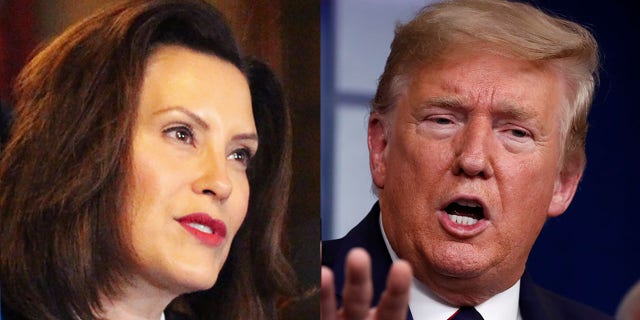
Trump fires back at Michigan’s Whitmer, claims Dem governor ‘doesn’t have a clue’


President Trump took aim at Michigan Gov. Gretchen Whitmer on Friday night, claiming in a Twitter message that the Democrat was “way in over her head” amid the coronavirus outbreak and “doesn’t have a clue.”
As of late Friday, Michigan had more than 2,200 confirmed cases of the virus, ranking fifth in the nation, and had seen at least 43 deaths.
“I love Michigan, one of the reasons we are doing such a GREAT job for them during this horrible Pandemic,” the president wrote. “Yet your Governor, Gretchen “Half” Whitmer is way in over her head, she doesn’t have a clue. Likes blaming everyone for her own ineptitude! #MAGA”
TRUMP SAYS GOVERNORS HAVE TO GET KEY MEDICAL GEAR THEMSELVES, BUT 'WE'RE HERE TO HELP THEM'
The Twitter message followed Whitmer’s accusations Friday that medical-supply vendors were being told “not to send stuff here to Michigan” – and her insinuation that the alleged orders were coming from the Trump administration.
It also followed the 48-year-old first-term governor's previous complaint that Michigan wasn’t receiving “clear directives and guidance” from Washington for handling the outbreak.
Earlier Friday, Trump told reporters during a White House news briefing that he advised Vice President Mike Pence – leader of the president’s Coronavirus Task Force – against communicating with Whitmer, claiming she was among a small group of governors who weren’t being “appreciative” of the Trump administration’s virus response efforts.
“I say, Mike … don’t call the woman in Michigan. I say, if they don’t treat you right, don’t call,” Trump told reporters.
The remark followed previous comments the president made Thursday during an interview with Fox News’ Sean Hannity.
“We've had a big problem with the young, a woman governor,” Trump said. “You know who I'm talking about, from Michigan. We don't like to see the complaints.”
That Thursday remark from Trump drew a Twitter response from Whitmer.
"Hi, my name is Gretchen Whitmer, and that governor is me," Whitmer wrote.
"I've asked repeatedly and respectfully for help. We need it. No more political attacks, just PPEs, ventilators, N95 masks, test kits. You said you stand with Michigan -- prove it."
Whitmer aired more concerns Friday during an interview with Detroit radio station WWJ-AM, according to Crain’s Detroit Business.
"When the federal government told us that we needed to go it ourselves, we started procuring every item we could get our hands on," Whitmer told WWJ. "What I've gotten back is that vendors with whom we had contracts are now being told not to send stuff here to Michigan. It's really concerning.”
Whitmer then doubled down on her claim during an appearance on CNN, Crain’s reported.
"We've entered into a number of contracts and as we are getting closer to the date when shipments are supposed to come in, they're getting canceled or they're getting delayed," Whitmer said. "We've been told they're going first to the federal government.”
Earlier in the week, Whitmer complained that Michigan wasn’t receiving “clear directives and guidance from the federal government” on how to handle the crisis.

The coronavirus outbreak has sparked tension between Michigan Gov. Gretchen Whitmer and President Trump.

The coronavirus outbreak has sparked tension between Michigan Gov. Gretchen Whitmer and President Trump.
“Frankly, a patchwork strategy of each state doing what they can, we’re going to do it if we need to, but it would be nice to have a national strategy," she said, according to MLive.
Whitmer claimed that if the Trump administration had focused on the pandemic sooner, Michigan and the U.S. would "be in a stronger position right now."
"Lives will be lost because we weren't prepared," she said.
Also on Friday, President Trump signed a more than $2 trillion legislative package intended to provide extensive relief to workers and businesses as they deal with the coronavirus outbreak.
In addition, the president named his trade adviser, Peter Navarro, to direct implementation of the Defense Production Act, which gives the president the authority to direct manufacturers to produce medical supplies such as ventilators.

Friday, March 27, 2020

Townhall Cartoons


US cases now most in world, US capital sees more infections

A police officer chases a man who violated the lockdown downtown Johannesburg, South Africa


TORONTO (AP) — The United States’ caseload of coronavirus infections surged to the most in the world and its capital reported more infections, as Italy shut most of its industry and masses of Indian day laborers received food rations after a lockdown put them out of work.
Increases in the number of cases have been expected as testing becomes more available. The U.S. passed China with more than 85,000 cases, and Italy also exceeded 80,000, the three countries together accounting for almost half of the world’s infections from the new virus.
Most of China’s patients have recovered, while places where the virus arrived later are now dealing with overwhelmed hospitals and supply shortages and are rushing to convert public spaces for treating the sick.
Washington, D.C., confirmed 36 new cases Thursday, raising its total to 267. The district is under a state of emergency, its major attractions like the Smithsonian museums and National Zoo closed and White House and Capitol tours cancelled. Police have blocked off streets, bridges and traffic circles to prevent crowds coming to see Washington’s blooming cherry blossom trees.
The stay-home order for India’s 1.3 billion people threw out of work the backbone of the nation’s economy — rickshaw drivers, fruit peddlers, cleaners and others who buy food from whatever they can earn in a day. The government announced a $22 billion stimulus to deliver monthly rations to 800 million people.
In some parts of India, people got rice rations or bank deposits from local authorities, and aid groups were working to expand their reach. The nation’s vital and massive train system was also halted, and jobless workers are now attempting to walk hundreds of miles to their home villages from India’s major cities.
Deaths from COVID-19 have surpassed 24,000, more than a third of them in Italy, according to a Johns Hopkins University tally. The U.S. had about 1,300 deaths, almost a quarter of them in New York City, where hospitals are overwhelmed.
In China, where the virus was first believed to have jumped from wild animals to humans, the National Health Commission on Friday reported 55 new cases, including 54 it said were imported infections in recent arrivals from overseas. Once again, there were no new cases reported in Wuhan, the provincial capital where the coronavirus emerged in December. China is barring most foreigners from entering as it tries to curb imported cases.
The economic damage of the pandemic was growing. Italy shut down most of its industry, and a record-shattering 3.3 million Americans applied for unemployment benefits in a single week.
Companies in Europe are laying off workers at the fastest pace since 2009, according to surveys of business managers. And the U.S. is bleeding jobs as well: The number of Americans applying for unemployment benefits last week was nearly five times the old record, set in 1982.
ADVERTISEMENT
Dann Dykas, 37, of Portland, Oregon, was laid off from his job helping design and set up displays for trade shows.
“Everything is so surreal,” he said. “I can’t even get an interview for another job, and we now have to worry more about being careful and taking care of ourselves.”
Wall Street rallied for the third straight day after an unprecedented $2.2 trillion economic rescue package to help businesses, hospitals and ordinary Americans pull through the crisis won passage in the Senate. The rescue plan, which is expected to be voted on in the House on Friday, would dispense checks of $1,200 per adult and $500 per child.
Elsewhere around the world, South Africa, with the most industrialized economy in Africa, began a three-week lockdown Friday. The country is already in recession, with an unemployment rate of 29%.
And Britain unveiled another relief effort, this time aimed at the gig economy, many of whose workers are facing financial ruin. The government will give the self-employed grants equal to 80% of their average profits, up to 2,500 pounds ($2,975) per month.
The outbreak has put huge pressure on foreign students, especially those at universities in North America and Europe.
Zoey Wang recently returned home to the southwestern Chinese city of Chengdu after her in-person classes and exams at the University of Toronto in Canada were cancelled. Her parents’ desire to have her home and the possibility of high medical costs if she became sick persuaded her to make the arduous return trip, she said.
Some on Chinese social media have attacked returning students for bringing “poison” into the country after its months-long fight to contain the virus, but Wang said that was unfair.
“It’s not like everyone is deliberately returning because they were infected,” Wang said. “People should remember that when the outbreak happened in China, international students were sending masks and other items.”
Wang flew from Toronto to Taipei, Taiwan, then from Taipei to Chengdu. The Chengdu leg was packed; everyone wore masks, most people donned goggles and gloves, and a few were garbed in full-body protective suits.
When she arrived in Chengdu, she was required to take a COVID-19 test and stay in a hotel for two nights until her results came back negative. Only then was she allowed to return to her own home for quarantine. Every day, a government neighborhood committee worker comes to take her temperature.
In other developments:
— New York state’s death toll jumped by 100 in one day, pushing the number to 385. Gov. Andrew Cuomo added that the number will increase as critically ill patients who have been on ventilators for several days succumb. “That is a situation where people just deteriorate over time,” Cuomo said.
— Saudi Arabia is locking down the capital, Riyadh, and Islam’s two holiest cities, Mecca and Medina, in addition to a nationwide curfew. In the United Arab Emirates, authorities announced an overnight weekend lockdown and used drones to tell people to stay home.
— The leaders of the Group of 20 major industrialized nations met in a video summit and vowed to work together to confront the crisis but made no specific commitments.
— In Brazil, the country’s governors are defying President Jair Bolsonaro over his call to reopen schools and businesses, dismissing his argument that the “cure” of widespread shutdowns is worse than the disease. As of Thursday, the country had more than 2,500 cases and 59 deaths.
— A U.S. soldier stationed at a camp near Seoul is the second case among U.S. service members in South Korea.
— Singapore has begun penalizing people who refuse to adhere to social distancing in the latest bid to curb the virus. Anyone not maintaining a distance of 1 meter (3.3 feet) from another person in a public place such as a shopping center or shopping mall can be jailed up to six months or fined up to Singapore dollars 10,000 ($7,000) or both.
For most people, the coronavirus causes mild or moderate symptoms, such as fever and cough that clear up in two to three weeks. For some, especially older adults and people with existing health problems, it can cause more severe illness, including pneumonia and death.
Of the world’s 532,000 confirmed cases, more than 122,000 people have recovered, according to the Johns Hopkins tally.
___
Associated Press journalists around the world contributed to this report.

Pelosi 'jiu-jitsu' claim on coronavirus relief all wrong, McCarthy says: 'She held the bill up'


House Speaker Nancy Pelosi is being disingenuous about her role in crafting the $2 trillion coronavirus aid package, House Minority Leader Kevin McCarthy said Thursday night.
"I know it is her birthday, but it does not give her the right to lie," McCarthy, a California Republican, said on Fox News' "The Ingraham Angle" on the day that Pelosi, a San Francisco Democrat, turned 80 years old.
"Ninety-nine percent of this bill was already decided on Sunday -- she held the bill up," McCarthy added.
MCCONNELL ADMONISHES PELOSI OVER CORONAVIRUS AID BILL: 'I WISH SHE'D TURN OFF THOSE POLITICAL TALKING POINTS'
Pelosi claimed in earlier remarks that she and other House Democrats had "performed jiu-jitsu on" the bill, preventing Republicans from making it a piece of "corporate first" legislation.
She claimed Democrats succeeded in shifting the bill's direction toward a "democratic, workers-first legislation."
McCarthy added that nearly 3.3 million Americans filed jobless claims this week, while Democrats "held up" the bill, which was being crafted to provide relief.
He also slammed Pelosi for trying to insert provisions enacting parts of the Green New Deal, giving millions to Planned Parenthood, transforming election law, granting money to sanctuary cities, and giving a handout to the Kennedy Center for the Performing Arts in Washington.
"That is what she was requesting -- that is what we kept out," he said, adding that during bipartisan negotiations, the provision giving $24 million to the Kennedy Center remained in the bill.
"[The Kennedy Center funding] is her 'jiu-jitsu'," he said.

Trump downplays worst-case coronavirus scenarios: 'I don't believe you need 40,000 or 30,000 ventilators'


President Trump expressed skepticism Thursday night that the worst-case coronavirus pandemic scenarios would come to pass in the U.S., telling Fox News' "Hannity" that "I have a feeling that a lot of the numbers that are being said in some areas are just bigger than they're going to be."
"I don't believe you need 40,000 or 30,000 ventilators," Trump told host Sean Hannity, an apparent reference to New York Gov. Andrew Cuomo's recent claim that the state needed 30,000 ventilators. "You know, you go into major hospitals sometimes and they'll have two ventilators and now all of a sudden they're saying, 'Can we order 30,000 ventilators?'"
The president also hammered two Democratic governors after they criticized the federal government's response to the pandemic.
"The first line of attack is supposed to be the hospitals and the local government and the states -- the states themselves," Trump said. "We have people like [Washington state] Governor [Jay] Inslee -- he should be doing more."
Trump went on to mock Inslee as a "failed [2020] presidential candidate" who is "always complaining."
The Associated Press reported Thursday that Inslee implored Trump on a private conference call with governors from both parties to use executive authority to ramp up production of necessary medical equipment. But Trump said the federal government is merely the “backup.”
“I don’t want you to be the backup quarterback, we need you to be Tom Brady here,” Inslee reportedly replied, invoking the football star and Trump friend.
Trump also criticized Michigan Gov. Gretchen Whitmer, telling host Sean Hannity "she's not stepping up."
"I don't know if she knows what's going on but all she does is sit there and blame the federal government," Trump said. "She doesn't get it done and we send her a lot. Now she wants a declaration of emergency and we have to make a decision on that. But Michigan is a very important state."
Earlier this week, Whitmer demanded "clear directives and guidance from the federal government."
“Frankly, a patchwork strategy of each state doing what they can, we’re going to do it if we need to, but it would be nice to have a national strategy," she said, according to MLive.
Whitmer claimed that if the administration had focused on the pandemic earlier, Michigan and the U.S. would "be in a stronger position right now."
"Lives will be lost because we weren't prepared," she said.
Late Thursday, Whitmer tweeted in response to Trump, saying: "I've asked repeatedly and respectfully for help. We need it. No more political attacks, just PPEs, ventilators, N95 masks, test kits. You said you stand with Michigan - prove it."
Trump did praise New York's Cuomo in another regard, saying the two have had constructive talks and correspondence over the past few weeks.
He also discussed his hope that parts of the U.S. economy would begin returning to normal by Easter Sunday.
"The end result is, we've got to get back to work," Trump went on. "And I think we can start by opening up certain parts of the country ... certain parts of the Midwest, other places" where the outbreak has been less acute.
Trump also ruled out canceling the Republican National Convention, which is scheduled to take place in Charlotte, N.C. in August, telling Hannity "no way I'm going to cancel the convention."
In addition, the president dismissed criticism from his likely 2020 opponent, former Vice President Joe Biden, who called Trump racist earlier this year after the president issued an order halting the entry of foriegn nationals into the U.S. from China.
"I had Biden calling me xenophobic -- yet he can't define the word," Trump said, joking that Biden called the H1N1 epidemic during the Obama-Biden administration the "N1H1" plague.

Ahead of coronavirus stimulus vote, House lawmakers concerned Rep. Massie may trigger delay


Furious lawmakers voiced serious concerns on Capitol Hill late Thursday that a Republican House member could “go rogue” and possibly scuttle a vote on the $2 trillion coronavirus stimulus package, and potentially endanger other House members in the process, Fox News has learned.
Fox News is told there is deep worry on both sides of the aisle that Rep. Thomas Massie, R-Ky., could try to sidetrack House plans to quickly approve the coronavirus bill via a “voice vote” -- a verbal exercise in which those in favor shout yea, and those opposed holler nay. The loudest side would prevail.
“It’s the Thomas Massie show,” said one senior Republican source who asked to not be identified.
“He is going to do it,” a senior Republican leadership source told Fox News, explaining that leadership had tried every type of arm twisting -- and it's not working. The source said he was actively calling members and telling them to get on planes in the morning to come back to Washington, so that a quorum of 216 members could be established if Massie or another member were to demand one.
The source explained that Massie got a very forceful call from a close confidant and member of the House Freedom Caucus urging him to allow the voice vote, but Massie won’t budge. “We have been riding [House Speaker Nancy] Pelosi for stalling things, and now this,” the source lamented.
Asked whether the House leadership was concerned about others besides Massie, another source replied, “There are others who are egging him on.”
“He had better not do that!” screamed one livid senior House Democratic aide into the phone when asked about such a scenario and Massie. “He’s going to make everyone in the building get [coronavirus].”
A senior administration source declined to comment to Fox News when asked if the Trump administration made efforts to curb any potential parliamentary mischief by Massie.
“A lot of members are pi--ed off,” one source said. “If we don’t have a quorum on tomorrow, we’ll definitely have one by Saturday.”
The 880-page coronavirus stimulus package would amount to the largest economic relief bill in the history of the U.S. for individuals, large corporations, and small businesses -- and its unanimous passage in the Senate came despite grave concerns on both sides about whether it involved too much spending, or not enough.
Massie did not respond to multiple requests for comment from Fox News late Thursday. It was unclear exactly why he may want to delay the bill, which some lawmakers have said contains too much wasteful spending -- including $25 million for the John F. Kennedy Center for the Performing Arts in Washington, D.C.

Rep. Thomas Massie, R-Ky., seen here in 2015, did not immediately comment. (Bill Clark/CQ Roll Call, File)

Amid the confusion, House Majority Leader Steny Hoyer, D-Md., distributed a floor schedule late Thursday saying the House will convene at 9 a.m. ET Friday, and there will be two hours of debate. "Members are advised that it is possible this measure will not pass by voice vote," the schedule reads.
"Members are encouraged to follow the guidance of their local and state health officials, however if they are able and willing to be in Washington D.C. by 10:00 a.m. tomorrow, Members are encouraged to do so with caution," Hoyer's schedule continues.
“You might have one grandstander,” President Trump warned at a coronavirus press conference earlier in the day. “It will pass. It will just take a little longer."
Also in the evening Thursday, Fox News spoke to a Republican member who was returning to Washington due to the potential Massie situation. The member expressed shock that there could be delays given that the Senate passed the stimulus bill by a 96-0 unanimous vote.
“I’m coming to D.C. to ensure the bill passes,” the GOP member told Fox News. “It’s frustrating having to be prepared for this scenario. ... I really wish members would put people first and just get this done. Heck, if 100 percent of senators can agree, it’s pretty clear this is going to pass. Only thing a member would be doing is holding it up at great risk to the American people. It’s very troublesome a member of Congress would engage in such a tactic.”
Top Democrats and Republicans have indicated they’d prefer a voice vote because it would not require as many members to return to the Capitol, and would speed a vote along.
However, after the voice vote, any member simply may call for “a recorded vote.” That automatically would trigger the roll call.
That’s where House members insert cards into electronic voting machines and vote either yes, no or present. The House then documents and records the ballot of each member.
"A lot of members are pi--ed off."
— Congressional source, concerning the possibility of a delayed vote
In the event a roll-call vote were to be needed because Massie demands one, leadership could push to delay the vote until Saturday to give members time to travel back to D.C., according to the two congressional sources.
The plan for a roll-call vote is to divide the members into 16 groups of 30 members apiece to file into the chamber “to minimize the risks posed by placing too many individuals in one location,” according to an internal security memo obtained by Fox News.
A "State of the Union"-style extreme posture will be in effect on Capitol Hill on Friday, according to the memo, sent by Capitol Attending Physician Dr. Brian Monahan and House Sergeant-at-Arms Paul Irving to all House members ahead of Friday's coronavirus vote.
“A recorded vote could take five or six hours,” even once all necessary members are back in Washington, one House aide complained. That’s because the House would stretch out the vote, according to the memo, having only members enter the chamber to vote in small clusters to contain the coronavirus risk.
Most votes in the House have taken about 20 or so minutes. Votes are sometimes reduced to five or even two minutes if everyone is in the chamber. (The longest vote in House history came on Nov. 23, 2003, and ran 2 hours and 55 minutes. It started at 3 a.m. ET and ended just before 6 a.m. ET on a measure to expand Medicare.)
There could be a deeper problem than the logistics of taking a roll call vote, however. Article I, Section 5 of the Constitution notes that the House and Senate need “a Majority of each shall constitue a Quorum to do Business.”
Massie or any other member could make a point of order -- in which a member asserts that the House or Senate is not operating properly under its own rules -- that the House doesn’t have a quroum. Therefore, the House can't vote if it lacks a quorum. With 430 members, 216 constitutes a quorum.
House Rule XX dictates parameters for establishing quorums in the House of Representatives. Rule XX, Clause 5 (c)(1) deals with the House reducing the number required for a quorum “due to catastrophic circumstances.” But, that rule would eventually trigger the House declaring a number of seats vacant over a period of days, and therefore isn't an option.
In short, the House may have the votes by just a simple majority to pass the coronavirus bill. But if someone makes a point of order about the House lacking a quorum, then leaders will likely have to rustle up 216 members – be that Friday, over the weekend or next week – before the House could vote on the coronavirus bill.
On a conference call with Democrats today, Pelosi, D-Calif., told members the House will vote Friday “if there’s a quorum tomorrow.”
Separately, the security memo also indicated that limited personnel with no extra aides will be permitted at the Capitol. Only one or two persons will be allowed in the elevators at a time, and most will be encouraged to use the stairs, according to the memo.
"Access will be strictly limited to members of Congress, congressional staff who have an office located inside the Capitol and staff who have designated floor access. If a staff person does not have a Capitol office -- even if accompanied by a member -- they will not be permitted inside the Capitol," the memo stated. "Credentialed press will be permitted, as will official business visitors to the House wing."
The document called for members to remain in their offices until voting. The officials are discouraging those “who are ill with respiratory symptoms or fever” from attending.
Officials also are expected to eliminate two of the six lecterns in the House chamber from which members may speak. The officials are asking members to keep away from each other inside the House chamber, and to clean the lectern themselves after they speak.
On a GOP call Thursday afternoon, House Minority Leader Kevin McCarthy, R-Calif., informed Republicans that a GOP member was threatening to request a recorded vote, according to one Republican on the call. The member wasn’t identified.
Democrats are united in favor of a voice vote on the legislation Friday and there was no talk on a caucus call Thursday afternoon that Rep. Alexandria Ocasio-Cortez, D-N.Y., or any other Democrat would try to gum up the process and force a recorded vote, according to a source familiar with the call.
Behind the scenes, Capitol attending physicians, as well as party leaders in the House, have been working to discourage members from coming back to Washington to vote on the package, Fox News has learned.
The not-so-subtle messaging, intended to avoid the unnecessary spread of the contagion, came as the House closed the gym normally available to members.
“That’s to make it as uncomfortable as possible on them,” one source who asked not to be identified told Fox News. “Some of these members practically live out of the gym.”
“Having all of these guys on planes, flying in and then going back spells trouble,” another senior source said.
Fox News is told both sides have been trying to get a head count of how many members may actually show up. One source ventured a guess that it could range from “70 to 150.”
Fox News' Leland Vittert contributed to this report.

Thursday, March 26, 2020

Democratic March 2020 Cartoons


US deaths top 1,000 as $2.2 trillion in virus aid approved


NEW YORK (AP) — U.S. deaths from the coronavirus pandemic topped 1,000 in another grim milestone for a global outbreak that is taking lives and wreaking havoc on economies and the established routines of ordinary life.
In a recognition of the scale of the threat, the U.S. Senate late Wednesday passed an unparalleled $2.2 trillion economic rescue package steering aid to businesses, workers and health care systems.
The unanimous vote came despite misgivings on both sides about whether it goes too far or not far enough and capped days of difficult negotiations as Washington confronted a national challenge unlike it has ever faced. The 880-page measure is the largest economic relief bill in U.S. history.
ADVERTISEMENT
Worldwide, the death toll climbed past 21,000, according to a running count kept by Johns Hopkins University, and the U.S. had 1,050 deaths and nearly 70,000 infections.
Spain’s death toll has risen past 3,400, eclipsing that of China, where the virus was first detected in December, and is now second only to that of Italy, which has 7,500. Lidia Perera, a nurse at Madrid’s 1,000-bed Hospital de la Paz, said more workers were desperately needed. “We are collapsing,” Perera said.
The Spanish parliament voted to allow the government to extend strict stay-at-home rules and business closings until April 11.
Such measures are becoming increasingly common in the U.S., where New York is the epicenter of the domestic outbreak, accounting for more than 30,000 cases and close to 300 deaths, most of them in New York City.
Public health officials in the city hunted down beds and medical equipment and called for more doctors and nurses for fear the number of sick patients will overwhelm hospitals as has happened in Italy and Spain.
A makeshift morgue was set up outside Bellevue Hospital, and the city’s police, their ranks dwindling as more fall ill, were told to patrol nearly empty streets to enforce social distancing.
In Washington, President Donald Trump has called for Americans to dedicate themselves to social distancing for 15 days, including staying home from work and closing bars and restaurants to help try to stall the spread of the disease.
Yet, he has also grumbled that “our country wasn’t built to be shut down” and vowed not to allow “the cure be worse than the problem” — apparently concerned that the outbreak’s devastating effects on financial markets and employment will harm his chances for reelection later this year.
ADVERTISEMENT
“The LameStream Media is the dominant force in trying to get me to keep our Country closed as long as possible in the hope that it will be detrimental to my election success,” Trump tweeted Wednesday.
Democrats say that Trump was prioritizing the economy over the health and safety of Americans.
“I’d like to say, let’s get back to work next Friday,” said Joe Biden, the front-runner for the Democratic presidential nomination. ”That’d be wonderful. But it can’t be arbitrary.”
Biden said the congressional aid package addressing the outbreak “goes a long way,” but that “meticulous oversight” is required.
“We’re going to need to make sure the money gets out quickly into peoples’ pockets and to keep a close watch on how corporations are using the taxpayers funds that they receive, to make sure it goes to help workers, not rich CEOs or shareholders,” the former vice president said.
Brazil President Jair Bolsonaro has also called to reopen schools and businesses, contending a clampdown ordered by many governors will deeply wound the economy and spark social unrest. He called for only high-risk people to quarantine and for governors to lift their stricter measures.
The country’s governors resisted, saying his instructions run counter to health experts’ recommendations and endanger Latin America’s largest population. The rebellion even included traditional allies of Brazil’s far-right president.
Meanwhile, the governor of a state in central Mexico said the poor are “immune” to the coronavirus, even as the federal government suspended all non-essential government activities.
Puebla Gov. Miguel Barbosa’s comment was apparently partly a response to statistics showing that the wealthy, who travel much more, have made up a significant percentage of Mexicans infected to date, including some prominent businessmen. The country has seen six deaths so far.
“The majority are wealthy people. If you are rich, you are at risk. If you are poor, no,” Barbosa said. “We poor people, we are immune.”
Barbosa also appeared to be playing on an old stereotype held by some Mexicans that poor sanitation standards may have strengthened their immune systems by exposing them to bacteria or other bugs.
In other developments:
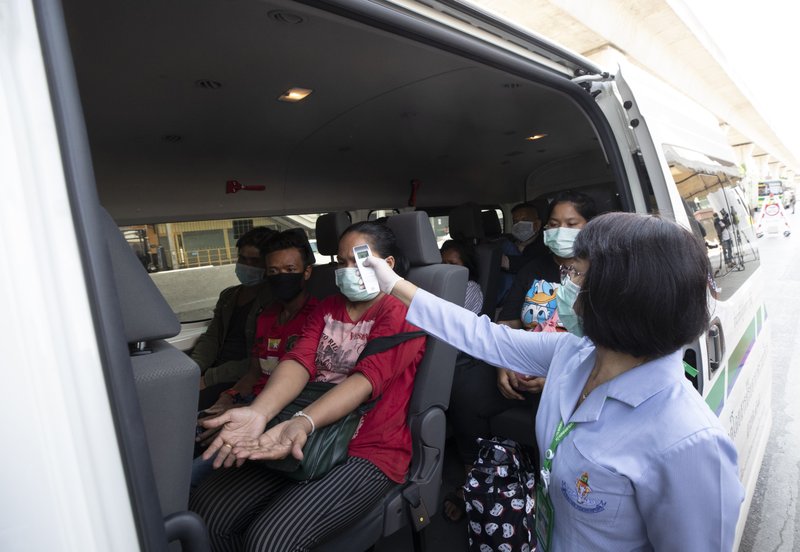
— Thailand’s capital, Bangkok, saw a drastic reduction in crowds and traffic on the first day of a national state of emergency declared to cope with the virus. The elevated Skytrain mass transit system was largely empty during the normal rush hour and a main bus station was quiet after the departure over the past week of many workers whose homes are in rural provinces.
Outside the usually throbbing city, checkpoints were set up to find travelers with symptoms of the disease. The state of emergency allows the government to implement curfews, censor the media, disperse gatherings and deploy the military for enforcement.
— Leaders of four Japaneses prefectures whose residents commute to work and school in Tokyo asked people to avoid non-essential visits to the capital. The calls come a day after Tokyo Gov. Yuriko Koike asked city residents to work from home if possible and avoid going out on the weekend. She said Tokyo is on the verge of a possible explosive increase in infections.
— Pakistani officials said a representative of an Islamic organization spread coronavirus on the outskirts of capital by visiting mosques and going house to house with other clerics. Several clerics and residents are among the 25 people who tested positive in Islamabad. Pakistan’s total of nearly 1,100 cases prompted efforts to persuade the country’s more than 200 million people to stay home.
— Pakistan’s giant neighbor, India, began enforcing the world’s largest coronavirus lockdown, a gargantuan task of trying to keep 1.3 billion people indoors. Official assurances that essentials wouldn’t run out clashed with people’s fears that the disease toll could soon worsen, gutting food and other critical supplies.
— Beginning Friday, South Korea will enforce 14-day quarantines on its nationals and foreigners with long-term stay visas arriving from the United States. It already applies to arrivals from Europe. South Koreans can be sued and foreigners expelled for failing to heed the order.
— China’s National Health Commission says its 67 new COVID-19 cases were all in recent arrivals from abroad. Once again, there were no new cases reported in Wuhan, the original epicenter of the illness and which remains under some restrictions until April 8. The government is trying to restart the world’s second-largest economy as its cases subside. Of the more than 81,000 people infected, more than 74,000 have been released from treatment, while just under 4,000 remain in care.
— British Prime Minister Boris Johnson said more than 400,000 people responded within a day to the government’s call for volunteers to help the country’s most vulnerable people.
— The Pentagon halted for 60 days the movement of U.S. troops and Defense Department civilians overseas, a measure expected to affect about 90,000 troops scheduled to deploy or return from abroad.
For most people, the coronavirus causes mild or moderate symptoms, such as fever and cough that clear up in two to three weeks. For some, especially older adults and people with existing health problems, it can cause more severe illness, including pneumonia and death.
___
Long reported from Washington. Associated Press journalists around the world contributed to this report.

When bad news is personal: Journalists, politicians fighting the virus


For millions around the globe waking up Wednesday, the big news was that Prince Charles has the coronavirus.
His symptoms are said to be mild, and the prince is believed to have gotten the virus from his high number of public engagements, during which he would try to stop himself and remember not to shake hands.
But for me, the news is that an old colleague, David Von Drehle, has mild to moderate symptoms, battling “waves of fever, I was drifting half in and half out of sleep. I was wearing a down jacket with the hood cinched around my head. I was buried under the covers, teeth chattering.” He’s “thankful” that it’s not worse.
And that another old colleague, Anne Kornblut, is fighting the disease, “telling my kids to back away from me, while informing them that this scary thing upending the entire planet is now inside our house. Inside their mom. My daughter cried and asked if I will get better. I couldn’t hug her.”
It’s not that these people are more deserving of sympathy because they’re journalists. Doctors, nurses, hospital staffers, police officers, even retail clerks are the ones on the front lines, their stories mostly untold. Journalists have a platform, of course, but they and their families are coping just like everyone else. The thing about this virus is that it doesn’t care if you are a working stiff, a prince, or a movie star.
The difference for me is that I know some of these people, and that wipes away the abstractions. It’s how so many of us felt when Tom Hanks and his wife got the virus in Australia (though I’ve only met the actor once, for a brief interview). When Andrew Cuomo tells the administration that he needs 26,000 more ventilators or that many people will die, it’s hard to wrap your head around such a figure. When people at your own news organization get the virus --as have six Fox News staffers in New York, now under self-quarantine --it hits home.
Von Drehle, with whom I shared a small New York office many years ago and later sat nearby in a Washington newsroom, now lives in Kansas City.
“I did not travel during the outbreak,” the former Washington Post editor and Time reporter says in his Post column. “I don’t mix in large groups. (On second thought, there was a college basketball game.) I earn my living by solitary work from my own home, and I adopted every recommended hygiene and distancing technique weeks before the president took the pandemic seriously. Bottom line: I don’t know where I picked it up. It’s everywhere.”
Dave says he hears people on TV all day talking about testing, but there was no testing in his area. A kind ER doctor listened to his lungs in a hospital parking lot, said he probably has the virus and told him to come back if he got worse.
“It’s going to be a race now to see whether I can finish this column before I pass out,” Von Drehle writes.
Kornblut, a longtime Washington Post reporter and editor, is now a Facebook executive living in California. After a trip to New York, she says on her page, “I had to get in bed and go to sleep. It hit me like a truck.”
Her son wrote up the development for their home newspaper: “Anne Kornblut has the coronavirus but do not worry it is not the bad kind. Please note that you should not be within ten feet of Anne.”
Kornblut says the health department “called to inform me to stay away from everyone, including my children. So who should take care of them if my husband tests positive, too? ‘We haven’t had that scenario yet,’ the public health nurse said.”
Her husband has since tested positive for the virus.
I was even harder hit by news yesterday that Alan Finder, a retired New York Times editor and reporter and onetime City Hall bureau chief, has died from the virus.
He was extremely gracious to me when I was a rookie reporter decades ago at New Jersey’s Bergen Record. Smart, savvy and a terrific writer, he was always generous and someone I looked up to.
Times reporter Kevin Sack tweeted that Finder was “a terrific reporter, a calming presence and, as anyone who knew him will attest, one of the menschiest guys around. RIP.”
I also know people in the world of politics who have been affected. Amy Klobuchar revealed that her husband, John Bessler, has the virus, and was hospitalized in Virginia after registering “very low oxygen levels.” The senator and former presidential candidate told MSNBC that “you can't go and visit your loved one. I would love to be at my husband's side right now.”
I’ve interviewed another former presidential candidate, Rand Paul, numerous times. He has come under sharp criticism from some fellow lawmakers because he continued to work for six days, including a visit to the Senate gym, after being tested for the virus, though he self-quarantined as soon as he got a positive result.
In a column for USA Today, Paul said he sought a test, even though that was not recommended by health officials, because he’d been traveling extensively and had part of his lung removed seven months ago:
“For those who want to criticize me for lack of quarantine, realize that if the rules on testing had been followed to a T, I would never have been tested and would still be walking around the halls of the Capitol.”
There are, as I mentioned, so many individual stories among the 60,000 confirmed virus cases in America. The Washington Post, to its credit, spotlighted some of them:
The Rev. Jadon Hartsuff, an Episcopal priest in D.C., who first felt drained after a Sunday service.
Mike Saag, an infectious disease doctor in Alabama, who developed a cough and was bone-tired.
Ritchie Torres, a New York City councilman from the Bronx, whose ordeal began with a general sickly feeling. “It is psychologically unsettling to know I am carrying a virus that could harm my loved ones,” he says.
Indeed, this entire crisis has been psychologically unsettling. It’s that way for journalists looking at the struggles of other journalists, health workers looking at the struggles of other health workers, or all of us, as Americans, looking at the suffering in our country. Even if those bearing the brunt aren’t royalty.

CartoonDems