Presumptuous Politics

Monday, March 30, 2020

Mnuchin lays out when Americans can expect their coronavirus rescue package checks


"We expect that within three weeks that people who have direct deposit information with us will see those direct deposits in their bank accounts," he said. "And we will create a web-based system for people where we don’t have their direct deposit they can upload it, so that they can get the money immediately as opposed to checks in the mail."
Individuals are eligible for payments up to $1,200, but that decreases for those who earn an adjusted gross income of more than $75,000 a year. The bill says that the payment is reduced by five percent of every dollar above that mark, or $50 for every $1,000 above $75,000.
CLICK FOR LATEST UPDATE ON CORONAVIRUS
Mnuchin told "Fox News Sunday" that he believes that by the third quarter of 2020, Americans will see an economic recovery with production and employment levels back up.
"I don’t know what the numbers are gonna be this quarter. What I do think is, we are gonna kill this virus," Mnuchin said. "We’re gonna re-open this economy. And in the third quarter of this year, you’re gonna see this economy bounce back with very large GDP numbers and low unemployment back to where we were beforehand."

Trump says coronavirus 'peak in death rate' likely in 2 weeks, extends social-distancing guidelines through April 30


Speaking at a contentious White House coronavirus news briefing on Sunday that involved testy standoffs with multiple reporters, President Trump declared that "the peak in death rate" in the coronavirus pandemic "is likely to hit in two weeks," and said the federal government will be extending its social-distancing guidelines through April 30.
"The modeling estimates that the peak in death rate is likely to hit in two weeks. I will say it again. The peak, the highest point of death rates, remember this, is likely to hit in two weeks... Therefore, we will be extending our guidelines to April 30, to slow the spread," the president said in the White House Rose Garden.
Saying his earlier hope that the country could reopen by Easter was "just an aspiration," Trump added: "We can expect that by June 1, we will be well on our way to recovery" and that "a lot of great things will be happening."
When asked about worst-case scenarios if the country were to remain closed indefinitely, the president responded, "You're gonna have large numbers of suicides -- tremendous [numbers of] suicides... You will see drugs being used like nobody has ever used them before, and people are going to be dying all over the place."
On a positive note, Trump went on to say that "two of the country's largest health insurers -- Humana and Cigna -- have announced that they will waive copays, coinsurance, and deductibles for coronavirus treatments."

President Donald Trump speaking during a coronavirus task-force briefing in the Rose Garden of the White House on Sunday. (AP Photo/Patrick Semansky)

In response to a question at the briefing, Dr. Anthony Fauci, the director of the National Institute of Allergy and Infectious Diseases, reiterated his estimate from earlier in the day that it remained possible that 100,000 to 200,000 people could die in the United States. "What we’re trying to do is not let that happen," he said, calling the extension of social-distancing guidelines "a wise and prudent decision." Over 2,300 people with the virus already have died in the U.S.
"Models are good, but models often generate the kind of anxious question you asked," Fauci said, when a reporter asked how bad the situation could become. "A model is as good as the assumptions you put into the model, and very often, many of these assumptions are based on a complexity of issues that aren't necessarily the same... from one country to another."
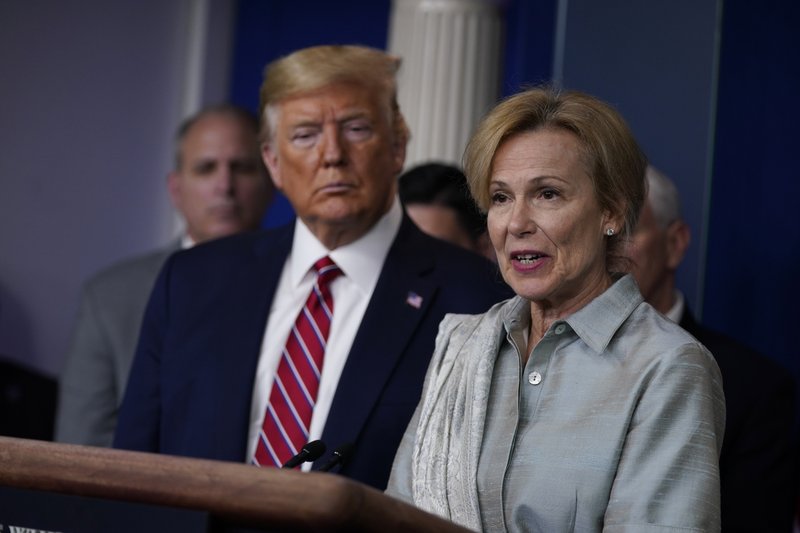
Fauci said the April 30 extension came after he, Dr. Deborah Birx and other members of the task force had made the recommendation.
"Why don't you people act a little more positively -- it's always get-you, get-you."
— President Trump, to PBS News reporter
Trump said he'd seen early estimates that 2.2 million people could have died if the government had done nothing in a worst-case scenario, so "if we can hold that down to 100,000" or less, it would be a "good job." Had the country simply ridden the virus "like a cowboy" and driven "that sucker right through," the president insisted, disaster would have unfolded.
Separately, Trump openly questioned why the demand for surgical masks has skyrocketed in New York City and elsewhere, urging assembled reporters that they "oughtta look into it" because "something's going on."
The head-turning moment came just hours after Trump touted the sky-high ratings for the events on social media, and shortly after New York City Mayor Bill de Blasio urged his constituents not to "look back" on his prior statements downplaying the coronavirus.
"How do you go from 10 to 20 to 30,000, to 300,000 [masks] -- even though this is different," Trump asked. "Something is going on, and you ought to look into it as reporters. Where are the masks going? Are they going out the back door? How do you go from 10,000 to 300,000? And, we have that in a lot of different places. So, somebody should probably look into that. I just don’t see from a practical standpoint how that's possible to go from that to that, and we have that happening in numerous places."
Pressed on the matter later at the briefing, Trump called on New Yorkers to "check" Gov. Andrew Cuomo and de Blasio, both Democrats, about the changing mask numbers. "People should check them, because there's something going on." He asserted that it could be "something worse than hoarding."
Cuomo said earlier this month that some people were stealing medical supplies. "Not just people taking a couple or three, I mean just actual thefts of those products," Cuomo said. "I've asked the state police to do an investigation, look at places that are selling masks, medical equipment, protective wear, feeding the anxiety." Nevertheless, a CNN "fact-check" reporter, among others, accused Trump of making his claim without "evidence."
Furious nurses staged protests outside of Jacobi Hospital’s emergency room in the Bronx over the weekend, claiming there was a dangerous shortage of masks and gloves there. Sean Petty, a pediatric nurse at the hospital, told the New York Post: 'We need billions of N95 masks. This policy that was put out by the [Centers for Disease Control and Prevention] is killing nurses. We already lost our first nurse in New York City. We’re gonna lose more.”
Trump remarked that "many of the states are stocked up" on various critical supplies including ventilators -- although, he added, "some don't admit it." Later, Trump suggested that "there's a question as to hoarding of ventilators" in which some hospitals may be keeping the devices in case of a major problem in the future.
Also at the briefing, Trump unloaded after PBS News' Yamiche Alcindor -- a frequent Trump antagonist who previously has asked numerous questions during coronavirus briefings about whether an unnamed administration official really used the term "Kung Flu" --  began with another critical query about Trump's past comments to Fox News on New York's demands or ventilators.
Specifically, Alcindor accused Trump of saying that governors were requesting equipment they "don't actually need." In fact, Trump said that in some cases, "equipment's being asked for that I don't think they'll need" by the end of the pandemic. Alcindor doubled down when Trump pushed back on her characterization of his comments.
"Why don't you people act a little more positively -- it's always trying to get-you, get-you, get you," Trump responded. "And you know what? That's why nobody trusts the media anymore. That's why you used to work for the Times and now you work for somebody else. Let me tell you something: Be nice. Don't be threatening. Be nice."
That confrontation prompted another wave of sympathy for Alcindor among left-wing journalists. Alcindor herself complained on social media that she was unfairly victimized by the president. ("I’m not the first human being, woman, black person or journalist to be told that while doing a job," she wrote.)
Minutes later, Trump tusseled with CNN reporter Jeremy Diamond, who alleged the president had definitively said on Friday that he'd cut off communications with governors who weren't appreciative of his coronavirus efforts. Trump shot back that Washington state's governor, Democrat Jay Inslee, was a "nasty" person, and reiterated that Vice President Mike Pence would remain in open communications even with hostile governors.
"Your statement is a lie," Trump said flatly. Trump slammed Diamond for omitting a portion of Trump's quote in which Trump said governors and local officials needed to appreciate the broader federal disaster relief effort, not just Trump's own initiatives.
"We lift up their ratings, because their ratings are very low," Trump said, explaining why CNN had sent Diamond to the briefing even though some network figures have expressed open disdain for the president.
"I’m well aware that Trump has made plenty of mistakes handling this crisis," wrote The National Review's Alexandra DeSanctis after the briefing."I’d just like to know how the media baiting him and alternating between throwing themselves pity parties and patting each other on the back improves that situation. These Gallup numbers [showing declining media popularity] are not a fluke."
For the most part, however, the president largely sounded positive notes as to practical developments over the past 24 hours of the crisis.
In addition to the waived copays and deductibles, Trump touted "some interesting" therapeutics that "will be announced over the next few weeks." He said he has been working on getting a system that could sterilize health-care workers' masks up to 20 times more quickly approved by the Food and Drug Administration.
Trump went on to praise the U.S. Army Corps of Engineers and Federal Emergency Management Agency [FEMA] for turning New York City's Javits Center into a makeshift emergency hospital.
"It's an incredible, complex, top-of-the-line hospital. Everyone's trying to figure out how they did it," Trump said, noting that he was also unsure. "And, I was a good builder."
The president maintained distance from other speakers at the briefing, and referenced social-distancing guidelines as soon as he took to the podium.
"Appreciate everybody being here -- beautiful day in the Rose Garden," Trump remarked as the press conference began. "Tremendous distance between chairs."
"We're all in this together -- all us of us," Trump said at the conclusion of the briefing. "I've never seen anything like it. It's a beautiful thing to watch. Unfortunately, the enemy is death, so it's very unpleasant. But, the level of competence, the level of caring, the level of love -- I just think it's brilliant. ... I'm very proud to be your president."

Sunday, March 29, 2020

March Madness 2020 Cartoons


The Latest: Jim Edmonds has pneumonia, awaiting virus tests


The Latest on the effects of the coronavirus outbreak on sports around the world:
___
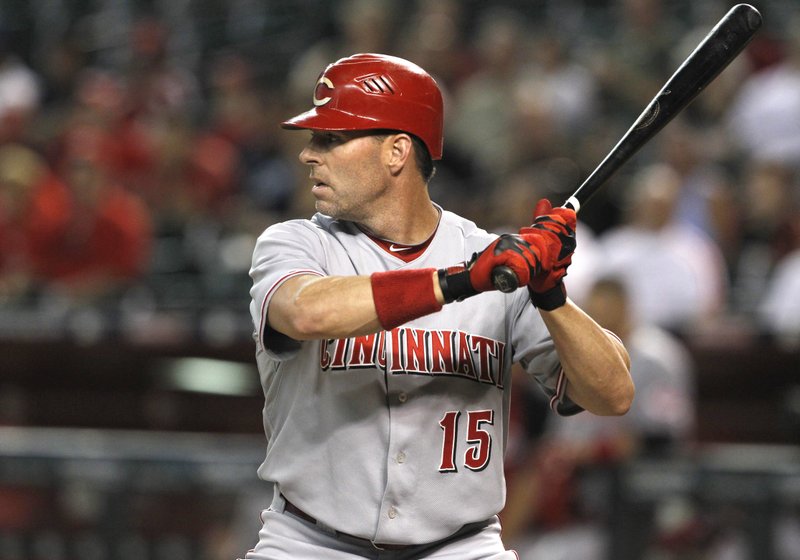
Former All-Star outfielder Jim Edmonds announced on his Instagram page that he went to the hospital to be tested for the coronavirus after displaying some symptoms.
The 49-year-old Edmonds sent a video update Saturday night on his Instagram Story saying he was back home after testing positive for pneumonia for the first time in his life, but was awaiting results of tests for the coronavirus.
“I’m just trying to rest up and get better,” Edmonds said, adding that he’d provide an update when he heard from doctors.
ADVERTISEMENT
Earlier Saturday, Edmonds posted a photo of himself in a hospital room with a facemask covering his nose and mouth.
“Held off as long as I could,” he wrote on the post. “I thought I was tough enough to get through. This virus is no joke. #gethealthy.”
He said he was feeling “super sick” and added that he wasn’t “taking any chances because it’s so hard to get tested by the rules of the CDC.”
Edmonds played 17 seasons in the majors, mostly with the Los Angeles Angels and St. Louis Cardinals. He won eight Gold Glove awards, and finished with a .284 career batting average with 393 home runs and 1,199 RBIs. Edmonds also helped the Cardinals win the World Series in 2006. He also played for the San Diego Padres, Chicago Cubs, Milwaukee Brewers and Cincinnati Reds late in his career before retiring in 2011.
___
Canadian hockey goalie equipment manufacturer Brian’s Custom Sports has begun producing medical supplies for hospitals in and around southwestern Ontario.
The company in Kingsville was originally approached by public health officials about its surplus of double-sided tape and foam. But when the Ontario government closed nonessential businesses to help stop the spread of COVID-19, the company was asked to change its production.
Now its 15-person sewing team is producing medical gowns for front-line medical workers for Windsor-Essex EMS.
___
Clemson quarterback Trevor Lawrence and his girlfriend have restarted their efforts to raise money for those affected by the new coronavirus.
They announced their decision Saturday on social media.
The two had set up a GoFundMe page earlier this week until told by Clemson compliance officials the site violated NCAA rules against using an athlete’s name, image and likeness for crowd funding. But the NCAA said Tuesday that Lawrence and other athletes could use such sites to raise money in this case.
ADVERTISEMENT
Lawrence’s girlfriend, Marissa Mowry, is a soccer player at Anderson University, about 15 miles from Clemson’s campus.
They created the “Trevor Lawrence and Marissa Mowry COVID-19 Relief Fund” designed to provide direct assistance to families affected by the pandemic.
___
The Colorado Avalanche say a second player has tested positive for the new coronavirus.
The team said it was informed Friday night and the player is in self-isolation.
In their statement Saturday, the Avalanche say those who came in close contact with the player have been informed and remain isolated.
The team says no other Avalanche player or staff member has shown symptoms at this time.
The unidentified player has become the fourth known NHL player to test positive for the virus. The other two are with Ottawa.
___
Two-time Grand Slam champion Naomi Osaka says she is disappointed that the Olympics in her native Japan were postponed because of the coronavirus pandemic, but she supports the decision to delay the Summer Games to 2021.
In a posting Saturday on social media, she said she’s “been thinking about how to articulate my thoughts on this for a couple of days now.”
The decision to push back the games from July and August 2020 until sometime next year was announced Tuesday.
Osaka wrote: “Sport will eventually unite us again and be there for us always, but that time is not now.”
She also addressed “the people of Japan,” where she was born, saying, “stay strong, hang in there and let’s show the world our beautiful country when the time is right.”
The 22-year-old Osaka figures to be one of the most-watched stars in Tokyo, given that she represents the host country and is a medal contender in tennis. She won the 2018 U.S. Open and 2019 Australian Open and became the first player from Asia to reach No. 1 in the singles rankings.
___
An A-League soccer player has become the first Australian professional footballer to test positive for the new coronavirus.
The unnamed player, who plays for the Newcastle Jets in New South Wales state, was tested Friday as a precaution before an international flight. He played in recent A-League matches against Brisbane and Melbourne City.
The player is now in quarantine and the A-League is suspended at least until April 22.
Jets chief executive Lawrie McKinna said the player is asymptomatic and in good health. McKinna said the rest of the squad does not “need to get into isolation” but are being monitored.
___
Soccer players and celebrities will take part in a global music festival on Saturday organized by the Spanish league in order to raise funds for the fight against the coronavirus.
Barcelona’s Gerard Piqué, Real Madrid’s Sergio Ramos and Sevilla’s Jesús Navas will be among the players involved in the charity event organized to raise money “for the purchase of medical supplies in the battle against the COVID-19 pandemic and to also support fans confined to their homes during the current period of quarantine,” the league said.
Celebrities in the festival will include singers Aitana, Alejandro Sanz, Beret and Luis Fonsi, actress Danna Paola, music bands Morat and Taburete, and tennis star Rafael Nadal.
The soccer players and celebrities will all participate from their homes. The concert is to be shown live through the league’s international broadcasters and streamed via YouTube and Facebook.
The “music extravaganza” will be broadcast in more than 180 countries simultaneously, starting at 1700 GMT (1 p.m. EST).
___
Barcelona has delivered 30,000 masks to the Catalonia government to help fight the coronavirus pandemic.
The masks were made in China and donated by insurance company Taiping, a regional partner of the club.
Barcelona said the “daily use” masks will be distributed to nursing homes.
The club added it is working through its foundation “to do as much as possible to help with this crisis, both locally and internationally.”
Spain, where stay-at-home restrictions have been in place for nearly two weeks, reported 832 more deaths on Saturday, its highest daily count yet, bringing its total to 5,690. An additional 8,000 confirmed infections pushed that count above 72,000.

US-led forces pull out of 3rd Iraqi base this month

U.S. soldiers stand guard during the hand over ceremony of Qayyarah Airfield, Iraqi Security Forces, in the south of Mosul, Iraq early Friday, March 27, 2020. Iraq's military on Thursday said at least two rockets hit inside Baghdad's heavily fortified Green Zone, the seat of Iraq's government and home to the American Embassy, in the first attack following a brief lull in violence from earlier this month. (AP Photo/Ali Abdul Hassan)

BAGHDAD (AP) — The U.S.-led coalition withdrew on Sunday from a military base in northern Iraq that nearly launched Washington into an open war with neighboring Iran.
The K1 Air Base is the third site coalition forces have left this month in line with U.S. plans to consolidate its troops in two locations in Iraq.
A rocket attack on the base in late December killed one American contractor and lead to a series of tit-for-tat attacks between the U.S. and Iran-backed Iraqi militia groups. The attacks culminated in the U.S.-directed killing of top Iranian general Qassim Soleimani and senior Iraqi militia leader Abu Mahdi al-Muhandis.
ADVERTISEMENT
Coalition forces handed over the K1 air base in the northern Iraqi province of Kirkuk to Iraq’s military, according to a coalition statement. At least $1.1 million of equipment was transferred to the Iraqis as 300 coalition personnel departed.
K1 has hosted coalition forces since 2017 to launch operations against the Islamic State group in the nearby mountainous areas. Areas south of Kirkuk, and north of neighboring provinces of Diyala, Salahaddin and Nineveh remain hot beds of IS activity.
The stretch of territory is also disputed between the federal Iraqi government and the autonomous Kurdish region, which has created security gaps benefiting IS militants. The coalition’s presence had at times been a mediating presence between the two competing authorities.
A senior coalition official earlier this month claimed IS forces weren’t as able to exploit the “security gap” between Iraqi and Kurdish forces as the militants did in the past.
“That doesn’t necessarily mean that Daesh is free to operate in the way that they wish,” said the official, using the Arabic acronym for the IS group. “They’re still pretty constrained.”
The coalition official was speaking on condition of anonymity in line with regulations.
U.S.-led forces have already withdrawn this month from Qaim, near the border with Syria and Qayara base, in Nineveh earlier. All were in line with plans to pullout from bases across Iraq and consolidate coalition forces in Baghdad and at Ain al-Asad Air Base in the country’s western desert.
The plan has been in the works since late last year, the senior coalition military official said, and accelerated when Iraqi forces proved they were capable of facing the threat from the IS with limited coalition assistance.
Coalition officials said they would still assist Iraqi forces with air support and surveillance, but significantly cut back on training and ground operations, as the limited withdrawal continues.
Until last month, there were some 7,500 coalition troops based in Iraq, including 5,000 U.S. forces.


Democrats fret as Joe Biden becomes ‘irrelevant’ in coronavirus crisis


Just days after his commanding primary victories in Florida, Arizona and Illinois, the coronavirus has turned former Vice President Joe Biden into a virtual prisoner of his Delaware home, where he’s reduced to sniping at President Trump from the family rec room.
“He’s making himself irrelevant,” Saikat Chakrabarti, a former chief of staff to Queens Rep. Alexandria Ocasio-Cortez, told The Post, saying the virtual broadcasts were not helping. “We need action immediately, and Biden can’t do anything real right now.”
“He’s making himself irrelevant. We need action immediately, and Biden can’t do anything real right now.”
— Saikat Chakrabarti, former chief of staff to Rep. Alexandria Ocasio-Cortez
Biden has been forced to watch from the sidelines as President Trump steals the spotlight with daily coronavirus briefings that have been a ratings smash.
Though some experts have criticized the president for spreading inaccurate information and promoting untested antibiotics during his briefings, polls suggest Americans are increasingly pleased with his performance handling the deadly pandemic.
The latest findings from Gallup show the president with a 49% approval rating, approaching a career high he last enjoyed in February during the height of his Senate impeachment trial. The same survey found 60% of Americans now approve of his handling of the coronavirus crisis, including more than a quarter of Democrats.
“I think Trump is being seen as handing the pandemic well by the public even though he was too late to start procuring any [personal protective equipment],” Chakrabarti said, explaining the polling bounce, adding that Biden missed his moment to make an impression. “[Trump] is the only one going up every day and talking to the American people.”
“[Trump] is the only one going up every day and talking to the American people.”
— Saikat Chakrabarti, former chief of staff to Rep. Alexandria Ocasio-Cortez
Sen. Bernie Sanders — whose challenge to Biden for the 2020 Democratic presidential nomination  is sagging — has been in D.C. helping to hammer out trillions of dollars in coronavirus relief spending. The 78-year has also held several in depth coronavirus town halls via Facebook Live.
But Biden has gone nearly dark. Aside from a call with reporters, and a virtual live-stream appearance at a fundraiser on Sunday, the ex-vice president reappeared on television on March 24.
And his appearances have not gone smoothly.
On his first day back on the air, Biden sat for an interview with CNN’s Jake Tapper. During the brief Q&A, Biden coughed repeatedly into his fist shortly after telling the anchor he had no symptoms of coronavirus and had not been tested. At one point Tapper even scolded the vice president for not directing coughs into his elbow.
The coughing came along with the usual Biden word salads. On “The View” that same day, the former veep told guest co-host Sara Haines that “we have to take care of the cure. That will make the problem worse no matter what.”
He also had an emotional moment during a virtual CNN town hall Friday talking about personal loss and almost gave out his telephone number on live television.
Many Democrats and armchair pundits have unflatteringly compared Biden’s performance with Gov. Cuomo, who has won praise from both sides of the aisle for his smooth command of facts, regular virus updates and tough, no-nonsense approach to defiant New Yorkers. The fervor peaked as the hashtag #PresidentCuomo zipped across Twitter last week.
“He is currently the only Democrat showing leadership in a moment of crisis, at least publicly,” Chakrabarti said. “Cuomo is doing the daily press conference, he’s leading in a way that President Trump was.”
Reps for Biden’s campaign declined to comment for this story.
Though the pandemic has prevented Biden from deploying his famous retail political skills, his campaign has tried to remain active, putting out a blizzard of press statements including his own “action plan to save the economy.”
He’s made overtures to the base even while in isolation, including checking in to DJ D-Nice’s “Club Quarantine” party on Instagram last week and making a virtual appearance on “Jimmy Kimmel Live!” Thursday.
The campaign is also confident Trump will ultimately botch the coronavirus response.
“Donald Trump’s failure to take this virus seriously in the face of urgent and obvious warning signs will go down as one of most incompetent and ultimately harmful decisions by a president in recent history,” a Biden aide told The Post.
Biden continues to hold a small but enduring lead over Trump in national head-to-head polls, with recent surveys from Emerson, Monmouth and NBCNews/WSJ all showing him out front. A Fox News polls this week gave him a 9 point lead.
Other Democrats said Trump’s 60 percent coronavirus rating should be taken with a grain of salt.
“During the Iran Hostage crisis, Carter had a 67 approval. For a leader in a time of crisis this is a pretty crappy rating. The Bushes both had 90s at one time,” Democratic strategist James Carville told The Post. “I think Biden will win easily. I don’t think it will be particularly close.”

Cuomo threatens lawsuit over Rhode Island crackdown on virus-fleeing New Yorkers


New York Gov. Andrew Cuomo is threatening to sue Rhode Island over its new coronavirus policy that calls for police to stop cars with New York license plates and has seen National Guard members go door-to-door to ask if anyone has arrived from the Empire State.
Rhode Island Gov. Gina Raimondo -- like Cuomo, a Democrat -- announced the drastic new policies last week to limit the spread of the coronavirus. New York is the epicenter of the outbreak in the U.S., confirming more than 52,000 cases of COVID-19 and recording more than 700 deaths.
"I understand the goal ... but there’s a point of absurdity, and I think what Rhode Island did is at that point of absurdity," said Cuomo. “We have to keep the ideas and the policies we implement positive rather than reactionary and emotional.”
"There’s a point of absurdity, and I think what Rhode Island did is at that point of absurdity."
— New York Gov. Andrew Cuomo
RHODE ISLAND HUNTING DOWN NEW YORKERS SEEKING CORONAVIRUS REFUGE
Andrew Cuomo D-N.Y.,  is threatening to sue Rhode Island after Gov. Gina Raimondo D-R.I., issued the drastic new policies to limit the spread of the virus
He added that he believes the two governors could "work it out."
Raimondo said the policies were intended to make sure people from New York would self-quarantine for 14 days upon arrival in Rhode Island.
“I want to be crystal clear about this: If you're coming to Rhode Island from New York you are ordered into quarantine," she said. "The reason for that is because more than half of the cases of coronavirus in America are in New York."
“I want to be crystal clear about this: If you're coming to Rhode Island from New York you are ordered into quarantine."
— Rhode Island Gov. Gina Raimondo
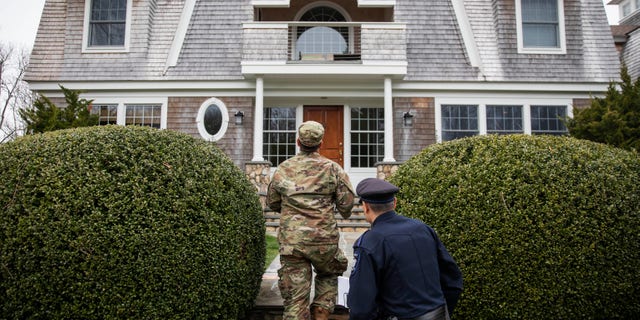
The National Guard started going door-to-door in Rhode Island's coastal area communities on Saturday to inform New Yorkers arriiving in the state about the 14-day quarantine policy.

Rhode Island Air National Guard Sgt. William Randall, left, and Westerly police Officer Howard Mills approach a home in Westerly, R.I., while looking for New York license plates in driveways to inform them of self quarantine orders, March 28, 2020. (Associated Press)

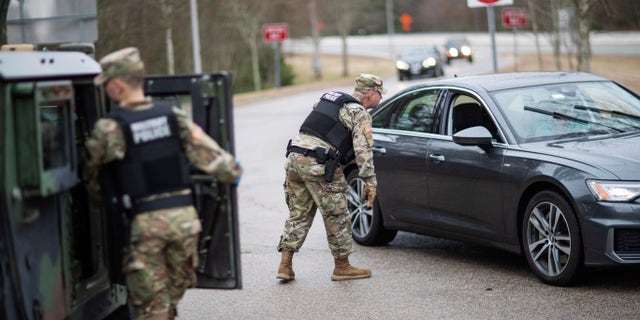
State Police reportedly set up a checkpoint on Interstate 95 in Hope Valley on Friday, where drivers with New York license plates had to stop and provide contact information, WPRI-TV of Providence reported. They were told to self-quarantine for two weeks.
TRUMP SAYS CORONAVIRUS QUARANTINE ON NEW YORK, NEW JERSEY, CONNECTICUT NOT NECESSARY, CDC ISSUES 14-DAY 'TRAVEL ADVISORY'
New Yorkers who fail to comply could face fines and jail time, Raimondo said -- although she added it wasn't the goal of her policy.

A member of the Rhode Island National Guard Military Police directs a motorist with New York license plates at a checkpoint on Interstate 95 in Hope Valley, R.I., March 28, 2020, (Associated Press)

Raimondo also ordered her state's residents to stay at home -- with exceptions for getting food, medicine or going to the doctor. Nonessential retail businesses were told to close from Monday until April 13.
Cuomo also spoke about President Trump considering a quarantine for the New York City metro area before the president ultimately decided against the move.
"It would be chaos and mayhem," Cuomo said, according to The Hill. "It's totally opposite everything he's been saying. I don't think it is plausible. I don't think it is legal."
Trump later tweeted that a travel advisory should be administered and not a quarantine.
The Associated Press contributed to this report

Saturday, March 28, 2020

pandemic and politics cartoons


A walk through town: Families, coronavirus and togetherness


GLEN ALLEN, Va. (AP) — In a quiet suburb just north of Richmond, Virginia, a mother and her three children spend a weekday afternoon planting a small garden of spinach, red cabbage and lettuce. Across town, a dad teaches his kids how to play volleyball on an empty court. In a sprawling park, a father shows his son and daughter the perfect flick of the wrist to skip rocks in a stream.
Similar scenes — idyllic, except for the context — are playing out in communities around the United States. Stuck at home, thrust together, parents and children are navigating the most unsettling of circumstances and finding new ways to connect. This is one community’s story, gathered this week from walks and observations of families keeping to themselves yet still, somehow, managing to remain part of a larger whole.
ADVERTISEMENT
With its top-rated schools, bucolic parks and large collection of shops and restaurants, Glen Allen is the kind of place built for families. The once-rural area is now one of the most sought-after suburbs of Richmond, 11 miles (18 kilometers) northwest of the capital. Its population of just under 15,000 gives it a not-too-big and not-too-small feel, and its proximity to Richmond makes it a prime commuter community.
As in so many other American towns, life here has changed since the coronavirus began to spread. Large gatherings are banned. Schools have closed through the rest of the academic year. Countless businesses are shuttered, at least for the time being.
Neighborhoods and parks that are normally deserted on weekdays are now filled with parents and children, out for a walk, run or bike ride together — carefully maintaining distance, but still clearly part of a community. On Wintercreek Drive, families play games together in their own yards and talk to neighbors over backyard fences, standing back at least 6 feet so as not to risk exposure. In Echo Lake Park, families walk their dogs, smile and nod as they pass other dog walkers on a half-mile nature trail.
In Crump Park, an expansive recreation area with large open fields and an 1860 living history farm, families play together in small groups, dotting the landscape with pods of people — each yards apart from the other, observing social distancing guidelines in the age of coronavirus. A father and his preteen son sit by a pond fishing. Two children ride scooters as their dad walks behind them. A family of four spreads out a blanket and has a picnic.
“All their activities — swimming, basketball, volleyball — they’ve all been canceled. That opens up a lot of free time,” says Dwayne Cook, a 52-year-old mortgage broker who has been taking breaks from working at home to go to the park with his two children, Cameron, 14, and Corinne, 12.
ADVERTISEMENT
Cook says he spent one trip teaching his kids how to skip rocks in a stream. He and his son also had a pull-up contest on the playground.
“It’s nice to be outside, get some sun and leave the phones in the car,” he says.
Fifty yards away, two kites bob high above a hill. Brett and Teresa Hobbs are teaching their two daughters, ages 7 and 11, about the gift of a perfect afternoon breeze.
“For our family, it’s given us more time to talk,” says Teresa Hobbs, a kindergarten teacher.
In a cozy subdivision called Winterberry, Meg and Dan Tully have been trying to come up with ways to balance working at home with schoolwork and the need to keep their three active boys busy. With the school running club shut down, they’ve been taking turns leading the boys on their usual mile run.
Dan Tully, a telecommunications engineering manager, still dresses in business attire for video conferences while working at home. During occasional breaks, he kicks a soccer ball around the yard with his kids. On one recent day off, he and his wife took the boys to a nearly empty Twin Hickory Park and taught them the finer points of spiking and serving a volleyball.
A quarter-mile away, Jamie and Joe Burton and their three children are eating dinner together every night, once a rarity with their busy schedules. Their daughters, 12 and 9, are competitive gymnasts who used to practice five nights a week, while their son had weekly baseball games and practices.
Jamie Burton, a registered nurse, still must go to work. But because the kids are home from school and their extracurricular activities have all been canceled, the family’s lighter schedules have opened up new opportunities for doing things together.
“My oldest daughter said, ‘Mom, I know this is scary and a lot of things are going on in the world. But the one positive I see immediately is that we’re able to spend more family time together,’” Burton says.
Burton’s neighbor Stephanie Owens, a pharmacist, has also continued her usual work schedule. But the kids being home from school has created extra pockets of time. Last week, she, her brother, mother and her three sons — 12, 8 and 3 — all planted a small garden in a corner of their backyard.
“It’s nice to be able to have more time with them,” Owens says. “Usually, it’s get up in the morning, get ready to go to school, do homework at night and go to bed.”
This is, it seems, a case of circumstances helping to double down on a trend that already exists. Liana Sayer, director of the Time Use Laboratory at the University of Maryland, says research shows that parents have been spending more leisure time with their children since the 1970s. She expects that trend to only accelerate as the coronavirus continues to disrupt daily life.
“We have a new set of constraints now — one that is forcing people to spend time together, not keeping them apart in the way that work schedules and school schedule and activities’ schedules did,” Sayer says.
All of this togetherness and free time has been a silver lining in the coronavirus outbreak for many middle-class and affluent families. But it’s hardly universal. Jessica Calarco, a sociology professor at Indiana University, says the crisis hasn’t provided the same opportunities for many working-class families, hourly workers and single parents. They’re wondering how they are going to pay for child care and worrying about losing their jobs as more and more businesses close.
“They don’t have the flexibility to work at home or take an hour out of the middle of the day to take a walk with their kids because of the other types of pressure they may be facing,” Calarco says. “I worry about the inequalities that are resulting from this.”
___
Follow Denise Lavoie on Twitter at http://twitter.com/deniselavoie_ap
___
Check out AP coverage of the virus outbreak at https://apnews.com/VirusOutbreak and https://apnews.com/UnderstandingtheOutbreak.

Virus coordinator Birx is Trump’s data-whisperer


WASHINGTON (AP) — For many in the public health and political worlds, Dr. Deborah Birx is the sober scientist advising an unpredictable president. She’s the data whisperer who will help steer President Donald Trump as he ponders how quickly to restart an economy that’s ground to a halt in the coronavirus pandemic.
Others worry that Birx, who stepped away from her job as the U.S. global AIDS coordinator to help lead the White House coronavirus response, may be offering Trump cover to follow some of his worst instincts as he considers whether to have people packing the pews by Easter Sunday.
ADVERTISEMENT
In coming days, immunologist Birx will be front and center in that debate along with the U.S. government’s foremost infection disease expert, Dr. Anthony Fauci, as well as Vice President Mike Pence. Birx will bring to the discussion what she fondly refers to as her sheet music — data on testing, mortality, demographics and much more.
“What the president has asked us to do is to assemble all the data and give him our best medical recommendation based on all the data,” Birx told reporters. “This is consistent with our mandate to really use every piece of information that we can in order to give the president our opinion that’s backed up by data.”
But will Trump listen?
The president has sent mixed messages on that. He plans to meet with the two doctors and Pence on Monday to review the latest data on the spread of the disease. His administration’s original 15-day guidelines promoting social distancing expire Tuesday.
Over a matter of weeks, Trump has veered from playing down the virus threat to warning Americans it could be summer before the pandemic is under control. And in more recent days, he’s talked eagerly about having parts of the country raring back by Easter in two weeks.
As the president’s message has vacillated, Birx has emerged as one of the most important voices laying out the administration’s pandemic response. She has a way of spelling out the implications of the virus to Americans in personal terms while offering reassurances that the administration is approaching the pandemic with a data-driven mindset.
For most people, the new coronavirus causes mild or moderate symptoms, such as fever and cough that clear up in two to three weeks. For some, especially older adults and people with existing health problems, it can cause more severe illness, including pneumonia, and death.
Former Health and Human Services Secretary Kathleen Sebelius, who helped shepherd Birx’s ambassadorial nomination through the Senate in the Obama administration, said it’s like Birx and Fauci have become a tag team for science in the midst of calamity.
“I can’t imagine how complicated it is to have a boss –- if you will — who insists on saying things on a regular basis that are just not true and aren’t based on any science,” Sebelius said.
ADVERTISEMENT
In her public comments, Birx has taken pains to avoid publicly contradicting Trump when he’s offered some decidedly unscientific riffs, unlike Fauci, a professional mentor, who has been known to push back pointedly.
Instead, her messaging has toggled between providing digestible interpretations of what the data is saying about the spread of the virus and offering relatable pleas to the American public to practice social distancing to help stem the disease.
In recent days, Birx has received praise from Trump backers and pushback from some fellow scientists after she minimized what she called “very scary” statistical modeling by some infectious disease experts.
One study, published this month by Harvard University epidemiologists, found that the need to maintain social distancing remains crucial in the weeks ahead to prevent the American healthcare system from becoming overwhelmed by new cases.
“The scenario Dr. Birx is ‘assuring’ us about is one in which we somehow escape Italy’s problem of overloaded healthcare system despite the fact that social distancing is not really happening in large parts of the US,” Marc Lipsitch, a co-author of the study, wrote on Twitter.
Birx also has drawn criticism for asserting that there are still beds in intensive care units and a “significant” number of ventilators available in hospitals around New York City -- the area hardest hit by virus. That message doesn’t jibe with the dire warnings of city hospital workers, who in recent days have said they’re ill-equipped and in danger of being overwhelmed by patients stricken with the virus.
Birx’s friends and colleagues say she is one of the adults in the room who is providing the president with clear-headed advice and giving Americans the information they need to stay safe.
“She’s a tough cookie,” said Michael Weinstein, who heads the AIDS Healthcare Foundation and got to know Birx professionally after she was named the global AIDS coordinator in 2014. “She’s 100% about the data.”
In the sea of men in dark suits who have been appearing with Trump for daily briefings, the 63-year-old mother of two with a fondness for colorful scarves stands out. Her seemingly endless scarf collection was even fodder for comedian Paula Poundstone recently on the NPR quiz show “Wait Wait...Don’t tell me!”
Birx’s resume is impressive: She is a U.S. Army physician and recognized AIDS researcher who rose to the rank of colonel, head of the global AIDS program at the Centers for Disease Control and Prevention, and a rare Obama administration holdover as the State Department’s ambassador-at-large leading a U.S. taxpayer-funded worldwide campaign to stop the spread of HIV/AIDS.
Birx has also developed a reputation as a tough boss. Some who fall under her watch at the global effort known as PEPFAR have complained that the leadership of her office has been“dictatorial” and “autocratic,” according to a State Department Office of Inspector General audit released earlier this year.
“She has somewhat of a reputation of being a hard task-master,” said John Auerbach, head of the nonprofit Trust for America’s Health.. “She is incredibly hard-working, someone who was driven and would drive other people to work really hard and to do their best work.”
Birx has also been perhaps the most outspoken in calling for Americans to be mindful in how they are interacting with others. And she’s made the case in personal terms.
The doctor says she’s avoided visiting with her young grandchildren as she practices social distancing, and she’s spoken in admiring tones of her two millennial daughters when making the case that younger Americans’ actions will play a key role in determining how quickly the country can contain the virus.
She also has spoken of her grandmother living with a lifetime of guilt, because she caught the flu at school as a girl and, in turn, infected her mother — one of an estimated 50 million people worldwide who died in the 1918 influenza epidemic.
“She never forgot that she was the child that was in school that innocently bought that flu home,” Birx said of her grandmother.
Birx, who declined to be interviewed for this article, told a Christian TV network popular with Trump’s evangelical base that she’s confident that the president is, like her, a student of data.
“He’s been so attentive to the scientific literature and the details and the data,” Birx told CBN. “I think his ability to analyze and integrate data that comes out of his long history in business has really been a real benefit during these discussions about medical issues because in the end, data is data.”

CartoonDems