Friday, April 3, 2020
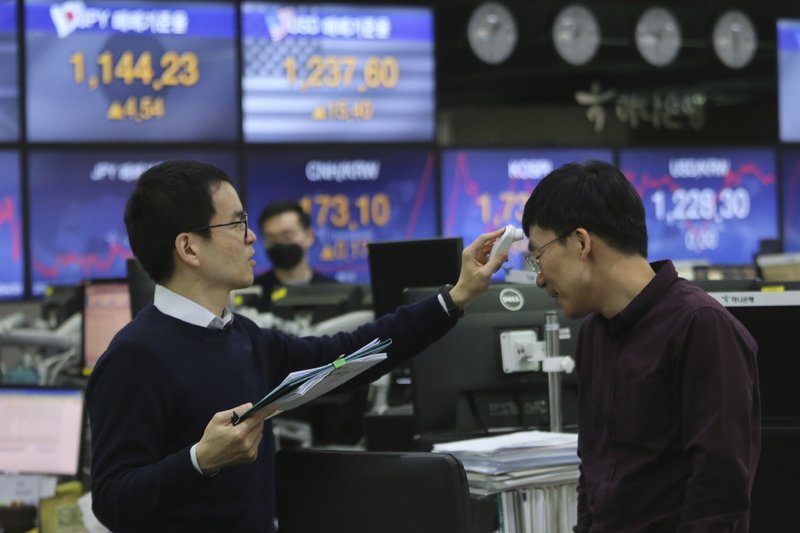
Global stocks down with US jobs, oil rally in focus

BEIJING
(AP) — Global stocks declined Friday after soaring U.S. job losses
tempered enthusiasm about a possible deal to stabilize oil prices amid
anxiety over the global economic decline due to the coronavirus
pandemic.
Markets
in London and Frankfurt traded lower while Shanghai, Hong Kong and
Sydney closed down. Tokyo ended little-changed after spending part of
the day in negative territory.
Some
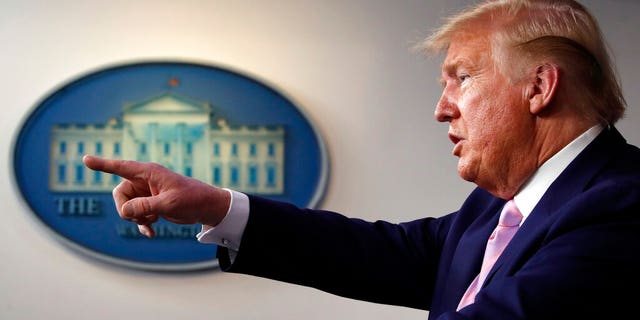
markets followed Wall Street higher after President Donald Trump said
on Twitter he expected major oil producers Saudi Arabia and Russia to
back away from their price-cutting war. But by midday, most Asian
markets had retreated again.
ADVERTISEMENT
U.S.
data showing 6.6 million Americans applied for unemployment this week
were a “hard dose of economic reality,” said Jeffrey Halley of Oanda in a
report.
That
was double the previous week’s record-breaking U.S. job losses of 3.3
million. It raised the total number of Americans who are out of work due
to the coronavirus-driven downturn to almost 10 million.
On
Friday, the government’s monthly jobs report is due and is expected to
show that the American jobs machine came to a sudden halt in March as a
result of the coronavirus. Economists have forecast employers shed about
150,000 jobs and that the unemployment rate rose from a half-century
low of 3.5% to 3.9%, according to FactSet.
In
Europe, the FTSE 100 in London sank 1.1% to 5,420 and Frankfurt’s DAX
shed 0.3% to 9,5537. The CAC 40 in Paris lost 0.9% to 4,182.
On Wall Street, futures for the benchmark S&P 500 index and the Dow Jones Industrial Average were both off 0.9%.
On
Thursday, the S&P 500 gained 2.3% after Trump said he expects
production cuts are coming after talking with Saudi Crown Prince
Mohammed bin Salman. The Dow Jones Industrial Average gained 2.2% and
the Nasdaq rose 1.7%.
In
Asia, the Shanghai Composite Index lost 0.6% to 2,763.99 and Tokyo’s
Nikkei 225 gained 1.5 points to 17,820.19. The Hang Seng in Hong Kong
lost 0.2% to 23,236.11 after falling as much as 0.8% earlier.
The
Kospi in Seoul ended unchanged at 1,725.44 after being down 0.6%.
Sydney’s S&P-ASX 200 declined 1.7% to 5,067.50 and India’s Sensex
lost 1.9% to 27,727.19.
Benchmark
U.S. crude added $1.30 to $26.62 per barrel in electronic trading on
the New York Mercantile Exchange. Brent crude, used to price
international oils, gained $2.32 to $32.26 per barrel in London.
Markets
usually welcome lower energy costs for companies and consumers. But the
abrupt plunge to below $20 this week from $60 at the start of the year
triggered fears heavily indebted producers might default, undermining
credit markets.
On
Thursday, U.S. crude surged $5.01, or almost 25%, to $25.32 per barrel
following Trump’s comments. The Kremlin denied President Vladimir Putin
had talked with the prince but Saudi Arabia called for a meeting of
major producers including Russia.
ADVERTISEMENT
Traders
expect more volatility in financial markets until numbers of new
coronavirus cases begin to decline, which forecasters say might be weeks
away.
The
number of confirmed cases worldwide has topped 1 million, led by the
United States with more than 236,000, according to a tally by Johns
Hopkins University.
More than 51,000 have died, but more than 208,000 have recovered.
For
most people, the coronavirus causes mild or moderate symptoms, such as
fever and cough that clear up in two to three weeks. For some,
especially older adults and people with existing health problems, it can
cause more severe illness, including pneumonia, and death.
The dollar edged up to 108.54 yen from Thursday’s 107.90 yen. The euro declined to $1.0793 from $1.0856.
Dan Crenshaw slams Biden, ex-Obama aide for criticizing US coronavirus response
The global coronavirus outbreak is no time for political sniping.
That’s the message outspoken U.S. Rep. Dan Crenshaw delivered this week to two key members of the Obama administration: former Vice President Joe Biden and former Obama senior adviser Valerie Jarrett.
Biden, the Democratic Party’s leading contender for the presidency, on Wednesday had harsh words for the Trump administration’s response to the COVID-19 crisis.
“It is a national disgrace that our health care workers still don’t have the protective equipment they need,” Biden wrote in a Twitter message.
The Biden tweet coincided with a disclosure from the U.S. Justice Department and Department of Health and Human Services that they were distributing nearly 200,000 N95 respirator masks and other medical supplies to hard-hit New York and New Jersey, after the supplies were seized from hoarders.
Reacting to Biden’s tweet, Crenshaw asserted that national stockpiles could have been better managed when Biden was vice president.
“Remember when you were VP and lived through H1N1 and Ebola?” Crenshaw wrote Thursday. “You could have added more PPE [personal protective equipment] to national stockpiles right? But you didn’t?”
But then Crenshaw made the point that political posturing wasn’t helping the nation address the crisis.
“See how easy it is to finger point? And play the bad-faith blame game?” Crenshaw continued. “Everyone is trying to solve this. These type of comments add nothing.”
Previously, Crenshaw called out Jarrett, after she claimed the U.S. would have been in safer hands had Obama been in charge of the virus response instead of President Trump.
“Someone asked me today how would @BarackObama have handled this crisis?” Jarrett wrote Wednesday. “Answer in one word – Better. OK, two words. Much better.”
Crenshaw, 36, who was elected to Congress in November 2018 after earning a Purple Heart and other honors for his service in Afghanistan as a Navy SEAL, wrote that the timing of Jarrett’s message seemed inappropriate to him.
“Why do so many Obama administration staffers constantly try to make Americans feel awful?” Crenshaw wrote. “Highlighting policy differences is expected – but this level of vitriol? During this pandemic? Why?”
Georgia governor says he only just learned coronavirus carriers can be asymptomatic
Georgia Gov. Brian Kemp said Wednesday that he had just learned this week that the coronavirus can be contagious before people are showing symptoms, citing that fact as part of the reason why he ordered a more strict shelter-in-place order for his state after previously balking on doing so -- yet the White House had said so as early as Jan. 31.
"I think as the reason I'm taking these actions it's like I've continued to tell people I'm following the data, I'm following the advice of Dr. Toomey," Kemp told reporters Wednesday, referencing Dr. Kathleen Toomey, the commissioner of the Georgia Department of Public Health. "Her and I both mentioned in our remarks, you know, finding out that this virus is now transmitting before people see signs so what we've been telling people from directives from the CDC for weeks now that if you start feeling bad, stay home -- those individuals could have been infecting people before they even felt bad."
Kemp, a Republican, continued: "But we didn't know that until the last 24 hours and as Dr. Toomey told me, she goes, 'this is a game-changer for us.'"
But Dr. Anthony Fauci, the director of the National Institute of Allergy and Infectious Diseases and one of the most recognizable faces of the White House coronavirus response, had disclosed that "game-changer" detail in January.
"You know that, in the beginning, we were not sure if there were asymptomatic infection, which would make it a much broader outbreak than what we’re seeing," Fauci said. "Now we know for sure that there are."
Kemp closed all public K-12 schools this week.
The Georgia Department of Public Health released a statement on Thursday that seemed to address and attempt to justify Kemp's Wednesday comments, which have been widely panned online, with one outlet suggesting he's either "lying or incompetent."
"For weeks it has been known that people who were positive for COVID-19 but did not have symptoms likely were able to transmit the virus," the release said. "However, on March 30, Centers for Disease Control and Prevention (CDC) Director Robert Redfield, M.D., confirmed that new data indicates that as many as 25% of individuals infected with COVID-19 remain asymptomatic. Additionally, science also now informs us that individuals who are symptomatic, are infectious up to 48 hours before symptoms appear."
On Wednesday, just three hours before Kemp's press conference, the CDC shared information that seemed to further confirm what Fauci had said in January -- that the coronavirus can be contagious in people who do not have symptoms.
"New @CDCMMWR report on #COVID19 in Singapore shows that some clusters of cases likely resulted from people without symptoms spreading illness," the agency tweeted. "Social distancing and avoiding crowds are key to slowing the spread of COVID-19."
After mocking Trump for promoting hydroxychloroquine, journalists acknowledge it might treat coronavirus
After repeatedly mocking President Trump for suggesting on March 19 that hydroxychloroquine could be an effective treatment for coronavirus, media organizations have begun acknowledging that the drug -- now approved for emergency use to treat coronavirus by the Food and Drug Administration (FDA) -- may be useful after all.
Journalists and top Democrats have beaten a similarly hasty retreat from their previous claims that Trump's ban on travel from China was both xenophobic and ineffective. But media outlets' misinformation on hydroxychloroquine was unique because it involved not simply policy disagreements but also suggestive medical advice and directives that could have dissuaded some from seeking certain treatments.
"Malaria Drug Helps Virus Patients Improve, in Small Study," The New York Times reported this week, adding: "A group of moderately ill people were given hydroxychloroquine, which appeared to ease their symptoms quickly, but more research is needed."
Michigan Gov. Gretchen Whitmer, a Democrat, went from threatening doctors who prescribed the drug with "administrative action" to requesting that the federal government ship her state some. Other state leaders have followed suit, including Nevada Gov. Steve Sisolak, also a Democrat.
It wasn't always considered acceptable to use that kind of optimistic rhetoric, however.
"Trump peddles unsubstantiated hope in dark times," read a March 20 "analysis" by CNN's Stephen Collinson. Saying Trump was "adopting the audacity of false hope" and embracing "premature optimism," Collinson charged that "there's no doubt he overhyped the immediate prospects for the drug" because the FDA refused to give a timeline on approving the drug to treat coronavirus.
"Trump is giving people false hope of coronavirus cures. It’s all snake oil," read one Washington Post headline. Added the Post's editorial board: "Trump is spreading false hope for a virus cure -- and that’s not the only damage."
"The most promising answer to the pandemic will be a vaccine, and researchers are racing to develop one," the paper insisted, although it is not staffed with medical experts. "Mr. Trump’s inappropriate hype has already led to hoarding of hydroxychloroquine and diverted supplies from people with other maladies who need it. His comments are raising false hopes. Rather than roll the dice on an unproven therapy, let’s deposit our trust in the scientists."
USA Today's editorial board was similarly aggressive and mocking, writing, "Coronavirus treatment: Dr. Donald Trump peddles snake oil and false hope."
"There are no approved therapies or drugs to treat COVID-19 yet, but the president hypes preliminary chloroquine trials at White House briefing and unproven remedies on Twitter," the paper wrote, just days before the FDA would approve the drug.
Communications strategist Drew Holden flagged these and numerous other examples of media misinformation on the matter in a lengthy Twitter thread.
Salon, Holden noted, called Trump's hope in the new treatment his "most dangerous flim-flam: False hope and quack advice."

The New Yorker pondered "The Meaning of Donald Trump’s Coronavirus Quackery," observing that Trump's "pronouncements are a reminder, if one was needed, of his scorn for rigorous science, even amid the worst pandemic to hit the U.S. in a century."
Michael Cohen, a Boston Globe columnist, urged networks to stop airing Trump's coronavirus press briefings because he was spreading "misinformation" about a potential cure.
And, NBC News complained, "Trump, promoting unproven drug treatments, insults NBC reporter at coronavirus briefing."
The New York Times' Kurt Eichenwald reported that a "Louisiana MD" on the "front lines of the COVID-19 fight" had told him that "Hydroxychloroquine doesn't work" and that "amateurs who dont [sic] understand research" were driving up demand for the drug. ("Count me skeptical of your source here, Kurt," Holden wrote.)
Vox mocked Trump's "new favorite treatment" for the drug, and said the evidence is "lacking" that it works.
Meanwhile, it has emerged that the Arizona woman who said she and her husband drank fish-tank cleaner to ward off coronavirus has donated heavily to Democrats and acknowledges she's not a Trump supporter -- despite news reports that she ingested the dangerous drug because she trusted what she thought was the president's advice.
The 61-year-old woman, whose first name is Wanda but has asked for her full identity to be withheld, survived the ordeal. Her 68-year-old husband, Gary, did not. Wanda has said that she and her husband each took a "teaspoon" of the fish-tank cleaner; medical toxicology results and a police investigation were pending.
"I saw it sitting on the back shelf and thought, 'Hey, isn't that the stuff they're talking about on TV?'" Wanda told NBC News, referring to the chloroquine phosphate in her fish-tank cleaner.
DEMS CALL CHINA TRAVEL BAN XENOPHOBIC, NOW CHANGE THEIR TUNE
On March 19, Trump had touted anecdotal evidence that the antimalarial drug chloroquine could be used as a treatment for coronavirus during a White House briefing, calling it a possible "game-changer." In fact, the Food and Drug Administration has approved the drug on an emergency basis, even though various media reports had mocked Trump's suggestion.
However, the woman and her husband ingested the additive chloroquine phosphate, which has been used in aquariums to kill microscopic organisms that might harm fish and other aquatic animals.
Several media organizations that confused the chloroquine medication with chloroquine phosphate later issued corrections. The New York Times, though, all but accused Trump of recommending the same substance in the fish-tank cleaner.
Nevertheless, Wanda drew national attention by claiming that Trump had suggested she consume the fish-tank cleaner with her husband, and that she did so to avoid "getting sick."
"My advice is don’t believe anything that the president says and his people because they don’t know what they’re talking about," Wanda told NBC News' Vaughn Hillyard.
WHAT IS CHLOROQUINE?
Federal Election Commission (FEC) records reviewed by The Washington Free Beacon revealed numerous other recipients of Wanda's cash, including Hillary Clinton, the Democratic Congressional Campaign Committee (DCCC) and the pro-choice EMILY's List.
Additionally, Fox News has reviewed a Facebook page apparently belonging to Wanda, which was first identified by the Twitter user Techno Fog.
"Your psycho prez is in [t]own, are you going to see him?" Wanda wrote on Facebook on Feb. 19, by way of wishing a friend a happy birthday. Trump was in town at a rally in Phoenix, Ariz., on that day.
Wanda has not replied to multiple requests for comment by Fox News. She deleted her Facebook page after Fox News attempted to contact her there.
Thursday, April 2, 2020
Virus masks, apps: The race is on to avoid hidden carriers

NEW
YORK (AP) — The worldwide race to protect people against unwitting
coronavirus carriers intensified Thursday, pitting governments against
each other in the race to buy protective gear and prompting new
questions about who should wear masks, get temperature checks or even be
permitted to go outside.
In the Chinese city of Wuhan, where the pandemic began in December, a green symbol
on their smartphones dictates the movements of residents. Green is the
“health code” that says a user is symptom-free and it’s required to
board a subway, check into a hotel or enter the central city of 11
million. Serious travel restrictions still exist for those who have
yellow or red symbols.
ADVERTISEMENT
In
northern Italy, the country with the most virus deaths in the world at
over 13,000, guards armed with thermometer guns decide who can enter
supermarkets. In Los Angeles, the mayor has recommended that the city’s 4
million people wear masks.
And
a top health official in France’s hard-hit eastern region said
Americans swooped in at a Chinese airport to spirit away a planeload of
masks that France had already ordered by.
“On
the tarmac, the Americans arrive, take out cash and pay three or four
times more for our orders, so we really have to fight,” Jean Rottner, an
emergency room doctor in Mulhouse told RTL radio.
A study by researchers in Singapore
on Wednesday estimated that around 10% of new infections may be sparked
by people who carry the virus but have not yet suffered its flu-like
symptoms.
In
response, the U.S. Centers for Disease Control and Prevention changed
how it defined the risks of infection, saying essentially that anyone
may be a carrier, whether they have symptoms or not. It is yet to change
its guidance against having everyone wearing masks.
But from New York to Los Angeles, U.S. officials warned that the worst is ahead.
“How
does it end? And people want answers,” New York Gov. Andrew Cuomo said.
“I want answers. The answer is nobody knows for sure.”
New York state’s coronavirus death toll doubled in 72 hours
to more than 1,900. Cuomo has already complained that U.S. states are
competing against each other for protective gear and breathing machines,
or being outbid by the federal government.
President Donald Trump acknowledged that the federal stockpile is nearly depleted of personal protective equipment used by doctors and nurses.
ADVERTISEMENT
“We’re
going to have a couple of weeks, starting pretty much now, but
especially a few days from now, that are going to be horrific,” he said.
Los
Angeles Mayor Eric Garcetti said even a “tucked-in bandanna” could slow
the spread of the virus and remind people to keep their distance.
“I know it will look surreal,” he said, donning a mask. “We’re going to have to get used to seeing each other like this.”
In
Greece, authorities placed an entire refugee camp under quarantine
Thursday after discovering that a third of the 63 contacts of an
infected woman tested positive for the virus — and none showed symptoms.
Altogether,
close to 940,000 people around the world have contracted the virus,
according to a tally by Johns Hopkins University. More than 47,000 have
died from the virus and another 195,000 have recovered.
The
real figures are believed to be much higher because of testing
shortages, differences in counting the dead and large numbers of mild
cases that have gone unreported. Critics say some governments have been
deliberately under-reporting cases in order to avoid public criticism.
As
hot spots flared in New Orleans and Southern California, the nation’s
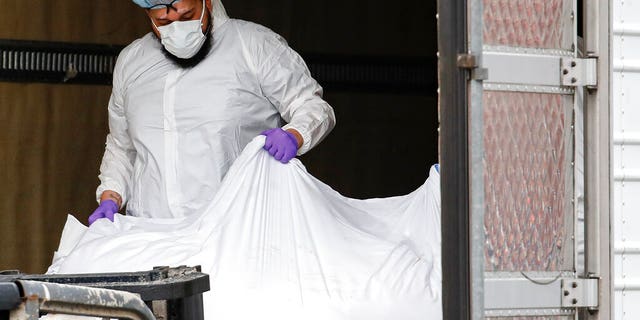
biggest city, New York, was the hardest hit of them all, with bodies
loaded onto refrigerated morgue trucks by forklifts outside overwhelmed
hospitals.
”It’s
like a battlefield behind your home,” said 33-year-old Emma Sorza, who
could hear the sirens from the swamped Elmhurst Hospital in Queens.
Cuomo
said projections suggest the crisis in New York will peak at the end of
April, with a high death rate continuing through July.
For
most people, the coronavirus causes mild or moderate symptoms, such as
fever and cough. But for others, especially older adults and people with
health problems, it can cause severe symptoms like pneumonia and lead
to death.
Asian
stocks meandered Thursday after a White House warning that as many as
240,000 Americans might die in the pandemic sent Wall Street tumbling.
The Dow Jones Industrial Average lost more than 970 points, or over 4%.
Many
countries are now modeling their response to the virus in part after
China, which in January closed off an entire province of over 70 million
people. The government says the measures have been a success and
reports that nearly all new cases of the virus have been imported from
abroad.
People
in Wuhan, once the epicenter of the crisis, are starting to return to
work, tracked by a smartphone app that shows if they are symptom free.
Walking
into a subway station Wednesday, Wu Shenghong, a manager for a clothing
manufacturer, used her phone to scan a barcode on a poster that
triggered her app. A green code and part of her identity card number
appeared on the screen. A guard wearing a mask and goggles waved her
through.
If the
code had been red, that would tell the guard that Wu was confirmed to
be infected or had a fever or other symptoms and was awaiting a
diagnosis. A yellow code would mean she had contact with an infected
person but hadn’t finished a two-week quarantine, meaning she should be
in a hospital or quarantined.
In
Europe, the strains facing some of the world’s best health care systems
has been aggravated by hospital budget cuts over the past decade in
Italy, Spain, France and Britain. They have called in medical students,
retired doctors and even laid-off flight attendants with first aid
training to help their country’s overstressed medical workers.
The
staffing shortage has been worsened by the high numbers of infected
personnel, many of whom are working without protective gear. In Italy
alone, nearly 10,000 medical workers have contracted the virus and more
than 60 doctors have died.
___
Hinnant reported from Paris. Associated Press writers around the world contributed to this report.
Residents snitch on businesses, neighbors amid shutdowns

OAK
PARK, Illinois (AP) — One Tulsa bar owner said more than a dozen
motorcyclists showed up unannounced, but he served them a round of shots
anyway to celebrate a birthday. Another live-streamed a drag queen show
on Facebook while up to 20 people drank inside the locked bar, ignoring
police when they knocked on the door.
Both
were busted — and received misdemeanor citations and court dates —
after police responded to tips that the bars were violating the mayor’s
order shuttering all nonessential businesses to help slow the spread of
the coronavirus.
“There has to be some consequence for violating an executive order,” said Tulsa Police Lt. Richard Meulenberg.
ADVERTISEMENT
It turns out plenty of people agree.
Snitches
are emerging as enthusiastic allies as cities, states and countries
work to enforce directives meant to limit person-to-person contact amid
the virus pandemic that has claimed tens of thousands of lives
worldwide. They’re phoning police and municipal hotlines, complaining to
elected officials and shaming perceived scofflaws on social media.
In
hard-hit New York City, police arrested the owner of an illegal
Brooklyn speakeasy where a dozen people were found drinking and gambling
after someone called 311 with a tip.
In
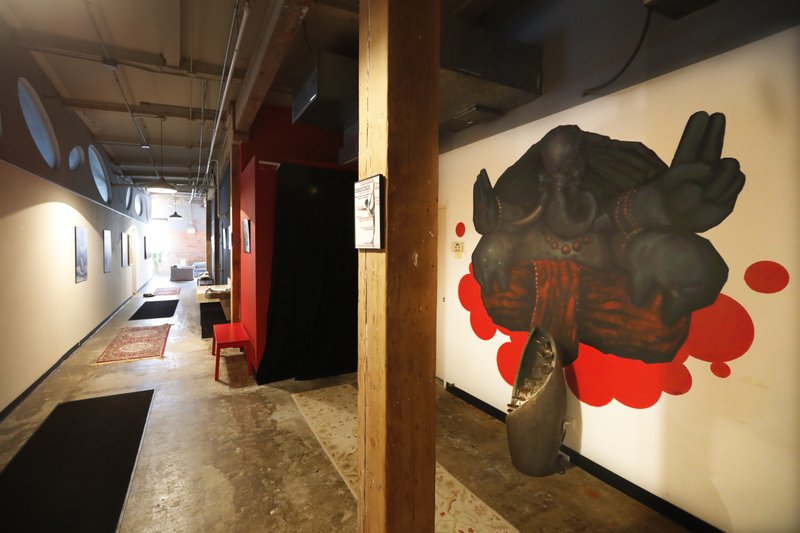
Chicago, a yoga studio that believed it qualified as an essential
health and wellness service was closed after the city — tipped off by
several residents — disagreed. Teacher Naveed Abidi of Bikram Yoga West
Loop studio said he thought the studio could remain open if the space
was sanitized, class size limited and students stayed far enough apart.
“If
we were naughty with the government’s order, then we’re very, very
sorry” said Abidi, who faces a fine of up to $10,000. “We’re not here to
cause problems, we’re here to practice our poses.”
For
most people, the new virus causes only mild or moderate symptoms, such
as fever and cough. For some, especially older adults and people with
existing health problems, it can cause more severe illness, including
pneumonia.
But the virus is spreading rapidly and starting to max out the health care system in several cities.
Naugatuck,
Connecticut, resident Gwen Becker said she was “mortified” when she
drove by a golf course and saw a crowd gathered around a food truck and
eating at tables together. So she took a video that her friend posted on
Facebook — prompting the mayor to shut down the course.
“I
was angry and upset, and I threw some f-bombs,” said Becker, 54.
“You’re not going to consider that what you’re doing could kill
somebody?”
ADVERTISEMENT
In some places, investigators are patrolling the streets, looking for violators
A
team enforcing Denver’s shelter-in-place order issued five citations —
including to Hobby Lobby and a Game Stop franchise that claimed it was
essential — and more than 600 warnings to businesses and individuals as
of Tuesday, city spokesman Alton Dillard said. The team also patrols
neighborhoods, parks and recreation areas.
In
Newark, New Jersey, police shut down 15 businesses in one night and
cited 161 people for violating the governor’s restrictions, saying
others would be next if they didn’t heed directives. And Maryland State
Police said they’d conducted nearly 6,600 business and crowd compliance
checks.
Chicago
police even disbanded a funeral Sunday after seeing a group of up to 60
people, many elderly, congregating inside a church, police spokesman
Anthony Guglielmi said.
In some cases, residents are turning on neighbors.
Police
in Spain — sometimes aided by videos and photos posted online by
zealous residents, or “balcony police” — have arrested nearly 2,000
people and fined over 230,000 for violating quarantine orders.
In
one viral video, the person recording it is heard criticizing a woman
who decides to go for a jog and resists police orders to produce her ID
card. Another shows a family of four heading to a supermarket carrying a
scooter for one of their children while half a dozen neighbors yell at
them from the window.
And
in New Zealand, a police website set up for the public to report
violators crashed after too many people tried to access it at once.
Among the complaints were people playing rugby and Frisbee and holding
impromptu “corona” parties, The Guardian reported.
Back
in Tulsa, Lt. Meulenberg said the department’s call volume has
increased substantially with residents ratting out businesses and
neighbors alike, though they can’t respond to all of them.
“The
fact that we have to do this at all means some people are not
interested in self-preservation” or protecting others, Meulenberg said.
“We’re not immunologists. We’re not scientists. We’re cops. We’re just
trying to do our part.”
___
Associated Press reporters Jim Anderson in Denver and Aritz Parra in Madrid contributed to this report.
After attacking Trump's coronavirus-related China travel ban as xenophobic, Dems and media have changed tune
Within hours of President Trump's decision to restrict travel from China on Jan. 31, top Democrats and media figures immediately derided the move as unnecessary and xenophobic -- and they are now beating a hasty retreat from that position as the coronavirus continues to ravage the economy and cause scores of deaths.
Democratic presidential contender Joe Biden led the way, quickly attacking what he called Trump's "record of hysteria, xenophobia and fear-mongering" after the travel restrictions were announced, and arguing that Trump "is the worst possible person to lead our country through a global health emergency." Biden, on Wednesday, didn't criticize the travel ban in any way, and instead accused Trump of "downplaying" the virus early on in remarks to Fox News.
"I had Biden calling me xenophobic," Trump told Fox News' "Hannity" on March 26. "He called me a racist, because of the fact that he felt it was a racist thing to stop people from China coming in."
In March, another Democratic presidential candidate, Sen. Bernie Sanders, I-Vt., conspicuously insisted at a Fox News town hall that he wouldn't consider closing the U.S. border to prevent the spread of coronavirus, before condemning what he called the president's xenophobia. The Vermont senator has since taken to promoting "Medicare-for-All" and workers' rights amid the outbreak, while deferring to health experts on border closings.
For many news outlets, the about-face has been stark. A Jan. 31 article in The New York Times quoted epidemiologist Dr. Michael Osterholm as saying that Trump's decision to restrict travel from China was "more of an emotional or political reaction."
Weeks later, though, the paper reported that dozens of "nations across the world have imposed travel restrictions to curb the spread of the coronavirus," and did not criticize any of them for the move.
The Washington Post ran a story quoting a Chinese official asking for "empathy" and slamming the White House for acting "in disregard of WHO [World Health Organization] recommendation against travel restrictions."
In March, The Post finally acknowledged that critics accused China and WHO of "covering up or downplaying the severity of an infectious disease outbreak."
A week earlier, Vox confidently declared that "The evidence on travel bans for diseases like coronavirus is clear: They don’t work." The article originally referred to the "Wuhan coronavirus" in its headline, before left-wing journalists and Democrats argued that terminology was racist.
Vox also tweeted on Jan. 31: "Is this going to be a deadly pandemic? No." On Mar. 24, Vox deleted that tweet, writing that it "no longer reflects the current reality of the coronavirus story."
The Heritage Foundation's Lyndsey Fifield identified numerous other instances of prominent media outlets criticizing the travel ban, in many cases without issuing any kind of correction. For example, The Verge cautioned that Trump's policies "contradict advice from the World Health Organization (WHO), which said yesterday that countries should not restrict travel or trade in their response to the new virus."
BuzzFeed News asserted that "barring foreign travelers from China, along with making U.S. citizens self-quarantine at home ... likely violated civil rights laws, without leading to any real lowered risk of a U.S. outbreak," citing "global health law expert" Lawrence Gostin of Georgetown University.
STAT, a health and medicine news site, reported that the travel ban was similar to calls from "conservative lawmakers and far-right supporters of the president," even as "public health experts ... warn that the move could do more harm than good."

On Jan. 15, when the first American with coronavirus returned from China, House Democrats were ceremoniously carrying their articles of impeachment against Trump to the Senate. (The president was acquitted overwhelmingly on each article of impeachment.)
Nevertheless, this week, House Speaker Nancy Pelosi, D-Calif., accused Trump of endangering lives by wasting time. “As the president fiddles, people are dying,” Pelosi told CNN's Jake Tapper.
“The president, his denial at the beginning, was deadly," she claimed.
Media outlets and Democrats have also retreated from their previous talking points that Trump was recklessly proposing an antimalaria drug as a possible coronavirus treatment. The FDA has since approved the drug on an emergency basis for coronavirus treatment.
In recent days, the Biden team and other Democrats have moved on to other lines of attack, including claiming that Trump once referred to the coronavirus as a "hoax." That claim has been refuted by numerous fact-checkers, including The Post's, which found that Trump was clearly referring to Democrats' efforts to blame him for the pandemic, not the virus itself.
MORE HYPOCRISY? DEMS, MEDIA ONCE CLAIMED FBI FISA PROCESS WAS ROBUST
Additionally, numerous Democrats, including Biden, have falsely claimed that the president cut the Centers for Disease Control and Prevention (CDC) budget. The Associated Press has noted that those claims "distort" the facts, largely because Congress blocked planned cuts.
Fox News has reported that the Obama administration also sought hundreds of millions of dollars in funding cuts to the CDC.
"Many in the scientific community beclowned themselves because their hatred for Trump blinded them -- and does to this day," Fifield said.
Meanwhile, even some prominent left-wing Democrats have come to the president's defense.
"This is not time to bicker," California Democratic Gov. Gavin Newsom said Wednesday on CNN. “Let me just be candid with you. I’d be lying to you to say that [Trump] hasn’t been responsive to our needs. He has. And so, as a sort of an offer of objectivity, I have to acknowledge that publicly."
OBAMA ADMIN SOUGHT HUNDREDS OF MILLIONS IN CDC BUDGET CUTS
Newsom added: "The fact is, every time that I've called the president, he's quickly gotten on the line. When we asked to get the support for that [USNS] Mercy ship in Southern California, he was able to direct that in real-time. We've got 2,000 of these field medical sites that are up, almost all operational now in the state, because of his support. Those are the facts."
Pelosi pushes 'SALT shakeup' stimulus that could reduce her tax bill and enrich her wealthy district
House Speaker Nancy Pelosi, D-Calif., is pushing for a new stimulus bill that would roll back the state and local tax deduction (SALT), a proposal that would predominately help wealthy individuals -- including most residents in Pelosi's district and perhaps even Pelosi herself.
A 2019 report from the Joint Committee on Taxation projected that of those who would face lower tax liability from the elimination of the SALT cap – which only affects those who itemize tax deductions – 94 percent earn at least $100,000. The government would lose out on $77.4 billion in tax dollars, with more than half of that amount being saved by taxpayers earning $1 million or more. Those earning more than $200,000 would reap most of the balance.
California's 12th congressional district, which Pelosi represents, is among the wealthiest in the U.S., with a median income of $113,919, according to census data. The average household income is $168,456 -- meaning most residents would benefit from any significant cut to SALT.
Pelosi and her husband have a property tax liability of approximately $198,337.62 considering their two homes, a winery and two commercial properties, public records show, indicating that the couple could reap benefits on roughly $188,000 given a full SALT repeal.
Pelosi's 2020 property taxes in Washington, D.C. totaled $13,997.20 given her Georgetown condo and garage, valued at $1,646,730. Her San Francisco property taxes totaled $51,480.02, plus $47,631.98 from her Napa winery, $64,874.66 from a San Francisco commercial property, and $20,353.76 for another building.
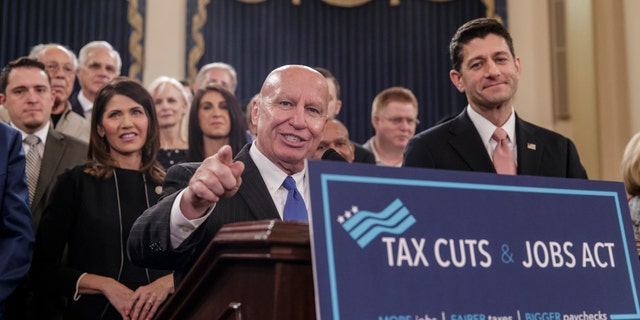
Just days after taking heat for successfully demanding $25 million in stimulus funds for the John F. Kennedy Center for the Performing Arts in Washington, D.C., Pelosi specifically declared this week that it might be wise to “retroactively undo SALT,” which was enacted as part of the 2017 tax cuts and prevents households from deducting more than $10,000 per year of their state and local tax expenditures from federal tax bills.
A Pelosi spokesperson said that a SALT drawdown would be “tailored to focus on middle-class earners and include limitations on the higher end.”
However, it was unclear exactly what the limitations would be in the proposed SALT shakeup. House Democrats voted last year to mostly repeal the SALT cap, and haven't hidden their desires to try again should control of the Senate change in November.

The cap has been particularly unpopular in high-tax blue states. New York, New Jersey, Maryland and Connecticut have even sued to repeal the SALT cap; that lawsuit was dismissed by a federal judge, and the states are appealing. The SALT cap is set to expire in 2025.
Roughly 13 million households nationally would benefit from slashing SALT, with the vast majority of them earning six-figure incomes and located in New York and California, The New York Times reported this week. Even a limited SALT reduction would predominately benefit wealthier Americans.
Pelosi's idea comes as House and Senate Republicans have sought to claw back the $25 million that the previous stimulus bill allocated to the Kennedy Center. President Trump called the payout a necessary compromise to win over Democratic support for the coronavirus relief package, but a chorus of lawmakers have called the spending irresponsible given the newly announced layoffs at the opera house.
Rep. Bryan Steil, R-Wisconsin – who on Tuesday introduced the bill to retract the funding, along with numerous cosponsors, including Rep. Steve Scalise, R-La. – said the bailout was always a "mistake," layoffs or not.
"If we determine that another measure is necessary, it should not be the vehicle for Speaker Pelosi’s partisan, parochial wish list."“Families and workers are struggling to pay rent, pay their mortgage and buy groceries," Steil said in a statement. "Americans need relief and assistance now, which is why I supported the CARES Act. However, some in Washington felt it was important to spend $25 million of taxpayer dollars on the Kennedy Center when there are obviously bigger needs right now. This is frivolous spending in the midst of a national emergency."
— Sen. Patrick J. Toomey, R-Penn.
“The ink is hardly dry on a $2 trillion-plus emergency package,” Sen. Patrick J. Toomey, R-Penn., told the Times. “It’s far too soon to know whether and of what nature additional legislation is needed. If we determine that another measure is necessary, it should not be the vehicle for Speaker Pelosi’s partisan, parochial wish list.”
GOP SEEKS TO CLAW BACK $25M ALLOCATED TO KENNEDY CENTER, AS OPERA HOUSE ANNOUNCES LAYOFFS
Senate Finance Committee Chairman Chuck Grassley, R-Iowa, has echoed that complaint.
"This is a nonstarter. Millionaires don’t need a new tax break as the federal government spends trillions of dollars to fight a pandemic," a spokesperson for Grassley said.
"Mrs. Pelosi’s remarks underscore the potential for further political mischief and long-term damage as the government intervenes to stimulate the economy," The Wall Street Journal editorial board wrote Tuesday. "When Democrats next complain that Republicans want to cut taxes 'for the rich,' remember that Mrs. Pelosi wants to cut them too—but mainly for the progressive rich in Democratic states."
Fox Business Network's Brittany De Lea, and Fox News' Jason Donner and Ronn Blitzer, contributed to this report.
Subscribe to:
Comments (Atom)
-
How many times do we need to say this? If you’re here illegally and get caught, you’re going back. It’s the la...