WASHINGTON
(AP) — President Donald Trump is warning that the country could be
headed into its “toughest” weeks yet as the coronavirus death toll
mounts, but at the same time he expressed growing impatience with social
distancing guidelines and said he’s eager to get the country reopened
and its stalled economy back on track.
“There
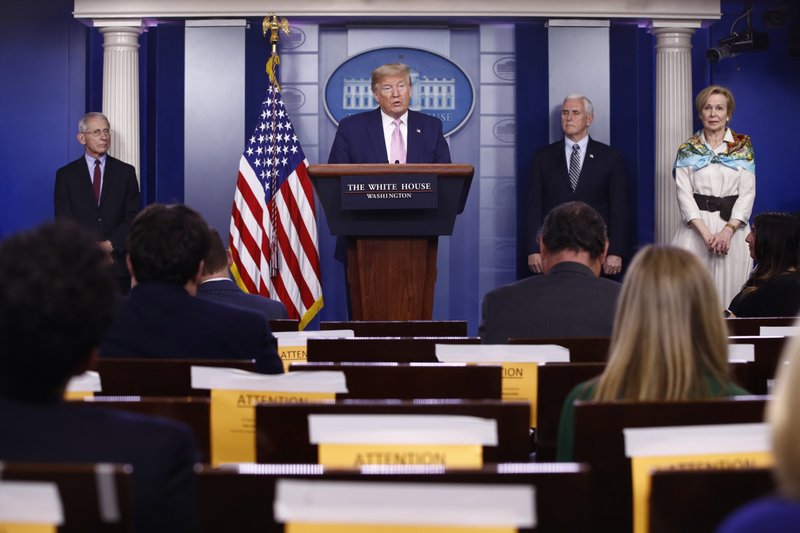
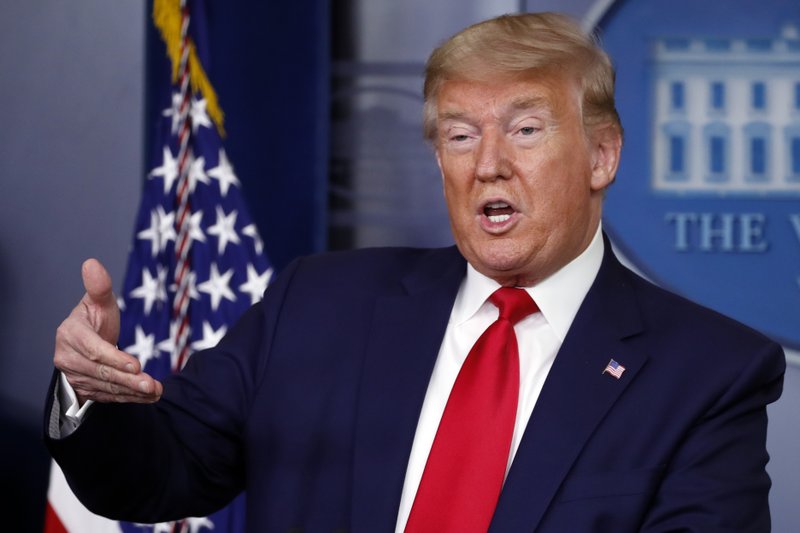
will be a lot of death, unfortunately,” Trump said Saturday in a somber
start to his daily briefing on the pandemic, “There will be death.”
Joining
Trump were Vice President Mike Pence, virus task force coordinator Dr.
Deborah Birx, and Dr. Anthony Fauci, the U.S. government’s foremost
infection disease expert. Each stood far apart from one another on the
small stage.
ADVERTISEMENT
Trump
added a twist on his familiar push for a drug that hasn’t been clearly
shown to work to stop the virus — he said he may start taking it as a
preventative measure after consulting with his doctor, even though
there’s no evidence to show it works for that, either.
The president initially had suggested the country could reopen by Easter but pulled back seeing projections of
a staggering death toll even if restrictive measures remain in place.
But just days after extending tough national guidelines through the end
of April, staring down historic levels of unemployment
and economic standstill, he was talking about reopening as soon as
possible, and speaking Saturday with leaders of professional sports
leagues about filling arenas again.
“This country was not designed to be closed,” he said. “The cure cannot be worse than the problem.”
The
number of people infected in the U.S. has exceeded 300,000, with the
death toll climbing past 8,400; more than 3,500 of those deaths are in
the state of New York. For most people, the virus causes mild or
moderate symptoms, such as fever and cough that clear up in two to three
weeks. For some, especially older adults and people with existing
health problems, it can cause more severe illness, including pneumonia,
and death.
Much
of the country is under orders to stay home, including professional
sports leagues that were among the first to clamp down in the pandemic. Trump spoke by phone with top leaders including
Roger Goodell of the National Football League and the NBA’s Adam
Silver, telling them he hoped to get people back in seats as soon as
possible.
“I want fans back in the arenas,” he said. “Whenever we’re ready, as soon as we can.”
The
virus has decimated the sports world with the National Basketball
Association and the National Hockey League suspending their seasons
indefinitely and Major League Baseball postponing the start of its
season. The NCAA basketball tournament was also canceled; so were
college spring sports.
A
person with knowledge of the call said some of the commissioners
weren’t quite as optimistic as Trump because of the concerns raised by
public health officials but appreciated the president’s desire to give
people hope and fans a reason to be optimistic. The person requested
anonymity to discuss the private call.
California’s
Gov. Gavin Newsom, who has three NFL teams in his state, was asked if
he thought the NFL season would start on time in September. “I’m not
anticipating that happening in this state,” he said.
Hard-hit states were seeing cases rise. Trump suggested that some states were asking for more medical supplies than they really needed. He said the goal was to stay several days ahead of critical medical needs in each state.
“The fears of the shortages have led to inflated requests,” he said.
Louisiana officials have said New Orleans
is on track to run out of ventilators by next week. New York Gov.
Andrew Cuomo, whose state is at the epicenter of the national pandemic
with over 113,700 confirmed cases as of Saturday morning, has pleaded
for ventilators for days. New York is poised to get more than 1,100
ventilators from China and Oregon.
Health
officials did offer some hope that social distance measures were
working. Fauci said he saw the efforts in action as he went out for a
walk in Washington, D.C., and noticed people waiting six feet apart for
restaurant take out.
“As sobering and a difficult as this is, what we are doing is making a difference,” Fauci said.
But
even as Fauci urged Americans to be patient and let mitigation efforts
work, Trump said: “Mitigation does work. But again, we’re not going to
destroy our country.”
The previously booming economy had been among Trump’s biggest talking points as he heads into the 2020 presidential election, but the past few weeks have seen precipitous drops
as the U.S. deals with the fallout from the virus that has shuttered
businesses, gutted airlines and forced people into their homes.
The president also continued to tout hydroxychloroquine,
a drug long used to treat malaria, rheumatoid arthritis and lupus,
after very small preliminary studies suggested it might help prevent the
coronavirus from entering cells and possibly help patients clear the
virus sooner. But the drug has major potential side effects, especially
for the heart, and large studies are underway to see if it is safe and
effective for treating COVID-19.
Trump
suggested he may consider whether he should start taking the drug,
though he also said he’d ask his doctor first. Some studies are testing
whether hydroxychloroquine can help prevent infections in health care
workers, but none has suggested that others, such as the president,
should take it to prevent infection.
With
Congress away, House Speaker Nancy Pelosi pressed for the next aid
package to be ready for an April vote in a letter to House Democrats.
“We
must double down on the down-payment we made in the CARES Act by
passing a CARES 2 package,” she wrote about the just-passed $2.2
trillion bill, pushing for another additional unemployment benefits,
small business loans and direct payments to Americans.
___
AP Pro Football Writer Rob Maaddi in Indian Shores, Florida, contributed to this report.
In the decade before Michigan and its largest city became the latest hot spot for the deadly coronavirus,
officials were steadily, and at times dramatically, cutting back on
their first line of defense against pandemics and other public health
emergencies.
Approaching
bankruptcy, Detroit disbanded most of its public health department and
handed its responsibilities to a private nonprofit. When the department
reopened in 2014 in the back of the municipal parking office, its per
capita budget was a fraction of other big cities’, to serve a needier
population.
ADVERTISEMENT
In
Ingham County, home to the capital city of Lansing, then-Public Health
Director Renee Branch Canady sat down at budget time every year for
seven straight years to figure out what more to cut.
“It
was just chop, chop, chop,” Canady said. By the time she left in 2014,
all the health educators, who teach people how to prevent disease, were
gone.
What
happened in Michigan also played out across the country and at the
federal level after the 2008 recession, which caused serious budget
problems for governments. But as the economy recovered, public health
funding did not, a review of budget figures and interviews with health
experts and officials shows.
A
shortfall persisted despite several alarming outbreaks, from H1N1 to
Ebola, and has left the U.S. more vulnerable now to COVID-19, experts
say. In normal times, public health workers are in the community,
immunizing children, checking on newborns and performing other tasks. In
a health emergency, they’re tracing outbreaks, conducting testing and
serving as “first responders” when people fall sick — efforts that are
lagging in many states as the coronavirus spreads.
“Our
funding decisions tied their hands,” said Brian Castrucci, who worked
with health departments in Philadelphia, Texas and Georgia and is now
president of the de Beaumont Foundation, a health advocacy organization.
The
cuts came under both Democratic and Republican administrations. While
there is no single number that reflects all federal, state and local
spending, the budget for the federal Centers for Disease Control, the
core agency for public health, fell by 10 percent between fiscal year
2010 and 2019 after adjusting for inflation, according to an analysis by
the Trust for America’s Health, a public health research and advocacy
organization. The group found that federal funding to help state and
local officials prepare for emergencies such as the coronavirus outbreak
has also fallen — from about $1 billion after 9/11 to under $650
million last year.
Between
2008 and 2017, state and local health departments lost more than 55,000
jobs — one-fifth of their workforce, a major factor as cities struggle
to respond to COVID-19.
“It
definitely has made a difference,” said John Auerbach, Trust for
America’s Health CEO and a former public health director in
Massachusetts.
New
York has seen the most COVID-19 cases in the U.S., but numbers are
surging in places such as Detroit, where those testing positive nearly
tripled in the week between March 28 and Saturday, when officials said
the city was approaching 4,000 cases, with 129 deaths. A more robust
health system could have done more earlier to track down and isolate
people who were exposed, said the city’s former health director, Abdul
El-Sayed.
State
spending on public health in Michigan dropped 16% from an
inflation-adjusted high point of $300 million in 2004, according to a
2018 study.
Some
of the funding problems, Canady and other public health advocates
believe, stem from a fundamental belief in smaller government among
Republican governors, including former Michigan Gov. Rick Snyder, who
called for “shared sacrifice” after the state’s auto-dependent economy
was battered by the recession.
In
Kansas, then-Gov. Sam Brownback ran what he called a “red-state
experiment” to cut taxes. State spending on its Public Health Division,
outside of federal funds, dropped 28% between 2008 and 2016.
The
cuts meant a “shifting of responsibility for services from the state
level to the county level,” Democratic Gov. Laura Kelly said in an
interview. “And we saw that in public health.”
In
Maine, then-Gov. Paul Le Page’s administration stopped replacing public
health nurses who were dealing with families in the opioid crisis. The
number of nurses fell from around 60 to the low 20s before the
Legislature tried to reverse the action.
Although agencies often receive emergency funding when a crisis strikes, the infusion is temporary.
“Decisions
are made politically to support something when it becomes an epidemic,”
said Derrick Neal, a public health official in Abilene when Ebola
surfaced in Texas. “And then as time passes, the funding shrinks.”
In
Oklahoma, state funding for the Department of Health still hasn’t
returned to its levels of 2014, when a combination of slumping oil
prices, tax cuts and corporate breaks punched a giant hole in the
state’s budget. When state revenues later improved, the money went to
other priorities.
“It’s
much easier to cut funding for public health than it is to start taking
away benefits from people or access to care for people,” said former
state Rep. Doug Cox, an emergency room doctor.
Castrucci
said the problem with providing more money only at times of emergency
is it doesn’t allow time to recruit and train new workers.
“We waited until the house was on fire before we started interviewing firefighters,” he said.
For
most people, the new coronavirus causes mild or moderate symptoms, such
as fever and cough that clear up in two to three weeks. For some,
especially older adults and people with existing health problems, it can
cause more severe illness, including pneumonia, and death.
___
Associated
Press reporters David Eggert in Lansing, Michigan, Paul Weber in
Austin, Texas, John Hanna in Topeka, Kansas, and Sean Murphy in Oklahoma
City contributed to this report.
Beginning 5 p.m. Saturday, Alabama joined the list of states where residents were under a stay-at-home order in response to the coronavirus outbreak. Gov. Kay Ivey
and state Health Officer Dr. Scott Harris announced that the order
would be in place until April 30, with a determination before then on
whether the order would be extended past that date, AL.com reported. “We
all have a duty to take this seriously,” the governor wrote in a
Twitter message. “Wash your hands frequently, disinfect commonly used
items often & practice social distancing.” Ivey warned that that the state would likely see sharp rises in confirmed cases and deaths in the weeks ahead. “Folks, April stands to be very tough, and potentially very deadly,” the governor said, according to AL.com. “You need to understand we are past urging people to stay at home. It is now the law.” As
of late Saturday, Alabama had more than 1,600 confirmed cases of
coronavirus – also known as COVID-19 – and had seen at least 26 deaths,
according to the state’s Department of Public Health, division of infectious diseases and outbreaks. Ivey,
a Republican, had faced some criticism in the state for not enacting a
stay-at-home order sooner. On Friday she addressed those concerns. "I
tried to find the right balance, something that was measured without
overreacting that looked after people’s health without choking out the
life from commerce," she said at a news conference Friday, according to the Advertiser.
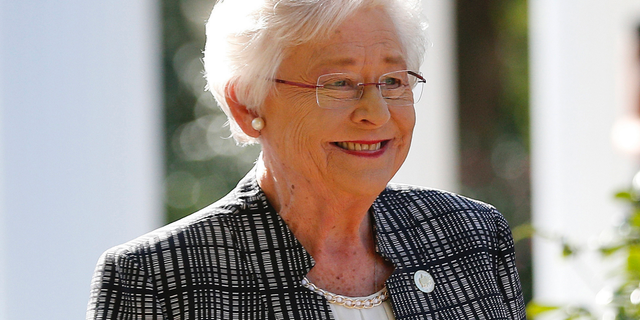
Alabama Gov. Kay Ivey speaks to the media in Montgomery, Ala., Nov. 17, 2017. (Associated Press)
U.S. Sen. Doug Jones, a Democrat, argued that slowing
the spread of the virus through a stay-at-home order would ultimately
prove to be the best way to revive the economy. “We help this economy by staying home,” Jones said Thursday, according to the Advertiser. “By staying home, we can stop the spread, and we can get this economy rolling soon.” On Friday, Ivey said the continued growth in cases in the state prompted her to finally issue the order. CLICK HERE FOR COMPLETE CORONAVIRUS COVERAGE "Yesterday
[Thursday] the number of new cases jumped 160," she said at the news
conference. “That was a big jump. Also EMA metrics that they got from
the cell phone data, and it shows people are not paying attention to the
orders we’ve asked them to abide by.” EMA refers to Alabama’s Emergency
Management Agency. Chambers County in eastern Alabama was
especially hard hit, with authorities suspecting that local church
gatherings may have helped spread the virus, the Advertiser reported.
Missouri’s governor announced a statewide stay-at-home coronavirus order Friday, leaving only a handful of states without one. Gov. Mike Parson’s
order, which takes effect Monday, says Missourians should avoid leaving
their homes except for essential activities like work, food or medical
care. Restaurants may stay open if they offer takeout or delivery and
schools have been ordered to close, FOX 2 in St. Louis reported. The
order allows nonessential businesses to stay open as long as they
adhere to social distancing requirements, according to the Kansas City
Star. The governor's March 21 order banning gatherings of more than 10 people will remain in place.
A man crosses an empty street Friday, April 3, 2020 in downtown
Kansas City, Mo. The city is under a stay-at-home order, asking everyone
to stay inside and away from others as much as possible, in an effort
to slow the spread of the new coronavirus. (Associated Press)
Alabama joins states under coronavirus stay-at-home order “There
comes a time when we have to make major sacrifices in our lives. Many
of us make sacrifices each and every day, but now more than ever, we
must all make sacrifices,” the governor said in a news conference
Friday. Parson had resisted such an order for weeks, opting to
leave enforcement to the local level. Most of St. Louis and Kansas City
areas, Springfield and Columbia are already under local stay-at-home
orders, according to FOX 4 in Kansas City. “This power is something I think should be rare for government to ever take advantage of,” he said, according to FOX 2. “For the sake of all Missourians, be smart, be responsible, and follow this order. Stay at home, Missouri." By Saturday evening, Missouri had nearly 2,300 cases and 24 deaths, according to FOX 4. After
Parson announced the order, Kansas City Mayor Quinton Lucas tweeted,
Kansas City’s order “adds additional limits and prohibitions to
non-essential activity,” which will remain in effect, The Star reported. The statewide order ends Friday, April 24. By
Saturday, only Arkansas, Iowa, Nebraska, North Dakota, South Dakota,
South Carolina, Utah, and Wyoming had no stay-at-home orders in effect.
WASHINGTON
(AP) — President Donald Trump announced new federal guidelines Friday
recommending that Americans wear face coverings when in public to help
fight the spread of the new coronavirus. The president immediately said
he had no intention of following that advice himself, saying, “I’m
choosing not to do it.”
The
new guidance from the Centers for Disease Control and Prevention
encourages people, especially in areas hit hard by the spread of the
coronavirus, to use rudimentary coverings like T-shirts, bandannas and
non-medical masks to cover their faces while outdoors.
The
president exempted himself from his administration’s own guidelines,
saying he could not envision himself covering his face while sitting in
the Oval Office greeting world leaders.
“It’s a recommendation, they recommend it,” Trump said. “I just don’t want to wear one myself.”
The
new guidance, announced as states are bracing for critical shortfalls
like those that other parts of the world have experienced, raises
concern that it could cause a sudden run on masks.
Trump
and other administration officials sought to minimize any burden by
stressing the recommendations did not amount to requirements and that a
variety of homemade coverings were acceptable. Federal officials said
that surgical masks and N95 respirator masks should be left for those on
the front lines of fighting the spread of the infection.
Friday’s
announcement capped an evolution in guidance from the White House that
officials acknowledged has at times been inconsistent and confusing,
with the administration insisting over the last month that masks were
not necessary or even helpful.
“I
want to unpack the evolution of our guidance on masks because it has
been confusing to the American people,” Surgeon General Jerome Adams
said Friday.
Adams
said that although and he other public health experts initially
believed wearing a mask would not have a substantial impact on curbing
the spread, the latest evidence makes clear that people who don’t show
any symptoms can nonetheless pass on the virus.
“We’re
looking at the data, we’re evolving our recommendations, and new
recommendations will come as the evidence dictates,” Adams said.
First
lady Melania Trump embodied the contradictory messaging with a tweet
endorsing the new guidance even as her husband chooses to disregard it.
“As
the weekend approaches I ask that everyone take social distancing &
wearing a mask/face covering seriously,” she tweeted.
The
administration has said states should have done more to stockpile
medical supplies, but it’s not clear if anyone is prepared for the
potential rush that could ensue if people try to obtain medical masks
for themselves from private industry.
In
rural Florida, Okeechobee Discount Drugs has been sold out of face
masks for almost two weeks, and “we don’t know where you can find any
masks at this point,” said Stacey Nelson, one of the pharmacy’s owners.
“It’s
very hard to get these products, but people want them,” Nelson said.
“They’ve been getting mixed messages and people aren’t sure if they
should be wearing masks in our daily lives. It’s very confusing. Wear
them, or don’t wear them?”
ADVERTISEMENT
For
most people, the new coronavirus causes mild or moderate symptoms, such
as fever and cough that clear up in two to three weeks. For some,
especially older adults and people with existing health problems, it can
cause more severe illness, including pneumonia, and death.
In
fashioning the recommendations, the administration appeared to be
striving to balance political concerns about wanting to preserve as much
normalcy as possible with public health concerns that some infections
are being spread by people who seem to be healthy.
The
White House has faced pushback against rigorous social distancing
guidelines from states with lesser rates of infection. For the
hardest-hit areas, where social distancing has already been in place for
some time, the White House coronavirus task force thought there would
be less risk of people ignoring the other guidance if they covered their
faces.
The CDC
is recommending that people wearing cloth face coverings in public
places, such as grocery stores and pharmacies, where “other social
distancing measures are difficult to maintain.” The guidance especially
applies “in areas of significant community-based transmission.”
The
White House task force was debating into Friday on the final language
of the CDC guidance. CDC scientists wanted to make it national guidance,
believing that would do more to slow the spread of the virus.
White
House advisers, including Dr. Deborah Birx, wanted to limit the
guidance to virus hot spots. Birx said Thursday that she feared wider
guidance would lead to a false sense of security for Americans and cause
them to back away from more critical social distancing.
In
the end, they found a middle ground: a national advisory with special
emphasis that those in hard-hit areas should wear masks. Two people
familiar with the discussions outlined the internal debate, speaking on
condition of anonymity because they weren’t authorized to describe it
publicly.
As
with other public health guidance, the recommendation on face covering
has been a moving target for the administration. Under the previous
guidance, only the sick or those at high risk of complications from the
respiratory illness were advised to wear masks.
Adams
wrote on Twitter at the end of February that people should “STOP BUYING
MASKS” and said they were not effective in protecting the general
public.
On
Monday, he noted that the World Health Organization does not recommend
masks for healthy members of the population. Three days later, he
tweeted that though there remains “scant” evidence that wearing a mask,
especially improperly, can protect the wearer, “emerging data suggests
facial coverings may prevent asymptomatic disease transmission to
others.”
Dr.
Michael Ryan, the WHO’s emergencies chief, on Friday acknowledged a
“very important and very healthy debate” about how masks are used.
“We
still believe the main driver of this pandemic is symptomatic
(transmission),” he said, not people who may be infected but aren’t
showing symptoms.
“We
can certainly see circumstances in which the use of masks — but
homemade or cloth masks — at the community level may help in an overall
comprehensive response to this disease,” Ryan said.
____
Schneider
reported from Orlando, Florida. Associated Press writers Jill Colvin in
Washington and Jamey Keaton in Geneva, Switzerland, contributed to this
report.
President Trump
has reportedly fired Michael Atkinson, the inspector general for the
U.S. intelligence community who alerted Congress to concerns about a
Trump phone call with the president of Ukraine – a matter that led to the president’s impeachment last year. Trump formally notified the intelligence committees of both the Senate and House in a letter dated Friday that was obtained by Politico. "This
is to advise that I am exercising my power as President to remove from
office the Inspector General of the Intelligence Community, effective 30
days from today," the president wrote.
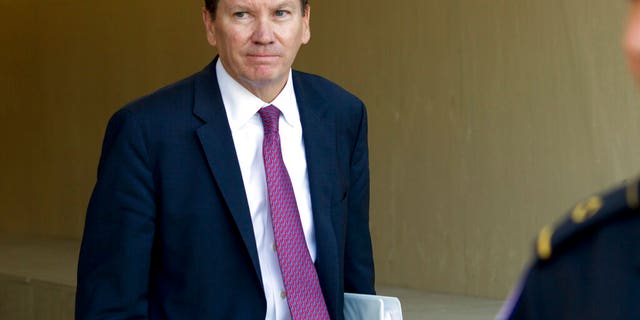
Michael Atkinson, the inspector general of the intelligence
community, leaves the Capitol after closed doors interview about the
whistleblower complaint that exposed a July phone call the president had
with Ukrainian President Volodymyr Zelenskiy in which Trump pressed for
an investigation of Democratic political rival Joe Biden and his
family, at the Capitol in Washington, Friday, Oct. 4, 2019. (Associated
Press)
"It is extremely important that we promote the
economy, efficiency, and the effectiveness of Federal programs and
activities. The Inspectors General have a critical role in the
achievement of these goals," the president continued. "As is the case
with regard to other positions where I, as President, have the power of
appointment, by and with the advice and consent of the Senate, it is
vital that I have the fullest confidence in the appointees serving as
Inspectors General. That is no longer the case with regard to this
Inspector General." The president added he would nominate a replacement "who has my full confidence and who meets the appropriate qualifications," at a later time. Tom
Monheim, a career intelligence professional, will be named acting
inspector general for the intelligence community, an intelligence
official who requested anonymity told The Associated Press. Monheim is
currently general counsel of the National Geospatial-Intelligence
Agency.
Democrats react
Leading Democrats quickly criticized the president's action. In
a statement, House Intelligence Committee Chairman Adam Schiff,
D-Calif., one of the Democrats' leaders of the impeachment efffort,
called the firing of Atkinson an act of "retribution" by President
Trump. Schiff called Friday's action “yet another blatant attempt
by the President to gut the independence of the Intelligence Community
and retaliate against those who dare to expose presidential wrongdoing,"
according to Politico. “At
a time when our country is dealing with a national emergency and needs
people in the Intelligence Community to speak truth to power, the
President’s dead of night decision puts our country and national
security at even greater risk,” Schiff added. House Speaker Nancy
Pelosi, D-Calif., blasted the president's move as "a brazen act against a
patriotic public servant who has honorably performed his duty to
protect the Constitution and our national security, as required by the
law and by his oath. “This latest act of reprisal against the
Intelligence Community threatens to have a chilling effect against all
willing to speak truth to power," Pelosi continued. "The President must
immediately cease his attacks on those who sacrifice to keep America
safe, particularly during this time of national emergency.” Senate Minority Leader Chuck Schumer, D-N.Y., condemned the president's action in a pair of late-night Twitter messages. "Whether
it's LTC Vindman, Captain Crozier, or Intelligence Community Inspector
General Michael Atkinson: President Trump fires people for telling the
truth," Schumer wrote in one message. "Michael Atkinson is a man of integrity who has served our nation for almost two decades," he added in a second post. "Being fired for having the courage to speak truth to power makes him a patriot."
Horowitz responds
Michael
Horowitz, chairman of the Council of the Inspectors General on
Integrity and Efficiency and the inspector general at the Department of
Justice, criticized the removal of Atkinson and defended his handling of
the Ukraine case. “Inspector General Atkinson is known throughout
the Inspector General community for his integrity, professionalism, and
commitment to the rule of law and independent oversight,” Horowitz told
the AP.
House GOP investigation
In
January, Fox News reported that Atkinson was being investigated by
Republican members of the House Intelligence Committee for his handling
of the Ukraine matter, which began with a complaint filed by an
unidentified "whistleblower." Last August, Atkinson received a
complaint from someone who raised concerns about Trump's July 25 phone
call with Ukrainian President Volodymyr Zelensky, in which Trump sought a
Ukraine-led investigation into the past business dealings in the
country of former Vice President Joe Biden and his son Hunter Biden. Democrats
argued that the president had tied the investigation request to the
withholding of U.S. military aid from Ukraine, in what they described as
a "quid pro quo" arrangement. But Trump denied any wrongdoing in
connection with Ukraine. The House ultimately impeached Trump on
charges of abuse of power and obstruction of Congress -- but the Senate
acquitted Trump of the charges in February. Fox News' Brooke Singman and The Associated Press contributed to this story.
Steve Forbes, chairman and editor-in-chief of Forbes Media, reacted Friday on "The Ingraham Angle" to U.S. unemployment climbing as coronavirus spreads and its effects on the economy if the shutdown continues. "[The]
devastation is going to be very real. You've already saw in that 10
million [unemployment] number in the last two weeks. That's going to get
worse," Forbes told host Laura Ingraham. "In effect, we've done the
economic equivalent of a medical shutdown of the economy -- a coma,
induced coma." Forbes called for ramped up testing in order to help the economy. "So
this gets to where economics and health care intertwine, and that is we
have to massively step up the testing. For example, [Abbot]
laboratories, has a test that can tell you in five or 15 minutes whether
you have this horrific disease," Forbes said. "They've only produced
5,000 kits. They should be producing 50,000 a day. They should be
licensing and the government should push them to do it. Other
manufacturers we should be doing not 100,000 tests a day for a country
our size, experts tell me we should be doing at least 500,000 a day to
find out who already has immunities." "We've got to do massive
testing so by the end of April we can have large parts of this economy
starting to function again," Forbes added. Forbes also said media
opposition to hydroxychloroquine, an anti-malaria drug that President
Trump has supported as a coronavirus treatment, was largely steeped in
anti-Trump sentiment. "The real push [against] hydroxychloroquine
is the fact that Donald Trump liked it. If Donald Trump said the sun
came up in the morning, they'd say, 'Oh no, that's a Chinese lightbulb
in the sky. It just is perverse." Forbes argued that another stimulus won't fix the problem and that the economy needs time to recover. "If
you take a sledgehammer to the American economy, it's going to take
time to bring it back. It'll recover quickly," Forbes said. "As long as
we have a benign environment which gets to the election, hopefully next
year we'll have that benign environment. Then you'll really see things
really start to turn."
CNN chief White House correspondent Jim Acosta was widely blasted for interrupting Dr. Deborah Birx during Friday's coronavirus briefing to attack President Trump. Birx
took a moment at the podium to address the "who knew what when"
concerns and said all the countries affected by the pandemic can "look
back" to develop a timeline but not while "in the middle" of the crisis. "We
can talk about why didn't Italy do something or Spain do something or
Germany do something, or we can really say right now -- we all can do
something," Dr. Birx explained. "We can do the social distancing and all
of the pieces that we know is starting to work around the globe in
country after country. And then when we get through all of this, we can
ask the questions about could we have done some piece of this better as a
global community." She
then pivoted to the apparent errors the World Health Organization (WHO)
made leading up to the outbreak in the U.S. as something that should be
examined. "I will remind you that on February 3rd, the head of
the WHO said there was no reason to ever do a travel ban," Dr. Birx
continued. "It wasn't until January 14th that we knew that there was
human-to-human transmission,"
Acosta quickly derailed her observations about WHO to knock President Trump. "Dr. Birx, the president was saying this was going to go away," Acosta said. "It's April." "It is going to go away," President Trump fired back. "I said it was going away and it is going away." Many took to social media to blast the reporter. "Jim
Acosta's interruption of Dr. Birx is an example of how CNN's
echo-journalism model is destroying the media's credibility," George
Washington University Law professor Jonathan Turley reacted. "Every
question from Acosta is an effort to score points rather than elicit
information. It is a press pandemic that continues to rage without
relief." Some accused Acosta of attempting to "mansplain" to the female medical expert. "'Dear
Diary: While I’m no expert, I tried #Mansplaining to an expert medical
expert named Dr. Birx. @Acosta,'" former CNN commentator Paris Dennard
quipped. "@Acosta just tried to mansplain to Dr. Birx," GOP national spokeswoman Elizabeth Harrington tweeted. Others
pointed out how Acosta interrupted Dr. Birx as she was being critical
of WHO, who critics have accused of shielding China amid the outbreak. "Of course Acosta interrupted Birx as she was making an interesting comment about WHO," Daily Caller reporter Chuck Ross said. TRUMP SPARS WITH JIM ACOSTA AT CORONAVIRUS BRIEFING: 'THIS IS WHY PEOPLE DON'T WANT TO LISTEN TO CNN ANYMORE' CNN did not immediately respond to Fox News' request for comment. Acosta has made a name for himself in the Trump era for his hostile exchanges with the president. However,
he is even criticized among his White House press corps colleagues. In
his new book, ABC News correspondent Jonathan Karl knocked his CNN
counterpart, accusing him of "playing into the explicit Trump strategy
of portraying the press as the opposition party." "The surest way
to undermine the credibility of the White House press corps is to behave
like the political opposition," Karl wrote. "Don't give speeches from
the White House briefing room."