Presumptuous Politics

Wednesday, April 15, 2020

Illinois Dem governor and China in secret talks for masks, gloves: report


The governor of Illinois is engaged in secret talks with China to obtain masks and gloves for the state’s medical workers fighting the coronavirus, hoping to avoid scrutiny by the Trump administration, according to reports.
Gov. J.B. Pritzker, a Democrat, is concerned that federal authorities may seize the items for a stockpile that would serve all 50 states, the Chicago Sun-Times reported Tuesday, citing unnamed sources.
News of the potential deal emerged on the same day that President Trump announced the U.S. will halt funding to the World Health Organization over "China-centric" policies such as opposing Trump's China travel ban, which the president credits with slowing the arrival of the coronavirus to the U.S.
Illinois recently spent $174 million on purchases related to the virus, including masks, gloves, gowns, eyewear and hand sanitizer, the Sun-Times report said.
The list also included two invoices for $888,275 each, to FedEx Trade Networks Transport for charter flights to Shanghai, but the governor’s press secretary would not provide details about the flights, the Sun-Times reported.
“The Governor has clearly outlined the challenges this administration has faced as we’ve worked around the clock to purchase PPE [personal protective equipment] for our healthcare workers and first responders,” Jordan Abudayyeh, the press secretary, wrote in a statement.
“The supply chain has been likened to the Wild West, and once you have purchased supplies, ensuring they get to the state is another herculean feat. These flights are carrying millions of masks and gloves our workers need. They’re scheduled to land in Illinois in the coming weeks and the state is working to ensure these much needed supplies are protected and ready for distribution around the state.”
President Trump has previously said that individual states were in charge of procuring medical gear for themselves, with the federal government “here to help them” if needed.
“They have to get that gear themselves," Trump told Fox News’ Bill Hemmer on March 24. “If they don't have -- like with [New York] Governor [Andrew] Cuomo -- he had a chance to order 16,000 ventilators ... two years ago and he turned it down -- now he can't be blaming us, but we're here to help them.”
Pritzker, like other Democrats, has been a harsh critic of Trump, telling Vanity Fair magazine earlier this month that “the failures of the White House, of the president, have visited greater illness and greater number of deaths across the country.”
Meanwhile on Tuesday, Pritzker said at a news conference that Illinois was “bending the curve” in its fight against the virus, explaining that it was starting to take longer for the state to double its number of confirmed cases, according to FOX 32 of Chicago.
“To be clear, there is nothing good about twice as many people having this virus, or worse, dying from it, no matter how long the increase takes,” Pritzker said. “But we won’t get to zero cases overnight. The fact that our doubling rate continues to increase in every metric, is a clear demonstration that there is a deceleration of virus transmission. We are, in fact, bending the curve.”
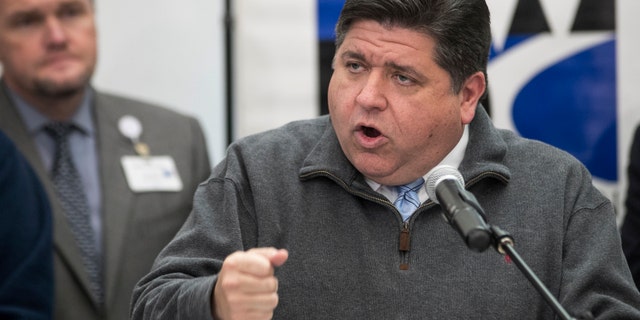
Illinois Gov. J.B. Pritzker speaks in Belleville, Ill., Jan. 16, 2019. (Associated Press)

Also Tuesday, Pritzker also said he was in talks with other governors in the Midwest about potentially forming an alliance for reopening their economies – similar to deals reached by governors on the Pacific coast and in the Northeast, Chicago’s WMAQ-TV reported.
“Governors that I've spoken with have been very, frankly, very positive about this idea," Pritzker said. "They've all been thinking about it individually for their states, and understand that speaking with a common voice might be a positive move."
The extent of the governors’ autonomy has been a topic of debate between them and President Trump, with the president saying Monday he had “total authority” over the reopening of the U.S. economy.
But governors and other lawmakers fired back, accusing Trump of acting like a “king.”
“We don’t have a king in this country,” New York Gov. Andrew Cuomo said Tuesday. “We didn’t want a king, so we have a Constitution and we elect a president.”
But Trump responded to Cuomo, accusing the Democrat of wanting control over his state only when it is convenient for him.
"Cuomo’s been calling daily, even hourly, begging for everything, most of which should have been the state’s responsibility, such as new hospitals, beds, ventilators, etc.," Trump wrote on Twitter. "I got it all done for him, and everyone else, and now he seems to want Independence! That won’t happen!"
Fox News' Ronn Blitzer contributed to this story.

Gretchen Whitmer clarifies stay-at-home order after Meghan McCain slam


Michigan Gov. Gretchen Whitmer clarified Sunday that the state’s updated coronavirus stay-at-home order doesn’t ban purchasing child car seats in stores after Meghan McCain slammed the governor in a retweet.
“Hi Meghan! Our Stay Home, Stay Safe executive order does not ban the purchasing of car seats for children,” Whitmer tweeted to the 'View' co-host.
McCain tweeted earlier, “Guess it’s good I don’t live in Michigan - otherwise how would I transport my child home from the hospital. @GovWhitmer?”  The post showed a sign in front of car seats at a Walmart saying items in the “non-essential” area will no longer be available for purchase.
McCain, who is expecting her first child, added, "Being pregnant during this time is insanely stressful - we are all doing our best. Shame on you for doing this @GovWhitmer."
Whitmer’s most recent version of the stay-at-home order, which went into effect on April 9, asks stores to stop selling “nonessential” products, The Hill reported.
Whitmer also tweeted a separate clarification.
Tori Sachs, the executive director of Michigan Rising Action who posted the original tweet asking Whitmer for clarification, on Sunday tweeted, “On Friday I posted a picture of the fact car seats were not being sold as a result of @GovWhitmer's exec order. The unfortunate incident happened as a result of the confusion caused by Whitmer's new EO.”
Many stores in the state reportedly found the order vague and open to interpretation for what is deemed "nonessential," leading a Walmart manager to prohibit purchasing car seats,  according to The Detroit News.
"Michigan customers are able to purchase baby car seats, baby furniture and other infant products at their local Walmart," a Walmart corporate spokesperson said, according to The Hill. "We are reiterating this direction with store management to ensure consistent service to our customers across our Michigan stores.
Others have posted similar pictures of items assumed nonessential under the order, including state Senator Aric Nesbitt.
“The big problem here is Whitmer’s order and its lack of clarity, Sachs added, according to The Detroit News. "There’s no reason for people to attack me or anyone else just documenting what is going on as a result of the confusion Whitmer has made.”

California mayor says he'll resign after comparing Trump backers to KKK: report

Idiot Mayor William Kirby
The mayor of a Northern California city said this week that he'll step down after posting social media messages comparing supporters of President Trump to members of the Ku Klux Klan, a report said.
Angry residents in Auburn, about 33 miles northeast of Sacramento, confronted Mayor William Kirby during a city council meeting conducted by video because of coronavirus concerns, FOX 40 of Sacramento reported.
Kirby appeared remorseful as he addressed the council and residents, the report said.
“I spent 40 years dedicating my life to serving the community of Auburn as a physician and through my volunteer efforts. Am I perfect? No. We’re all a little flawed,” Kirby said, admitted to the council that some of his recent posts were misguided.
In one of the posts, the mayor -- who is also a physician -- shared a photo of a Ku Klux Klan hood, with the caption, “Good news for Trump supporters is that most of them already have masks,” the report said. The post was later taken down.
“Good news for Trump supporters is that most of them already have masks.”
— Social media message allegedly posted by town's mayor
Kirby blamed Trump for his frustration, explaining that as a doctor he now puts his life on the line because of a lack of proper gear and testing capabilities.
“This president has put us all at risk,” Kirby said.
The council also heard voicemails about Kirby left by city residents and fellow council members, FOX 40 reported.
“These comments are hateful, degrading, bigoted and more consistent with the mentality of a 15-year-old,” one voicemail said.
“These comments are hateful, degrading, bigoted and more consistent with the mentality of a 15-year-old.”
— Resident opposing mayor's social media posts
“It is extremely disappointing and I believe that he should be removed,” another message said.
Others supported the mayor.
“And this is how I feel: I abhor the things that he has said and done and I did not hear an apology from him tonight,” City Councilwoman Cheryl Maki said.
“We need to be focused right now and our staff needs to be focused on the response to COVID and the recovery of COVID,” said Councilman Daniel Berlant.
Kirby said he will step down at the next council meeting on April 27, the report said.

Gordon G. Chang: Trump right to stop funding World Health Organization over its botched coronavirus response


President Trump was right to announce Tuesday that he will immediately stop funding the World Health Organization, which was scheduled to get $893 million from the U.S. in the current two-year funding period.
The president’s action is the first step needed to spark meaningful reform of the United Nations organization and the global health architecture.
Trump last week signaled he was unhappy with the WHO. In an interview aired April 7 on “Hannity” on Fox News, Trump suggested the U.S. might stop contributing to the organization.
By Tuesday, Trump had seen enough.
“So much death has been caused by their mistakes,” Trump said of the WHO. He is absolutely correct.
The WHO helped spread the coronavirus in four principal ways.
First, in public the WHO disseminated China’s false narrative that the virus was not transmissible person-to-person.
The U.N. organization, however, knew or should have known the Chinese government was not telling the truth. Among other things, Taiwan on Dec. 31 told the U.N. body it suspected the pathogen was contagious in this fashion – and WHO professionals also knew that to be the case.
Maria Van Kerkhove, a WHO doctor, said at a press briefing on Monday that “right from the start” she thought the coronavirus was human-to-human transmissible, but senior WHO leadership disregarded the evidence of this.
Second, the WHO in its public statements supported the Chinese government’s attempt to prevent the imposition of travel bans and quarantines on travelers from China. It was these travelers who turned an epidemic in central China into a global pandemic.
Third, the WHO publicly backed the reliability of Beijing’s statistics. China’s substantial undercounting of its coronavirus cases and deaths lulled the U.S. into not taking precautions it would otherwise have adopted.
Dr. Deborah Birx, the White House coronavirus coordinator, said March 31 that her team reviewed China’s statistics and thought the coronavirus outbreak would be no worse than SARS (Severe Acute Respiratory Syndrome), the 2002-03 epidemic that effected more than 8,000 people in 26 countries.
It was not until Birx saw the coronavirus strike Italy and Spain that the White House realized the truth – the coronavirus was far more dangerous than the Chinese government claimed. But by then it was too late.
Dr. Anthony Fauci, the director of the National Institute of Allergy and Infectious Diseases and a key Trump adviser in the coronavirus crisis has made comments similar to Birx.
As of Tuesday, there were nearly 2 million confirmed cases of COVID-19 – the respiratory disease caused by the coronavirus – around the world, including nearly 610,000 in the U.S. There were over 126,000 deaths confirmed worldwide, including nearly 26,000 in the U.S. However, all these figures are understated because of Chinese underreporting and because few people around the world have been tested.
Fourth, the WHO unreasonably delayed declaring the coronavirus epidemic a “public health emergency of international concern” until Jan. 30.
The WHO, President Trump correctly said Tuesday, failed its “basic duty and must be held accountable.”
There is no nation in a position to hold the WHO accountable other than the U.S., which gives the WHO far more money than does any other country.
“As the organization’s leading sponsor, the United States has a duty to insist on full accountability,” Trump correctly said.
Trump’s withdrawal of funding does not mean the U.S. is abandoning the world during the middle of a pandemic.
“We will continue to engage with the WHO to see if it can make meaningful reforms,” Trump pledged. “For the time being, we will redirect global health and directly work with others.”
Who are these others? The U.S. can work with Taiwan, which of all the countries in the world has had arguably the best response to the coronavirus pandemic.
But Taiwan is the one country the World Health Organization – bowing to Beijing’s demands – will not work with.
This shunning of the island republic was something painfully evident from Dr. Bruce Aylward’s March 28 interview with Hong Kong’s RTHK. The senior adviser to WHO Director-General Tedros Adhanom Ghebreyesus refused to talk about Taiwan.
Now, after Trump’s announcement, the global community has the opportunity to work closely with a valuable partner.
Of course, it’s not certain Trump will be able to fashion a better response to the coronavirus pandemic in the middle of the emergency, but defunding the WHO was a precondition for doing so.
Thanks to Trump taking the right step Tuesday, at least now there is hope.

Tuesday, April 14, 2020

US Economy 2020 Cartoons


With no new virus hotspots, debate rages on when to reopen


BANGKOK (AP) — A lack of new hotspots in the coronavirus pandemic appeared to be holding Tuesday, fueling a debate about how soon authorities could start scaling back social restrictions and reopen economies.
While concerns remained over the virus’ fresh spread in places like Japan and Indonesia, nowhere was currently undergoing the explosion in hospitalizations and deaths that were seen earlier in China, southern Europe and parts of the United States.
Even in New York — where deaths passed 10,000 on Monday — Gov. Andrew Cuomo declared the “worst is over if we can continue to be smart.”
ADVERTISEMENT
“I believe we can now start on the path to normalcy,” he said.
The number of people hospitalized with the virus in New York has almost flattened at just under 19,000, once discharges and deaths are taken into account. That’s a relief after weeks of increases raised fears New York City hospitals would be overwhelmed.
Dr. Sebastian Johnston, a professor of respiratory medicine at Imperial College London, said it appeared that COVID-19 illnesses had peaked in much of Europe, including France, Spain, Germany, Italy and Britain.
While the death toll in Britain climbed past 11,300, the 717 deaths reported were the third daily decline in row, though it was unclear if that might in part be because of delays in reporting over the Easter holiday.
With social distancing and lockdowns in place across a large portion of the world, grim projections that the virus that would spread with equal ferocity to other corners the world have yet to materialize. But questions remain about what could happen once those measures are eased.
Health authorities have warned that easing up too soon could undo the hard-earned progress and lead to new outbreaks.
Still, there were signs countries were looking in that direction. Spain permitted some workers to return to their jobs, while a hard-hit region of Italy loosened its lockdown restrictions.
Governors on both coasts of the U.S. announced that they would join forces to come up with a coordinated reopening at some point, setting the stage for potential conflict with President Donald Trump, who asserted that he is the ultimate decision-maker for determining how and when to reopen.
Trump continued those assertions during an afternoon White House briefing, pushing back against reporters’ questions about whether the president or governors have the authority to ease the restrictions. He said “the federal government has absolute power” in that decision-making process if it chooses to exercise it.
ADVERTISEMENT
The Constitution largely gives states the authority to regulate their own affairs.
California Gov. Gavin Newsom said he would announce a detailed plan Tuesday for lifting virus restrictions. He cautioned people can expect an “incremental release of the stay-at-home orders” that will use “science to guide our decision-making and not political pressure.”
In some European countries, officials pointed to positive signs as they began prepping for the reopening of largely shuttered economies and industries.
Italy’s day-to-day increase in infections was one of the lowest in weeks, bolstering a generally downward trend. Slightly eased restrictions were about to take effect in some sectors of the country, such as allowing stores selling necessities for newborns to reopen.
In hard-hit Spain, workers were permitted to return to some factory and construction jobs as the government looked to restart manufacturing. Retail stores and services were still required to stay closed, and the government required office workers to keep working from home.
Some health experts and politicians argue that it’s premature to ease the lockdown in a nation that has suffered more than 17,750 deaths and reported more than 170,000 infections, second only to the United States’ more than 582,000 cases.
Health Minister Salvador Illa said he would proceed with “the utmost caution and prudence ... and always based on scientific evidence.”
Johnston, the Imperial College professor, said he worried the virus might take off across Latin America, Africa and Southeast Asia. He also expressed concern about Russia.
The infection rate remains relatively low in areas of the developing world that have poor or nonexistent health care infrastructure. The rapid spread of the coronavirus beyond cities to more rural areas often depends on travel and social connections, said Dr. Mike Ryan, the World Health Organization’s emergencies chief.
But he noted that rural areas often have less sophisticated health surveillance systems to pick up potential disease clusters, prompting the question, “Is it that it’s not there, or is it that we’re not detecting the disease when it is there?”
Indonesia, the world’s fourth most populous nation, has seen a worrying increase in cases in the past few weeks even though it has conducted fewer than 30,000 tests among its 270 million people. It has confirmed 4,557 cases with 399 deaths, the highest number of recorded fatalities in Asia after China.
After weeks of delays, the capital, Jakarta, finally put in place legally enforceable social distancing regulations last Friday. President Joko Widodo, meanwhile, pledged to be more transparent after admitting he deliberately withheld some information on COVID-19 cases to prevent panic.
Japan, with the world’s oldest population, has also seen a worrying growth in cases since the decision was made to postpone this summer’s Tokyo Olympics until next year. It reported another 390 new cases Tuesday.
And tiny Singapore, which had been lauded for its early success in containing the virus, reported its biggest daily jump in new coronavirus infections Tuesday, most of them linked to foreign workers living in crowded dormitories.
More than 200,000 migrant workers live in 43 registered dormitories that house up to 20 men per room, with shared toilets, cooking and other facilities.
More than 1.9 million infections have been reported and over 119,000 people have died worldwide, according to count kept by Johns Hopkins University. The figures certainly understate the true size and toll of the pandemic, due to limited testing, uneven counting of the dead and some governments’ desire to play down the extent of outbreaks.
For most people, the coronavirus causes mild or moderate symptoms, such as fever and cough. But for others, especially older people and the infirm, it can cause severe symptoms and lead to death.
___
Associated Press journalists around the world contributed to this report.

Taiwan releases December email to WHO showing unheeded warning about coronavirus


The World Health Organization (WHO) is under fire after Taiwan released the contents of a December email inquiring about the person to person spread of COVID-19, saying it was instead ignored by WHO and denied adequate information to fight the virus.
Taiwan is accusing WHO of downplaying the severity and spread of the coronavirus in an attempt to pander to China even after Taiwan sounded the alarm about at least seven cases of atypical pneumonia that they were aware of in Wuhan where the virus originated.
When asked about the cases by the media, Taiwan said China's health authorities said "the cases were believed not SARS; however samples are still under examination, and cases have been isolated for treatment," according to the contents of an email sent by Taiwan's Center for Disease Control and Prevention to the WHO on Dec. 31.
"I would greatly appreciate it if you have relevant information to share with us," the email said.
Taiwan is located about 80 miles off China's coast but has declared itself an independent nation for over 70 years. China, however, has refused to acknowledge Taiwan's sovereignty and consistently fights to bring them back under Beijing's control.
As a result, China has successfully persuaded WHO to exclude Taiwan from the organization.
WHO denied that Taiwan ever alerted them to the potential person-to-person spread of the virus, but Taiwan's CDC said that because they specifically mentioned "atypical pneumonia"-- reminiscent of SARS, which is transmitted between human contact-- "public health professionals could discern from this wording that there was a real possibility of human-to-human transmission of the disease," they said in a press release.
"However, because at the time there were as yet no cases of the disease in Taiwan, we could not state directly and conclusively that there had been human-to-human transmission," Taiwan's CDC said.
Taiwan said that the WHO and the Chinese CDC both refused to provide adequate information that could have potentially prepared the government for the impact of the virus sooner.
WHO ignored warnings from Taiwan and continued to reiterate China's false talking points -- that "there was no evidence of human-to-human transmission" of the novel pathogen even as late as Jan 14.
In addition, the WHO failed to mandate that Chinese officials share the viral strains that would have allowed diagnostic tests to have been produced significantly earlier worldwide.
Tensions between Taiwan and the WHO have caused President Trump to consider pulling funding from the U.N. agency, which receives the bulk of its money from U.S taxpayers' dollars.
Trump said Monday during the White House's coronavirus task force briefing that he expects to reach a decision by the end of the week -- days after he vowed that his administration would be "looking into" WHO's operations.
WHO chief Tedros Adhanom Ghebreyesus has accused the U.S. of "politicizing" its handling of the virus and said that doing so would result in "more body bags."
Currently, the coronavirus pandemic has killed 118,854 people in the world and infected over 2 million others.
Fox News' Rich Edson contributed to this report.

Stock futures rise ahead of bank earnings


U.S. equity futures are pointing to a higher open as the nation's biggest banks kickoff earnings season.
The major futures indexes are indicating a rise of 1.2 percent or about 270 Dow points when trading begins on Tuesday.
Wall Street began the week with the S&P 500 losing 1 percent after cutting early losses by more than half toward the end of the day. The benchmark index surged 12 percent last week, its best gain since 1974.
TickerSecurityLastChangeChange %
I:DJIDOW JONES AVERAGES23390.77-328.60-1.39%
SP500S&P 5002761.63-28.19-1.01%
I:COMPNASDAQ COMPOSITE INDEX8192.42471+38.85+0.48%
The S&P lost 28.19 points to 2,761.63. The Dow Jones Industrial Average fell 1.4 percent. The Nasdaq rose 0.5 percent.
China's exports fell 6.6 percent in March from a year earlier, while imports shrank 0.9 percent, a better than expected outcome as factories restarted production, though the global coronavirus health crisis looks set to keep trade under pressure over coming months.
Japan's benchmark Nikkei 225 added 3.1 percent, Hong Kong's Hang Seng rose 0.6 percent and China's Shanghai Composite added 1.6 percent.
In Europe, London's FTSE slipped 0.5 percent, Germany's DAX gained 1 percent and France's CAC added 0.3 percent.
This week, stocks could be in for more volatility as companies report results for the first quarter, though analysts will be focused primarily on what management teams have to say about what the rest of the year looks like.
JPMorgan Chase and Wells Fargo will report quarterly earnings on Monday.
Analysts predict that earnings for all the companies in the S&P 500 will be down 9 percent in the first quarter from a year earlier, according to FactSet. That would be the biggest annual decline in earnings for the index since the third quarter of 2009 when earnings slumped nearly 16 percent.
The closure of businesses and mandates for people to stay home to combat the coronavirus pandemic have forced a record number of Americans out of work and raised the possibility that many businesses could end up bankrupt. That has many investors anticipating what may be the worst recession since the Great Depression.
There are more than 1.86 million confirmed cases worldwide, led by the United States with more than 557,000, according to a tally by Johns Hopkins University.
U.S. benchmark crude slipped 45 cents to $21.95 a barrel in electronic trading on the New York Mercantile Exchange.
Brent, the international standard, fell 36 cents to $31.38 a barrel.
The Associated Press contributed to this article.

Trump talks about reopening US amid coronavirus fight after virus takes toll on economy, way of life


A few weeks ago, President Trump took to Twitter and—in all caps—wrote, “We cannot let the cure be worse than the problem itself.”
The president was apparently referring to the dramatic steps that the U.S. and other countries around the world were taking to defend their citizens against the new coronavirus.
The pandemic was unfamiliar territory for federal, state and local governments. U.S. officials relied on data from epidemiologists to prevent the country from spiraling into a more severe health crisis. A famous saying in the early days of the crackdown was: better to overreact than to underreact.
But after weeks of adhering to strict social distancing guidelines that were praised by health experts, the country is experiencing some dramatic side effects. The economy has ground to a halt and some Americans claim that their civil liberties were another casualty of the disease.
Trump told a White House press briefing Monday that he has “total” authority on when to reopen the U.S. and said he believes that the economy will "boom" once he gives it the green light.
He said he has a new task force that will be focused solely on that task. He said that he has been holding discussions with senior aides on how to roll back federal social distancing recommendations that are set to expire at the end of the month. He stressed that he wants Americans to be “very, very safe.”
Health officials are still learning about the coronavirus’ transmission and — since its early days in the U.S. — have stressed that the most effective way to protect yourself from the virus is to practice social distancing and proper hygiene, like frequent handwashing.
Until there is herd immunity, a cure or a vaccine, the threat to the public will likely remain.
Little has changed from the federal government’s 100-page response plan last month that warned that the coronavirus will last for “18 months or longer,” according to the New York Times.
“It’s not going to be a light switch that we say, ‘OK, it is now June, July, or whatever, click, the light switch goes back on. It’s going to be depending where you are in the country, the nature of the outbreak that you already experienced and the threat of an outbreak that you may not have experienced,” Dr. Anthony Fauci, the head of the National Institute of Allergy and Infectious Diseases, told CNN on Sunday.
Neel Kashkari, the president of the Federal Reserve Bank of Minneapolis told CBS Thursday that, at best, the U.S. is looking at a mild recession, like in the aftermath of 9/11.
“If this is a three-month shutdown, we’ll find the bottom pretty soon,” he said. “If this is a year-long shutdown, this could be very damaging to the U.S. economy, and most importantly, to the American people.”
Trump has said that the health of Americans is always at the center of his policy decisions. As of early Tuesday, Johns Hopkins reported that there were 582,607 official cases in the U.S. and 23,000 deaths.
George Lowenstein, a professor of economics and psychology at Carnegie Mellon University, told MarketWatch that it might be a “false dichotomy” to make the choice between human lives and the economy.
He said it is unclear what the long-term impact a severe depression would have on human life.
“It will dramatically decrease the quality of human life, and it will certainly kill people as well,” he said. He continued, “We’ve already had unprecedented levels of deaths of despair, and, if we lose a generation as a result of the coronavirus pandemic, that’s going to have mortality consequences.”
Trump signed a $2 trillion stimulus last month to help prop up small businesses and families across the  U.S. It was reported Monday that the $1,200 checks for qualifying Americans will be sent out this week.  Nearly 17 million Americans have filed for unemployment benefits since mid-March and the Wall Street Journal reported that the numbers are expected to keep worsening.
“We clearly are still processing individuals who are having a hard time getting claims through at the state level in addition to the large numbers of layoffs that corporate America is now doing,” Joseph Brusuelas, the chief economist for RSM US LLP, told the Journal. He said he would not be surprised to see the unemployment rate up to 20 percent, which rivals Great Depression numbers.
John Yoo, a University of California at Berkeley law school professor, recently told the Federalist Society in a phone call that there are clear limits on what the president and federal government can enact when it comes “to domestic affairs.”
Michigan Gov. Gretchen Whitmer, a Democrat, said “the government doesn’t get opened up via Twitter. It gets opened up at the state level.”
Trump himself has said that state governors should lead the response and for good reason. States like Wyoming, North Dakota, South Dakota and Montana all have under 750 cases. New York, on the other hand, has nearly 200,000 cases.
The Smithfield pork-producing plant in Sioux Falls was closed after hundreds of its employees tested positive for the virus, raising concerns that the country could be headed to meat supply issues.
"It is impossible to keep our grocery stores stocked if our plants are not running," Kenneth Sullivan, the company's CEO, said.
Six governors from states in the Northeast have formed a joint reopening task force after signs that the curve is flattening. Gov. Andrew Cuomo, the New York Democrat who is part of the task force, said that the economy will have to be slowly reopened.
“If you see [infections start rising] then you know you’ve opened the valve too fast,” he said.
Besides the country’s health and economy,  another concern for some Americans was how quickly individual liberties were sacrificed during statewide orders. Americans were told to stay indoors and state governments were tasked to determine which businesses were “essential” and which were “nonessential.”
Pastors in some Southern states have found themselves on the wrong side of the law for allegedly breaking social distancing guidelines and holding public services. Some of these pastors questioned how a grocery store could be considered “essential” and a church “nonessential.”
Yoo, the Berkeley law professor, and Harmeet K. Dhillon, a lawyer, and Republican Party official, co-authored a column for the Hoover Institution that said under the Constitution’s system of federalism, “the authority to lift the quarantine orders lies in the same people who issued them in the first place: the state governors.”
“Our state officials should explain whether they could have implemented other policies that could have reduced the spread of the disease without incurring such massive economic destruction,” they wrote.
“Was any consideration given to the human health effects of the mandatory stay-at-home order, including exacerbation of mental health issues such as depression and anxiety; a predicted increase in domestic violence; suicides by business owners facing debt and ruin? We simply don’t know."
The Associated Press contributed to this report

CartoonDems