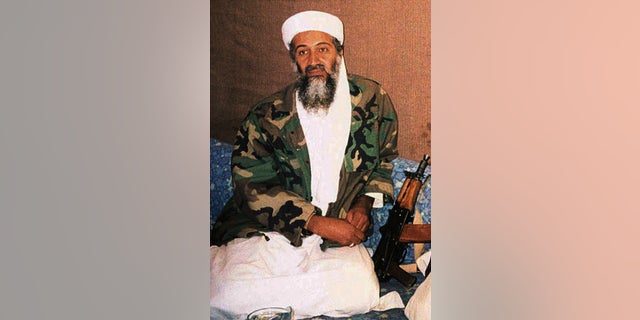
Usama
bin Laden wanted to assassinate then-President Barack Obama so that the
"totally unprepared" Joe Biden would take over as president and plunge
the United States "into a crisis," according to documents seized from
bin Laden's Pakistan compound when he was killed in May 2011. The secretive documents, first reported
in 2012 by The Washington Post, outlined a plan to take out Obama and
top U.S. military commander David Petraeus as they traveled by plane. “The
reason for concentrating on them is that Obama is the head of
infidelity and killing him automatically will make [Vice President]
Biden take over the presidency," bin Laden wrote to a top deputy. "Biden
is totally unprepared for that post, which will lead the U.S. into a
crisis. As for Petraeus, he is the man of the hour ... and killing him
would alter the war's path" in Afghanistan. Bin Laden specifically wanted fellow terrorist Ilyas Kashmiri to shoot down Obama. “Please
ask brother Ilyas to send me the steps he has taken into that work,”
bin Laden wrote to the top lieutenant, Atiyah Abd al-Rahman. Kashmiri
wouldn't get too far along in the plot, however; he was killed in 2011
in a U.S. drone strike shortly after bin Laden himself was shot to death
by U.S. special forces.
Usama bin Laden said he wanted Joe Biden to be president, according to declassified documents.
Intelligence officials told the Post that bin Laden's plan never progressed past the aspirational stage. For his part, Biden has sent mixed signals on his role in bin Laden's death, as explained at length in a timeline
by The Washington Examiner's Jerry Dunleavy. In late April 2011, Obama
gathered together a team that included Biden before making a final
decision on whether to strike at bin Laden's suspected compound. In January 2012, Biden revealed he had opposed to
the raid, and claimed that “every single person in that room hedged
their bet” except for CIA Director Leon Panetta, who supported striking
the compound. “Mr. President, my suggestion is, don’t go,” Biden said he told his boss, as reported by The New York Times. "We have to do two more things to see if he's there.'" But in 2015, Biden changed his mind and said he had told Obama he "should go." Obama
himself verified Biden's opposition to the plan, telling Mitt Romney in
a 2012 presidential debate, “Even some in my own party, including my
current vice president, had the same critique as you did." On CBS’s “60 Minutes" in Oct. 2015, Biden tried to clear up the confusion, and insisted everything he said had been "accurate." “In
order to give the president the leeway he needed, I said, ‘Mr.
President, there’s one more thing we can do.’ … One more pass to see if
it was bin Laden. I said, ‘You should do that, and there’d still be time
to have the raid, but that’s what I would do,” Biden said. SEAL
Team Six ultimately landed at bin Laden's compound in two MH-60 Black
Hawks, killed the terror leader and seized a fateful cache of valuable
intelligence.
California Gov. Gavin Newsom
is facing pushback as state lawmakers have begun demanding details of
his nearly $1 billion deal to receive 200 million masks per month from a
Chinese manufacturer. Just two weeks after announcing the deal, Newsom has remained largely mum on the specifics. Advisers to the California Democrat have declined requests for comment from the Los Angeles Times about
the agreement, which was inked with Chinese electric car manufacturer
BYD — which stands for Build Your Dreams — earlier this month. BYD
was formed in 1995 as a battery manufacturer. In 2008, Warren Buffett’s
Berkshire Hathaway purchased a 24.8% stake in the company. Since
then, it has grown into one of the largest electric car makers and
partnered with Toyota in November to launch a joint venture into
electric car batteries. The Buffett-backed company also operates a
US subsidiary in Lancaster, California, which employs about 1,000
people, according to the Times. Despite its growth under Buffett,
the company announced it saw a 42% drop in profits from 2019, citing the
coronavirus pandemic, cuts to government subsidies and changes to
emissions rules in China. Around the same time, the company said
on its website that it had converted one of its manufacturing facilities
into “the world’s largest mass-produced face masks plant,” adding that
it would make 5 million masks per day in the fight against the spread of the virus. After
announcing the deal, MSNBC’s Rachel Maddow pressed Newsom for details,
though he would only say he had decided to utilize “the purchasing
power” of California “as a nation-state,” and that of the 200 million
masks, 150 million would be N95 masks and the remainder would be
surgical masks. Pressed by reporters this week about withholding details of the contract, Newsom maintained scant specifics. “I’m
for outcome here. Some are consumed by process, personality, intrigue.
Who’s up, who’s down. We are for actually solving a major, major problem
— not only for the state but potentially a template for the country,”
he said. The California Senate and Assembly have also been kept in the dark about the deal, according to the San Francisco Chronicle. “It
would be great to get a heads-up directly from the governor’s office
rather than watching it on national TV,” Assembly Budget Committee Phil
Ting (D-San Francisco) said in an interview Wednesday with the
Chronicle. “We don’t have any information as to how many masks
we’re buying, who we’re buying them from, at what price … What are we
obligated? For how long are we obligated?” Senate Budget Committee
Chairwoman Holly Mitchell (D-Los Angeles) sent a letter to the Newsom
administration requesting full details, including quality standards and
price per mask. “Under normal circumstances, the Legislature would
have had more time to deliberate an expenditure of this magnitude and
would have been allowed to thoroughly vet the details of the contract
before proceeding,” Mitchell wrote. The paper reports that a
Newsom administration official refused to provide state senators with a
copy of the contract during a budget oversight hearing in Sacramento
last Thursday, despite the state having already paid half the cost. The
state’s chief deputy director of the Office of Emergency Services told
senators via videoconference that providing all specifics of the deal
would risk disrupting the supply line of masks to the state. A BYD
spokesperson referred all questions about negotiations over the
purchase of masks to Newsom’s office when reached by the Times. A spokesperson for Newsom could not immediately be reached for comment by The Post.
A judge in Harris County, Texas,
on Wednesday ordered residents to start wearing face masks in public
for 30 days beginning next week -- or face a possible fine. But Judge Lina Hidalgo’s action, intended to help stem the spread of the coronavirus,
drew immediate pushback – including from the state’s lieutenant
governor, who called the move, “the ultimate government overreach,” and
U.S. Rep. Dan Crenshaw, who wrote that "commonsense guidelines" should never lead to "unjust tyranny." Lt.
Gov. Dan Patrick noted in a Twitter message that Hidalgo’s order was
announced on the same day as plans surfaced for closing a local hospital
“because it wasn’t needed.” “These
kind of confused government policies fuel public anger – and rightfully
so,” wrote Patrick, who has been a vocal advocate for reopening the
Texas economy and getting people back to work. Crenshaw said health guidelines should be "emphatically promoted," but he objected to the punitive aspects of the judge's order. The
order by Hidalgo -- whose role as a county judge in Texas is similar to
that of "county executive" in other states -- is scheduled to take
effect Monday. It requires that people in public areas or in close
proximity to other people cover their nose and mouth with a mask or
other covering – or face a possible $1,000 fine, FOX 26 of Houston reported. The order does not apply for exercising or outdoor walks and does not apply to children under 10, the report said. Aside
from Patrick, Hidalgo’s order also drew backlash from a Houston police
officers’ union, which called the order “draconian,” and said it was
seeking guidance from the state attorney general’s office on whether the
fine for offenders was legal, the Houston ouston HoustonHChronicle
reported. “It is clear the so-called leader of Harris County lacks
any critical thinking skills,” President Joe Gamaldi of Houston Police
Officers’ Union Lodge 110 wrote in a statement. “But let me assure the
public, our officers do!” Hildalgo responded by saying the police
were “entitled to their opinions. She added that she wasn’t looking to
impose “a police state,” but rather was looking to slow the spread of
the virus. “It’s something we have to do for the sake of our safety, our lives and our economy,” the judge said, according to the Chronicle. The
city of Houston reported 27 new infections Wednesday, and for the third
straight day reported no deaths related to the virus, the newspaper
reported.
Michigan Gov. Gretchen Whitmer's administration
acknowledged Tuesday that normal protocols were bypassed when a no-bid
contract for coronavirus contact tracing was awarded by the state to
Great Lakes Community Engagement, which is operated by a well-known
Democratic consultant Michael Kolehouse
-- who has previously written that President Trump should
"get Coronavirus ASAP" and that someone should "do the country a favor
and cough on that man," Facebook posts reviewed by Fox News show. The Washington Free Beacon reported earlier
Tuesday that Michigan gave a separate contract to track the spread of
coronavirus to Every Action VAN, a division of the Democratic data
operation NGP VAN. The contract for Great Lakes Community Engagement,
which would total $200,000 over eight weeks, was to be executed in
coordination with EveryAction, which is tightly linked to NGP VAN's
operation. The state abruptly canceled the contract Tuesday. “Nearly
every major Democratic campaign in America is powered by NGP VAN's
software, including the Obama campaign’s voter contact, volunteer,
fundraising and compliance operations in all 50 states," NGP VAN boasts on its website. The Washington Post has described NGP VAN as "the voter file provider for Democratic campaigns and independent groups up and down ballot." NGP VAN has previously exposed secretive and proprietary information due to technical glitches, The Washington Post has reported, including when a software patch was improperly applied. The
contracts raised concerns that Whitmer's administration was tying
confidential health information to a political data gathering
operation and that Whitmer, a rising star floated as a possible vice
presidential candidate, had circumvented the state's normal process for
awarding key financial resources. "This is who Gov. Whitmer is giving state contracts to?" asked GOP chairwoman Ronna McDaniel. “I
want to know how Gov. Whitmer’s administration decided to hire this
company without a competitive bid process, or letting the Legislature —
charged with ensuring accountability within state government — know
about it,” wrote GOP state Rep. Shane Hernandez in a letter to Whitmer
that was first reported by The Detroit News. “I
want to know what safeguards the governor has in place to ensure the
information gathered during this COVID-19 response doesn’t wind up in
the hands of any campaigns." Whitmer's office told Fox News that
neither Kolehouse's operation nor NGP VAN should have gotten the funds,
but didn't explain how the purported mistake had occured in the first
place.
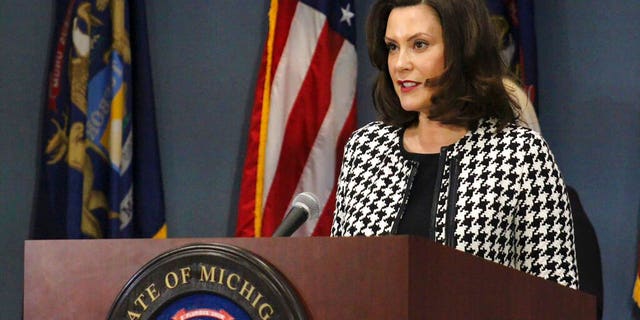
In this photo, provided by the Michigan Office of the Governor,
Michigan Gov. Gretchen Whitmer addresses the state in Lansing, Mich.,
Monday, April 20, 2020. (Michigan Office of the Governor via AP, Pool)
"This contract should have been approved by the State
Emergency Operations Center," a Whitmer spokesperson said by
email. "This issue is being corrected, and a different vendor and
software platform will be selected by the SEOC. The state is committed
to ensuring this important tracing work can begin quickly to help save
lives, while also ensuring that public health data is safe and secure." The governor's office separately told
The Washington Post: “The executive office is uncomfortable with this
vendor for the same reason others are. The public needs to have
confidence that this tracing work is being done by a nonpartisan firm.
The state is committed to ensuring this important tracing work can begin
quickly to help save lives, while also ensuring that public health data
is safe and secure.” Kolehouse Strategies appears in contact tracing testing materials obtained by Fox News, although the governor's office indicated that the firm hadn't yet begun work. There
was little doubt that Kolehouse and NGP VAN were no strangers to the
Whitmer administration before they secured the contracts. Kolehouse also
runs Kolehouse Strategies,
which openly advocates on behalf of progressive candidates. In other
social media posts, including one on April 1, he has praised Whitmer and
called Trump a "maniac." "We stand with that women [sic] and her name is Governor Whitmer!" Kolehouse wrote on March 30. Kolehouse has since locked down his Facebook account, and he did not respond to Fox News' request for comment. Contact
tracing allows health officials to proactively address the spread of a
virus by assessing exposure among individuals, and involves major
potential privacy risks. Wes Nakagiri, a local county commissioner, was
the first to discover the contract arrangement -- and told the Free Beacon that the Whitmer contract was unprecedented. "I’ve
been involved with grassroots activists for a little over a decade,"
Nakagiri told the outlet. "I’ve never seen anything like this on the
conservative side of the ledger, where you’ve got this entity working
with governmental bodies, dumping huge networks of information into one
database. They’re asking for contact information, they’re asking for who
else lives in the house—it’s troubling that this information is being
stored in a Democrat-aligned database." Whitmer has taken numerous
hits on the national stage amid the coronavirus epidemic, even as her
profile surges and she is discussed as a possible running mate for Joe
Biden. Two Michigan business owners who filed a lawsuit against Whitmer after she imposed one of the strictest stay-at-home orders in the country told “Fox & Friends Weekend” on Sunday that they weren't alone. “We
are representing thousands of business owners like us in the state of
Michigan,” Chris Welton, a co-owner of Welton Lawn Care, said. “It’s our
peak season and it’s devastating to the entire industry.” “We
have customers that want us to come. They don’t understand why
we can’t,” she continued. “We have lost revenue, employees that are laid
off that we’re trying to take care of, unused inventory,
customer retention issues, that really is a problem.” Whitmer was facing at least two federal lawsuits challenging her April 9 executive order to combat the coronavirus pandemic. In
the complaints filed last week, several Michiganders said the
governor’s recent tightening of restrictions infringed on their
constitutional rights. Whitmer’s April 9 order prohibited people
in her state from visiting family or friends in groups of any size, in
public or private. It also placed restrictions on what types of
businesses may operate and restricted essential businesses from selling
non-essential items. It also banned travel to second homes and vacation
properties. Fox News' Talia Kaplan contributed to this report.
BATON
ROUGE, La. (AP) — Governors in 17 states have committed to regional
coordination to reopen their economies during the coronavirus outbreak —
but none are in the South, where leaders are going it alone, just as
they did in imposing restrictions.
As
questions about when and how to ease virus-control measures becomes
increasingly politically charged, governors in the Deep South have
resisted any appearance of synchronization, instead driving home their
message that each state must make its own decision.
Georgia
Gov. Brian Kemp plans to have many of his state’s businesses up and
running again as soon as Friday. Fellow Republican Tennessee Gov. Bill
Lee announced that most businesses will begin resuming operations as
soon as next week.
ADVERTISEMENT
Some
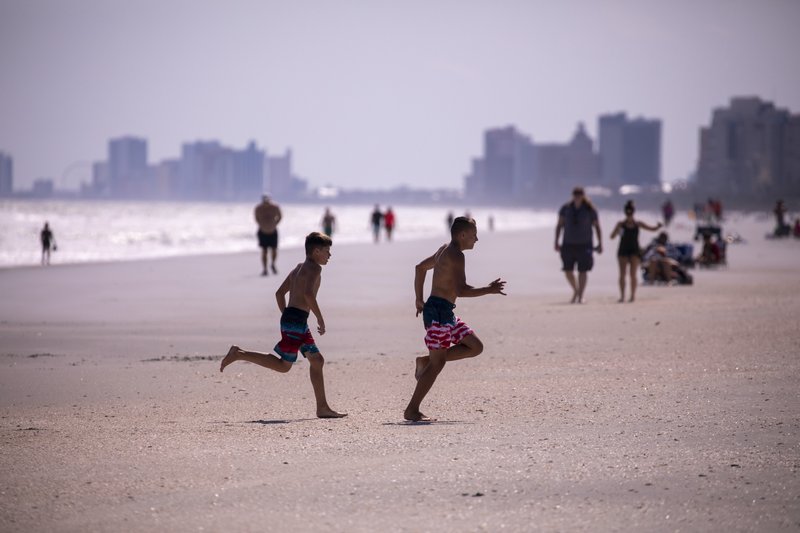
other Republican leaders were taking smaller steps, like reopening
their beaches. In the virus hot spot of Louisiana, Democratic Gov. John
Bel Edwards was also taking a more cautious approach, announcing he’ll
first allow some non-emergency medical procedures to resume next week.
But
no one wants to coordinate. Edwards, for one, notes neighboring states
have less expansive outbreaks. Even when several Republican governors
held phone calls to talk about reopening plans, they insisted they
weren’t working in concert — and left out their Democratic counterparts
in the region.
“We’re trying to take, where we can, our destiny into our own hands,” said Kemp.
He’s
been one of the region’s most aggressive so far, allowing gyms, bowling
alleys, tattoo parlors and other businesses to reopen Friday, if owners
follow social-distancing and hygiene requirements. Restaurants can
bring back dine-in service and movie theaters can reopen by Monday.
Such moves runs counter to the advice of many experts and have left many businesses wary.
The
lack of regional coordination also raises concerns that a loosening in
one state — especially with insufficient testing — could lead to a spike
in cases in another. But agreement would be difficult in a region with
such disparate approaches.
The strategy stands in stark contrast to coordination elsewhere.
California, Oregon and Washington have agreed to synchronize how they
will begin lifting their shelter-in-place restrictions. Seven states in
the Northeast have done the same as have seven governors in the Midwest.
In the latter two regions, governors from both parties are involved.
ADVERTISEMENT
In
the South, it’s ad hoc: Kemp said he’s talked to other Southern
governors, but he didn’t coordinate with any of them, even though urban
areas in Georgia lap over borders with several. Edwards and Republican
Mississippi Gov. Tate Reeves have also had conversations because of the
travel and business shared between New Orleans and the Mississippi Gulf
Coast. But Edwards said he did not believe further coordination was
necessary.
“I
think if you look at those areas where this is happening, you have very
similar situations in terms of the amount of COVID that they have in
those various states and they have a much greater degree of
inter-connectedness in terms of their economies,” he said.
Beyond
easing the medical restrictions, Edwards says he’s waiting to see if
Louisiana’s improving trajectory — fewer hospitalizations, fewer people
on ventilators — remains on course, before deciding what steps he’ll
take when his stay-at-home order expires April 30. Louisiana still has
more cases and far more deaths than any other state in the region.
For
most people, the highly contagious coronavirus causes symptoms such as
high fever and a dry cough. But some people, especially older adults and
people with existing health problems, become much sicker and even die.
Elsewhere in the South, decision-making is varied.
Even
as neighboring Georgia pushed to reopen, Republican Alabama Gov. Kay
Ivey decided to keep a stay-home order in place through the end of the
month. Meanwhile, Arkansas’ Republican governor, Asa Hutchinson, never
issued such a mandate, though he’s imposed other restrictions.
Reeves
in Mississippi and Florida Gov. Ron DeSantis, meanwhile, have allowed
beaches to reopen. Reeves also has said that nonessential businesses can
start offering curbside pickup or delivery.
In
South Carolina, barricades came off public boat ramps Friday. Closed
retailers, like department stores and specialty shops, were next, but
only, Republican Gov. Henry McMaster insisted, if strict social
distancing was followed. He let local governments decide whether to
reopen beaches. Most declined, for now.
Still,
it wasn’t clear if the state’s COVID-19 cases had peaked yet, since
state health data shows the number of coronavirus tests have fallen.
Georgia, too, is seeing a testing decline.
Experts
say that’s the opposite of what’s needed as restrictions ease. The
leader of South Carolina’s teaching hospital warned the state also
needed robust tracing of the people who have had contact with the sick.
“We
need to have in place the pieces to keep a second wave from becoming
crippling,” said Dr. David Cole, president of the Medical University of
South Carolina.
The
outbreak has hit different parts of the country in different ways — and
the response has been just as varied — so there isn’t one playbook,
said Dr. Richard Oberhelman, an infectious disease specialist at Tulane
University’s School of Public Health and Tropical Medicine in New
Orleans.
“Coordination
makes sense, but the flip side is different states are in different
parts of the epidemic,” Oberhelman said, adding that communication
remained key.
Some
fear that if Southern states get too far out ahead of the rest of the
country, they could attract visitors — and possibly open the door to
more infections.
Myrtle
Beach has suffered, but if it starts to ease restrictions on hotels and
short-term rentals, it could see an influx of visitors looking for warm
weather far from hot spots. Without extensive testing, that could spell
disaster, infectious control nurse Debbie Borst told a meeting of the
Myrtle Beach City Council.
“The
public hears one thing, but they don’t realize we don’t have testing
available like other cities and states, so I’m worried that they have a
false sense of security concerning our numbers,” Borst said.
___
Collins
reported from Columbia, South Carolina. Associated Press writers Jeff
Amy in Atlanta; Andrew DeMillo in Little Rock, Arkansas; and Emily
Wagster Pettus in Jackson, Mississippi, contributed to this report.
And people like this is why I'm voting Republican.
A member of the far-left "Squad" of freshmen congresswomen slammed President Trump’s coronavirus response this week, alleging it was “akin to war crimes.” U.S. Rep. Ayanna Pressley, D-Mass., made her allegations in a video posted Monday. Claiming
“criminal negligence, science denials, [and] a sluggish response,” on
the part of Trump, she said the U.S. was now playing catchup during the
pandemic, “which is the last place that you want to be in the midst of
any public health crisis.” Pressley said relief efforts shouldn’t
discriminate based on race, income or immigration status and advocated
for universal paid leave, sick pay for all workers and "long-term
financial assistance.” “This hurt is unprecedented, it is being
felt by everyone and the relief should be felt by everyone,” she added
during the video conference with other progressive leaders. Pressley
said progressives need to be even more “unapologetic” and “emboldened”
in pushing for proposals that she said Senate Majority Leader Mitch
McConnell has derided as Democratic “wish lists." "When Leader McConnell says he's tired of our wish list, we're going to keep wishing," she said.
"When Leader McConnell says he's tired of our wish list, we're going to keep wishing." — U.S. Rep. Ayanna Pressley, D-Mass.
“Now
is not the time to be incremental,” she added. “I don’t think that it
is too big of a wish to want to center the humanity and the dignity and
the very preservation of life for every individual, every family and
every worker.” Trump has been criticized by Democrats for not
taking the threat of the virus more seriously when it first showed up in
the U.S., for being slow to react and for not getting more testing kits
and personal protective equipment to states. The president has
pointed to a travel ban he placed on China in late January as an example
of his quick response and has accused the World Health Organization of
covering up for China as the virus began to spread, saying the WHO put
"political correctness over lifesaving measures.” War crimes are
defined as "grave breaches of the Geneva Conventions" and include
torture, willful killing and taking hostages, among others. Trump
was accused by Rep. Alexandria Ocasio-Cortez and others in January
other threatening to commit war crimes when he tweeted that the U.S. had
targeted Iranian cultural sites. He later backtracked and said he would
“obey the law.” Pressley went into self-isolation in late March
after contracting flu-like symptoms that she feared at the time could
have been the coronavirus, the Washington Examiner reported. She later tested negative.
California Democratic Gov. Gavin Newsom Tuesday implied local leaders in the state won’t be allowed to lift coronavirus stay-at-home
orders yet as certain communities have expressed interest in easing
restrictions and some protesters took to the streets last weekend
demanding the reopening of the economy, according to reports. “I
imagine there’ll be some examples of people just getting ahead of that
collaborative spirit,” he said in a news conference, according to The
Los Angeles Times. “And we may have to dial a little bit of that back.” He
said local officials may ease stay-at-home restrictions as long as they
don’t conflict with state orders but would "encourage" any local
officials who go too far to "pull back." Ventura County, for
example, will reopen golf courses, some small businesses that don’t deal
with the public, allow gatherings in cars and in-person meetings of
fewer than 5 people and in-person car sales on May 15, KTLA-TV in Los
Angeles reported. HUNDREDS PROTEST CORONAVIRUS STAY-AT-HOME ORDER IN CALIFORNIA TO 'DEFEND CONSTITUTIONAL RIGHTS' He
said “appropriate queries” about local changes to the stay-at-home
order have been brought by certain counties, including San Luis Obispo,
Ventura and Placerville and said he hoped to work with local leaders to
coordinate any easing of restrictions in certain areas, The Times
reported. San Luis Obispo County officials said this week they are
planning to gradually lift restrictions and reopen businesses but said
any changes would need the governor’s approval, KTLA reported. “I
caution those, including local election officials, that practicing
physical distancing has worked to keep those numbers relatively modest
in terms of growth, but if we pull back too quickly, those numbers will
go through the roof,” Newsom stressed. Last week, he outlined
criteria that must be met before the stay-at-home order can be lifted,
including widespread testing, developing therapeutics and potentially a
vaccine, enacting social distancing inside businesses, protecting the
vulnerable and addressing needs of hospitals. “Normal it will not be, at least until we have herd immunity and we have a vaccine,” he said. Hundreds of protesters took to the streets in Huntington Beach over the weekend, claiming the lockdown was too restrictive. “If
we pull back too quickly, those numbers will go through the roof,”
Newsom said. “And I don’t think any of the people, in their goodwill and
the spirit in which they are wanting to loosen things up, want to see
those numbers increase," The Times reported.
The head of the Centers for Disease Control and Prevention (CDC) is
warning that a second wave of coronavirus could coincide with the start
of flu season, proving to be even more devastating than the enduring COVID-19 pandemic. CDC Director Robert Redfield told The Washington Post
in an interview Tuesday that the nation should be cautious even as some
states attempt to reopen their economies in the coming weeks and
continue to practice social distancing measures to mitigate the spread
of the virus. Redfield
stressed that the practice has had “an enormous impact" on containing
the outbreak, but said Americans need to plan ahead and consider getting
a flu shot in the summer so that when winter comes, hospitals are not
once again overburdened. He added that the precaution “may allow
there to be a hospital bed available for your mother or grandmother that
may get coronavirus.” The coronavirus pandemic has overcrowded
hospitals around the world and across the country, taxed the capacity of
morgues and exposed the shortage of ventilators and protective
equipment for health care workers and others on the front lines of the
virus. Redfield said that in order to avoid a repeat of the
horrors of this pandemic, which has killed 43,630 people and infected
804,194 others in the U.S. alone, the CDC is beefing up the workforce
that is dealing with public health issues to accommodate and adequately
plan for a second onslaught. The agency plans to add an additional
650 personnel to the already existing 500 staff members across the
nation to “substantially augment” the public health response when all of
the states begin to roll back stay-at-home restrictions and have people
reenter the workforce and resume daily life. Still,
more workers are needed and the CDC is weighing utilizing field workers
intended for the Census Bureau -- which suspended operations until May
due to the coronavirus outbreak -- as well as the Peace Corps and
AmeriCorps to establish "an alternative workforce," it said.