Presumptuous Politics

Saturday, May 9, 2020

Court halts ban on mass gatherings at Kentucky churches


FRANKFORT, Ky. (AP) — A federal court halted the Kentucky governor’s temporary ban on mass gatherings from applying to in-person religious services, clearing the way for Sunday church services.
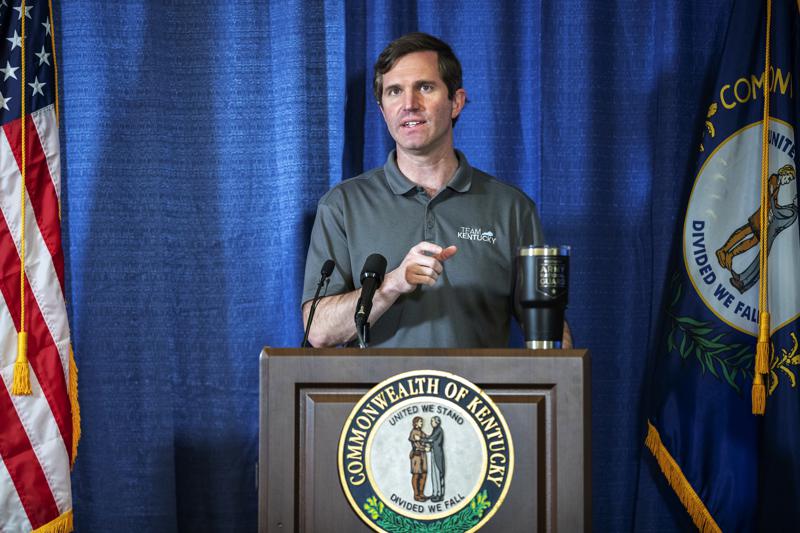
U.S. District Judge Gregory F. Van Tatenhove on Friday issued a temporary restraining order enjoining Gov. Andy Beshear’s administration from enforcing the ban on mass gatherings at “any in-person religious service which adheres to applicable social distancing and hygiene guidelines.”
The ruling from the Eastern District of Kentucky sided with the Tabernacle Baptist Church in Nicholasville, but applies to all places of worship around the commonwealth. Two other federal judges, including U.S. District Judge David Hale, had previously ruled the ban was constitutional. But also on Friday, Hale, of Kentucky’s western district, granted Maryville Baptist Church an injunction allowing in-person services at that specific church, provided it abide by public health requirements.
Exceptions to the Democratic governor’s shutdown order include trips to the grocery store, bank, pharmacy and hardware store. Beshear had previously announced that places of worship in Kentucky will be able to once again hold in-person services starting May 20, as part of a broader plan to gradually reopen the state’s economy. Earlier Friday, he outlined requirements for places of worship to reopen, including limiting attendance at in-person services to 33% of building occupancy capacity and maintaining 6 feet (2 meters) of distance between household units.
The federal judge’s order in the Tabernacle Baptist Church case said Beshear had “an honest motive” in wanting to safeguard Kentuckians’ health and lives, but didn’t provide “a compelling reason for using his authority to limit a citizen’s right to freely exercise something we value greatly — the right of every American to follow their conscience on matters related to religion.”
Tabernacle had broadcast services on Facebook and held drive-in services, but the substitutes offered “cold comfort,” according to the opinion. The opinion went on to say that Tabernacle alleged irreparable injury and was likely to succeed on the merits of its federal constitutional claim, as the defendants didn’t “dispute the challenged orders place a burden on the free exercise of religion in Kentucky.”
“The Constitution will endure. It would be easy to put it on the shelf in times like this, to be pulled down and dusted off when more convenient,” Van Tatenhove’s opinion read. “But that is not our tradition. Its enduring quality requires that it be respected even when it is hard.”
His opinion says Kentucky’s attorney general urged the court to apply the injunction statewide, and since the executive order challenged didn’t solely apply to Tabernacle, the injunction granted would also have a similar scope.
“Both rulings affirm that the law prohibits the government from treating houses of worship differently than secular activities during this pandemic,” Attorney General Daniel Cameron, a Republican, said in a statement late Friday.
A three-judge federal appeal court panel had last week cleared the way for Maryville Baptist Church to hold drive-in worship services while adhering to public health requirements, an alternative that Beshear has strongly encouraged throughout the coronavirus pandemic. But that panel had stopped short of applying its order to in-person worship services.
Maryville had defied Beshear’s order for houses of worship to not hold in-person services amid the COVID-19 outbreak. At least 50 people attended its Easter service at the church, and the church has held other services since. In response, the governor said Kentucky State Police troopers would record license plates and place notices on vehicles telling Easter service attendees they would have to self-quarantine.
Maryville had turned to the appeals court after Hale had initially refused to stop Beshear’s order from applying to religious services, saying it bans all mass gatherings and thus does not discriminate against religion.
In his order Friday, Hale said the governor failed to prove there was no less restrictive alternative to help reduce the spread of COVID-19 and failed to address the appeals court’s suggestion to limit the number of people who could attend services. He said that the burden of proof was on the governor and Maryville Baptist Church “would likely succeed on the merits of their claim under the Kentucky Religious Freedom Restoration Act.”
Beshear’s office had not issued a statement on the injunctions as of late Friday night.
For most people, the coronavirus causes mild or moderate symptoms, such as fever and cough that clear up within weeks. For some, especially older adults and those with existing health problems, it can cause more severe illness, even death.

Russia, Belarus mark Victory Day in contrasting events


MOSCOW (AP) — Russian President Vladimir Putin marked Victory Day, the anniversary of the defeat of Nazi Germany in World War II, in a ceremony shorn of its usual military parade and pomp by the coronavirus pandemic.
In neighboring Belarus, however, the ceremonies went ahead in full, with tens of thousands of people in the sort of proximity that has been almost unseen in the world for months.
Putin on Saturday laid flowers at the tomb of the unknown soldier just outside the Kremlin walls and gave a short address honoring the valor and suffering of the Soviet army during the war.
Victory Day is Russia’s most important secular holiday and this year’s observance had been expected to be especially large because it is the 75th anniversary, but the Red Square military parade and a mass procession called The Immortal Regiment were postponed as part of measures to stifle the spread of the virus.
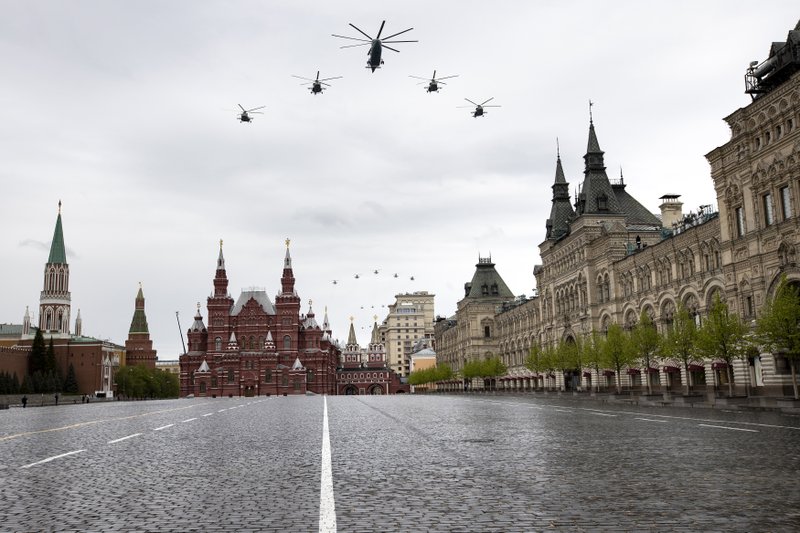
The only vestige of the conventional show of military might was a flyover of central Moscow by 75 warplanes and helicopters.
The ceremony was the first public appearance in about a month for Putin, who has worked remotely as the virus took hold.
In his speech, he did not mention the virus — Russia has nearly 200,000 confirmed cases — or how its spread had blocked the observances that were to be a prestige project for him.
But he promised that full commemorations would take place.
“We will, as usual, widely and solemnly mark the anniversary date, do it with dignity, as our duty to those who have suffered, achieved and accomplished the victory tells us,” he said. “There will be our main parade on Red Square, and the national march of the Immortal Regiment — the march of our grateful memory and inextricable, vital, living communication between generations.”
The sharply reduced observances this year left a hole in Russia’s civic and emotional calendar. The war, in which the Soviet Union lost an estimated 26 million people including 8.5 million soldiers, has become a fundamental piece of Russian national identity.
Beyond the stern formalities of the Red Square military parade and smaller parades in other cities, Russians in recent years have turned out in huge numbers for the Immortal Regiment processions, when civilians crowd the streets displaying photographs of relatives who died in the war or endured it. Russian officials routinely bristle at criticism of the Red Army’s actions in the war, denouncing the comments as attempts to “rewrite history.”
An online substitute for the processions was taking place Saturday and many people are expected to display relatives’ photos from their balconies and windows in the evening.
A full military parade of some 3,000 soldiers was held Saturday in Minsk, the capital of Belarus, which has not imposed restrictions to block the virus’ spread despite sharply rising infection figures. Tens of thousands of spectators, few of them wearing masks, watched the event.
President Alexander Lukashenko, who has dismissed concerns about the virus as a “psychosis,” said at the parade that Belarus’ ordeal in the war “is incomparable with any difficulties of the present day.”
In one of the final events of the VE Day commemoration in Western Europe, which took place a day earlier, Berlin’s landmark Brandenburg Gate was illuminated late Friday.
The words “Thank You” against a blue backdrop were projected onto the monument in Russian, English, French and German.
Earlier in the day German President Frank-Walter Steinmeier described May 8 as the day Germany, too, was “liberated” from Nazi dictatorship.
___
Yuras Karmanau in Minsk, Belarus, contributed to this report.

Trump says ‘jury’s still out’ on FBI boss Wray – despite Barr defense


In a Fox News interview Friday, President Trump was noncommittal on whether FBI Director Christopher Wray would remain in the job following the Justice Department’s decision to drop its case against Michael Flynn.
“Let’s see what happens with him,” the president told “Fox & Friends,” adding that “the jury’s still out” on Wray’s future in the bureau.
Trump said he would leave the decision up to Attorney General William Barr, head of the Justice Department, which oversees the FBI.
“You know, I told Bill Barr, you handle it,” the president said. “I would be absolutely entitled in theory, as the chief law enforcement officer, in theory. But I said, ‘You know what, I want Bill Barr to handle it,” adding that the attorney general “has done an unbelievable job.”
One day earlier, Barr appeared to defend Wray during an interview with CBS News, although he claimed that both he and Wray needed to “step up” following the Flynn case.
“You know, he's been a great partner to me in our effort to restore the American people's confidence in both the Department of Justice and the FBI,” Barr said Thursday, according to the Washington Examiner. “And we work very well together. And I think both of us know that we have to step up. That it's very important to restore the American people's confidence.”
In the same interview, Barr said he still had confidence in Wray’s ability to do the job.
“Well, you know, Chris Wray has always supported and been very helpful in various investigations we've been running,” Barr told CBS. “But, you know, there are a lot of cases in the Department of Justice, and I don't consider it the director's responsibility to make sure that all the documents are produced in each case. So I don't — I wouldn't say that this has affected my confidence in Director Wray.”
Also defending Wray on Friday was Brian O'Hare, president of the FBI Agents Association.
The director “continues to lead through unprecedented challenges with a steady hand,” O’Hare told The Washington Post, credting Wray with making “the changes needed to ensure that the FBI is best positioned to deal with threats to the American people.”
On Thursday, Barr’s Justice Department moved to drop its case against Flynn, the former U.S. national security adviser who had pleaded guilty in 2017 to lying to the FBI. The decision followed the release of documents that called into question the handling of the Flynn case by FBI personnel.
On the same day, the FBI’s top prosecutor in the case, Brandon Van Grack, abruptly withdrew, without explanation.
Prior to the Justice Department dropping the Flynn case, several Republicans on Capitol Hill and in the Trump administration placed pressure on Wray following the release of the documents, which included handwritten notes from former FBI official Bill Priestap that showed FBI personnel had debated whether they should try to catch Flynn in a lie during a conversation at the White House on Jan. 24, 2017 – just days after President Trump took office.
Although Wray did not become FBI director until August of that year – succeeding James Comey, whom Trump fired in May 2017 – Republicans including Rep. Jim Jordan of Ohio and Mike Johnson of Louisiana earlier this week questions why Wray hadn’t previously divulged information about the Flynn case that wasn’t made public until earlier this week.
“It is well past time that you show the leadership necessary to bring the FBI past the abuses of the Obama-Biden era,” the congressmen wrote in a letter to Wray on Monday.
On Wednesday, counselor to the president Kellyanne Conway called on Wray and Comey to fully disclose what they know about the Flynn case.
“We have every need to know transparently what happened,” Conway told Fox News.
On Thursday, documents released in connection with the Justice Department’s motion to drop the Flynn case revealed that former President Barack Obama had been aware of details of intercepted December 2016 phone calls between Flynn and then-Russian Ambassador Sergey Kislyak.
In statements to the Washington Examiner, Brian Hale, the FBI’s assistant director for the Office of Public Affairs, said that recently released documents from the Flynn case had previously been made available to the inspector general of the Justice Department and to U.S. Attorney John Durham, who had been appointed by Barr to investigate the origins of former Special Counsel Robert Mueller’s Russia investigation.
Hale also underscored that Wray was not with the bureau at the time of the Flynn investigation.
“The Flynn investigation was initiated and conducted during this time period, under prior FBI leadership,” Hale said. “Since taking office, Director Wray has stressed the importance of strictly abiding by established processes, without exception. Director Wray remains firmly committed to addressing the failures under prior FBI leadership while maintaining the foundational principles of rigor, objectivity, accountability, and ownership in fulfilling the Bureau’s mission to protect the American people and defend the Constitution.”
Fox News’ Ronn Blitzer and Gregg Re contributed to this story.

Obama says ‘rule of law is at risk’ after DOJ dropped Michael Flynn case


Former President Barack Obama on Friday reacted to the Justice Department’s move to end its case against Michael Flynn by declaring that the “rule of law is at risk” -- as new details emerge about what the former president knew about the case against Flynn in the last days of his administration.
“The news over the last 24 hours I think has been somewhat downplayed — about the Justice Department dropping charges against Michael Flynn,” Obama said, according to News, in a web talk with members of the Obama Alumni Association
“And the fact that there is no precedent that anybody can find for someone who has been charged with perjury just getting off scot-free," he reportedly said. "That’s the kind of stuff where you begin to get worried that basic — not just institutional norms — but our basic understanding of rule of law is at risk. And when you start moving in those directions, it can accelerate pretty quickly as we’ve seen in other places.”
Yahoo News, in reporting the tape, noted that Obama incorrectly states the charges against Flynn, who was not charged with perjury. Instead, Flynn pleaded guilty in 2017 to lying to the FBI about his conversations with the Russian ambassador in the transition period between the Obama and Trump administrations. But Flynn’s supporters have long argued that the FBI set a perjury trap for Flynn.
The move this week by the DOJ came after the release of memos showing bureau officials debating at the time whether their purpose in interviewing Flynn was to get him to lie and prosecute him or get him to “admit to breaking the Logan Act” -- an obscure law that bars non-government officials from pretending to represent the U.S.
New details emerged also this week about what Obama himself knew at the time of the Flynn case. Obama warned the Trump administration against hiring Flynn and said he was “not a fan” of the former head of the Defense Intelligence Agency.
According to declassified interview transcripts, Obama told then-Deputy Attorney General Sally Yates and then-FBI Director James Comey in early 2017 that he had “learned of the information about Flynn” and his conversation with the Russian ambassador about sanctions
Obama "specified that he did not want any additional information on the matter, but was seeking information on whether the White House should be treating Flynn any differently, given the information."
At that point, the documents showed, "Yates had no idea what the president was talking about, but figured it out based on the conversation. Yates recalled Comey mentioning the Logan Act, but can't recall if he specified there was an 'investigation.' Comey did not talk about prosecution in the meeting."
The exhibit continues: "It was not clear to Yates from where the President first received the information. Yates did not recall Comey's response to the President's question about how to treat Flynn. She was so surprised by the information she was hearing that she was having a hard time processing it and listening to the conversation at the same time."
On Friday, Obama cited the Flynn case as a reason for why former officials needed to help his former Vice President Joe Biden beat Trump in November.
“So I am hoping that all of you feel the same sense of urgency that I do,” he said. “Whenever I campaign, I’ve always said, ‘Ah, this is the most important election.’ Especially obviously when I was on the ballot, that always feels like it's the most important election. This one — I’m not on the ballot — but I am pretty darn invested. We got to make this happen.”
Obama also reportedly cited the coronavirus pandemic as a reason to fight harder for Biden, blaming what he saw as a poor response on “tribal” trends stoked by Trump and his allies.
“What we’re fighting against is these long-term trends in which being selfish, being tribal, being divided, and seeing others as an enemy — that has become a stronger impulse in American life,” he said.
“And by the way, we’re seeing that internationally as well. It’s part of the reason why the response to this global crisis has been so anemic and spotty. It would have been bad even with the best of governments. It has been an absolute chaotic disaster when that mindset — of ‘what’s in it for me’ and ‘to heck with everybody else’ — when that mindset is operationalized in our government.”
Fox News’ Brooke Singman and Gregg Re contributed to this report.

Friday, May 8, 2020

Chinese Virus Cartoons


Navy vet mocked by Dem rival may help California GOP capture Katie Hill's former House seat


A special election in California next Tuesday may give Republicans the chance to win back a House seat lost to a Democrat during 2018’s so-called "blue wave."
Former Rep. Katie Hill, a Democrat, won the seat north of Los Angeles in the state's 25th Congressional District, which had been a GOP stronghold for more than two decades. But last October, Hill resigned amid a nude photo scandal and accusations by her estranged husband of an inappropriate relationship with a staffer. Hill denied a relationship.
On May 12, voters will decide who will serve out the remainder of Hill's term in the House. The candidates are Democrat Christy Smith and Republican Mike Garcia. Then in November -- against the backdrop of the presidential election -- they'll decide whether to elect Smith or Garcia for a full term.
Smith received a high-profile endorsement from former President Obama this week, but she also got into a bit of hot water when a leaked video showed her mocking Garcia’s focus on his military experience, according to The Hill. Garcia is a former Navy pilot.
She later tried to undo the damage.
“Without question, I have the deepest respect for Mike Garcia’s service to our country and I’m sorry for comments that I made that might suggest otherwise,” she later said in a statement.
“Without question, I have the deepest respect for Mike Garcia’s service to our country and I’m sorry for comments that I made that might suggest otherwise.”
— Democrat Christy Smith
President Trump has endorsed Garcia and slammed Smith on Twitter: “Vote @MikeGarcia2020 by May 12th! His opponent @ChristyforCA25 . . . Now she’s mocking our Great Vets! We need Navy Fighter Pilot Mike Garcia in #CA25!” he wrote.
The seat of was one 39 Democrats flipped in 2018 but early mail-in ballot returns seem to be favoring Republicans.
So far, 32 percent of registered Republicans have voted in the special election, compared to 20 percent of Democrats and 15 percent of independents, according to The Washington Post.
Complicating the election is the coronavirus pandemic, which makes both campaigning and voting more difficult.
Only a small number of polling locations will be open, which means most voters will need to cast absentee ballots.
Democrats say they will likely do better in November when turnout for the presidential election is expected to be higher.
“We’re trying to run a campaign at the height of the crisis when it is hard to get people’s attention because people are so distracted by the crisis,” Smith said, according to The Post. “We’re hopeful for the best and that the turnout breaks in our favor.”
Hill’s high unfavorability in the district also hasn’t helped Smith, who is a California assemblywoman and former school board member, according to The New York Times.
While Smith calls herself a moderate with public service experience, Garcia has pledged to “to cut taxes, grow jobs, and keep Sacramento policies from spreading to DC” if elected, according to The Post.

Dallas salon owner Shelley Luther speaks out after release from jail: 'I couldn't bring myself to apologize'


Dallas salon owner Shelley Luther, who was ordered jailed for seven days Tuesday after she violated a local coronavirus-related business closure order, joined "Hannity" for an interview Thursday, hours after her release.
Luther said she is feeling much better after being allowed to go back home, and told host Sean Hannity she stands by her decision not to apologize as instructed by state District Judge Eric Moye.
"That was the last thing I was going to do, honestly," she said. " ... I just couldn't, I couldn't bring myself to apologize."
Moye gave Luther the option of avoiding prison if she apologized for what he described as her "selfish" behavior, paid a fine and kept her doors closed until Friday, when hair salons across Texas can open with restrictions.
"We were shut down March 22, so it had been several weeks that the government was kind of telling us the [small business] money was coming," Luther told Hannity. "The Dallas County Judge, Clay Jenkins, kept pushing back the date of when we would open weeks out in advance, before we would hear any new comings of what was going on with masks or whatever.
"When he finally pushed it back a final time I just woke up one day and I said, 'I have to open, my stylists are calling me, they're not making their mortgage,'" she continued. " ... I'm two months behind on my mortgage.
"My stylists were telling me that they wanted [to go] underground and go to people's houses," she said. "I just said, 'You know, that's not a good idea because we can't control the environment there. We don't know if it's been disinfected or anything like that,' and I just decided I would open."
Luther added that during the time she was open in defiance of the order, the salon instituted strict sanitation and social distancing measures.
'We tried to use gloves at first," she said, adding that the hairstylists couldn't work with them. "But we made sure that I had no clients waiting inside the salon at all. I had chairs six feet apart outside of the salon ... and when the stylist was ready and wearing a mask -- we didn't let any clients come in without a mask -- they instantly sanitized their hands, the hairstylist sanitized their hands. They came in, they did the cut and that person left."
Luther said her brief stay in jail was "not pleasant," though she did have a cell to herself.
"The worst thing was that I didn't get to call anybody when I got there, the whole first night," she said. "And that's kind of scary, because I have a daughter that just turned 17 at home, and if my boyfriend wasn't there to tell, you know, to talk to her or anything, I would not have come home and she would not have known where I was."
Fox News' Tyler Olson contributed to this story.

Ted Cruz slams San Antonio plan declaring 'Chinese virus' to be hate speech: 'This is NUTS'


Hate speech directed against certain ethnic groups in connection with the coronavirus outbreak will not be tolerated, the city council of San Antonio, Texas, decided Thursday.
Council members unanimously passed a resolution that specifically addresses anti-Chinese COVID-19 references, including terms such as “Chinese virus” or “kung fu virus,” claiming such language encourages hate crimes and other incidents against Asian-Americans and Asian immigrants.
"Unfortunately, during times of crisis we do see the best of humanity and sometimes we also see the worst," said Mayor Ron Nirenberg, who initiated the resolution, according to San Antonio's WOAI-TV. "There has been a rise of hate speech throughout the course of this pandemic."
But prior to the vote, U.S. Sen. Ted Cruz, R-Texas, blasted the plan as political correctness run amok.
"This is NUTS," Cruz wrote on Twitter on Thursday. "SA City Council behaving like a lefty college faculty lounge, triggered by Chick-fil-A & the words 'Wuhan virus.' If they want to investigate someone, start with NYT & CNN who both repeatedly (and rightly) referred to it as "the Chinese coronavirus."
The resolution asserts the coronavirus was not created or caused by any race, nationality or ethnicity.
It also refers to World Health Organization guidance against using geographic descriptors for the virus that could fuel acts of ethnic or racial discrimination.
"Our efforts must meet the indiscriminate nature of COVID-19 with empathy and compassion for all our neighbors," Nirenberg said.
Businesses and individuals in San Antonio have been victimized due to the coronavirus -- including Golden Star, a Chinese restaurant near the city's downtown, officials said.
"It’s been in operation for almost 90 years," Councilwoman Shirley Gonzales said, according to the station. "They’re a Chinese restaurant family and they have been threatened. They have been the victims of hate speech and hate crimes, with vandalism and that sort of thing on their property."
President Trump said in March he might stop referring to coronavirus as a “Chinese virus” if it bothered the Chinese community. Although he said that he would consider ending the term, he didn’t think there was anything wrong with it -- arguing it referred to geography, not race or ethnicity.

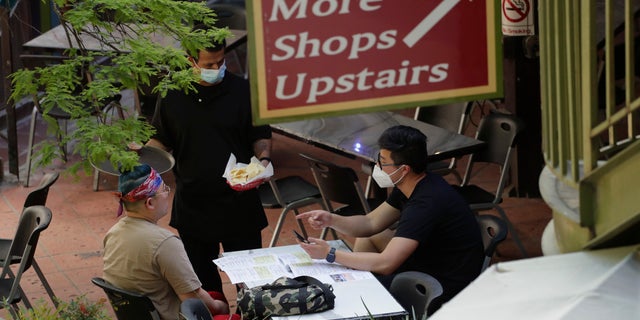
A waiter serves a group dining at a restaurant that reopened at the River Walk in San Antonio, Friday, May 1, 2020. (Associated Press)

“If you look at Ebola, right, if you look at Lyme in Connecticut, you look at all these different horrible diseases, they seem to come with a name with a location,” he said. “I don’t have to say it if they feel so strongly about it, we’ll see.”
Meanwhile, Asian-Americans reported more than 650 racist acts over one week in March in the wake of the coronavirus outbreak, according to data from online reporting forum Stop AAPI Hate.
The forum said incidents varied from attackers spitting or coughing on victims, to victims being told to leave stores or having Uber and Lyft drivers refuse to pick them up.
China has been accused of possibly covering up the coronavirus pandemic, although hate speech against its people differs from possible outrage over actions taken by its government.

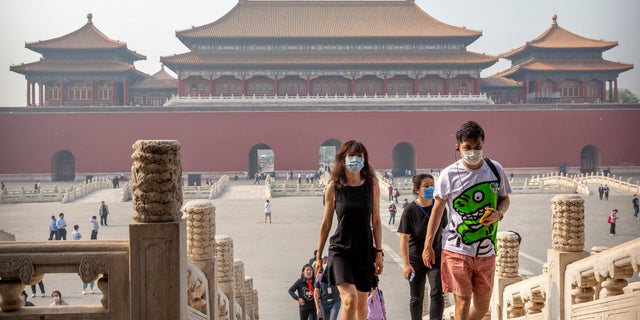
Visitors wearing face masks to protect against the new coronavirus walk through the Forbidden City in Beijing, Friday, May 1, 2020. (Associated Press)

Nirenberg said he was aware of several examples of hate speech and subsequent actions taken against people in the city. He added the resolution wasn't directed at constitutionally protected free speech, as guaranteed by the First Amendment.
"Oh no, not at all. What this is, is a statement of values, as we say we’re a compassionate community," the mayor said, according to WOAI-TV.
The resolution also includes speech directed at the Jewish community, which it says have been targeted with "blame, hate, antisemitic tropes and conspiracy theories about their creating, spreading and profiting from COVID-19."
City council members voted in favor of the resolution 11 to 0.
Texas has seen more than 36,036 confirmed coronavirus cases and at least 985 deaths from the virus as of late Thursday, according to data from Johns Hopkins University.
Fox News' Morgan Phillips and Peter Aitken contributed to this report.

Trump calls Flynn 'innocent man' after DOJ drops case against former national security adviser


President Trump praised his former national security adviser Michael Flynn and tore into the administration of former President Barack Obama on Thursday after learning that the Justice Department had dropped its case against Flynn.
“He was an innocent man,” Trump said of Flynn during a meeting at the White House with Texas Gov. Greg Abbott. “Now in my book he’s an even greater warrior.”
The Justice Department’s move to drop its case comes shortly after internal memos were released that raised serious questions about the nature of the investigation that led to the retired Army lieutenant general’s 2017 guilty plea for lying to the FBI.
Those documents showed how agents discussed their motivations for interviewing him in the Russia probe—questioning whether they wanted to “get him to lie” so he'd be fired or prosecuted, or get him to admit wrongdoing. Flynn allies howled over the revelations, arguing that he was essentially set up in a perjury trap.
Flynn in January moved to withdraw his guilty plea for lying to the FBI in the Russia probe, citing "bad faith" by the government. That court filing came just days after the Justice Department reversed course to recommend up to six months of prison time in his case, alleging he was not fully cooperating or accepting responsibility for his actions.
The case had been plodding through the court system with no resolution ever since his original plea, even amid speculation about whether Trump himself could extend a pardon.
Trump on Thursday claimed Flynn was a target of the Obama administration and called the investigation into his former national security adviser treasonous.
“They’re human scum,” Trump said. “It’s treason.”
The president also targeted the news media for its coverage on Flynn, and called on the New York Times and the Washington Post to return their Pulitzer prizes for coverage on the investigations into Russian interference during the 2016 election.
“Those writers... are thieves,” Trump said. “They should be forced to give back Pulitzer prizes.”
Flynn's case stemmed from a 2017 FBI interview, in which he was asked about his conversations with former Russian Ambassador to the U.S. Sergey Kislyak. Flynn ultimately pleaded guilty to making false statements regarding those conversations during his interview, as part of former Special Counsel Robert Mueller’s Russia investigation.
Flynn resigned from his White House post in February 2017. The resignation came as he was accused of misleading Vice President Mike Pence and other senior White House officials about his communications with Kislyak. Pence, after being briefed by Flynn, had said in television interviews that Flynn did not discuss sanctions with the ambassador.
Following Flynn's resignation, Trump quickly tweeted a defense of Flynn’s exit from the White House in 2017 – arguing that despite Flynn pleading guilty to lying to the FBI, his actions were lawful.
"I had to fire General Flynn because he lied to the Vice President and the FBI,” Trump tweeted. “He has pled guilty to those lies. It is a shame because his actions during the transition were lawful. There was nothing to hide!"
Fox News’ Brooke Singman contributed to this report.

CartoonDems