Presumptuous Politics

Sunday, May 17, 2020

Andrew McCarthy: Obamagate – Was Flynn identity unmasked or never masked in call with Russian ambassador?


Despite Wednesday’s blockbuster news about the dozens of Obama administration officials who “unmasked” then-incoming Trump National Security Adviser Michael Flynn, there remains a gaping hole in the story: Where is the record showing who unmasked Flynn in connection with his fateful conversation with Russian Ambassador to the U.S. Sergey Kislyak?
There isn’t one.
There is no such evidence in the unmasking list that acting National Intelligence Director Richard Grenell provided to Sens. Chuck Grassley, R- Iowa, and Ron Johnson, R-Wis.
I suspect that’s because Lt. Gen. Flynn’s identity was not “masked” in the first place. Instead, his Dec. 29, 2016 call with Kislyak was likely intercepted under an intelligence program not subject to the masking rules, probably by the CIA or a friendly foreign spy service acting in a nod-and-wink arrangement with our intelligence community.
“Unmasking” is a term of art for revealing in classified reports the names of Americans who have been “incidentally” monitored by our intelligence agencies. Presumptively, the names of Americans should be concealed in these reports, which reflect the surveillance of foreign targets, primarily under the Foreign Intelligence Surveillance Act. Broadly speaking, FISA governs two kinds of intelligence collection.
The first is “traditional” FISA – the targeted monitoring of a suspected clandestine operative of a foreign power. If the FBI shows the Foreign Intelligence Surveillance Court (FISC) probable cause that a person inside the United States is acting as a foreign power’s agent, it may obtain a warrant to surveil that person.
If the foreign power’s suspected agent communicates with Americans, the latter are incidentally intercepted even though they are not the targets of the surveillance.

Wisconsin again? Swing state a hotbed of virus politics


MADISON, Wis. (AP) — Wisconsin has been the battleground for political proxy wars for nearly a decade, the backdrop for bruising feuds over labor unions, executive power, redistricting and President Donald Trump.
Now, six months before a presidential election, the state is on fire again. With a divided state government and a polarized electorate, Wisconsin has emerged as a hotbed of partisan fighting over the coronavirus, including how to slow its spread, restart the economy, vote during a pandemic and judge Trump’s leadership.
In recent weeks, every political twist has been dissected by the parties, political scientists and the press, all searching for insight into which way the swing state might be swinging in the virus era.
ADVERTISEMENT
Democrats had the most significant recent win, a contested statewide Supreme Court race. It gave them a claim on sense of momentum after making gains in the 2018 midterm elections. But Republicans this past week won a special election for Congress, albeit in a GOP stronghold, and successfully had the governor’s stay-at-home order tossed out by the state Supreme Court.
But no one is making predictions about Wisconsin in November, other than to note that the latest fight over the fallout from the coronavirus may be the most important of them all.
“The jury’s still out,” said former Gov. Scott Walker, perhaps the figure most closely associated with Wisconsin’s political turbulence. The Republican had previously said the economic recovery favored Trump carrying the state. On Friday, he said the November presidential election will be a referendum on Trump’s handling of the pandemic.
“One, how do you feel about your own health and health of your family,” Walker said. “Two, how do you feel about the health of the economy, particularly your own job. ... If people are still freaked out, then I think it’s always tough for any incumbent.”
Taking their cues from Trump, who has called on states to “liberate” residents from stay-at-home orders and get back to normal, state Republican lawmakers challenged Democratic Gov. Tony Evers’ order in court. Similar maneuvers have been tried in Michigan and Pennsylvania, the other Rust Belt states that backed Trump in 2016 and handed him the White House.
But only in Wisconsin have Republicans gotten what they wanted, suddenly taking ownership of the state’s coronavirus response and, with it, new political risk. While some Wisconsinites rushed out to bars to celebrate the court’s ruling, many in the state were confused about the new patchwork of restrictions. Meanwhile, a solid majority of Wisconsin residents have said they support Evers’ handling of the crisis, according to a new Marquette University Law School poll.
ADVERTISEMENT
Democrats were quick to cast the issue as much larger than the previous partisan feuds.
“By November, a significant fraction of Wisconsinites might be close to someone who has been hospitalized or even died because of coronavirus,” Wisconsin Democratic Party Chairman Ben Wikler said. “And those are, unlike passing news cycles, the things that can create scars that change how people view politics in their own lives.”
As in other states, the virus has moved beyond Wisconsin’s big Democratic cities. Brown County, home of Green Bay and a number of meat processing plants, has become Wisconsin’s fastest-growing coronavirus hot spot.
In 2016, Trump easily carried the county. But in last month’s election, Democrats’ choice for the state Supreme Court, Jill Karofsky, won Brown County, part of her surprisingly strong showing in an election plagued by long lines at polling places and widespread worries over whether it was safe to be voting at all.
Evers tried at the last minute to postpone the election, but Republicans refused. Again, Wisconsin’s drama was projected on the national stage — and mined for lessons about organizing, mail-in voting and ballot access.
“Republicans in my district were begging us not to hold an in-person election,” said state Rep. Robyn Vining, a Democrat whose district spans western Milwaukee County and GOP-leaning suburbs. “People who said they had voted Republican their entire lives were furious.”
Whether Republicans will take out any frustrations on Trump is far from clear. The Marquette University poll this week found Trump has a 47% approval rate in Wisconsin, virtually unchanged from March. The poll also registered the impact of the state’s decade of political battles — an intense polarization.
“There’s not much of a middle in Wisconsin, at least as far as Donald Trump is concerned,” said John Johnson, a research fellow from Marquette University Law School.
The state was a hotbed of tea party opposition to Barack Obama’s administration in 2010, sentiment that helped Walker win office and move to cut public-sector unions’ bargaining rights. The effort ignited mass Capitol protests in Madison and prompted a bitter recall election a year later. Walker beat it back and went on to win reelection in 2014.
His tenure hit at the heart of Wisconsin’s once-progressive tradition. In addition to his labor legislation, he enacted deep tax cuts and prevailed over a challenge to Wisconsin’s legislative redistricting — leaving the state with districts heavily gerrymandered to favor his party.
Since Trump’s narrow 2016 victory in Wisconsin — the first by a Republican presidential candidate since 1984 — Wisconsin has become home to a permanent campaign. Democrats began a year-round organizing initiative that led to a comeback with Evers’ narrow defeat of Walker in 2018.
Republicans, too, have invested in organizing in the state, particularly in hunting for new voters in the rural counties where Trump made strong gains over past Republicans candidates.
The Trump campaign says its staff of 60 turned its attention this week to a special election for a congressional seat in northern Wisconsin. They made 2.4 million get-out-the-vote calls in the district — roughly half of all the voter contacts they’ve made this election cycle in the state.
State Sen. Tom Tiffany won the seat by 14 percentage points. Trump carried the district by 20 percentage points in 2016.
___
Beaumont reported from Des Moines, Iowa, and Burnett from Chicago.

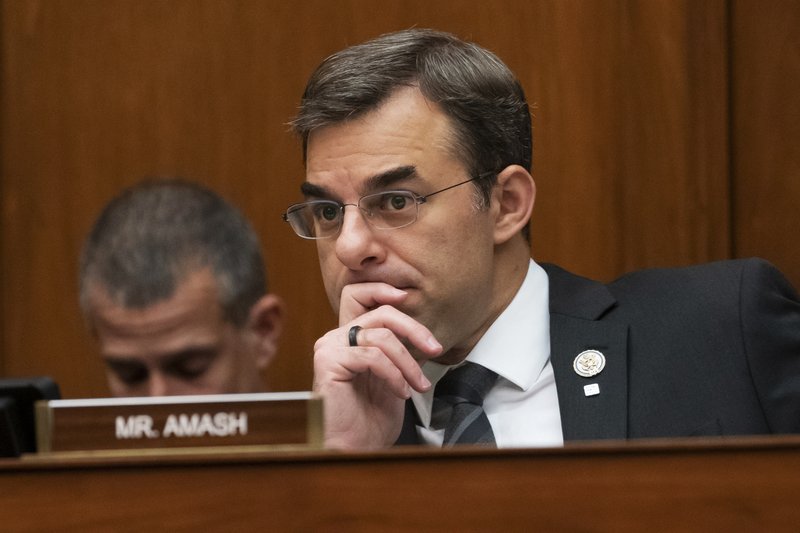
Michigan Rep. Amash ends his Libertarian bid for White House


WASHINGTON (AP) — Michigan Rep. Justin Amash, a high-profile critic of President Donald Trump who quit the GOP and became an independent, announced Saturday he would not seek the Libertarian nomination for the White House, weeks after saying he was running because voters wanted an “alternative” to the two major parties.
In deciding to drop out, he cited the challenges of trying to campaign as a third-party candidate during the coronavirus pandemic.
“After much reflection, I’ve concluded that circumstances don’t lend themselves to my success as a candidate for president this year, and therefore I will not be a candidate,” he said in one in a series of tweets explaining his decision. He said “the new reality of social distancing levels the playing field among the candidates in many respects, but it also means lesser known candidates are more dependent on adequate media opportunities to reach people.”
ADVERTISEMENT
Amash said he still thinks such a candidacy could prove successful in the future.
“I continue to believe that a candidate from outside the old parties, offering a vision of government grounded in liberty and equality, can break through in the right environment,” he tweeted. “But this environment presents extraordinary challenges.”
Amash would have faced nearly impossible odds of winning the presidency. But third-party campaigns can have unpredictable consequences for the Democratic and Republican candidates in the race.
In 2000, Ralph Nader’s Green Party presidential bid cost Democrat Al Gore crucial support and was a contributing factor in Republican George W. Bush’s narrow victory. Democrat Hillary Clinton’s 2016 loss to Trump has been blamed in part on the support that Green Party candidate Jill Stein picked up in states such as Pennsylvania.
Amash left the Republican Party last year and later supported Trump’s impeachment in the Democratic-led House.
In announcing his intention in late April to seek the Libertarian nomination, Amash said he wanted to represent the millions of Americans who do not feel well represented by either major party.

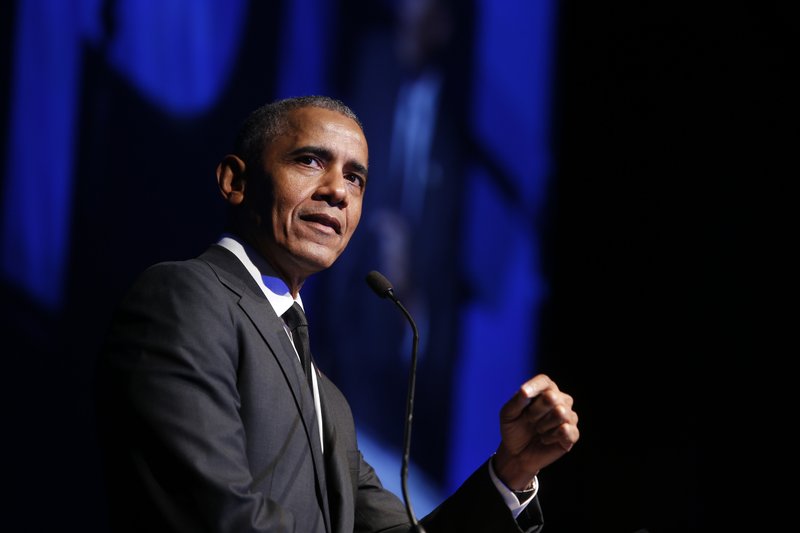
Obama criticizes virus response in online graduation speech

No matter how much you spray the roaches never completely go away.

WASHINGTON (AP) — Former President Barack Obama on Saturday criticized U.S. leaders overseeing the nation’s response to the coronavirus, telling college graduates in an online commencement address that the pandemic shows many officials “aren’t even pretending to be in charge.”
Obama spoke on “Show Me Your Walk, HBCU Edition,” a two-hour event for students graduating from historically black colleges and universities broadcast on YouTube, Facebook and Twitter. His remarks were unexpectedly political, given the venue, and touched on current events beyond the virus and its social and economic impacts.
“More than anything, this pandemic has fully, finally torn back the curtain on the idea that so many of the folks in charge know what they’re doing,” Obama said. “A lot them aren’t even pretending to be in charge.”
ADVERTISEMENT
Later Saturday, during a second televised commencement address for high school seniors, Obama panned “so-called grown-ups, including some with fancy titles and important jobs” who do “what feels good, what’s convenient, what’s easy.”
“Which is why things are so screwed up,” he said.
Obama did not name President Donald Trump or any other federal or state officials in either of his appearances. But earlier this month, he harshly criticized Trump’s handling of the pandemic as an “absolute chaotic disaster” in a call with 3,000 members of his administrations obtained by Yahoo News.
The commencement remarks were the latest sign that Obama intends to play an increasingly active role in the coming election. He has generally kept a low profile in the years since he left office, even as Trump has disparaged him. Obama told supporters on the call that he would be “spending as much time as necessary and campaigning as hard as I can” for Joe Biden, who served as his vice president.
As he congratulated the college graduates Saturday and commiserated over the enormous challenges they face given the devastation and economic turmoil the virus has wrought, the former president noted the February shooting death of Ahmaud Arbery, 25, who was killed while jogging on a residential street in Georgia.
“Let’s be honest: A disease like this just spotlights the underlying inequalities and extra burdens that black communities have historically had to deal with in this country,” Obama said. “We see it in the disproportionate impact of COVID-19 on our communities, just as we see it when a black man goes for a jog and some folks feel like they can stop and question and shoot him if he doesn’t submit to their questioning.”
“Injustice like this isn’t new,” Obama went on to say. “What is new is that so much of your generation has woken up to the fact that the status quo needs fixing, that the old ways of doing things don’t work.” In the face of a void in leadership, he said, it would be up to the graduates to shape the future.
“If the world’s going to get better, it’s going to be up to you,” he said.
It is a perilous time for the nation’s historically black colleges and universities, which have long struggled with less funding and smaller endowments than their predominantly white peers and are now dealing with the financial challenges of the coronavirus. Even at the better-endowed HBCUs, officials are bracing for a tough few years.
Obama’s message to high school students came at the end of an hourlong television special featuring celebrities, including LeBron James, Yara Shahidi and Ben Platt, and was less sharp-edged than his speech to the college graduates. He urged the young graduates to be unafraid despite the current challenges facing the nation and to strive to be part of a diverse community.
“Leave behind all the old ways of thinking that divide us — sexism, racial prejudice, status, greed — and set the world on a different path,” Obama said.

NYC councilman calls out Cuomo, de Blasio, asks for 'urgency' and 'reasonable guidelines' in reopening

Joe Borelli, councilman to the 51st District in New York City
Joe Borelli, councilman to the 51st District in New York City, called for state and local government officials to start addressing “reasonable guidelines” to reopen the Big Apple and get people back to work.
“The mayor and governor put a lot of effort into the lockdown and securing supplies. But now, every day more families are being bankrupted and forced on unemployment,” Borelli, a Republican, told Fox News on Saturday.
In a Friday tweet showing pictures of crowded street corners in Manhattan, Borelli wrote: “This is #NYC tonight. Manhattan, not a right wing backwater. People are ready to start reopening and our businesses and workers need it. We need to see some urgency - not blue ribbon commissions, business czars, & bureaucracy - just reasonable guidelines that we can safely follow.”
More than 1.9 million New Yorkers have filed for unemployment since the week of March 14, and New York City accounts for nearly half of the state’s claims with 930,000 jobless residents, according to the Department of Labor.
“And there’s no urgency whatsoever in addressing our financial issues. Not to mention, the city and state are going broke and they will simply be unable to support progressive social programs they support,” said Borelli, who is also a Fox News commentator.
New York has been the epicenter of the coronavirus in the United States, with more than 348,000 confirmed cases and nearly 22,500 deaths, according to the state’s Department of Health.
New York Gov. Andrew Cuomo, a Democrat, laid out a four-phase plan on May 4 for how the state will likely reopen if regions met certain health-based guidelines.
On May 14, he signed an executive order extending "New York State on PAUSE" for five of the 10 regions in New York, including New York City, until on May 28. The other five regions in the state were allowed to start phase one of reopening on May 15, as they had met the criteria.
Speaking during his press briefing on Saturday, Cuomo warned that there will be an increase in coronavirus cases now that some regions are allowed to begin partially reopening, “but you don't want to see a spike.”
The New York City region has only met four out of the seven criteria required to initiate phase one.
“We are social creatures. We need to be with each other. We need to collaborate. We need to think together. We need to experience things together, [but] that may not be… possible for the next few months,” said New York City Mayor Bill de Blasio, also a Democrat, in a Saturday press briefing. “We… have to meet the state indicators.”
The five regions still under executive order could be set to initiate phase one of reopening on May 28, but it is unclear how likely it is that they meet the seven requirements set by the governor in that timeframe.
Plans for initiating phase two for other parts of the state have not yet been laid out.
“I'm not for a moment trying to ignore the tough challenges, the tough questions ahead. But I'll tell you something, you get nowhere being pessimistic,” de Blasio said Saturday.
De Blasio came under fire last month after he criticized those involved in a large gathering at a Jewish funeral in Brooklyn. He later apologized for his warning to the Jewish community as a whole that threatened future arrests.
"I regret if the way I said it in any way gave people a feeling of being treated the wrong way, that was not my intention," de Blasio said at the time. "It was said with love, but it was tough love.”
De Blasio had tweeted after police in Williamsburg broke up the funeral of Rabbi Chaim Mertz, specifically calling out Jews instead of only giving a general warning to the city.
Fox News' Ronn Blitzer contributed to this report.

Saturday, May 16, 2020

CDC chief Redfield predicts coronavirus deaths to top 100,000 in June


The head of the Centers for Disease Control and Prevention (CDC) warned Friday that the U.S. is likely to top 100,000 coronavirus deaths by the start of June -- citing a dozen forecasting models that make the grim prediction.
placeholder
"CDC tracks 12 different forecasting models of possible #COVID19 deaths in the US. As of May 11, all forecast an increase in deaths in the coming weeks and a cumulative total exceeding 100,000 by June 1,” CDC Director Robert Redfield tweeted.
While the prediction is to an extent expected -- the U.S. is already on 87,530 deaths, according to Johns Hopkins University -- it marks a grim milestone in the fight against the virus.
However, it is significantly lower than the 2 million deaths the White House was warned in January and February could result if precautions were not implemented.
But there has also been some skepticism about the way officials are reporting deaths. Some states count presumed coronavirus deaths along with confirmed cases under CDC guidance issued last month. Other states don’t count those deaths.
Deaths have been classified as a COVID-19 death even after a physician or loved ones reported otherwise. And those who died “with" COVID-19 have been included in the count with those who died “of" COVID-19.
placeholder
“I think a lot of clinicians are putting that condition (COVID-19) on death certificates when it might not be accurate because they died with coronavirus and not of coronavirus,” Macomb County, Mich., Chief Medical Examiner Daniel Spitz in an interview with the Ann Arbor News last month.
Redfield’s prediction came as the White House ramps up efforts to reopen the country after the measures to stop the slow of the spread of the virus sent the economy into freefall -- with the unemployment rate hitting 14.7 percent this month and expected to rise further.
President Trump on Friday announced "Operation Warp Speed" -- a new initiative aimed at developing, manufacturing and distributing a "proven" vaccine.
Trump described the administration's plan as "a massive scientific industrial and logistical endeavor unlike anything our country has seen since the Manhattan Project" of World War II, with the intent to rapidly develop and distribute a vaccine with help from the U.S. military and world-renowned doctors and scientists.
placeholder
"We'd love to see if we can do it prior to the end of the year," the president said. "We think we're going to have some very good results coming out very quickly."
Fox News' Robert Gearty contributed to this report.

New Jersey, Murphy campaign agree to pay $1M to settle rape accusation against ex-aide


The state of New Jersey and Gov. Phil Murphy’s campaign agreed Friday to pay $1 million in a lawsuit brought by a state employee who alleged a campaign aide raped her in 2017.
Katie Brennan, chief of staff of the state's housing finance agency, accused Murphy’s then-campaign chief of staff Albert Alvarez of raping her on April 8, 2017, after Alvarez drove her home from a campaign event while they were both working to get Murphy elected. Alvarez left as the chief of staff of the Schools Development Authority in October 2018 when a news account of the accusation was about to come out.
Alvarez has denied the allegations and wasn’t criminally charged, but it sparked monthslong investigations by Murphy’s team and lawmakers.
“I think it’s a fair and reasonable settlement. We’ve worked collaboratively and constructively with Katie and her team to institute meaningful reforms to support survivors in the workplace,” Murphy said, according to NorthJersey.com. “We look forward to continuing our work on these issues to make New Jersey a leading state for survivor-centric policies as we have been doing now for a long time.”
"I think it’s a fair and reasonable settlement."
— New Jersey Gov. Phil Murphy
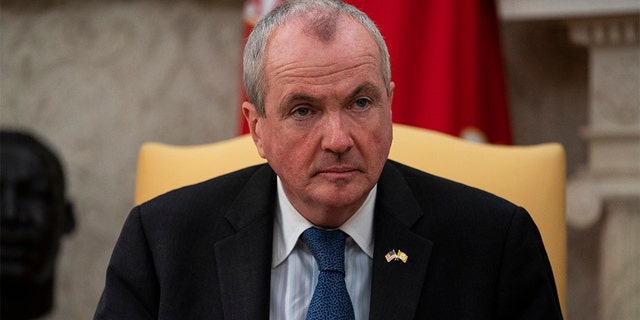
Gov. Phil Murphy, D-N.J., listens to President Donald Trump speak during a meeting about the coronavirus response in the Oval Office of the White House, Thursday, April 30, 2020, in Washington. (Associated Press)

Gov. Phil Murphy, D-N.J., listens to President Donald Trump speak during a meeting about the coronavirus response in the Oval Office of the White House, Thursday, April 30, 2020, in Washington. (Associated Press)

No money will go to Brennan, officials said: $600,000 will go to a charity she selected that helps low-income survivors of sexual assault and $400,000 will go to pay her attorneys.
As part of the settlement, Brennan and Alvarez will have a meeting through a facilitator and he will attend an anti-sexual harassment class.
“All survivors deserve the excellent support I had,” Brennan said in a news release Friday. “I hope to create that support for others so that a lack of legal representation is never a barrier to justice.”
“I hope that this can create a model program for other New Jersey survivors,” she added. “Living in silence did not serve me or any other survivors in this state. Speaking out gave me great strength."
"Living in silence did not serve me or any other survivors in this state. Speaking out gave me great strength."
— Katie Brennan
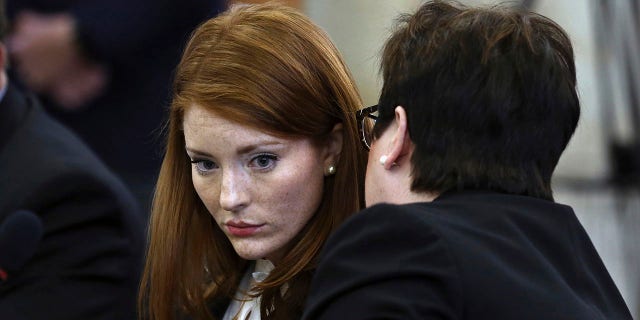
Katie Brennan, left, chief of staff at the New Jersey Housing and Mortgage Finance Agency, listens while testifying before the Select Oversight Committee at the Statehouse in Trenton, N.J., Dec. 4, 2018. (Associated Press)

Katie Brennan, left, chief of staff at the New Jersey Housing and Mortgage Finance Agency, listens while testifying before the Select Oversight Committee at the Statehouse in Trenton, N.J., Dec. 4, 2018. (Associated Press)

Brennan filed a police report at the time, but prosecutors said no charges would be filed because of "a lack of credible evidence."
In June 2018, The Wall Street Journal reported, Brennan emailed Murphy and his wife, asking to speak with them about a "sensitive matter" that had occurred the previous year.
Although Brennan did not specify the nature of the matter, Murphy responded within an hour and said he would schedule a meeting to talk with Brennan, The Journal reported.
“Hang in,” Murphy wrote to Brennan. “We are on it.”
But the meeting never happened, and there were no ramifications for Alvarez, the paper reported.
In October 2018, both of New Jersey's legislative houses voted to start a special commission to look into why Alvarez then scored a $140,000-per-year job in Murphy's administration.
Brennan sued the state over its handling of her allegation, which she reported to officials in the governor's transition and administration. She has said the administration botched its response to her claims, which officials have testified that they found to be credible.
Alvarez filed a countersuit alleging his reputation was destroyed by her claim. The countersuit was resolved in the settlement. Neither party admitted any wrongdoing.
He claimed the two had a consensual encounter, according to NorthJersey.com.
Fox News' Gregg Re and the Associated Press contributed to this report. 

Trump fires Steve Linick, Obama appointee who briefed Congress on Biden-Ukraine ties


President Trump on Friday night fired the State Department’s inspector general, saying in a letter to Congress that he no longer had confidence in the Obama administration appointee.
The president’s letter did not mention Steve Linick by name but said his removal would take effect in 30 days, The Associated Press reported.
Linick, a former assistant U.S. attorney in California and Virginia who has held the IG position since 2013, had overseen reports that were highly critical of the State Department's management policies since Trump took office.
His office had also criticized several Trump appointees for their treatment of career staff for allegedly being insufficiently supportive of Trump and his policies, the AP reported.
Last October, Fox News reported Linick had hosted a closed-door briefing on Ukraine for aides from several congressional committees. The briefing examined communications between Trump lawyer Rudy Giuliani and fired Ukrainian prosecutor Viktor Shokin and current Prosecutor General Yuriy Lutsenko. Linick also shared news clips and information regarding Ukrainian energy company Burisma, Fox reported.
The conversations between Giuliani and the Ukrainians were in reference to reports that former Vice President Joe Biden had sought to have Shokin fired amid an investigation into Burisma, whose board members included Hunter Biden, son of the former vice president.
President Trump’s July 2019 request that Ukraine’s president investigate the Biden matter led House Democrats to impeach the president last December on charges of abuse of power and obstruction of Congress. The Senate acquitted Trump in February.
Democrats in Congress immediately cried foul, with the chairman of the House Foreign Affairs Committee suggesting that Linick was fired in part in retaliation for opening an investigation into Secretary of State Mike Pompeo.
“This firing is the outrageous act of a president trying to protect one of his most loyal supporters, the secretary of state, from accountability,” Eliot Engel, D-N.Y., said in a statement. “I have learned that the Office of the Inspector General had opened an investigation into Secretary Pompeo. Mr. Linick’s firing amid such a probe strongly suggests that this is an unlawful act of retaliation.”
Engel offered no details of the alleged investigation into Pompeo, although two congressional aides told the Associated Press the investigation involved allegations that Pompeo may have improperly treated staff.
Linick’s removal continues a series of changes among the government’s inspectors general.
In April, Trump fired Michael Atkinson, the inspector general for the intelligence community, for his role in the whistleblower complaint that led to Trump’s impeachment.
Then Trump removed Glenn Fine as acting inspector general at the Defense Department, a move that stripped him of his post as chairman of the Pandemic Response Accountability Committee. That panel is charged with overseeing the allocation of more than $2 trillion in coronavirus relief funding.
During a White House briefing on the cornavirus, Trump questioned the independence of an inspector general of the Department of Health and Human Services over a report that said there was a shortage of supplies and testing at hospitals.
When Linick departs he will replaced by Stephen Akard, a former career foreign service officer with close ties to Vice President Mike Pence, a Trump administration official told the AP. Akard currently runs the department's Office of Foreign Missions. He had been nominated to be the director general of the Foreign Service but withdrew after objections he wasn't experienced enough.
Democrats in Congress, meanwhile, objected to the president’s move.
“The president must cease his pattern of reprisal and retaliation against the public servants who are working to keep Americans safe, particularly during this time of global emergency,” House Speaker Nancy Pelosi said in a statement.
Pelosi claimed Linick was being “punished for honorably performing his duty to protect the Constitution and our national security.”
Rep. Eliot Engel, D-N.Y., chairman of the House Foreign Affairs Committee, suggesting Linick was fired in part in retaliation for opening an unspecified investigation into Secretary of State Mike Pompeo.
“This firing is the outrageous act of a president trying to protect one of his most loyal supporters, the secretary of state, from accountability,” Engel said in a statement. “I have learned that the Office of the Inspector General had opened an investigation into Secretary Pompeo. Mr. Linick’s firing amid such a probe strongly suggests that this is an unlawful act of retaliation.”
Engel offered no details of the alleged investigation into Pompeo, but Linick's office had issued several reports critical of the department’s handling of personnel matters, including accusing some of Trump’s appointees of retaliating against career officials.
The Associated Press contributed to this report.

Nevada Democrat Horsford admits affair with former Reid intern known as ‘Love Jones’


A Democratic congressman from Nevada admitted Friday that he was involved in “a previous relationship outside of my marriage.”
U.S. Rep. Steven Horsford – a married man with three children who represents the state’s 4th Congressional District -- acknowledged the affair after a former intern to former Senate Majority Leader Harry Reid revealed she is “Love Jones,” the focus of a podcast series called “Mistress for Congress.”
“It is true that I had a previous relationship outside of my marriage, over the course of several years,” Horsford said Friday, according to the Las Vegas Review-Journal.
“I’m deeply sorry to all of those who have been impacted by this very poor decision, most importantly my wife and family. Out of concern for my family during this challenging time, I ask that our privacy is respected.”
"I’m deeply sorry to all of those who have been impacted by this very poor decision, most importantly my wife and family."
— U.S. Rep. Steven Horsford, D-Nev.
The woman’s real name is Gabriela Linder and she told the Review-Journal that she and the congressman were engaged in an off-and-on sexual relationship between 2009 and 2019. (Horsford married his wife in 2000.)
When they first met, she was 21 and Horsford was the 36-year-old majority leader of the Nevada state Senate. (He is now 47.) She said she wants her story to be a warning for other young women about relationships with older men in positions of power.
“He knew how in love with him I was, and he knew what he could do and get away with," she told the newspaper. “He knows I would support him. He never told me to keep quiet. He didn’t have to. He knew I was loyal to a fault."
“He knew how in love with him I was, and he knew what he could do and get away with."
— Gabriela Linder, aka 'Love Jones'
Linder never worked for Horsford, but said on her podcast that he provided job referrals and “financial support” over the years, the newspaper reported.
She added that she had no knowledge of Horsford ever misusing campaign funds or money from his state Senate or congressional offices to pay for anything for her.
On April Fools’ Day, Horsford appeared on a YouTube program hosted by Linder’s young son but the woman told the newspaper that Horsford is not the boy’s father. Linder and Horsford stopped speaking after the YouTube show, though the reason was unclear, the report said.
She said she launched the podcast series as “an empowering journey” away from the relationship and is also writing a book about their time together. She also claims that no one offered her money to produce the podcast, and she was not prompted by any of Horsford’s opponents as he seeks reelection.
Linder told the newspaper she thinks Horsford should withdraw from the race for misrepresenting himself to voters as “a family man and man of God.”
“He should take a step back, atone, and if people are satisfied, then he can come back into politics,” she told the Review-Journal.
“He should take a step back, atone, and if people are satisfied, then he can come back into politics.”
— Gabriela Linder, aka 'Love Jones'
In February, Horsford appeared on Fox News to announce his endorsement of Democrat Joe Biden for president after a poll showed Biden losing support from African-Americans.
"I am supporting Joe Biden for president because he is vetted, he is trusted and he has delivered,” Horsford said at the time.

CartoonDems