Tuesday, May 19, 2020
California opens up coronavirus funding for immigrants in state illegally, faces backlash
Undocumented immigrants in California are now allowed to apply for the state’s coronavirus relief program that will pay $500 per person and up to $1,000 per household, according to reports Monday.
The Los Angeles Times reported that Sacramento has freed up $75 million for the fund, which could help about 150,000 who may be facing severe hardships during the pandemic. An earlier report in the paper said the Center for American Liberty is suing the state, claiming that the money is “not a slush fund for the governor to spend as he sees fit.” It hopes to block the package.
Opponents of the measure insist that any taxpayer funds should be directed to U.S. citizens who are also struggling amid the pandemic.
The LA Daily News reported that the state is home to about 2 million undocumented immigrants who are not eligible to receive any kind of federal stimulus. The report said the fund could hit $125 million, which would include $50 million from donations. The money is expected to run out quickly.
The state website opened on Monday and there was so much traffic that the site crashed, the Fresno Bee reported.
“The website is currently up and running, and we are continuing to increase its capacity,” Scott Murray, a spokesman for the state’s Department of Social Services, told the Bee.
Kim Ouillette, attorney and fellow with Legal Aid at Work, told the paper that the state should “step in and do something more significant” because the funds will only cover a percentage of the immigrants in the state illegally. Applications will be accepted until June 30 or until funds run dry.
Gov. Gavin Newsom announced in April that he would spend $75 million of taxpayer money to create a Disaster Relief Fund for immigrants living in the country illegally.
He was criticized by some Republicans in the state. Senate Republican Leader Shannon Grove said at the time that Newsom should spend the money instead on food banks, equipment for students to continue their education online and local governments struggling with revenue losses.
“Instead of meeting these urgent needs, Governor Newsom has chosen to irresponsibly pursue a left-wing path and unilaterally secured $125 million for undocumented immigrants,” said Grove, who represents Bakersfield.
The Associated Press contributed to this report
Trump threatens to keep WHO funding freeze in place after WH investigation
President Trump released a blistering letter late Monday to the head of the World Health Organization, stating that his administration conducted an investigation that confirmed the health body’s multiple failures in the early stages of the coronavirus outbreak, and warned that his current funding freeze will become permanent if the organization does not make “substantive” improvements within 30 days.
“It is clear the repeated missteps by you and your organization in responding to the pandemic have been extremely costly for the world,” he wrote in the letter to Dr. Tedros Adhanom Ghebreyesus. “The only way forward for the World Health Organization is if it can actually demonstrate independence from China.”
The White House has insisted that Beijing downplayed the virus' threat in December, which led to the subsequent outbreak. China has denied the charge.
Trump announced in April that the U.S. would halt funding to the organization. He said at the time that his administration would undertake a 60-to-90 day investigation into why the "China-centric" WHO had caused "so much death" by "severely mismanaging and covering up" the coronavirus' spread, including by making the "disastrous" decision to oppose travel restrictions on China.
The U.S. was the WHO's largest single donor. Trump said the United States contributes roughly $400 to $500 million per year to WHO, while China offers only about $40 million.
The letter offers a bullet-point list of shortcomings at the agency that Trump claimed could have been prevented under the right leadership.
The WHO “consistently ignored credible reports of the virus” in December 2019. By the end of that month, it was clear at the organization that the virus was a “major health concern.” Taiwanese authorities told health officials at the organization about human-to-human transmission, but that revelation was not shared with the international community.
Trump’s letter stated that International Health Regulations require countries to report the “risk of a health emergency within 24 hours.”
The letter laid the blame squarely on China and the WHO for weeks of non-action. The health body even accused U.S. travel restrictions to the country in late February of causing “more harm than good.”
“By the time you finally declared the virus a pandemic on March 11, 2020, it had killed more than 4,000 people and infected more than 100,000 people in at least 114 countries,” the letter read.
Trump's letter comes as Democrats criticize the White House for not taking the virus seriously from the outset.
Dr. Rick Bright, a whistleblower who ran the Biomedical Advanced Research and Development Authority, blamed the Trump administration for its own slow response to the pandemic and said the administration was instead worried about politics instead of science.
Trump has dismissed Bright's charges and has indicated that he is a disgruntled employee with a political bent.
The WHO bowed to calls Monday from most of its member states to launch an independent probe into how it managed the international response to the coronavirus pandemic that has killed over 300,000 people and leveled the global economy.
Fox News' Gregg Re and the Associated Press contributed to this report
Monday, May 18, 2020
CNN's Kaitlan Collins spars with Trump after video shows her removing mask in WH briefing room
![]() |
Hypocrite |
CNN reporter Kaitlan Collins sparred with President Trump on Sunday for the second time in a week, this time on Twitter, after the president called her a “CNN Faker” over video showing her removing her mask while inside the White House briefing room.
Trump had retweeted his son Eric, who wrote: “Just a reminder that @CNN is a total joke.”
Collins responded: “Nearly 90,000 Americans have been killed by coronavirus, and the president is tweeting about me pulling my mask down for six seconds on Friday.”
The video showed Collins taking off her mask in the briefing room and not following social-distancing guidelines of staying at least six feet away from others.
Collins previously questioned why Trump administration officials weren’t wearing masks during the global pandemic.
Trump also got into a dustup with Collins at a Rose Garden news conference last week. She had approached the microphone after he apparently called on her, but he tried to move on to another reporter since Collins "didn't respond."
However, after Collins attempted to "let my colleague finish" and not step away from the microphone, Trump thanked the crowd and quickly walked away from the podium.
The coronavirus has infected over 4.7 million people and killed over 315,000 worldwide, according to a tally by Johns Hopkins University that experts said undercounted the true toll of the pandemic.
The U.S. has reported over 89,000 dead and Europe has seen at least 160,000 deaths.
AOC allegedly on hook for unpaid seven-year-old tax bill: report
US Rep. Alexandria Ocasio-Cortez wants to raise taxes on the rich — just not pay her own.
The Democratic socialist congresswoman from The Bronx still hasn’t paid a 7-year-old tax bill leftover from a failed business venture.
AOC had founded Brook Avenue Press, a publishing house that sought designers, artists and writers from urban areas to help paint The Bronx in a positive way in children’s stories, in 2012.
As the Post previously reported, public records show the state dissolved the company in October 2016. The state can make such a move when a business fails to pay corporate taxes or file a return.
The state Tax Department then filed a warrant against her now-defunct business on July 6, 2017, over a $1,618.36 unpaid bill.
As of Friday, the tax warrant had still not been satisfied, and the outstanding balance had grown to $2,088.78, the department said.

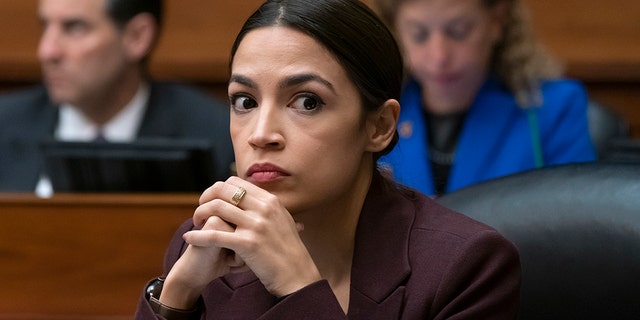
Rep. Alexandria Ocasio-Cortez, D-N.Y., listens to questioning of Michael Cohen, President Donald Trump's former personal lawyer, at the House Oversight and Reform Committee, on Capitol Hill in Washington, Wednesday, Feb. 27, 2019. (AP Photo/J. Scott Applewhite)
“She just thinks she’s better than everyone else. Clearly, she’s worse,” said Hank Sheinkopf, spokesman for AOC’s chief June primary-race opponent, Michelle Caruso-Cabrera, to The Post.
But Ocasio-Cortez’s camp says the rep is challenging the $2,088.78 bill because it was issued “in error."
“The congresswoman is still in the process of contesting the tax
warrant. The business has been closed for several years now, and so we
believe that the state Tax Department has continued to collect the
franchise tax in error,” said Lauren Hitt, an AOC spokeswoman.
“As anyone who’s tried to contest a tax bill in error knows, it takes time,” Hitt added.AOC, a first-term incumbent, will face Democratic voters in the June 23 primary in the 14th Congressional District covering portions of The Bronx and Queens.
She shocked the political world when she toppled Ex-Congressman and former Queens Democratic Party Chairman Joe Crowley in the 2018 Democratic primary.
In one of her first moves as a congresswoman in 2019, AOC said taxes on the country’s wealthiest should be increased to as much as 70 percent.
Meanwhile, the financial statement of Caruso-Cabrera, a former CNBC anchor, has yet to be publicly posted. Her campaign spokesman said it was filed Friday – the May 15 deadline.
Pat Sajak sides with out-of-work Americans, questions media telling those out-of-work to stay home
Longtime "Wheel of Fortune" host Pat Sajak questioned how talk show hosts and members of the media-- working remotely-- are telling those in financial trouble to stay home during the coronavirus pandemic, saying on Sunday, "it’s okay to question the premise."
"When a disc jockey or a talk show host or a journalist who is being paid to work from his or her home tells people who can’t work, pay bills or pay their rent or mortgage to 'Stay home and be careful because we’re all in this together,' it’s okay to question the premise," he wrote on Twitter.
His tweet comes as protests have broken out across the country urging state governments to reopen their economies with millions of Americans are currently out of work.
Those demonstrators, frustrated by certain stay-at-home orders, have swept many state capitals, including Ohio, North Carolina and Michigan. Other protests have broken out in New York, North Carolina, Rhode Island, and Washington D.C.
On Sunday, Federal Reserve Chair Jerome Powell warned on CBS's "60 Minutes" that the nation's unemployment rate could soar to 25 percent during the coronavirus pandemic. More than 36 million people in the U.S. have lost their jobs due to the virus.
Even with protests sweeping the country, Powell believes that opening the economy won't have a great impact unless people are confident to go out, which likely won't happen until a vaccine is developed.
It's also important to have enough testing when states reopen to prevent a second wave. Opening businesses too early could cause the economy to be impacted for even longer and lead to more deaths due to the virus.
"I would say though we're not going to get back to where we were quickly. We won't get back to where we were by the end of the year. That's unlikely to happen," the U.S. central bank chief said. "For the economy to fully recover, people will have to be fully confident. And that may have to await the arrival of a vaccine."
Popular game shows like, “Jeopardy!” and “Wheel of Fortune” are currently taping without studio audiences in response to the ongoing virus outbreak. Both shows are filmed at a studio in Culver City, California.
As of Sunday night, the U.S. has more than 1,486,757 confirmed coronavirus cases, and at least 89,562 deaths from the virus, according to data from Johns Hopkins University.
Trump blasts ’60 Minutes,’ ‘creep’ HHS whistleblower after broadcast
President Trump late Sunday accused CBS’ “60 Minutes” of putting the spotlight on another “Fake Whistleblower” who wants to inflict damage on his administration's coronavirus response in order to benefit the "Radical Left Democrats."
Dr. Rick Bright, who has a Ph.D. in virology and ran the Biomedical Advanced Research and Development Authority, reiterated earlier claims that the government was slow to respond to the unfolding pandemic and said the administration was instead worried about politics instead of science. He blamed Health and Human Services Secretary Alex Azar of not heeding early warning about the virus.
Bright told the show that there was a Jan. 23 meeting where he was the only person in the room who said, "We're going to need vaccines and diagnostics and drugs. It's going to take a while and we need to get started."
Bright told Norah O’Donnell, the "60 Minutes" correspondent, that his resistance to Trump’s push of hydroxychloroquine was what ultimately cost him his position at the agency.
“I believe my last-ditch effort to protect Americans from that drug was the final straw that they used and believed was essential to push me out,” he said.
Bright told the House Energy and Commerce Committee last week that the nation could face “the darkest winter in modern history” if the virus rebounds.
"We don't yet have a national strategy to respond fully to this pandemic," he told O'Donnell. "The best scientists that we have in our government who are working really hard to try to figure this out aren't getting that clear, cohesive leadership, strategic plan message yet. Until they get that, it's still gonna be chaotic."
Trump was quick to lash out against the criticism. He said this “whole whistleblower racket” needs to be “looked at very closely” because it is “causing great injustice & harm.”
Trump has had famous run-ins with whistleblowers, including the one who made a complaint about Trump’s July 25, 2017, phone call with Ukrainian President Volodymyr Zelensky, which almost cost him his presidency, and another whistleblower behind an unfavorable book about his leadership called “A Warning.”
Trump has been quick to defend his administration over its COVID-19 response and said an early travel ban with China played a major role in limiting early disease transmission.
Trump said the famed program and O’Donnell “are doing everything in their power to demean our Country, much to the benefit of the Radical Left Democrats. Tonight they put on yet another Fake “Whistleblower”, a disgruntled employee who supports Dems, fabricates stories & spews lies.”
He called the “60 Minutes” report “incorrect, “which they couldn’t care less about. I don’t know this guy, never met him, but don’t like what I see. How can a creep like this show up to work tomorrow & report to @SecAzar, his boss, after trashing him on T.V.”
"60 Minutes" did not immediately respond to an after-hours email from Fox News for comment.
Bright was removed from his BARDA position in April and reassigned to a post at the National Institutes of Health (NIH), but he has yet to show up at that post. HHS denied Bright’s claim that he was unfairly demoted, and blamed him of “politicizing the response” to the virus. HHS told “60 Minutes” that it was Bright who made the request for an emergency use authorization for hydroxychloroquine.
“Bright was transferred from his role as BARDA director to lead a bold new $1 billion testing program at NIH, critical to saving lives and reopening America,” an HHS spokesperson said in a statement last week. “Mr. Bright has not yet shown up for work, but continues to collect his $285,010 salary, while using his taxpayer-funded medical leave to work with partisan attorneys who are politicizing the response to COVID-19.”
Bright's lawyers told CNN that he intends to report to that job next week.
"Contrary to administration talking points, Dr. Bright has never refused to report to NIH, and now that his position there has been identified, he plans to begin next week," the attorneys said. "Dr. Bright is fully prepared to step into this new role unless Secretary Azar honors OSC's request and grants a stay of his reassignment."
Azar hit back Thursday, slamming Bright's testimony as "yet another attack on President Trump" laden with "disproven, unfounded allegations."
"The president literally did what Bright is saying should be done," Azar told "The Story." "This guy was singing in a choir back then of everybody. We were all singing the same tune, and now he's trying to claim that he was a soloist."
Fox News' Yael Hanlon, Morgan Phillips and the Associated Press contributed to this report
Sunday, May 17, 2020
Andrew McCarthy: Obamagate – Was Flynn identity unmasked or never masked in call with Russian ambassador?
Despite Wednesday’s blockbuster news about the dozens of Obama administration officials who “unmasked” then-incoming Trump National Security Adviser Michael Flynn, there remains a gaping hole in the story: Where is the record showing who unmasked Flynn in connection with his fateful conversation with Russian Ambassador to the U.S. Sergey Kislyak?
There isn’t one.
There is no such evidence in the unmasking list that acting National Intelligence Director Richard Grenell provided to Sens. Chuck Grassley, R- Iowa, and Ron Johnson, R-Wis.
I suspect that’s because Lt. Gen. Flynn’s identity was not “masked” in the first place. Instead, his Dec. 29, 2016 call with Kislyak was likely intercepted under an intelligence program not subject to the masking rules, probably by the CIA or a friendly foreign spy service acting in a nod-and-wink arrangement with our intelligence community.
“Unmasking” is a term of art for revealing in classified reports the names of Americans who have been “incidentally” monitored by our intelligence agencies. Presumptively, the names of Americans should be concealed in these reports, which reflect the surveillance of foreign targets, primarily under the Foreign Intelligence Surveillance Act. Broadly speaking, FISA governs two kinds of intelligence collection.
The first is “traditional” FISA – the targeted monitoring of a suspected clandestine operative of a foreign power. If the FBI shows the Foreign Intelligence Surveillance Court (FISC) probable cause that a person inside the United States is acting as a foreign power’s agent, it may obtain a warrant to surveil that person.
If the foreign power’s suspected agent communicates with Americans, the latter are incidentally intercepted even though they are not the targets of the surveillance.
Wisconsin again? Swing state a hotbed of virus politics
MADISON, Wis. (AP)
— Wisconsin has been the battleground for political proxy wars for
nearly a decade, the backdrop for bruising feuds over labor unions,
executive power, redistricting and President Donald Trump.
Now,
six months before a presidential election, the state is on fire again.
With a divided state government and a polarized electorate, Wisconsin
has emerged as a hotbed of partisan fighting over the coronavirus,
including how to slow its spread, restart the economy, vote during a
pandemic and judge Trump’s leadership.
In
recent weeks, every political twist has been dissected by the parties,
political scientists and the press, all searching for insight into which
way the swing state might be swinging in the virus era.
ADVERTISEMENT
Democrats had the most significant recent win, a contested statewide Supreme Court race.
It gave them a claim on sense of momentum after making gains in the
2018 midterm elections. But Republicans this past week won a special election for Congress, albeit in a GOP stronghold, and successfully had the governor’s stay-at-home order tossed out by the state Supreme Court.
But
no one is making predictions about Wisconsin in November, other than to
note that the latest fight over the fallout from the coronavirus may be
the most important of them all.
“The
jury’s still out,” said former Gov. Scott Walker, perhaps the figure
most closely associated with Wisconsin’s political turbulence. The
Republican had previously said the economic recovery favored Trump
carrying the state. On Friday, he said the November presidential
election will be a referendum on Trump’s handling of the pandemic.
“One,
how do you feel about your own health and health of your family,”
Walker said. “Two, how do you feel about the health of the economy,
particularly your own job. ... If people are still freaked out, then I
think it’s always tough for any incumbent.”
Taking
their cues from Trump, who has called on states to “liberate” residents
from stay-at-home orders and get back to normal, state Republican
lawmakers challenged Democratic Gov. Tony Evers’ order in court. Similar maneuvers have been tried in Michigan and Pennsylvania, the other Rust Belt states that backed Trump in 2016 and handed him the White House.
But only in Wisconsin have Republicans gotten what they wanted,
suddenly taking ownership of the state’s coronavirus response and, with
it, new political risk. While some Wisconsinites rushed out to bars to
celebrate the court’s ruling, many in the state were confused
about the new patchwork of restrictions. Meanwhile, a solid majority of
Wisconsin residents have said they support Evers’ handling of the
crisis, according to a new Marquette University Law School poll.
ADVERTISEMENT
Democrats were quick to cast the issue as much larger than the previous partisan feuds.
“By
November, a significant fraction of Wisconsinites might be close to
someone who has been hospitalized or even died because of coronavirus,”
Wisconsin Democratic Party Chairman Ben Wikler said. “And those are,
unlike passing news cycles, the things that can create scars that change
how people view politics in their own lives.”
As
in other states, the virus has moved beyond Wisconsin’s big Democratic
cities. Brown County, home of Green Bay and a number of meat processing
plants, has become Wisconsin’s fastest-growing coronavirus hot spot.
In
2016, Trump easily carried the county. But in last month’s election,
Democrats’ choice for the state Supreme Court, Jill Karofsky, won Brown
County, part of her surprisingly strong showing in an election plagued by long lines at polling places and widespread worries over whether it was safe to be voting at all.
Evers tried at the last minute to postpone the election, but Republicans refused. Again, Wisconsin’s drama was projected on the national stage — and mined for lessons about organizing, mail-in voting and ballot access.
“Republicans
in my district were begging us not to hold an in-person election,” said
state Rep. Robyn Vining, a Democrat whose district spans western
Milwaukee County and GOP-leaning suburbs. “People who said they had
voted Republican their entire lives were furious.”
Whether
Republicans will take out any frustrations on Trump is far from clear.
The Marquette University poll this week found Trump has a 47% approval
rate in Wisconsin, virtually unchanged from March. The poll also
registered the impact of the state’s decade of political battles — an
intense polarization.
“There’s
not much of a middle in Wisconsin, at least as far as Donald Trump is
concerned,” said John Johnson, a research fellow from Marquette
University Law School.
The
state was a hotbed of tea party opposition to Barack Obama’s
administration in 2010, sentiment that helped Walker win office and move
to cut public-sector unions’ bargaining rights. The effort ignited mass
Capitol protests in Madison and prompted a bitter recall election a
year later. Walker beat it back and went on to win reelection in 2014.
His
tenure hit at the heart of Wisconsin’s once-progressive tradition. In
addition to his labor legislation, he enacted deep tax cuts and
prevailed over a challenge to Wisconsin’s legislative redistricting —
leaving the state with districts heavily gerrymandered to favor his
party.
Since
Trump’s narrow 2016 victory in Wisconsin — the first by a Republican
presidential candidate since 1984 — Wisconsin has become home to a
permanent campaign. Democrats began a year-round organizing initiative that led to a comeback with Evers’ narrow defeat of Walker in 2018.
Republicans,
too, have invested in organizing in the state, particularly in hunting
for new voters in the rural counties where Trump made strong gains over
past Republicans candidates.
The
Trump campaign says its staff of 60 turned its attention this week to a
special election for a congressional seat in northern Wisconsin. They
made 2.4 million get-out-the-vote calls in the district — roughly half
of all the voter contacts they’ve made this election cycle in the state.
State Sen. Tom Tiffany won the seat by 14 percentage points. Trump carried the district by 20 percentage points in 2016.
___
Beaumont reported from Des Moines, Iowa, and Burnett from Chicago.
Subscribe to:
Comments (Atom)
-
How many times do we need to say this? If you’re here illegally and get caught, you’re going back. It’s the la...
-
The problem with the courts is the same as the problem with many of our other institutions. Called the Skins...