Presumptuous Politics

Saturday, May 23, 2020

San Francisco sanctions once-shunned homeless encampments


SAN FRANCISCO (AP) — San Francisco is joining other U.S. cities in authorizing homeless tent encampments in response to the coronavirus pandemic, a move officials have long resisted but are now reluctantly embracing to safeguard homeless people.
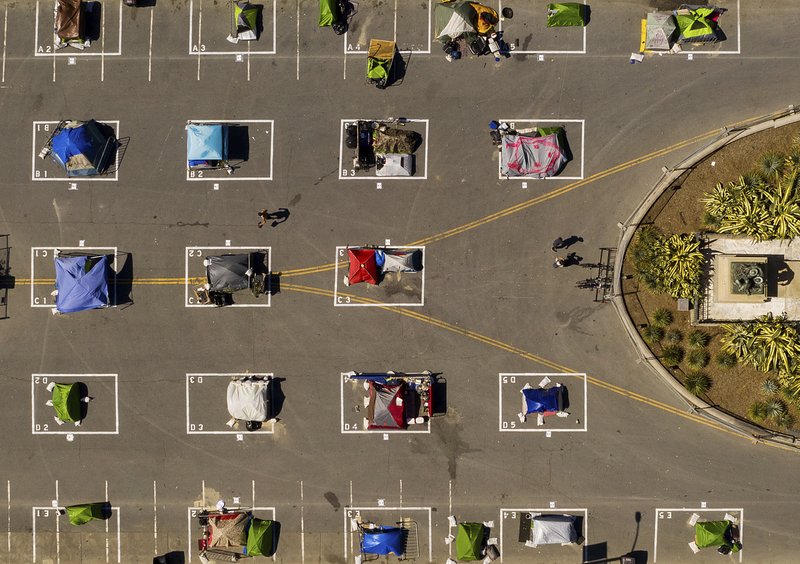
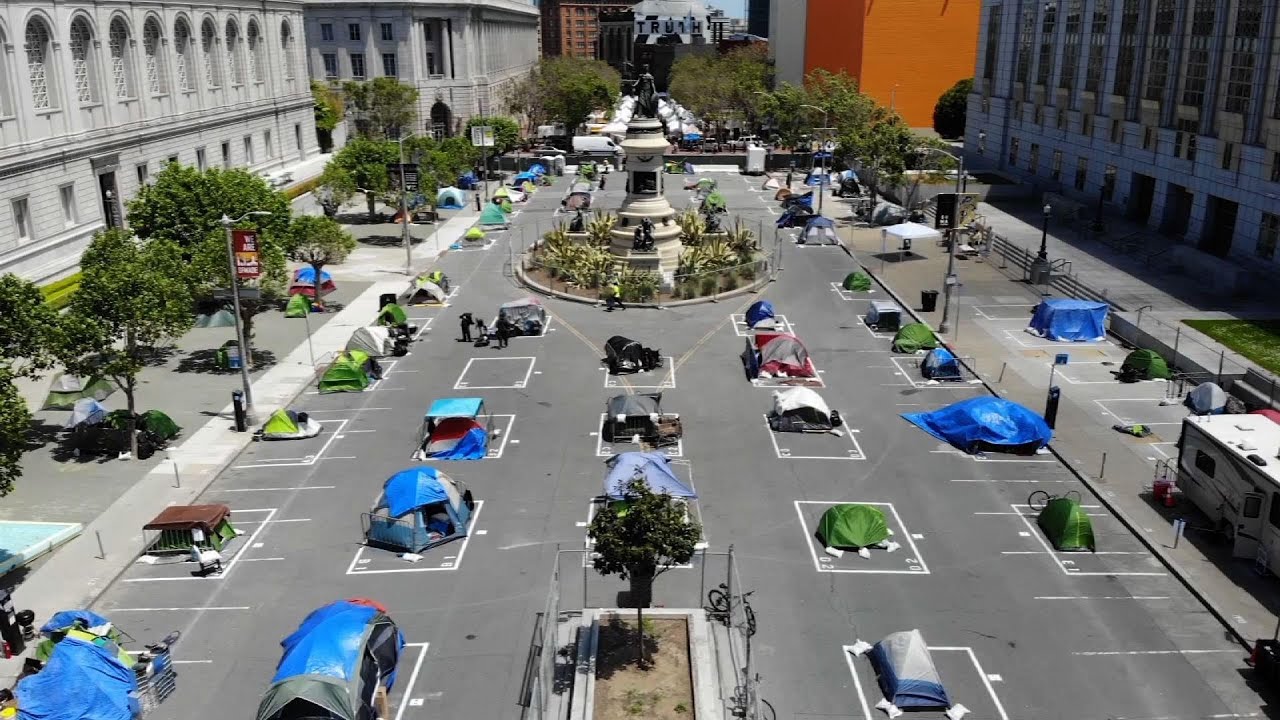
About 80 tents are now neatly spaced out on a wide street near San Francisco City Hall as part of a “safe sleeping village” opened last week. The area between the city’s central library and its Asian Art Museum is fenced off to outsiders, monitored around the clock and provides meals, showers, clean water and trash pickup.
In announcing the encampment, and a second one to open in the famed Haight-Ashbury neighborhood, San Francisco’s mayor acknowledged that she didn’t want to approve tents, but having unregulated tents mushroom on sidewalks was neither safe nor fair.
“So while in normal times I would say that we should focus on bringing people inside and not sanctioning tent encampments, we frankly do not have many other options right now,” she said in a tweet last week.
Nicholas Woodward, 37, is camping at the safe sleeping site, but he said he preferred sleeping in his tent before the city stepped in; he finds the fencing belittling and the rules too controlling. His friend, Nathan Rice, 32, said he’d much rather have a hotel room than a tent on a sidewalk, even if the city is providing clean water and food.
Youtube video thumbnail

“I hear it on the news, hear it from people here that they’re going to be getting us hotel rooms,” he said. “That’s what we want, you know, to be safe inside.”
San Francisco has moved 1,300 homeless people into hotel rooms and RVs as part of a statewide program to shelter vulnerable people but the mayor has been criticized for moving too slowly. She has said she is not inclined to move all the city’s estimated 8,000 homeless into hotels, despite complaints from advocates who say overcrowded tents are a public health disaster.
San Francisco is just the latest city to authorize encampments as shelters across the country move to thin bed counts so homeless people, who are particularly susceptible to the virus due to poor health, have more room to keep apart.
Santa Rosa in Sonoma County welcomed people this week to its first managed encampment with roughly 70 blue tents. Portland, Oregon, has three homeless camps with city-provided sleeping bags and tents, and Maricopa County opened two parking lots to homeless campers in Phoenix.
ADVERTISEMENT
San Francisco officials have historically frowned upon mini tent cities and routinely rounded up tents on city streets. But with an estimated 150,000 homeless people in California, most of them living out in the open, it’s impossible to stamp out the highly visible tents along highways and on crowded urban sidewalks.
The Centers for Disease Control and Prevention recommends that officials not disturb tent encampments during the coronavirus pandemic unless people are given individual hotel rooms, as homeless advocates want to see. Those advocates say providing a safe space where people can get meals, use a toilet and avoid harassing passers-by is a reasonable option given the times.
“The best, best option would be housing. The second-best option would be hotel rooms, but if you can’t do that and we’re going to have so many people outside then I think it makes sense ... to make those outside as safe as can be,” said Dr. Margot Kushel, director of the Center for Vulnerable Populations at the University of California, San Francisco.
But Nan Roman, president and CEO of the National Alliance to End Homelessness, said the federal government is providing an astonishing amount of money to battle the pandemic and she hopes cities and counties use it to put people into empty hotels, motels and other unused places.
“It’s almost like we’re giving ourselves permission that it’s OK that people will sleep outside, and once we’ve given ourselves that permission, it’s very difficult to get the initiative together to do otherwise,” she said.
Still, government-sanctioned tent camps may be here to stay, at least until a coronavirus vaccine is distributed.
At the urging of San Francisco Supervisor Sandra Lee Fewer, the city’s parks and real estate departments are compiling an inventory of open spaces that might be suitable for tent camps. She said sidewalk space is a coveted commodity for retailers, given coronavirus restrictions, and the city’s strategy of adding more shelter beds doesn’t make sense with a contagious virus.
”It is just a new world that we’re living in,” she said, “and it’s going to have to be our new normal.”

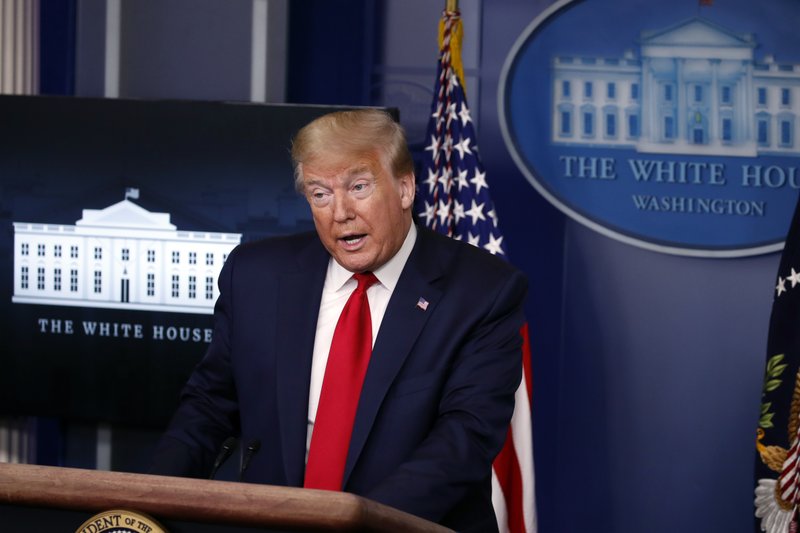
Trump declares churches ‘essential,’ calls on them to reopen


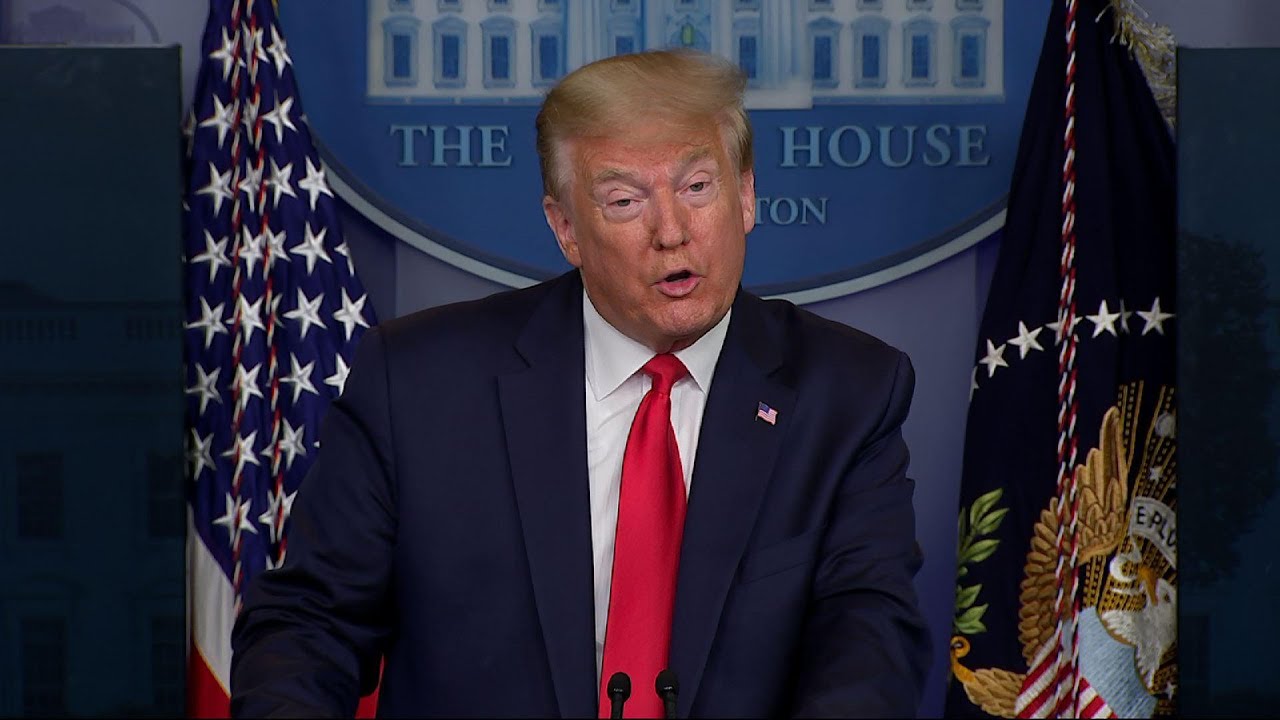
WASHINGTON (AP) — President Donald Trump has labeled churches and other houses of worship as “essential” and called on governors nationwide to let them reopen this weekend even though some areas remain under coronavirus lockdown.
The president threatened Friday to “override” governors who defy him, but it was unclear what authority he has to do so.
“Governors need to do the right thing and allow these very important essential places of faith to open right now — for this weekend,” Trump said at a hastily arranged press conference at the White House. Asked what authority Trump might have to supersede governors, White House press secretary Kayleigh McEnany said she wouldn’t answer a theoretical question.
Trump has been pushing for the country to reopen as he tries to reverse an economic free fall playing out months before he faces reelection. White evangelical Christians have been among the president’s most loyal supporters, and the White House has been careful to attend to their concerns throughout the crisis.
Following Trump’s announcement, the Centers for Disease Control and Prevention released new guidelines for communities of faith on how to safely reopen, including recommendations to limit the size of gatherings and consider holding services outdoors or in large, well-ventilated areas.

Youtube video thumbnail

Public health agencies have generally advised people to avoid gatherings of more than 10 people and encouraged Americans to remain 6 feet (1.8 meters) away from others when possible. Some parts of the country remain under some version of remain-at-home orders.
In-person religious services have been vectors for transmission of the virus. A person who attended a Mother’s Day service at a church in Northern California that defied the governor’s closure orders later tested positive, exposing more than 180 churchgoers. And a choir practice at a church in Washington state was labeled by the CDC as an early “superspreading” event.
But Trump on Friday stressed the importance of churches in many communities and said he was “identifying houses of worship — churches, synagogues and mosques — as essential places that provide essential services.”
“Some governors have deemed liquor stores and abortion clinics as essential” but not churches, he said. “It’s not right. So I’m correcting this injustice and calling houses of worship essential.”
“These are places that hold our society together and keep our people united,” he added.
Dr. Deborah Birx, coordinator of the White House coronavirus task force, said faith leaders should be in touch with local health departments and can take steps to mitigate risks, including making sure those who are at high risk of severe complications remain protected.
“There’s a way for us to work together to have social distancing and safety for people so we decrease the amount of exposure that anyone would have to an asymptomatic,” she said.
A person familiar with the White House’s thinking who spoke on condition of anonymity to discuss internal deliberations said Trump had called the news conference, which had not been on his public schedule, because he wanted to be the face of church reopenings, knowing how well it would play with his political base.
Churches around the country have filed legal challenges opposing virus closures. In Minnesota, after Democratic Gov. Tim Walz this week declined to lift restrictions on churches, Roman Catholic and some Lutheran leaders said they would defy his ban and resume worship services. They called the restrictions unconstitutional and unfair since restaurants, malls and bars were allowed limited reopening.
Some hailed the president’s move, including Kelly Shackelford, president of the conservative First Liberty Institute.
“The discrimination that has been occurring against churches and houses of worship has been shocking,” he said in a statement. “Americans are going to malls and restaurants. They need to be able to go to their houses of worship.”
But Rabbi Jack Moline, president of Interfaith Alliance, said it was “completely irresponsible” for Trump to call for a mass reopening of houses of worship.
“Faith is essential and community is necessary; however, neither requires endangering the people who seek to participate in them,” he said. “The virus does not discriminate between types of gatherings, and neither should the president.”
Rhode Island Gov. Gina Raimondo, a Democrat, made clear that churches and other houses of worship will not resume in-person services in her state until at least next weekend and said she was skeptical Trump had the authority to impose such a requirement.
“It’s reckless to force them to reopen this weekend. They’re not ready,” she said. “We’ve got a good plan. I’m going to stick with it.”
New Hampshire Gov. Chris Sununu, a Republican, said he would review the federal guidance, while maintaining a decision rests with him.
“Obviously we’d love to get to the point where we can get those open, but we’ll look at the guidance documents and try to make some decisions rather quickly, depending on what it might say,” he said. “It’s the governor’s decision, of course.”
The CDC more than a month ago sent the Trump administration documents the agency had drafted outlining specific steps various kinds of organizations, including houses of worship, could follow as they worked to reopen safely. But the White House dragged its feet, concerned that the recommendations were too specific and could give the impression the administration was interfering in church operations.
The guidance posted Friday contains most of the same advice as the draft guidance. It calls for the use of face coverings and recommends keeping worshippers 6 feet from one another and cutting down on singing, which can spread aerosolized drops that carry the virus.
But there are some differences.
The draft guidance discussed reopening in steps. A first phase would have limited gatherings to video streaming and drive-in services. Later phases allow in-person gatherings of limited size and only when social distancing precautions could be followed. The new guidance has no discussion of such phases.
Another difference: The draft guidance said everyone who attends a service should wear a face covering, while the new guidance says masks should be used when social distancing cannot be maintained.
___
Associated Press writers Mike Stobbe and Jonathan Lemire in New York, Philip Marcelo in Boston and Holly Ramer in Concord, N.H., contributed to this report.

Trump rips Jeff Sessions, backs his Senate-runoff opponent: ‘He let our Country down’


If former Attorney General Jeff Sessions – now running to regain a U.S. Senate seat in Alabama -- was hoping to reconcile with President Trump and gain his endorsement, that hope seemed to evaporate Friday night.
The president once again backed Sessions’ opponent, former Auburn football coach Tommy Tuberville, in the Alabama GOP Senate primary runoff scheduled for July 14.
“3 years ago, after Jeff Sessions recused himself, the Fraudulent Mueller Scam began,” Trump wrote on Twitter. “Alabama, do not trust Jeff Sessions. He let our Country down. That’s why I endorsed Coach Tommy Tuberville (@TTuberville), the true supporter of our #MAGA agenda!”
The president’s tweet included a link to Tuberville’s campaign-donation site, and retweeted a Tuberville post from last Sunday, promoting his campaign.
Trump previously endorsed Tuberville in March, after Tuberville garnered the most votes in the state’s GOP Senate primary, AL.com reported. But because Tuberville did not attract support from an outright majority, he will face Sessions – the No. 2 finisher in March – in the July runoff.
The runoff was initially scheduled for March 31 but was rescheduled to July because of the coronavirus outbreak.
Back in March, Sessions brushed off Trump’s decision to back his opponent.
“Of course, President Trump can endorse anyone he chooses for the U.S. Senate election in Alabama," Sessions tweeted at the time. "But the Constitution expressly empowers the people of Alabama, and only them, to select their Senator. I intend to take my case directly to the people of Alabama.”
President Trump's relationship with Jeff Sessions soured after Sessions recused himself from the Russia investigation.
Later Friday, Sessions responded on Twitter to Trump's latest message.
"Look, I know your anger, but recusal was required by law," Sessions wrote. "I did my duty & you're damn fortunate I did. It protected the rule of law & resulted in your exoneration. Your personal feelings don't dictate who Alabama picks as their senator, the people of Alabama do."
In a separate message, Sessions also slammed Tuberville.
"Tuberville's a coward who is rightly too afraid to debate me," Sessions wrote. "He says you're wrong on China & trade. He wants to bring in even more foreign workers to take American jobs. That's not your agenda and it's not mine or Alabama's. I know Alabama. Tuberville doesn't."
Sessions, 73, represented Alabama in the U.S. Senate from 1997 to 2017 but resigned when Trump appointed him U.S. attorney general. Sessions had been one of the first high-profile Republicans to endorse Trump’s 2016 presidential campaign.
But Sessions resigned as attorney general in November 2018. His relationship with Trump soured after Sessions recused himself from the Russia investigation, paving the way for the appointment of former FBI Director Robert Mueller to lead a probe that tormented Trump for two years.
Sessions was ultimately succeeded by William Barr, who became attorney general in February 2019. Matthew Whitaker led the Justice Department on an interim basis between Sessions’ departure and Barr taking office.
The winner of the Sessions-Tuberville runoff will face Democratic incumbent Sen. Doug Jones.

CNN downplays Biden's 'you ain't black' comments, avoids on-air coverage throughout the day

Fake News


CNN, which often dedicates wall-to-wall coverage for any latest controversy from President Trump, virtually avoided covering Joe Biden's "you ain't black" remarks Friday morning that sparked backlash throughout the day.
The presumptive Democrat nominee sparked a firestorm on Friday during an interview with Charlamagne tha God on the radio show "The Breakfast Club" as he defended his record with the black community.
“I tell you if you have a problem figuring out whether you’re for me or Trump, then you ain’t black,” Biden said.
Later in the afternoon, Biden walked back those remarks during a conversation with black business leaders, stopping short of a full apology.
"I've never ever taken the African-American community for granted, had their support ... I shouldn't have been such a wise guy. I shouldn't have been so cavalier," Biden later said. "I don't take it for granted at all, and no one, no one should have to vote for any party, based on their race or religion or background."
Still, Biden's remarks dominated the conversation on social media with the hashtags #YouAintBlack and #JoeBidenIsARacist trending on Twitter.
 Fox News and MSNBC covered the dust-up throughout the day. ABC News, CBS News and NBC News all addressed the controversy on their evening programs.
However, CNN's lack of coverage throughout the day was called out by critics.
"Fascinating to watch how the left-leaning cable networks have covered Biden’s 'you ain’t black' comment. MSNBC has discussed it nearly every hour... CNN hasn’t mentioned it once," former CNN digital producer-turned-media critic Steve Krakauer tweeted.
George Washington University law professor Jonathan Turley pointed out the "crickets" coming from CNN. In the afternoon, Republican National Committee (RNC) Chairwoman Ronna McDaniel called out the network for going hours without mentioning the controversy.
"It’s been over 5 HOURS since Biden told Black people they 'ain’t black' if they support @realDonaldTrump. How many times has CNN mentioned his bigoted comment on air? ZERO. Unreal," McDaniel tweeted.
She later slammed the anti-Trump network for waiting until "12 hours" to mention Biden's "bigoted remarks," tweeting, "We all know that if a Republican made a similar comment, CNN would have reworked their entire day of programming to feature 9-person panels condemning it. The bias is unbelievable."
"When you take into account how both MSNBC covered this repeatedly and Biden decided to issue a mea culpa, you're left with no conceivable excuse for CNN other than they did so on purpose," NewsBusters managing editor Curtis Houck told Fox News. "Instead, they decided that trashing the administration for allowing houses of worship to reopen and gleefully touting negative hydroxychloroquine headlines were jobs one and two."
Houck continued: "CNN has their insane way of going about their newsgathering, presentation and selection, but ignoring a story like this for hours and hours reminds us that their demands that other news organizations act like they do should not only be dismissed but laughed out of the room."
CNN didn't offer a full on-air report of Biden's remarks until the end of the 7 p.m. ET hour, when anchor Erin Burnett spoke with Charlamagne tha God about the interview, making it the last major news network to report on Biden's comments. It had articles published on the website earlier in the day.
Instead, the network spent much of the day offering critical coverage of the Trump administration's handling of the coronavirus outbreak.
Jordan Chariton, co-founder of the progressive media outlet Status Coup, said CNN's lack of coverage of the controversy is because the network "has been in the tank for Biden for over a year."
"They dragged their feet on many stories related to him including him lying on being arrested in apartheid South Africa on his way to meeting Nelson Mandela," Chariton told Fox News. "Outlets like CNN are protectors of the status quo and as such, they will always try and cover up bad stories for candidates like Biden rather than cover and challenge him."
This isn't the first time CNN's on-air coverage has raised eyebrows. On Thursday, CNN bizarrely spent over 100 minutes covering President Trump's refusal to wear a mask at the Ford plant. Meanwhile, the network spent just 15 minutes combined from Monday through Thursday covering the growing nursing-home controversy plaguing Democrat New York Gov. Andrew Cuomo.
A CNN insider told Fox News that while Trump should have worn the mask, the network is putting an undue emphasis on "what's not important."
"I don't know why they focus on things like this when there are certainly more important things to focus on," the network source said.
The insider knocked CNN, suggesting that if Trump found the cure for the coronavirus without wearing a mask, him not wearing the mask would become "the story" on the network.
Cuomo has largely gotten a pass from CNN, as the network has largely refrained from airing critical coverage of the Democrat governor. On Wednesday, he appeared for his 10th interview with his brother, "Cuomo Prime Time" anchor Chris Cuomo.
As in previous interviews, the CNN anchor made no mention of the growing death toll in New York nursing homes. Yet, he did manage to squeeze in some prop comedy, mocking the governor's televised coronavirus test examination with overly-sized cotton swabs while poking fun at the size of his nose.
"CNN's coverage of Andrew Cuomo has been consistent with much of the media: focus on the glowing verbiage and ignore the catastrophic mishandling of nursing homes that led to thousands of deaths,” Cornell Law School professor and media critic William A. Jacobson told Fox News.
“This problem is compounded by a serious conflict of interest arising from the relationship between Chris Cuomo, one of CNN's highest-profile news personalities, and his brother the governor,” Jacobson added. “Chris Cuomo should not be allowed to cover or comment on air about his brother, and CNN should appoint someone to monitor and review coverage of Andrew Cuomo to prevent this conflict of interest from bleeding over to other news coverage.”
Fox News senior meteorologist Janice Dean told "Tucker Carlson Tonight" Thursday that Cuomo's failed nursing-home policy should be "one of the biggest" stories of the year after both of her parents-in-law lost their lives to the coronavirus.
"I have not seen the coverage of this," an emotional Dean said. "Twenty percent of our lost loved ones are from nursing homes ... because Governor Cuomo and several other governors forced COVID-recovering patients into nursing homes."
Dean, who rarely comments on political issues, felt compelled to speak out after watching Wednesday night's CNN interview between the two playful Cuomo brothers.
"The fact that I am seeing, last night, him ... making fun, inappropriate jokes and insensitive jokes, cruel jokes ... make no mistake," Dean said, "I am glad that Chris Cuomo has recovered from COVID because he apparently did have it. And I'm glad that their family is well, but my family is not well. And that is not something to joke about."
Fox News' Brian Flood, Yael Haron, Paul Steinhauser, Madeleine Rivera and Allie Raffa contributed to this report.

Friday, May 22, 2020

Left-Wing Cartoons


Pennsylvania's Wolf begins to feel pressure from fellow Dems over restrictions: report


Some Democrats in Pennslyvania are reportedly beginning to put some pressure on Gov. Tom Wolf about the state’s reopening process two months after his office issued a stay-at-home order.
The Philadelphia Inquirer pointed to a few recent instances where Democrats seemed eager to see bigger steps in the state's reopening, including a letter from State. Sen. Maria Collett that relayed some frustrations of residents in Montgomery County. 
The Tuesday letter informed Wolf that many in her county have seen little evidence that Wolf's administration “recognizes and sympathizes with the added physical,  emotional, and financial suffering they are facing as a result of  our prolonged stay-at-home conditions, which you know.”
Wolf has maintained that his top priority is safety, but like other states, residents have suffered financially from coronavirus guidelines.
About 2 million Pennsylvania residents have lost their jobs since mid-March. Food and milk giveaways draw long lines. Some people have gone two months without money because of the state’s problem-plagued online unemployment benefits portal.
“We’re making decisions based on the best information we have, and making the best decisions we can, based on the best models that are always changing and moving," Wolf said, according to PennLive.com.
placeholder
The state is reportedly taking a county-centric approach. The PennLive report said 37 of the state’s 67 counties are in the yellow stage, which essentially means caution and mitigation. Eighteen counties are red, which means a stay-at-home order is in place.
President Trump recently talked about the state’s lockdown and said Pennsylvanians “want their freedom now.”
The paper reported that Wolf’s response to the coronavirus has been praised and “Democrats aren’t exactly defecting” but there is some pressure.  The paper reported that 16 Senate Democrats signed a letter recently for the governor’s office to consider permitting non-“life-sustaining” stores for curbside pickup.
“The truth of the matter is we do need to start thinking about getting people back to work," State Sen. Steve Santarsiero, a Democrat, said. "I really think we’re getting very close to that point. Curbside pickup is part of that question. I think that would really help get things moving again.”
Dr. Rachel Levine, Wolf’s health secretary, said the Health Department will soon release criteria for moving a county into the green phase of Wolf’s reopening plan.
“As we release the metrics to go into the green zone, we’re also working on what life in the green zone would (look) like, especially for businesses, restaurants, etc.,” Levine said.
placeholder
The Associated Press contributed to this report

Barr says America's 'democratic values' are dependent on the US beating China in the 5G race


In a round table with the State Department Thursday, Attorney General William Barr emphasized the importance of the US beating China in the race for 5G telecommunications networks.
“The United States and our partners are in an urgent race against the People’s Republic of China (PRC) to develop and build 5G infrastructure around the world,” said Barr in a statement.
5G is expected to change the way people live and work by supplying a faster and more reliable internet connection - along with a host of technological advances such self-driving cars, smart cities and remote surgeries.
“Our national security and the flourishing of our liberal democratic values here and around the world depend on our winning it,” Barr said Thursday. “Future 5G networks will be a critical piece of global infrastructure, the central nervous system of the global economy.”
The race to achieving 5G first, is in developing infrastructure to allow 5G to work in the United States and allied countries.
Security officials warn that China may use the development of 5G and its infrastructure to be able to spy on people more easily.
“5G technology lies at the center of the technological and industrial world that is taking shape,” said Barr in a February speech addressing a conference on the security risks China poses.
“In essence, communications networks are not just for communications anymore. They are evolving into the central nervous system of the next generation of internet.”
Barr noted that telecom giants like Huawei are leading the 5G race, and currently account for 40 percent of the global 5G infrastructure market.
US intelligence officials have also said that the equipment made by Chinese telecom companies could possibly threaten national security.
“If the PRC [People’s Republic of China] wins the 5G race, the geopolitical, economic, and national security consequences will be staggering,” said Barr Thursday.
Huawei is known to have built equipment that preserves and shares private information to Chinese law enforcement officials, through a process known as “lawful interception interfaces.” US security officials believe this access could be shared on a larger scale with the Chinese government and put US intelligence in jeopardy.
But Barr said he believes the US could catch up with China’s 5G progress by working “closely with trusted vendors to pursue practical and realistic strategies.”
We can win the race, but we must act now.”

McConnell says Senate 'not quite ready' to craft new stimulus: 'It won't be a $3 trillion left-wing wish list'


Senate Majority Leader Mitch McConnell, R-Ky., told "The Story with Martha MacCallum" Thursday that the Senate is "not quite ready to intelligently" lay out the next coronavirus stimulus package, but added "it's not too far off."
"The [CARES] Act, which passed a month or so ago on a bipartisan basis, only about half of that money has gone out yet," McConnell said. "I think there's a high likelihood we will do another rescue package, but we need to be able to measure the impact of what we've already done, what we did right, what we did wrong [and] correct that.
"Let me tell you what it won't be," McConnell added. "It won't be a $3 trillion left-wing wish list as it passed the House."
The majority leader went on to say that lawmakers "need to work smart here, help the people who are desperately in need, try to save as many jobs as possible and begin to open up the states, which are decisions by the governors that are going on all over America now and get this economy growing again."
With that in mind, McConnell said any new stimulus package would not include enhanced unemployment benefits.
"The problem was by paying people more not to work than to work, it's making it difficult to get people back to work. You can understand that," McConnell told MacCallum. "We do need to continue unemployment insurance, [it's] extremely important at a time like this.
"But to pay people more not to work than to work doesn't encourage resuming your job. And that will end in July. And we think that in order to create jobs, we need to incentivize people to go back to work, not encourage them to stay home."
The senator also reemphasized the need for businesses to receive liability protections in any future stimulus.
"You're going to have liability protection in there so that people, or the plaintiffs' lawyers are prevented from stealing, in effect, all of this public money we're sending down to hospitals and doctors and non-profits as a result of the coronavirus," McConnell told MacCallum. "And so that's one of our red lines, that the next bill will need to have liability protection in there just to cover narrowly cover the coronavirus, not anything else."
McConnell also responded to criticism that such liability provisions would shield nursing homes and care facilities where coronavirus victims died from legal action
"Well, the answer is it wouldn't protect any nursing home from from a gross negligence or intentional misbehavior [claim]," McConnell said. "So it's not an absolute protection against any kind of behavior. So those kinds of lawsuits would still lie."

Trump blasts Michigan AG for 'viciously threatening' Ford for letting him tour plant without mask


President Trump blasted the attorney general of Michigan late Thursday after she said she was going to have a “very serious conversation” with Ford Motor Co. for allowing the president to go without a mask during part of a tour of the company's Rawsonville Components Plant in Ypsilanti.
“The Wacky Do Nothing Attorney General of Michigan, Dana Nessel, is viciously threatening Ford Motor Company for the fact that I inspected a Ventilator plant without a mask,” Trump tweeted after his tour. “Not their fault, & I did put on a mask. No wonder many auto companies left Michigan, until I came along!”
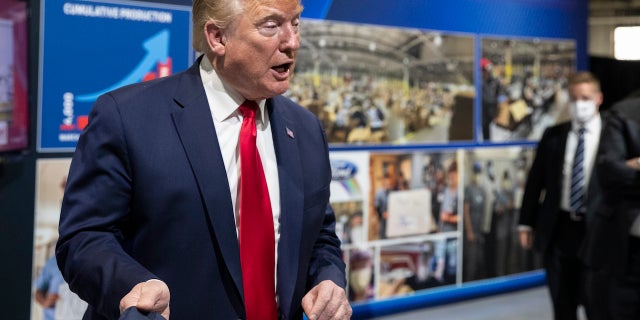
Trump did wear a mask for part of the tour of the plant that has been repurposed to make medical supplies, but refused to put it on in front of reporters -- although at least one photographer snapped a photo that was posted on social media. It showed the president wearing a mask that included the presidential seal.

President Trump holds his protective face mask as he speaks while touring Ford's Rawsonville Components Plant that has been converted to making personal protection and medical equipment, Thursday, May 21, 2020, in Ypsilanti, Mich. (Associated Press)

President Trump holds his protective face mask as he speaks while touring Ford's Rawsonville Components Plant that has been converted to making personal protection and medical equipment, Thursday, May 21, 2020, in Ypsilanti, Mich. (Associated Press)

"I had one on before,” Trump told reporters during the visit. “I wore one on in this back area. I didn't want to give the press the pleasure of seeing it. In the back area I did have a mask on. I had goggles and a mask right back there.”
He added it wasn’t necessary to wear a mask around reporters and Ford representatives in the front of the plant because “Everybody's been tested.”
Nessel told CNN the state would be speaking to Ford about allowing the president to go without a mask for the public portion of the tour in what she said was a violation of Gov. Gretchen Whitmer’s executive order requiring masks in enclosed public spaces.
"They knew exactly what the order was and if they permitted anyone, even the president of the United States, to defy that order, I think it has serious health consequences potentially to their workers,” Nessel told CNN.
She also said she was "ashamed" to have him as the president and she hoped Micigan voters voters "will remember this when November comes, that he didn't care enough about their safety, he didn't care about their welfare, he didn't respect them enough just to engage in the very simple task, the painless task, the easy task of wearing a mask when he was provided one."
Trump suggested in another tweet that Ford might leave Michigan if they’re held accountable for his actions.
“Do nothing A.G. of the Great State of Michigan, Dana Nessel, should not be taking her anger and stupidity out on Ford Motor - they might get upset with you and leave the state, like so many other companies have - until I came along and brought business back to Michigan. JOBS!”  he wrote.
When asked if it was true that it wasn’t required that the president wear a mask, Ford’s CEO, Jim Hackett, told reporters, “It’s up to him.”
In a statement Thursday afternoon, the Ford Motor Company added: “Bill Ford encouraged President Trump to wear a mask when he arrived. He wore a mask during a private viewing of three Ford GTs from over the years. The president later removed the mask for the remainder of the visit.” Bill Ford, the great-grandson of Henry Ford, has been the company’s executive chairman.
Nessel later responded to Trump on Twitter, defending the state's auto industry.
"Hi! After struggling with our Gov & SOS, impressed you know my name," she wrote. "Seems like you have a problem with all 3 women who run MI-as well as your ability to tell the truth. The auto industry has been thriving for years bc of our incredible auto workers & companies."
She added that it was hard to say she's done nothing "with all the lawsuits myself and the other @DemocraticAGs have filed and won against you."

Justice Alito's Just Took Ketanji Brown Jackson to the Cleaners

It’s official: the Louisiana congressional maps are released. The Supreme Court issued its decision last night, striking down the maps at ...