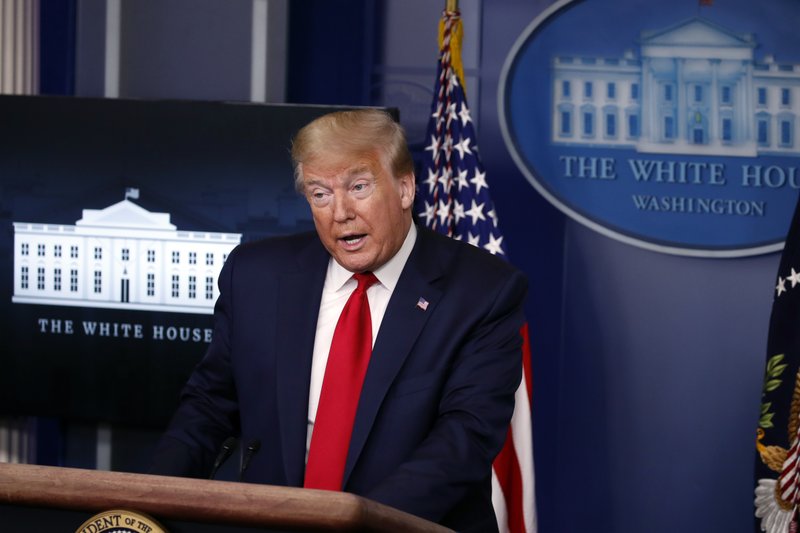
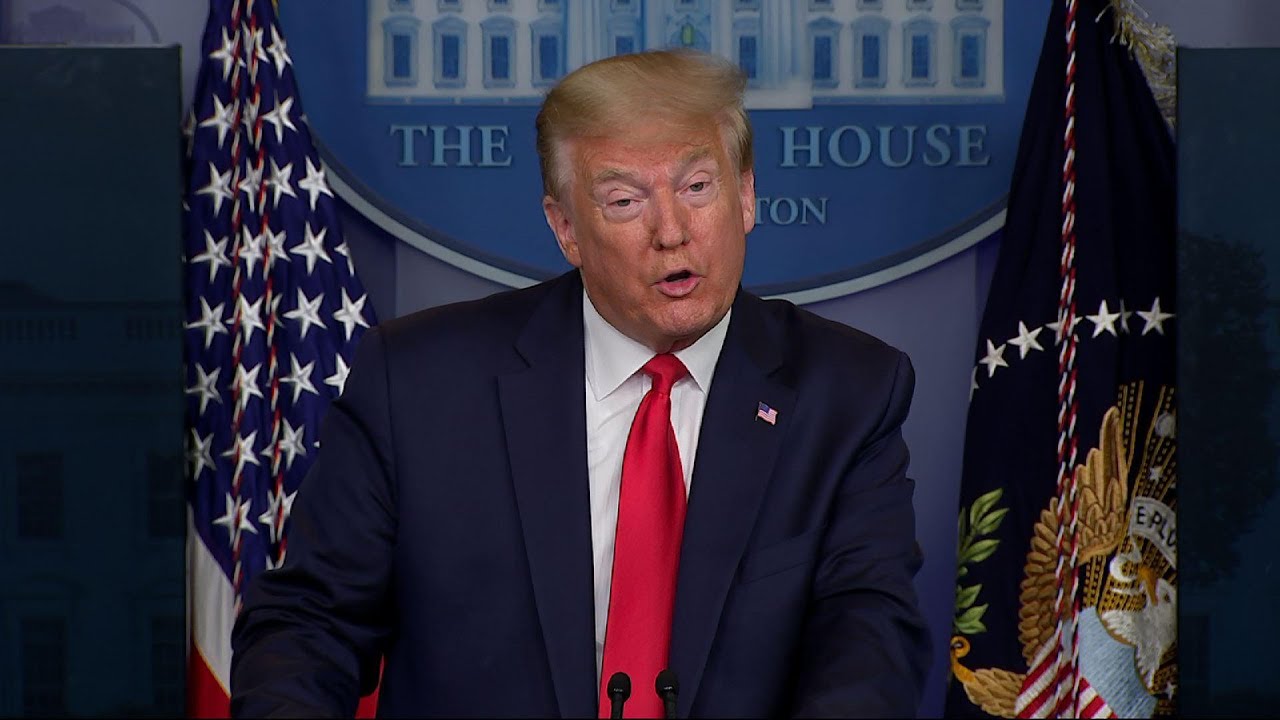
President Trump urged for the reopening of school throughout the U.S. on Sunday, as most remain closed to limit the coronavirus spread and protect the health of students during the pandemic. His
tweet was an apparent reaction to similar comments from Fox News' Steve
Hilton on his program "The Next Revolution." Trump tagged Hilton and
Fox News in a tweet Sunday where he mentioned reopening schools "ASAP." "Schools in our country should be opened ASAP. Much very good information now available. @SteveHiltonx @FoxNews," Trump wrote. Hilton had demanded on his show the need to, "Get on with it and reopen schools now before you do even more needless damage." He
said using masks to stop the virus' spread seems appropriate, but added
that measures like temperature checks seem to be "totally pointless."
He also called certain social distancing rules as "totally arbitrary." "Only one or two people allowed in an elevator at one time, good luck trying to reopen New York on that," he said. Hilton
cited some studies that suggested students can't transmit the virus to
others. He also referenced an NPR report this month that said the mental
health of children has been impacted as they stay at home during the
coronavirus outbreak. Dr. Anthony Fauci, the director of the
National Institute of Allergy and Infectious Diseases, was cautious
about reopening schools -- even in the fall -- due to the emergence of a
severe inflammatory condition found in children believed to
be associated with the coronavirus. While
the coronavirus in normally less harmful in children -- who typically
have only mild symptoms -- the Centers for Disease Control and
Prevention (CDC) issued an advisory earlier this month regarding the
potentially severe condition. Doctors describe the inflammatory
condition (MIS-C), to be similar to Kawasaki disease, a rare
illness that causes swelling in medium-sized arteries throughout the
body. MIS-C can cause persistent fever and symptoms
that include hypotension, rashes, gastrointestinal symptoms such as
vomiting and diarrhea, as well as elevated inflammatory markers, the CDC
said. At least four children have died of apparent MIS-C in recent weeks, the Washington Post reported. "We
don't know everything about this virus, and we really better be very
careful, particularly when it comes to children," Fauci said, according
to NPR.
President Trump late Sunday lashed out at Joe Biden
after the likely Democrat nominee criticized his golf outing earlier in
the day as the country approaches 100,000 coronavirus deaths.
Biden
has been a fierce critic of Trump’s handling of the outbreak and the ad
juxtaposed Trump playing golf at the Trump National Golf Club in
Sterling, Va., and the death toll numbers. “Nearly 100,000 lives
have been lost, and tens of millions are out of work,” Biden tweeted.
“Meanwhile, the president spent his day golfing.” Trump took to Twitter himself to call out “Sleepy Joe.” He said Biden’s team apparently thinks he “should stay in the White House at all times." "What
they didn’t say is that it’s the first time I’ve played golf in almost 3
months, that Biden was constantly vacationing, relaxing & making
shady deals with other countries, & that Barack [Obama] was always
playing golf, doing much of his traveling in a fume spewing 747 to play
in Hawaii—Once even teeing off immediately after announcing the gruesome
death of a great young man by ISIS!”
Trump
did not specify the instance. But in 2014, then-President Obama faced
criticism over his reaction to the death of James Foley, an American
journalist. The New York Times reported at the time that Obama spoke
with Foley’s parents and as soon as “the cameras went off,”
he headed to a golf course on Martha’s Vineyard. The paper reported,
“He spent the rest of the afternoon on the links even as a firestorm of
criticism erupted over what many saw as a callous indifference to the
slaughter he had just condemned.” Trump critics likely see Biden engaging in the same technique Trump has employed to damage political rivals. Mediate pointed out that Trump has long criticized Obama for playing golf during his presidency. “President
Obama has a major meeting on the N.Y.C. Ebola outbreak, with people
flying in from all over the country, but decided to play golf!” Trump
wrote in 2014. The Twitter exchange may be a preview of what is still to come before the 2020 elections.
Trump has recently tried to go on the offensive over the unmasking tied
to the Gen. Michael Flynn case. He told Fox News exclusively last week
that the Russia probe was the “greatest political crime in the history
of our country.” Biden was recently asked
by ABC News’ George Stephanopoulos about the Obama administration’s
investigation into Flynn and about a mystery Jan. 5, 2017 meeting at the
Oval Office. He said he was “aware that there was—that they asked for
an investigation, but that’s all I know about it, and I don’t think
anything else…” The 2020 election will likely hinge on the way the
public perceives Trump’s handling of the virus. Democrats, like Biden,
have been critical of what they said was a slow response and
inconsistent messaging. Biden wrote in
the Washington Post earlier this month that Trump has failed to unify
the country and instead “is reverting to a familiar strategy of
deflecting blame and dividing Americans.” Trump said his early
travel ban with China saved lives. He launched “Operation Warp Speed” in
an effort to create and distribute a coronavirus vaccine by combining
the military, private industry and other government agencies.
Trump said one of his top priorities is getting the country reopened. The Associated Press contributed to this report
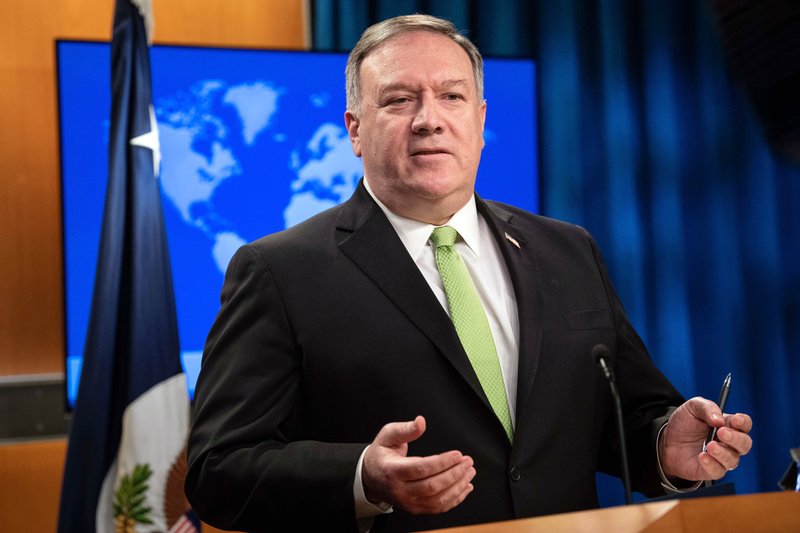
Secretary
of State Mike Pompeo speaks during a press briefing at the State
Department on Wednesday, May 20, 2020, in Washington. (Nicholas
Kamm/Pool Photo via AP)
WASHINGTON
(AP) — Secretary of State Mike Pompeo on Friday condemned China’s
effort to take over national security legislation in Hong Kong, calling
it “a death knell for the high degree of autonomy” that Beijing had
promised the territory.
Pompeo
called for Beiing to reconsider the move and warned of an unspecified
U.S. response if it proceeds. Meanwhile, White House economic adviser
Kevin Hassett said China risked a major flight of capital from Hong Kong
that would end the territory’s status as the financial hub of Asia.
Shortly afterward, the Commerce Department announced new restrictions on
sensitive exports to China.
The contentious measure, submitted Friday on the opening day of China’s national legislative session, is strongly opposed by pro-democracy lawmakers in semi-autonomous Hong Kong.
Pompeo called the proposal an effort to “unilaterally and arbitrarily impose national security legislation on Hong Kong.”
“Hong
Kong has flourished as a bastion of liberty. The United States strongly
urges Beijing to reconsider its disastrous proposal, abide by its
international obligations, and respect Hong Kong’s high degree of
autonomy, democratic institutions, and civil liberties, which are key to
preserving its special status under U.S. law,” Pompeo said in a
statement.
He
said the decision to ignore the will of the people of Hong Kong would be
a “death knell for the high degree of autonomy Beijing promised for
Hong Kong” under a decades-old agreement known as the Sino-British Joint
Declaration.
The
U.S. has limited leverage with China over Hong Kong but it could end
preferred economic privileges that Hong Kong currently enjoys if the
Trump administration determines that the declaration, which was supposed
to give the territory 50 years of special status after it reverted to
Chinese rule in 1997, has been violated.
The proposed bill
is aimed at forbidding secessionist and subversive activity, as well as
foreign interference and terrorism. It comes after months of
pro-democracy demonstrations last year that at times descended into
violence between police and protesters.
Speaking
in an interview with the Fox Business Network on Friday, Hassett
suggested the damage that would come from China’s proposal would be
mostly self-inflicted.
“They’re
going to see a lot of economic harm from what they’re doing,” he said,
adding that businesses would not want to invest or keep money “in a
place where they’re basically sneering at the rule of law.”
“And
so, I would expect that they’re going to have serious capital flight
problems,” Hassett said. “And Hong Kong, if they follow through this,
will no longer be the financial center of Asia, and they themselves will
bear very, very heavy costs.”
Later
Friday the Commerce Department struck yet another blow to Chinese
industry, announcing plans to bar the export of U.S. technology without a
license to 33 companies and government institutions including major
research labs.
It
accused two dozen of the targeted entities of threatening U.S. national
security because they could help China develop weapons. They include
China’s top cybersecurity company, Qihoo 360, the robotics and
artificial intelligence firm Cloudminds Inc., and various research
isntitutes involved in laser and other advanced technology.
The
other targets, named in a separate news release, included the Institute
of Forensic Science at China’s public security ministry and companies
that make facial recognition products. Commerce accused them of
complicity in human rights abuses targeting Uighurs and other ethnic
minorities.
The
restrictions compound previous sanctions the Trump administration
imposed on U.S. technology sales to Chinese companies involved in
supercomputer development, facial recognition and other areas the White
House deemed a threat to national security. That includes the technology
giant Huawei.
A
week ago, Commerce issued a new rule designed to bar foreign
semiconductor makers from making chips for Huawei that it has designed.
China
contends Washington is using national security as an excuse to try to
crush its rise as a global competitor in the tech sector.
Tech
expert Paul Triolo of the Eurasia Group political risk research firm
said it appeared from the list of new targets that the Commerce
Department was applying a rather sweeping definition of military
end-use.
“It’s
ratcheting up the pressure,” Triolo said of the newest sanctions. “I
keep thinking, ’What’s the straw that breaks the camel’s back here” and
provokes retaliation from Beijing against U.S. companies that do
business in China.
China
has threatened countermeasures against U.S. businesses — many of which
have major manufactoring operations in its territories— but so far has
held off.
———
Associated Press writer Frank Bajak in Boston contributed to this report,
President Trump
is considering establishing a panel to review complaints of
anticonservative bias on social media, according to people familiar with
the matter, in a move that would likely draw pushback from technology companies and others. The plans are still under discussion but could include the establishment of a White House-created commission that would examine allegations of online bias and censorship,
these people said. The administration could also encourage similar
reviews by federal regulatory agencies, such as the Federal
Communications Commission and the Federal Election Commission, they
said. “Left-wing
bias in the tech world is a concern that definitely needs to be
addressed from our vantage point, and at least exposed [so] that
Americans have clear eyes about what we’re dealing with,” a White House
official said.
“Left-wing bias in the tech world is a
concern that definitely needs to be addressed from our vantage point,
and at least exposed [so] that Americans have clear eyes about what
we’re dealing with.” — White House official
Mr. Trump has long expressed that viewpoint, and in a recent Twitter post indicated that a plan to address complaints of bias is in the works. Facebook Inc., which also owns Instagram, defended its practices when asked for a response to the nascent proposal. “People
on both sides of the aisle disagree with some of the positions we’ve
taken, but we remain committed to seeking outside perspectives and
communicating clearly about why we make the decisions we do,” the
company said.
President Trump has long expressed concerns about left-wing bias in the technology sector.
Twitter
Inc. said: “We enforce the Twitter Rules impartially for all users,
regardless of their background or political affiliation. We are
constantly working to improve our systems and will continue to be
transparent and in regular communication with elected officials in
regard to our efforts.” A spokeswoman for Alphabet Inc.’s Google
said the company builds its products “with extraordinary care and
safeguards to be a trustworthy source of information for everyone,
without any regard for political viewpoint.”
Virginia Gov. Ralph Northam faced criticism on social media after appearing in Virginia Beach Saturday without a face mask and not practicing social distancing measures around members of the public. Northam reportedly visited the beach with Mayor Bobby Dye on the second day of the beach’s reopening, according to local news outlet 13News Now.
Virginia Beach's reopening is considered a test to see if people can
safely follow social distancing rules before other beaches in Virginia
reopen. But Northam, who previously served as an Army doctor, came
under fire when images of him surfaced on social media not wearing a
face mask and apparently in close contact with other community members. The Centers for Disease Control and Prevention
(CDC) reminded the public this week that the coronavirus mainly spreads
person-to-person when in close proximity, while it also revealed that
surface contamination is far less likely than previously thought. According
to the state-mandated rules, people are allowed to be outside without a
mask when sunbathing, swimming and fishing as long as they remain
distant from other parties. The governor’s office told NBC
in a statement: “The governor has repeatedly encouraged wearing face
coverings inside or when social distancing is impossible. He was outside
today and not expecting to be within 6 feet of anyone.” The governor is expected to announce new mask protocols on Tuesday, according to an NBC source in the governor’s office. All inside businesses will have new face-covering requirements as the state slowly returns to business as usual. The
state initiated Phase One of its reopening plan on May 15, but northern
Virginia was allowed to wait until midnight May 28 to start reopening,
to give local businesses more time to meet the new health and safety
standards. Phase One of the plan still bans social gatherings of
10 people or more, and the recommended social distancing guideline of
six feet or more is still in place. Northam
could not be immediately reached by Fox News for comment on his
violation of the state’s social distancing regulations at the beach.
Democrat Beto O’Rourke Tried to get the upper hand late Friday, mocking the gradual reopening of the Texas economy from coronavirus shutdowns as “Dangerous, dumb and weak.” But at least two Texas Republicans weren’t having it. U.S. Rep. Dan Crenshaw and U.S. Sen. Ted Cruz
each fired back at O’Rourke, the former congressman from El Paso who
failed to unseat Cruz in 2018 and then ran an unsuccessful bid for the
Democratic Party’s 2020 presidential nomination. O’Rourke’s
Twitter post was a reaction to a tweet by Texas Gov. Greg Abbott, who
touted the Lone Star State’s reopening plan as “Safe, Smart, and
Strong.” “Dangerous, dumb and weak,” O’Rourke wrote in retweeting Abbott’s message. “Is this the new Dem slogan?” Cruz snapped back. Crenshaw derided O’Rourke’s post as “a condescending reaction.” “The
guy who wanted to be Texas’s Senator truly believes Texans can’t make
decisions for themselves and that they are ‘dumb and weak’ for living
their lives and trying to feed their families,” Crenshaw wrote. “And
yes, he’s talking to all Texans, not just our governor,” Crenshaw
added. “Governor Abbott can’t force anyone to go back to work. Texans
are choosing to do that, despite what people like Beto scream from their
ivory towers.” In a separate tweet, O’Rourke accused Crenshaw of
“getting rich selling his own book to the GOP (and being Trump’s most
reliable enabler in the House).” O’Rourke then asked his Twitter
followers to donate to Crenshaw’s election opponent, Democrat Sima
Ladjevardian, a Houston attorney.
“Millionaires fundraising for millionaires,” Crenshaw
responded. “All while telling middle-class Texans they’re ‘dumb and
weak’ for wanting to get back to work.”
Crenshaw, who served in Afghanistan as a Navy SEAL, then invited his Twitter followers to donate to his campaign. In more commentary on the Texas reopening plan, O’Rourke retweeted a Washington Post story that said Texas recently reported new single-day highs in both coronavirus infections and deaths. “Despite
what Trump & co. (Abbott & Patrick) say, stay home if you can
& wear a mask if you have to go out. It will save lives,” O’Rourke
wrote.” Last week Gov. Abbott outlined Phase II of the Texas
reopening plan. It permits child care centers, massage and personal care
spas and youth clubs to reopen May 18, bars, bowling alleys, bingo
halls and other entertainment events to resume May 22 – with restaurants
at 50 percent of capacity – and sets a May 31 reopening date for youth
camps and sporting events. As of early Sunday, Texas – the
nation’s No. 2 most populous state, with about 29 million residents –
ranked No. 15 with about 1,400 coronavirus deaths, according to Johns
Hopkins University.
SAN
FRANCISCO (AP) — San Francisco is joining other U.S. cities in
authorizing homeless tent encampments in response to the coronavirus
pandemic, a move officials have long resisted but are now reluctantly
embracing to safeguard homeless people.
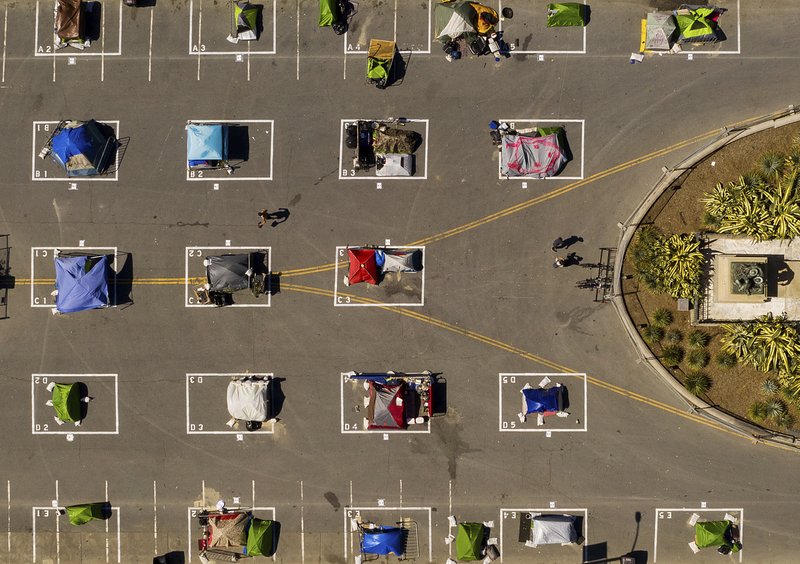
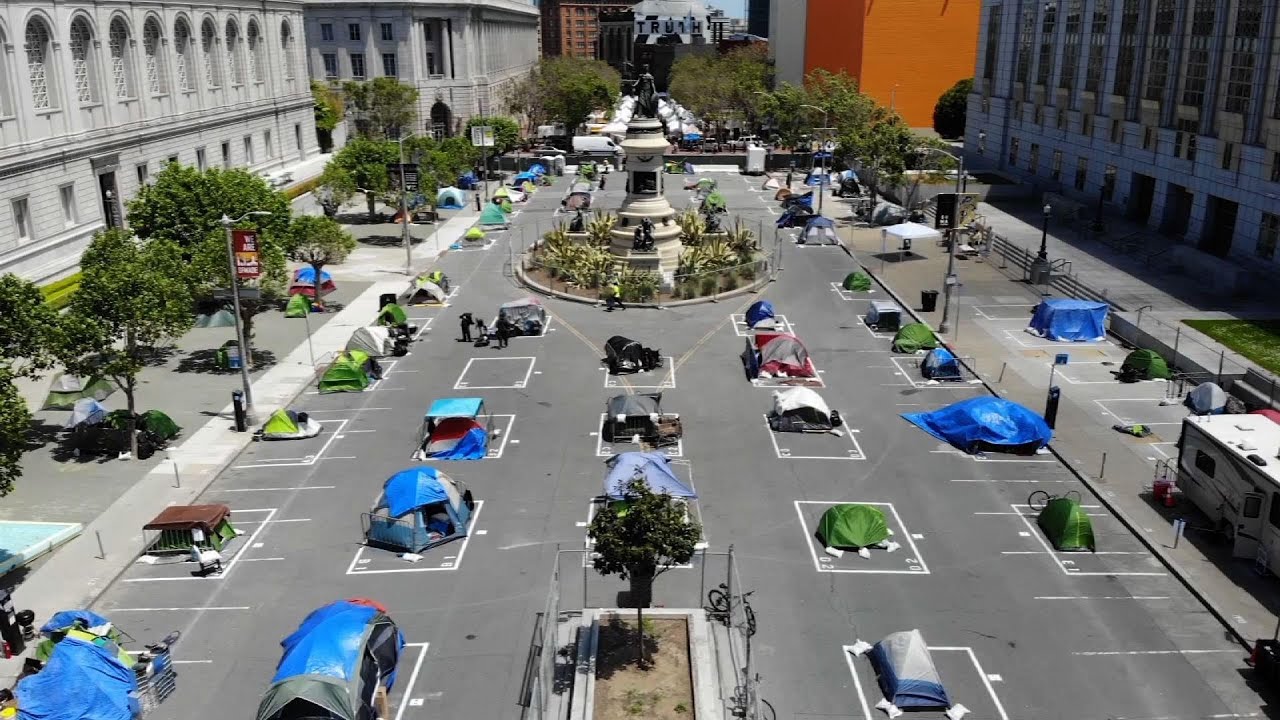
About
80 tents are now neatly spaced out on a wide street near San Francisco
City Hall as part of a “safe sleeping village” opened last week. The
area between the city’s central library and its Asian Art Museum is
fenced off to outsiders, monitored around the clock and provides meals,
showers, clean water and trash pickup.
In
announcing the encampment, and a second one to open in the famed
Haight-Ashbury neighborhood, San Francisco’s mayor acknowledged that she
didn’t want to approve tents, but having unregulated tents mushroom on
sidewalks was neither safe nor fair.
“So
while in normal times I would say that we should focus on bringing
people inside and not sanctioning tent encampments, we frankly do not
have many other options right now,” she said in a tweet last week.
Nicholas
Woodward, 37, is camping at the safe sleeping site, but he said he
preferred sleeping in his tent before the city stepped in; he finds the
fencing belittling and the rules too controlling. His friend, Nathan
Rice, 32, said he’d much rather have a hotel room than a tent on a
sidewalk, even if the city is providing clean water and food.
“I
hear it on the news, hear it from people here that they’re going to be
getting us hotel rooms,” he said. “That’s what we want, you know, to be
safe inside.”
San
Francisco has moved 1,300 homeless people into hotel rooms and RVs as
part of a statewide program to shelter vulnerable people but the mayor has been criticized
for moving too slowly. She has said she is not inclined to move all the
city’s estimated 8,000 homeless into hotels, despite complaints from
advocates who say overcrowded tents are a public health disaster.
San
Francisco is just the latest city to authorize encampments as shelters
across the country move to thin bed counts so homeless people, who are
particularly susceptible to the virus due to poor health, have more room
to keep apart.
Santa Rosa in Sonoma County welcomed people this week to its first managed encampment with roughly 70 blue tents. Portland, Oregon, has three homeless camps with city-provided sleeping bags and tents, and Maricopa County opened two parking lots to homeless campers in Phoenix.
ADVERTISEMENT
San
Francisco officials have historically frowned upon mini tent cities and
routinely rounded up tents on city streets. But with an estimated
150,000 homeless people in California, most of them living out in the
open, it’s impossible to stamp out the highly visible tents along
highways and on crowded urban sidewalks.
The Centers for Disease Control and Prevention
recommends that officials not disturb tent encampments during the
coronavirus pandemic unless people are given individual hotel rooms, as
homeless advocates want to see. Those advocates say providing a safe
space where people can get meals, use a toilet and avoid harassing
passers-by is a reasonable option given the times.
“The
best, best option would be housing. The second-best option would be
hotel rooms, but if you can’t do that and we’re going to have so many
people outside then I think it makes sense ... to make those outside as
safe as can be,” said Dr. Margot Kushel, director of the Center for
Vulnerable Populations at the University of California, San Francisco.
But
Nan Roman, president and CEO of the National Alliance to End
Homelessness, said the federal government is providing an astonishing
amount of money to battle the pandemic and she hopes cities and counties
use it to put people into empty hotels, motels and other unused places.
“It’s
almost like we’re giving ourselves permission that it’s OK that people
will sleep outside, and once we’ve given ourselves that permission, it’s
very difficult to get the initiative together to do otherwise,” she
said.
Still, government-sanctioned tent camps may be here to stay, at least until a coronavirus vaccine is distributed.
At
the urging of San Francisco Supervisor Sandra Lee Fewer, the city’s
parks and real estate departments are compiling an inventory of open
spaces that might be suitable for tent camps. She said sidewalk space is
a coveted commodity for retailers, given coronavirus restrictions, and
the city’s strategy of adding more shelter beds doesn’t make sense with a
contagious virus.
”It is just a new world that we’re living in,” she said, “and it’s going to have to be our new normal.”
WASHINGTON
(AP) — President Donald Trump has labeled churches and other houses of
worship as “essential” and called on governors nationwide to let them
reopen this weekend even though some areas remain under coronavirus
lockdown.
The president threatened Friday to “override” governors who defy him, but it was unclear what authority he has to do so.
“Governors
need to do the right thing and allow these very important essential
places of faith to open right now — for this weekend,” Trump said at a
hastily arranged press conference at the White House. Asked what
authority Trump might have to supersede governors, White House press
secretary Kayleigh McEnany said she wouldn’t answer a theoretical
question.
Trump
has been pushing for the country to reopen as he tries to reverse an
economic free fall playing out months before he faces reelection. White
evangelical Christians have been among the president’s most loyal
supporters, and the White House has been careful to attend to their
concerns throughout the crisis.
Following Trump’s announcement, the Centers for Disease Control and Prevention released new guidelines
for communities of faith on how to safely reopen, including
recommendations to limit the size of gatherings and consider holding
services outdoors or in large, well-ventilated areas.
Public
health agencies have generally advised people to avoid gatherings of
more than 10 people and encouraged Americans to remain 6 feet (1.8
meters) away from others when possible. Some parts of the country remain
under some version of remain-at-home orders.
In-person
religious services have been vectors for transmission of the virus. A
person who attended a Mother’s Day service at a church in Northern
California that defied the governor’s closure orders later tested
positive, exposing more than 180 churchgoers. And a choir practice at a
church in Washington state was labeled by the CDC as an early “superspreading” event.
But
Trump on Friday stressed the importance of churches in many communities
and said he was “identifying houses of worship — churches, synagogues
and mosques — as essential places that provide essential services.”
“Some
governors have deemed liquor stores and abortion clinics as essential”
but not churches, he said. “It’s not right. So I’m correcting this
injustice and calling houses of worship essential.”
“These are places that hold our society together and keep our people united,” he added.
Dr.
Deborah Birx, coordinator of the White House coronavirus task force,
said faith leaders should be in touch with local health departments and
can take steps to mitigate risks, including making sure those who are at
high risk of severe complications remain protected.
“There’s
a way for us to work together to have social distancing and safety for
people so we decrease the amount of exposure that anyone would have to
an asymptomatic,” she said.
A
person familiar with the White House’s thinking who spoke on condition
of anonymity to discuss internal deliberations said Trump had called the
news conference, which had not been on his public schedule, because he
wanted to be the face of church reopenings, knowing how well it would
play with his political base.
Churches
around the country have filed legal challenges opposing virus closures.
In Minnesota, after Democratic Gov. Tim Walz this week declined to lift
restrictions on churches, Roman Catholic and some Lutheran leaders said
they would defy his ban and resume worship services. They called the
restrictions unconstitutional and unfair since restaurants, malls and
bars were allowed limited reopening.
Some hailed the president’s move, including Kelly Shackelford, president of the conservative First Liberty Institute.
“The
discrimination that has been occurring against churches and houses of
worship has been shocking,” he said in a statement. “Americans are going
to malls and restaurants. They need to be able to go to their houses of
worship.”
But
Rabbi Jack Moline, president of Interfaith Alliance, said it was
“completely irresponsible” for Trump to call for a mass reopening of
houses of worship.
“Faith
is essential and community is necessary; however, neither requires
endangering the people who seek to participate in them,” he said. “The
virus does not discriminate between types of gatherings, and neither
should the president.”
Rhode
Island Gov. Gina Raimondo, a Democrat, made clear that churches and
other houses of worship will not resume in-person services in her state
until at least next weekend and said she was skeptical Trump had the
authority to impose such a requirement.
“It’s
reckless to force them to reopen this weekend. They’re not ready,” she
said. “We’ve got a good plan. I’m going to stick with it.”
New
Hampshire Gov. Chris Sununu, a Republican, said he would review the
federal guidance, while maintaining a decision rests with him.
“Obviously
we’d love to get to the point where we can get those open, but we’ll
look at the guidance documents and try to make some decisions rather
quickly, depending on what it might say,” he said. “It’s the governor’s
decision, of course.”
The
CDC more than a month ago sent the Trump administration documents the
agency had drafted outlining specific steps various kinds of
organizations, including houses of worship, could follow as they worked
to reopen safely. But the White House dragged its feet, concerned that
the recommendations were too specific and could give the impression the
administration was interfering in church operations.
The
guidance posted Friday contains most of the same advice as the draft
guidance. It calls for the use of face coverings and recommends keeping
worshippers 6 feet from one another and cutting down on singing, which
can spread aerosolized drops that carry the virus.
But there are some differences.
The
draft guidance discussed reopening in steps. A first phase would have
limited gatherings to video streaming and drive-in services. Later
phases allow in-person gatherings of limited size and only when social
distancing precautions could be followed. The new guidance has no
discussion of such phases.
Another
difference: The draft guidance said everyone who attends a service
should wear a face covering, while the new guidance says masks should be
used when social distancing cannot be maintained.
___
Associated
Press writers Mike Stobbe and Jonathan Lemire in New York, Philip
Marcelo in Boston and Holly Ramer in Concord, N.H., contributed to this
report.