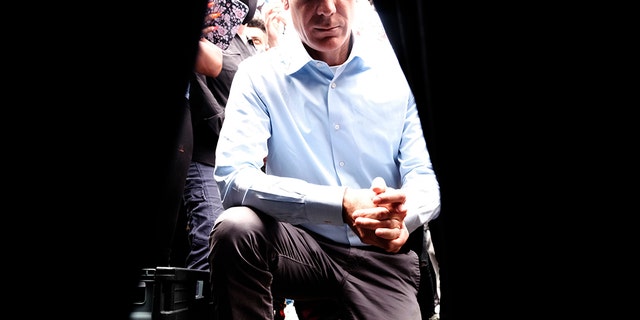
More than 1,000 protesters gathered Tuesday outside the Getty House in Los Angeles, which serves as the residence of Mayor Eric Garcetti. The crowd appeared to remain peaceful, with no reports of vandalism or looting in the immediate area, as demonstrations following the May 25 death of George Floyd in Minneapolis continued across the U.S., FOX 11 of Los Angeles reported. “It’s a Black Lives Matter thing,” one protester told FOX 11.
“It’s not to get confused; it’s not us versus you, it’s not white
versus black. It’s a lot of our people versus bad cops. We understand
there’s good cops but there’s a lot of bad cops and it’s not a job that
can have bad cops.”
Joined by community faith leaders Los Angeles Mayor Eric Garcetti
takes a knee in prayer during a Black Lives Matter protest in downtown
Los Angeles on Tuesday, June 2, 2020. (Associated Press)
After the protest was already underway, Garcetti made some remarks at an evening news conference at City Hall. “I
hear you that this isn’t just about the criminal justice system. This
is also about society and where we put out resources,” Garcetti said,
according to KTLA-TV of Los Angeles. Also appearing at the
briefing was Davion Pilgrim, 16, a student from Morningside High School
in Inglewood, who was recently stopped by police, and racially and
criminally profiled. “I was accused of being associated with a gang and that really hurt, because that’s not me,” Pilgrim said, according to KTLA. “We want to make sure that what happened to George Floyd does not ever happen to someone who looks just like me.” Earlier in the day, Garcetti appeared at a protest outside Los Angeles police headquarters, where he kneeled in solidarity with the protesters. “I hear you. I hear what you are saying about the police,” the Democrat said. The
protest at the mayor’s residence came one day after a previous news
conference in which Los Angeles police Chief Michel Moore drew criticism
for claiming protesters shared in the blame
for the death of Floyd, the Minneapolis man who died in police custody,
sparking a weak of protests, rioting and looting throughout the U.S. Moore
apologized soon after making the remarks – but Garcetti, who appeared
at the same news conference, faced calls to fire Moore and resign from
office himself. Fox News’ Nick Givas contributed to this story.
The statement by President Trump that the United States will designate Antifa
as a terrorist group is an important one. The biggest reason is they
are one, so we can now properly frame their actions. But there are
other advantages both in preventing more attacks and catching and
punishing the perpetrators. Their actions fit the definition of terrorism as I pointed out in this piece calling for this designation: “The president’s accurate description of Antifa fits the definition under
federal law of a domestic terror group. Under that definition, such a
group breaks laws ‘to intimidate or coerce a civilian population’ or to
‘influence the policy of a government by intimidation or coercion.’” Most
of the hardcore activists wouldn’t even argue with the description or
the goals, but previously they were dealing with a much smaller
potential downside. Now the array and severity of crimes and especially
punishments just jumped exponentially. Many of these wannabe
revolutionaries are willing to spend a night in jail, but how many are
willing to do 20 years in prison. The immediate effect will be to
change the dynamic for the radical Left and their “Burn it all down”
wing and create a real deterrent. They have been free to commit
vandalism escalating up to violent acts and turn their protests into
riots because even if they were caught the local charges were usually
minor. This
will help slow their ability to grow a pack of angry activists into a
howling mob burning buildings, beating bystanders and even killing
people. They rely on riding along with the other radical Left activist
groups who are all too happy to have them do the dirty work. But if
those groups risk being swept up for supporting terror, they are much
less likely to tolerate Antifa & friends in their midst. It will
also make the college student adventure activists wary and the folks
just out for a quick looting consider whether a flat-screen is worth
doing real time. Those are real benefits and should not stop
anyone who wants to peaceably assemble and petition their government for
a redress of grievances. But it will serve as a reminder the word
“peaceably” is in there for a reason.
Another major damage the designation has on their efforts is the prohibition of financing and material support for terrorism.
This
won’t deter the diehards who believe rioting is just a warm-up. They
will be targets of the increased law enforcement and surveillance powers
enabled by the terror designation. This is important due to the very
nature of an anarchistic movement like Antifa. They don’t organize as
much as they flock together in common cause. That makes identifying,
tracking and catching them difficult. A whole
array of online surveillance and nationwide warrant capabilities allow
our federal law enforcement agencies to watch and identify their members
and plans as well as gather evidence if crimes have already been
committed. Without the designation the diffuse nature of Antifa makes it
very tough to jump through all the hoops needed to make this happen. Another
major damage the designation has on their efforts is the prohibition
of financing and material support for terrorism. While Antifa operations
are not particularly high budget, they do cost money and require some
types of expertise. Anyone providing that type of support will now find
themselves in jeopardy. Antifa and other radical left
organizers often pay protesters. Drying up that funding stream and
ensuring other groups sympathetic to their cause can’t financially
support them will severely hamper their efforts. One
more positive aspect of this action is to show the vast majority of
people in this country that this type of terror against them and their
livelihoods will not be tolerated. The avowed goal of Antifa and the
other radicals with these riots is to create fear and force changes that
will appease the attackers. The governors and mayors have the
still difficult task of reining in the current violence. This action by
the president will make it less likely another one will happen, or if it
does, that those responsible pay a heavy price.
The thug disguised as a Minneapolis police officer who is charged with third-degree murder in the death of George Floyd does not speak for me.
The rioters
on the streets of dozens of American cities,
destroying valuable property, from shopping malls to synagogues, also do
not speak for me. So who does? I am not a racist and neither are most Americans or most police officers. I am not a destroyer of property and neither are most Americans. Chances
are, you are just as appalled by what happened in Minneapolis, and what
has happened in American cities and in some other places around the
world, as I am.
So who speaks for us? I resent the implication that if I’m not torching police cars, I am condoning the actions of a bad cop. I equally resent the implication that my attitudes toward race can be divined simply by looking at the color of my skin. When it comes to race, it seems that we Americans have lost the plot. There
was a time, not that long ago, when we had begun to move toward a
society where people judged each other as individuals, by the content of
their character, in Dr. Martin Luther King Jr.’s words. And
somehow that morphed into a new kind of racism, where assumptions are
made that if you’re white, you think this way, if you’re black, you
think that way, if you’re straight, if you’re gay, and so on. What happened?
When
did we move from striving for color-blindness to living in a world
where color and other forms of identity trump individual thinking? The academy and social media deserve much of the blame. College
students are being taught to see life through a prism of race,
gender and sexuality, as if you could define a human being in all of his
or her complexity by a few key tests. You can’t. You can’t shorthand people. And
yet, my visits to college campuses over the last 10 years have
indicated that the progressive movement has taught the young to view
themselves and others almost entirely in terms of race, sexual identity,
and so on. We used to be people.
Now we’re categories. And
then what kids learn in college makes its way into the workplace, as
they graduate and get jobs, and then into the culture, through
the shorthanding of ideas that occurs in social media.
In
the musical "South Pacific," there was a groundbreaking song about
racism called “You’ve Got To Be Carefully Taught.” In other words,
racism and hatred are not built into us from birth.
All that gets amplified by progressive politicians who play the shame and blame game to accumulate more power and prestige. And
now we live in a world where interactions between people of different
opinions, colors, religions or lack thereof, and sexual identity are
rooted in distrust, cynicism and outright hatred. In the musical "South Pacific," there was a groundbreaking song about racism called “You’ve Got To Be Carefully Taught.” In other words, racism and hatred are not built into us from birth. They are learned behaviors.
And
in my lifetime, we recognized the folly of such bigoted thinking and we
began to move toward a society where people were accepted as
individuals and not judged as members of groups. A far-from-perfect society, but a better society. As Dr. King said, the arc of the moral universe is long, but it bends toward justice. And then things went the other way. The thug in a cop’s uniform who has been charged with murder was likely taught to believe certain things about race. The
thugs in expensive jeans and designer tops rampaging through our cities
and destroying parts of an already fragile economy were carefully
taught that annihilation and rage are appropriate responses to behavior
of which they disapprove. Neither of those kinds of people speaks for me.
Or, I would think, for you. Or for who we are trying to be, fitfully, agonizingly, as a just society. I am not a racist, or one who condones rogue cops or rioters. They are not America. This is not a society of blind hate. We have come too far.
We took a wrong turn. We sent
our children to college, and the progressive movement that controls
thought on college campuses carefully taught our children to hate. And now we are reaping that whirlwind.
This is a heartbreaking time for our country, and journalists are caught squarely in the middle. In
covering the riots that have gripped cities across the country, they
have been arrested, assaulted and shot, in some cases seemingly targeted
by aggressive police tactics and in others besieged by angry
protesters. I don’t expect much sympathy for my much-maligned
profession, but it’s a reminder that many journalists don’t just sit in
climate-controlled studios, and a reflection of the broader fissions in
our society. At the same time, the media’s relentless focus on
President Trump has cast him as essentially missing in action during
this crisis, which may have prompted him--four hours after his press
secretary said there was no need for a speech--to make a Rose Garden
statement last night. And by declaring “I am your president of law
and order,” he followed the Nixon playbook of 1968 and sought to make
violent protest, not police brutality, the dominant issue in this
election year. On the metaphor front, journalists seized on the
president retreating to an underground bunker while rock-throwing
protesters gathered strength outside the White House, which is unfair
because the Secret Service made that call. In the wake of the
brutal killing of George Floyd in Minneapolis, pundits and politicians
have been faced with the dual challenge of grappling with the black
community’s anger and frustration while cracking down on the violence
and lawlessness that obscures that cause. When
Omar Jiminez, a black reporter for CNN, was arrested by Minnesota state
police despite repeatedly offering to move, it was an outrage that led
Gov. Tim Walz to apologize to the network. MSNBC anchor Ali Velshi and
correspondent Garrett Haake have both been struck by rubber bullets.
Police in numerous instances have either been reckless or antagonistic
when it comes to journalists who are trying to cover the urban chaos. Another
victim in Minneapolis, Linda Tirado, a freelance photographer and
activist, was shot in the left eye and says she has permanently lost
vision in that eye. On the other side, protesters smashed windows
and defaced the famous red logo at CNN headquarters in Atlanta. In
Washington, protesters threw punches and bottles as they chased a Fox
News crew before the journalists found a police cruiser, a situation
that anchor Leland Vittert compared to his coverage of Egypt’s Tahrir
Square uprising. In Pittsburgh, KDKA photojournalist Ian Smith was
brutally beaten by demonstrators and said another group saved his life
by pulling him to safety. Even the harshest critics of the media
should decry these abominable tactics by both the police and the
protesters, though in fairness the cops are often overwhelmed and
numerous officers have been injured in the riots. As for the coverage, a Washington Post news
story said yesterday: “Never in the 1,227 days of Trump’s presidency
has the nation seemed to cry out for leadership as it did Sunday, yet
Trump made no attempt to provide it. “That was by design. Trump
and some of his advisers calculated that he should not speak to the
nation because he had nothing new to say and had no tangible policy or
action to announce yet, according to a senior administration official.
Evidently not feeling an urgent motivation Sunday to try to bring people
together, he stayed silent.” “Privately,” says the New York Times,
“advisers complained about his tweets, acknowledging that they were
pouring fuel on an already incendiary situation.” These included the
missive about “when the looting starts, the shooting starts,” which
Trump later clarified by saying he meant people in the crowds could be
hurt. Now
it’s no secret that the president has struggled in the area of race
relations. There was Charlottesville, of course, and his
back-where-they-came-from tweets about members of the Squad, and
denigrating Baltimore as “a rat and rodent infested mess.” Trump
also has an instinct to rally his side against the other side, which
makes it harder to unite the country. He blamed Democrats when the
pandemic exploded and blamed Democratic mayors and governors for not
controlling the urban violence. In fact, he told governors on a
conference call yesterday that most of them are “weak” and “you have to
dominate or you’ll look like a bunch of jerks.” He has blamed the media on both fronts as well. And in the past week he has gone after China, the WHO and Joe Scarborough. But
there is a level on which the president is getting a bum rap. He said
right away he was shocked by the video of Floyd being killed by an
officer’s knee pressing against his neck for nine minutes. At the
SpaceX launch in Florida on Saturday, Trump called Floyd’s death “a
grave tragedy. It should never have happened. It has filled Americans
all over the country with horror, anger and grief.” Those remarks got
little attention. In the same comments, Trump said he was allied
with people seeking justice and peace, but opposed to “anyone exploiting
this tragedy to loot, rob, attack, and menace.” But the president
was all tough talk last night, with just a nod to peaceful protest, in a
split-screen moment when riot police stood guard at Lafayette Park
across from the White House. He railed against “professional
anarchists,” Antifa and “violent mobs,” spoke of innocent people being
killed and the capital’s monuments defaced. “These are acts of domestic
terror,” he declared, “a crime against God,” and vowed to deploy the
military. Donald Trump had chosen his side. Any public official,
Democrat or Republican, has to take the stance that what happened to
Floyd is reprehensible but that lawlessness is unacceptable. At the
moment, the violence from New York to Philadelphia to Minneapolis to
Santa Monica is overshadowing the cause that the protesters profess to
embrace. The looting and the fires and the rock-throwing do more
than jeopardize the safety of journalists and of community residents;
they change the national subject from police brutality to law and order.
And, as happened after the 1968 riots, that can cause a political
backlash that can last for years.
The protesters outside the White House Monday
who were cleared by police prior to President Trump’s brief visit to
St. John’s Episcopal Church were “professional agitators” and the media
fell for their “calculated” tactics, Sen. Marco Rubio, R-Fla., said on
late Monday. “They
knew the street needed to be cleared before 7 pm curfew,” Rubio
tweeted. “But they deliberately stayed to trigger police action &
get the story they wanted, that “police attacked peaceful protesters.” The
criticism that Trump faced after being photographed outside the church
was swift. House Speaker Nancy Pelosi and Senate Minority Leader Chuck
Schumer issued a joint statement to call out the “photo-op.” “Across
our country, Americans are protesting for an end to the pattern of
racial injustice and brutality we saw most recently in the murder of
George Floyd,” the statement read. “Yet, at a time when our country
cries out for unification, this President is ripping it apart.
Tear-gassing peaceful protestors without provocation just so that the
President could pose for photos outside a church dishonors every value
that faith teaches us.” The Associated Press reported that at
about 6:30 p.m., law enforcement officers were “aggressively forcing the
protesters back “firing tear gas and deploying flash bangs into the
crowd to disperse them from the park for seemingly no reason. It was a
jarring scene as police in the nation’s capital forcefully cleared young
men and women gathered legally in a public park on a sunny evening, all
of it on live television.” Washington D.C.'s Mayor Muriel Bowser
tweeted that federal police "used munitions on "peaceful
protesters" a full 25 minutes before the curfew. She called the decision
shameful. The church caught fire the previous night during unrest over Floyd’s death
in police custody. Trump has spoken out about Floyd’s death and called
the video “horrible.” Former Minneapolis police officer Derek Chauvin
was charged with third-degree murder and the three other officers with
Chauvin were fired but not yet charged. Attorneys for Floyd's
family released the results of an independent autopsy report Monday
afternoon showing that Floyd's death was caused by asphyxia due to neck
and back compression that led to a lack of blood flow to the brain. Another autopsy, conducted by
the Hennepin County Medical Examiner's office, stated that Floyd died
from "cardiopulmonary arrest complicating law enforcement subdual
restraint, and neck compression" while being restrained, Fox 9 reported. Its updated results went public Monday evening. Hillary
Clinton and Joe Biden, the likely Democrat nominee to face Trump in
2020, also criticized the president for removing the protesters. "Tonight
the President of the United States used the American military to shoot
peaceful protestors with rubber bullets & tear gas them. For a photo
op," Clinton said. "This is a horrifying use of presidential power
against our own citizens, & has no place anywhere, let alone in
America. Vote." NPR reported that U.S. Park Police and National
Guard troops were tasked with removing the protesters. The report said
Trump stopped in front of the church, held up a Bible and said, “We have
the greatest country in the world. Keep it nice and safe.” Trump
was also criticized by church leaders who said they were not aware of
the visit. Episcopal Church Presiding Bishop Michael Curry told NPR
that Trump “used a church building and the Holy Bible for partisan
political purposes. This was done in a time of deep hurt and pain in our
country, and his action did nothing to help us or to heal us.” Fox News' David Aaro, Bradford Betz, Vandana Rambaran and the Associated Press contributed to this report
Former Deputy Attorney General Rod Rosenstein played a central role in the Russia hoax. He was vindictive, conniving and unscrupulous as he sought to destroy the very president he pretended to support and serve. On
Wednesday, Rosenstein will finally be questioned about his actions by
the Senate Judiciary Committee as its first witness into an
investigation of the origins and evolution of the Russia probe that was
opened by the FBI
in the summer of 2016. Ten months later —thanks to Rosenstein— it
morphed into a special counsel case that dragged on for an agonizing 22
months. It was Rosenstein who presided over the special counsel investigation of President Trump, all the while conspiring behind the scenes to overthrow him. The duplicity was classic Rosenstein. He
well knew that his appointment of Robert Mueller in May of 2017 was an
illegitimate abuse of power and contrary to federal regulations
governing the naming of a special counsel, as explained in my last
column. At the time, there was no evidence that Trump or his campaign
had colluded with Russia to steal the 2016 presidential election. It was
all there in the FBI files, hidden from the public but readily
available to Rosenstein. Months earlier in January of 2017, the
FBI had debunked the anti-Trump “dossier” as little more than scurrilous
lies, exaggerations and fiction. There was no other credible evidence
of a collusion conspiracy. James Comey’s FBI knew it, and so did
Rosenstein. Yet, he was undeterred. In a fit of anger, he hired Mueller
for an investigation in search of a crime, which is anathema to the rule
of law. The
White House was understandably shocked. And so were other top officials
at the Department of Justice (DOJ). As I recounted in my book, "Witch Hunt: The Story Of The Greatest Mass Delusion In American Political History" (page 155), Rosenstein was allegedly confronted in his office over what he had done: “Rosenstein was literally cowering … hiding behind and somewhat below his desk. ‘Am I gunna get fired?’ blubbered Rosenstein.” It
is a scathing indictment of Rosenstein’s lack of character that he only
seemed to care about himself. Never mind that he had launched — on his
own authority — a national nightmare that would hobble the presidency
for two more years, divide Americans over an unfounded scandal and
inflict profound damage to our system of justice. Why did
Rosenstein appoint Mueller? It was an act of retaliation. The deputy
attorney general was furious that Democrats in Congress blamed him for
the firing of Comey as FBI director. Rosenstein, who authored the
firing memo, was suddenly “regretful and emotional,” according to people
who interacted with him at the time. He became unglued and blamed Trump
for all the criticism. Mueller was Rosenstein’s revenge. But
hiring the special counsel was merely the first part of Rosenstein’s
nefarious scheme. Part two constituted one of the most diabolical plots
in American political history. The Attempted Coup The
moment Comey was fired by the president, Rosenstein began meeting
secretly with Comey’s temporary replacement, acting FBI director Andrew
McCabe (who was later fired for lying). McCabe decided to initiate a new
FBI investigation of Trump simultaneous with Rosenstein’s appointment
of Mueller as special counsel. In other words, they double-teamed Trump
even though neither one had a scintilla of evidence to justify their
actions. At the same time, Rosenstein and McCabe convened
repeatedly behind closed doors to discuss a plan to evict the duly
elected president of the United States from office and undo the 2016
election results. According to McCabe, it was Rosenstein’s idea to
depose Trump by secretly recording the president for the purpose of
gathering incriminating evidence of something —anything. Armed with such
supposed evidence, he would recruit cabinet members to remove Trump
under the 25th Amendment Here is what McCabe later told CBS’s "60 Minutes": “The
deputy attorney general offered to wear a wire into the White House. He
said, ‘I never get searched when I go into the White House, I could
easily wear a recording device, they wouldn’t know it was there.’ Now,
he wasn’t joking, he was absolutely serious, and in fact, he brought it
up in the next meeting we had.” McCabe didn’t stop there in
unraveling the sordid story. He explained how Rosenstein intended to use
whatever evidence he might gather furtively as a basis for convincing
cabinet officials to remove Trump from office. “Discussion of the
25th Amendment was simply, Rod raised the issue and discussed it with
me in the context of thinking about how many other cabinet officials
might support such an effort.” McCabe claimed that Rosenstein was
already “counting votes” among cabinet members he had contacted
surreptitiously. Government memos confirm this account, and those
documents were handed over to Mueller. Did he do anything about it? Of
course not. The special counsel report made no mention of it.
The
Senate Judiciary Committee must confront Rosenstein about his warrant
application. The Justice Department has stated that it was illegally
obtained without probable cause.
The plot to carry
out the equivalent of a coup would have been a lawless misuse of
power. The 25th Amendment provides for the removal of a president if he
is incapacitated or “unable to discharge the powers and duties of his
office.” Disliking a president or his decision-making is not a basis for
evicting him from office under the amendment. When the story of
Rosenstein’s scheme was later revealed in news reports, he dismissed the
story as “inaccurate and factually incorrect.” But in his meticulously
worded statement to the media, he did not deny seeking an illegitimate
basis for removing Trump. It was a canny misdirection and quite typical
of Rosenstein’s propensity for deflection. In a bid to hang on to
his job, Rosenstein arranged a meeting with Trump. Here is what the
president told me about their conversation: President Trump: He
(Rosenstein) said it didn’t happen. He said he never said it. What he
told other people is that he was joking. But to me, he claimed he never
said it. Jarrett: Did you believe him? President: I didn’t really know what to believe. So
which was it? A joke or a fiction? Logically, it cannot be both. During
which account was Rosenstein telling the truth? In one of them, he must
have been lying. On Wednesday, the Senate Judiciary Committee
must grill Rosenstein in detail about his attempted coup to remove the
president and subvert democracy. Spying On Carter Page The
four successive surveillance warrants to spy on former Trump campaign
associate Carter Page were serial abuses of constitutional rights and
the legal process. Factual asserts submitted to the Foreign Intelligence
Surveillance Court (FISC) were not just wrong, they were never
validated as true even though the FBI and DOJ officials who signed the
documents swore that the information was, indeed, verified. The
applications were filled with errors, omissions, deceptions and lies. Rosenstein
signed off on the final renewal in June of 2017 shortly after he
wrongfully appointed the special counsel and schemed to depose Trump
from office. The deputy attorney general was desperate to come up with
some kind of evidence that would justify what he had already done. The
FBI and Rosenstein relied almost entirely on the “dossier” composed by
ex-British spy Christopher Steele. It was phony on its face. It was
commissioned by the Hillary Clinton campaign and Democrats. Newly
declassified documents show that it was nothing more than malicious
Russian disinformation. By January of 2017, the FBI knew this. Surely,
Rosenstein knew it too. All of this was concealed from the judges. Yet,
he affixed his signature on the warrant to spy on Page, thereby
representing to the court that the information was both true and
verified when he must have known that it was not. Lying to a court
constitutes fraud and other potential crimes. Rosenstein was well aware
of this, as any lawyer would be. Consider what he said at a public forum several months after he signed the warrant application: “In
order to get a FISA warrant, you need an affidavit signed by a career
law enforcement officer who swears the information is true… And if it is
wrong, that person is going to face consequences. You can face
discipline and sometimes prosecution.” Rosenstein’s words
frame a prophetic indictment of his own wrongful and, arguably, illegal
actions. He swore the information was true and verified. The opposite
was true. Rosenstein was acutely aware that the FBI had spent months
trying in vain to verify the evidence. A month after his public
remarks, Rosenstein was questioned by the House Judiciary Committee. He
refused to answer direct questions but suggested that he might not have
even read the warrant application that he signed. Grudgingly, he
admitted that he did not always read what he was signing. It is
ironic that the man who so sternly lectured an audience about how
imperative it was for every prosecutor to ensure that a spy warrant
contained truthful information is the same man who may never have
bothered to read the one he signed against Carter Page. Or perhaps he
read it but didn’t care about the many lies and misrepresentations
contained therein. On Wednesday, the Senate Judiciary Committee
must confront Rosenstein about his warrant application. The Justice
Department has stated that it was illegally obtained without probable
cause. It has Rosenstein’s dirty fingerprints all over it. Attorney
General William Barr has denounced government officials for their
“misconduct,” “malfeasance and misfeasance” and “clear abuse of the FISA
process.” Rosenstein was an integral part of it. Barr has said
that officials “misled the FISA court, omitted critical exculpatory
facts from their filings and suppressed or ignored information negating
the reliability of their principal source.” Rosenstein
is far more guilty than others. As the highest-ranking official
involved, he had a special and affirmative duty to ensure that the law
was being scrupulously followed. His chronic failures and malevolent
actions, as described above, constitute an egregious breach of trust. Come
Wednesday, senators in their questioning of Rosenstein should give no
quarter in demanding honest answers from a man who has shown no regard
for either honesty or justice.
Podcast host Buck Sexton on Sunday called “completely unfair” the NBC report that claimed President Trump was fanning flames amid the coronavirus pandemic and civil unrest in the wake of the death of George Floyd.
“I
had the president on my radio show last week. We spoke specifically
about the George Floyd case. He said it was horrible, the Justice
Department was looking into it, that he expected authorities to bring
swift justice,” host of the "Buck Sexton Show" told Howard Kurtz on “Media Buzz.” Sexton said that President Trump’s comments during his show were “exactly what I would want a commander in chief to say.” “There isn’t a whole lot of debate or discussion about how horrible what happened in Minnesota was.” Dozens of cities across the United States were picking up the pieces on Sunday after a grim night of violent riots that
left at least three dead, dozens injured, hundreds arrested and
buildings and businesses in charred ruins as protests over the death of a
black Minneapolis man in police custody continued for a fifth day. Mayors of major cities imposed curfews, governors in nearly a dozen states deployed the National Guard in a desperate bid to stem the mayhem, chaos and wreckage. Though the incident that touched off the rioting occurred Monday in Minnesota and led to a cop being swiftly charged with murder, the damage seemed to culminate Saturday night and spanned from coast to coast. In New York City,
the NYPD said at least 345 people were arrested and at least 47 police
vehicles damaged or destroyed during the incidents on Saturday. A total
of 33 police officers were also injured. In Beverly Hills, Calif., shops
along the storied Rodeo Drive were looted as a crowd estimated at more than 2,000 people chanted "Eat the rich!'
Sexton pushed back on the media and others whom he claimed were “fanning the flames.” “If
you’re looking for people who are fanning the flames, I saw protesters
here on the street. I walked amongst them several times just because
they’re all over the city. They’re screaming profanity at police
officers, They’re calling them racist murderers. It’s appalling and
then, on top of that, you add the destruction of property, the NYPD cars
lit on fire, and the media always soft peddling this: ‘oh this is an
expression of rage,’” Sexton said. Sexton went on to say, “No, this is looting, this is arson, this is violence and it needs to be stopped.” Fox News' Caitlin McFall and Dom Calicchio contributed to this report.
Demonstrators standing off with police in downtown Raleigh, N.C.,
on Saturday, during a protest over the death of George Floyd, who died
in police custody on Memorial Day in Minneapolis. (Ethan Hyman/The News
& Observer via AP)
The coronavirus lockdown is seemingly down and out, as many Democrats
in charge of big cities -- including several who once insisted on
strict quarantine measures -- line up to champion the nationwide mass
demonstrations over the in-custody death of George Floyd, sans social distancing. New York Gov. Andrew Cuomo lashed out
at protesters calling to reopen the state earlier this month, saying at
a news conference, "you have no right to jeopardize my health ... and
my children's health and your children's health." Cuomo's directives
have been enforced throughout the state: A New York City tanning salon
owner told Fox News he was fined $1,000 for reopening briefly last week, calling the situation "insane" and saying he already was "broke." On Friday, though, Cuomo said
he "stands" with those defying stay-at-home orders: "Nobody is
sanctioning the arson, and the thuggery and the burglaries, but the
protesters and the anger and the fear and the frustration? Yes. Yes, and
the demand is for justice." In April, New York City Mayor Bill de Blasio told the
Jewish community that "the time for warnings has passed" after he said a
funeral gathering had violated social distancing guidelines. On
Sunday, the mayor asserted, "We have always honored non-violent protests." Minneapolis
Mayor Jacob Frey, meanwhile, had warned that in-person worship services
would be a "public-health disaster," disregarding constituents'
concerns that he was violating their First Amendment rights. Now, his
administration has been distributing masks to rioters, even though public gatherings of 10 or more are still ostensibly banned. Frey also allowed a police station to burn, saying it was necessary to protect police and rioters. "The
city encourages everyone to exercise caution to stay safe while
participating in demonstrations, including wearing masks and physical
distancing as much as possible to prevent the spread of COVID-19," a
news release read. "The city has made hundreds of masks available to protesters this week." The mayor of Washington D.C., Muriel Bowser, vowed $5,000
fines or 90 days in jail for anyone violating stay-at-home orders. This
weekend, though, Bowser defended the protests: "We are grieving
hundreds of years of institutional racism. ... People are tired, sad,
angry and desperate for change." An angry mob of rioters in
the city turned its rage on a Fox News crew early Saturday, chasing and
pummeling the journalists outside the White House in a harrowing scene captured on video. And, Los Angeles Mayor Eric Garcetti threatened in
March to cut power and water for businesses that reopened, saying he
wanted to punish "irresponsible and selfish" behavior. In recent days,
he has encouraged mass gatherings, even as he condemned violence. "I
will always protect Angelenos' right to make their voices heard — and we
can lead the movement against racism without fear of violence or
vandalism," he said. These officials were just some of the most
prominent politicans to have adopted strikingly different rhetoric on
mass gatherings over Floyd's death, including several protests that have
triggered property damage, injuries, beatings, and several deaths.
The mayor of Atlanta, Keisha Lance Bottoms, has been one of the few
politicians to keep up her coronavirus admonitions. "If you were out
protesting last night, you probably need to go get a COVID test this
week," she told CNN on Sunday. "There is still a pandemic in America
that’s killing black and brown people at higher numbers." Although some Democrats, including Garcetti, have since welcomed
the support of the National Guard to quell the demonstrations, they
explicitly noted they were doing so to combat "destruction" and
"vandalism" -- not widespread defiance of stay-at-home orders. Four officers have been fired in the Floyd case, and one has been arrested and charged. A video
showed the arrested officer kneeling on Floyd for several minutes as he
screamed that he could not breathe, although an initial medical
examiner's report found "no physical findings that support a diagnosis
of traumatic asphyxia or strangulation" -- and cited Floyd's "underlying
health conditions including coronary artery disease and hypertensive
heart disease," as well as the "potential intoxicants" in his system. "Democratic
elected officials have now all-but destroyed any remaining political
deference in terms of policies needed to enforce social distancing,
limit crowd size and the like," journalist Michael Tracey said. He also suggested the protests obfuscated key data, pointing to statistics from The Washington Post showing
that a total of 41 unarmed people were shot and killed by U.S. police
in 2019 -- 19 of them white, nine black and nine Hispanic. Others noted
that the "Grim Reaper" who patrolled Florida's beaches to shame swimmers and sunbathers amid the pandemic was nowhere to be seen at the protests. "WE
LITERALLY STAYED IN OUR HOUSES FOR A MONTH BECAUSE OF FEAR OF A VIRUS
WITH A 99.74% SURVIVAL RATE AND NOW ARE SUPPOSED TO IGNORE NATIONAL
COP-KILLING RIOTS?!!" Kentucky State political science professor Wilfred
Reilly tweeted. "SERIOUS question, as re these riots - where are all
these Governors that gave daily three hour press conferences about
whether you could walk down the beach or visit your dying relatives? Is
the COVID-19 crisis over?" There have been other indicators that
officials' concerns about the coronavirus were overblown. Warnings from
Democrats that the recent Wisconsin election would lead to a spike in
coronavirus cases, for example, proved unfounded.
("I don’t think that the in-person election led to a major effect, to
my surprise. I expected it,” infectious diseases expert Oguzhan Alagoz said.) Reilly
added: "The way you create a narrative is to isolate and publicize
every incident of the phenomenon you're focused on. Black:
white/inter-racial violent crime is 5% of crime (600K cases/12M crimes),
and 80% of THAT is Black on white. Wouldn't think that from the papers,
wouldja?" Scattered efforts by the Democrats to condemn some of
the protesters have relied on inaccurate information and unfounded
assertions that contradict available data and video evidence. For
instance, former Obama National Security Advisor Susan Rice appeared to blame the Russians for the protests on Sunday, saying the violence was right out of their "playbook" and that they're "probably" involved. Rice also falsely claimed that Trump had called white supremacists "very fine people," which has been repeatedly debunked.
Like Rice, Trump specifically made a distinction between peaceful
political protesters and white supremacists, whom Trump said he
condemned "totally." ("Very fine people" were protesting the censorship
and removal of a Civil War statue, Trump said.) And, Frey said
Saturday that officials thought "white supremacists" and "out-of-state
instigators" could be behind the protests in the wake of Floyd's death,
and Minnesota Gov. Tim Walz also claimed most of the protesters arrested
were from outside Minneapolis and sought to take advantage of the
chaos. "We are now confronting white supremacists, members of
organized crime, out of state instigators, and possibly even foreign
actors to destroy and destabilize our city and our region," Frey had
tweeted Saturday. However, a report by
KARE 11 showed "about 86 percent" of the 36 arrests listed their
address in Minnesota, and that they live in Minneapolis or the metro
area, according to data the outlet analyzed from the Hennepin County
Jail's roster. Five out-of-state cases came from Arkansas, Florida,
Illinois, Michigan and Missouri. St. Paul Mayor Melvin Carter later admitted
he was wrong when he falsely claimed that "every person" arrested in
Minneapolis protests was from out of state. Frey has not issued a
similar retraction, and multiple calls by Fox News to his office seeking
comment were met with a busy signal. An emailed message was not
immediately returned. On Sunday, White House National Security
Adviser Robert O'Brien disputed reports that far-right and white
supremacist groups were involved in stoking the violence. "I
haven't seen reports of far-right groups," O'Brien said in an interview
Sunday morning on CNN's "State of the Union." "This is being driven by
Antifa." Later Sunday, Trump announced he would designate Antifa a terrorist organization. "The United States of America will be designating ANTIFA as a Terrorist Organization," Trump tweeted Sunday afternoon. "It’s ANTIFA and the Radical Left. Don’t lay the blame on others!" Trump had tweeted Saturday. Secretary
of State Mike Pompeo was less decisive in stating who was behind the
looting, arson, and violence that has taken place. While he called
rioters "Antifa-like" during an appearance on Fox News' "Sunday Morning Futures,"
he said, "I think it still remains to be seen exactly how" the
situation devolved from peaceful protests to something entirely
different. Fox News' Caitlin McFall, Andrew O'Reilly, Tyler Olson and Fox Business' Maria Bartiromo contributed to this report.