An
NYPD police officer randomly attacked and stabbed in the neck late
Wednesday patroling in Brooklyn, which led to a struggle for the knife
and two additional police officers suffering gunshot wounds. Police
said at an early news conference Thursday that a preliminary
investigation indicated that a male walk up to the officers casually
and whipped out the knife. "That officer was stabbed in the left
side of his neck, thank God, missing an artery," New York City Police
Commissioner Dermot Shea said in a press conference. Two police
officers were shot and another was stabbed in Brooklyn on Wednesday
night during a confrontation with a knife-wielding suspect, police said. Shea called it a "completely cowardly, despicable, unprovoked attack on a defenseless police officer." Soon
after, police and the suspect reportedly fought for a weapon, which
caused gunfire to strike two officers in the hand, authorities said. Two
of the officers involved were assigned to an anti-looting post. The
scene was chaotic. Nearby officers heard the gunshots and responded to
find the suspect brandishing a gun police say he likely took from an
officer. The suspect was shot multiple times. Police said 22 shell
casings were recovered. Police said one officer was shot in the
arm and the other struck in the hand by gunfire. They were rushed to
Kings County Hospital and are expected to survive. New York City
has been trying to get a handle on the widespread unrest after the death
of George Floyd in Minneapolis police custody. The city has enforced a
strict curfew.
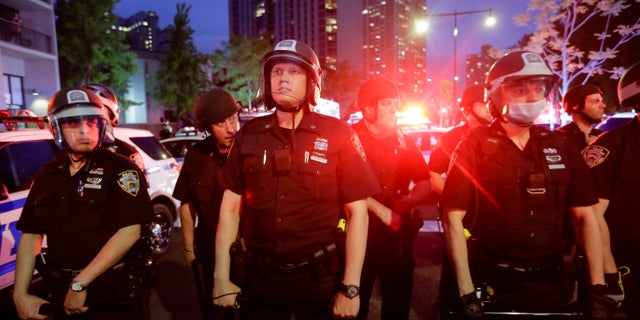
New York City police officers watch protesters calling for justice
over the death of George Floyd, Wednesday, June 3, 2020, in the
Brooklyn borough of New York. Floyd died after being restrained by
Minneapolis police officers on May 25. (AP Photo/Frank Franklin II)
The shooting occurred nearly four hours the 8 p.m. curfew. Mayor
Bill de Blasio went to the hospital after the incident to check on the
officers, according to a spokesperson. The area was filled with police
personnel and vehicles in the hour after the shooting. "Thank God
all our officers will recover," de Blasio said. "It's another example of
what it means every day for men and women of the NYPD to protect all of
us." Video purportedly of the incident on Twitter showed streets
filled with police cars at the scene, while multiple gunshots could be
heard. "No matter what else is happening around us, we've got to
be there for each other," the mayor added. "Officers protect us. We
have to respect, support, protect them. We've got to find a way to move
forward no matter how much is thrown at us. The coronavirus and
everything else." New York City has been roiled by days of
protests over police brutality, It didn't appear that the unprovoked
incident was related to the demonstrations. Several
large marches in other parts of Brooklyn had continued after the curfew
that authorities imposed to stop stores from being damaged and
ransacked. A neighborhood resident said there was no protest in the area at the time of the shooting. "We
have to find a way to come together and move forward," de Blasio said.
"Tonight is a story of bravery, courage, and thank god the story ends
with a day soon when officers will leave this hospital and go home to
their families." An investigation into the incident is ongoing. Shea said an update will be provided later today. The Associated Press contributed to this report
In virtually everything he does, and the rioting across America is no exception, President Trump tries to project strength. One
of his favorite epithets is “weak,” which is what he accused many of
the nation’s governors of being during a conference call. Whether he’s
taking on the Democrats, the media, Twitter, the WHO, China or other
targets, he’ll use tough rhetoric--sometimes over-the-top language--and
let others debate legal niceties about the limits of his power. Unfortunately
for the man who just declared himself “your law-and-order president,”
his message was undermined by having military police use smoke canisters
against peaceful protesters across from the White House so he could
visit a fire-damaged church. That the stroll to St. John’s Church, where
Trump held up a Bible, was nothing more than a photo op was underscored
by the fact that he made no attempt to enter the church or meet with
its leaders, drawing a blast of outrage from Washington’s Episcopal
bishop. The
episode Monday evening played out on live television as the cable
networks waited for Trump’s announced appearance in the Rose Garden.
That was delayed as the federal police dispersed the crowd in Lafayette
Park, who were planning to leave anyway because of a 7 p.m. curfew
imposed by the city. CNN and MSNBC ran split-screen images during
Trump’s speech, showing the chaos outside the executive mansion. Trump
was widely denounced, by commentators and Democrats for authoritarian
behavior and a misuse of the military. HuffPost, which despises the
president, ran a banner headline deriding a “FASCIST PHOTO OP.” Trump
got the images he wanted, but at a price. (He visited a Catholic shrine
devoted to John Paul II yesterday, prompting journalistic reminders
that his polling support among evangelical and Catholic voters has
recently slipped.) The president is reported to have been upset at
the media’s disdain when the Secret Service ordered him into a bunker
during White House protests, a move he must have seen as projecting
weakness. In a Washington Post poll that had Joe Biden leading the race,
Trump still scored a bitter better with 50 percent saying he’s a strong
leader and 49 percent disagreeing, compared to 43 percent backing that
description of Biden and 49 percent disagreeing. What happened in
the Rose Garden may mark a turning point in Trump’s effort to fully
reclaim the mantle of strength. Tough talk proved useless during the
pandemic, which has claimed the lives of 105,000 Americans after the
president initially spent weeks downplaying the threat (though he did
threaten to override the governors to force the reopening of houses of
worship). And while Trump made several expressions of sympathy
after the brutal killing of George Floyd, projecting empathy has never
come easily to him. But Trump was in his element when he declared
that “our nation has been gripped by professional anarchists, violent
mobs, arsonists, looters, criminals, rioters, Antifa, and others.” And
when he said “these are not acts of peaceful protest. These are acts of
domestic terror.” If you think that’s not a powerful
message--while hardly unifying--you haven’t been watching television.
Stores are being smashed and looted from New York’s Fifth Avenue to
Santa Monica’s Third Street Promenade. Police officers have been shot in
St. Louis and Las Vegas, run over by cars in New York and Buffalo, and a
protester was shot by police in Austin. There are burning cars and
buildings in city after city. There
is a sense that society is out of control, and people are
understandably scared. Most demonstrators are peaceful, but the looters
and arsonists have inflicted huge damage, ignoring a plea from Terrence
Floyd that violence won’t bring his brother back. That’s why Trump
is threatening to use the military if local officials can’t regain
control--and why the violent extremists have played into his hands. What a striking contrast when Biden yesterday spoke in Philadelphia, an address carried live by the three cable news networks. He
took the obligatory stance by saying “there is no place for violence,”
that the riots are damaging businesses built by people of color, and
that the country needs to distinguish “between peaceful protest and
opportunistic violent destruction.” But the former vice president,
who won the nomination with African-American votes, described the
community as having “a knee on its neck” for a long time, with millions
saying to themselves, “I can’t breathe.” He said it was time to confront
“systemic racism.” Biden took a shot at Trump brandishing the
Bible in front of the church--“I just wished he opened it once in
awhile”--and called for police reform and a national oversight
commission. “I won’t traffic in fear and division,” he said. “I’ll seek to heal the racial wounds.” Now
I happen to believe you can simultaneously support healing racial
divisions and cracking down on rioters. But each candidate is playing to
his base in a hugely polarized country as cities are smoldering. It
may all come down to whether the president or his opponent are seen as
stronger--and which challenge is viewed as the most dire.
President Trump signed an executive order to rein in social media giants on Thursday.
The order comes after Twitter added a fact check label to one of the president’s tweets about mail-in ballots. What’s in the order? Reining in of Section 230 protections The
order does not remove Section 230 of the Communications Decency Act of
1996 (CDA), but it would cut federal funding for tech companies that
engage in censorship and political conduct, as well as remove statutory
liability protections. Section 230 says: "No provider or user of
an interactive computer service shall be treated as the publisher or
speaker of any information provided by another information content
provider.” In other words, online platforms that host or republish
speech are protected from a wide range of laws that could otherwise be
used to hold them legally responsible for what others say and do.
(Copyright law, which has a strong constitutional foundation, ordinarily
does require sites like Twitter to remove offending content, or face
liability.) "My executive order calls for new regulations under
Section 230 of the Communications Decency Act to make it so that social
media companies that engage in censoring any political conduct will not
be able to keep their liability shield," the president said. “Immunity
should not extend beyond its text and purpose to provide protection for
those who purport to provide users a forum for free and open speech,
but in reality use their power over a vital means of communication to
engage in deceptive or pretextual actions stifling free and open debate
by censoring certain viewpoints,” the order said. Thus, the order
states that social media companies who remove or restrict content be
exposed to liability “like any traditional editor and publisher that is
not an online provider.”
Prohibition of federal tax dollars from financing online platforms that restrict free speech The
order calls for executive departments and agencies to review their
spending on advertising and marketing paid to online platforms. The head
of each agency is to report its findings to the director of the Office
of Management of Budget. The Department of Justice will, according
to the order, review “viewpoint-based” speech restrictions imposed by
online platformers to assess whether they amount to “problematic
vehicles for government speech,” and funding will be reassessed. Public Big Tech bias complaints The
White House launched a tech bias reporting tool in May 2019. The White
House will now submit such complaints to be reviewed by the Department
of Justice and the Federal Trade Commission. The FTC will consider
“taking action” to prohibit deceptive practices which affect commerce. The FTC will also consider making complaints of bias specifically against Twitter into a publicly available report.
Establishment of a “working group” to enforce State statutes and anti-discrimination laws The
order states that the attorney general will establish a “working group”
in consultation with state attorneys general which will discuss
enforcement of state statutes that prohibit online platforms from
engaging in “unfair or deceptive” practices and help states which do not
have such laws on the books to develop legislation. The
group will also gather information about algorithms that suppress
content or users based on political alignment and policies that allow
“otherwise impermissible behavior” from actors such as the Chinese
Communist Party or other anti-democratic organizations.
President Trump announced late Tuesday that Republicans are "forced" to seek another state to host their convention, saying North Carolina's
governor was "still in Shelter-In-Place Mode" and had "refused
to guarantee that we can have use of the Spectrum Arena" in Charlotte,
despite earlier assurances. The president didn't name an
alternative venue. Earlier in the day, GOP officials said they had
started visiting potential alternative sites after Gov. Roy Cooper, a
Democrat, told them the coronavirus pandemic required them to prepare for a scaled-back event if they wanted to hold it in Charlotte. "Had
long planned to have the Republican National Convention in Charlotte,
North Carolina, a place I love," Trump wrote on Twitter. "Now, @NC_Governor
Roy Cooper and his representatives refuse to guarantee that we can have
use of the Spectrum Arena - Spend millions of dollars, have everybody
arrive, and then tell them they will not be able to gain entry. Governor
Cooper is still in Shelter-In-Place Mode, and not allowing us to occupy
the arena as originally anticipated and promised. Would have showcased
beautiful North Carolina to the World, and brought in hundreds
of millions of dollars, and jobs, for the State. Because of @NC_Governor, we are now forced to seek another State to host the 2020 Republican National Convention." In
a tweet after Trump's post, Cooper said it was "unfortunate" that
Republicans "never agreed to scale down and make changes to keep people
safe." Cooper had written in a letter to the top convention
organizer and the national GOP chairwoman that "planning for a
scaled-down convention with fewer people, social distancing and face
coverings is a necessity." The letter came on the eve of a deadline from the GOP for assurances that Cooper would allow a full-scale event in August. Later,
Cooper told reporters it's unlikely that virus trends would allow a
full-capacity nominating convention for Trump to proceed at Charlotte's
NBA arena.
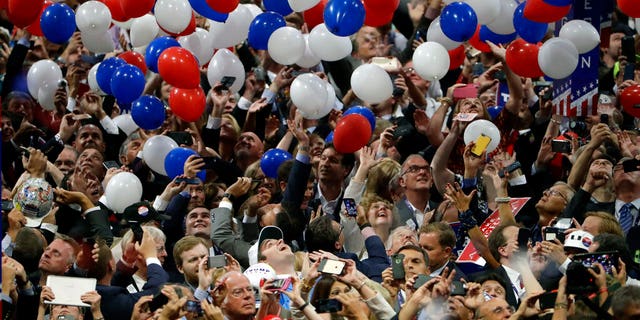
A scene from Donald Trump's acceptance speech on the final day of
the Republican National Convention in Cleveland, in 2016. (AP Photo/Matt
Rourke, File)
“We think it is unlikely that we would be to the
point at the end of August to be able to have a jam packed 19,000-person
convention in the Spectrum arena," Cooper said. "So the likelihood of
it being in Charlotte depends upon the RNC’s willingness to discuss with
us a scaled-down convention, which we would like to do.” Republican
National Committee Chairwoman Ronna McDaniel, one of the recipients of
Cooper's letter, accused him of “dragging his feet” on giving them
guidance for proceeding with convention plans. She released a statement
saying that while the party would like to hold its event in Charlotte,
“we have an obligation to our delegates and nominee to begin visiting
the multiple cities and states” that have reached out to express
interest in hosting. Officials in Charlotte, meanwhile, posted on
Twitter that they had yet to receive word from the Repubican National
Committee about a relocation of the convention. "We have yet to
receive any official notification from the Republican National Committee
regarding its intent for the location of the convention," a city
statement said. "We have a contract in place with the RNC to host the
convention and the City Attorney will be in contact with the attorneys
for the RNC to understand their full intentions." Republican
governors of Tennessee, Florida and Georgia have said they would be
interested in hosting if North Carolina fell through. Tennessee Gov.
Bill Lee said that GOP officials are coming to scout Nashville on
Thursday, calling the city "the best place in America to have a
convention." The New York Times has reported
that Trump has "wondered aloud to several aides why the convention
can’t be held in a hotel ballroom in Florida, a state with a Republican
governor that is further along in relaxing restrictions related to the
coronavirus."
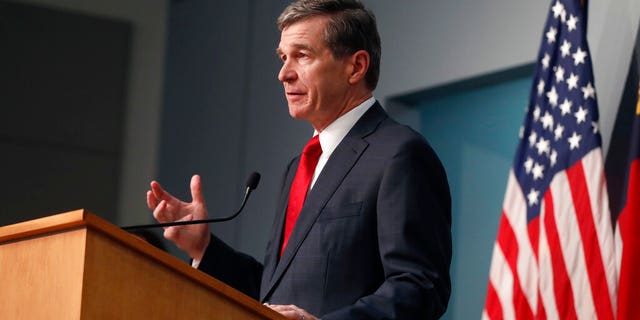
North Carolina Gov. Roy Cooper speaking in Raleigh on Tuesday. (Ethan Hyman/The News & Observer via AP)
Wednesday was the GOP's deadline for assurances from
Cooper. Last week, Trump demanded Cooper that guarantee him a full-scale
event or he would be forced to move the event elsewhere. North
Carolina faces an upward trend in its virus cases, reporting about
29,900 cumulative cases and 900 deaths as of Tuesday. Around 700
COVID-19 patients are currently hospitalized. Mecklenburg County
accounted for 4,500 cases — more than double the next-highest county —
and nearly 100 deaths. Earlier in the day, North Carolina GOP
Chairman Michael Whatley acknowledged some changes would likely be
needed, but maintained Republicans want a “full-scale” convention. “Look,
we’re not going to move forward with any activities that do not follow
federal, state or local requirements and regulations. So, we need to
know what those requirements are going to be,” he said. This
is a developing story. Check back soon for updates. Fox News' Brooke
Singman and The Associated Press contributed to this report.
More than 1,000 protesters gathered Tuesday outside the Getty House in Los Angeles, which serves as the residence of Mayor Eric Garcetti. The crowd appeared to remain peaceful, with no reports of vandalism or looting in the immediate area, as demonstrations following the May 25 death of George Floyd in Minneapolis continued across the U.S., FOX 11 of Los Angeles reported. “It’s a Black Lives Matter thing,” one protester told FOX 11.
“It’s not to get confused; it’s not us versus you, it’s not white
versus black. It’s a lot of our people versus bad cops. We understand
there’s good cops but there’s a lot of bad cops and it’s not a job that
can have bad cops.”
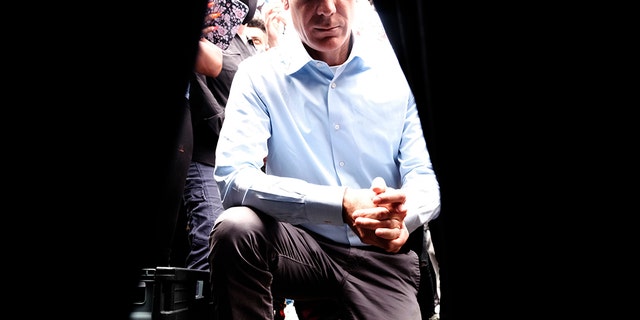
Joined by community faith leaders Los Angeles Mayor Eric Garcetti
takes a knee in prayer during a Black Lives Matter protest in downtown
Los Angeles on Tuesday, June 2, 2020. (Associated Press)
After the protest was already underway, Garcetti made some remarks at an evening news conference at City Hall. “I
hear you that this isn’t just about the criminal justice system. This
is also about society and where we put out resources,” Garcetti said,
according to KTLA-TV of Los Angeles. Also appearing at the
briefing was Davion Pilgrim, 16, a student from Morningside High School
in Inglewood, who was recently stopped by police, and racially and
criminally profiled. “I was accused of being associated with a gang and that really hurt, because that’s not me,” Pilgrim said, according to KTLA. “We want to make sure that what happened to George Floyd does not ever happen to someone who looks just like me.” Earlier in the day, Garcetti appeared at a protest outside Los Angeles police headquarters, where he kneeled in solidarity with the protesters. “I hear you. I hear what you are saying about the police,” the Democrat said. The
protest at the mayor’s residence came one day after a previous news
conference in which Los Angeles police Chief Michel Moore drew criticism
for claiming protesters shared in the blame
for the death of Floyd, the Minneapolis man who died in police custody,
sparking a weak of protests, rioting and looting throughout the U.S. Moore
apologized soon after making the remarks – but Garcetti, who appeared
at the same news conference, faced calls to fire Moore and resign from
office himself. Fox News’ Nick Givas contributed to this story.
The statement by President Trump that the United States will designate Antifa
as a terrorist group is an important one. The biggest reason is they
are one, so we can now properly frame their actions. But there are
other advantages both in preventing more attacks and catching and
punishing the perpetrators. Their actions fit the definition of terrorism as I pointed out in this piece calling for this designation: “The president’s accurate description of Antifa fits the definition under
federal law of a domestic terror group. Under that definition, such a
group breaks laws ‘to intimidate or coerce a civilian population’ or to
‘influence the policy of a government by intimidation or coercion.’” Most
of the hardcore activists wouldn’t even argue with the description or
the goals, but previously they were dealing with a much smaller
potential downside. Now the array and severity of crimes and especially
punishments just jumped exponentially. Many of these wannabe
revolutionaries are willing to spend a night in jail, but how many are
willing to do 20 years in prison. The immediate effect will be to
change the dynamic for the radical Left and their “Burn it all down”
wing and create a real deterrent. They have been free to commit
vandalism escalating up to violent acts and turn their protests into
riots because even if they were caught the local charges were usually
minor. This
will help slow their ability to grow a pack of angry activists into a
howling mob burning buildings, beating bystanders and even killing
people. They rely on riding along with the other radical Left activist
groups who are all too happy to have them do the dirty work. But if
those groups risk being swept up for supporting terror, they are much
less likely to tolerate Antifa & friends in their midst. It will
also make the college student adventure activists wary and the folks
just out for a quick looting consider whether a flat-screen is worth
doing real time. Those are real benefits and should not stop
anyone who wants to peaceably assemble and petition their government for
a redress of grievances. But it will serve as a reminder the word
“peaceably” is in there for a reason.
Another major damage the designation has on their efforts is the prohibition of financing and material support for terrorism.
This
won’t deter the diehards who believe rioting is just a warm-up. They
will be targets of the increased law enforcement and surveillance powers
enabled by the terror designation. This is important due to the very
nature of an anarchistic movement like Antifa. They don’t organize as
much as they flock together in common cause. That makes identifying,
tracking and catching them difficult. A whole
array of online surveillance and nationwide warrant capabilities allow
our federal law enforcement agencies to watch and identify their members
and plans as well as gather evidence if crimes have already been
committed. Without the designation the diffuse nature of Antifa makes it
very tough to jump through all the hoops needed to make this happen. Another
major damage the designation has on their efforts is the prohibition
of financing and material support for terrorism. While Antifa operations
are not particularly high budget, they do cost money and require some
types of expertise. Anyone providing that type of support will now find
themselves in jeopardy. Antifa and other radical left
organizers often pay protesters. Drying up that funding stream and
ensuring other groups sympathetic to their cause can’t financially
support them will severely hamper their efforts. One
more positive aspect of this action is to show the vast majority of
people in this country that this type of terror against them and their
livelihoods will not be tolerated. The avowed goal of Antifa and the
other radicals with these riots is to create fear and force changes that
will appease the attackers. The governors and mayors have the
still difficult task of reining in the current violence. This action by
the president will make it less likely another one will happen, or if it
does, that those responsible pay a heavy price.
The thug disguised as a Minneapolis police officer who is charged with third-degree murder in the death of George Floyd does not speak for me.
The rioters
on the streets of dozens of American cities,
destroying valuable property, from shopping malls to synagogues, also do
not speak for me. So who does? I am not a racist and neither are most Americans or most police officers. I am not a destroyer of property and neither are most Americans. Chances
are, you are just as appalled by what happened in Minneapolis, and what
has happened in American cities and in some other places around the
world, as I am.
So who speaks for us? I resent the implication that if I’m not torching police cars, I am condoning the actions of a bad cop. I equally resent the implication that my attitudes toward race can be divined simply by looking at the color of my skin. When it comes to race, it seems that we Americans have lost the plot. There
was a time, not that long ago, when we had begun to move toward a
society where people judged each other as individuals, by the content of
their character, in Dr. Martin Luther King Jr.’s words. And
somehow that morphed into a new kind of racism, where assumptions are
made that if you’re white, you think this way, if you’re black, you
think that way, if you’re straight, if you’re gay, and so on. What happened?
When
did we move from striving for color-blindness to living in a world
where color and other forms of identity trump individual thinking? The academy and social media deserve much of the blame. College
students are being taught to see life through a prism of race,
gender and sexuality, as if you could define a human being in all of his
or her complexity by a few key tests. You can’t. You can’t shorthand people. And
yet, my visits to college campuses over the last 10 years have
indicated that the progressive movement has taught the young to view
themselves and others almost entirely in terms of race, sexual identity,
and so on. We used to be people.
Now we’re categories. And
then what kids learn in college makes its way into the workplace, as
they graduate and get jobs, and then into the culture, through
the shorthanding of ideas that occurs in social media.
In
the musical "South Pacific," there was a groundbreaking song about
racism called “You’ve Got To Be Carefully Taught.” In other words,
racism and hatred are not built into us from birth.
All that gets amplified by progressive politicians who play the shame and blame game to accumulate more power and prestige. And
now we live in a world where interactions between people of different
opinions, colors, religions or lack thereof, and sexual identity are
rooted in distrust, cynicism and outright hatred. In the musical "South Pacific," there was a groundbreaking song about racism called “You’ve Got To Be Carefully Taught.” In other words, racism and hatred are not built into us from birth. They are learned behaviors.
And
in my lifetime, we recognized the folly of such bigoted thinking and we
began to move toward a society where people were accepted as
individuals and not judged as members of groups. A far-from-perfect society, but a better society. As Dr. King said, the arc of the moral universe is long, but it bends toward justice. And then things went the other way. The thug in a cop’s uniform who has been charged with murder was likely taught to believe certain things about race. The
thugs in expensive jeans and designer tops rampaging through our cities
and destroying parts of an already fragile economy were carefully
taught that annihilation and rage are appropriate responses to behavior
of which they disapprove. Neither of those kinds of people speaks for me.
Or, I would think, for you. Or for who we are trying to be, fitfully, agonizingly, as a just society. I am not a racist, or one who condones rogue cops or rioters. They are not America. This is not a society of blind hate. We have come too far.
We took a wrong turn. We sent
our children to college, and the progressive movement that controls
thought on college campuses carefully taught our children to hate. And now we are reaping that whirlwind.
This is a heartbreaking time for our country, and journalists are caught squarely in the middle. In
covering the riots that have gripped cities across the country, they
have been arrested, assaulted and shot, in some cases seemingly targeted
by aggressive police tactics and in others besieged by angry
protesters. I don’t expect much sympathy for my much-maligned
profession, but it’s a reminder that many journalists don’t just sit in
climate-controlled studios, and a reflection of the broader fissions in
our society. At the same time, the media’s relentless focus on
President Trump has cast him as essentially missing in action during
this crisis, which may have prompted him--four hours after his press
secretary said there was no need for a speech--to make a Rose Garden
statement last night. And by declaring “I am your president of law
and order,” he followed the Nixon playbook of 1968 and sought to make
violent protest, not police brutality, the dominant issue in this
election year. On the metaphor front, journalists seized on the
president retreating to an underground bunker while rock-throwing
protesters gathered strength outside the White House, which is unfair
because the Secret Service made that call. In the wake of the
brutal killing of George Floyd in Minneapolis, pundits and politicians
have been faced with the dual challenge of grappling with the black
community’s anger and frustration while cracking down on the violence
and lawlessness that obscures that cause. When
Omar Jiminez, a black reporter for CNN, was arrested by Minnesota state
police despite repeatedly offering to move, it was an outrage that led
Gov. Tim Walz to apologize to the network. MSNBC anchor Ali Velshi and
correspondent Garrett Haake have both been struck by rubber bullets.
Police in numerous instances have either been reckless or antagonistic
when it comes to journalists who are trying to cover the urban chaos. Another
victim in Minneapolis, Linda Tirado, a freelance photographer and
activist, was shot in the left eye and says she has permanently lost
vision in that eye. On the other side, protesters smashed windows
and defaced the famous red logo at CNN headquarters in Atlanta. In
Washington, protesters threw punches and bottles as they chased a Fox
News crew before the journalists found a police cruiser, a situation
that anchor Leland Vittert compared to his coverage of Egypt’s Tahrir
Square uprising. In Pittsburgh, KDKA photojournalist Ian Smith was
brutally beaten by demonstrators and said another group saved his life
by pulling him to safety. Even the harshest critics of the media
should decry these abominable tactics by both the police and the
protesters, though in fairness the cops are often overwhelmed and
numerous officers have been injured in the riots. As for the coverage, a Washington Post news
story said yesterday: “Never in the 1,227 days of Trump’s presidency
has the nation seemed to cry out for leadership as it did Sunday, yet
Trump made no attempt to provide it. “That was by design. Trump
and some of his advisers calculated that he should not speak to the
nation because he had nothing new to say and had no tangible policy or
action to announce yet, according to a senior administration official.
Evidently not feeling an urgent motivation Sunday to try to bring people
together, he stayed silent.” “Privately,” says the New York Times,
“advisers complained about his tweets, acknowledging that they were
pouring fuel on an already incendiary situation.” These included the
missive about “when the looting starts, the shooting starts,” which
Trump later clarified by saying he meant people in the crowds could be
hurt. Now
it’s no secret that the president has struggled in the area of race
relations. There was Charlottesville, of course, and his
back-where-they-came-from tweets about members of the Squad, and
denigrating Baltimore as “a rat and rodent infested mess.” Trump
also has an instinct to rally his side against the other side, which
makes it harder to unite the country. He blamed Democrats when the
pandemic exploded and blamed Democratic mayors and governors for not
controlling the urban violence. In fact, he told governors on a
conference call yesterday that most of them are “weak” and “you have to
dominate or you’ll look like a bunch of jerks.” He has blamed the media on both fronts as well. And in the past week he has gone after China, the WHO and Joe Scarborough. But
there is a level on which the president is getting a bum rap. He said
right away he was shocked by the video of Floyd being killed by an
officer’s knee pressing against his neck for nine minutes. At the
SpaceX launch in Florida on Saturday, Trump called Floyd’s death “a
grave tragedy. It should never have happened. It has filled Americans
all over the country with horror, anger and grief.” Those remarks got
little attention. In the same comments, Trump said he was allied
with people seeking justice and peace, but opposed to “anyone exploiting
this tragedy to loot, rob, attack, and menace.” But the president
was all tough talk last night, with just a nod to peaceful protest, in a
split-screen moment when riot police stood guard at Lafayette Park
across from the White House. He railed against “professional
anarchists,” Antifa and “violent mobs,” spoke of innocent people being
killed and the capital’s monuments defaced. “These are acts of domestic
terror,” he declared, “a crime against God,” and vowed to deploy the
military. Donald Trump had chosen his side. Any public official,
Democrat or Republican, has to take the stance that what happened to
Floyd is reprehensible but that lawlessness is unacceptable. At the
moment, the violence from New York to Philadelphia to Minneapolis to
Santa Monica is overshadowing the cause that the protesters profess to
embrace. The looting and the fires and the rock-throwing do more
than jeopardize the safety of journalists and of community residents;
they change the national subject from police brutality to law and order.
And, as happened after the 1968 riots, that can cause a political
backlash that can last for years.