Attorney
General Bill Barr told Fox News' Bret Baier in an exclusive interview
aired Tuesday that Americans will be able to recognize "some" of the
names under investigation as part of U.S. Attorney John Durham's ongoing
probe into federal surveillance abuses -- and that he is "very
troubled" by "what has been called to" his attention so far. Barr
asserted that despite the coronavirus pandemic, the Durham team "has
been working very aggressively to move forward," and that there "will be
public disclosure" of his findings. Part one of Baier's interview with Barr aired on Monday. "I
think before the election, I think we're concerned about the motive
force behind the very aggressive investigation that was launched into
the Trump campaign without, you know, with a very thin, slender reed as a
basis for it," Barr told Baier. "It seemed that the bureau was sort of
spring-loaded at the end of July to drive in there and investigate a
campaign." The Justice Department's (DOJ's) watchdog has
identified critical errors in every FBI wiretap application that it
audited as part of the fallout from the bureau's heavily flawed investigation into former Trump adviser Carter Page, who was surveilled during the campaign in part because of a largely discredited dossier funded by the Hillary Clinton campaign and the Democratic National Committee (DNC). Additionally, an ex-FBI lawyer in that case even falsified a
CIA email submitted to the Foreign Intelligence Surveillance Act (FISA)
court in order to make Page's communications with Russians appear
nefarious, the DOJ inspector general found. The FBI lawyer, Kevin Clinesmith,
was allegedly told by the CIA that Page had reported his Russian
contacts and was essentially acting as an informant -- only for
Clinesmith to allegedly omit that exculpatory information in a
surveillance warrant application that framed Page's communications with
Russians as a sign that he was a secret foreign agent. Barr said
he couldn't comment on whether criminal charges were coming, including
concerning Clinesmith -- but that people shouldn't become impatient. The
DOJ has concluded that the Page warrant was legally improper and lacked probable cause.
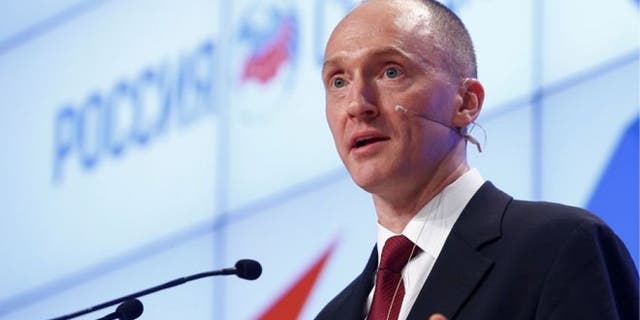
Carter Page, one-time adviser to then-candidate Donald Trump,
addresses the audience during a presentation in Moscow, Russia, December
12, 2016.
(Reuters)
"We can't discuss future
charges. But I have to say that I do find a little irritating," Barr
said. "You know, the propensity in the American public on all sides of
the political spectrum when they see something they think could be a
criminal violation, I say, why hasn't this person been indicted again?
And, you know, there's the old saying that that the wheels of justice
grind slow and they do run slow because we have due process and we
follow the process. But people should not draw from the fact that no
action has been taken that taken yet, that that means that people or
people are going to get away with wrongdoing." The attorney general emphasized, however, that he wasn't concerned about criticisms of the Durham probe in an election year. "For
the first time in American history, police organizations and the
national security organizations were used to spy on a campaign, and
there was no basis for it," Barr said. "The media largely drove that --
and all kinds of sensational claims were being made about the president
that could have affected the election. And then and then later on, in
his administration, there were actions taken that really appear to be
efforts to sabotage his campaign. And that has to be looked at. And if
people want to say that I'm political because I am looking at those
potential abuses of power, so be it. But that's the job of the attorney
general." Internal FBI documents unsealed in April indicate that Peter Strzok -- the now-disgraced anti-Trump
former head of FBI counterintelligence -- ordered the investigation
of former national security adviser Michael Flynn to remain open even
after it was slated to be closed due to a lack of so-called "derogatory"
information.
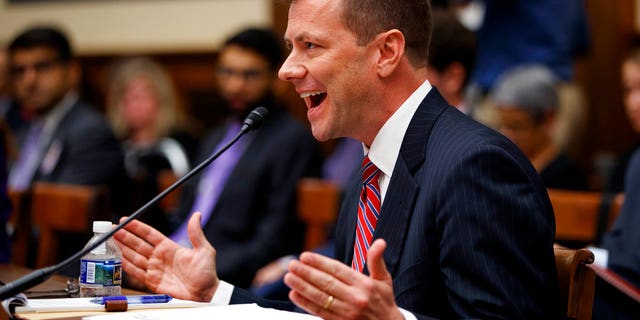
FBI Deputy Assistant Director Peter Strzok, testifies before a
House Judiciary Committee joint hearing on "oversight of FBI and
Department of Justice actions surrounding the 2016 election" on Capitol
Hill in Washington, Thursday, July 12, 2018. (AP Photo/Evan Vucci)
(Copyright 2018 The Associated Press. All rights reserved.)
The materials surfaced just a day after explosive FBI communications revealed that top bureau officials discussed their motivations for interviewing Flynn in the White House on Jan. 24, 2017 -- and openly questioned if their "goal" was "to get him to lie, so we can prosecute him or get him fired." Top Republicans, meanwhile, have accused FBI
Director Christopher Wray of ignoring their May 4 letter seeking
information and interviews with key FBI officials in the Flynn case -
prompting the lawmakers to take matters into their own hands. "Because Director Wray has declined to respond to our request, we are forced to write to you directly," Reps. Jim Jordan, R-Ohio, and Mike Johnson, R-La., wrote in an extraordinary letter last month to FBI agent Joe Pientka, who participated in the unusual January
24, 2017 White House interview that led to Flynn's prosecution for one
count of making false statements to the FBI. The lawmakers requested
Pientka sit for a transcribed interview with the Judiciary Committee. Fox News previously determined that Pientka also was intimately involved in the Carter Page probe, which the DOJ has since acknowledged was riddled with fundamental errors and premised on a discredited dossier that the bureau was told could be part of a Russian disinformation campaign. Pientka was removed from the FBI's website after Fox News contacted the FBI about his extensive role in Crossfire Hurricane FISA matters -- a change first noticed by
Twitter user Techno Fog -- but sources said Pientka remained in a
senior role at the agency's San Francisco field office. The FBI told Fox
News shortly before Pientka's removal from the website that reporting
on his identity could endanger his life, even though he serves in a
prominent senior role at the bureau. "They seem to have ignored
all the exculpatory evidence that was building up and continued
pell-mell to push it forward," Barr told Baier. "So that's one area of
concern."
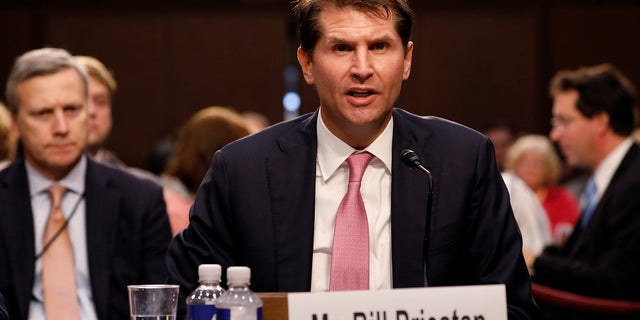
In this July 26, 2017 photo, Bill Priestap, assistant director of
the FBI's Counterintelligence Division, testifies during a Judiciary
Committee hearing into alleged collusion between Russian and the Trump
campaign.
(Reuters)
Barr also slammed Judge Emmet Sullivan for trying to become an "alternative prosecutor" in the Flynn case. The D.C. Circuit Court of Appeals will hear oral arguments
in the case on Friday, after Flynn's lawyer Sidney Powell said it was
unconstitutional for Sullivan to keep the case alive even though both
the prosecution and defense want it dismissed. The DOJ has accused Sullivan of usurping the executive branch's constitutional prosecutorial discretion. Brandon
Van Grack, a top Justice Department prosecutor and former member of
Special Counsel Robert Mueller's team, withdrew from the Flynn case in
May. His departure came just days after Fox News reported that the explosive, newly unsealed evidence documenting
the FBI's efforts to target Flynn called into question whether Van
Grack complied with a court order to produce favorable evidence to
Flynn. Just minutes after Van Grack exited, the DOJ announced it was seeking to drop the Flynn case entirely.
That came on the recommendation of U.S. Attorney Jeff Jensen, who
served as an FBI agent for more than a decade and had been evaluating
the Flynn case. "The
other area of concern is that after the election, even though they were
closing down some of that, as we've seen in the Flynn case, and say
there's nothing here, for some reason, they went right back at it, even
at a time where the evidentiary support or claim support like the
dossier was falling apart," Barr said. "And it's very hard to understand
why they continued to push and even make public testimony that they had
an investigation going when it was becoming painfully obvious or should
have been obvious to anyone that there was nothing there." Barr
said that the DOJ was "looking at" names that some might recognize --
although not at the level of Joe Biden or Barack Obama.
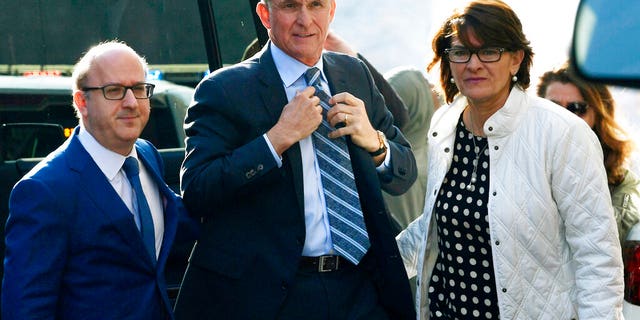
FILE - In this Dec. 1, 2017, file photo, Michael Flynn, center,
arrives at federal court in Washington. A judge set a sentencing hearing
for Michael Flynn after rejecting arguments from the former Trump
administration national security adviser that prosecutors had withheld
evidence favorable to his case. (AP Photo/Susan Walsh, File)
The DOJ, Barr added, was also taking a look at requests by several Obama administration officials -- including Biden and Obama's chief of staff -- to obtain the identity of an individual who turned out to be Flynn through a process known as "unmasking." The
process ordinarily begins when a U.S. citizen's communications with a
foreign adversary are intercepted by U.S. intelligence. Limited numbers
of U.S. officials can then request the identity of the U.S. citizen,
which is normally shielded for privacy reasons. Flynn was unmasked by a
slew of Obama administration officials, and news of his calls with
Russian officials immediately leaked to the news media, furthering Russia collusion narratives. A transcriptunearthed by Fox News
indicates that The Washington Post’s newsroom was deeply divided over
whether it was even worth reporting that Flynn was speaking to Kislyak
in December 2016 -- before the Post published details in a column from
an opinion writer who “was able to just throw this piece of red meat out
there.” OBAMA KNEW DETAILS OF WIRETAPPED FLYNN CALLS, STUNNING DOJ "You
know, unmasking is not by itself illegal, but the patterns of unmasking
can tell us something about people's motivations at any given point of
time," Barr said. "So we're trying to take a look at the whole
waterfront on unmasking what was done, especially in 2016." Obama
was aware of the details of Flynn's intercepted December 2016 phone
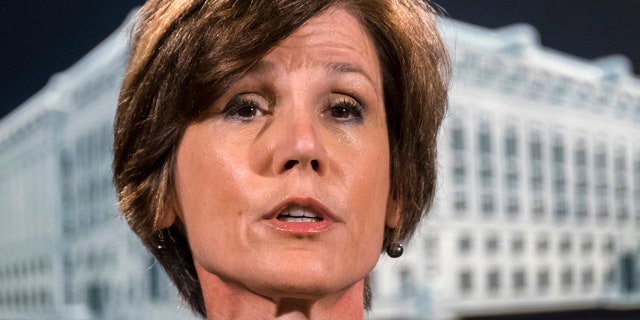
calls with Kislyak, apparently surprising then-Deputy Attorney General Sally Yates, according to documents released as exhibits to the government's motion to dismiss the Flynn case.
Sally Yates was removed from her position as acting attorney
general after she refused to enforce President Donald Trump's travel
ban.
(AP Photo/J. David Ake)
Obama's unexpectedly intimate knowledge of the details of Flynn's calls, which the FBI acknowledged at the time were not criminal or even improper, raised eyebrows because of his own history with Flynn -- and because top FBI officials secretly discussed whether their goal was to "get [Flynn] fired" when they interviewed him in the White House on Jan. 24, 2017. Obama personally had warned the Trump administration against hiring Flynn, and made clear he was "not a fan," according to
multiple officials. Obama had fired Flynn as head of the Defense
Intelligence Agency in 2014; Obama cited insubordination, while Flynn
asserted he was pushed out for his aggressive stance on combating
lslamic extremism. "I mean, for example, let's say suppose for a
period in the spring, there was a lot of heavy unmasking done on people
involved with the Trump campaign," Barr added. "That would be very
relevant as to what people were thinking at that time and what their
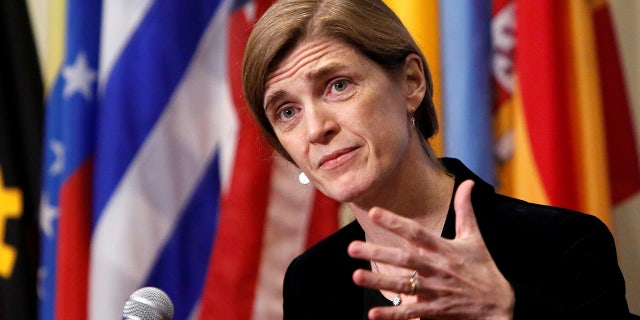
motivations were." Former U.S. ambassador to the United Nations Samantha Powersought to obtain Flynn's redacted identity on at least seven occasions, according to newly declassified list of names from the intelligence community -- even though Power testified under oath before the House Intelligence Committee that she had “no recollection” of ever making such a request even once. The records raised new concerns over exactly who might have leaked details of the Flynn investigation to The Washington Post in January 2017. That
leak apparently was illegal, given national security laws and the
classified nature of the Flynn probe. In early January 2017, President
Obama loosened rules
governing the sharing of intelligence information within the federal
government -- which Trump attorney Jay Sekulow said was intended to
"pave the way for a shadow government to leak classified information"
more easily.
Former U.S. ambassador to the United Nations Samantha Power wrote a
book review this week outlining how Major League Baseball can be saved
in the "Age of Distraction."
(Reuters)
And, the breadth of unmasking
requests relating to Flynn was striking enough to prompt questioning in
congressional hearings. According to the documents, Power may have
received Flynn’s identity after an unmasking request on Nov. 30, 2016;
Dec. 2, 2016; Dec. 7, 2016; Dec. 14, 2016 (two unmasking requests); Dec.
23, 2016, and Jan. 11, 2017. The list does not make clear whether Power, or other named officials, actually received the identity they sought to unmask. “The
number of unmasking requests by yourself began to go up dramatically in
2014,” House Intelligence Committee Chairman Adam Schiff, D-Calif.,
told Power, as noted by The Federalist's Sean Davis. According to transcripts of her testimony released
last month after Republicans demanded them, Power claimed: “Any time a
U.S. person or entity's name came to me disclosed or annotated, or where
I requested it and it came back, I never discussed it with another
member of the human race. ... I have no recollection of making a request
related to General Flynn.” Power added, “I have never leaked
classified information. .. I have never leaked names that have come back
to me in this highly compartmented process. I have, in fact, never
leaked, even unclassified information.” At the same time, Power acknowledged she had a “significant appetite for intelligence.” As if to prospectively assuage any concerns of impropriety, former national security adviser Susan Rice sent an email to herself on Jan. 20, 2017,
the day of Trump's inauguration, stating multiple times that Obama
wanted everything done "by the book" concerning Flynn. Republicans called the strange email an obvious attempt by Rice to cover herself politically. "I mean, it’s the most bizarre thing I’ve read," former House Oversight Committee Chairman Trey Gowdy told Fox News. "It is, ‘Dear Diary, President Obama is perfect and Jim Comey says he’s done everything by the book.’ Well, I’d like to know what book he's following."
The
transformation of journalism that began with the political birth of
Donald Trump has exploded into a full-blown crisis with the death of
George Floyd. It is, and I don’t say this lightly, a battle for
the soul of the profession. And if you take a snapshot of this moment,
those who believe in the old-fashioned notions of fairness and balance
are losing. That’s why the editorial page editor of the New York
Times was forced out, that’s why the editor of the Philadelphia Inquirer
was forced out, and that’s why a vast swath of this country no longer
trusts the media. It’s
easy to understand why black journalists, who a generation ago didn’t
get to run papers like the Times or anchor many television shows, are
filled with anger and passion over the systemic racism that showed its
ugly face with Floyd’s killing. And having reported on civil rights,
affirmative action and other issues for many years, I’ll readily concede
that the white media power structure covered these issues sporadically
and didn’t fully grasp the depth of frustration in the black community. But
a dangerous trend began when Trump ran for president, and it’s no
accident that his views on immigration and other social issues were
viewed by detractors as either flirting with racism or the real thing.
Media critics began to write, and this intensified when he got to the
White House, that perhaps journalists had a higher duty to oppose him,
that just-the-facts reporting was now obsolete. With their
overwhelmingly negative coverage and caustic commentary, from a slew of
scandals and controversies to impeachment and the coronavirus, the media
increasingly came to be seen as part of the resistance. The culture
rewarded their increasingly anti-Trump stance, which is shared by
academics, entertainers and late-night comics. And these journalists
would reassure themselves that this president is such an authoritarian
figure, such a threat to democracy, that history demanded they toss out
the old rulebook. In the process, the roughly 40 percent of the
country that supports Trump came to view the mainstream media as an arm
of the Democratic Party. And the president was more than happy to
demonize the business with his enemy-of-the-people rhetoric, fueling the
us-versus-him atmosphere. Now we're hearing many of the same
arguments after nearly two weeks of nationwide protests, sometimes
violent, even as four Minneapolis police officers have been charged in
Floyd’s death. No responsible journalist supports racism or police
brutality, but the sentiment that carried the day at the Times is that
contrary opinions about handling the protests, such as that of
Republican Sen. Tom Cotton, simply can’t be published because they hurt
the cause. James Bennet was ousted as the Times editorial page
editor after he and Publisher A. G. Sulzberger eloquently defended the
need to run contrary opinions such as Cotton’s, even if they are deemed
“painful” or “dangerous,” as Bennet put it. They were right. But
Sulzberger reversed himself under intense pressure from black and other
staffers who denounced what was an online-only column by a United States
senator who said the military could be brought in if urban riots were
out of control. I don’t necessarily agree, but it's not a fringe view by
a fringe figure. At the Inquirer, Executive Editor Stan
Wischnowski was pushed out after a 20-year career over an admittedly
insensitive headline -- “Buildings Matter, Too” -- despite a quick and
fulsome apology by the paper. The Inga Saffron column, while saying that
black anger was justified after 400 years of oppression in America,
argued that the destruction of downtown property would also permanently
scar the city. Protesting
staffers wrote, and this is telling: “We’re tired of being told to show
both sides of issues there are no two sides of.” Ben Smith, in a thoughtful Times column,
says America’s biggest newsrooms “are trying to find common ground
between a tradition that aims to persuade the widest possible audience
that its reporting is neutral and journalists who believe that fairness
on issues from race to Donald Trump requires clear moral calls.” That’s
the heart of the issue. “Moral calls” is a euphemism for political
judgments, for taking a stand, for deciding which opinions are
acceptable and which must be excluded. Smith goes on to say that
“the shift in mainstream American media — driven by a journalism that is
more personal, and reporters more willing to speak what they see as the
truth without worrying about alienating conservatives — now feels
irreversible. It is driven in equal parts by politics, the culture and
journalism’s business model, relying increasingly on passionate readers
willing to pay for content rather than skittish advertisers.” That
candid admission reveals how high the stakes are. Perhaps, in this
hyperpolarized era, news outlets can no longer sell themselves as
objective arbiters and taking sides rings the cash register. But then
it’s time to admit they are taking sides and drop the fig leaf of
objectivity. Bennet, a smart journalist and former Atlantic
editor, didn’t help himself by failing to read the Cotton piece in
advance. And Sulzberger made clear to his paper that the resignation wasn’t voluntary. “We
saw a significant breakdown in our editing processes, not the first
we’ve experienced in recent years,” he said. “Both of us concluded that
James would not be able to lead the team through the next leg of change
that is required.” After Sulzberger initially defended the
publication of Cotton’s online-only column, he used various rationales
to explain why the paper was now denouncing it. One was that there were
factual problems, although Cotton’s staff went through three drafts and
questions that included fact-checking. The next was that its tone was
“needlessly harsh.” Would the same standard apply to the
subsequent Bret Stephens column, “Donald Trump Is Our National
Catastrophe”? Or to the subsequent Michelle Goldberg column,
“Tom Cotton’s Fascist Op-Ed”? An argument by a United States senator
that has majority support in the polls is now fascism? Or is the
harshness label only slapped on columns that challenge the Times
orthodoxy? In her piece, Goldberg wrote that “there’s generally no
way to defend the administration without being either bigoted or
dishonest.” There you have it: there is no other side but the anti-Trump
side, at least none that should be deemed fit to print. News
organizations have to choose whether they want to win back the
confidence of the entire country or only publish material that appeals
to the woke crowd. The racial tensions that have gripped the country
turn on matters of life and death, and that put a harsh spotlight on how
journalists are defining their future. The pretense isn’t working
anymore.
President Trump
will resume hosting campaign rallies sometime in the next two weeks,
returning one of the president's most potent weapons to his arsenal as
the 2020 campaign season enters a pivotal stretch, Fox News is told. Trump
had suspended the rallies, which energize his base and allow his team
to collect a treasure trove of voter data, in early March amid the coronavirus pandemic. “Americans
are ready to get back to action and so is President Trump," Trump
campaign manager Brad Parscale told Fox News. "The Great American
Comeback is real and the rallies will be tremendous. You’ll again see
the kind of crowds and enthusiasm that Sleepy Joe Biden can only dream
of.” As late as March 9, Anthony Fauci, the director of the National Institute of Allergy and Infectious Diseases, remarked that going to campaign rallies may not be a bad idea. "You
know, I can’t comment on campaign rallies," Fauci told reporters. "It
really depends. We are having as we all said — this is something in
motion. This is an evolving thing. ... If you want to talk about large
gatherings in a place you have community spread, I think that’s a
judgment call, and if someone decides they want to cancel it, I wouldn’t
publicly criticize them." Days later, the president pulled the
plug. “I’m not going to do it if I think it’s going to be negative at
all,” Trump said. “I don’t want people dying.”
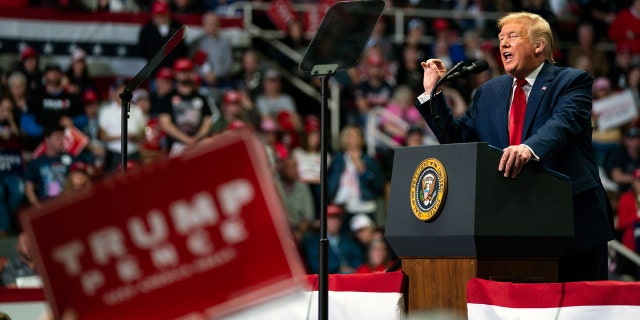
President Donald Trump speaks during a campaign rally at Bojangles
Coliseum, Monday, March 2, 2020, in Charlotte, N.C. (AP Photo/Evan
Vucci)
Monday's announcement that the rallies would resume comes as some polls show the president's support significantly trailing rival Joe Biden. “CNN
Polls are as Fake as their Reporting,” Trump tweeted early Monday.
“Same numbers, and worse, against Crooked Hillary. The Dems would
destroy America!” The change-up also follows statements by many Democrats in charge of big cities --
including several who once insisted on strict quarantine measures --
championing the nationwide mass demonstrations over the in-custody death
of George Floyd, sans social distancing. Epidemiologists, too, have abruptly changed their tune,
even though they once said lockdown measures were so important that
they justified widespread unemployment and business closures. "We
spent the last couple of months being hectored by public health experts
and earnestly righteous media personalities who insisted that easing
lockdown policies was immoral, that refusing to social distance or wear
masks was nigh upon murderous," Jonah Goldberg wrote
for the G-File. "They even suggested that protests were somehow
profane. But now that the George Floyd protests are serving as some kind
of Great Awokening, many of the same are saying 'never mind' about all
of that. Protests aren’t profane, they’re glorious and essential—if they agree with what you’re protesting about." More and more states
are now reopening pursuant to federal guidelines and local leaders'
assessments, and the nonenforcement of quarantine measures during the
Floyd protests has left governors with little room to argue for
extending the lockdowns. Nevertheless, the left-wing taxpayer-funded radio station NPR ran a story late Monday suggesting that the rallies will be dangerous. NPR did not indicate that the Floyd protests would be dangerous in posts covering those demonstrations. Prior
to suspending rallies in March, the Trump campaign had previously been
eyeing, but had not yet announced, a rally in Tampa, Florida, on March
25. The
massive events are often an opportunity for Trump to hone attack lines
against his opponents -- but also present chances for them to hit back.
At a campaign rally in late February, for example, Trump calls
Democrats' criticisms of his coronavirus response "their new hoax." Biden and other Democrats then falsely accused Trump of calling the virus itself a hoax. Several fact-checkers, including The Washington Post, make clear that Trump was referring to the Democrats' response to the virus. The Associated Press contributed to this report.
Donald Trump Jr. on Monday called out Democrats looking to defund police departments in the wake of George Floyd protests should start by cutting their own security detail. Trump
said that the entire country has called for the end of police brutality
but said calls to cut funding for police departments would do little to
stop abuses and would make the most vulnerable communities more
vulnerable. “Will those same anti-cop Dems call for their security details to be cut?” Trump asked. Democratic leadership in the House and Senate on Monday unveiled legislation
that would increase the accountability of police officers and remove
immunity from legal consequences stemming from acts committed in the
line of duty. But came up short from calling for police departments to
be defunded. Reps. Alexandria Ocasio-Cortez and Ilhan Omar have been two vocal advocates to take drastic action. Ocasio-Cortez, D-N.Y., told
Spectrum News 1 that some of the NYPD's $6 billion in annual funding
should be redirected to address systemic racism. She said the $6 billion
budget for the city police “costs us books in the hands of our children
and costs us very badly needed” investment in public housing. Omar,
D-Minn., took it a step further and said that the Minneapolis Police
Department is “rotten to the root” and should be dismantled. She called
the department a cancer that needs to be amputated so it does not
spread, the New York Post reported. Key Democrats, including presumptive presidential nominee Joe Biden, are distancing themselves from the “defund” push. “I
don’t support defunding the police. I support conditioning federal aid
to police based on whether or not they meet certain basic standards of
decency, honorableness and, in fact, are able to demonstrate they can
protect the community, everybody in the community,” Biden told “CBS
Evening News” on Monday. Floyd, a handcuffed black man, died May
25 after a white police officer pressed his knee into his neck for
several minutes even after he stopped moving and pleading for air. His
death set off protests, some violent, in Minneapolis that swiftly spread
to cities around the U.S. and the globe. Derek Chauvin, a former
Minneapolis police officer charged with second-degree murder, appeared
in court Monday and Hennepin County Judge Jeannice M. Reding raised his
bail from $500,000 to $1 million Last week, Los Angeles Mayor Eric
Garcetti said that he tasked the city to “identify $250 million in
cuts” to invest more money into the black community, communities of
color, women and “people who have been left behind." “It’s time to
move our rhetoric towards action to end racism in our city,” he said,
according to Deadline. “Prejudice can never be part of police work…It
takes bravery to save lives, too.” House Speaker Nancy Pelosi,
D-Calif., and Senate Minority Leader Chuck Schumer, D-N.Y., were asked
by a CNN reporter if they supported the movement to defund the police
entirely. “That’s a local decision,” Pelosi said. Fox News' Brooke Singman and the Associated Press contributed to this report
Former Acting Director of National Intelligence Richard Grenell told "Tucker Carlson Tonight" Monday
that his time in the Trump administration has shown him that the great
political struggle is no longer between Republicans and Democrats, but
between the District of Columbia and the rest of the U.S. In his
first TV interview since leaving the administration, Grenell explained a
tweet he posted Saturday in response to criticism of Trump from former
Defense Secretary James Matts. "The fact of the matter is,"
Grenell said, "we have a real problem in Washington, D.C., because it’s
a system that it no longer is Republicans and Democrats pushing against
each other to create good policy. It’s a fight between Washington and
the rest of America." "What we have [is] a system in Washington
where people get jobs if you're there, if you know someone and you work
your way up, and it’s like musical chairs from one agency to another,"
Grenell added. "There is no outside thought, there's no outside
perspective." Grenell, who also spent two year's as U.S.
ambassador to Germany, characterized Trump as a great disruptor of this
insular system. "He's breaking their system," he said. "He doesn't play by the rules. "I
saw that at ODNI," Grenell added. "I saw that by entering the
intelligence world, and senators from the Democratic Party saying, 'You
have no experience, what are you doing -- why should you be there?''" Grenell
specifically called out Sen. Mark Warner, D-Va., the top Democrat on
the Senate Intelligence Committee, by noting that Grenell had received
his first intelligence briefing back in 2001, before Warner was elected
to public office. "He said that I wasn’t qualified," Grennell said
of Warner. "I actually am a receiver of intelligence, and [I'm] an
expert on the consumer part of the intelligence and how to utilize it,
but that perspective is never brought to Washington."
"The Purge" movies have become reality -- but blame only those on the left, Greg Gutfeld said Saturday. "Last
week was a victory for mayhem, left-wing violence disguised as justice,
and the media gets the assist with a disguise," Gutfeld said on the
"Greg Gutfeld Show." "I remember dystopian science-fiction movies
I'd watch as a child: 'Soylent Green,' 'The Omega Man,' 'Chitty Chitty
Bang Bang,' and wondered, 'How could that happen? Is it caused by
overpopulation? Lack of resources? Cocoa Pebbles?' I assumed our society
was too rich and resourceful for anything like that to happen. I was
wrong to say these are weird times. It's like saying Rome around 476
A.D. was weird times." "The
Purge" films and television series center on one night per year where
there is no law -- thus no legal consequences for any crime committed
that night. Gutfeld blamed liberal leaders and the media for permitting the lawlessness that resulted following the death of George Floyd. "'The
Purge' occurred and -- sorry, Hollywood script writers -- it didn't
come from some autocratic right-winger," Gutfeld said. "No, Stephen
King, Cher and anyone else snorting horse tranquilizers behind a gated
community who thought Trump was Hitler: It was actually your side." Gutfeld
then listed CNN's Chris Cuomo, New York City Mayor Bill de Blasio and
California Gov. Gavin Newsom as likely villains -- along with liberal
news network CNN. He ripped Cuomo for recently saying, "Show me where it says the protests are supposed to be polite and peaceful." "Say that to the black man who watched his business burn down or the immigrant facing his boarded up deli," Gutfeld said. Gutfeld also slammed Cuomo's brother, New York Gov. Andrew Cuomo, for defending rioters and looters. "So
as New York implodes, its governor thinks the biggest problem is people
seeing the implosion, the death, the mayhem, the desecration of Mr.
Floyd's memory -- like this video of David Dorn, a retired 77-year-old
police chief who bled to death after being shot by looters. I'm sorry, I
meant peaceful protesters," Gutfeld said. "Please don't watch
because you might blur the lines between peaceful protests and looters.
But who is blurring the lines? It's those who accuse you of demeaning
protesters when you are pleading for help to stop the violence." "And that allows cities to burn," he said, "because it makes it impossible to stop the mob if you continue to deny it exists."
Ivanka Trump, senior adviser to U.S President Donald Trump, speaks
during a press conference at the World Economic Forum in Davos,
Switzerland, Wednesday, Jan. 22, 2020. (Associated Press)
Run by a bunch of stupid ass Liberal Leftest.
Ivanka Trump took to Twitter Friday evening to call out cancel culture after she was dropped as a commencement speaker for Wichita State University. “Our nation’s campuses should be bastions of free speech. Cancel culture and viewpoint discrimination are antithetical to academia,” she said. “Listening to one another is important now more than ever!” The president’s daughter and senior White House advisor also posted a video of the remarks she had planned to give. “I know that all of these talented graduates will dream big and aspire to make the world a better place!” she said. Ivanka was dropped by the university after student protests online over President Trump’s response to the death of George Floyd in Minneapolis last week.
“Ivanka Trump, obviously, represents her father’s
administration as one of his closest advisors,” Jennifer Ray, associate
professor of photo media said in a letter posted
online, which drew hundreds of signatures from students, alumni and
faculty. “To many Americans, that administration has come to signify the
worst of our country, particularly in its recent actions toward those
peacefully protesting against racist police brutality.” A
joint statement from Wichita State President Dr. Jay Golden and WSU
Tech President Dr. Sheree Utash offered no explanation for why she was
dropped as a speaker. “The WSU Tech commencement plans have been refocused more centrally on students — student voices in particular,” they said.
Nobody should be attacked for their political views, Charlie Chase says.
But according to authorities, that’s exactly what happened last week to the 82-year-old U.S. military veteran and supporter of President Trump. The Fall River, Mass.,
man says he was holding a Trump sign and wearing a Trump hat when
suddenly a motorist allegedly got out of his car and charged toward him. “Give me the (expletive) sign!” the suspect said, according to police. “The
guy, when he came at me, I had never seen a horror story … that the
face was so filled with hate and anger, as his was,” Chase told WPRI-TV
of Providence, R.I. Everything happened so fast that Chase had to ask a buddy what transpired, he said. “According
to the other fella that was with me, I didn’t know that [the suspect]
had lifted me up, but he apparently lifted me up and flung me down on my
back to the ground,” Chase told the station.
The
suspect, identified as Aidan Courtright, 27, of Fall River, also
grabbed Chase’s Trump sign, tore it in half, and threw it on the ground,
the Providence Journal reported. After Chase landed on the
ground, the suspect allegedly kicked the elderly man in his ribs and
legs before returning to his vehicle and driving away, police said. Police
responded to the scene on a call that Chase was “violently targeted for
his political views and violently assaulted,” the Journal reported. The
offices saw visible bruising on Chase’s lower back and he was treated
at a local hospital, the report said. Courtright
later turned himself in after being contacted by authorities. He was
charged with a civil-rights violation with injury, assault and battery
on a person over 60, vandalism of personal property, and assault and
battery with a dangerous weapon, the report said. Donald Trump Jr. learned about the story and posted a Twitter message Friday. "What kind of person commits violence against an elderly man?" Trump wrote.
After
a hearing Thursday, the suspect was released and ordered to have no
contact with Chase or post anything political online, with a date to
return to court Aug. 6, WPRI reported. Chase told the station that political differences should be addressed through conversation rather than violence. “If
you’ve got something, listen to what they’re saying, figure out whether
you agree you don’t agree -- ‘Ah some of that’s good, maybe I should
change some of the things I think’,” he said. “That’s the American way.”