Presumptuous Politics

Friday, June 19, 2020

Chief Justice John Roberts Cartoons


Trump touts nearly $1B in US infrastructure plans, proposals


America’s roads, bridges and other infrastructure are being eyed for sorely needed funding boosts, according to a series of Twitter messages from President Trump on Thursday evening.
The president’s messages listed 20 states as being set to divvy up nearly $1 billion in federal dollars – with much of the money being directed to state transportation departments and port operators.
The largest single allocation mentioned by the president Thursday was $135 million proposed for Louisiana – to build 8.3 miles of elevated highway between the Leeville Bridge and Golden Meadow, south of New Orleans, in order to avoid flooding.
However, the president’s broader plan for pumping $1 trillion into infrastructure improvements faces opposition from Senate Republicans, who are concerned about spiraling federal deficits, The Hill reported.
Other planned allocations mentioned Thursday include:
$79.5 million to Port Houston in Texas to boost capacity and efficiency of its Barbours Cut Container Terminal.
$73.7 million for the Puget Sound Gateway Program in Washington state.
$71.5 million for completion of the Greenville Bypass in Washington County, Miss., a project that’s expected to reduce travel times along Highway 82.
$65 million for Rhode Island for “multiple safety improvements and repairs” along the state’s RI-246 corridor.
$60.7 million for Eagle County, Colo., for improvements to a stretch of the Vail Pass along Interstate 70.
$56.8 million to New Castle County, Del., for a redesign of an interchange at Interstate 95 and state Highway 896.
$55.1 million to Kentucky for widening of a stretch of the Mountain Parkway from two lanes to four lanes.
$50 million to Nevada for a proposed reconstruction of the interchange between Tropicana Avenue and Interstate 15.
Other states eyed for infrastructure funding include Arkansas ($40 million); Minnesota ($40 million); Maine ($38.1 million); South Carolina ($34.6 million); Florida ($29.9 million); Michigan ($25 million); North Carolina ($25 million); West Virginia ($12 million); Tennessee ($11.2 million); Wisconsin ($6.8 million); and Oklahoma ($6.2 million).

Former Baltimore Mayor Catherine Pugh expected to plead guilty to perjury Friday: report


ANNAPOLIS, Md. — Baltimore’s disgraced former mayor Catherine Pugh, who was embroiled in a scandal involving her “Healthy Holly" children's books, is expected to plead guilty to perjury Friday, the state prosecutor said.
A plea hearing on the state misdemeanor charge is scheduled Friday in Anne Arundel County Circuit Court.
The state perjury charge relates to Pugh’s failure to disclose her business interest in Healthy Holly, LLC on her financial disclosure forms when she was a Maryland state senator. Pugh earned at least $345,000 in income in 2016 through sales of her books, but failed to mention her ownership in the forms filed with the Maryland State Ethics Commission and signed under the penalties of perjury, according to the state prosecutor’s office.
She faces up to 10 years in prison on the misdemeanor charge.
Pugh served in the Maryland Senate from 2007 to 2016, when she was elected Baltimore’s mayor. She resigned as mayor under pressure last year as authorities investigated bulk sales of her paperbacks.
In the federal case, Pugh admitted to defrauding purchasers of her books to pay for straw donations to her political campaign for mayor and to fund the purchase and renovation of a house in Baltimore.
She also admitted to selling her books to the University of Maryland Medical System, where she had served as a board member.

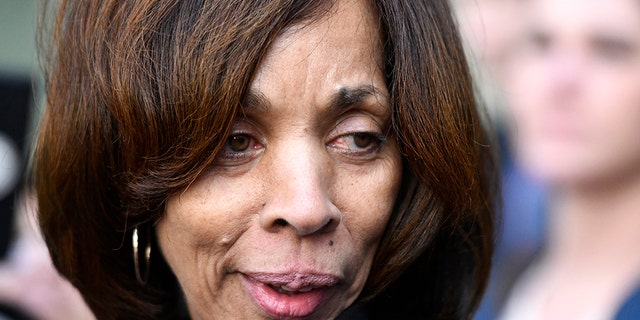
FILE - In this Feb. 27, 2020, file photo, former Baltimore Mayor Catherine Pugh leaves her sentencing hearing at U.S. District Court in Baltimore. Pugh was sentenced to three years in federal prison for arranging fraudulent sales of her self-published children's books to nonprofits and foundations to promote her political career. Pugh is expected to plead guilty to perjury. A plea hearing on the state misdemeanor charge is scheduled Friday in Anne Arundel County Circuit Court in Annapolis. (AP Photo/Steve Ruark, File)

FILE - In this Feb. 27, 2020, file photo, former Baltimore Mayor Catherine Pugh leaves her sentencing hearing at U.S. District Court in Baltimore. Pugh was sentenced to three years in federal prison for arranging fraudulent sales of her self-published children's books to nonprofits and foundations to promote her political career. Pugh is expected to plead guilty to perjury. A plea hearing on the state misdemeanor charge is scheduled Friday in Anne Arundel County Circuit Court in Annapolis. (AP Photo/Steve Ruark, File)

The medical system paid Pugh a total of $500,000 for 100,000 copies that were meant to be distributed to schoolchildren, but about 60,000 of those books were sent to a city warehouse and a Pugh office where thousands were removed to give to other customers. Prosecutors say Pugh never delivered the other 40,000 books the health system purchased for city schools.
While serving in the state Senate, Pugh sat on a committee that funded the medical system. She also sat on the hospital network’s board from 2001 until the scandal erupted in March 2019. Pugh returned the last $100,000 payment.
Before her federal sentencing in February, Pugh accepted “full responsibility” for her actions and apologized through tears during the roughly 10 minutes she spoke in federal court in Baltimore. She said she did not want to bring “any more shame” to Maryland’s largest city, which for years has struggled with grinding poverty, political mismanagement, record crime rates and police abuses that led to massive riots.

AOC rival Michelle Caruso-Cabrera turns to Wall Street for huge fundraising windfall: report


Some of Wall Street’s biggest titans are pumping big bucks into defeating first-term Democratic socialist Rep. Alexandria Ocasio-Cortez by bankrolling the campaign of her business-friendly Democratic primary opponent, Michelle Caruso-Cabrera, campaign records reveal.
placeholder
Caruso-Cabrera’s donors include Blackstone CEO Steve Schwarzman and Goldman Sachs CEO David Solomon. Both gave the maximum $2,800 for the Democratic primary against the far-left freshman AOC.
Home Depot co-founder Ken Langone and his wife, Elaine, kicked in a combined $11,200 to Caruso-Cabrera. They gave the maximum each for primary ($2,800) and general election ($2,800) — Caruso-Cabrera can only spend half of that for the primary.
The Post previously reported that pro-President Trump Republicans and corporate types contributed to Caruso-Cabrera’s campaign as well as an anti-AOC super PAC partly financed by her husband, investment banker and GOP donor Stephen Dizard.
Wall Street titans are pumping thousands of dollars into the campaign coffers of Alexandria Ocasio-Cortez's Democratic primary challenger Michelle Caruso-Cabrera.
Caruso-Cabrera, a former business journalist and CNBC host, is challenging Ocasio-Cortez in next Tuesday’s June 23 primary in the 14th Congressional District that takes in neighborhoods in parts of The Bronx and Queens.
AOC shocked the political world two years ago when she toppled Congressman and Queens Democratic Party chairman Joe Crowley in the Democratic primary. She has become a leading voice on the political far left.
placeholder
The first-time incumbent had $4.6 million in cash on hand to Caruso-Cabrera’s $1 million, according to reports filed with the Federal Election Commission.
“It’s not surprising that Republicans would finance the campaign of a lifelong Republican in a Democratic primary,” said Ocasio-Cortez’s spokeswoman, Lauren Hitt.
“While we have pushed against corporate power with policies that favor everyday working Americans, those donors prefer to bankroll a candidate who answers to Wall Street over the needs of our constituents.”
Caruso-Cabrera’s camp defended the Wall Street donations, saying the finance money is coming because she’s the pro-jobs candidate while Ocasio-Cortez opposed the aborted Amazon plan to open a headquarters along the Queens waterfront that the company said would have created 25,000 jobs.
“New York businesses are supporting a Caruso-Cabrera because she wants to create jobs for people. What’s bad about that? Compare that with AOC, who chased 25,000 jobs out of New York,” said Caruso-Cabrera spokesman Hank Sheinkopf.

Cotton blasts Roberts over DACA, invites him to resign, run for office


Sen. Tom Cotton, R-Ark., said Thursday that Supreme Court Chief Justice John Roberts should resign from his position and run for office if he “believes his political judgment is so exquisite” after siding with the court’s liberal wing on two key decisions this week.
Roberts, who was criticized earlier this week by some conservatives for siding with the left-leaning justices in an LGBT rights case, wrote the opinion on Wednesday on why President Trump should not be allowed to end the Obama-era Deferred Action for Childhood Arrivals, or DACA.
“John Roberts again postures as a Solomon who will save our institutions from political controversy and accountability,” Cotton, according to the Federalist. “If the Chief Justice believes his political judgment is so exquisite, I invite him to resign, travel to Iowa, and get elected. I suspect voters will find his strange views no more compelling than do the principled justices on the Court.”
The court ruled that Trump didn’t properly end the program, which then-President Barack Obama created in 2012. The administration argued the program was illegal and that although Trump didn’t favor punishing children for the actions of their parents, “we must also recognize that we are nation of opportunity because we are a nation of laws.” His administration has also cited a lower court’s ruling striking down an expansion of DACA that would have applied to parents as another reason to end the program.
Trump was critical of the court’s decision and promised to release a list of “Conservative Supreme  Court Justice nominees.”
“The recent Supreme Court decisions, not only on DACA, Sanctuary Cities, Census, and others, tell you only one thing, we need NEW JUSTICES of the Supreme Court. If the Radical Left Democrats assume power, your Second Amendment, Right to Life, Secure Borders, and ... Religious Liberty, among many other things, are OVER and GONE!”  he tweeted.
The Hill pointed out that Sen. Ted Cruz, R-Texas, also criticized the court’s decision.
“Judging is not a game. It’s not supposed to be a game but sadly over recent years more and more, Chief Justice Roberts has been playing games with the court to achieve the policy outcomes he desires,” Cruz said.
The Associated Press contributed to this report

Thursday, June 18, 2020

John Bolton Cartoons


Ted Cruz rips FAA chief over 737 MAX probe: ‘You do not work for Boeing’


U.S. Sen. Ted Cruz grilled the head of the Federal Aviation Administration on Wednesday during a Capitol Hill hearing that addressed two fatal crashes that have grounded Boeing’s 737 MAX passenger planes.
The Texas Republican accused the FAA of lacking urgency in responding to the problems with the 737 MAX – linked to fatal crashes in Indonesia in 2018 and Ethiopia in 2019 that killed a total of 346 people -- and at one point appeared to question whether FAA Administrator Stephen Dickson was doing his job, The Dallas Morning News reported.
“You understand, sir, you do not work for the airlines and you do not work for Boeing,” Cruz said at a Senate transportation committee hearing, according to the newspaper. “You work for the American people.”
Dickson, who became head of the agency after the crashes occurred, was at the hearing to answer lawmakers’ questions on the FAA’s oversight of aircraft certification, the Morning News reported. He told lawmakers the agency was “learning from the past and making the process and the agency more effective.”
“OK, let’s learn from the past,” Cruz responded. “Did the FAA screw up in certifying the 737 MAX?”
“OK, let’s learn from the past. Did the FAA screw up in certifying the 737 MAX?”
— U.S. Sen. Ted Cruz, R-Texas
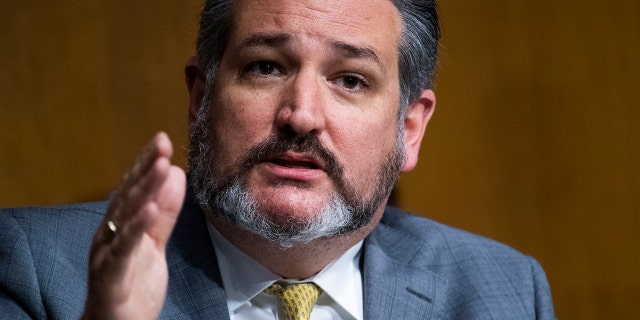
U.S. Sen. Ted Cruz, R-Texas, is seen on Capitol Hill in Washington, June 16, 2020. (Associated Press)

U.S. Sen. Ted Cruz, R-Texas, is seen on Capitol Hill in Washington, June 16, 2020. (Associated Press)

“I have concerns, I would say, that there were mistakes made, yes,” Dickson replied.
Cruz then tore into Dickson for using passive phrasing and asked him to instead be specific about who made the mistakes, according to the Morning News.
“The manufacturer made mistakes and the FAA made mistakes in its oversight of the manufacturer,” Dickson answered.
"The manufacturer made mistakes and the FAA made mistakes in its oversight of the manufacturer."
— Stephen Dickson, FAA administrator
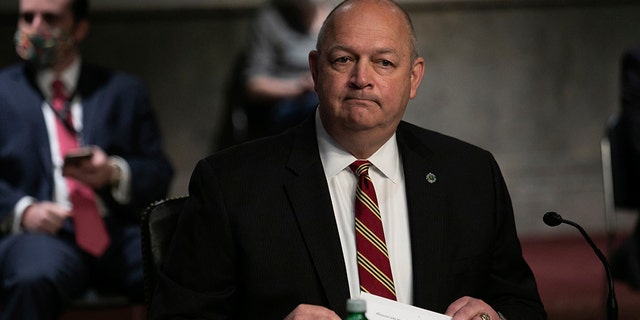
Federal Aviation Administration administrator Stephen Dickson waits to testify during a hearing of the Senate Commerce, Science, and Transportation Committee on Capitol Hill on June 17, 2020, in Washington. (Associated Press)

Federal Aviation Administration administrator Stephen Dickson waits to testify during a hearing of the Senate Commerce, Science, and Transportation Committee on Capitol Hill on June 17, 2020, in Washington. (Associated Press)

When Cruz inquired whether anyone had been fired or disciplined at the FAA because of its mistakes, Dickson said no, but added “there have been changes in leadership in various areas.”
“So unknown somebodies made unspecified mistakes for which there have been no repercussions,” Cruz said. “Is that right?”
Dickson later pushed back against a Cruz assertion that the FAA was bowing to Boeing as it reviewed the problems with the 737 MAX, instead claiming that the review process didn’t always help the FAA “see the while picture.”
Cruz appeared dissatisfied with the answer, the Morning News reported.
“We’re not seeing from you any of the urgency of fixing this problem,” Cruz said.
U.S. Sens. Roger Wicker, R-Miss., and Richard Blumenthal, D-Conn., were among other senators finding fault with the FAA, Reuters reported.
Wicker accused the FAA of not cooperating with the panel’s investigation into the Boeing crashes.
“Your team at FAA has attempted deliberately to keep us in the dark,” Wicker said.
Blumenthal accused the agency of being too passive in conducting jetliner certification.
“It’s been like a dog watching TV,” Blumenthal said.
The FAA has faced scrutiny for approving a 737 MAX flight-control system that has since been suspected of being faulty. After the second crash, the 737 MAX model has been grounded as the manufacturer looks to pinpoint what caused the crashes and work to regain trust in the model’s safety.
At Wednesday’s hearing, Dickson spoke of new “audit processes and review processes and more robust safety systems,” the Dallas newspaper reported.
Cruz, like Wicker, also accused Dickson of stonewalling the Senate panel’s investigations, such as failing to supply requested information and appearing unable to answer basic questions about the FAA’s role in addressing the problems with the 737 MAX.
Last October, Cruz grilled then-Boeing CEO Dennis Muilenburg regarding the two crashes, questioning whether the company valued safety.
At that hearing, Cruz pointed to internal communications that showed Boeing officials knew about potential problems with the flight-control system as far back as 2016, the Morning News reported.
“You’re the CEO, the buck stops with you,” Cruz said to Muilenburg. “How did your team not put it in front of you, run in with their hair on fire, saying, ‘We’ve got a real problem here’? How did that not happen? What does that say about the culture at Boeing?”
“We made mistakes and got some things wrong,” Muilenburg responded. “We own that, and we are fixing them.”
Muilenburg resigned from the company last December and was replaced in January by Boeing Chairman Dave Calhoun.

Attorney for Atlanta officer accused of murder says Rayshard Brooks 'was not running away' when he died


The attorney for a former Atlanta police officer facing a charge of felony murder in the shooting death of Rayshard Brooks last week told "The Ingraham Angle" in an exclusive interview Wednesday that several claims made by the district attorney when he announced the charges were "not true."
Lance LoRusso also told host Laura Ingraham that he was "kind of getting tired of people saying that Mr. Brooks was running away.
"Mr. Brooks was not running away," he said. "Mr. Brooks turned and offered extreme violence toward a uniformed law enforcement officer. If he was able to deploy the Taser, it would incapacitate Officer [Garrett] Rolfe through his body armor, and at that point, if he decided to disarm another officer, he would be in possession of a firearm."
Ingraham told LoRusso that Fulton County District Attorney Paul Howard Jr. appeared to emphasize the early part of the encounter in which Brooks is seen speaking cordially with Rolfe -- LoRusso's client -- and Devin Brosnan, rather than the later scuffle with the officers in which Brooks steals one of their stun guns.
"I have no idea why [Howard] is doing that," LoRusso said. "There's a lot of things I have no idea [about]. He is saying one of the officers [Brosnan] is cooperating with the DA's office. The lawyer for that officer said that's not true."
LoRusso also responded to Howard's contentions that the officers did not render medical assistance to Brooks for two minutes and 12 seconds after he was shot and that Rolfe kicked Brooks as he lay dying.
"My client never kicked Mr. Brooks," the lawyer said. "If there was a video of my client kicking Mr. Brooks, you would have seen it.
"He [the DA] shows a still [where] one leg is planted and the other one's bent. He could be leaning down to try to give him first aid, it could have been when he was trying to evaluate whether he needed handcuffs. This officer gave him CPR, monitored his pulse prior to that, talked to him to try to keep him breathing and called for EMS and coordinated other efforts on the scene.
"And the other thing the DA said was that he's never seen another officer agree to testify against a bad officer," LoRusso went on. "My client [Rolfe] testified against an Atlanta Police officer in the grand jury when that officer had done something wrong. So, this is an officer who's known to the law enforcement community, he's known to the DA's office, and he was actually cleared of another use of force [incident] and he testified on behalf of the DA to prosecute a bad officer."

Bolton memoir discusses possibility of replacing Pence, 'cool' Venezuela invasion, and more


Fox News has obtained former national security adviser John Bolton's upcoming 592-page memoir, "The Room Where it Happened" -- and the manuscript contains several previously unreported claims of intrigue and realpolitik among key administration figures, past and present.
The Wall Street Journal on Wednesday published an excerpt of the book, and The New York Times and The Washington Post authored stories revealing some details. Among the main revelations were that Bolton charged that President Trump regularly gives "personal favors to dictators he liked," backed the idea of more concentration camps in China, and asked Chinese President Xi Jinping to help him in the 2020 election by buying more U.S. agricultural goods.
Trump also apparently was unaware that Britain is a nuclear power and asked whether Finland is part of Russia, according to Bolton -- who further claims that during Trump's 2018 meeting with North Korea's leader, Secretary of State Mike Pompeo handed Bolton a note saying of Trump, “He is so full of sh--."
A source close to Pompeo told Fox News late Wednesday: “Bolton is about selling books, not about telling the truth.“ The source added that Pompeo isn’t a note-passer, and suggested Bolton should prove his claim by producing the purported note.
The president, meanwhile, unloaded on Bolton in an exclusive interview with Fox News' "Hannity" on Wednesday night. And, in a series of tweets early Thursday, Trump called Bolton a "Wacko," a "dope," and a "disgruntled boring fool who only wanted to go to war." Noting that The New York Times had described Bolton's book as "exceedingly tedious," Trump added: "President Bush fired him also. Bolton is incompetent!"
The Justice Department is seeking an emergency injunction preventing the release of Bolton's book, saying Bolton had deliberately bypassed the necessary classification review process and that his manuscript still contains classified information.
Bolton served as national security adviser from April 2018 to September 2019 and was United Nations ambassador in the George W. Bush administration. The following are selected portions of Bolton's manuscript that shed additional light on his various publicized claims, as well as those that introduce new allegations.

Replacing Pence with Nikki Haley

En route to al-Asad Air Base in Iraq on a secretive flight in late 2018, Bolton writes, Trump "raised the widespread political rumor he would dump [Vice President Mike] Pence from the ticket in 2020 and run instead with [then-U.S. Ambassador to the U.N. Nikki] Haley, asking what I thought."
Conventional wisdom at the gossip-prone White House, Bolton asserts in the book, was that "Ivanka [Trump] and [Jared] Kushner favored this approach, which tied in with Haley's leaving her position as UN Ambassador in December 2018, thus allowing her to do some politicking around the country before being named to the ticket in 2020."
The alleged calculus was that Haley could boost Trump among disaffected women voters, at the possible cost of losing evangelicals partial to Pence.
"I explained it was a bad idea to jettison someone loyal," Bolton writes.

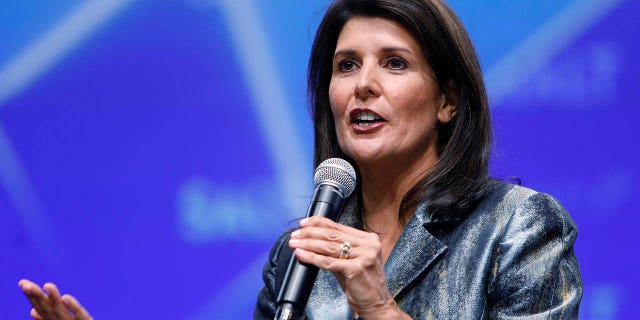
Nikki Haley, former U.S. ambassador to the United Nations (UN), speaks during the Skybridge Alternatives (SALT) conference in Las Vegas, Nevada, U.S., on Thursday, May 9, 2019. SALT brings together investors, policy experts, politicians and business leaders to network and share ideas to unlock growth opportunities in finance, economics, entrepreneurship, public policy, technology and philanthropy. Photographer: Joe Buglewicz/Bloomberg via Getty Images

Nikki Haley, former U.S. ambassador to the United Nations (UN), speaks during the Skybridge Alternatives (SALT) conference in Las Vegas, Nevada, U.S., on Thursday, May 9, 2019. SALT brings together investors, policy experts, politicians and business leaders to network and share ideas to unlock growth opportunities in finance, economics, entrepreneurship, public policy, technology and philanthropy. Photographer: Joe Buglewicz/Bloomberg via Getty Images
In a separate episode, Bolton says, Trump offered a head-turning anecdote involving then-Secretary of State Rex Tillerson.
While waiting in the Oval Office for a call from France's president, Bolton claims, "Trump railed away about Tillerson and how much he disliked him, recalling a dinner with Tillerson and Haley. Haley, said Trump, had some disagreement with Tillerson, who responded, 'Don't ever talk to me that way again.' Before Haley could say anything, Tillerson said, 'You're nothing but a c--t, and don't ever forget it.'"
Bolton, however, writes that he suspected Trump wasn't telling the truth.
"In most Administrations, that would have gotten Tillerson fired, so I wondered if he ever actually said it," Bolton says. "And if he hadn't, why did Trump tell me he had?"
Bolton adds that Kushner had told him Trump thought he had done a "great job" early on in his tenure, which to Bolton "meant I would probably make it through the end of my fourth day on the job."

'Cool' invasion of Venezuela

The memoir describes frustration by John Kelly, who served as Trump's chief of staff, over the president's push to revoke the security clearance of ex-CIA Director John Brennan in late 2018. At the time, the White House charged that Brennan, an anti-Trump political commentator, had been "leveraging" the clearance to make "wild outbursts" and claims against the Trump administration in the media.
Kelly told Bolton he had an "argument" with Trump, saying it was "not presidential" to publicly revoke Brennan's security clearance, according to Bolton. Kelly also told Bolton it was "Nixonian" behavior.
Bolton writes: "'Has there ever been a presidency like this?' Kelly asked me, and I assured him there had not. ... I thought there was a case against Brennan for politicizing the CIA, but Trump had obscured it by the blatantly political approach he took. It would only get worse if more clearances were lifted."
In an "emotional" moment, Bolton goes on, Kelly produced "a picture of his son, killed in Afghanistan in 2010."
"Trump had referred to him earlier that day, saying to Kelly, 'You suffered the worst,'" the manuscript reads. "Since Trump was disparaging the wars in Afghanistan and Iraq at the time, he had seemingly implied that Kelly's son had died needlessly. 'Trump doesn't care what happens to these guys,' Kelly said. He says it would be 'cool' to invade Venezuela.'"

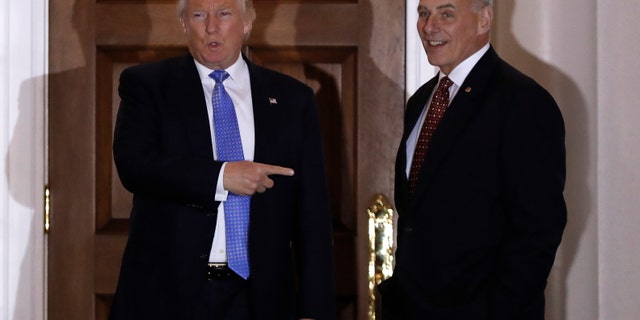
President-elect Donald Trump with retired Marine Corps Gen. John Kelly at the Trump National Golf Club Bedminster in New Jersey. He has picked Kelly to lead the Homeland Security Department.

President-elect Donald Trump with retired Marine Corps Gen. John Kelly at the Trump National Golf Club Bedminster in New Jersey. He has picked Kelly to lead the Homeland Security Department. (AP)

Bolton describes the conversation as Kelly "venting his frustrations," and says he largely agreed with Kelly.
Kelly, a retired four-star Marine Corps general, publicly sparred with Trump earlier this year when he defended Alexander Vindman, a key impeachment witness.
“When I terminated John Kelly, which I couldn’t do fast enough, he knew full well that he was way over his head. Being Chief of Staff just wasn’t for him,” Trump tweeted in response. “He came in with a bang, went out with a whimper, but like so many X’s, he misses the action & just can’t keep his mouth shut, which he actually has a military and legal obligation to do."

'Breathtaking' China talks

Trump at various times lost faith in Treasury Secretary Steven Mnuchin amid China trade negotiations with President Xi Jinping, according to Bolton's book.
"Mnuchin fretted constantly about how this or that prosecution for hacking or other cybercrimes would have a negative effect on the trade negotiations, which Trump sometimes bought and sometimes didn't," Bolton writes. "At one point, he said to Mnuchin, 'Steve, the Chinese see fear in your eyes. That's why I don't want you negotiating with them.'"
Elsewhere in the manuscript, Bolton accuses the president of soliciting foreign election help during a June 29, 2019 meeting with Xi in Osaka, Japan.
"Xi told Trump that the U.S.-China relationship was the most important in the world. He said that some (unnamed) American political figures were making erroneous judgments by calling for a new Cold War with China," Bolton writes. "Whether Xi meant to finger the Democrats or some of us sitting on the U.S. side of the table, I don’t know, but Trump immediately assumed that Xi meant the Democrats."
That's when, according to Bolton, the conversation took a troubling turn.

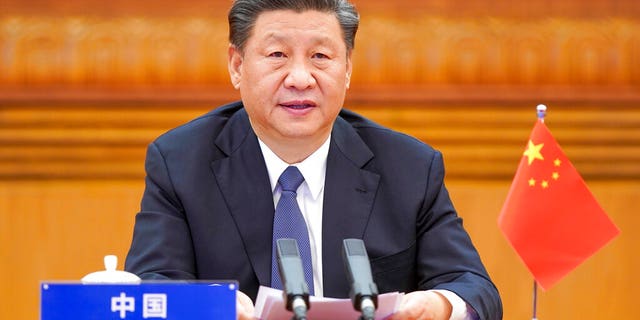
In this photo released by Xinhua News Agency, Chinese President Xi Jinping attends the G20 Extraordinary Virtual Leaders' Summit on COVID-19 via video link in Beijing, capital of China, March 26, 2020. Leaders of the world's most powerful economies convened virtually on Thursday with the aim of coordinating a global response to the fast-spreading coronavirus, which has shuttered businesses and forced well over a quarter of the world's population into home isolation. (Li Xueren/Xinhua via AP)

In this photo released by Xinhua News Agency, Chinese President Xi Jinping attends the G20 Extraordinary Virtual Leaders' Summit on COVID-19 via video link in Beijing, capital of China, March 26, 2020. Leaders of the world's most powerful economies convened virtually on Thursday with the aim of coordinating a global response to the fast-spreading coronavirus, which has shuttered businesses and forced well over a quarter of the world's population into home isolation. (Li Xueren/Xinhua via AP)

"Trump then, stunningly, turned the conversation to the coming U.S. presidential election, alluding to China’s economic capability and pleading with Xi to ensure he’d win," Bolton writes. "He stressed the importance of farmers and increased Chinese purchases of soybeans and wheat in the electoral outcome. I would print Trump’s exact words, but the government’s prepublication review process has decided otherwise."
The president then urged China to "buy as many American farm products as China could," Bolton says, and "Xi agreed that we should restart the trade talks, welcoming Trump’s concession that there would be no new tariffs and agreeing that the two negotiating teams should resume discussions on farm products on a priority basis."
Bolton also writes: "Xi had explained to Trump why he was basically building concentration camps in Xinjiang. According to our interpreter, Trump said that Xi should go ahead with building the camps, which Trump thought was exactly the right thing to do. The National Security Council’s top Asia staffer, Matthew Pottinger, told me that Trump said something very similar during his November 2017 trip to China."
Contrary to his public image of being tough on China, Bolton asserts, the president was deferential to Xi.
"There were no winners in the trade war, said Xi, so we should eliminate the current tariffs, or at least agree there would be no new tariffs," the book reads. "I feared at that moment that Trump would simply say yes to everything Xi had laid out. He came close, unilaterally offering that US tariffs would remain at 10 percent rather than rise to 25 percent as he had threatened. In exchange, Trump asked merely for some increases in farm-product purchases (to help with the critical farm-state vote. If that could be agreed, all the tariffs would be reduced. Intellectual property was left to be worked out at some unspecified point. ... It was breathtaking."

North Korea's 'Brooklyn Bridge' sale

Bolton's eyewitness account of Trump's North Korea diplomacy, including his summit with the country, paints a mixed portrait -- at times offering an unsparing critique of the president's political motivations, while sometimes crediting his distrust of dictator Kim Jong Un.
On May 25, 2019, a reporter asked Bolton if North Korea's then-recent short-range missile launches violated Security Council resolutions, putting him in an "awkward position," he writes.
Bolton "knew full well they did, having helped write the first two, Resolutions 1695 and 1718, when I was US Ambassador to the UN," the book states, adding that he "wasn't about to ignore" those resolutions. At the same time, "it was entirely possible for the launches to violate the resolutions without violating Kim's pledge to Trump, which involved only ICBM launches. It was equally true that Trump looked foolish for not understanding that Kim had, in effect, sold him the Brooklyn Bridge with that pledge, but we were never able to shake Trump's faith he had scored a coup in getting it."
At the press conference, Bolton responded that there was "no doubt" of a violation: "The UN resolution prohibits the launch of any ballistic missiles."
Trump then fired off a tweet that rankled Bolton: "North Korea fired off some small weapons, which disturbed some of my people, and others, but not me. I have confidence that Chairman Kim will keep his promise to me, & also smiled when he called Swampman Joe Biden a low IQ individual, & worse. Perhaps that’s sending me a signal?"
And, during Trump's meeting with Kim Jong Un, Bolton writes, Pompeo "passed me his note pad, on which he had written, 'he is so full of s--t.' I agreed. Kim promised there would be no further nuclear tests, and that their nuclear program would be dismantled in an irreversible manner."
Fox News had confirmed that Bolton was referring to Trump as the person who was "so full of s--t."
However, the president did occasionally have flashes of insight, according to Bolton.
"After the meet-and-greet, Trump [said] he was prepared to sign a substance-free communique, have his press conference to declare victory, and then get out of town."
— John Bolton's memoir
"When Pompeo told Trump that North Korea wanted 'security guarantees' before denuclearization, Trump responded, 'This 'trust building' is horsesh--,' the smartest thing on Pyongyang he had said in months," the book says, noting that Pompeo added, "'It's all an effort to weaken the sanctions, a standard delaying tactic,' which was correct."
The memoir continues: "'This is an exercise in publicity,'" said Trump, which is how he saw the entire summit. Kelly said to me while Trump did a meet-and-greet with the Singapore US embassy staff, 'the psychology here is that Trump wants to walk out in order to preempt Kim Jong Un.' I agreed, and became somewhat hopeful we could avoid major concessions. After the meet-and-greet, Trump told [Sarah] Sanders, Kelly, and me he was prepared to sign a substance-free communique, have his press conference to declare victory, and then get out of town."

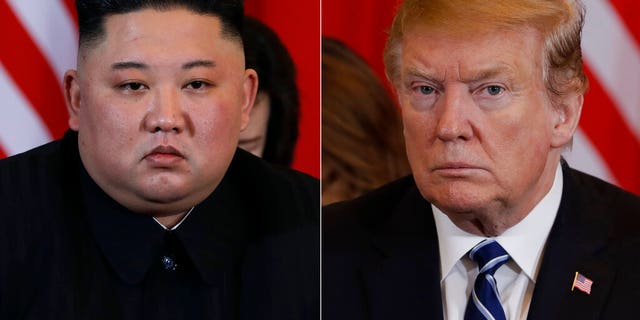
In this combination of images. North Korean leader Kim Jong Un, left, and President Donald Trump during their meeting Thursday, Feb. 28, 2019, in Hanoi. (AP Photo/Evan Vucci)

In this combination of images. North Korean leader Kim Jong Un, left, and President Donald Trump during their meeting Thursday, Feb. 28, 2019, in Hanoi. (AP Photo/Evan Vucci)

According to the book, Trump said the summit would be a "success no matter what," adding, "We just need to put on more sanctions, including on China for opening up the border. Kim is full of sh--, we have three hundred more sanctions we can impose on Friday."
Bolton writes that this development "threw logistics back into disarray (not that they had been in array since we left Canada), but Kelly and I said we'd get back to him with options later that day."

'Impeachment malpractice' 

As excerpts of Bolton's manuscript began leaking Wednesday, Rep. Adam Schiff, D-Calif., who led Democrats' impeachment effort, slammed Bolton in no uncertain terms.
"Bolton’s staff were asked to testify before the House to Trump’s abuses, and did," Schiff tweeted. "They had a lot to lose and showed real courage. When Bolton was asked, he refused, and said he’d sue if subpoenaed. Instead, he saved it for a book. Bolton may be an author, but he’s no patriot."
Democrats were upset with Bolton during the impeachment proceedings, as well, saying he had even declined to produce an affidavit in the Senate trial for unclear reasons. Republicans pointed out that Democrats dropped their bid to compel testimony from Bolton, seemingly to push the proceedings along for political reasons -- an assessment that Bolton affirms in his book.
From the "very outset of the proceedings in the House of Representatives," Bolton writes, "advocates for impeaching Trump on the Ukraine issue were committing impeachment malpractice. They seemed governed more by their own political imperatives to move swiftly to vote on articles of impeachment in order to avoid interfering with the Democratic presidential nomination schedule than in completing a comprehensive investigation."

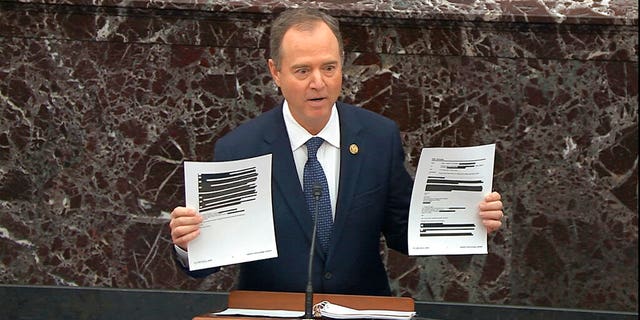
In this image from video, House impeachment manager Rep. Adam Schiff, D-Calif., holds redacted documents as he speaks during the impeachment trial against President Donald Trump in the Senate at the U.S. Capitol in Washington, Wednesday, Jan. 22, 2020. (Senate Television via AP)

In this image from video, House impeachment manager Rep. Adam Schiff, D-Calif., holds redacted documents as he speaks during the impeachment trial against President Donald Trump in the Senate at the U.S. Capitol in Washington, Wednesday, Jan. 22, 2020. (Senate Television via AP)

Had the Democratic-controlled House of Representatives not focused "solely" on Ukraine, Bolton wrote, they could have probed "the broader pattern of his behavior -- including his pressure campaigns involving Halkbank, ZTE, and Huawei among others."
Such an approach, Bolton muses, could have led to a "greater chance to persuade others that 'high crimes and misdemeanors' had been perpetrated. In fact, I am hard-pressed to identify any significant Trump decision during my tenure that wasn't driven by re-election calculations."
Although Democrats fretted over his failure to testify, Bolton says, they were missing the forest for the trees.
"Had a Senate majority agreed to call witnesses and had I testified, I am convinced, given the environment then existing because of the House's impeachment malpractice, that it would have made no significant difference in the Senate outcome," Bolton writes.

Ukraine meltdown: 'They tried to f--k me'

All the same, Bolton's book devotes substantial consideration to Ukraine, and the president's dealings with Ukrainian President Volodymyr Zelensky that led to his impeachment.
On March 25, 2019, Trump called Bolton to the Oval Office, but Bolton says he found the president seated in a small dining room alongside personal attorneys Rudy Giuliani and Jay Sekulow. Giuliani was "the source of the stories about [then-U.S. Ukraine ambassador Marie] Yovanovitch," whom Giuliani said was "being protected" by George Kent, another State Department official. Trump ordered Yovanovitch fired at the meeting, the book states.
Speaking to Bolton, Pompeo "protested that Giuliani's allegations simply weren't true and said he would call Trump," who had complained that the diplomat was "bad-mouthing us," according to the memoir.
On April 23, Trump and then-chief of staff Mick Mulvaney were in the Oval Office on the phone with Giuliani. Yovanovitch, Giuliani was telling Trump, "had spoken to President-Elect Zelensky to tell him Trump himself wanted certain investigations by Ukrainian prosecutors stopped."
Bolton writes that Giuliani offered "no evidence" on the call for the allegations, which included that Yovanovitch was "protecting Hillary Clinton" because her campaign could be under investigation in Ukraine -- "and there was some connection with Joe Biden's son Hunter in there as well."

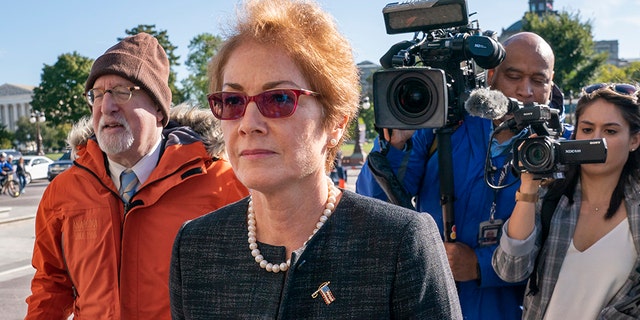
Former U.S. ambassador to Ukraine Marie Yovanovitch, arrives on Capitol Hill, Friday, Oct. 11, 2019, in Washington, before testifying to Congressional lawmakers as part of the House impeachment inquiry into President Donald Trump.

Former U.S. ambassador to Ukraine Marie Yovanovitch, arrives on Capitol Hill, Friday, Oct. 11, 2019, in Washington, before testifying to Congressional lawmakers as part of the House impeachment inquiry into President Donald Trump. (Associated Press)

Trump said he couldn't believe Pompeo hadn't fired the diplomat yet, and reiterated that Zelensky should know Yovanovitch didn't speak for the administration, according to the book.
By May 22, after addressing the Coast Guard Academy's graduation ceremony in Connecticut, Trump made clear he had had enough, Bolton writes, citing Bolton deputy Charles Kupperman.
"I don't want to have any f---ing thing to do with Ukraine," Trump reportedly said. "They f---ing attacked me. I can't understand why. Ask [lawyer] Joe diGenova, he knows all about it. They tried to f--k me. They're corrupt. I'm not f---ing with them."
Trump's remarks, Bolton says, concerned what Trump saw as the Clinton campaign's efforts, "aided by Hunter Biden, to harm Trump in 2016 and 2020." When [U.S. diplomat Kurt] Volker tried to say something, Trump responded, "I don't give a sh--." When another official interjected that "we couldn't allow a failed state, presumably a Ukraine where effective government had broken down," Trump replied, "Talk to Rudy and Joe. ... I want the f--king DNC server."
Bolton writes: "I was stunned at the simplemindedness of pressing for a face-to-face Trump-Zelensky meeting where the 'Giuliani issues' could be resolved, an approach it appeared Mulvaney shared from his frequent meetings with [Gordon] Sondland. I told [NSC official] Fiona Hill to take the whole matter to the White House Counsel's office; she quoted me accurately as saying, 'I am not part of whatever drug deal Sondland and Mulvaney are cooking up.' I thought the whole affair was bad policy, questionable legally, and unacceptable as presidential behavior. Was it a factor in my later resignation? Yes, but as one of many 'straws' that contributed to my departure."

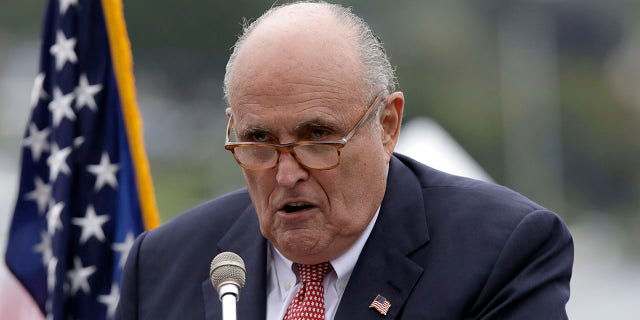
FILE - In this Aug. 1, 2018, file photo,Rudy Giuliani, personal attorney for President Donald Trump, speaks in Portsmouth, N.H. Giuliani, says he’s being represented by three lawyers as federal prosecutors in New York look into his business dealings. (AP Photo/Charles Krupa, File)

FILE - In this Aug. 1, 2018, file photo,Rudy Giuliani, personal attorney for President Donald Trump, speaks in Portsmouth, N.H. Giuliani, says he’s being represented by three lawyers as federal prosecutors in New York look into his business dealings. (AP Photo/Charles Krupa, File)

Hill, a former top White House expert on Russia, testified at Trump's impeachment proceedings that Bolton distanced himself from the effort to leverage investigations from Ukrainians in exchange for a White House meeting -- and warned that Giuliani was a “hand grenade” who was “going to blow up everyone,” according to transcripts.
On August 20, Trump "said he wasn't in favor of sending [Ukraine] anything until all the Russia-investigation materials related to Clinton and Biden had been turned over," Bolton writes. "That could take years, so it didn't sound like there was much of a prospect that the military aid would proceed."
"When, in 1992, Bush 41 supporters suggested he ask foreign governments to help out in his failing campaign against Bill Clinton, Bush and Jim Baker completely rejected the idea. Trump did the precise opposite," Bolton concludes.
Bolton's critics, however, argue that history cuts both ways. The White House has repeatedly challenged Bolton's credibility based on his previous statements, and The Federalist's Sean Davis pointed out that Bolton advanced false narratives in the run-up to the Iraq war in 2003.
A string of resurfaced video clips earlier this year led Trump to tweet "GAME OVER!" -- including an interview of Bolton in August 2019 where he appears to have no issues with Trump foreign policy concerning Ukraine or any other nation. The interview seemingly contradicted assertions in Bolton's book that Trump explicitly told him he wanted to tie military aid to Ukraine to an investigation into Joe and Hunter Biden. (Zelensky has said his communications with Trump involved no pressure for any investigation.)

'Axis of adults' 

Bolton begins the memoir by dismissing "Washington's conventional wisdom on Trump's trajectory," saying it is largely "wrong" and "intellectually lazy" to conclude, as many have, that the president was held in check by an "axis of adults" during his first fifteen months in office.
That overall picture is "simplistic," Bolton writes.  In fact, the "axis of adults in many respects caused enduring problems not because they successfully managed Trump ... but because they did precisely the opposite. They didn't do nearly enough to establish order, and what they did do was so transparently self-serving and so publicly dismissive of many of Trump's very clear goals (whether worthy or unworthy) that they fed Trump's already-suspicious mindset, making it harder for those who came later to have legitimate policy exchanges with the President."
Because his "axis of adults" performed so poorly, Trump "second-guessed people's motives, saw conspiracies behind rocks, and remained stunningly uninformed on how to run the White House, let alone the huge federal government," Bolton says. The president began relying largely on "instinct" and "foreign relationships with other leaders," and as a result, "botched irretrievably" his transition and "opening year-plus" in office.

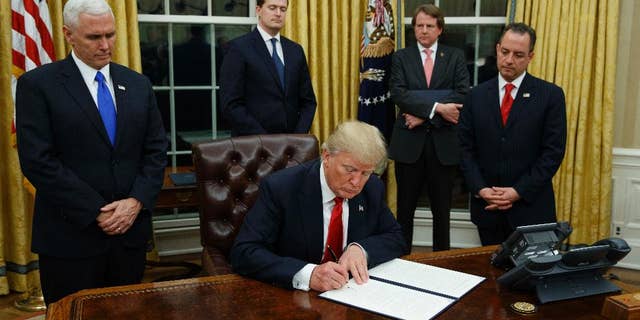
FILE - In this Jan. 20, 2017, file photo,President Donald Trump, flanked by Vice President Mike Pence and Chief of Staff Reince Priebus, signs his first executive order on health care in the Oval Office of the White House in Washington. (AP Photo/Evan Vucci, File)

FILE - In this Jan. 20, 2017, file photo,President Donald Trump, flanked by Vice President Mike Pence and Chief of Staff Reince Priebus, signs his first executive order on health care in the Oval Office of the White House in Washington. (AP Photo/Evan Vucci, File) (The Associated Press)

Bolton asserts that many key Trump advisers would tend toward describing life in the White House as philosopher Thomas Hobbes' described human existence: "solitary, poor, nasty, brutish, and short."
"My goal was not to get a membership card, but to get a driver's license," Bolton writes. "That thinking was not common at the Trump White House. In early visits to the West Wing, the differences between this president and previous ones I had served were stunning. What happened on one day on a particular issue often had little resemblance to what happened the next day, or the day after. Few seemed to realize it, care about it, or have any interest in fixing it. And it wasn't going to get much better, which depressing but inescapable conclusion I reached only after I had joined the Administration."
Throughout the memoir, Bolton raises various concerns about the day-to-day operations at the White House. For example, Trump chaired "weekly meetings" that "more closely resembled college food fights than careful decision making," Bolton writes. "After these sessions, had I believed in yoga, I probably could have used some."
"Trump generally had only two intelligence briefings per week, and in most of those, he spoke at greater length than the briefers, often on matters completely unrelated to subjects at hand," Bolton adds.
And, the day then-Secretary of Defense Jim Mattis resigned, Trump told Bolton in the Oval Office: "He's leaving ... I never really liked him."

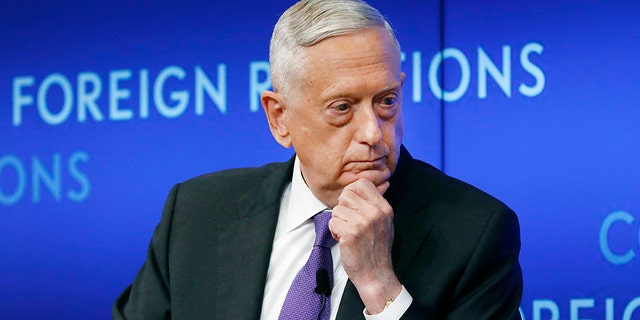
Former U.S. Secretary of Defense Jim Mattis listens to a question during his appearance at the Council on Foreign Relations, in New York, Tuesday, Sept. 3, 2019. (AP Photo/Richard Drew)

Former U.S. Secretary of Defense Jim Mattis listens to a question during his appearance at the Council on Foreign Relations, in New York, Tuesday, Sept. 3, 2019. (AP Photo/Richard Drew)

Earlier this month, Mattis excoriated the president in a statement to The Atlantic published -- urging Americans to "reject and hold accountable those in office who would make a mockery of our Constitution."
Trump issued his own blistering condemnation on Twitter hours later, pointing out that then-President Obama removed Mattis as head of U.S. Central Command in 2013.
"Probably the only thing Barack Obama and I have in common is that we both had the honor of firing Jim Mattis, the world’s most overrated General," Trump wrote. "I asked for his letter of resignation, & felt great about it. His nickname was 'Chaos', which I didn’t like, & changed it to 'Mad Dog.' His primary strength was not military, but rather personal public relations. I gave him a new life, things to do, and battles to win, but he seldom 'brought home the bacon'. I didn’t like his 'leadership' style or much else about him, and many others agree. Glad he is gone!"

Leak intrigue

On Sept. 9, 2019, Trump told Bolton in the Oval Office that the press coverage concerning the canceled Camp David meeting with Taliban and Afghan leaders was unfair, according to the memoir.
Days earlier, Trump tweeted that he had canceled the planned secret meetings after the Taliban claimed responsibility for a car bombing that killed a U.S. soldier, a Romanian soldier, and 10 civilians in Kabul earlier that week.
"Unbeknownst to almost everyone, the major Taliban leaders and, separately, the President of Afghanistan, were going to secretly meet with me at Camp David on Sunday," Trump tweeted. "They were coming to the United States tonight. Unfortunately, in order to build false leverage, they admitted to an attack in Kabul that killed one of our great great soldiers, and 11 other people. I immediately cancelled [sic] the meeting and called off peace negotiations. What kind of people would kill so many in order to seemingly strengthen their bargaining position?"

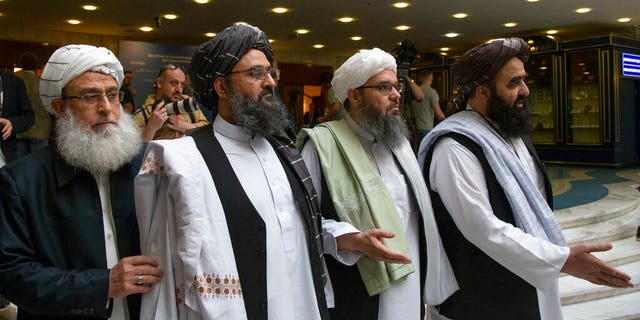
FILE - In this May 28, 2019, file photo, Mullah Abdul Ghani Baradar, the Taliban group's top political leader, second left, arrives with other members of the Taliban delegation for talks in Moscow, Russia. U.S. peace envoy Zalmay Khalilzad held on Saturday, Dec. 7, 2019 the first official talks with Afghanistan's Taliban since last September when President Donald Trump declared a near-certain peace deal with the insurgents dead. (AP Photo/Alexander Zemlianichenko, File)

FILE - In this May 28, 2019, file photo, Mullah Abdul Ghani Baradar, the Taliban group's top political leader, second left, arrives with other members of the Taliban delegation for talks in Moscow, Russia. U.S. peace envoy Zalmay Khalilzad held on Saturday, Dec. 7, 2019 the first official talks with Afghanistan's Taliban since last September when President Donald Trump declared a near-certain peace deal with the insurgents dead. (AP Photo/Alexander Zemlianichenko, File)

Bolton's memoir charges that Trump's tweets were making him look bad -- but that the president sought to blame others.
"He was furious he was being portrayed as a fool, not that he put it that way," Bolton writes. "He said, 'A lot of people don't like you. They say you're a leaker and not a team player.' I wasn't about to let that go. I said I'd been subject to a campaign of negative leaks against me over the past several months, which I would be happy to describe in detail, and I'd also be happy to tell him who I thought the leaks were coming from. (Mostly, I believed the leaks were being directed by Pompeo and Mulvaney.)"
Bolton said he told Trump that there were no "favorable stories" about Bolton in the New York Times or Washington Post, which "often revealed who was doing the leaking."
Separately, Bolton confirms reports that Trump didn't want notes taken from his private conversation with Russian President Vladimir Putin in Helsinki, Finland in July 2018. That summit attracted international scrutiny, as Trump suggested Russia might be right -- and U.S. intelligence might be wrong -- about Russian election interference efforts.
"In fact, the US interpreter told Fiona Hill and Joe Wang later that Putin had talked for 90 percent of the time (excluding translation); she also said Trump had told her not to take any notes, so she could only debrief us from her unaided memory," Bolton writes. "It was clear, said Trump, that Putin 'wants out' of Syria, and that he liked Netanyahu. Trump also said Putin didn't seem to care much one way or the other about our leaving the Iran nuclear deal, although he did say Russia would stay in." Trump told Putin he had 'no choice' but to be 'tough' on China."

Trump responds

Trump lashed out at Bolton in an exclusive interview on "Hannity" on Wednesday night, saying Bolton "broke the law" by writing a forthcoming book about his time in the Trump administration.
"He was a washed-up guy," Trump told host Sean Hannity, referring to Bolton. "He couldn't get Senate-confirmed. So I gave him a non-Senate-confirmed position. I could just put him there, see how we worked. And I wasn't very enamored."
Hannity had asked Trump to respond to a claim in "The Room Where it Happened," that the president asked Xi for assistance with Trump's reelection campaign during the G-20 summit in June 2019.
"Well, first of all," Trump responded, "nobody has been tougher on Russia or China than I have. Nobody even close. China's paying us billions of dollars a year. They never gave us 10 cents [before], and [Joe] Biden's son walked away with a billion and a half dollars to manage, making hundreds of thousands and millions of dollars on it.
"So nobody has been tough on China, and nobody has been tough with Russia, like I have. And that's that's in the record books. And it's not even close. The last administration did nothing on either."
Later in the interview, Trump criticized Bolton for his advocacy of the invasion of Iraq in 2003.
"He went into the Middle East," the president said. "He was one of the big guns for, 'Let's go into Iraq,' and that didn't work out too well." Trump added that he had asked Bolton about a month into the latter's tenure as national security adviser, "What do you think? Do you think you made a mistake there?"
"'No, I don't think so,'" Trump said Bolton responded, to which the president said he replied, "Explain that one."
"He broke the law, very simple," Trump repeated. "I mean, as much as it's going to be broke. This is highly classified. That's the highest stage. It's highly classified information and he did not have approval. That's come out now very loud and very strong."
Fox News' Rich Edsen contributed to this report.

Wednesday, June 17, 2020

The Silence of the Lambs

The Silence of the Lambs
 
There is a big chill descending on freedom of expression in America. A few examples. Liberal journalists at the Philadelphia Inquirer and the The New York Times recently lost their jobs because they were not liberal enough.  The successful cable show “Live PD” was canceled by the Arts and Entertainment Network because of anti-cop fervor, and the legendary movie “Gone with the Wind” has been banished by HBO because it’s “racist.”
 
And that’s just a small sample of the Stalinist thought-terror presently enveloping the country.
 
Everyone’s scared. The totalitarian left, using the brutal police killing of George Floyd, has basically told American corporations that they will be branded racist if they allow or support criticism of the far left agenda.
 
A vivid example is the vicious Media Matters organization threatening companies that advertise on Tucker Carlson’s Fox News program.  Media Matters, heavily funded by far left zealots like George Soros, accuses Mr. Carlson of “white supremacy.”  Disney, T-Mobile, and Papa John’s pizza cancelled sponsorship last week.
 
We can expect much more of this as the Stalinists understand it is their time.  The rush on the part of corporate America to “virtue signal,” that is, present themselves as champions of social justice and change, means any dissent from the Black Lives Matter agenda will not be tolerated.  
 
We have never seen this before in America, at least on this kind of scale.  Individuals are losing jobs and careers simply for expressing honest beliefs.  Even in the 1950s when the communist witch-hunt was underway, you didn’t have this kind of assault on personal freedom across the board.
 
Twitter and social media are largely responsible.  In a blink, any American can be labeled a racist without a shred of evidence. And who will defend the accused?  No one. Because if you do - YOU become a racist, or a misogynist, or a “nationalist.”
 
The radical playbook written by Saul Alinsky is now dominating the media.  There are currently phrases like “all lives matter” that absolutely cannot be said.  If you put forth that you will stand and respect the National Anthem, you’re “insensitive.”  If you believe most police officers are noble, you are the enemy of justice.
 
I never thought I would see freedom of expression crushed in my country.  But that is what is happening.
 
We do need honest reform to help Americans, especially minorities, who are not treated fairly.  This can happen using robust debate and the exchange of effective  ideas. That’s the improvement process a free and mature society uses.
 
But the totalitarian left does not want a free society because things like the election of Donald Trump happen in it.  No, the radicals want to shut down opposing points of view, punish opponents, and have designed a frightening strategy to accomplish that.
 
It is obvious corporate America is surrendering to the totalitarians, and many in the media are enabling the suppression of freedom by promoting far left actions.
 
So who will stop this?  It will have to be “we the people” vehemently rejecting the far left revolt.  I think that will occur.  But with so much damage being done, I pray it happens soon.  Because the longer folks stay silent, the more we’ll be like lambs.

CartoonDems