Presumptuous Politics

Monday, June 29, 2020

Worst virus fears are realized in poor or war-torn countries


CAPE TOWN, South Africa (AP) — For months, experts have warned of a potential nightmare scenario: After overwhelming health systems in some of the world’s wealthiest regions, the coronavirus gains a foothold in poor or war-torn countries ill-equipped to contain it and sweeps through the population.
Now some of those fears are being realized.
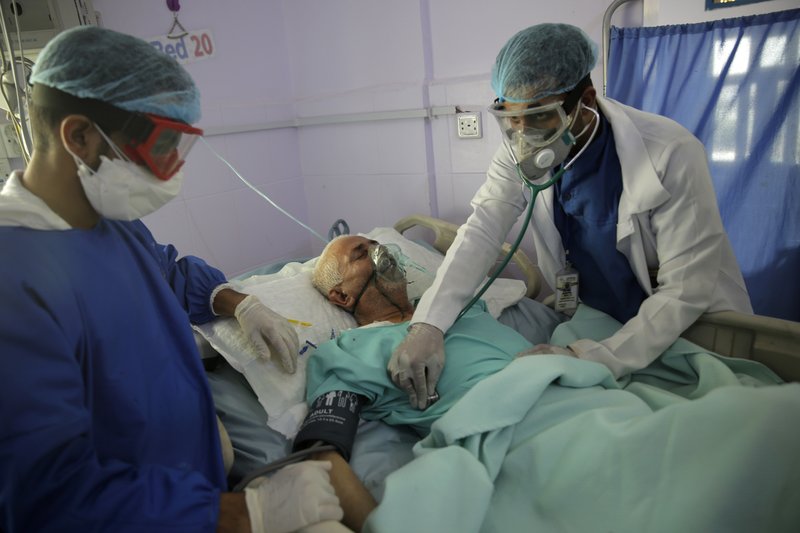
In southern Yemen, health workers are leaving their posts en masse because of a lack of protective equipment, and some hospitals are turning away patients struggling to breathe. In Sudan’s war-ravaged Darfur region, where there is little testing capacity, a mysterious illness resembling COVID-19 is spreading through camps for the internally displaced.
Cases are soaring in India and Pakistan, together home to more than 1.5 billion people and where authorities say nationwide lockdowns are no longer an option because of high poverty.
In Latin America, Brazil has a confirmed caseload and death count second only to the United States, and its leader is unwilling to take steps to stem the spread of the virus. Alarming escalations are unfolding in Peru, Chile, Ecuador and Panama, even after they imposed early lockdowns.
The first reports of disarray are also emerging from hospitals in South Africa, which has its continent’s most developed economy. Sick patients are lying on beds in corridors as one hospital runs out of space. At another, an emergency morgue was needed to hold more than 700 bodies.
“We are reaping the whirlwind now,” said Francois Venter, a South African health expert at the University of Witswatersrand in Johannesburg.
Worldwide, there are 10 million confirmed cases and over 500,000 reported deaths, according to a tally by Johns Hopkins University of government reports. Experts say both those numbers are serious undercounts of the true toll of the pandemic, due to limited testing and missed mild cases.
South Africa has more than a third of Africa’s confirmed cases of COVID-19. It’s ahead of other African countries in the pandemic timeline and approaching its peak. If its facilities break under the strain, it will be a grim forewarning because South Africa’s health system is reputed to be the continent’s best.
Most poor countries took action early on. Some, like Uganda, which already had a sophisticated detection system built up during its yearslong battle with viral hemorrhagic fever, have thus far been arguably more successful than the U.S. and other wealthy countries in battling coronavirus.
But since the beginning of the pandemic, poor and conflict-ravaged countries have generally been at a major disadvantage, and they remain so.
The global scramble for protective equipment sent prices soaring. Testing kits have also been hard to come by. Tracking and quarantining patients requires large numbers of health workers.
“It’s all a domino effect,” said Kate White, head of emergencies for Doctors Without Borders. “Whenever you have countries that are economically not as well off as others, then they will be adversely affected.”
Global health experts say testing is key, but months into the pandemic, few developing countries can keep carrying out the tens of thousands of tests every week that are needed to detect and contain outbreaks.
“The majority of the places that we work in are not able to have that level of testing capacity, and that’s the level that you need to be able to get things really under control,” White said.
South Africa leads Africa in testing, but an initially promising program has now been overrun in Cape Town, which alone has more reported cases than any other African country except Egypt. Critical shortages of kits have forced city officials to abandon testing anyone for under 55 unless they have a serious health condition or are in a hospital.
Venter said a Cape Town-like surge could easily play out next in “the big cities of Nigeria, Congo, Kenya,” and they “do not have the health resources that we do.”
Lockdowns are likely the most effective safeguard, but they have exacted a heavy toll even on middle-class families in Europe and North America, and are economically devastating in developing countries.
India’s lockdown, the world’s largest, caused countless migrant workers in major cities to lose their jobs overnight. Fearing hunger, thousands took to the highways by foot to return to their home villages, and many were killed in traffic accidents or died from dehydration.
The government has since set up quarantine facilities and now provides special rail service to get people home safely, but there are concerns the migration has already spread the virus to India’s rural areas, where the health infrastructure is even weaker.
Poverty has also accelerated the pandemic in Latin America, where millions with informal jobs had to go out and keep working, and then returned to crowded homes where they spread the virus to relatives.
Peru’s strict three-month lockdown failed to contain its outbreak, and it now has the world’s sixth-highest number of cases in a population of 32 million, according to Johns Hopkins. Intensive care units are nearly 88% occupied, and the virus shows no sign of slowing.
“Hospitals are on the verge of collapse,” said epidemiologist Ciro Maguiña, a professor of medicine at Cayetano Heredia University in the capital, Lima.
Aid groups have tried to help, but they have faced their own struggles. Doctors Without Borders says the price it pays for masks went up threefold at one point and is still higher than normal.
The group also faces obstacles in transporting medical supplies to remote areas as international and domestic flights have been drastically reduced. And as wealthy donor countries struggle with their own outbreaks, there are concerns they will cut back on humanitarian aid.
Mired in civil war for the past five years, Yemen was already home to the world’s worst humanitarian crisis before the virus hit. Now the Houthi rebels are suppressing all information about an outbreak in the north, and the health system in the government-controlled south is collapsing.
“Coronavirus has invaded our homes, our cities, our countryside,” said Dr. Abdul Rahman al-Azraqi, an internal medicine specialist and former hospital director in the city of Taiz, which is split between the rival forces. He estimates that 90% of Yemeni patients die at home.
“Our hospital doesn’t have any doctors, only a few nurses and administrators. There is effectively no medical treatment.”
___
Krauss reported from Jerusalem. Associated Press writers Andrew Meldrum in Johannesburg, Emily Schmall in New Delhi, Isabel DeBre in Cairo, Franklin Briceño in Lima, Peru, and Michael Weissenstein in Havana contributed to this report.
___

Democrats want John Wayne’s name, statue taken off airport


SANTA ANA, Calif. (AP) — In the latest move to change place names in light of U.S. racial history, leaders of Orange County’s Democratic Party are pushing to drop film legend John Wayne’s name, statue and other likenesses from the county’s airport because of his racist and bigoted comments.
The Los Angeles Times reported that earlier this week, officials passed an emergency resolution condemning Wayne’s “racist and bigoted statements” made in a 1971 interview and are calling on the Orange County Board of Supervisors to drop his name, statue and other likenesses from the international airport.
The resolution asked the board “to restore its original name: Orange County Airport.”
“There have been past efforts to get this done and now we’re putting our name and our backing into this to make sure there is a name change,” said Ada Briceño, chair of the Democratic Party of Orange County.
According to those who crafted the resolution, the effort to oust Wayne, a longtime resident of Orange County who died in 1979, is part of “a national movement to remove white supremacist symbols and names (that are) reshaping American institutions, monuments, businesses, nonprofits, sports leagues and teams.”
In a 1971 Playboy magazine interview, Wayne makes bigoted statements against Black people, Native Americans and the LGBTQ community.
“I believe in white supremacy until the blacks are educated to a point of responsibility. I don’t believe in giving authority and positions of leadership and judgment to irresponsible people,” he said.
Wayne also said that although he didn’t condone slavery: “I don’t feel guilty about the fact that five or 10 generations ago these people were slaves.”
The actor said he felt no remorse in the subjugation of Native Americans.
“I don’t feel we did wrong in taking this great country away from them. … (O)ur so-called stealing of this country from them was just a matter of survival,” he said. “There were great numbers of people who needed new land, and the Indians were selfishly trying to keep it for themselves.”
Wayne also called movies such as “Easy Rider” and “Midnight Cowboy” perverted, and used a gay slur to refer to the two main characters of the latter film.
Orange County Supervisor Don Wagner told the newspaper that he had just heard about the Democratic resolution and was unaware of its wording or merit.

Mississippi surrenders Confederate symbol from state flag


JACKSON, Miss. (AP) — Mississippi will retire the last state flag in the U.S. with the Confederate battle emblem, more than a century after white supremacist legislators adopted the design a generation after the South lost the Civil War.
A broad coalition of lawmakers — Black and white, Democrat and Republican — voted Sunday for change as the state faced increasing pressure amid nationwide protests against racial injustice.
Mississippi has a 38% Black population, and critics have said for generations that it’s wrong to have a flag that prominently features an emblem many condemn as racist.
ADVERTISEMENT
Democratic Sen. David Jordan told his colleagues just before the vote that Mississippi needs a flag that unifies rather than divides.
“Let’s do this because it’s the right thing to do,” Jordan said.
The Senate voted 37-14 to retire the flag, hours after the House voted 91-23.
Cheers rang out in the state Capitol after the Senate vote. Some spectators wept. Legislators embraced each other, many hugging colleagues who were on the opposing side of an issue that has long divided the tradition-bound state.
Republican Gov. Tate Reeves is expected to sign the bill into law in the next few days.
Democratic Rep. Robert Johnson of Natchez choked back tears as he told reporters that he has seen white colleagues develop more empathy about how the Confederate symbol is painful to him and other African Americans.
“They began to understand and feel the same thing that I’ve been feeling for 61 years of my life,” Johnson said.
A commission will design a new flag that cannot include the Confederate symbol and that must have the words “In God We Trust.” Voters will be asked to approve the new design in the Nov. 3 election. If they reject it, the commission will set a different design using the same guidelines, and that would be sent to voters later.
Republican House Speaker Philip Gunn, who is white, has pushed for five years to change the flag, saying the Confederate symbol is offensive.
“How sweet it is to celebrate this on the Lord’s day,” Gunn said.
Legislators put the Confederate emblem on the upper left corner of Mississippi flag in 1894, as white people were squelching political power that African Americans had gained after the Civil War.
In a 2001 statewide election, voters chose to keep the flag. An increasing number of cities and all Mississippi’s public universities have taken down the state flag in recent years. But until now, efforts to redesign the flag sputtered in the Republican-dominated Legislature.
ADVERTISEMENT
That dynamic shifted as an extraordinary and diverse coalition of political, business, religious groups and sports leaders pushed for change.
At a Black Lives Matter protest outside the Mississippi Governor’s Mansion in early June, thousands cheered as an organizer said the state needs to divorce itself from all Confederate symbols.
Religious groups said erasing the rebel emblem from the state flag is a moral imperative. Notable among them was the state’s largest church group, the 500,000-member Mississippi Baptist Convention, which called for change last week after not pushing for it before the 2001 election.
Business groups said the banner hinders economic development in one of the poorest states in the nation.
In a sports-crazy culture, the biggest blow might have happened when college sports leagues said Mississippi could lose postseason events if it continued flying the Confederate-themed flag. Nearly four dozen of Mississippi’s university athletic directors and coaches came to the Capitol to lobby for change.
Many people who wanted to keep the emblem on the Mississippi flag said they see it as a symbol of heritage.
The battle emblem is a red field topped by a blue X with 13 white stars. The Ku Klux Klan and other hate groups have waved the rebel flag for decades.
The Mississippi Supreme Court found in 2000 that when the state updated its laws in 1906, portions dealing with the flag were not included. That meant the banner lacked official status. The Democratic governor in 2000, Ronnie Musgrove, appointed a commission to decide the flag’s future. It held hearings across the state that grew ugly as people shouted at each other about the flag.
Legislators then opted not to set a flag design themselves, and put the issue on the 2001 statewide ballot.
Former Mississippi Gov. William Winter, who is now 97, served on then-President Bill Clinton’s national advisory board on race in the 1990s and was chairman of the Mississippi flag commission in 2000. Winter said Sunday that removing the Confederate symbol from the banner is “long overdue.”
“The battle for a better Mississippi does not end with the removal of the flag, and we should work in concert to make other positive changes in the interest of all of our people,” said Winter, a Democrat who was governor from 1980 until 1984.
Democratic state Sen. Derrick Simmons of Greenville, who is African American, said the state deserves a flag to make all people proud.
“Today is a history-making day in the state of Mississippi,” Simmons told colleagues. “Let’s vote today for the Mississippi of tomorrow.”

Trump says intel doesn’t back up report on Russian bounties against US troops


President Trump late Sunday said U.S. intelligence could not confirm an explosive story that Russian military officials offered bounties to militants linked to the Taliban to kill U.S. troops in Afghanistan.
The New York Times, citing unnamed officials, reported Friday that it is believed that some “Islamist militants” or “criminal elements” collected payouts. The report pointed out that 20 Americans were killed there in 2019. It was not clear if any of those deaths were the result of a bounty.
“Intel just reported to me that they did not find this info credible, and therefore did not report it to me or @VP. Possibly another fabricated Russia Hoax, maybe by the Fake News @NYTimesbnooks, wanting to make Republicans look bad.”
TASS, the state news agency, reported that the Russian Foreign Ministry called the reports “information fakes.” A Taliban spokesman also denied any truth to the report.
Thomas Joscelyn, a senior fellow at the Foundation for Defense of Democracies, a think tank, told the Wall Street Journal that “Moscow’s willingness to embrace the Taliban openly and publically dates back several years” and he would not be surprised if there is truth to the report.
“The truly shocking revelation that if the Times report is true, and I emphasize that again, is that President Trump, the commander in chief of American troops serving in a dangerous theater of war, has known about this for months, according to the Times, and done worse than nothing,” Joe Biden, the presumptive Democratic nominee, said during a virtual town hall.
The White House said neither Trump nor Vice President Mike Pence was briefed on such intelligence. “This does not speak to the merit of the alleged intelligence but to the inaccuracy of the New York Times story erroneously suggesting that President Trump was briefed on this matter,” press secretary Kayleigh McEnany said in a statement.
The Times’ report sent a shockwave through the Capitol on Friday where politicians have been focused on the recent unrest after George Floyd’s death in police custody and what many are referring to a resurgent coronavirus outbreak.
The paper said that Trump was briefed on the intelligence and the administration’s National Security Council considered issuing a diplomatic complaint to Moscow.  The report said that Russia is conducting what is referred to as a hybrid war with the U.S.—which consists of cyberattacks and military operations that can be denied.
Trump’s tweet was in response to Sen. Lindsey Graham, R-S.C., who tweeted earlier that it is “imperative Congress get to the bottom” of the report.
The Associated Press contributed to this report

Sunday, June 28, 2020

Who you Gonna Call Cartoons


4 men charged in attack on Jackson statue near White House today

 
The base of the statue of former president Andrew Jackson is power washed inside a newly closed Lafayette Park, Wednesday, June 24, 2020, in Washington, which has been the site of protests over the death of George Floyd, a black man who was in police custody in Minneapolis. Floyd died after being restrained by Minneapolis police officers. (AP Photo/Jacquelyn Martin)

WASHINGTON (AP) — Federal authorities have charged four men in connection with a failed effort last week to pull down the statue of President Andrew Jackson near the White House.
In a complaint unsealed Saturday, authorities allege that the men damaged and attempted to tear down the Jackson statue, which is located in Lafayette Square, last Monday. The square has been the site of protests in the aftermath of George Floyd’s death while in police custody in Minneapolis.
Those charged are Lee Michael Cantrell, 47, of Virginia; Connor Matthew Judd, 20, of Washington, D.C.; Ryan Lane, 37, of Maryland; and Graham Lloyd, 37, of Maine.
Judd was arrested on Friday and appeared in Superior Court of the District of Columbia on Saturday, authorities said. The other three have not been apprehended. The FBI and the U.S. Park Police have been investigating the incident.
A statement from the U.S. Attorney’s Office for the District of Columbia says the complaint alleges that Cantrell was captured on video attempting to pry the statue off its base with a wooden board and trying to pull the statue down with the aid of a yellow strap. Judd is seen on video trying to pull down the statue while Lane is seen on video affixing a rope to one part of the statue and then pulling on another rope tied to the statue, the complaint alleges.
The video also shows Lloyd as he breaks off and destroys the wheels of cannons located at the base of the statue, pulling on ropes in an effort to topple the statue, and handing a hammer to an unidentified individual involved in the incident, the complaint alleges.
“The United States Attorney’s Office for the District of Columbia will not stand idly by and allow our national monuments to be vandalized and destroyed,” Acting U.S. Attorney Michael R. Sherwin said in a statement.

Biden VP hopeful Karen Bass slammed over past praise for Fidel Castro: report


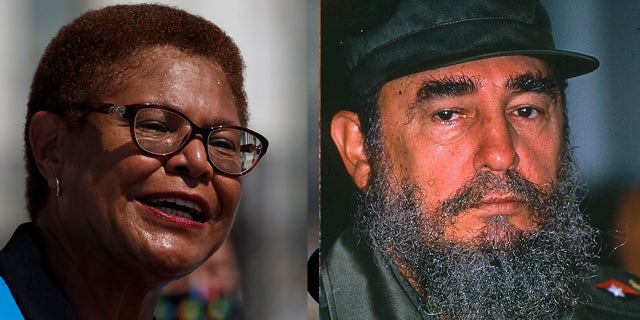
Past praise for the late Cuban dictator Fidel Castro has some Miami-area Democrats worried about a lawmaker said to be in the running to join the Joe Biden ticket.
U.S. Rep. Karen Bass, a Los Angeles Democrat who heads the Congressional Black Caucus, referred to Castro as “comandante en jefe” after he died in 2016 – and called his passing “a great loss to the people of Cuba,” Politico reported.
The phrase Bass used translates to “commander in chief.”
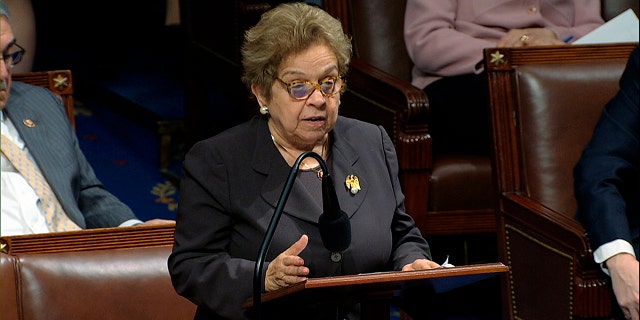
Democrats speaking out against Bass’s apparent admiration for the late dictator – who led the Cuban Revolution in the 1950s and was a thorn in the side of U.S. presidents for a half-century – include U.S. Rep. Donna Shalala, D-Fla., and Miami state Rep. Javier Fernandez.

U.S. Rep. Karen Bass, D-Calif., is facing backlash from Miami-area Democrats over her past praise of the late Cuban dictator Fidel Castro.

U.S. Rep. Karen Bass, D-Calif., is facing backlash from Miami-area Democrats over her past praise of the late Cuban dictator Fidel Castro.
Both Shalala and Fernandez represent an area with a high number of exiles from communist and socialist regimes in Cuba, Venezuela and Nicaragua – a constituency that has a history of opposing candidates who express even the slightest amount of sympathy for Castro, who ruled in Cuba as president until 2008 and as Communist Party leader until 2011 before dying five years later at age 90.
“I disagree with the Congresswoman's comments on Cuba. I invite people to come to Miami where we can educate them on the tyrannical dictatorship that has decimated Cuba for 60 years,” Shalala, who served in former President Bill Clinton’s administration, told Politico.
"I invite people to come to Miami where we can educate them on the tyrannical dictatorship that has decimated Cuba for 60 years."
— U.S. Rep. Donna Shalala, D-Fla.
U.S. Rep. Donna Shalala, D-Fla.

U.S. Rep. Donna Shalala, D-Fla.
“The comments are troubling,” Fernandez told the outlet. “It shows a lack of understanding about what the Castro regime was about. So I have to learn more about her position and perspective on Fidel Castro.
“Praise like the one that was given by Bass at the time of Castro’s death is inconsistent with my family’s experience with what the regime did — and continues to do — to people on the island, which is to suppress human rights, keep people under a totalitarian thumb and stifle economic growth.”
Bass’s congressional office told Politico the congresswoman’s remarks in 2016 were similar to those uttered by former President Barack Obama, who at the time was seeking better relations with Cuba as the country prepared to transition from the leadership of Castro and his brother, Raul Castro, now 89, who remains a Communist Party leader there after succeeding Fidel Castro as president from 2008-2018.
Biden’s campaign declined to comment to Politico about Bass’s remarks.
The news outlet noted that former Biden primary opponent Bernie Sanders was heavily criticized in Florida for making pro-Castro comments during a “60 Minutes” interview on CBS in February, after being asked about previous pro-Castro remarks attributed to him in 1985.

Trump veto of student loan bill stands as House Dems' override attempt fails


President Trump and Education Secretary Betsy DeVos are seen at Trump National Golf Club Bedminster in Bedminster, N.J., prior to Trump taking office, in an undated photo. (Associated Press) 

House Democrats on Friday failed to override President Donald Trump’s veto of a measure that would have reversed the Education Department's tough policy on loan forgiveness for students misled by for-profit colleges.
The House voted 238-173 in support of the override measure, coming up short of the two-thirds majority needed to send it to the Senate.
It marks a victory for Education Secretary Betsy DeVos, whose policy on student loan forgiveness was in jeopardy after Congress voted to reverse it in March. It now remains in place and will take effect July 1.
A statement from the Education Department said it looks forward to implementing a rule “that protects students from fraud, treats higher education institutions fairly and protects taxpayers.”
The measure Congress approved in March would have restored a 2016 rule created by the Obama administration. It was approved using the Congressional Review Act, which allows Congress to overturn federal rules with a simple majority of both chambers and approval of the president.
While the original measure had bipartisan support, just six Republicans voted in favor of overriding the veto, while 172 opposed it.
In calling for the override, Democrats said DeVos' rule made it nearly impossible for cheated students to get loans canceled. They accused her of stacking the rules in favor of the for-profit college industry, which has found an ally in the Trump administration.
placeholder
But Republicans said DeVos' rule is an improvement over the Obama-era policy, which they say granted loan cancellations too freely.
“Massive loan forgiveness has long been a Democrat objective, and the Obama rule was a giant leap toward that goal. One that also ignored the high cost to taxpayers,” said Rep. Virginia Foxx, R-N.C., the ranking Republican on the House education committee.
“Massive loan forgiveness has long been a Democrat objective, and the Obama rule was a giant leap toward that goal -- one that also ignored the high cost to taxpayers.”
— U.S. Rep. Virginia Foxx, R-N.C.
The dispute stems from a policy known as borrower defense to repayment, which allows borrowers to get their federal student loans erased if their colleges made false claims to get them to enroll.
The rule was created in the 1990s but was expanded under President Barack Obama after the collapse of for-profit college chain Corinthian Colleges. The chain closed in 2015 after authorities found it used misleading ads to recruit students and lied about the success of its graduates.
Students could get loans forgiven under the Obama-era rule if there was evidence of significant misrepresentation or breach of contract by the college. In cases of widespread fraud, entire groups of students could get loans discharged under a single claim.
But DeVos halted the policy before it took effect, saying it had become too easy to get loans forgiven. Last year, DeVos replaced it with a new policy that she said protects taxpayers and colleges from frivolous claims.
placeholder
Her rule sets a higher bar for loan relief, requiring borrowers to prove their schools knowingly misled them and caused personal financial harm. It also sets a time limit on claims, giving students up to three years after they graduate or withdraw.
Other changes include the elimination of group claims and a provision that automatically canceled loans for students who went to schools that shut down before they could graduate.
Her policy was backed by Republicans and by the for-profit college industry, which says it was unfairly targeted by the Obama administration. Democrats and consumer advocates, though, say the rule strips protections for defrauded students.
The Institute for College Access and Success on Friday said the rule will leave many defrauded students stuck repaying their loans.
“The rule creates roadblocks for defrauded students in the middle of an economic and a public health crisis, while imposing next to no consequences for the deceitful colleges,” said James Kvaal, the nonprofit's president.
DeVos has faced sharp criticism from Democrats over her handling of the policy and a backlog of loan cancellation claims. In April, DeVos said she would process more than 170,000 claims as part of a settlement in a lawsuit alleging that she illegally halted the process while she rewrote the rule.
placeholder
As of April 30, the agency said it has 130,000 pending claims out of 318,000 total received applications.
DeVos separately changed the policy to provide only partial loan relief to many students. Her update provides full discharges only if students attended programs that produce graduates with average earnings far below those of graduates at similar programs. Other students get portions of their loans erased. The Obama-era rule provided full loan forgiveness only.
Consumer groups filed a lawsuit challenging DeVos' partial relief rule in June.

Minneapolis council members calling to defund police spend $63G on private security details after receiving death threats


Several Minneapolis City Council members who have received death threats following their calls to defund the police after the death of George Floyd have been assigned private security details -- reportedly costing the city $4,500 a day in taxpayer dollars.
placeholder
According to information obtained by Fox News, the city has spent $63,000 on private security over the last three weeks.
“The names of the people getting security details are not public,” a city spokesperson told Fox News Saturday.
The names of three council members who are receiving private security detail have already been made public, two of whom interviewed with local affiliate Fox 9 on Friday. The spokesperson did not respond to Fox News' questions about whether or not there were additional council members receiving security detail.
The threats reportedly came after the council members were vocal in their calls to defund the Minneapolis Police Department (MPD).
The Minneapolis City Council unanimously approved a proposal to eliminate the city's police department Friday, initiating steps toward establishing a new "holistic" approach to public safety.
The largely white police force has struggled to regain the city’s trust after the death of George Floyd. The new proposal would eliminate the existing police department and instead create "a department of community safety and violence prevention, which will have responsibility for public safety services prioritizing a holistic, public health-oriented approach."
placeholder
One council member told Fox 9: “I don’t feel comfortable publicly discussing the death threats against me or the level of security I currently have protecting me from those threats.”
They noted that the security detail was temporary.
But another council member told the outlet they had been worried about security since they were sworn in.
“My concern is the large number of white nationalist[s] in our city and other threatening communications I’ve been receiving,” they said.
None of the council members responded to Fox News’ request for comment.
LAW ENFORCEMENT EXPERTS ON DEFUNDING, DISMANTLING POLICE: 'WHEN YOU CALL 911 WHO IS GOING TO COME OUT?'
The Minneapolis Police Department, which would traditionally provide security in this scenario, could not be reached by Fox News but told Fox 9 that the MPD does not have any records of recent threats against the three council members -- adding that it was possible the record could have been filed confidentially.
placeholder
“Council members have reported to staff numerous threats to themselves personally,” the city told Fox News Saturday.
One of the council members who spoke with Fox 9 said they did not alert the threats to the MPD because they were consumed with dealing with the “global pandemic and global uprising” after Floyd's death. But they noted that the threats had been wide-ranging, attacking their ethnicity, gender identity and sexuality.
The Minneapolis mayor’s office could not be reached by Fox News to address the security threats against the council members. But a city spokesperson told Fox 9 that the MPD resources were needed elsewhere in the community. They also said that the cost of the private security detail was roughly the same as the cost for the taxpayer as would be MPD security services.
Private security has been provided by two firms, Aegis and BelCom, as an interim fix until other security solutions can be established.
“This security service was intended to be temporary and [a] bridge to other security measures implemented by council members themselves,” a city spokesperson told Fox News.
The security expenses do not need city council approval unless the amount surpasses $175,000. A spokesperson for the city told Fox 9 that the temporary security costs are not anticipated to come near that threshold.
placeholder

Minneapolis council members (IDIOTS)


City Council members


Transforming public safety

The City Council and the Minnesota Department of Human Rights have started a process to transform public safety in Minneapolis with the help of community leaders and residents.
We invite you to submit your thoughts to the City Council.
Learn more and add your commen

CartoonDems