


Conservative Blogger

Sen. Ted Cruz on Friday urged his fellow lawmakers to nominate and confirm a Supreme Court justice before the Nov. 3 presidential election following the death of Ruth Bader Ginsburg, warning of a looming "constitutional crisis" if the seat remains vacant.
"We cannot have Election Day come and go with a four-four court," Cruz said during an interview with Fox News' Sean Hannity. "A four-four court that is equally divided cannot decide anything. And I think we risk a constitutional crisis if we do not have a nine-justice Supreme Court, particularly when there is such a risk of a contested election."
The Texas Republican -- one of President Trump's 20 potential nominees to the court, according to a list issued last week by the White House -- called on Trump to nominate Ginsburg's successor next week. Ginsburg died Friday due to complications of metastatic pancreatic cancer. She was 87.
"I think it is critical that the Senate takes up and confirms that successor before Election Day," he said. "There's going to be enormous pressure from the media, there's going to be enormous pressure from the Democrats to delay filling this vacancy. But this election, this nomination is why Donald Trump was elected. This confirmation is why the voters voted for a Republican majority in the Senate."
Cruz continued: "I'll tell you one reason in particular why I think it is tremendously important that not only does the nomination happen next week, but that the confirmation happen before Election Day. Democrats and Joe Biden have made clear they intend to challenge this election. They intend to fight the legitimacy of this election. As you know, Hillary Clinton has told Joe Biden 'under no circumstances should you concede. You should challenge this election.'"
Earlier in the night, before learning of Ginsburg's death, Trump told supporters at a Minnesota rally that he was "putting Ted Cruz as one of the people for the Supreme Court."
"Ted’s the only man I know who could get 100 votes from the Senate," he said. "Every single senator is going to vote for him. But he’s a great guy, and he's a brilliant guy.”
Cruz has said that he would not accept a nomination to the Supreme Court.
"It is deeply honoring, it is humbling to be included in the list," he said during an interview on "Sunday Morning Futures." "But it's not the desire of my heart. I want to be in the political fight."
Ginsburg's death, less than seven weeks before the Nov. 3 election, sets up a fierce partisan battle over the future of the court.
Conservatives outnumbered liberals on the court 5-4 before the death of Ginsburg, a liberal stalwart. With a new right-leaning justice, conservatives could hold a solid 6-3 majority.
Senate Majority Leader Mitch McConnell, R-Ky., pledged on Friday that "President Trump's nominee will receive a vote on the floor of the United States Senate."
"Americans reelected our majority in 2016 and expanded it in 2018 because we pledged to work with President Trump and support his agenda, particularly his outstanding appointments to the federal judiciary," McConnell said in a statement. “Once again, we will keep our promise. President Trump’s nominee will receive a vote on the floor of the United States Senate.”
Republicans hold a slim 53-47 majority in the Senate, and it's unclear that they have the necessary votes to nominate and confirm a new justice. A simple majority of senators present and voting is required for the confirmation of a Supreme Court justice.
Senate Minority Leader Chuck Schumer, D-N.Y., has already said the open seat should not be filled until after the Nov. 3 election.
"The American people should have a voice in the selection of their next Supreme Court Justice. Therefore, this vacancy should not be filled until we have a new president," Schumer, D-N.Y., tweeted on Friday.
Democratic presidential candidate Joe Biden has vowed to nominate a Black woman to the nation's highest court system, though he has not released specific candidates.
In a statement Friday night, the former vice president said the Senate should wait until after the election to nominate and confirm a new justice, citing Republicans' opposition in 2016 to former President Barack Obama's nomination of Merrick Garland to fill Scalia's seat.
"The voters should pick a president, and that President should select a successor to Justice Ginsburg," Biden said. "This was the position that the Republican Senate took in 2016, when there were nearly nine months before the election. That is the position the United States Senate must take now, when the election is less than two months away."
The 2016 presidential election happened as a seat on the Supreme Court was at stake following the death of a justice -- that will be the case yet again in 2020 after Justice Ruth Bader Ginsburg, the face of the liberal bloc on the Supreme Court and a trailblazer for women's rights, died on Friday.
In 2016, the vacancy was for Justice Antonin Scalia's seat, and Senate Majority Leader Mitch McConnell, R-Ky., used his caucus' numbers to hold the seat open until after the presidential election, saying Americans should have a say in who chooses Scalia's successor. That led to the confirmation of Trump nominee Justice Neil Gorsuch.
Senate Judiciary Committee Ranking Member Dianne Feinstein, D-Calif., at the time told Republicans "to do their job" and give then-President Barack Obama nominee Merrick Garland "full and fair consideration."
Now in 2020 the roles are reversed.
McConnell has indicated that he intends to have the Senate vote on a nominee from President Trump. Feinstein said that "under no circumstances" should the vacancy opened by Ginsburg's death be filled before the January inauguration.
Feinstein argues things are the same now as they were in 2016.
"Merrick Garland was nominated to fill Scalia’s seat on March 16, 2016 – 237 days before the presidential election. Today, we’re just 46 days away from an election," she said in a statement Friday. "To jam through a lifetime appointment to the country’s highest court – particularly to replace an icon like Justice Ginsburg – would be the height of hypocrisy."
McConnell says things are different.
"In the last midterm election before Justice Scalia’s death in 2016, Americans elected a Republican Senate majority because we pledged to check and balance the last days of a lame-duck president’s second term," the majority leader said. "We kept our promise. Since the 1880s, no Senate has confirmed an opposite-party president’s Supreme Court nominee in a presidential election year."
He added: "By contrast, Americans reelected our majority in 2016 and expanded it in 2018 because we pledged to work with President Trump and support his agenda, particularly his outstanding appointments to the federal judiciary. Once again, we will keep our promise."
McConnell and Feinstein are fundamentally aiming to ensure the next justice the Senate confirms is nominated by a president from their party. But their arguments for whether precedent is on their side -- and about who is acting hypocritically -- are likely to take center stage in the next few months. And the pair of powerful senators are far from the only ones apparently changing their tunes from 2016.
Another is Sen. John Thune, R-S.D., the Republican whip in the Senate. He said in 2016 that the Republican Senate "was elected to be a check and balance on President Obama. The American people deserve to have their voices heard on the nomination of the next Supreme Court justice, who could fundamentally alter the direction of the Supreme Court for a generation. Since the next presidential election is already underway, the next president should make this lifetime appointment to the Supreme Court."
On Friday Thune said: "While tonight the nation rightly mourns, we’ll soon turn to the Senate’s constitutional role in this process. I believe Americans sent a Republican president and a Republican Senate to Washington to ensure we have an impartial judiciary that upholds the Constitution and the rule of law. We will fulfill our obligation to them. As Leader McConnell has said, President Trump’s Supreme Court nominee will receive a vote on the floor of the U.S. Senate."
Senate Minority Leader Chuck Schumer, D-N.Y., changed his tune as well.
"Garland has integrity, a brilliant legal mind & is a perfect fit for #SCOTUS," he tweeted in 2016. "GOP inaction does our country a great disservice. #DoYourJob."
Schumer on Friday, however, said that the vacancy created by Ginsburg's passing shouldn't be filled until there is "another president," likely meaning the Senate should not act until after the January presidential inauguration.
"The American people should have a voice in the selection of their next Supreme Court Justice. Therefore, this vacancy should not be filled until we have a new president," he said.
Others have changed their attitudes as well, but at least one senator has already doubled down on the same position she held in 2016.
Sen. Lisa Murkowski, R-Alaska, a moderate and a swing vote on many judicial nominations, said before Ginsburg's death that she would not support action on a Supreme Court nomination before the presidential election.
"I would not vote to confirm a Supreme Court nominee. We are 50 some days away from an election," she told Alaska Public Media.
That statement matches her 2016 stance that a justice should not be confirmed before the election.
"[G]iven the timing of this vacancy, in the middle of a Presidential election and in an increasingly toxic political environment, I had urged the President to refrain from naming a nominee," Murkowski said in 2016. "I believe he should have left that task to the next administration. Vice President Joe Biden, during his time in the Senate, advised that consideration of a Supreme Court nominee should be put off until after the election is over, because the thoughtful consideration that a Supreme Court nominee deserves simply cannot occur at the height of a political season. I find a great deal of wisdom in those words, because in my judgment they accurately describe what is already happening with regard to this election-year nomination."
Meanwhile, Sen. Susan Collins, R-Maine, was one of the few Republicans in 2016 to say that the Senate should consider Garland.
“The meeting left me more convinced than ever that the process should proceed. The next step, in my view, should be public hearings," she said. Collins on Friday did not indicate her thoughts on whether the Senate should process a Trump nominee.
Notably silent on the issue of whether or not there should be a vote on a replacement for Ginsburg as of Friday evening, however, are multiple Republican senators who are currently up for reelection in competitive races and in 2016 said that the Senate should wait until after the presidential election to confirm a nominee.
Among these are Sens. Thom Tillis, R-N.C.; Joni Ernst, R-Iowa; Cory Gardner, R-Colo.; Steve Daines, R-Montana; and Senate Judiciary Committee Chairman Lindsey Graham, R-S.C.
The Supreme Court vacancy, which if filled by Trump, has the potential to fundamentally alter the balance of the court, is likely to spur tens of millions of dollars in political spending and will alter the complexion of the presidential election and many Senate races.
Fox News' Jon Decker contributed to this report.

Sen. Susan Collins, R-Maine, on Friday night called Supreme Court Justice Ruth Bader Ginsburg a “fierce champion for equality” after the news broke of Ginsburg’s death from pancreatic cancer.
But Collins, who faces the fiercest reelection battle of her Senate career, was silent on whether she would support or oppose a vote on Ginsburg’s successor before the presidential election -- or the inauguration in January if Democrat Joe Biden were to win the presidency.
“Justice Ruth Bader Ginsburg was a trailblazer for women’s rights, a fierce champion for equality, and an extremely accomplished American who broke countless barriers in the field of law,” Collins said in a statement. “Throughout her life, Justice Ginsburg surmounted discrimination and sexism through her brilliance, tenacity, and wit, becoming one of the most prominent legal luminaries of our time.”
Collins added that she "had the great honor of getting to know Justice Ginsburg personally when the women Senators twice had dinner with her and former Justice Sandra Day O’Connor. She has been a role model to generations of women, and her legacy will live on in the countless people she inspired.”
Collins, 67, who has served in the Senate since 1997, is among a handful of Republican senators occasionally willing to break rank with her party. So her vote on a Trump nominee to succeed Ginsburg prior to the presidential election could loom large.
Her crucial vote to confirm Justice Brett Kavanaugh to the Supreme Court in 2018 angered many progressive women across the country (who opposed his nomination because of sexual assault allegations) -- as well as many Mainers who are determined to unseat her.
Recent polls show Collins running around 5 points behind her Democratic challenger Sara Gideon, speaker of Maine's House of Representatives.
It's unclear if voting for a Trump Supreme Court nominee so close to the election would help or hurt Collins' own reelection chances.
Senate Majority Leader Mitch McConnell said in a statement Friday that a Trump nominee would get a vote in the Senate -- in stark contrast to his previous stance that the next president should appoint Supreme Court Justice Antonin Scalia’s successor after Scalia died in early 2016.
The Senate refused a hearing on former President Obama's nominee, Merrick Garland, and Trump's nominee, Justice Neil Gorsuch, was confirmed by the Senate shortly after Trump took office in 2017.
Fellow Senate Republican nonconformist Lisa Murkowski of Alaska, prior to hearing about Ginsburg’s death Friday, said she "would not vote" for a new Supreme Court justice before the election.
“We are 50 some days away from an election,” Murkowski said in an interview, according to Alaska Public Media.
A representative for Collins, however, declined twice to give an answer on whether Collins would vote for a Trump nominee, according to the Portland Press Herald in Maine.

The death of Ruth Bader Ginsburg put the Supreme Court at the epicenter of the 2020 presidential election, setting up a furious battle over who should fill the vacancy.
Ginsburg, 87, died Friday of complications from metastatic pancreatic cancer, just weeks before the Nov. 3 presidential election, likely marking the start of a bitter partisan feud over who will fill her empty seat.
Conservatives outnumbered liberals on the court 5-4 before the death of Ginsburg, a liberal stalwart. With a new right-leaning justice, conservatives could hold a solid 6-3 majority.
At the beginning of September, President Trump unveiled a list of potential Supreme Court nominees should he have future vacancies to fill. The list included a trio of conservative senators -- Ted Cruz, R-Texas; Josh Hawley, R-Mo., and Tom Cotton, R-Ark., -- as well as Kentucky Attorney General Daniel Cameron and Christopher Landau, the U.S. ambassador to Mexico.
“Wow. I didn’t know that," Trump told reporters Friday night when informed of Ginsburg's death. "You’re telling me now for the first time. She led an amazing life. What else can you say? She was an amazing woman, whether you agreed or not, she was an amazing woman who led an amazing life. I’m actually saddened to hear that."
Senate Majority Leader Mitch McConnell has repeatedly said that he would move swiftly to fill a Supreme Court vacancy, despite opposing a push by Democrats and former President Barack Obama to fill Justice Antonin Scalia's seat after he died in February 2016. McConnell reiterated that pledge on Friday night.
"Americans reelected our majority in 2016 and expanded it in 2018 because we pledged to work with President Trump and support his agenda, particularly his outstanding appointments to the federal judiciary," McConnell said in a statement. “Once again, we will keep our promise. President Trump’s nominee will receive a vote on the floor of the United States Senate.”

Republicans hold a slim 53-47 majority in the Senate, and it's unclear that they have the necessary votes to nominate and confirm a new justice. A simple majority of senators present and voting is required for the confirmation of a Supreme Court justice.
Several senators who are facing tight re-election odds this year, including Joni Ernst, R-Iowa, and Lindsey Graham, R-S.C., in 2016 suggested the Senate should wait until after the November election to nominate and confirm a new justice.
Senate Minority Leader Chuck Schumer, D-N.Y., has already said the open seat should not be filled until after the Nov. 3 election.
"The American people should have a voice in the selection of their next Supreme Court Justice. Therefore, this vacancy should not be filled until we have a new president," Schumer, D-N.Y., tweeted on Friday.
Democratic presidential candidate Joe Biden has vowed to nominate a Black woman to the nation's highest court system.
In a statement Friday night, the former vice president said the Senate should wait until after the election to nominate and confirm a new justice, citing Republicans' opposition in 2016 to Obama's nomination of Merrick Garland to fill Scalia's seat.
"The voters should pick a president, and that President should select a successor to Justice Ginsburg," he said. "This was the position that the Republican Senate took in 2016, when there were nearly nine months before the election. That is the position the United States Senate must take now, when the election is less than two months away."

Centers for Disease Control and Prevention Director Dr. Robert Redfield holds up a CDC document that reads “COVID-19 Vaccination Program Interim Playbook for Jurisdiction Operations” as he speaks appears at a Senate Appropriations subcommittee hearing on a “Review of Coronavirus Response Efforts” on Capitol Hill, Wednesday, Sept. 16, 2020, in Washington. (AP Photo/Andrew Harnik, Pool)
Federal health agencies and the Department of Defense have revealed a coronavirus vaccine “playbook,” which outlined how shots will be administered across the U.S. This comes as several companies are nearing the final stage of vaccine trials.
In a report to Congress, the CDC put forward a plan they said is “much larger in scope and complexity than seasonal influenza or other previous outbreak related vaccination responses.” Their “playbook” is geared toward state and local governments, which will take on the responsibility of developing precise plans for receiving and distributing the vaccine.
Other key details of the distribution campaign included its source of funding. The plan is currently set to be backed by taxpayer dollars, which will enable any American to be vaccinated without having to pay out of pocket.
The plan will also require most people to get two doses of the vaccine. They will reportedly need to get the second dose between 21 and 28 days later from the same manufacturer.

FILE – In this July 30, 2020 photo, Kai Hu, a research associate transfers medium to cells, in the laboratory at Imperial College in London. (AP Photo/Kirsty Wigglesworth)
The government is hoping to launch the campaign gradually in January, or possibly later this year. Resources will first be prioritized for certain populations, including at risk groups, health care workers and other essential employees.
HHS Secretary Alex Azar has reaffirmed the government will be working on all levels to “ensure Americans can receive the vaccine as soon as possible and vaccinate with confidence.” He also said “Americans should know the vaccine process is being driven completely by science and data.”
There are over 170 possible coronavirus vaccines being developed across the world right now. At least 35 of those are under clinical evaluation.
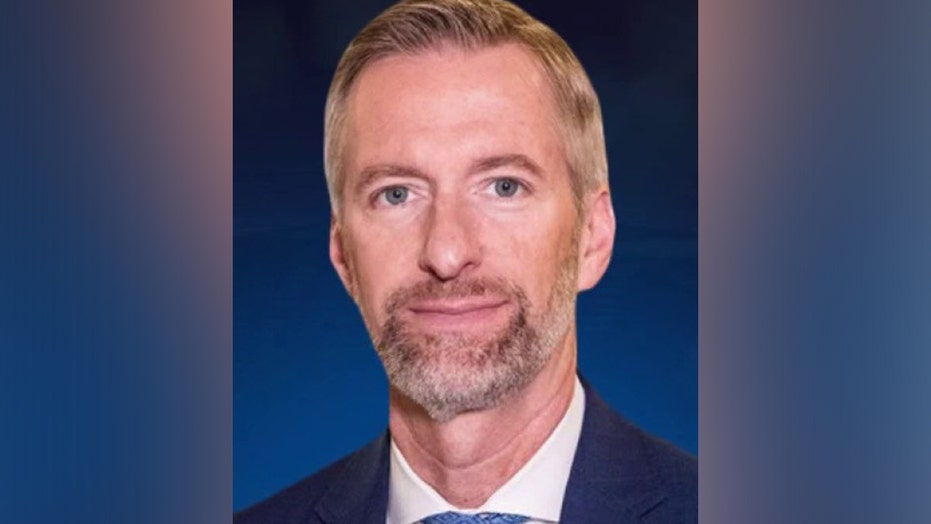
Portland, Ore., Mayor Ted Wheeler hired a new campaign manager this week – his third such hire in nine months – after the second person to take the job left last week, according to reports.
The hiring of Danny O’Halloran, a veteran of U.S. Sen. Cory Booker’s presidential campaign, comes just weeks before the city's mayoral election and as polls show Wheeler with high "unfavorable" numbers among voters, OregonLive.com reported.
The embattled mayor, who is also the city’s police commissioner, has faced criticism from all sides over his handling of months of nightly anti-police protests that frequently turn violent.
Late last month, a clash between opposing groups resulted in the shooting death of Aaron Danielson, a backer of President Trump was killed by an Antifa supporter.
PORTLAND MAYOR TED WHEELER VIEWED NEGATIVELY BY TWO-THIRDS OF CITY'S VOTERS: REPORT
Wheeler's most recent campaign manager, Amy Rathfelder, left as the campaign underwent “a bit of financial restructuring due to budgetary constraints,” Wheeler’s campaign field director Nate Chock said, according to Oregon Public Broadcasting.
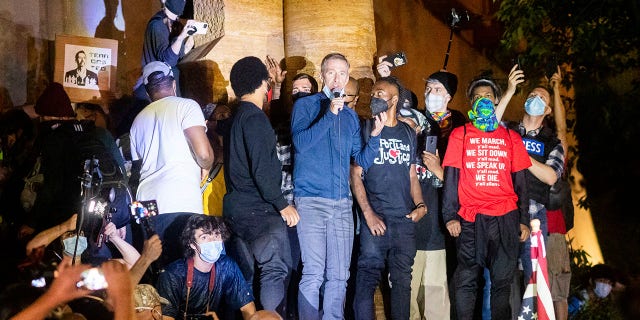
Portland Mayor Ted Wheeler speaks to Black Lives Matter protesters in Portland, Ore in July. (Associated Press)
Rathfelder reportedly left to take a new job. She had been named campaign manager in January when Wheeler’s first campaign manager, Jennifer Arguinzoni, left.
Former communication director Lorien Seroka also left in the last nine months.
Wheeler’s embattled campaign has also been hit with 23 city election violations, including listing campaign donors in a font too small for an average reader on a flier, OregonLive.com reported.
The 58-year-old incumbent, who has been the city's mayor since January 2017 after previously serving as state treasurer and as a Multnomah County commissioner, is facing a challenge from urban policy consultant Sarah Iannarone, who has referred to herself as an “everyday anti-fascist," Willamette Week reported.
She has raised more than $600,000 with the city’s 6-1 match for small campaign donations compared to Wheeler’s nearly $261,000. He opted out of the program, according to OregonLive.com.
There are no public polls on the race between Wheeler and Iannarone.

Washington state is known for its apples -- but Gov. Jay Inslee didn't appear to do the popular fruit any public-relations favors last week.
The Democrat, in an effort to bring comfort to communities in Eastern Washington devastated by recent wildfires, unknowingly and illegally gifted baskets of apples from his orchard in Olympia that were later found to be infested with apple maggot larvae, according to reports.
Thurston County, where Inslee lives, is an apple maggot quarantine area --meaning it was illegal for Inslee to bring homegrown apples from that area to a non-quarantine area like Douglas County, according to Q13 FOX in Seattle.
The governor expressed his regrets in a statement.
“Last week Trudi [Inslee's wife] and I wanted to express comfort for the communities suffering from devastating fires," Inslee said. "When I visited some of these areas, I took some apples we picked from our tree in Olympia. We regret this mistake. This is a good reminder of the importance of awareness around apple quarantine. We appreciate the Washington State Department of Agriculture’s efforts to help recover these apples and we are assisting to help make that happen.”
A basket of apples the governor gave to a retirement home in Omak, Wash., later tested positive for apple maggot larvae so officials were desperately trying to find the basket he left at a church in Omak, Wash., but no one knows where it went, according to the station.
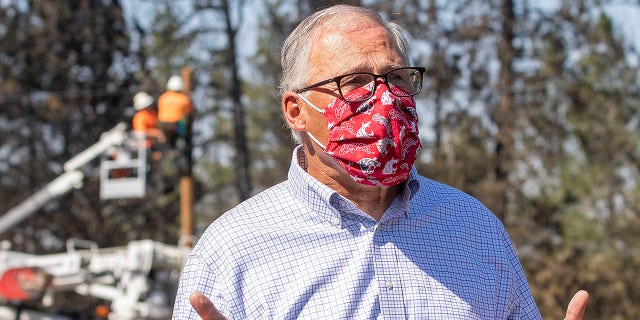
Washington Gov. Jay Inslee speaks on the state's wildfires during a news conference in Malden, Wash., Sept. 10, 2020. (Associated Press)
Douglas County, west of Spokane, is currently pest-free and could be infected by the bad apples.
"Apple Maggots are an incredibly serious pest and could have dire consequences for the orchardists of Douglas County if we are unable to find the infected apples and mitigate the effects immediately," Douglas County officials wrote on Facebook. "Douglas County orchardists, regulators, and processors have worked tireless to ensure that our area stays free of apple maggots and this event could have serious implications for the region. It is of the utmost importance these apples are safely disposed of immediately."
Officials said they had reason to believe the apples may have been mixed with others that weren’t contaminated, according to Q13.
With apple orchards everywhere in the town, some in Bridgeport called the governor’s gift – contaminated or not -- a “slap in the face,” according to Seattle's KUOW-TV.
“Some people are living in tents; some people with relatives,” a 45-year resident of the devastated town said. “The most challenging thing is building back, you know. There’s people asking for money, which a lot of people don’t have it here.”

The U.S. attorney for the Western District of Washington issued a statement early Thursday denying an explosive report that claimed Attorney General William Barr asked federal prosecutors to explore whether they could bring criminal charges against Seattle Mayor Jenny Durkan for allowing the Capitol Hill Organized Protest (CHOP) police-free protest zone that led to two fatal shootings.
Brian T. Moran, the federal prosecutor, said he has had multiple conversations with leadership inside within the Department of Justice and "at no time has anyone at the Department communicated to me that Seattle Mayor Jenny Durkan is, was or should be charged with any federal crime" related to CHOP.
"As U.S. Attorney I would be aware of such an investigation," he said.
The New York Times reported Wednesday that Barr directed the Justice Department’s civil rights division to consider criminal charges against the Democratic mayor, who publicly sparred with President Trump and repeatedly denied federal help to quell the unrest in her city. A department spokesman told the paper that Barr did not direct the civil rights division to explore this idea.
The report also accuses Barr of directing federal prosecutors to consider charging rioters and other violent actors with federal charges -- including sedition -- in a call with U.S. attorneys last week.
Federal sedition charges apply to two or more people who "conspire to overthrow, put down, or to destroy by force" the U.S. government, and carries a maximum penalty of 20 years in prison.
Durkan issued her own statement in light of the Times' report. She said the report was "chilling and the latest abuse of power from the Trump administration."
"Ultimately, this is not a story about me. It is about the (sp) how this President and his Attorney General are willing to subvert the law and use the Department of Justice for political purposes. It is particularly egregious to try to use the civil rights laws to investigate, intimidate, or deter those that are fighting for civil rights in our country," she wrote.
The administration's aggressive crackdown on demonstrators follows warnings from Barr and other officials who anticipate an increase in violence ahead of the November election.


