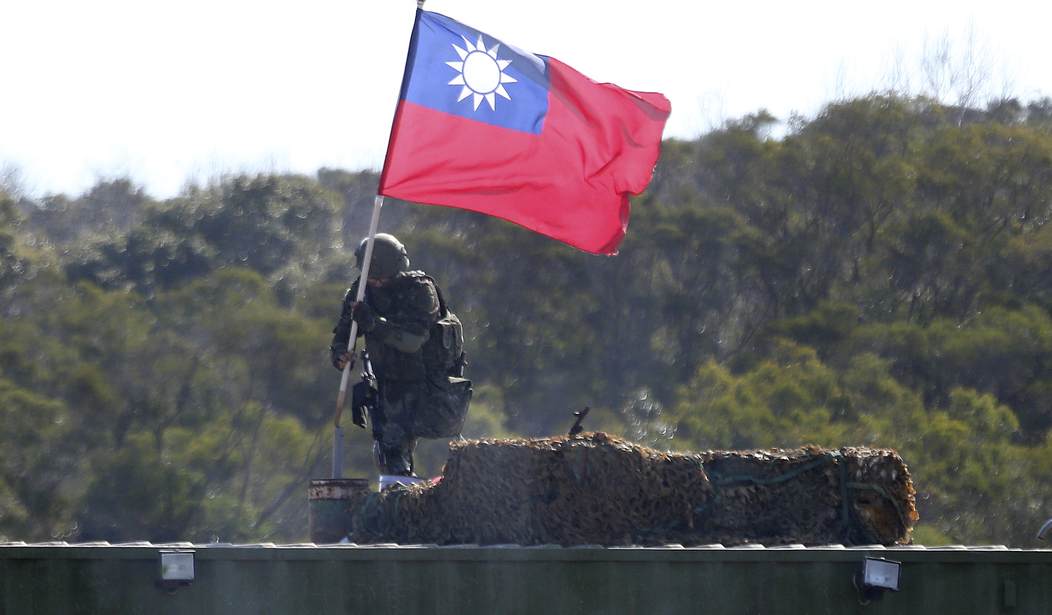
I think China will attack Taiwan at some point in the near
future. Near future is a relative term, of course, because it could mean
anything from next weekend to five years from now. But they are sending
all the right signals and doing all the right things to foreshadow
their intentions. They want that island badly, and they're probably not
going to go away without trying to take it. At least as long as Xi is
still breathing.
So, I guess the first question I have is, "Why didn't they do it
while Biden was president?" He was weak, probably compromised by Chinese
money, and was certainly non compos mentis Seemed like a prime
opportunity for them, but I surmise that they simply didn't feel that
the time was right. I doubt that they really care who's POTUS because I
don't think they have much fear of the US military. Biden may have done
nothing, or he may have done something in the event of an attack.
Apparently, it didn't matter much to them. Trump will certainly do
something, but again, based on their recent activities, they don't care
what he'll do either. They have their own plans that will run on their
own timetable. And they seem to be full of confidence in their
abilities.
What's Holding China Back?
So, at
times like this, I cannot help but wonder what's holding them up?
Anybody who has read more than two Tom Clancy novels has a little part
of themselves that says, "Hey, I can figure this out too!" After all, he
got his initiation into the world of spy/military writing by wargaming
and reading history books. He didn't have a formal background in
military planning, but he talked to people who did, and he had a great
mind for figuring stuff out. Well before the end of his life, military
experts were coming to him with questions and opinions. I'm certainly
not on that level, but I admit I do like to dabble. So before anybody
flames me for being a know-nothing armchair quarterback, understand that
I realize my experience and knowledge are very limited, but I am willing to learn.
China
is a large country that is obsessed with taking over a small country.
This small country has chips. Lots and lots of chips, but these aren't
chips that they can't make themselves, so it isn't about chips, or
natural resources, or anything like that. I don't think anyway.
Breakaway province and all of that, but I think, as these things usually
are, it's simply about nationalism, hegemony, and power. They have a
fair amount of money, and they want to use it to flex muscle by
extending cheap loans to countries that can never pay them back. Which
means they want to force some foreclosures in the future. Which means
they want global assets to secure global aims.
Okay, so back to my other question: What are they waiting on? Only
they know, but it could be a number of things. I'd like to contemplate
some of the possibilities here. Maybe they are still testing reaction
times with their encroachment into Taiwanese airspace. Every time they
compel the ROCAF
to take off and respond, they're putting wear and tear on Taiwanese
jets and pilots. Parts burn out that can't be replaced right away, and
pilots get fatigued. Sounds kind of frivolous, but it turns out this is a
real thing.
The Challenge of Landing Troops
Maybe
they're still working on the problem of landing hundreds of thousands
of troops on the Taiwanese coast. The Chinese have always relied on mass
quantities of men to achieve their military goals. Korea, everybody
knows that story. And for a story not everybody does, see Vietnam in
1979. The Chinese launched a punitive attack (for Hanoi's decapitation
of the Khmer Rouge in Cambodia, a Chinese ally) with 600,000 troops.
The People's Liberation Army occupied a sizable portion of northern
Vietnam, stuck around for a couple of months, lost around 26,000 dead,
and then just up and left. They wanted to send a message that they could
come in anytime they desired and do anything they wished. We want that new car in the showroom. We don't care how much it costs.
So today, with Taiwan, they aren't going to care about the cost either,
but they will care about the logistical problems of getting enough
people on the island to saturate its defenses and absorb it like The
Borg.
There are problems. The undersea shelf that Taiwan sits on
is kind of shallow on the western side (facing China), and it actually
has few beaches that aren't full of rocks, cliffs, and other such
obstacles... on all coasts. If you want your landing craft to avoid
destruction, you probably want some water under that keel because of
mines, traps, and tides. If you want your troops to get a beachhead,
terrain that favors your enemy is going to slow you down. Especially if
your plans are reliant on pushing huge quantities of men onto that beach
before they can be blown up by artillery, missiles, or bombs while
massed there. So maybe they're in the process of working that out. Or it
could be that they're still building the number of landing craft that
they think they'll need. Might be that.
Right now, they're building some very interesting self-propelled
landing barges that analysts are likening to the Mulberry harbors the
Allies employed during the Normandy invasion. Think of Speed Racer's car up on the automatic jacks....only
a lot bigger. And they come in three sizes. It's believed that they
have 3-5 of these things, and they can move up and down with the tides
by crawling vertically on their support pylons as needed. These have
"bailey bridges" up to about 430' long that will reach over poor terrain
from which to offload vehicles and men. I think if you're China,
there's only one reason for constructing these. I guess a good question
would be, how many of these will they need to carry out a successful
invasion?
Vulnerabilities at Sea
Anyway, an
invasion force of that size is going to have to be supplied by sea,
which, of course, will be very exposed to US submarine attack. China has
submarines of its own, slightly fewer than we do, but not nearly as
capable. Most of those are diesel/electric, which means they have to
surface about every 48 hours to recharge their batteries. A significant
vulnerability. Ours are all nuclear. They never have to pop up in the
daylight, if at all. It's also interesting that the Chinese don't seem
to be placing a lot of emphasis on producing submarines for an upcoming
war effort. It's true that they're developing boats like the Type 095,
which is supposed to have a water jet propulsion
instead of standard props to keep noise levels down, as well as a lot
of other whiz bangs, but that's a completely new class under
construction and likely won't show up for work anytime soon. But right
now, they are trying to sell
submarines (that you would think they'd want to keep for a new war) to
countries like Thailand and India. I think that's a little odd.
Especially when they trail us in capability and generally rely on
numbers to overcome such gaps.
When the Chinese do invade, they could lose a lot of ships, but with the largest merchant capability
in the world, it may not matter how many hulls go down, but what type
of cargo those hulls were carrying and how critical to their war effort
those items were. Moreover, the US invests a significant amount of time
and money in anti-submarine warfare (ASW). The Chinese don't. They put
their efforts into anti-shipping, with most of their destroyer types
emphasizing those types of weapons.
I would expect that Chinese
efforts to conquer Taiwan will include resupply by air. That won't be
able to deliver the numbers they need, and it will be a supplemental
effort to a sealift as with many historic invasions. Transports are not
stealthy, nor are they fast, so one can expect an attrition rate on
those from either land-based missiles or fighter planes. But being a
stone's throw away from home, Chinese airpower is certainly going to
have the numbers to favor their efforts. Especially if the claims about
their hypersonic missiles are true and will keep our carriers with their
fighter wings loitering out around Guam. I don't know if there's really
any reliable information about either their capabilities or our
defenses against those. Maybe someone on here can enlighten. But an
airlift will require that runways be captured at some point because
resupply by parachute isn't ever going to be as effective.
So now
I guess it's time to look at the people involved. I'm not going to
consider the US Navy right now because of the hypersonic missile threat.
If it's as real as some analysts believe, and we have no effective
defense against them, I'm not sure pushing them into the South China Sea
is going to be a great course of action. You don't want to turn your
best capital ships into floating hotels that never see their intended
purpose (Tirpitz, Yamato, Musashi), but then again, you don't
want to waste them (and the 5,000 men and women who crew them) on a
fight they have no defense against. So I guess for us, that leaves the
silent service. American submarine crews have a very long history and a
very long learning curve of how to do things right. The Chinese don't.
It's that straightforward. Those shortcomings will manifest themselves
somehow in a fight, and it probably won't favor the Chinese Navy-Army,
Army-Navy, or whatever they call it.
The Role of Airpower
I would expect the US Air
Force will be showing up with bombers out of Guam and Australia and a
lot of other stuff out of Japan, like fighters and surveillance. And I
also expect the US Air Force will display their usual expertise and
professionalism. They'll bloody some noses. I also expect that China
will "punish" the Japanese for hosting the Allied war effort (I think
that's how we'll look at it because Australia and Japan are probably
going to get involved under the "You're Next" maxim) by
extending the fight to their soil as a way to get their populations to
pressure their governments toward neutrality. I don't think this will
work and, at the same time, will probably invite direct airstrikes on
the Chinese coast. China will saber rattle about nuclear retaliation,
and Trump might respond with a typical "You want to take a swing at us
that way, remember that you have 500 nukes and we have 5000." They
probably think he's crazy anyway, but they do know he's unpredictable.
Anyway,
back to people, particularly how the Chinese may fight. Their pilots
have been aggressive to the point of ramming American surveillance
aircraft. They've also done the reckless stuff that you read in the news
from time to time (thumping, crazing, and near-misses). Like fighter
pilots the world over, these are your Type-A personalities. I don't
think any of them will shy away from a fight, and their effectiveness
will come down to how well the equipment works and the numbers they put
up since they have no experience. Experience in a flier counts for a lot
because of rule #11. "The best pilots fly more than the others; that's why they're the best." So I think the Chinese-Air Force-Army...Navy-thing, or whatever they call that one, will
show up. The actual Army is not going to be full of your Type-A
personalities but a mix of everything. However, they will all be stamped
from the same die. Probably very radical and very motivated. One would
think they'd fight very hard because Beijing is likely telling them that
Taiwan is really Chinese soil, so they're probably going to motivate
the troops by saying, "You're fighting for your homeland." I think the
plan will be to saturate and overcome since Beijing doesn't care how
many death notices it has to send out to families. Nobody over there is
going to be aware of the kinship they will share with other "gold star"
mothers because Xinhua will just compartmentalize it all.
And What of the Taiwanese?
So, finally, we have the
Taiwanese. I have absolutely no doubt that they will fight very hard and
be extremely difficult to overcome. Taiwan is their home, Red China is
their enemy, and I don't think any of them want to be subjugated and
forced to live under the communist system. There are over 23 million of
them, and they are all being asked to train for war
on some level. I think that if they are initially overcome, they will
resort to asymmetrical warfare, and given the fact that they share the
physical characteristics and language of their enemy, it will be very
hard for the PLA to pacify them all. As we have learned from past wars,
they're difficult to win when you cannot tell your friends from your
enemies. And maybe this is the main concern of the Chinese war planners.
I don't know, and I don't think anyone else does either, but if Beijing
is not threatened by this puzzle piece, it probably should be.
To
conclude, I don't think a Chinese invasion of Taiwan is going to be a
walkover. I think it will turn out to be a very bloody war of attrition
and a festering wound for the Chinese. It is almost certainly going to
cost them something in world trade and the state of their economy. Which
right now, might just be a little bit iffy.
Editor's Note:
Every single day, here at RedState, we will stand up and FIGHT, FIGHT,
FIGHT against the radical left and deliver the conservative reporting
our readers deserve.
Help us continue to tell the truth about the Trump administration and its major wins. Join RedState VIP and use promo code FIGHT to get 60% off your membership.