Fifty-two American diplomats and citizens were held hostage for 444 days from November 4, 1979, to January 20, 1981, after a group of Iranian college students belonging to the Muslim Student Followers of the Imam's Line, who supported the Iranian Revolution, took over the U.S. Embassy in Tehran.
In
this May 21, 2019, photo, acting Defense Secretary Patrick Shanahan,
left, and Secretary of State Mike Pompeo speak to members of the media
after a classified briefing for members of Congress on Iran on Capitol
Hill in Washington. (AP Photo/Patrick Semansky)
Mike Pompeo’s Iranian counterpart Javad Zarif claims that he’s never directly spoken with the secretary of state.
On Friday, the foreign minister said the main reason for the lack of communication was due to Pompeo’s “tendency to insult” him.
In
this May 21, 2019, photo, acting Defense Secretary Patrick Shanahan,
left, and Secretary of State Mike Pompeo speak to members of the media
after a classified briefing for members of Congress on Iran on Capitol
Hill in Washington. (AP Photo/Patrick Semansky)
A State Department spokeswoman deflected concern over Zarif’s
comments, explaining the administration’s “high-pressure campaign is
aimed at forcing Iran to the negotiating table.”
She added, “if the Iranians are willing to engage on changing their
ways to behave like a normal nation, we are willing to talk to them.”
Meantime, the foreign minister also took aim at the White House for its recent deployment of 15,000 troops to the Middle East.
In a statement Saturday, Zarif called the president’s move dangerous
for peace in the region, adding the U.S. is “inflating tensions with
Iran.”
His comments come after President Trump announced he will send troops
to assist our Middle Eastern allies, including Saudi Arabia, Jordan,
and the UAE.
He said the move was meant as a “deterrent” to Iran’s military, and will help guarantee the safety of U.S. forces.
Japanese Prime Minister Shinzo Abe seems to know how to appeal to President Trump as he tries to ease trade tensions between Japan and the U.S. – including a threat of auto tariffs -- and continue to receive U.S. support in dealing with North Korea.
On
Sunday morning, Abe took Trump to a golf course, where the two leaders
played 16 holes before heading to a lunch of cheeseburgers made with
American beef.
On the links, Trump and Abe were joined by Japanese
professional golfer Isao Aoki, known for his putting technique. Aoki
was expected to present Trump with a putter he designed.
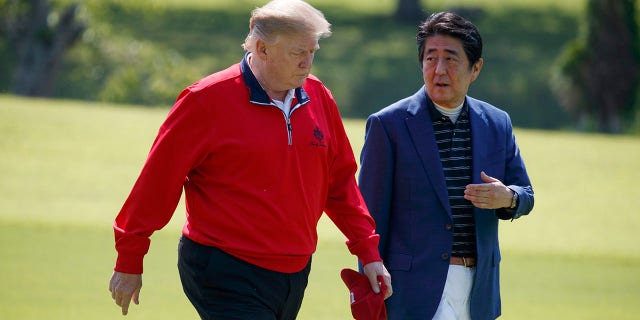
President Donald Trump walks with Japanese Prime Minister Shinzo
Abe before playing a round of golf at Mobara Country Club, on Sunday, in
Chiba, Japan. (Associated Press)
The outing seemed to go well, Abe told reporters.
"We
were able to exchange our views frankly in a cozy atmosphere. It was
wonderful," Abe said as he returned to his official residence.
Abe tweeted a photo of himself and Trump, taken on the greens.
Trump
tweeted that he'd had "Great fun and meeting with Prime Minister
@AbeShinzo," but also continued to stew about domestic politics,
claiming that, "Numerous Japanese officials told me that the Democrats
would rather see the United States fail than see me or the Republican
Party succeed - Death Wish!"
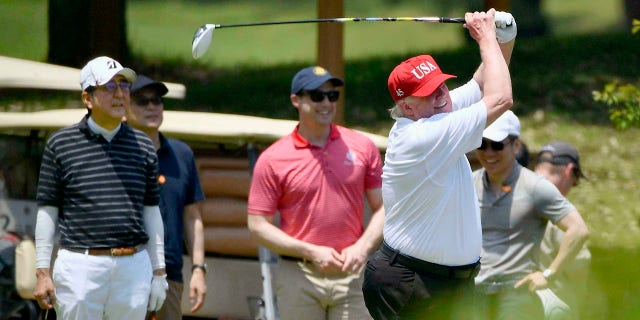
U.S. President Donald Trump, right, plays golf with Japanese Prime
Minister Shinzo Abe, left, at Mobara Country Club in Mobara, south of
Tokyo, on Sunday. (Associated Press)
The leaders then attended a sumo wrestling event in
the evening, where Trump presented a large trophy to a tournament winner
– in a first for a U.S. president.
On Monday, Trump will be the first foreign leader to meet with Japan's new emperor, Naruhito, since he took the throne May 1.
Then
Trump and Abe are expected to get down to business regarding trade
matters before ending the state visit with Trump the guest of honor at a
banquet hosted by the emperor. The Associated Press contributed to this story.
Do you think she'll ever go to jail ? She believes she can't be touched.
Hillary Clinton
hasn’t announced a 2020 run for the White House but remarks she
delivered in Houston may have sounded like a campaign speech to some
listeners.
Clinton launched a fiery attack Friday against President Trump, claiming the president tweeted a disputed video of House Speaker Nancy Pelosi because he was “running scared.”
"Just
look at what's happened in the last 24 hours," she said. "The president
and his cronies have been running around spreading a doctored video of Nancy Pelosi. Now, it is sexist trash. But it is also a sign that Trump is running scared."
The
former secretary of state, U.S. senator and 2016 Democratic
presidential nominee made the remarks at a gathering of the Harris
County Democratic Party.
Her speech seemed aimed at motivating Houston-area Democrats to get out the vote for the party’s candidates in 2020.
'Constitutional crisis'
“We
have to remind Americans we are the party that can deliver for them,”
Clinton said. “But we also are the party that will stand up and protect
the Constitution and address what is a very real constitutional crisis
that this president has put us in.”
Earlier this month, House Judiciary Committee Chairman Jerrold Nadler, D-N.Y., declared the U.S. was in a “constitutional crisis,” after Attorney General William Barr declined to testify before his panel after being subpoenaed.
Nadler
claimed the Trump administration was “stonewalling” efforts by
congressional Democrats to continue probes into possible collusion
between the Trump campaign and Russia, even though Special Counsel
Robert Mueller’s report on the investigation he led for two years
claimed no evidence of collusion existed.
The next day after Nadler spoke, Pelosi said she agreed with him that the nation was in a constitutional crisis.
President
Trump, meanwhile, has maintained that the Russia investigations still
underway in Congress should end because of Mueller’s findings, and
claimed that the Democrats’ continued focus on Russia was designed to
motivate their voters in 2020 – and was perhaps proof that the party had
not yet recovered from Trump’s defeat of Clinton in 2016.
Some
political observers have suggested that Clinton could make a third bid
for the presidency in 2020 if none of the more than 20 Democrats
currently in the running emerges as a clear threat to deny Trump a
second term.
A recent Fox News Poll
shows former Vice President Joe Biden leading the Democratic field with
support from 35 percent of respondents, followed by Sen. Bernie Sanders
at 17 percent and the rest of the pack in single digits.
Biden baggage?
But a Biden nomination would carry some baggage heading into a general election: The former U.S. senator from Delaware is known for gaffes during public appearances and recently drew criticism for his history of placing his hands on women and girls. In addition, his son Hunter Biden has drawn scrutiny over business dealings in China, Ukraine and Romania.
A
sudden loss of confidence in Biden among Democratic voters, coupled
with the failure of any of the other Democrats to fill the void, could
motivate Clinton – who attracted nearly 66 million votes in 2016 – to
make another run at the White House, some argue.
Clinton made headlines in March when she told a New York-area news station that she would not seek the presidency in 2020.
"Aw-shucks,"
President Trump responded in a Twitter message, "does that mean I won’t
get to run against her again? She will be sorely missed!"
But just a day later, “someone close to Clinton” told the New York Times that Clinton didn’t intend for her comments to “close the door on running.”
“She has told her team she is waiting at least to see the Mueller report,” the Times reported, citing the same source.
But
has Clinton's chance to win the presidency come and gone? A joint
speaking tour with her husband, former President Bill Clinton, resulted
in plunging ticket prices in several cities. In December, deals on tickets were being offered on Groupon.
Last week, Newsweek magazine
featured the Clintons on its cover with the headline, "Clintons in
Exile: What's it like when you're no longer the world's most powerful
couple?"
President Trump presents the "President's Cup" to the Tokyo Grand
Sumo Tournament winner Asanoyama, at Ryogoku Kokugikan Stadium, on
Sunday, in Tokyo. (Associated Press)
President Trump is accustomed to congratulating sports stars in the United States. But no president before him has ever presented a championship trophy to a sumo wrestler in Japan.
Trump
on Sunday awarded a giant, eagle-topped “President's Cup” to wrestler
Asanoyama, a 25-year-old athlete who clinched a tournament win a day
earlier.
The president -- the first American to participate in the
tournament -- then congratulated Asanoyama on his “outstanding
achievement.”
President Trump presents the "President's Cup" to the Tokyo Grand
Sumo Tournament winner Asanoyama, at Ryogoku Kokugikan Stadium, on
Sunday, in Tokyo. (Associated Press)
Then, with a little help, Trump handed the heavy cup to the champ. The White House said the 54-inch-high trophy weighs 60 to 70 pounds.
Asanoyama, whose real name is Hiroki Ishibashi, weighs 390 pounds, according to the Associated Press.
Earlier,
Trump sat ringside and watched some wrestling action, accompanied by
first lady Melania Trump and Japanese Prime Minister Shinzo Abe and his
wife, Akie – along with a crowd of about 11,500 wrestling fans.
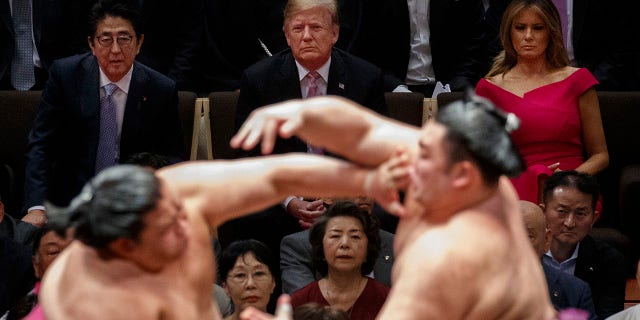
President Trump attends the Tokyo Grand Sumo Tournament with
Japanese Prime Minister Shinzo Abe at Ryogoku Kokugikan Stadium, on
Sunday, in Tokyo. First lady Melania Trump is at top right. (Associated
Press)
The size of the crowd was half the normal capacity,
as part of security preparations for Trump’s visit, and spectators went
through security checks, the Associated Press reported.
The
president is in Japan on a four-day visit that will include meeting
Japan’s new emperor and discussing trade issues with the Asian nation’s
leaders. The Associated Press contributed to this story.
President Donald Trump greets troops after landing at Joint Base
Elmendorf-Richardson for a refueling stop en route to Japan Friday, May
24, 2019, in Anchorage. (Associated Press)
President Trump greeted military personnel in Alaska during a refueling stop on Friday while on his way to Japan for a state visit.
Trump talked with American troops on the tarmac at Joint Base Elmendorf-Richardson, posed for photos and signed caps.
“Nice stop,” he was heard saying while walking across the tarmac.
“We’re
here in Alaska, we’re on our way to Japan, we’re with our great
military. These are great, great future leaders, right?” Trump said in a
video posted on Twitter.
“We just got off the plane, I wanted to
say hello, and these are tremendous people,” he continued, pointing at
the troops. “So thank you very much.”
Trump also met with Gov.
Mike Dunleavy during the stop, discussing issues concerning Alaska such
regulations affecting Alaska economy.
Trump was set to arrive in
Japan on Saturday evening local time, with the president being the first
foreign leader to meet Japan’s new emperor, Naruhito.
The latest charm offensive from Japan comes amid
fears among Japanese leaders that the potential U.S. tariffs on cars
could be devastating to the economy.
Japanese Prime Minister
Shinzo Abe likely to use his close relationship with Trump to make sure
his country is spared of the tariffs.
To
make that happen, the organizers of the state visit will show Trump the
country’s traditions, including meeting the emperor and attending sumo
wrestling matches. The Associated Press contributed to this report.
Actor Jon Voight expressed his support for President Trump, declaring him "the greatest president since Abraham Lincoln" in a two-part video message posted on Twitter on Friday night. Voight, one of the very few outspoken conservative actors in Hollywood, spoke directly to the "people of the Republican Party."
"I
know that you'll agree with me when I say that our president has our
utmost respect and our love," Voight began. "This job is not easy for
he's battling the left and their absurd words of destruction. ... Our
nation has been built on the solid ground from our forefathers and there
is a moral code of duty that has been passed on from President
Lincoln."
The Academy Award-winning actor told his followers that
he wanted to "acknowledge the truth" that "our country is stronger,
safer, and with more jobs" because President Trump "has made every move
correct."
"Don't
be fooled by the political left because we are the people of this
nation that is witnessing triumph," Voight continued. "So let us stand
with our president, let us stand for this truth that President Trump is
the greatest president since Abraham Lincoln. God bless America."
Voight
is best known for his lead role as Joe Buck in the 1969 film "Midnight
Cowboy." His decades-long career includes movie roles in "Deliverance,"
"Mission: Impossible," "Anaconda," "Zoolander," and "Transformers" as
well as television roles in "24" and "Ray Donovan."
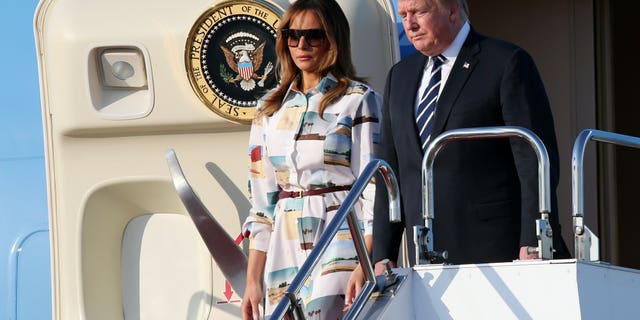
President Trump and first lady Melania Trump landed in Japan
on Saturday, kicking off a highly anticipated state visit -- with the
president to become the first foreign leader to meet Japan’s new Emperor
Naruhito.
The trip, which will last through Tuesday, comes amid
fears among Japanese political and business leaders that U.S. tariffs on
the auto industry will have a crippling effect on the Asian nation's
economy.
The president’s first stop was a dinner with business
leaders at the U.S. ambassador’s residence in Tokyo after a brief
airport welcome.
Trump told reporters that he’s working to introduce “fairness and reciprocity” in the new American-Japanese trade agreement.
“Japan
has had a substantial edge for many, many years but that’s OK," Trump
said during remarks with the business leaders in Tokyo, noting that
negotiators were “hard at work” on the trade talks. “We’ll get it a
little bit more fair.”
“Japan has had a substantial edge for many, many years but that’s ok. We’ll get it a little bit more fair.” — President Trump
He added that the new trade deal will “address the trade imbalance” and eliminate the existing “barriers to U.S. exports.”
Japan
enjoys a $70 billion trade surplus with the U.S, while it imports just a
fraction of U.S. goods and imposes protective measures against
competition from other countries, a source of frustration for Trump, who sees tariffs as a corrective measure.
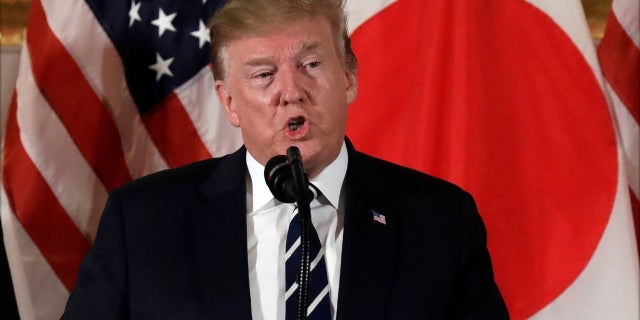
President Donald Trump speaks as he meets with Japanese business leaders, Saturday, in Tokyo. (Associated Press)
Japan is expected to use the state visit as a charm offensive to convince Trump to spare the country of the punitive tariffs.
To
fulfill this task, Trump is officially the first foreign leader invited
to meet with the country’s new Emperor Naruhito, who inherited the
throne earlier this month, a fact Trump gleefully acknowledged earlier
this week. The emperor will treat Trump to a meeting and host an
imperial banquet in Trump's honor.
“Prime Minister [Shinzo] Abe
said to me, very specifically, 'You are the guest of honor.' There's
only one guest of honor ... I'm the guest of honor at the biggest event
that they've had in over 200 years,” Trump said this week.
“So it's a great thing. And we get along very well with Japan. I get along very well with the prime minister.”
U.S. President Donald Trump, right, and first lady Melania Trump
arrive at the Haneda International Airport Saturday, May 25, 2019, in
Tokyo. (Associated Press)
During the first remarks in Japan, Trump also
stressed that Japan is buying military equipment from the U.S., which he
says was a sign of threats in the world.
“We make the best
equipment in the world -- the best jets, missiles, the best rockets, the
best everything,” he said. “So Japan is doing very large orders and we
appreciate that.”
“It's probably appropriate for everything going on,” he added. “The world is changing.”
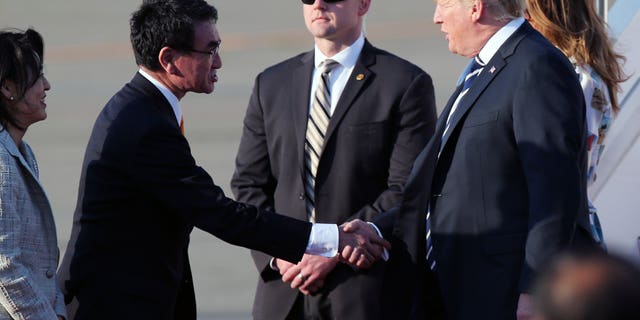
U.S. President Donald Trump, right, is greeted by Japanese Foreign
Minister Taro Kono, left, on Trump's arrival at the Haneda
International Airport Saturday, May 25, 2019, in Tokyo. (Associated
Press)
On Sunday, Trump and Abe are expected to play golf
and then watch a sumo wrestling tournament in front-row seats. Trump
previously called the sport “fascinating.”
Only on Monday will the
two leaders sit down to talk about trade. A possibility of a trade deal
is reportedly on the table, but officials on neither side committed to
such goal. (Because of the Japan trip, Trump paid a pre-Memorial Day visit to Arlington National Cemetery on Thursday, to honor America's war dead.)
The
U.S. and Japanese leaders will also discuss the threat from North
Korea, an issue that comes in the wake of U.S. national security adviser
John Bolton’s comments on Friday that a series of short-range missile
tests by North Korea last month was a violation of U.N. Security Council
resolutions.
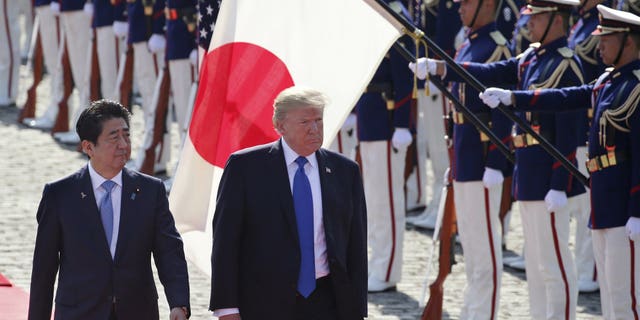
U.S. President Donald Trump, second from left, reviews an honor
guard during a welcome ceremony, escorted by Japanese Prime Minister
Shinzo Abe at Akasaka Palace in Tokyo, Nov. 6, 2017. (Associated Press)
But it remains to be seen whether the celebrations
and close relationship between Trump and Abe will be enough to force
Washington to reconsider imposing tariffs on Japanese auto exports.
The Trump administration is currently embroiled in a trade war against China over the country’s treatment of American companies.
Yet
the administration has been tough and criticized both Japan and the
European Union for, in its view, unfair trade practices that exploit the
U.S. economy. The Associated Press contributed to this report.