Rep. Ilhan Omar, D-Minn., rebuked a 2020 Democratic presidential candidate on Wednesday after he defended his offer to debate Rep. Alexandria Ocasio-Cortez, D-N.Y.
"No means no!" Omar said, using the language surrounding consent.
She was responding to former Rep. John Delaney, D-Md., who pushed to debate Ocasio-Cortez after she told him to "sashay away" from the 2020 field, citing his position on "Medicare-for-all"
Delaney appeared to provoke the ire of California Democrats on Saturday when he told the state's Democratic convention that "Medicare-for-all" was bad policy.
“We
should have universal health care. We should have universal health
care, but it shouldn’t be a kind of health care that kicks 150 million
Americans off their health care. That’s not smart policy," Delaney said.
When
Ocasio-Cortez, a prominent "Medicare-for-all" supporter, criticized
Delaney's statement, he requested a debate with the progressive
congresswoman.
Her
refusal prompted the response that Omar blasted on Wednesday. "At a
minimum, we have to be tolerant of different views on achieving the same
goal: universal healthcare," Delaney tweeted, alongside an article
about Ocasio-Cortez's refusal.
"That's why I responded to @aoc tweet with a debate offer. This isn't about slogans - people's lives are at stake. We need debates and the truth."
"AOC
and Rep Omar are incredibly intelligent women and rising stars inside
of the Democratic party. Instead of tweeting at our campaign and taking
pot shots, we should be sitting down and talking about the best path
forward," said Michael Starr Hopkins, the Delaney campaign's national
press secretary. "We’re on the same team. It’s okay to disagree, but
refusing to have a substantive conversation helps no one, especially not
the Americans who so desperately need us to solve this healthcare
crisis."
Delaney, on Wednesday, also lamented the Democratic Party's "intolerance to different ideas." He told Fox News that "Medicare-for-all" made it difficult for Democrats to beat Trump in 2020.
“In
the Medicare-for-all bill, it makes private insurance illegal. And
there are 150 million Americans who have private insurance and most of
them like it," he said.
"And
I think the Republicans are not going to be afraid to talk about this
and they’re going to pound it over the American people’s heads and make
them afraid that the Democrats are going to make them lose their health
insurance, and tell them that they’ve got to go on a government website
to get their health insurance,”
Their exchange came as 2020
Democrats faced scrutiny over how they would pay for the program as well
as whether or not it would kick millions off of their private health
insurance plans.
Sen. Bernie Sanders, I-Vt., an ally of Ocasio-Cortez, said at the end of May
that he would likely pay for the program with a progressive income tax
increase and a payroll tax on employers. The program has been estimated
to cost more than $30 trillion, according to two right-leaning think
tanks that looked at the issue.
The Trump administration has blasted the proposal as "the biggest threat to the American health care system." Fox News' Paul Steinhauser contributed to this report.
House Speaker Nancy Pelosi told senior Democrats on Tuesday that she ultimately wants to see President Trump “in prison,” according to a report.
The
speaker reportedly made the remark while defending her stance against
impeaching the president in an evening meeting with House Judiciary
Chairman Jerry Nadler and other top Democrats, according to Politico.
“I
don’t want to see him impeached, I want to see him in prison,” she
said, according to multiple Democratic sources familiar with the
meeting. House Intelligence Chairman Adam Schiff, Oversight Chairman
Elijah Cummings, Ways and Means Chairman Richard Neal and Foreign
Affairs Chairman Eliot Engel also reportedly attended the meeting.
“I don’t want to see him impeached, I want to see him in prison.” — Remark attributed to House Speaker Nancy Pelosi, according to a report
Pelosi
wants to hold the president accountable, the sources said, but thinks
voters should get him out of office in 2020, after which he could
possibly face criminal charges.
Nadler and dozens of Democrats
have been pressing Pelosi to hold impeachment hearings, but the speaker
reportedly believes there should be public and bipartisan support to
launch the process, according to Politico.
Pelosi has previously said the president’s actions “are villainous to the Constitution of the United States."
A Pelosi spokesperson told the New York Post
the lawmakers “had a productive meeting about the state of play with
the Mueller report. They agreed to keep all options on the table and
continue to move forward with an aggressive hearing and legislative
strategy, as early as next week, to address the president’s corruption
and abuses of power uncovered in the report.”
The spokesperson did not directly address whether Pelosi made the remark about Trump that was attributed to her.
The House will hold hearings next week "focused on the alleged crimes and other misconduct laid out in Special Counsel Robert Mueller's report."
Operation
Overlord — or D-Day as it came to be known — was the highest risk
venture of World War II. Researching my upcoming book, "Three Days at the Brink: FDR’s Daring Gamble to Win World War II," I was struck by the drama involved in the decision to launch an invasion across the English Channel on Western Europe.
At a critical conference in Tehran
in November 1943, the “Big Three” – President Franklin Delano
Roosevelt, British Prime Minister Winston Churchill and Soviet leader
Josef Stalin –fiercely debated the wisdom and timing of such a launch.
They all knew it was a high-stakes gamble and that failure could lead to
a catastrophic bloodbath that would turn the war in German leader Adolf
Hitler’s favor. And yet, they decided it must be done.
Supreme Commander Gen. Dwight D. Eisenhower was aware that, despite the peril, Overlord was a necessity.
"Every
obstacle must be overcome, every inconvenience suffered and every risk
run to ensure that our blow is decisive," Eisenhower wrote to his
commanders. "We cannot afford to fail."
He had devised an elaborate plan, choreographed to the last detail, but he knew that some circumstances were out of his control.
On
June 4, 1944, hearing discouraging weather reports and already having
delayed the invasion a day because of storms, Eisenhower faced an
agonizing moment of decision: to go on June 6 or wait for better
weather.
When President Trump delivers his D-Day
remarks Thursday at the U.S. Cemetery in Normandy, he has the rare
opportunity to pay tribute with emotion, personal stories, and soaring
words to the service and the sacrifice of those who died on those
beaches and saved the world.
At Southwick House, the
invasion headquarters in the southern English town of Portsmouth,
Eisenhower sat bowed, head in hands, and contemplated a seemingly
impossible choice. He wasn’t all-knowing; he could only judge
circumstances as they were set before him.
Further delay
might mean scrapping the mission altogether; the tides allowed only the
narrowest window for invasion, and the troops were already poised. "How
can you keep this invasion on the end of a limb and let it hang there?"
he asked.
On the other hand, if Allied forces invaded as a storm
rolled across the Channel, landing craft would be overwhelmed, air
support would be impossible, and thousands could perish to no avail.
Indeed,
unbeknownst to Eisenhower, German Gen. Erwin Rommel had already decided
the Allies would never risk the invasion and had left the theater to
meet with Hitler in Germany.
Eisenhower finally rose from his
seat, unwilling to decide just yet. He suggested to his team that they
try to get a few hours sleep and reconvene later.
At 3:30 a.m. on
June 5, Eisenhower brought his team back together and polled them for
their opinions, pacing the room as they spoke. He was heartened by an
improved weather forecast.
After everyone had finished speaking, he paused, and then said, "OK, we’ll go."
The invasion was on for the following day.
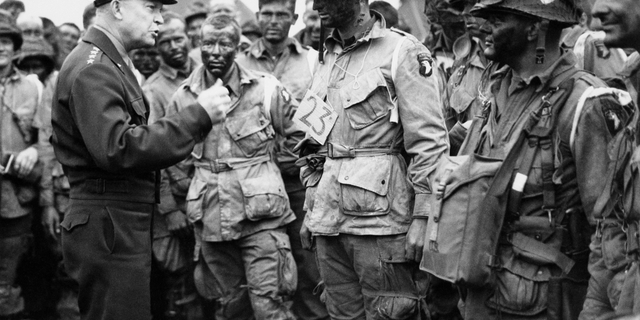
FILE -- June 6, 1944: U.S. Gen. Dwight D. Eisenhower, left, gives
the order of the day to paratroopers in England prior to boarding their
planes to participate in the first assault of the Normandy invasion.
(U.S. Army Signal Corps via AP)
Back in his quarters, Eisenhower privately agonized
over the decision. He wrote a note in longhand, which he folded into his
wallet, accepting responsibility in the event of Overlord’s failure.
The
note said: "Our landings in the Cherbourg-Havre area have failed to
gain a satisfactory foothold and I have withdrawn the troops. My
decision to attack at this time and place was based upon the best
information available. The troops, the air, and the navy did all that
Bravery and devotion to duty could do. If any blame or fault attaches to
the attempt it is mine alone."
That night Eisenhower drove to
Newbury, where the 101st Airborne Division was preparing to fly out. He
walked among the paratroopers, with their blackened faces, and spoke to
as many of them as he could. Then he waited until the last of them were
in the air before returning to headquarters around midnight, his mind
filled with thoughts of the brave men who would risk their lives at
dawn.
On
Thursday, as we commemorate the 75th Anniversary of D-Day, we know the
story of what happened on the Normandy coast. The scenes of courage, of
horror, of loss and ultimately triumph are stamped on our minds.
It
was the beginning of the end for Hitler, and although VE Day would not
occur until May 8, 1945, we know we have the brave forces who fought on
D-Day to thank for our victory.
On the evening of June
6, as the early positive reports from the invasion reached his desk in
the Oval Office, President Roosevelt, who had accepted the risk of the
invasion back in Tehran, was filled with a mixture of relief and also
heartache over the sacrifices suffered that day. He chose to broadcast
to the nation — not a speech, but a prayer.
President
Roosevelt said this prayer to radio listeners: "Almighty God: Our sons,
pride of our nation, this day have set upon a mighty endeavor, a
struggle to preserve our Republic, our religion, and our civilization,
and to set free a suffering humanity ... they will need Thy blessings.
Their road will be long and hard. For the enemy is strong. He may hurl
back our forces. Success may not come with rushing speed, but we shall
return again and again; and we know that by Thy grace, and by the
righteousness of our cause, our sons will triumph … Some will never
return. Embrace these, Father, and receive them, Thy heroic servants,
into Thy kingdom."
When President Trump delivers his D-Day remarks
Thursday at the U.S. cemetery in Normandy, he has the rare opportunity
to pay tribute with emotion, personal stories, and soaring words to the
service and the sacrifice of those who died on those beaches and saved
the world.
President Trump planned
to join other world leaders in Europe on Thursday to commemorate the
75th anniversary of the D-Day invasion, a monumental event that was
largely responsible for shaping the outcome of World War II.
The ceremony was to take place on the edge of Omaha Beach in Normandy where thousands of American and Allied soldiers lost their lives.
Trump,
continuing the tradition of his predecessors, will stand alongside
leaders from Britain, Canada, France, and even Germany to pay homage to
the troops who stormed the fortified Normandy to help turn the tide of
the war.
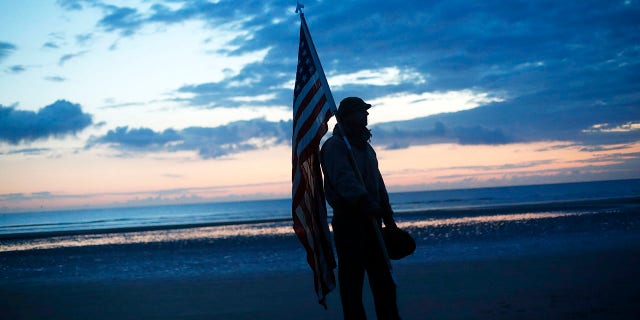
Udo Hartung from Frankfurt, Germany, a World War II reenactor,
holds the U.S. flag as he stands at dawn on Omaha Beach, in Normandy,
France on Thursday. (Associated Press)
In a Twitter message early Thursday, the president seemed to be looking forward to the day's events.
"Heading over to Normandy to celebrate some of the bravest that ever lived. We are eternally grateful!" the president wrote.
The message included a Defense Department video featuring remembrances of some veterans who participated in the D-Day invasion.
Earlier, the president tweeted an excerpt from his D-Day remarks.
"They
did not know if they would survive the hour," the president wrote.
"They did not know if they would grow old. But they knew that America
had to prevail. Their cause was this Nation, and generations yet
unborn."
Remembrances will continue to take place throughout the
day. Trump will deliver a speech later Thursday at the Normandy American
Cemetery and Memorial, where more than 9,000 American military dead are
buried.
On Wednesday, Trump joined British Prime Minister Theresa May
and about 300 veterans – ages 91 to 101 – on the southern coast of
England where he read a prayer delivered by President Franklin Roosevelt
on D-Day.
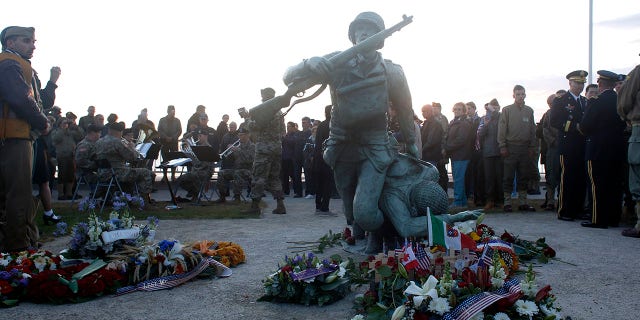
floral tributes are placed at the National Guard Monument Memorial
as members of the USAREUR band play in the background near Omaha Beach,
in Normandy, France, on Thursday. (Associated Press)
D-Day was the largest invasion – by both air and sea –
in history. On June 6, 1944, 160,000 Allied troops carried by 7,000
boats landed on the beaches code-named Omaha, Utah, Juno, Sword, and
Gold.
When
the day was over, 4,414 Allied troops – including 2,501 Americans –
were killed, and 5,000 were injured. That summer, Allied troops would
advance their fight, take Paris, and race against the Soviets to control
as much German territory as possible by the time Hitler committed
suicide in a Berlin Bunker in May 1945. The Associated Press contributed to this report.
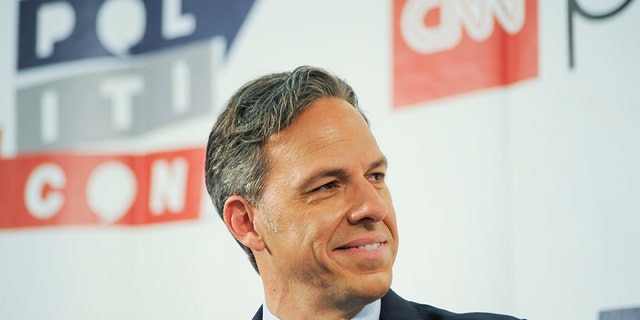
Reporter Jake Tapper and his panel on Tuesday took presidential candidate Joe Biden to task over his 30-year-old claim that he marched during the civil rights movement.
"More
than once" Biden's advisors reminded him during 1988 presidential
campaign that he, in fact, had not marched for civil rights, but Biden
continued to make the claim to voters, The New York Times reported.
“That is really, really weird,” Tapper commented on the report.
“When
he gets really comfortable out on the stump,” Jeff Zeleny, a CNN
reporter, told Tapper, “he has tended to embellish.” He added that
Biden’s aides said, “he was in office marching for the idea of civil
rights.”
CNN anchor Jake Tapper hosts "The Lead."
(Reuters)
“That’s not what the word marching means,” Tapper laughed in response.
In the age of social media, Zeleny said, Biden would not be able to get away with the same embellishments reported in The New York Times
story. “So that’s his big challenge,” he added, explaining that those
lies were why Biden ended up having to drop out of the race before the
Iowa caucuses - "because he plagiarized a speech."
The debate over impeachment is growing both deafening and dispiriting.
On one side, liberal pols and pundits argue that the Democrats have an absolute duty to make the move against Donald Trump because he's so obviously broken the law — never mind Bob Mueller's lack of charges — and is so awful that history demands action, regardless of the political drawbacks.
Other
pols and pundits on the left say impeachment would be futile and
self-destructive, divide the country, obliterate the Democrats' agenda —
and then ultimately fail in the Senate.
This has been cranked up
across the media echo chamber for days, endless iterations of the same
two arguments. It's gotten, honestly, rather boring.
And
there's a surreal element to it as well. Impeachment is either very
likely not going to happen (as long as Nancy Pelosi wields the gavel),
or it will become an empty exercise (since 20 GOP senators would have to
vote to dump Trump).
But now comes a different view, from one of Trump's least favorite newspapers.
Fred Hiatt, the Washington Post's longtime editorial page editor, has actually come out against impeachment.
This is startling at first glance, because the Post's editorials, and
Hiatt himself, have been harshly critical of Trump for years.
In
fact, the editorial board wrote when Trump was nominated in 2016 that he
was "uniquely unqualified to serve as president. A Trump presidency
would be dangerous for the nation and the world."
And, Hiatt says, they were right. But here's the twist:
"We thought his unfitness was evident before he was elected, and Americans chose him anyway ...
"To
impeach him now for what the electorate welcomed or was willing to
overlook isn't the democratic response. The right response is to defeat
him in 2020."
Just in case anyone thought they were going soft on Trump.
Hiatt's
argument, from the platform owned by Jeff Bezos, packs an added punch
precisely because the paper has been so critical of Trump.
Many
of Trump's traits — the blustering style, the mixed business record,
the anti-immigrant attacks, the womanizing background, the slams against
fake news — were on ample display during the campaign. People didn't
think they were getting a choirboy or even a polished political
practitioner. They wanted a disruptor.
On Russian interference,
Hiatt says "the broad outlines were known before the election," such as
Trump praising WikiLeaks for released the hacked Democratic emails.
On
the Mueller report and alleged obstruction of justice, "Mueller found
no underlying crime that would explain an attempt to obstruct; and Trump
in the end did not prevent Mueller from completing his work ... Are we
going to impeach a president for wanting to obstruct?"
Of
course, Hiatt says Congress should continue to investigate and see
where that leads, but should seriously pause "before impeaching Trump
for the high crime of being who we knew he was before we elected him."
Now
I'm sure this piece wasn't popular among some Post readers who want the
president driven from the public square today. Nor will it be embraced
by most of the right, which believes Trump is doing a great job and
there's no case for impeaching him on the merits.
But for
open-minded folks, there's a strong case here for not using the
Constitution as a last resort to overturn an election, especially with
another election approaching that can render a verdict on the incumbent.
Hours
after the Department of Justice (DOJ) slammed House Democrats for
planning a contempt vote against Attorney General Bill Barr -- and
charged that Democrats had privately admitted their subpoena requests
were "overbroad" -- House Judiciary Committee Chairman Jerry
Nadler announced late Tuesday that he is open to negotiating with the
DOJ "without conditions."
The remarkable turn of events reopened
the possibility that Barr's contempt vote may be postponed or canceled,
if both sides return to the negotiating table. Nadler, however,
pointedly refused to cancel the planned contempt vote prior to beginning
any new negotiations, as the DOJ had demanded.
At the same time,
Nadler criticized what he called DOJ "brinksmanship," and blamed the
Justice Department for purportedly cutting off negotiations on May 7.
The brouhaha began Tuesday morning with a DOJ letter, written by Assistant Attorney General Stephen Boyd, that blasted House Democrats and Nadler, D-N.Y., for announcing they would vote next week on whether to hold Barr and former White House counsel Don McGahn in contempt.
In its letter to
Nadler, the DOJ publicly revealed that Democrats had acknowledged in a
May 24 letter they were open to "further negotiations" regarding
concerns that their subpoena demands were "unworkably overbroad."
Nevertheless, Democrats announced just days later their plans to hold
Barr in contempt for allegedly failing to comply with those demands.
The
DOJ said it was "prepared to resume negotiations with the committee
regarding accommodation of its narrowed Subpoena" -- as long as
Democrats removed the "threat of an imminent vote by the House of
Representatives to hold the attorney general in contempt."
"The
department was disappointed by the committee's abrupt termination of
ongoing negotiations aimed at reaching a reasonable accommodation that
respects both sides' legitimate interests regarding the materials
sought," Boyd wrote to Nadler. "Further, the department is disappointed
by news reports indicating that Democratic leaders have scheduled a
contempt vote in the House of Representatives for June 11, 2019."
In his response late Tuesday,
Nadler took issue with the DOJ's characterization of Democrats' May 24
letter, and insisted that Democrats had "always remained open to
continuing negotiations. ... We are here and ready to negotiate as early
as tomorrow morning."
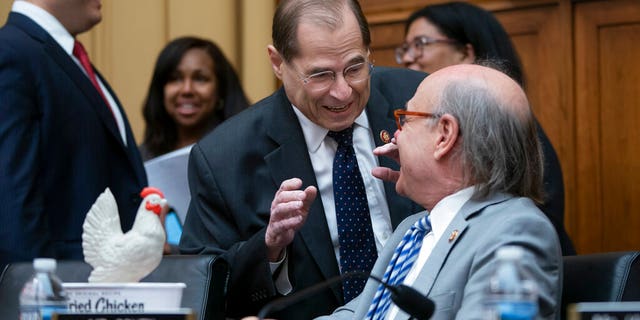
House Judiciary Committee Chairman Jerrold Nadler, D-N.Y., center,
with Rep. Steve Cohen, D-Tenn., ahead of a hearing on the Mueller
report last month.
(AP Photo/J. Scott Applewhite, File)
"I
... take exception to your characterization of how our prior
accommodation efforts ended," Nadler wrote back to Boyd. "Contrary to
the account in your letter, the Committee has always remained open to
continuing negotiations. We had an offer on the table late on the
evening of May 7 when the Department suddenly declared an end to the
accommodation process. My staff was still in their offices after the
close of business hours awaiting a counteroffer when the Department
broke off negotiations with a letter demanding that the contempt
vote—scheduled to begin the next day— be cancelled if we wished to
proceed with the accommodations process."
Nadler continued: "At
any rate, we are ready to proceed without conditions—as shown by the
initiative we took with our detailed May 24 offer. I should add that,
contrary to your argument that the Committee’s continuing accommodation
efforts somehow suggest that our prior requests were overbroad, our
offer to compromise was intended to respond to your prior objections by
seeking a middle ground. We urge the Department to do the same."
The DOJ's letter, meanwhile, had called on the House Judiciary Committee to "moot" its May 8 vote to hold Barr in contempt,
which the DOJ called "premature and unnecessary." That vote came after
congressional Democrats subpoenaed Mueller's full and unredacted report
on his probe of Russian meddling in the 2016 elections.
Republicans
have countered that federal law protecting secretive grand-jury
information would prevent Barr from turning over the entirety of the
report. The DOJ has offered Democrats the opportunity to review the
report, minus those grand jury-related redactions, in a secure setting
-- but those offers have been rebuffed. (In a rare public statement last
week, Mueller specifically remarked, "I certainly do not question the
attorney general's good faith" in deciding to make the report "largely
public.")
"It would hardly make sense for the full House of
Representatives to act upon the committee's prior recommendation to hold
the attorney general in contempt for not complying with a subpoena that
even the committee now appears to acknowledge was overbroad in seeking
immediate disclosure of the entirety of the special counsel's
investigative files,” Boyd wrote.
That was a conspicuous reference
to the previously unreported May 24 letter to the DOJ, in which the
Democrats on the Judiciary Committee wrote to privately emphasize "the
Committee's willingness to engage in further negotiations to resolve
this dispute" -- only to resort to public political posturing, the DOJ
charged.
The Democrat-led committee also offered to "identify
specific materials that if produced would be deemed to satisfy the
subpoena" in an effort to make the subpoena more workable, according to
the DOJ, which quoted the Committee's letter verbatim.
"In your
May 24, 2019, letter, the committee appears to recognize that the
subpoena is unworkably overbroad and offers -- for the first time -- to
narrow the subpoena's scope to cover a much more limited set of
documents," the DOJ wrote. "The department believes that the committee's
new offer reflects a more reasonable request and could mitigate some of
the legal barriers to disclosure that we have discussed."
The
letter continued: "The committee held its contempt vote only 19 days
after issuing the subpoena. Traditionally, congressional committees have
only proceeded with contempt votes after lengthy periods of
negotiations have failed to reach an accommodation. For example, the
House Oversight and Government Reform Committee negotiated with the
department over the Operation Fast and Furious subpoena for months, and
only voted to cite Attorney General [Eric] Holder for contempt 252 days
after issuing its subpoena."
Since 1975, according to the
DOJ, "committees and subcommittees have averaged 103 days between
issuing a subpoena to an executive branch official and holding a
contempt vote. By any measure, the committee rushed its decision and
bears responsibility for the termination of the accommodation process.”
But in his letter, Nadler took issues with those characterizations.
"We
cannot agree that the House’s sense of urgency here is 'premature and
unnecessary,'" Nadler wrote. "It has been over 100 days since we first
initiated the accommodations process on February 22, 2019. The pace
with which we are proceeding is consistent with the exceptional urgency
of this matter: an attack on our elections that was welcomed by our
President and benefitted his campaign, followed by acts of obstruction
by the President designed to interfere with the investigation of that
attack. All of this misconduct was documented by the Special Counsel in
the documents we now seek."
In a statement, House Judiciary
Committee ranking member Doug Collins, R-Ga., highlighted the DOJ's
revelation that Nadler apparently signaled a willingness to work with
the DOJ.
“After racing to hold Attorney General Barr in contempt,
Chairman Nadler finally seems ready to join the Justice Department at
the negotiating table," Collins said. "When Judiciary Democrats wield
subpoena power like a sword instead of a plow, their investigations bear
little fruit. The House Intelligence Committee has shown us that
working with the Justice Department in good faith yields documents.
Abusing subpoena and contempt authority, however, has left the Judiciary
Committee with little to show for its obsessively unreasonable
demands."
As for McGahn, the White House has instructed its former top lawyer not to testify,
saying he is legally immune from being compelled to testify about
privileged discussions occurring in the course of his official duties.
Democrats have responded that McGahn waived that privilege by agreeing
to speak to Mueller.
Trump did not assert executive privilege to
shield any aspect of the Mueller report itself, and has derided
Democrats' efforts as politically motivated attempts to keep what he's
called the "Russia collusion hoax" alive -- and to distract from or
derail -- Barr's own ongoing probes into Justice Department and FBI
misconduct.
News of the planned contempt vote came days after Barr said he has not received answers from the intelligence community that were "at all satisfactory" in the early stages of his review into the origins of the Russia investigation. Last month, Barr appointed the U.S. attorney from Connecticut, John Durham, to
lead the investigation, which is to focus on the use of FBI informants
and the alleged improper issuance of Foreign Intelligence Surveillance
Act (FISA) warrants to monitor a variety of individuals, including
former Trump aide Carter Page.
A Barr contempt vote would be historic, but not unprecedented. In 2012, the GOP-controlled House's vote to hold the attorney general at that time, Holder, in contempt for
failing to comply with investigations into the Obama administration's
failed gun-running sting operation, "Fast and Furious." Holder became
the first-ever sitting Cabinet member to be held in contempt of Congress
in that manner.
The resolution scheduled for a June 11 floor vote
would allow the Judiciary Committee to pursue civil action to seek
enforcement of its subpoenas in federal court.
Such an approach
would rule out so-called "inherent contempt," a process in which
Congress technically can enforce contempt citations on its own --
whether by arrest or fine. In May, Barr reportedly joked about that possibility with House Speaker Nancy Pelosi, D-Calif, asking, "Did you bring your handcuffs?" Fox News' Jake Gibson contributed to this report.
Fox News' Sean Hannity
didn't hold back Tuesday, going after Democrats for their latest
anti-Trump comments and for inviting Watergate figure John Dean to speak
on Capitol Hill, while also bashing the "mainstream media" for
continuing to "smear" the president.
"Dean only now works for
'fake news' CNN as a professional Trump hater. 24/7 hate, rage
psychosis. So, now Jerry Nadler figures 'oh nobody more perfect let's
roll him out for yet another... round of Trump bashing even though he
has no relevance to the case," Hannity said on his television show.
Democrats on the House Judiciary Committee announced Monday
that they would convene a hearing with Dean, the former White House
counsel to Richard Nixon and a key figure in the Watergate scandal, in
an effort to keep the public focused on the Mueller report. Nadler,
D-N.Y., is the committee's chairman.
Hannity also directed his ire at Rep. Adam Schiff, D-Calif., who Tuesday called Attorney General William Barr the "second most dangerous man in the country."
"The
most dangerous place in the country is being between the cowardly
Schiff and either a microphone or a camera because he's obsessed with
seeing himself and hearing himself," Hannity charged.
Hannity added, "He has lied more than any other single member of congress which says a lot about him."
The Fox News host didn't stop there, calling out MSNBC host Rachel Maddow calling her a "conspiracy theorist" and a "liar."
"Sadly,
Rachel Maddow's delusion is not uncommon in the so-called mainstream
media. In other words 99% of the media that spent two years lying again
and again to the American people," Hannity said.
Hannity also took a shot at Maddow and CNN's ratings saying,
"Maddow could use the publicity because her ratings as well CNN ratings
have taken a dive" due to their coverage of the Russia investigation. Fox News' Samuel Chamberlain contributed to this report.