Former
Minnesota Lt. Gov. Michelle Fischbach on Tuesday declared victory in
the GOP primary for Minnesota’s 7th congressional district in the rural
western part of the state. It sets up what is likely to be one of the
most competitive battleground states as the GOP aims to end the 30 year
dominance of Democratic incumbent Collin Peterson. In a
contentious five way primary, Fischbach, who earned crucial endorsements
from both Minnesota GOP and President Trump in the final weeks,
dominated the race by more than 59% of the total vote.
She easily defeated out her strongest opponent, Air Force veteran and
the GOP challenger from the district in 2016 and 2018, Dave Hughes by
almost 40%.
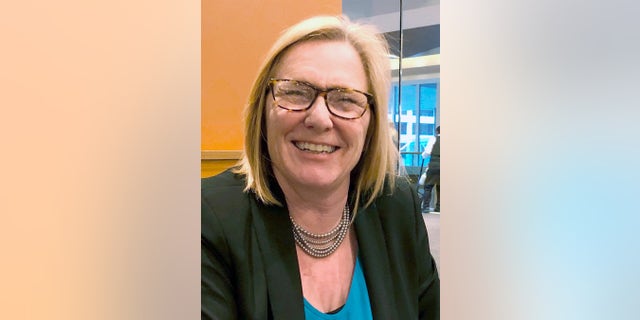
FILE - In this Nov. 22, 2019 file photo, Michelle Fischbach visits
a coffee shop in Minneapolis. (AP Photo/Steve Karnowski,File)
Despite the key endorsements and Fischbach’s long tenure as a state senator and nearly $350,000 cash advantage, her campaign was frequently caught in controversy. Fischbach’s campaign manager was handed
a restraining order against Hughes for allegedly calling him more than
300 times in “coordinated attacks” to disrupt virtual campaign speeches.
Hughes also filed an FEC complaint accusing
Fischbach of accepting more than $20,000 from political action
committees that are controlled or influenced by members of her immediate
family. Furthermore, while she was able to secure the endorsement from the Minnesota GOP, it took 8 rounds
of voting to gain the 60% needed for endorsement. Indicating that state
party officials did not have resounding confidence in her campaign. Her
next challenge will be finding a way to distinguish her conservative
brand from Peterson, the 15 term incumbent and chair of the House
agriculture committee. Peterson is considered one of if not the most
conservative members of the house Democratic party. He is anti
abortion, has received an A rating from the NRA and was one of two
democrats to vote against impeachment of President Trump. His
chairmanship of the house agriculture committee also gives him
incredible influence in a district where cropland dominates the region. Peterson carried his primary easily with 75% of the vote. In
2016, Trump managed to win the district by +30%, Rep. Peterson was able
to retain his seat by a 5.1%. In order for the GOP to have any chance
of taking back the house, candidates will have to dominate in rural
districts such as MN-07. A recent Fox News Poll had Trump trailing Former VP Biden by 13% in a statewide race. 2020
may prove to be the perfect year for Fischbach to challenge. Cook
Political Report, a non-partisan election rating service, has labeled
this race a tossup, Peterson had his smallest margin of victory in 2018
since his first election in 1990, and with Trump on the top of the
ticket it may be all she needs to overtake a longtime democratic
stronghold.
We're
all living in an age where every social media post is scrutinized down
to the smallest detail, so you can imagine the rigorous inspection that Joe Biden’s Instagram post announcing Sen. Kamala Harris as his running mate was subject to. To
the untrained eye, Biden is seen sitting at a smart desk dressed in a
crisp shirt chatting with Harris on a sleek Apple laptop. The décor was
something you’d see in a cavernous library at an illustrious New England
university. But social media users were able to spot some irregularities upon closer inspection. Benny
Johnson, the chief creative officer at Turning Point USA, the
conservative student organization, took to Twitter shortly after Biden’s
announcement and identified a note tucked under the laptop that was
tough to read but he said looked something like a “script.” He
noted that Biden is s holding his iPhone upside down and any
eagle-eyed observer can also spot a cartoon on his desk with a character
screaming, “WHY ME?!” Biden's defenders took to social media and
said he is likely holding the phone upside down because another person
was part of the conference and was on speaker phone.
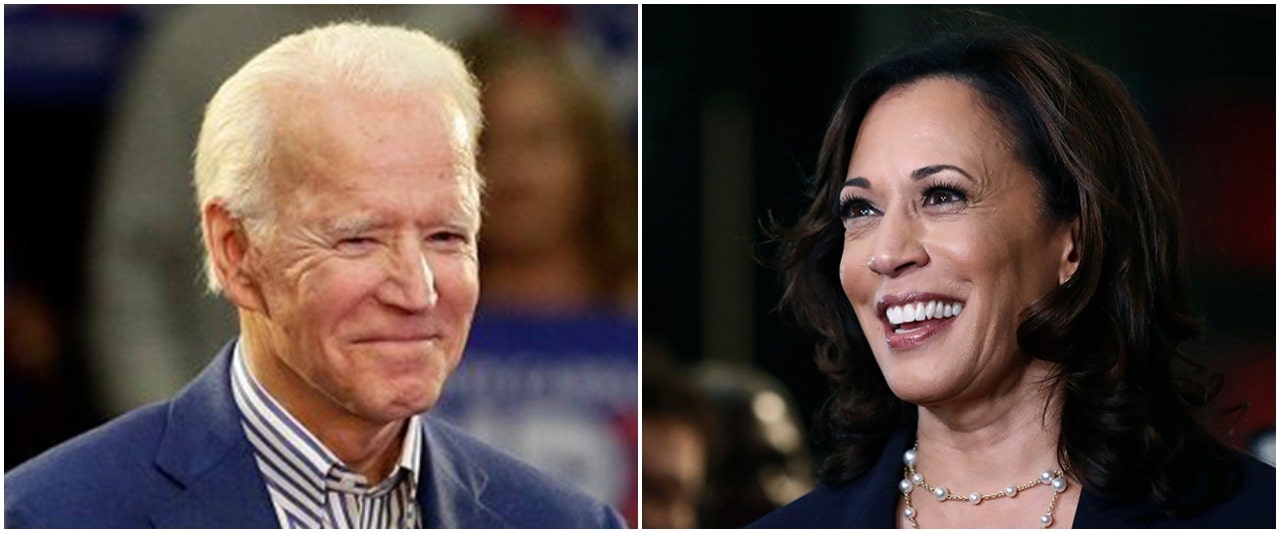
The post illustrates how the 2020 campaign is in full swing after Biden's selection of Harris. Biden
wrote in the post that it is his great honor to announce his selection
of Harris as his pick for a running mate and called her a “fearless
fighter for the little guy, and one of the country’s finest public
servants.” He also credited her work with his late son, Beau, and
said, as attorney general, she“took on the big banks, lifted up working
people, and protected women and kids from abuse.” “I was proud then, and I’m proud now to have her as my partner in this campaign,” he posted.
President Trump doubled down on his criticism of mail-in voting on Tuesday, telling Fox News' Sean Hannity
in an exclusive interview that it would lead to “catastrophic
corruption,” and slammed the process as "a rigged election waiting to
happen."
"This whole thing with his mail-in ballots, that's a
rigged election waiting to happen. It's rigged and everyone knows it,"
Trump said. "You
can't send out 16 million mail-in ballots ... who knows who's getting
them?" he argued. "The mailmen are going to get them, people are going
to just grab batches of them and you talk about China and
Russia, they'll be grabbing plenty of them. It's a disaster. It's a
rigged election waiting to happen." The president and the GOP have been warning for months about possible fraud
connected to mail-in voting. The RNC and the Trump reelection
campaign have doubled their legal budget this year to hit back at
efforts by Democrats to overhaul voting laws in response to the
pandemic. Democrats, pushing back against the claims by Trump and
the GOP, say that cases of actual voter fraud are limited and claim that
Republicans are trying to suppress voter turnout to improve their
chances of winning elections. "It's
just common sense," Trump argued. "You wouldn't even have to
know anything about politics or elections. It's common sense." Trump clarified that because of the process required to obtain an absentee ballot, such voting is safer than general mail-in balloting — and pointed to a voter-fraud scandal out of New Jersey as evidence that universal mail-in voting would cause widespread problems.
"An absentee ballot is okay ...," he said, "but these
mail-in ballots where they send millions of them all over the country,
it's going to be a rigged election, and this country shouldn't
allow it." If the courts don't intervene, "you'll never know who won the election," Trump warned. The
process "can't work," he said plainly. "It hasn't worked in
little districts. Small little defined districts, they can't do it. It's
an impossibility. Plus, the post office isn't set up for this. The post
office is not set up for millions -- when you look at what they did in Nevada ...
where they're sending millions of ballots [to registered voters] and
you don't have to have a confirmed signature, there's nothing to say
that that person signed it. "It's going to be catastrophic corruption." Fox News' Brooke Singman contributed to this report.
The great Peggy Lee song comes to mind: “Is that all there is?” Sen. Kamala Harris checks
off two big boxes for 2020 Dems — gender and race. But the moment, if
not the actual choice, feels underwhelming because of the amateurish way Joe Biden and his team let the process spin out of control. The
drawn-out, overhyped vetting often made it seem as if the running mate
would save the ticket. A month ago there were six finalists, then maybe
12. Some openly campaigned, with Stacey Abrams and Karen Bass
enlisting supporters to speak to Biden directly. Susan Rice talked up
what she saw as her qualifications on television as if picking her was a
no-brainer. Much
of the time it seemed as if the campaign was putting out leaks to give
the impression there were developments when there were none. With Biden
mostly basement-bound in Delaware and slow to roll out serious policy
proposals, the veep hunt and the speculation took on outsized
importance. Throughout,
there were two acknowledged subtexts. The first was Biden’s decision,
in the midst of the #MeToo movement, that it had to be a woman, a vow
that immediately undercut the credentials of the winner, no matter whom
it would be. That’s what quotas do. Would Harris have gotten the spot if men had been considered and acceptable? Merely to ask is to cast doubt on her. The
selection was even more tilted because it increasingly became clear
that the veep candidate had to be not only a woman, but also black. The
lack of enthusiasm for Hillary Clinton among black voters helped sink
her four years ago. Although Biden largely owes his nomination to
the turnout of black voters in the South Carolina primary, being Barack
Obama’s vice president could not by itself guarantee him sufficient
loyalty and turnout in November. He needed to shore up his party’s most
important and reliable bloc, so the intrigue was really about which
black woman he would select. The second subtext is Biden’s obvious
mental and physical frailties, with more than one observer noting that
there was a good chance that the running mate could become president
within a first term, should the Dems prevail. The president-in-waiting,
as even Biden supporters put it. His advanced age, 77, needed to
be countered, and Harris does that, turning 56 in October. At her best,
she’s quick and appealing, a contrast to his often befuddled and halting appearances. Measured
against those specific requirements, then, Harris is definitely
qualified, though she’s not the superstar she once seemed destined to
be. Her trajectory in the primaries offers ammunition to both
supporters and detractors. She started fast, yet ironically peaked after
a debate in June 2019 — by attacking Biden over his friendships with
Southern senators and his anti-busing stance decades ago. Harris
had, in effect, one good sound bite, “That little girl was me,” and one
good debate. After that, she became a target and quickly wilted over
charges from also-ran Tulsi Gabbard that she had been an overly
aggressive prosecutor in California on relatively minor marijuana cases. In
the end, Harris did not give the kind of performance that leaves the
public wanting more. Pete Buttigieg and Sen. Amy Klobuchar, for two
examples, stayed until just before the deciding contests and got far
better reviews than they got at the beginning. Moreover,
the simple fact that Harris was a prosecutor could be a big mark
against her among many of those on the far left whom the ticket will
need to attract. It’s possible the selection signals that Biden wants to
separate himself and the party from the violent radicals leading riots
and looting in many urban areas, but that would be unusual given how
quiet he has been on the subject so far.
The
FBI under Director Christopher Wray's leadership deceived lawmakers
on the Senate Intelligence Committee during a 2018 briefing on the Russia investigation, Senate Judiciary Committee Chairman Lindsey Graham told "Hannity" Monday, citing a document he obtained from the Department of Justice. "This
is really unbelievable ... " said Graham, R-S.C. "A year after
they knew the Russian dossier was no longer reliable, they told the same
lies to the Congress, not just the [FISA] court, as a completely
new front of legal liability, and I'm going to find out what happened." According to Graham, the committee called the FBI to testify
on the reliability of the notorious Steele Dossier. The dossier was
pivotal to the Foreign Intelligence Surveillance Act (FISA) warrants the
bureau obtained for former Trump aide Carter Page as part of its "Crossfire Hurricane" investigation into Russian election interference. The
senator said that the FBI told the committee there was no reason to
doubt the dossier and the primary sub-source that ex-British spy
Christopher Steele used to put together the dossier, despite the fact
the source had previously said that the dossier mischaracterizes the
information he gave Steele. In
one line of the document released Sunday, the FBI said that "[a]t
minimum, our discussions with [the primary subsource] confirm that the
dossier was not fabricated by Steele." Graham argued, however,
that the unnamed sub-source "told the FBI that the dossier is a bunch of
bar talk, hearsay, never corroborated," and that it should be taken
"with a grain of salt," but "they continued to use it against Carter
Page to get a warrant in April and June [2017]," he explained. Documents
recently released by the Senate Intelligence Committee indicate that
there were strong doubts about the reliability of the Steele Dossier as
early as December 2016. As the FBI and CIA worked together to create an
Intelligence Community Assessment (ICA) to present to President Barack
Obama, those in the CIA camp, according to the now-declassified
interviews conducted by the Senate Intelligence Committee, worried that
the FBI was playing up the Steele Dossier too much. Graham called
on FBI Director Christopher Wray to address why "the Senate Intel
Committee was briefed about the dossier and the Russian subsource in
the same fashion that the FISA court was briefed," which Graham called
"very misleading." "This happened on Wray's watch," he emphasized. "Apparently,
somebody on the Intel committee and the Senate wanted to be briefed
about the reliability of the sub-source," Graham said. " We found that
briefing paper and they told the Senate Intel committee the same story
they told the FISA court. They did not tell the truth about the Russian
sub-source, just about the dossier and I want Christopher Wray to
account for how that happened." Fox News' Tyler Olson contributed to this report.
Democrats' push to "defund the police"
is backfiring as protests spread into elite neighborhoods and produce
more violence in U.S. cities, attorney and U.S. Commission on Civil
Rights member Peter Kirsanow argued on Monday. "The insanity
related to 'defund the police' is now going to redound to the detriment
of the left, Democrats and it's going to have a cultural impact also,"
Kirsanow told "Tucker Carlson Tonight." "People
are going to be fleeing the cities. In inner-city neighborhoods,
we've seen this over and over and over again and now it's metastasizing
into the broader environs such as the 'Magnificent Mile' in Chicago and
more elite neighborhoods, and the left understands, Democrats understand
-- this does not help their candidate in November. And because the
media is carrying the water quite blatantly now for the left and for
Democrats, they will shut this down." Kirsanow added that Democrats are "alienating" Americans with their stances on law enforcement. "This
is different than Ferguson and it is qualitatively and quantitatively
different than Ferguson," he said, referring to the unrest following the
death of Michael Brown in 2014. "Again, they actually tried
to change the cultural, the sociological landscape and that's going to
take a while to put the genie back in the bottle ... that's a
real problem for them, especially now, because they are trapped. They
know they must defeat Trump, [but] they have no way out. They've been
riding this for a while and they don't want to antagonize the Black
Lives Matter movement or the far left. By the same token, they know they
are alienating just average, everyday people who are saying 'Wait a
minute, what happens to me?'" Kirsanow even suggested that Democrats could lose enough Black votes for Trump to win re-election. "Here's
the real troubling part for Democrats," he said. "81% of blacks either
want police presence to be the same or greater, because it's
Black neighborhoods, as usual, that suffer most ... It's spreading out
into other neighborhoods too. But if just 2-3% of those individuals
shift their vote to Trump, game over." Rep. Karen Bass, D-Calif., who led the House's recent efforts on criminal justice reform, recently said
the slogan "defund the police" was "probably one of the worst slogans
ever." She went on to explain that while she did not support “defunding”
police, she believed law-enforcement budgets could be reduced if
communities did not rely on police officers to deal with issues outside
of their training. Fox News' Morgan Phillips contributed to this report.
Connecticut, Minnesota, Vermont and Wisconsin hold primaries on Tuesday, with a Georgia holding a Republican primary runoff in the state’s 14th Congressional District. But the race grabbing the most national attention is in Minnesota, where Rep. Ilhan Omar -
known from coast to coast as one of the four members of the group of
progressive first-term congresswomen of color known as “The Squad” -- is
facing a Democratic primary challenge from a candidate who’s vastly
outraised the incumbent. The
firebrand freshman lawmaker quickly became a nationally known
politician two years ago as one of the first Muslim women elected to
Congress -- and for her outspoken criticism of President Trump. But the
attention surrounding the Somali born progressive lawmaker – and her
Twitter feed – have made her a target of Republicans and even some
fellow Democrats. And Omar’s no stranger to controversy, apologizing
early in her congressional tenure for making comments viewed as
anti-Semitic. Omar has the backing of some of the biggest names in politics – such as House Speaker Nancy Pelosi, progressive leader Sen. Elizabeth Warren of Massachusetts, and Sen. Bernie Sanders of Vermont – whom she joined on the campaign trail when the populist champion was running for the Democratic presidential nomination. She
also enjoys the support of leading Minnesota Democrats, such as Gov.
Tim Walz, Lt. Gov. Peggy Flanagan, state House Speaker Melissa Hortman
and Attorney General Keith Ellison. And she has the backing of local
unions and the state party as she runs for a second two-year term
representing Minnesota’s 5th Congressional District – which covers much
of the city of Minneapolis and was ground zero for the nationwide protests sparked by the death of George Floyd at the hands of police. But
in the crucial battle for campaign cash, she’s been walloped by Antone
Melton-Meaux, her main primary challenger in the multi-candidate field. The
lawyer and mediator hauled in an eye-popping $3.2 million in the
April-June quarter of fundraising, according to filings with the Federal
Election Commission. That far surpassed Omar, who raised nearly
half-a-million dollars during the same period of time. Melton-Meaux
reported having $2 million in his campaign coffers as of the end of
June, nearly double of Omar’s $1.1 million cash on hand. The fundraising advantage for a newcomer challenging an incumbent is striking. Meltons-Meaux,
who’s criticized Omar for the number of votes she’s missed,nlanded the
endorsement of the Star Tribune – Minnesota’s largest newspaper. Meltons-Meaux
– who says he supported Omar’s 2018 campaign – pointed to the
controversies surrounding the congresswoman as the reason why he decided
to run for office. He’s argued that Omar’s “lost the trust of the
Jewish community by her insensitive and harmful tropes.” Omar
has worked to repair any potential damage – holding regular discussions
with the Minneapolis Jewish community – and supported House resolutions
condemning anti-Semitism amid the shooting last year at a Poway,
Calif., synagogue. Omar’s campaign last month put out an internal
poll showing her with a large double-digit lead. But former Minnesota
Democratic–Farmer–Labor (DFL) Party Chairman Mike Erlandson said he
thinks “the race is much closer than that. The numbers that have been
shared with me from some other private polls show the race within
striking distance for Antone. He’s run a strong campaign.” The
District – which used to be represented by Ellison – is one of the
safest blue districts in the country, which means the winner of the
Democratic primary will be the overwhelming favorite in November’s
general election. Fellow "Squad" member Rep. Alexandria Ocasio-Cortez also
faced a well-financed Democratic primary challenger in the New York
State’s June primary. Former CNBC correspondent and anchor Michelle
Caruso-Cabrera hauled in roughly $2 million ahead of the contest. But
Ocasio-Cortez dramatically outraised her rival and crushed
Caruso-Cabrera and other challengers in the contest. Another member of "The Squad," Rep. Rashida Tlaib of Michigan, also
faced a formidable primary challenge from former Detroit City Council
President Brenda Jones. But Tlaib vastly outraised her challenger and
ended up trouncing Jones by a two-to-one margin in last week’s primary
election. The fourth member of “The Squad” -- Rep. Ayanna Pressley
who represents Massachusetts’ 7th congressional District – doesn’t face
a Democratic primary challenge in the state’s Sept. 1 primary. And she
may not face a Republican in November’s general election, as none
qualified to place their name on the primary ballot. Georgia showdown A
GOP primary runoff in a congressional district in the northwest corner
of Georgia is also grabbing national attention because of controversy
surrounding one of the two candidates: Marjorie Taylor Greene. Two
months ago some top House GOP leaders disavowed Greene, who has
reportedly made racist Facebook videos and embraced QAnon movement
conspiracy theories. Greene and neurosurgeon and business owner
John Cowan – who are both touting their conservative credentials - are
battling for the Republican nomination to succeed retiring Rep. Tom
Graves in the deeply red district. The winner will be considered the
overwhelming favorite in November’s general election. Establishment
Republicans are worried that a Greene victory would be a stain on the
GOP as it tries to cope with national protests over systemic racism. And
they say it would be a step back for a party that saw longtime Rep.
Steve King of Iowa – who had a history of making racist comments --
defeated by a Republican primary challenger in June. Wisconsin Four
months after Wisconsin’s controversial April primary election – which
witnessed a lack of poll workers, long lines, and little social
distancing as the coronavirus pandemic was sweeping across the nation –
the state holds another round of primaries. This time around
there’s little of the partisan warfare the proceeded the April contest –
and this time around 170 polling locations will be open in Milwaukee.
In April, just 5 polling locations were available for voters in the
state’s largest city. Connecticut Cities
and towns in Connecticut are experiencing a record-breaking surge in
absentee ballot requests – amid serious health concerns over in-person
voting at polling stations due to the coronavirus. The spike comes after
the state’s Democratic governor and secretary of state expanded
eligibility for absentee voters and mailed out ballot applications to
registered voters. Even though it’s just a formality at this
point, the state is holding both Democratic and Republican presidential
primary contests, as well as down ballot contests. Vermont Republican
Gov. Phil Scott is the favorite as he faces four GOP challengers in his
bid for third 2-year term steering Vermont. There are four Democrats
running in their party’s primary, including current lieutenant governor
David Zuckerman.