


Conservative Blogger
Iran has received an American plan to pause the war in the Middle East, officials said Wednesday — a proposal sent even as Washington deploys paratroopers and more Marines to the region. Tehran did not confirm receiving the plan and publicly dismissed the diplomatic effort while launching more attacks on Israel and Gulf Arab countries, including an assault that sparked a huge fire at Kuwait International Airport. Iran also continued to come under attack. Two officials from Pakistan, which delivered the plan to Iran, described the 15-point proposal broadly, saying it addressed sanctions relief, a rollback of Iran’s nuclear program, limits on missiles and reopening the Strait of Hormuz, a crucial waterway through which a fifth of the world’s oil is shipped. An Egyptian official involved in the mediation efforts added that the proposal includes restrictions on Iran’s support for armed groups. The officials spoke on condition of anonymity to discuss details not yet released. Some of those points were nonstarters in negotiations before the war: Iran has insisted it won’t discuss its ballistic missile program or its support of regional militias, which it views as key to its security. And its ability to control passage through the Strait of Hormuz represents one of its biggest strategic advantages. Iran’s attacks on regional energy infrastructure along with its restrictions on the strait have sent oil prices skyrocketing and rocked world markets over fears of a global energy crisis, in turn putting pressure on the U.S. to find a way to end the chokehold and calm markets. At least 1,000 troops from the 82nd Airborne Division will be sent to the Mideast in the coming days, three people with knowledge of the plans told The Associated Press. They spoke on condition of anonymity to discuss sensitive military plans. The paratroopers are trained to jump into hostile or contested areas to secure key territory and airfields. The Pentagon is also in the process of sending about 5,000 more Marines, trained in amphibious assaults, and thousands of sailors to the region. The 15-point plan now in Iranian hands is “a comprehensive deal” to reach a ceasefire, according to the Egyptian official. Mediators are pushing for possible in-person talks between the Iranians and the Americans, perhaps as soon as Friday in Pakistan, the Egyptian and Pakistani officials said. Speaking Tuesday at the White House, Trump said the U.S. is “in
negotiations right now” and that the participants included special envoy
Steve Witkoff, his son-in-law Jared Kushner, Secretary of State Marco
Rubio and Vice President JD Vance. He has not said who from Iran they
are in contact with.
“We have a number of people doing it,” Trump said. “And the other side, I can tell you, they’d like to make a deal.” Iran’s Khatam Al-Anbiya Central Headquarters, which commands both the regular military and the paramilitary Revolutionary Guard, dismissed the idea of talks. Iranian leaders have repeatedly denied they are happening, while acknowledging that the foreign minister is in contact with various countries but not the U.S. or Israel. “Our first and last word has been the same from day one, and it will stay that way: Someone like us will never come to terms with someone like you,” Lt. Col. Ebrahim Zolfaghari, a spokesman for the headquarters, said in the video statement aired on state television. “Not now, not ever.” Israeli officials, who have been advocating for Trump to continue the war against Iran, were surprised by the submission of a ceasefire plan, according to a person who was briefed on the contours of the proposal and also confirmed it had been submitted. They spoke on condition of anonymity because they were not authorized to speak publicly. Any talks between the U.S. and Iran would face monumental challenges. It’s not clear who in Iran’s government has the authority to negotiate — or would be willing to, as Israel has vowed to continue killing the country’s leaders. Iran remains highly suspicious of the United States, which twice under the Trump administration has attacked during high-level diplomatic talks, including with the Feb. 28 strikes that started the current war. “We have a very catastrophic experience with U.S. diplomacy,” Iranian Foreign Ministry spokesperson Esmail Baghaei told India Today on Tuesday. The Israeli military announced new wide-scale attacks on Iran early Wednesday targeting government infrastructure, and witnesses reported airstrikes in the northwestern city of Qazvin. Missile alert sirens sounded multiple times in Israel as Iran launched its own attacks. Iran also kept up the pressure on its Gulf Arab neighbors, with Saudi Arabia’s Defense Ministry saying it had destroyed at least eight drones in the kingdom’s oil-rich Eastern Province, and missile alert sirens sounding in Bahrain. Kuwait said it shot down multiple drones but one hit a fuel tank at Kuwait International Airport, sparking a fire, the General Civil Aviation Authority said. Firefighters were working to contain the blaze. Iran’s death toll has passed 1,500, its Health Ministry has said. In Israel, 16 people have died. At least 13 U.S. military members have been killed, along with more than a dozen civilians in the occupied West Bank and Gulf Arab states. Meanwhile, authorities say more than 1,000 people have died in Lebanon, where Israel has targeted the Iran-linked Hezbollah militant group, which has also fired on Israel. The news of potential negotiations drove down the price of oil — after it skyrocketed in recent weeks. Brent crude oil, the international standard, has neared $120 a barrel during the conflict but was trading below $100 Wednesday. It is still up around 35% from the start of the war. Economists and leaders have warned of far-reaching effects if energy prices remain high — from rising prices on food and other basics to higher rates for mortgages and auto loans. A big driver of the spike in the oil price has been Iran’s stranglehold on the Strait of Hormuz, which leads from the Persian Gulf to the open ocean. Iran has allowed a small number of ships through the strait, but has said no ships from the U.S., Israel or countries seen as linked to them can pass. Asked in the interview with India Today whether Iran was charging ships for passage, Baghaei, the Iranian Foreign Ministry spokesperson, said “absolutely.” He did not elaborate. |
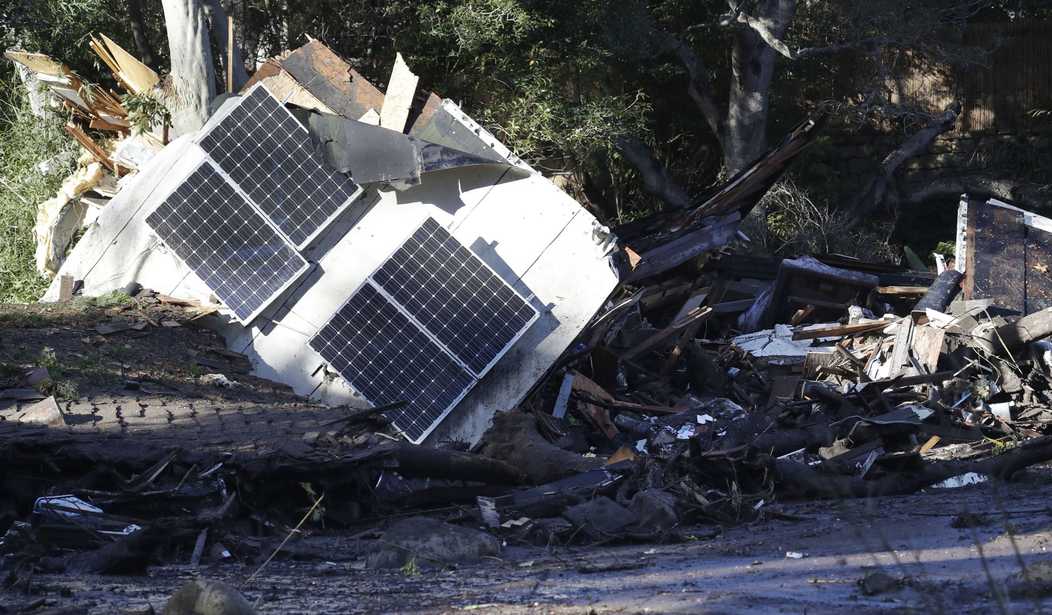 |
America has a quickly growing waste problem. I’m talking about how to dispose of or treat the vast, rapidly increasing amount of waste tied to the wind and solar energy, which the federal and various state governments have obsessed over, subsidized, and mandated. This is not a theoretical problem of the distant future. It is a tangible problem right now. Many
wind turbines and solar panels are nearing the end of their useful
life, or have already been replaced early, as new, more efficient panels
and more powerful turbines become available. In addition, emergency
situations are causing further waste, such as hailstorm damage in Texas in 2024. More recently, damage in Indiana and Illinois,
where vast industrial solar facilities were destroyed by storms,
including hail and tornadoes, took the facilities offline and created a
clean-up problem. Nearby residents and communities have expressed
concern about potentially toxic chemicals leaching from the shattered
panels. Recycling solar panels is challenging and expensive. It costs $30 to recycle a solar panel, to recover between $3 and $8 worth of minerals, metal, and glass. By contrast, it costs approximately $1 per panel to ship used panels to a landfill, and slightly more to ship inefficient used panels for reuse in developing countries overseas, shifting the waste problems elsewhere. Because of the economics,
less than one in 10 solar panels is recycled. With millions more panels
being installed each year, the problem is growing, as was recently
recognized in studies published by the London School of Economics in the Harvard Business Review (HBR).
“If early replacements occur as predicted by our statistical model, they can produce 50 times more waste in just four years than IRENA anticipates,” the HBR article notes. “The industry’s current circular capacity is woefully unprepared for the deluge of waste that is likely to come. “While panels contain small amounts of valuable materials such as silver, they are mostly made of glass, an extremely low-value material.” HBR continues. “The direct cost of recycling is only part of the end-of-life burden, however. RELATED: The Hidden Cost of Renewable Power: Toxic 'Green' Waste to Hit 1 Million Tons Climate Change: Trillions Spent, and Now We See Nothing Gained The problem of solar panel disposal isn’t just limited to the volume of the waste stream, but also how the panels must be handled. “Panels are delicate, bulky pieces of equipment usually installed on rooftops in the residential context [with] [s]pecialized labor . . . required to detach and remove them, lest they shatter to smithereens before they make it onto the truck,” writes HBR. “In addition, some governments may classify solar panels as hazardous waste, due to the small amounts of heavy metals (cadmium, lead, etc.) they contain [resulting in] . . . expensive restrictions—hazardous waste can only be transported at designated times and via select routes, etc.” As daunting as the current waste problem for solar panels is, the looming waste problem from industrial wind is even worse. Although the metal in the towers and machinery can be recycled, it is difficult to do anything useful with the massive blades other than shred them into small bits for select uses, which is very expensive. It costs $440,000 to $675,000 per unit to decommission and dispose of each onshore wind turbine from base to blade. Dismantling offshore wind turbines is even more expensive, topping $1 million per turbine. The value of the material from the towers and gear boxes is about $28,000 per unit, far less than a 10th of the cost of dismantling. As a result, the metal, gears, concrete, and other materials often end up in landfills, as do the composite blades after they’ve been crushed at great expense and with large emissions of carbon dioxide from the machinery used to haul and crush them. Five years ago, journalist Duggan Flanakin described the disposal methods and the obstacles the industry faced then, which have only grown along with the number and size of turbines. “A separate tractor-trailer is needed to haul each blade to a landfill, and cutting them up requires powerful specialized equipment,” Flanakin wrote. “With some 8,000 blades a year already being removed from service just in the United States, that’s 32,000 truckloads over the next four years; in a few years, the numbers will be five times higher. “Over the next 20 years, the U.S. alone could have to dispose of 720,000 tons of waste blade material,” said Flanakin. “Yet a 2018 report predicted a 15% drop in U.S. landfill capacity by 2021, with only some 15 years’ capacity remaining [meaning] [w]e will have to permit entirely new landfills simply to handle wind turbine waste—on top of mountains of solar and battery waste.” Not every landfill is certified to handle wind or solar waste, and many have decided to refuse to do so because it demands too much space. Closing landfills early because there is no more room in the pit or pile is expensive, requiring communities to find new landfills or other ways to dispose of waste. Setting aside so much space in public landfills is making less sense to local governments. That has led wind and solar profiteers to a different “solution,” piling up decommissioned turbines and solar panels on open land. Thousands of acres are covered by turbines and panels left to decompose over time, with unknown environmental impact, on land useful for purposes other than wind and solar junkyards. This controversial practice has resulted in an increasing number of state and local governments imposing restrictions on the renewable energy industry’s growing number of unregulated piles of unsightly, chemical-laced waste. The LSE article and the HBR analysis identify the problem, but their solution, forcing wind and solar companies to take back and recycle all their waste, is economically and politically unrealistic. It doesn’t make recycling cheaper, and the costs borne by the companies will simply be passed onto ratepayers and the public. This will make the energy affordability crisis Americans are rightly incensed about even worse. Making rising power bills even more expensive is not a winning electoral message for politicians, I suspect. Government subsidies and mandates created the renewable waste problem. The solution is not more expensive, misguided government mandates or subsidies, but ending wind and solar incentives and mandates, which are responsible for the huge waste stream. H. Sterling Burnett, Ph.D., (hsburnett@heartland.org) is the Director of the Arthur B. Robinson Center on Climate and Environmental Policy at The Heartland Institute, a non-partisan, non-profit research organization based in Illinois. |
 |
In early March, we wrote about a state senate GOP primary race here in North Carolina that had the potential to upend the power structure in the NC senate should the primary night election results hold. The contest between longtime Senate President Pro Tempore Phil Berger and Rockingham County Sheriff Sam Page for Senate District 26 saw Page shockingly ahead of Berger by two votes on primary night. By the March 13th canvass deadline, Page's lead had increased to 23 votes after provisionals were reviewed, overseas and military ballots were counted, and absentee ballots that needed them were cured. After a machine recount and random sample hand-to-eye recounts were done, the results remained unchanged. On Tuesday, Berger conceded that he had lost the primary, ensuring there would be no protracted legal fight as we saw in the hotly contested NC Supreme Court race in 2024:
Berger's concession brings the total to nine NC General Assembly incumbents - three Democrats and six Republicans - who lost their reelection bids well before the general election. As we noted before, Berger has been serving in the NC General Assembly since 2001. In 2011, he became State Senate leader and has been called the most powerful man in state politics. He has been instrumental in many GOP legislative victories on issues like redistricting (as recently as late 2025), crime, the Second Amendment, ICE cooperation, anti-DEI in public schools, increased oversight of higher education, pro-life and anti-trans causes, and neutering the power of the governor while increasing the power of the legislature - against the objections of our Democrat governors, of course. He also had the support of President Donald Trump. But in a way, so did Page, with Trump unofficially endorsing Page in the same statement where he backed Berger. Page was an early supporter of Trump's back in 2015, and it's something Trump never forgot. So, how was Page able to do it after years of Berger easily getting reelected and being such a shrewd and effective leader? It was probably a combination of having MAGA bona fides going way back, nearly 30 years of sheriffing, a budget stalemate between Berger and GOP NC House leaders, along with a controversial Berger-backed casino proposal in 2023 that perhaps had enough Republicans in the district believing it was time for a change. It also should be noted that Page had some help from Democrats and their affiliated special interest groups, who hate Berger almost as much as they hate Trump, with some apparently even encouraging party members to cross over to vote for Page in the primary to oust Berger. That said, I've likened Berger's and Page's staunch supporters to the Duke-Carolina college basketball rivalry: you can like one (Berger or Page), but you absolutely can't like both. In any event, what's done is done. Though Berger's legacy will live on in North Carolina politics for decades to come, it remains to be seen just how much his departure at the end of this year will change how business is done on the state senate side of things, not to mention what the possible national implications could be of losing a power player of his immense stature. Update: I deliberately left my opinion on whether this was a good or bad thing out of this piece so that readers could draw their own conclusions, but if you're interested, I shared more thoughts on it in the comments section. Update 2: Since I've gotten several requests for it, here are my general thoughts (as posted in the comments) on whether what happened in this primary was good or bad:
Please join us in the comments and share your thoughts. |
 |
First, man, just stop. No one from a foreign government is talking to you, especially about matters like Operation Epic Fury. Miles Taylor appeared on CNN on Monday and tried to argue with Scott Jennings. It failed spectacularly, with Jennings clearly showing that Taylor was largely wrong on almost everything. He’s not some top-level staffer—he’s the equivalent of the bagel boy who wrote an op-ed in the New York Times, which confirmed the existence of an anti-Trump deep state within the intelligence community; he even admitted he was a member.
He wasn’t the only one who got raked over the coals: Ashley Williams also got taken to school. And
later, he doubled down on being a whiny little brat, even posting
things that are likely not true. Apparently, Jennings mocks Trump during
commercial breaks and in the green room. Okay, man. Sure. What did he
say? There are no quotes because it never happened:
Look, we watch this stuff so you don’t have to, but it’s funny watching these idiots get tossed into the woodchipper. They know nothing, but act like they’re the key players in what’s going on today. God, these theater kids are fragile. |
 |
What do you mean you’ll look into it, Hakeem? Mr. Hakeem Jeffries, the leader of House Democrats, was asked the easiest question regarding the case of Sheridan Gorman, 18, the Loyola University student who was shot and killed by an illegal alien, Jose Medina, 25, in the early morning hours of March 19. It’s another Laken Riley-like story: an American citizen killed by an
illegal alien who not only shouldn’t have been here but had an active
warrant for shoplifting charges. Medina entered the US illegally in
2023. It’s another Joe Biden special. When asked if Medina should be deported, Jeffries said, “I’ll look into the case.” Are you kidding me? The reactions are stark and disturbing: an American citizen is murdered at the hands of an illegal, and there are crickets from these Democrats. An illegal alien is detained by ICE at an airport, and everyone thinks it’s Berlin 1943. The coldness is akin to Michael Dukakis’ answer about the death penalty. It’s one of many things that cost him the election. No, Mr. Jeffries, Medina should be deported. I’d rather we execute him, though. Some local Chicago Democrats have even engaged in victim-blaming over this story. You already know why this party bends over backwards over these thrid world imports; it's the only way they can win elections. |
 |
Oklahoma GOP Governor Kevin Stitt announced that he has appointed energy executive Alan Armstrong to the United States Senate, filling the vacancy created by Markwayne Mullin’s recent confirmation as the new secretary of Homeland Security. The appointment, announced during a morning press conference at the State Capitol, places the former CEO of Williams Companies in the upper chamber at a pivotal moment for federal energy policy. Armstrong was sworn in Tuesday afternoon by Senate President Pro Tempore Chuck Grassley (R-Iowa), ensuring Oklahoma maintains its full representation as the Senate moves forward with a packed spring legislative calendar. He will serve alongside Oklahoma Senator James Lankford as an interim appointee. Under Oklahoma law, he will serve until the results of the November 3, 2026, general election are certified, which is expected to happen by late November or early December. Armstrong is also legally barred from running for the seat himself in that election. Governor Stitt emphasized that Armstrong’s selection was driven by a need for a conservative business leader who could hit the ground running on infrastructure and regulatory reform.
Armstrong, 63, spent nearly four decades at Williams Companies, a Fortune 500 natural gas giant headquartered in Tulsa. He served as the company’s president and CEO for 14 years before transitioning to executive chairman in 2025. According to surfacing reports, Armstrong’s primary focus during his tenure will be permitting reform. Both Stitt and Armstrong noted that they had consulted with President Donald Trump and Senate Majority Leader John Thune (R-S.D.) regarding the appointment. All parties purportedly agreed that the Senate needs a technical expert to help break the long-standing deadlock over streamlining federal approvals for large-scale energy projects.
“This was definitely a tough decision on one hand,” Armstrong continued at the Tuesday press conference. “But on the other hand, it was kind of a no-brainer, because I really wouldn’t want to be sitting around in my retirement thinking, ‘gosh, I could’ve contributed and done something.’” _______________________________________________________________________________ Duration Armstrong will serve as an interim senator until the results of the November 3, 2026, general election are officially certified. Under Oklahoma’s 2021 vacancy law, the interim term concludes once a permanent successor is elected and sworn in, which is expected to occur in January 2027. Party Alignment Per Senate Bill 959, any interim appointee must have been a member of the same political party as the departing senator — in this case, the Republican Party — for at least five years immediately preceding the appointment. Additionally, the appointee must sign a legally binding public oath or affidavit with the Secretary of State affirming they will not seek the office in the upcoming election, a measure designed to prevent them from having an “incumbency advantage.” Succession Republican Representative Kevin Hern of Oklahoma’s 1st District has solidified his position as the leading candidate for the permanent seat. Recently, his campaign gained significant momentum after receiving an early endorsement from President Donald Trump, who praised Hern as a “warrior” for the America First agenda. With fellow Representative Stephanie Bice opting to run for re-election to the House instead of challenging him, Hern enters the June primary as the clear favorite. _______________________________________________________________________________ The seat became vacant after Mullin was confirmed by the Senate in a 54-45 vote on Monday night to lead the Department of Homeland Security (DHS). Mullin succeeds Kristi Noem, who was recently removed from the post by the Trump administration. Mullin, a member of the Cherokee Nation and a former MMA fighter, had served in the Senate since 2023. Meanwhile, Armstrong’s arrival in Washington does not change the balance of power in the Senate, where Republicans currently hold a 53-47 majority. However, his deep ties to the energy sector and his previous roles, including chairing the National Petroleum Council, are expected to make him a central figure in upcoming debates over the “America First” energy agenda. Stay informed! Receive breaking news alerts directly to your inbox for free. Subscribe here. https://www.oann.com/alerts What do YOU think? Click here to jump to the comments! Sponsored Content Below |
 |
Recently, an insightful discussion took place centered around a pivotal piece of American history: Federalist 45, authored by James Madison. This analysis is especially relevant as it directly pertains to the ongoing debate surrounding the Second Amendment and individual liberties today. The themes presented in Federalist 45 remain crucial for understanding the balance of power in the United States, and why the right to bear arms is essential for American citizens to protect themselves and their freedoms. During the 1787-1788 debates on the
newly drafted Constitution, many Americans were worried about creating a
powerful central government that could infringe upon their rights.
These concerns were articulated by the Anti-Federalists, who feared a
federal authority that could overshadow state power and erode local
governance. Madison’s Federalist 45 was his reassuring response to these
fears, emphasizing that the federal government would have limited,
defined powers while leaving numerous responsibilities and liberties
with the states and the people. This promise of limited government is
particularly relevant to today’s discussions around the Second Amendment
and the regulation of firearms. Madison argued that the Constitution was intentionally designed to prevent tyranny by keeping power divided. The most famous assertion from Federalist 45 states that the federal government’s powers are few and defined, while those of the states are numerous and indefinite. This division was a safeguard against any single entity, including the federal government, from gaining excessive control over the lives of citizens. Today, many observers note that the landscape has dramatically shifted, with a federal government that has expanded far beyond the intended scope, resulting in numerous regulations that affect citizens’ rights, particularly regarding firearms. In light of this historical context, the Second Amendment is seen not only as a personal right to self-defense but also as a crucial mechanism for preserving liberty. Madison noted that armed citizens would serve as a counterbalance to governmental overreach. This principle resonates strongly in today’s society, where some states have enacted Second Amendment sanctuary laws, demonstrating a pushback against federal authority and underlining the foundational belief that the people must ultimately remain armed to defend their rights against potential government tyranny. Furthermore, Madison’s arguments highlight a critical expectation that state governments would operate as closer and more accountable authorities. He believed that because state officials lived among citizens, they would better represent and safeguard their interests. Unfortunately, many states today seem to be moving in the opposite direction, implementing strict gun control measures that challenge the Second Amendment. This shift raises questions about how effectively state governments are fulfilling their role as protectors of individual liberties. In conclusion, Federalist 45 serves as both a reminder and a call to action. The principles espoused by Madison illuminate the need for citizens to understand and advocate for the limits placed on federal power, particularly regarding the protection of their Second Amendment rights. As gun owners and advocates for personal freedom reflect on these foundational ideals, they must consider what actions they can take to ensure that the balance of power envisioned by the Founding Fathers is upheld. The ongoing discourse about the Second Amendment represents not only a debate about policies but also a fight for the very essence of American liberty. The question now is whether Americans will rise to the challenge of defending their rights as their forebearers intended. |
 |
In the unpredictable landscape of today’s world, there exists a profound struggle that echoes through the halls of history. The challenges faced by Western society stand as stark reminders of battles fought long ago, not just on foreign lands but within our own borders. While the media often directs attention toward distant conflicts, there looms a pressing issue that demands our immediate focus—the preservation of Western culture and values. This internal war is subtle yet significant, marked by a growing influence that many believe threatens the very essence of our societies. The concerns raised by various commentators highlight an alarming shift, as cultures intertwine and worldviews collide. This war, described by observers, does not merely involve military might but rather an ideological clash that has the power to reshape our way of life. It evokes a sense of urgency, similar to historical moments when societies faced external pressures that could have easily eroded their foundations. Exploring these themes
necessitates a look back at history, where similar tensions arose during
significant times of change. From the fall of the Roman Empire to the
rise of various world religions, each epoch reveals the complexities of
cultural exchange and the resilience of communities in the face of
adversity. There were once battles fought over ideas, beliefs, and
societal norms—struggles that reshaped nations, both for better and
worse. Today, many argue that we are witnessing a renaissance of sorts, yet those in the shadows are fervently at work, crafting narratives that could potentially dismantle what generations have built. The rise of ideologies that challenge Western values can be seen as both a reinvigoration and a peril. This dilemma invites reflection on fundamental questions: What does it mean to be part of the West? How can communities stand firm against divisive forces that seek to undermine unity? In this moment of reckoning, it is crucial for individuals to engage deeply with the narrative of their own culture and the history that informs it. While challenges may seem overwhelming, the opportunity to foster discussions that encourage understanding and resilience exists. Every conversation, every shared story about community values, and every notion of tradition played its part in creating a narrative that remains resilient amid changing tides. As we navigate this complex landscape, reflecting on the past can provide a beacon of hope. History teaches that the spirit of a nation lies in its people’s ability to endure and adapt. Just as those who came before us faced their own trials, so too do we have the power to shape our future. The question remains: Will communities rise to the occasion, or will history repeat itself, leading to further disillusionment and division? The answer may lie in our hands, through the choices we make and the conversations we foster in our own neighborhoods. Engaging in this dialog not only honors our past but ultimately paves the way for a more united future. |


