House Speaker Mike Johnson, R-La., urged Republican lawmakers Monday
not to block House business as they press the Senate to pass the SAVE America Act, calling that strategy "self-defeating."
"To my colleagues, whomever is thinking that stopping the work of
House Republicans to make Americans safer right now and to bring down
the cost of living, impeding that progress just because stubborn Senate
Democrats won't do the job of the American people is self-defeating,"
Johnson told reporters. "It doesn't make any sense."
The Hill
reported that Johnson's comments came after House conservatives blocked
unrelated legislation last week to pressure the Senate to pass the SAVE
America Act, which would require proof of citizenship for voter
registration and voter identification to cast a ballot.
The dispute is now threatening House consideration of the annual National Defense Authorization Act.
Johnson said he spent several hours at the White House on Monday discussing legislative strategy with President Donald Trump.
Last week, Trump canceled a planned signing ceremony for a bipartisan
housing bill over his frustration with the Senate's handling of the
SAVE America Act.
After later meeting with Johnson, Trump urged House Republicans on
Truth Social to stop "grandstanding," "unify," and stop voting against
procedural rules that delay House business.
Johnson said the House has already approved the SAVE America Act three times and intends to pass it again.
He argued the most realistic path to enactment is through a budget
reconciliation bill, which can pass the Senate with a simple majority
instead of the 60 votes typically needed to overcome a filibuster.
"Remember, we passed it three times in the House, and we intend to
pass it again," Johnson said. "But the only way to get that to the
president's desk, we've been shown many times, is to put it on a
reconciliation bill. So that is in process.
"We have a plan to do that, to tie it to reconcile the budget, which
should clearly pass the Byrd Rule, the Byrd test over there."
The Byrd Rule generally limits reconciliation bills to provisions directly affecting federal spending or revenues.
Rep. Anna Paulina Luna,
R-Fla., who has led the effort to withhold support for House procedural
votes until the Senate acts on the SAVE America Act, rejected Johnson's
proposal.
"This cannot be done. It is impossible. It will not pass the Byrd
bath. I have amendments that should be made in order," Luna wrote on X.
Most Americans' introduction to Minneapolis Mayor Jacob Frey was back
in 2020 after the death of George Floyd. Frey cried, knelt, and
pandered to the Black Lives Matter crowd in every way possible because he would not defund the police. Well, Hizzonor Frey is still around and still pandering. This time to the Minneapolis Somali community.
"Through
the most difficult of times and through Operation Metro surge, we all
saw that they tried to come for some of us. And when that happens, we
say that you're coming for all of us. In Minneapolis, we loved our
neighbors. In Minneapolis, we do not see you as immigrants. We see you
as our family. You are our brothers. You’re our sisters. You have done
so much for this incredible city, and for that, we stand with you."
Frey's
reference to "Operation Metro Surge" was in relation to Immigration and
Customs Enforcement (ICE) operations that ended in February, which
border czar Tom Homan said resulted in more than 4,000 people being
arrested in the Minneapolis-St. Paul area, reducing what he
characterized as public safety threats.
Frey also stated at the event:
"Here
in Minnesota, home to one of the largest Somali communities in the
United States, we celebrate the resilience, culture, and leadership that
continue to enrich our city and community."
While Jacob Frey "celebrates" the Somali community in Minneapolis,
the GOP-led House Oversight Committee investigation into rampant fraud
in Minnesota's social service programs and whether Minnesota Gov. Tim Walz's administration knew
what was happening but failed to act continues. The Committee has
reported that over 110 people, many of them identified as members of the
Somali community, have been charged with several fraud schemes in
Minnesota. On Thursday, one of the ringleaders of
the massive "Feeding Our Future" fraud schemes, Abdikerm Eidleh, was
arrested in Mogadishu, Somalia, after being on the run from American
authorities for four years.
Another violent weekend in Minneapolis: Two dead, several injured after at least 10 shootings
Another
violent weekend in Minneapolis left two people dead and several injured
in at least ten shootings across the city during Pride weekend. pic.twitter.com/f6A1bdSeGd
Jacob
Frey's pandering to the Somali community, annoying as it is, also has
another vital purpose. This is an election year, and Frey is doing his
part to protect those precious Somali Democrat votes. Because of the
Committee's report, Minnesota voters now know that the Walz
administration was not so much concerned about law enforcement, but more concerned about possible
legal action and accusations of racism for failing to let the fraud
continue. Walz and officials in his administration have disputed the
Committee's findings.
As the 2026 midterm elections get closer, we can expect to see Jacob
Frey dancing, singing, and partaking in Somali culinary delicacies more
and more. Because, after all, what's a little fraud among family
members?
Happy Somali Independence Day!
Here
in Minnesota, home to one of the largest Somali communities in the
United States, we celebrate the resilience, culture, and leadership that
continue to enrich our city and community. pic.twitter.com/RP7jlgO5ar
On one hand, it's been somewhat amusing to watch the House Democrats
who are trying so hard to distance themselves from the Democratic
Socialists of America (DSA) Party members who won their House primary
races in New York last week, and the ones whose political futures will soon be decided in states like Colorado and Michigan.
I mean, when you look at the batcrap crazy things some of them, like
newly minted NY-13 Democrat nominee Darializa Avila Chevalier, have said
and done over the years, one could almost understand why the
purportedly "moderate" House Democrats who have signed on to a "Promise
to America" letter stressing that they love America and are not socialists would take the actions they have ahead of the 2026 midterms.
On
the other hand, it's a bit rich to see others, like Democrat House
Minority Leader Hakeem Jeffries (NY-08), try to pretend that Democrats
haven't been courting and coddling the extremists in their party,
playing footsie with them for decades, which led them to where they are
now.
But
that's not the way Jeffries sees it. His idea of who to blame for the
rise of the Democratic Socialist Party primary and general election
successes boils down to, you guessed it, Orange Man Bad:
Hakeem
Jeffries blames President Trump for the communist takeover of his party
when asked if more Democrat incumbents will lose to Democrat
Socialists:
“The reality is we have an unsettled electoral environment, which is going to be the case when Donald Trump is President.” pic.twitter.com/dipqSRA4qQ
Now, to be fair, Trump Derangement Syndrome has driven some
of these folks crazy enough that it's inspired them to be what I call
openly unapologetic socialists rather than masking it as mere
"Democratic Party" values. I say that because as recently as eight to 10
years ago, Democrats would accuse Republicans who trotted out the word
"socialism" to describe the left of using scare tactics.
But again, socialism was already
well-established in the Democrat Party prior to Trump's rise to
national political prominence. It just became far more obvious in the
Trump 45 and 47 eras.
Now, the label is openly embraced by a
growing number of them, some of whom - like Jeffries' colleague
Alexandra Ocasio-Cortez (NY-14) - have gone on to win congressional
races and reelection. There was also Zohran Mamdani's victory in the NYC
mayoral race in 2025. Perhaps even more than AOC, Mamdani waves the DSA
flag like a badge of honor and dares anyone to contradict his push for
"free" stuff at the expense of "the rich."
Let us not forget, too,
one of the most well-known longtime champions of so-called "Democratic
Socialism" nationally: Sen. Bernie Sanders (I-VT), who was touting the
supposed benefits of it well before Trump came onto the political scene.
AOC and other congressional DSA Party members have long viewed Sanders
with deep respect and admiration and have largely followed his model of
presenting socialism as the way forward for America.
Further, when one looks at the various stances of the Democratic
Socialists who won their primary races and the ones who are trying to,
like Colorado congressional candidate Melat Kiros (seen below), one is hard-pressed to see how Trump allegedly influenced these people to believe this way:
The
socialists' foreign policy advisor is apparently Osama bin Laden. This
is word-for-word how the Taliban justified 9/11. The DSA wants to
destroy society altogether. pic.twitter.com/IZHj0h6Veb
The
Colorado primary is Tuesday. Kiros, another hate-America socialist who
is endorsed by Sanders and the radical Justice Democrats coalition, is
viewed as a serious threat to Democrat Rep. Diana DeGette (CO-01), who has been in Congress since 1997.
If
Democrats want to continue to go down this road, they are free to try
and do so. The voters will ultimately decide their political fates.
Other Democrats can even try to downplay the significance of it if they
want to. But what they are not entitled to are their own "facts."
As my RedState colleague Joe Cunningham so eloquently noted
in his own write-up on this topic, this is the house that was built
with the help of Hakeem Jeffries and Sen. Minority Leader Chuck Schumer
(D-NY), both of whom are socialists themselves who allowed the more
fanatical lunatics like AOC's "Squad" to take control of the asylum,
with what's playing out now being the inevitable result. Chickens coming
home to roost and all that.
Editor’s Note: The
2026 Midterms will determine the fate of President Trump’s America First
agenda. Republicans must maintain control of both chambers of Congress.
Do you like Tillamook Ice Cream? Well, you might
have to say goodbye if this voter initiative passes in Oregon. Despite
its political leaders in the capital, the state remains quite rural,
Republican, and pro-hunting outside the urban centers. It’s a confusing
voter initiative that somehow gathered enough signatures to qualify for
the ballot. It essentially bans any form of hunting or fishing that
harms animals or activities similar to them. Artificial insemination for
cows? That’s banned.
The state’s agriculture and hunting culture is set to be drastically
changed if this passes. The good news is that even liberal Democrats find this proposal insane, including Gov. Tina Kotek (via KOIN):
A
petition to ban hunting and fishing in Oregon has received 138,335
signatures …exceeding the 117,173 required to make the ballot a week
ahead of the July 2 deadline.
Even though the signatures still
need to be verified, and 50% of Oregon voters would still need to
approve the measure, strong opposition to it is brewing.
Initiative
Petition 28, or the People for the Elimination of Animal Cruelty
Exemptions Act, would criminalize hunting, fishing and trapping, as well
as scientific research that involves the use of animals. Dairy farms
and ranching would also be impacted, since artificial insemination would
no longer be allowed.
Even though the petition’s organizers have
said they don’t expect voters to approve the measure, the number of
signatures its gathered has sparked some concerns.
As the petition
gained traction in recent weeks, Oregon Democrats have attempted to
distance themselves from it. Governor Tina Kotek took to Facebook to say
she believes that IP 28 would be wrong for Oregon. Oregon House
Democrats released a statement opposing the measure, and U.S. Senator
Ron Wyden also voiced his opposition to it on social media.
As of
this week, another petition has been filed—this one for the 2028
election—that would enshrine hunting protections in Oregon’s
constitution.
The more alarming part is how many reckless people supported this
measure. Hopefully, some will be rejected, and we can end this
foolishness, but this ‘don’t worry’ attitude isn’t enough. Oregon voters
who aren’t insane have to forever kill these measures that could
devastate the economy.
The socialist wave that removed establishment
Democrats in New York might soon reach Colorado. Sen. Michael Bennet
(D-CO) appeared to have secured the gubernatorial nomination with a
strong war chest, top endorsements, and a 30-point lead in the polls.
However, this is now uncertain, as the structural advantages Bennet once
had have diminished.
State Attorney General Phil Weiser could challenge Bennet, but he isn’t alone: Rep. Diana DeGette is fighting for her political life
against a candidate who would make Mamdani socialists proud in Melat
Kiros. Internal polling indicates that DeGette and Kiros are within the
margin of error. If Kiros can pick off DeGette, it’ll be, as some
Colorado politicos noted, a total game-changer (via Politico).
Democrats
in the Centennial State are bracing for an anti-establishment
earthquake of their own. Tuesday’s primary election will test the left’s
momentum beyond the five boroughs — and whether the anti-incumbent
fever will topple Sen. Michael Bennet and Rep. Diana DeGette, a pair of
longtime fixtures of state Democratic politics.
Bennet allies
acknowledge his primary for governor race is far closer than they
expected, a startling position for one of the state’s best-known
Democrats, while DeGette is facing similar anti-Washington headwinds, as
internal polling in recent days has set off alarm bells for the 30-year
incumbent.
[…]
While Bennet allies maintain they still
believe he has the slight edge, two Democratic strategists familiar with
his campaign said internal polling has shown a tighter contest than
they expected, raising concerns that voter anger toward any close
association with Washington has made even the well-known statewide
figure vulnerable. A recent public survey conducted by the liberal
pollster PPP showed him trailing outside the margin of error.
“There
may be only a slight Bennet advantage at this point,” said a Democratic
strategist close to the Colorado governor’s race, granted anonymity to
candidly discuss the campaign, adding that private polling has been “all
over the place.”
[…]
The race has increasingly become a
contest over who has fought President Donald Trump harder, reflecting
what many Democrats describe as the defining mood of this year’s primary
electorate: anger with Washington, frustration with Democratic
leadership and a desire for candidates who project an ability to fight.
[…]
The
anxiety may be even greater around DeGette. The 68-year-old is facing
her most serious primary challenge of her three decades in Congress from
democratic socialist Melat Kiros, who at 29 years old was born just a
few months after DeGette first won her seat.
People close to
DeGette’s campaign say the warning signs have been there for months. But
her team’s concern ratcheted up in recent weeks as the campaign’s
internal polling found the race also narrowing to within the margin of
error, according to two political strategists close to DeGette’s
campaign. The tightening, coupled with New York’s insurgent sweep that
took out a pair of congressmen, set off a panic and helped to finally
convince skeptical donors and allied groups that the threat was real
after DeGette’s team had spent weeks warning national Democrats they
were facing a far more competitive race than many appreciated. National
groups have poured in money in the race’s final week in a desperate
attempt to save the Congress member, even as some DeGette allies
privately grumble that she had not done nearly enough to stave off her
challenger.
[…]
Several Colorado Democrats cautioned Denver
is not New York. The city is not as liberal, its DSA infrastructure is
significantly smaller, and DeGette still benefits from decades of name
recognition and relationships across the district. But they also
acknowledge Denver has become younger, more progressive and increasingly
receptive to anti-establishment candidates.
“Everybody now knows
this is a race. This is no longer sneaking up on everybody,” one
longtime Democratic strategist close to the DeGette campaign said. “I
think DeGette should be very concerned.”
Having a strong name ID isn’t always enough. In 2014, Eric Cantor was
well-known, yet he lost his primary to David Brat. Cantor spent a lot
of money attacking Brat, which only made voters in his district remember
there was another choice, and Republicans decided to try a different
approach that cycle.
Yes, Colorado isn’t New York, but we’ll see if a red wave sweeps through, albeit one that carries a hammer and sickle.
California motorists will face another increase in expenses at the
pump starting July 1, 2026, as the state’s excise tax on gasoline is
scheduled for its annual upward adjustment.
Under the state’s framework, the gasoline excise tax will rise from
61.2 cents per gallon to 63.4 cents per gallon. The diesel tax will
increase from 46.6 cents to 48.2 cents per gallon. California maintains
the highest state fuel taxes in the country.
This incremental increase stems from the Road Repair and
Accountability Act of 2017, known as Senate Bill 1. Designed to fund
infrastructure repairs, highway expansions, and mass transit upgrades,
SB 1 mandated that fuel taxes adjust automatically each July 1 based on
changes in the California Consumer Price Index.
Since implementation, the base excise tax has more than doubled from
its pre-SB 1 baseline of approximately 27.8–30 cents per gallon.
The 2.2-cent excise tax hike represents only a portion of the total
taxes and fees applied to gasoline in California. When combined with
state and local sales taxes, the cap-and-trade program, underground
storage tank fees, the Low Carbon Fuel Standard (LCFS), and other
charges, these policies add a substantial premium — often estimated in
the range of $1.15–$1.20 or more per gallon depending on market
conditions and methodology.
Critics, including Republican lawmakers, have called for suspending
the adjustment, maintaining that the cumulative burden
disproportionately affects working-class families and small businesses,
especially during peak summer travel.
On the “Hidden Tax” / Costs to Working Families
Republican lawmakers frequently highlight that the LCFS acts as an
invisible surcharge that disproportionately hits low- and middle-income
drivers.
“Central Valley families are already feeling the strain of
California’s high cost of living, and they can’t afford to pay an extra
71 cents per gallon every time they fill up their tanks. California
drivers pay almost $2 more per gallon than the national average, yet
[Democrat] Governor [Gavin] Newsom continues to advance policies that
will drive prices even higher,” says Representative David Valadao
(R-Calif.).
“These price changes aren’t driven by global oil markets, they result
from policy decisions made right here in Sacramento. … Economists
predict these changes could increase gas prices by up to 65 cents per
gallon or more — all without a clear plan to protect working families or
small businesses,” remarked a representative from the California Fuels
& Convenience Alliance.
“The increase is coming at an economically challenging time… higher
fuel prices can lead to potential increases in everyday costs like
groceries. While other states have suspended gas taxes, at least
temporarily, during periods of higher fuel prices, California continues
down a path of increasing the burden,” said state Senator Tony
Strickland (R-Huntington Beach).
Proponents, including Democrat state officials and environmental
advocates, defend the structure as “essential for maintaining
infrastructure and advancing climate goals.” They claim that programs
like the LCFS will eventually reduce the carbon intensity of fuels and
support long-term transition to lower-emission options.
Recent data shows California’s average retail gasoline price around
$5.45–$5.60 per gallon in late June 2026, roughly $1.50–$1.65 above the
national average, reflecting a combination of taxes, regulatory costs,
refining expenses and market factors.
The latest New York Times / Portland Press Herald / Siena poll of
Maine likely voters landed like a splash of cold water on Democrats’
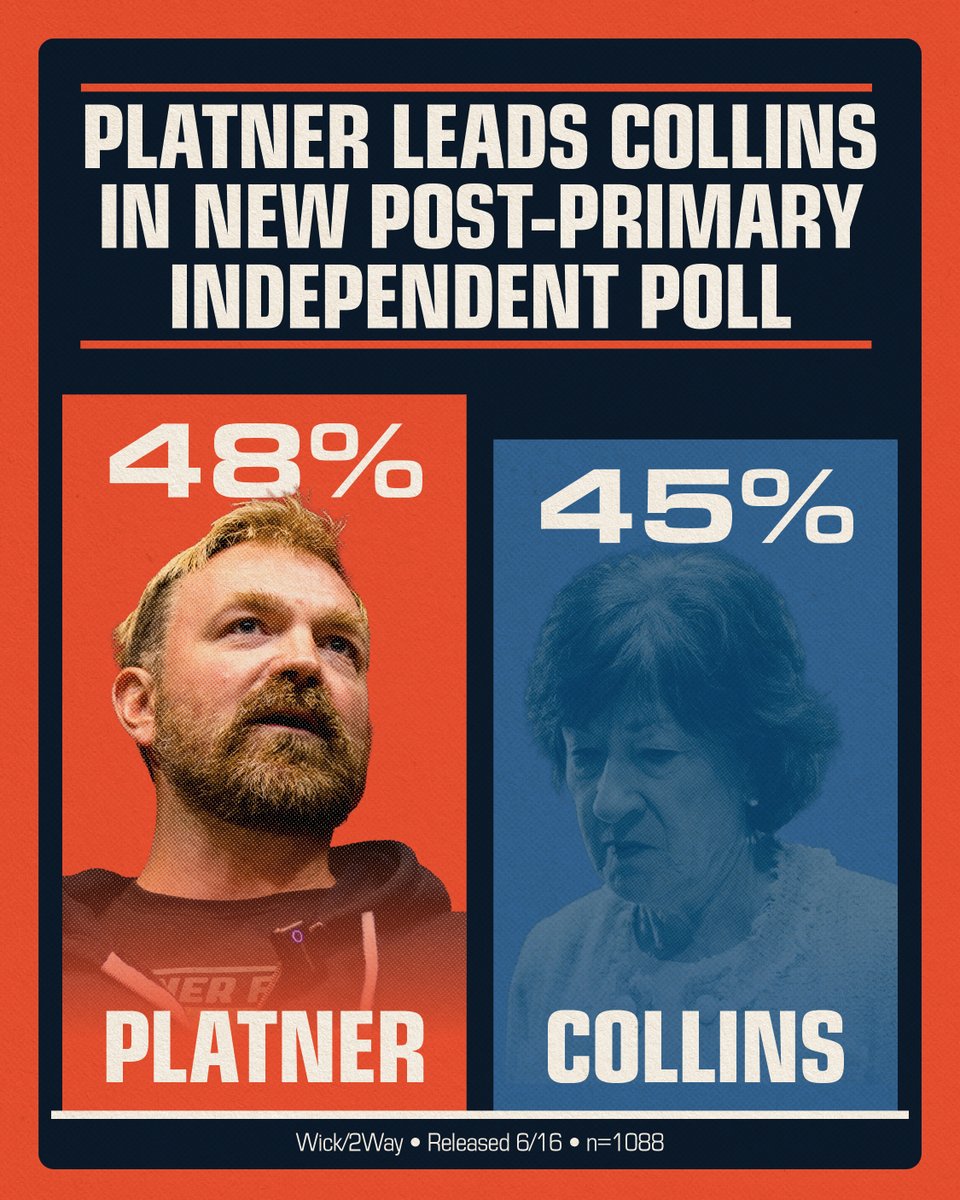
hopes. It shows Democrat Graham Platner narrowly ahead of U.S. Senator
Susan Collins, but the lead is tiny and inside the poll’s margin of
error. More important than the two-point edge are the red flags voters
raised about Platner’s character and past controversies.
Poll shows a tight race — and big warning signs for Platner
The
Siena poll of 608 likely voters finds Platner at about 49% and Senator
Collins at about 47%, a gap well within the reported ±4.8 percentage
points margin of error. That sounds close until you look at the
character questions. Roughly two‑thirds of respondents rate Collins
higher on “good character” and “moral values.” Many Mainers describe
Platner as “too extreme,” and a sizable share say recent revelations
have either made them unable to support him or are causing them to
question their support.
Numbers that matter for control of the Senate
Why
does this matter beyond Maine? Because control of the U.S. Senate is on
the line, and this race was supposed to be a relatively easy pickup for
Democrats. Instead, the data shows a messy mix: voters who want
Democrats to run the Senate still exist in Maine, but candidate quality
is changing behavior. About 28% said they cannot back Platner because of
the controversies, another chunk are rethinking their vote, and roughly
39% say the scandals don’t matter. Translation: national tides can help
you, but a weak nominee can sink a wave.
What Democrats and Republicans will do next
Democrats
doubled down on Platner after the primary, and national operatives have
invested political capital in Maine. That was a gamble — betting on a
nominee with a pile of baggage. Republicans and the NRSC have been
patient, waiting for the legal and strategic deadline that would allow a
last‑minute replacement if Platner were to collapse. Expect more attack
ads, fresh polling, and a scramble for narratives. Collins still has
clear advantages with some key groups, especially non‑college voters,
where the old incumbent’s standing looks surprisingly strong.
Bottom
line: the poll is not a knockout blow for either side, but it is a
delivery of reality to the DNC. Platner’s slim lead is flimsy, and
character doubts are real swing factors. If Republicans play smart, they
can keep the focus on Platner’s scandals and make this a referendum on
judgment rather than national headlines. If Democrats keep pretending
the controversies don’t matter, they’re banking the Senate on wishful
thinking — and wishful thinking doesn’t win close races in Maine or
anywhere else.
Glenn Beck’s recent sit-down with Lara Trump makes one thing plain: the
White House is no longer content to treat the border as a suggestion. On
Beck’s program, Lara Trump defended President Donald Trump’s aggressive
immigration moves and blamed Democrats for what she called “panic” over
enforcement. Whether you cheer or jeer, the administration’s policy
changes are real, sweeping, and shaping the national debate on border
security and illegal immigration.
Why Democrats Are Saying “Panic” — And Why Conservatives Don’t Buy It
Lara
Trump’s message was simple: the administration is delivering on
promises to secure the border, and Democrats are mad because it works
politically. The White House has used new tools — designating major
cartels as terrorist organizations, installing Tom Homan as the border
czar, and putting Secretary of Homeland Security Markwayne Mullin in
charge — to speed enforcement. Those are headline-grabbing moves. They
also send a clear signal that border security and stopping cartel
violence are now front-and-center priorities for the federal government.
What’s Actually Happening on the Ground
The
shift is not just rhetoric. The administration points to high-volume
removals, expanded expedited removal policies, and targeted federal
surges like the Minneapolis operation to show results. Critics rightly
point out the human costs and legal concerns — Minneapolis saw protests,
investigations, and at least one fatal encounter that amplified
pushback from local officials and civil-rights groups. Independent
analysts also caution that the administration’s aggregate deportation
totals mix different categories (returns, removals, voluntary
departures), so the flashy numbers should be read with a grain of salt.
Courts, Litigation, and the Limits of Executive Power
Don’t
think this is a simple left-versus-right slugfest. The administration’s
attempts to deport migrants to third countries and to broaden expedited
removal have been tied up in courtrooms across the country. Judges have
alternately blocked and allowed parts of the program, and stays and
appeals keep the rules changing. That legal tug-of-war matters: policy
statements mean little if injunctions or appellate rulings tie the hands
of DHS and ICE.
Why This Matters — And What Voters Should Watch
At
stake is more than politics. Stronger border enforcement is sold as a
way to cut cartel power, control illegal immigration, and reduce crime.
Opponents say the tactics are heavy-handed and risk civil-rights
violations. Both sides make valid points, but voters should demand
clarity: give us consistent, transparent data on removals, clear rules
of engagement for federal agents, and a legal path that respects due
process. Lara Trump and conservative voices are pushing the narrative
that action beats talk — and the administration is proving they mean it.
If Democrats want to keep shouting “panic,” they better offer a
workable plan instead of headlines.
The United States and Iran have agreed to halt
military attacks as they prepare for talks Tuesday in Qatar aimed at
resolving their dispute over the Strait of Hormuz, Axios reported Sunday, citing a senior U.S. official.
"We decided to stop all the kinetic activity," the official said, using the military term for strikes and other attacks.
The talks were originally expected to take place Tuesday in
Switzerland and focus on Iran's nuclear program, but the recent
escalation shifted the meeting to Qatar and refocused it on the Strait
of Hormuz.
Nick Stewart, who heads the U.S. technical team, is expected to take part in the talks.
The diplomatic push came after Iran skipped technical talks with the
United States scheduled for Sunday, citing recent attacks on Iranian
targets and what Tehran described as unfulfilled terms of its memorandum
of understanding with Washington, Reuters reported.
Mehdi Fazaeli, a member of the Office of Preservation and Publication
of the Works of Iran's Supreme Leader, told Iranian state TV that Iran
did not participate because it was still reviewing whether the U.S. had
met its obligations under the MOU.
"For example one of the reasons is checking if we have access to the
unfrozen funds, if there is no access then this condition has not been
fulfilled," Fazaeli said.
A senior U.S. official offered a different account, telling The New
York Times that technical talks on implementing the MOU are still
expected in the coming days.
The official, who spoke on condition of anonymity to discuss ongoing
diplomacy, said no talks had been canceled and that the two sides
continued to exchange messages through deconfliction channels despite
recent U.S. and Iranian strikes.
The conflicting accounts underscored the fragile state of the interim
agreement, which was intended to create a 60-day window for Washington
and Tehran to work toward a broader deal while reducing military
tensions.
Iran has accused the United States of failing to meet conditions tied
to the release of frozen assets, while Washington has blamed Tehran for
continued attacks on commercial shipping in and around the Strait of
Hormuz.
The White House did not immediately respond to Axios' request for comment.