Hillary Clinton or her representatives have, on at least two occasions, declined to accept legal papers delivered in connection with Tulsi Gabbard’s lawsuit against her, Gabbard’s attorney claims. Gabbard, a Democratic congresswoman from Hawaii who is seeking the party's 2020 presidential
nomination, filed a $50 million lawsuit against Clinton last week over
the former secretary of state’s insinuation that Gabbard was a “Russian asset.” Brian
Dunne, an attorney representing Gabbard, told the New York Post that
Secret Service agents turned away a process server Tuesday when the
server tried to deliver the lawsuit to Clinton’s home in Chappaqua,
N.Y., north of New York City. Dunne
said the server was instructed instead to deliver the papers to the
Washington office of Clinton’s lawyer, David Kendall, but Kendall’s
firm, Williams & Connolly, also declined to accept the legal papers,
according to the Post. “I find it rather unbelievable that
Hillary Clinton is so intimidated by Tulsi Gabbard that she won’t accept
service of process,” Dunne told the newspaper. “But I guess here we are.”
“I
find it rather unbelievable that Hillary Clinton is so intimidated by
Tulsi Gabbard that she won’t accept service of process. But I guess here
we are.” — Brian Dunne, attorney for Tulsi Gabbard
Dunne told the paper his team is considering what steps to take next. During a Jan. 23 appearance on "Fox & Friends," Gabbard accused Clinton of using “smear tactics” against her in an attempt to suppress her freedom of speech. “I
have dedicated my entire adult life to serving our country,” said
Gabbard, 38, a member of the Hawaii Army National Guard who served in
Iraq before being elected to Congress in 2012, “and for Hillary Clinton
and her powerful allies to attempt to smear me and accuse me -- really
implying that I'm a traitor to the country that I love -- is something
that I cannot allow to go unchecked." Clinton had said in an October 2019 interview that one of the Democratic presidential candidates was “the favorite of the Russians” and was being groomed as a third-party candidate for the 2020 general election in November. Clinton
never mentioned Gabbard by name, but when asked to confirm whether the
former first lady was referring to Gabbard, Clinton spokesman Nick
Merrill responded, “If the nesting doll fits … ” a reference to popular
Russian dolls. The remarks from Clinton drew immediate pushback from Gabbard on Oct. 18. “Great!
Thank you @HillaryClinton. You, the queen of warmongers, embodiment of
corruption, and the personification of the rot that has sickened the
Democratic Party for so long, have finally come out from behind the
curtain. From the day I announced my candidacy, there has been a …
concerted campaign to destroy my reputation. We wondered who was behind
it and why. Now we know – it was always you, through your proxies and …
powerful allies in the corporate media and war machine, afraid of the
threat I pose. It’s now clear that this primary is between you and me.
Don’t cowardly hide behind your proxies. Join the race directly. Gabbard’s
camp announced the lawsuit soon after the congresswoman’s Jan. 21
remarks, in which she criticized Clinton for claiming about Sen. Bernie
Sanders that “nobody likes him” and that “he got nothing done” as a
lawmaker. “It’s
time to grow up, you know? This isn’t high school,” Gabbard told
WMUR-TV in Manchester, N.H., referring to the Clinton comments. Gabbard
had supported Sanders in the 2016 race, and visited a Sanders campaign
office in Plymouth, N.H., earlier this week in what was being viewed as a
sign of dealmaking among Democratic candidates as the Iowa caucuses and
New Hampshire primary draw closer, The Washington Post reported. Fox News’ Julia Musto contributed to this story.
Harvard Law Professor Alan Dershowitz, a member of President’s Trump's impeachment defense team, argued Wednesday that former Vice President Joe Biden’s
presidential candidacy justifies the president wanting to investigate
his son Hunter's involvement with a Ukrainian oil company. “The
fact that he’s announced his candidacy is a very good reason for upping
the interest in his son,” Dershowitz said, adding that the House
managers would agree that Trump running for re-election is the only
reason it could be an impeachable offense. Dershowitz asserted
that, hypothetically, if Trump wanted Hunter Biden investigated for
alleged corruption in his second term it wouldn't be impeachable. “The
difference, the House managers would make, is whether he’s in his first
term or his second term, whether he’s running for re-election or not
running for re-election," he said. "If he’s running for re-election
suddenly that turns it into an impeachable offense." Dershowitz
added that even if there was a quid pro quo by withholding $391 million
in military aid to Ukraine it wouldn’t matter because “if a president
does something which he believes will help him get elected in the public
interest, that cannot be the kind of quid pro quo that results in
impeachment.” He suggested Trump’s alleged request for
investigations during the July phone call with Ukrainian
President Volodymyr Zelensky was a “mixed motive,” meaning Trump
believed it would benefit both the country and incidentally himself. The
House managers have argued that Trump abused his power in asking
Ukraine to meddle in a U.S. election by investigating the son of his
political rival. "If you say you can’t hold a president
accountable in an election year where they are trying to cheat in that
election, then you are giving them carte blanche,” House manager Adam
Schiff responded. “So all quid pro quos are not the same. Some are
legitimate, and some are corrupt and you don’t need to be a mind reader
to figure out which is which.” Democrats
have also said that if Trump was legitimately concerned about
corruption involving Hunter Biden, he should have called for the Justice
Department to launch an official investigation.
Gov. Kay Ivey warned Alabamans on Wednesday that they can expect to see her with one of her arms in a sling following a Tuesday night fall. The governor said in a statement that she expects no disruption of her work schedule after tripping over her dog Missy and fracturing one of her shoulders, Birmingham's FOX6 reported. “Alabama’s
First Dog Missy is such a fun and active friend to have at home, and
she is fiercely protective,” Ivey wrote. “Last night, she
unintentionally tripped me up, and I hit my shoulder. You’ll see me in a
sling, but this won’t slow me down a bit! I’ll keep you posted on the
recovery, but most importantly, Missy is also doing just fine!” It wasn’t clear from the statement or from local news reports whether the governor’s left or right shoulder was injured. The
governor is expected to deliver the annual State of the State address
next Tuesday, FOX6 reported. On Wednesday, Ivey congratulated President
Trump after he signed the USMCA trade agreement. "What an exciting
day for our country as @POTUS officially signs #USMCA!" the governor
wrote. "Alabama is grateful for the hard work & leadership of
@realDonaldTrump & all involved for bringing this monumental deal to
fruition. Thank you for supporting the American people!" Ivey,
75, a Republican, became Alabama’s governor in April 2017 following the
resignation of her predecessor, Robert Bentley. She was then elected
outright in November 2018.
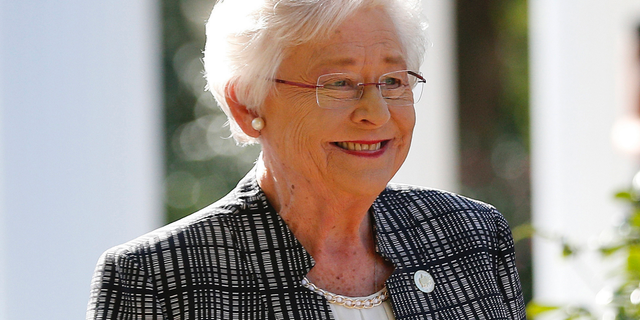
Alabama Gov. Kay Ivey speaks to the media in Montgomery, Ala., Nov. 17, 2017. (Associated Press)
Earlier
this month Ivey announced she had received a positive report from her
doctor following radiation treatment for a cancerous spot found on one
of her lungs, according to AL.com. In November 2018, Ivey’s 14-year-old Chow mix, named Bear, died after a struggle with some health issues, AL.com reported. Ivey had adopted that dog from a local veterinarian after it was struck by a car, the report said.
Chief Justice of the United States John Roberts
blocked Kentucky Republican Sen. Rand Paul from posing a question
during the Senate impeachment trial Wednesday that would have named the
alleged whistleblower at the center of the case, Fox News is told -- and
Paul may try to force the issue during the question-and-answer session
that begins Thursday afternoon. Roberts, for now, has ball
control because he actually receives the questions in note cards from
senators, then reads the question aloud in the Senate chamber to be
answered by either House Democratic managers or Trump's defense team.
But, Fox News has learned Roberts may soon lose his grip on the
proceedings amid a torrent of criticism both inside and outside the
Senate. The Federalist co-founder Sean Davis condemned what he
called Roberts' "arbitrary and unilateral censorship of senators and
Senate business," and reported that
Roberts had initially sought to block even general questions of the
intelligence community whistleblower. When Republicans threatened a vote
rebuking Roberts on the record, Davis reported, Roberts backed down and
decided only to prohibit mentioning the whistleblower's name. A reporter for Roll Call observed that during a break in the trial Wednesday, Paul was fuming. "I don't want to have to stand up to try and fight for recognition," Paul shouted, according to reporter Niels Lesniewski, who noted that Paul's complaint was "audible from the galleries above the chamber." "If I have to fight for recognition, I will," Paul said. Asked by Fox News whether Paul, who has long raised concerns about possible
intelligence community overreach, would press the issue during the
upcoming question period, a spokesman for the senator told Fox News
only, "tbd" -- short for "to be determined." Last year, Paul was vocal about wanting testimony from the whistleblower on the record.
"If I have to fight for recognition, I will." — Kentucky GOP Rep. Rand Paul
Roberts,
under the Constitution, presides over the impeachment trial. But the
precise contours of his authority are not clearly established, and
remain up for debate; Democrats have even said they will attempt a
long-shot motion to give Roberts the unprecedented power to approve or
reject witnesses, for example. Federal law protects
whistleblowers only from retaliation in the workplace, and does not
ensure their anonymity; and Republicans have disputed whether this
particular whistleblower would even qualify for those limited
protections, saying his complaint concerns a policy dispute and does not
allege criminal or civil wrongdoing by the president. Republicans have sought more information on the whistleblower ever since the intelligence community's internal watchdog found several indicators that
the person might have a political bias. Fox News has previously
reported the whistleblower is a registered Democrat and had a prior work history with a senior Democrat running for president. The whistleblower's attorney, Mark Zaid, openly admitted
back in 2017 that a "coup" had started against the president from
within the administration, and that CNN's coverage would play a "key
role" in the effort. He also openly solicited intelligence community members
to help impeach and "get rid" of Trump, years before Trump's call with
Urkaine's leader that triggered the current impeachment proceedings. Additionally, Zaid acknowledged that
the whistleblower had contact with a prominent Democratic presidential
contender, amid reporters that he had served closely with Joe Biden when
he was vice president. Trump's alleged pressure on Ukraine to
investigate Biden is at the center of the current probe. Conspicuously,
Democrats' lead House impeachment manager Rep. Adam Schiff, D-Calif.,
has made public inconsistent statements concerning the House
Intelligence Committee's contacts with the whistleblower. Schiff first denied that his panel had such contact, then reversed course and admitted that members of the committee had spoken to the whistleblower. It
could be, Republicans have asserted, that the whistleblower coordinated
his complaint with Schiff's panel for partisan reasons -- a disclosure
that, if true, would likely undermine the credibility of the impeachment
proceedings and possibly expose Schiff to his own "abuse of power"
allegations. Thus far, the impeachment effort has arguably been elevated
in importance from normal partisan bickering in part by the gravitas
afforded to the supposedly well-meaning whistleblower at the center of
the case. On Wednesday, Schiff again denied knowing the identity
of the whistleblower, even as Republicans accused him of deliberately
lying. Schiff repeatedly shut down GOP questions during the House
impeachment proceedings concerning White House leaks -- even though
doing so at one point seemingly demonstrated that Schiff likely knew the
whistleblower's identity. “Lietenant Colonel Vindman, did you
discuss the July 25 phone call [between Trump and Ukraine's president]
with anyone outside the White House on July 25 or the 26 and if so, with
whom?” Republican California Rep. Devin Nunes asked last year. “Yes.
I did,” Vindman, who has also claimed not to know the whistleblower's
identity, responded. He said he had spoken to Deputy Assistant Secretary
George Kent but, before he could mention the other person, Schiff
intervened and urgently blocked the questioning. “We
need to protect the whistle-blower," Schiff interjected. "Please stop. I
want to make sure that there is no effort to out the whistle-blower
through these proceedings. If the witness has a good faith belief that
this may reveal the identity of the whistle-blower, that is not the
purpose that we’re here for. I want to advise the witness accordingly.” Roberts has mostly stayed out of the spotlight in the trial. In the first day of the proceedings, Roberts admonished both sides
for misconduct in the chamber, saying their rhetoric had gotten too
heated. That warning reportedly came after a "stunned" Republican Sen.
Susan Collins passed a note to Roberts, following Democrats' claims that a vote against their witness resolution would amount to a "coverup." Wednesday's
lengthy question-and-answer session contained other notable moments,
including another spirited constitutional argument by liberal Harvard
Law Professor Alan Dershowitz. Multiple media outlets, including
CNN, mischaracterized Dershowitz throughout the day as saying that
presidents can do "anything" as long as they can argue it's in the
"public interest." In fact, Dershowitz maintained that criminal or
criminal-like conduct is impeachable, regardless of its motivation. Instead,
Dershowitz asserted the Senate should not be in the business of
removing presidents based on nebulous and unconstitutional "abuse of
power" charges that the framers expressly rejected. It would be a
standard Democrats would not want applied to their own presidents, he
argued. To demonstrate that point, Dershowitz made thinly veiled
references to President Obama's refusal to send lethal military aid to
Ukraine, as well as his failed, unenforced "red line" warning for Syria
not to use chemical weapons. Obama was also caught on a hot microphone promising Russia's president he would have "more flexibility" on missile defense issues after the 2012 election. "Let's
consider a hypothetical," Dershowitz said. "Let's assume that President
Obama had been told by his advisors that it really is important to send
lethal weapons to the Ukraine. But then he gets a call from his
pollster and his political adviser, who says we know it's in the
national interest to send lethal weapons to the Ukraine, but we're
telling you that the left-wing of your party is really going to give you
a hard time if you start selling lethal weapons and potentially get
into a lethal war with Russia. Would anybody here suggest that is
impeachable?" He
continued: "Or let's assume President Obama said, 'I promise to bomb
Syria if they had chemical weapons. But I'm now told by my pollster that
bombing Syria would hurt my electoral chances.' Simply not impeachable
at all." It would be difficult if not impossible, Dershowitz said,
to determine that a president has acted with corrupt "motive," given
that countless presidents inevitably consider both the national interest
and their personal political gain when making decisions. Rarely do
presidents act with purely corrupt or purely noble motives, he said.
Often, he went on, presidents want to help themselves but in doing so
believe they are also helping the country. There were signs
Dershowitz's argument was making headway among moderate swing-vote GOP
senators. Maine Republican Sen. Susan Collins was reportedly "clearly
unhappy" with Democrats' explanation as to why they had not charged
actual crimes in the articles of impeachment, and was shaking her head
while they answered her question on the topic by claiming their
allegations were "akin" to criminal conduct, Roll Call's Todd Ruger reported. When
House Democratic impeachment manager Jerry Nadler, D-N.Y., claimed "all
scholars" except for Dershowitz agreed that impeachment didn't have to
involve crimes or criminal-like conduct, there were audible groans from
the GOP side of the chamber. Dershowitz rose, turned to Nadler, and said he was simply ignorant of the facts. "By
the way, the congressman was just completely wrong when he said I'm the
only scholar who supports this position," Dershowitz said. "In the 19th
century, which is much closer in time [to the founding of the country
and the drafting of the Constitution,] Dean [Theodore] Dwight of the
Columbia Law School wrote that 'the weight of authority,' by which he
meant the weight of scholarly and judicial authority, this is in 1867,
is in favor of requiring a crime. Justice [Benjamin Robbins] Curtis came
to the same conclusion." Dershowitz reiterated that the "abuse of
power" charge was vague and indeterminate, and was precisely the kind
of article of impeachment that the framers wanted to reject -- as
evidenced by their explicit repudiation of the charge of
"maladministration,' which he said is synonymous with "abuse" or
"misconduct" in office. He then took a shot at fellow Harvard Law
School professor Laurence Tribe for being a partisan hack, and warned
that scholars often have partisan biases, too. Dershowitz noted that he
voted for Hillary Clinton and would be making the same argument if she
were on trial. Later, Dershowitz deployed another hypothetical to
argue that Democrats' impeachment was itself, somewhat ironically, a
partisan proceeding. "Let’s assume hypothetically that the
president was in his second term and he said to himself, you know, Joe
Biden is running for president," Dershowitz said. "I really should now
be concerned about whether his son is corrupt,
because he’s not only a candidate ... but he could be the President of
the United States, and if he’s the president of the United States and he
has a corrupt son, the fact that he’s announced his candidacy is a very
good reason for upping the interest in his son." Dershowitz
continued: "If he wasn’t running for president, he’s a has-been. He is
the former vice president of the United States. Okay, big deal. But if
he’s running for president, that’s an enormous big deal. So the
difference the House managers would make is whether the president’s in
his first term or his second term, whether he’s running for reelection
or not running for reelection. I think they would have to concede that
if he was not running for reelection, this would not be a corrupt
motive, or it would be a mixed motive, but leaning on the side of
national interest. If he is running for reelection, suddenly that turns
it into an impeachable offense!” Schiff rose to claim that
Republicans surely would have impeached Obama if he sought to tie
financial aid to a foreign country to secure a probe into Romney; he did
not address Dershowitz's argument that such an impeachment, too, would
be improper. A string of newly resurfaced video clips of former national security adviser John Bolton spurred Trump and his supporters Wednesday to highlight what they described as Bolton's serious credibility questions amid the Senate impeachment trial, as the president tweeted, "GAME OVER!" In
his tweet, Trump linked to an interview of Bolton in August 2019 where
he discusses Ukraine policy. In the Radio Free Europe/Radio Liberty
interview clip, Bolton made no mention of any illicit quid pro quo, and
acknowledged, as Republicans have claimed, that combating "corruption"
in Ukraine was a "high priority" for the Trump administration. Bolton
also called Trump's communications with Ukrainian President Volodymyr
Zelensky "warm and cordial," without mentioning any misconduct. It
seemingly contradicted reported assertions in Bolton's forthcoming book
that Trump explicitly told him he wanted to tie military aid to Ukraine
to an investigation into Joe and Hunter Biden. (Zelensky has said his communications with Trump involved no pressure for any investigation.) Fox
News later identified clips of Schiff, D-Calif., now the lead House
impeachment manager, in which he says Bolton had a distinct "lack of
credibility" and was prone to "conspiracy theories." This week, Schiff
said Bolton needed to testify in the impeachment trial as an important and believable witness. "This
is someone who's likely to exaggerate the dangerous impulses of the
president toward belligerence, his proclivity to act without thinking,
and his love of conspiracy theories," Schiff told MSNBC's Rachel Maddow
on March 22, 2018, when Trump named Bolton national security adviser. "And
I'll, you know, just add one data point to what you were talking about
earlier, John Bolton once suggested on Fox News that the Russian hack of
the DNC [Democratic National Committee] was a false flag operation that
had been conducted by the Obama administration," he said. "So, you add
that kind of thinking to [former U.S. attorney] Joe diGenova and you
have another big dose of unreality in the White House." Schiff
made similar arguments back in May 2005, saying in an interview with
CNN's "Crossfire" that Bolton was "more focused on the next job than
doing well at the last job" when he was up for nomination as ambassador
to the United Nations under then-President George W. Bush. "And
particularly given the history, where we've had the politicizing of
intelligence over WMD [weapons of mass destruction], why we would pick
someone who the very same issue has been raised repeatedly, and that is
John Bolton's politicization of the intelligence he got on Cuba and
other issues, why we would want someone with that lack of credibility, I
can't understand," Schiff had said. Bolton himself had admitted in the past that he would be more than willing to lie if he felt it was in the nation's best interest. “If I had to say something I knew was false to protect American national security, I would do it," Bolton said in an interview with Fox Business in 2010. But, speaking to CNN on Monday, Schiff took a different approach -- calling Bolton essential to the "search for truth." "I
think for the senators, and I'm just not talking about the four that
have been so much the focus of attention, for every senator, Democrat
and Republican, I don't know how you can explain that you wanted a
search for the truth in this trial and say you don't want to hear from a
witness who had a direct conversation about the central allegation in
the articles of impeachment," Schiff said on CNN's "New Day." Seemingly
responding to charges of hypocrisy, Schiff remarked on the Senate floor
late Wednesday: "I'm no fan of John Bolton, but I like him a little
more now than I used to." Whether
or not the Senate will vote to call Bolton as a witness -- or whether he
will legally be able to testify -- remain open questions. Republicans
have suggested that Schiff himself should testify. Any
witness resolution would likely require four Republican defections in
the Senate, because in the event of a 50-50 tie, Chief Justice of the
United States John Roberts is highly likely to abstain rather than
assert his debatable power to cast a tie-breaking vote. The witness question will be decided later this week, after the question-and-answer session of the trial wraps up. Republicans, who have a 53-47 majority in the chamber, have suggested to Fox News that
they would amend any witness resolution that subpoenas Bolton to also
require the appearance of several additional witnesses favorable to the
Trump administration -- likely killing support in the Senate for the
whole witness package altogether. In the meantime, concerns over
Bolton potentially divulging classified information, as well as
violating the legal principle of executive privilege, have emerged. On
Wednesday, the White House revealed
it had told Bolton not to publish his upcoming tell-all book about his
time in the Trump administration until classified material is removed
from the manuscript. “Under federal law and the nondisclosure
agreements your client signed as a condition for gaining access to
classified information, the manuscript may not be published or otherwise
disclosed without the deletion of this classified information,” Ellen
J. Knight, a National Security Council (NSC) aide, wrote in a letter to
Bolton attorney Charles J. Cooper last week, which was obtained by Fox
News. Bolton’s book has disrupted Trump’s impeachment trial. The
New York Times reported that Bolton's draft manuscript includes a claim
that Trump explicitly linked a hold on military aid to Ukraine to an
investigation of Joe and Hunter Biden -- a central part of the case
against Trump. The
letter from the NSC was transmitted to Bolton’s attorney on Jan 23. The
New York Times article about the manuscript came out on Sunday, Jan. 26
-- three days after the letter was transmitted. That indicates that the
NSC had already made the determination that there was top secret
information in Bolton’s manuscript before anything became public. Earlier
in the day, CNN reported that the letter amounted to a threat against
Bolton. But sources told Fox News this was not a “threat,” saying the
letter merely points out that there is top secret information contained
in the manuscript that cannot be released to the public. Fox News' Chad Pergram and Sally Persons contributed to this report.
WASHINGTON
(AP) — President Donald Trump’s impeachment trial is shifting to
questions from senators, a pivotal juncture as Republicans lack the
votes to block witnesses and face a potential setback in their hope of
ending the trial with a quick acquittal.
After
Trump’s defense team rested Tuesday with a plea to “end now,” Senate
Majority Leader Mitch McConnell privately told senators he doesn’t yet
have the votes to brush back Democratic demands for witnesses now that
revelations from John Bolton, the former national security adviser, have
roiled the trial.
Bolton
writes in a forthcoming book that Trump told him he wanted to withhold
military aid from Ukraine until it helped with investigations into
Democratic rival Joe Biden. That assertion, if true, would undercut a
key defense argument and go to the heart of one of the two articles of
impeachment against the president.
“I think Bolton probably has something to offer us,” said Sen. Lisa Murkowski, R-Alaska.
Not
in Trump’s view. “Why didn’t John Bolton complain about this ‘nonsense’
a long time ago, when he was very publicly terminated,” Trump tweeted
shortly after midnight. “He said, not that it matters, NOTHING!”
The
uncertainty about witnesses arises days before crucial votes on the
issue. In a Senate split 53-47 in favor of Republicans, at least four
GOP senators must join all Democrats to reach the 51 votes required to
call witnesses, decide whom to call or do nearly anything else in the
trial. Several Republicans apparently are ready to join Democrats in
calling witnesses.
The
two days set aside for questions, Wednesday and Thursday, also allow
each side more time to win over any undecided senators pondering the
witness issue. In the meantime, all will have the opportunity to grill
both the House Democrats prosecuting the case and the president’s
defense team.
Held
to submitting written questions to be read by Chief Justice John
Roberts, senators are expected to dig into the big themes of the trial —
among them whether what Trump did or may have done rises to the level
of “high crimes and misdemeanors” — as well as pointed and partisan
attacks on each side’s case.
Trump faces charges
from Democrats that he abused his power like no other president,
jeopardizing U.S.-Ukraine relations by using the military aid as
leverage while the vulnerable ally battled Russia. Democrats say Trump
then obstructed their probe in a way that threatens the nation’s
three-branch system of checks and balances.
The
president’s legal team tried to lock up its case Tuesday and convince
GOP senators that the president was right to ask Ukraine for
investigations of Biden and his son Hunter and was well within his power
to block the aid. They said he was not bound to abide by the
congressional investigation.
Sen. Lindsey Graham, R-S.C., Tuesday called on former national security adviser John Bolton to hold a press conference to expand on a New York Times bombshell report that
claimed Bolton wrote in his upcoming book that President Trump
explicitly tied $391 million in Ukrainian military aid to investigating
the Bidens. “John, you’ve kind of thrown the country into a ditch
here,” Graham told Fox News' Martha MacCallum. “Just come forward and
say what’s on your mind, hold a news conference and we’ll consider what
you’ve got to say if you think it’s that important." Graham said from his point of view, he believes he has all the evidence he needs in Trump's impeachment trial, which he said he was optimistic would wrap up with an acquittal before the State of the Union next Tuesday. He added that even if what Bolton said Trump did was true it wouldn’t be an impeachable offense. The
White House’s plans for a speedy trial without witnesses were thrown
into doubt this week after the Times' report, which renewed calls from
Democrats to subpoena Bolton who has said he is willing to be a witness. Some
moderate Republicans have said they might be open to hearing his
testimony in the wake of the report and House Speaker Mitch McConnell
reportedly said he didn't have the votes as of Tuesday to dismiss
calling witnesses. Graham said he blames House Democrats for not pursuing a Bolton subpoena in the courts. Lead
House impeachment manager Rep. Adam Schiff explained Democrats decided
not to go through the courts to compel Bolton’s testimony because he
believes it would be used as a stall tactic. “If you argue that,
well, the House needed to go through endless months or even years of
litigation before bringing about an impeachment, you effectively nullify
the impeachment clause,” Schiff said earlier this month. “You allow the
president of the United States — by delay, by playing rope-a-dope in
the courts — to defeat the power of the impeachment clause.” Graham added that he would be open to calling Joe and Hunter Biden and the whistleblower as witnesses. “It’s a partisan, political exercise,” he said of Trump’s impeachment, “that needs to die this week.” Fox News' Marisa Schultz contributed to this report.