Sessions vows 'emergency' Supreme Court battles amid 'outrageous' discovery rulings by federal judges
Attorney
General Jeff Sessions on Monday lit into federal judges for what he
called a dramatic uptick in "outrageous" decisions threatening to
interfere with the separation of powers by exposing internal White House
deliberations.
In a fiery speech to the conservative Heritage
Foundation in Washington, Sessions warned that "once we go down this
road in American government, there is no turning back." He vowed to take
"these discovery fights to the Supreme Court in emergency postures. ...
We intend to fight this, and we intend to win."
Sessions
specifically singled out New York district court judge Jesse M. Furman,
who ruled that Commerce Secretary Wilbur Ross could be questioned in an
ongoing lawsuit concerning the legality of the Trump administration's
decision to add a citizenship question to the 2020 census.
Furman's
decision, Sessions said, contradicts longstanding statutory provisions
that protect certain executive branch discussions from disclosure, in
order to encourage free and open deliberations by executive branch
officials. The plaintiffs in the lawsuit, including several liberal
states, are arguing in part that the White House added the citizenship
question for political reasons.
The judge wants "to hold a trial
over the inner workings of a Cabinet secretary’s mind," and
inappropriately allow inquiry into the motivations for the Trump
administration's decisions, Sessions said.
Furman's order, which
was upheld by a New York federal appellate court, has been stayed by
Supreme Court Justice Ruth Bader Ginsburg. The full Supreme Court is
expected to decide the issue soon.
"Once we go down this road in American government, there is no turning back." — Attorney General Jeff Sessions
The
pending court challenges against the Trump administration's decision to
add a citizenship question, legal experts tell Fox News, face an uphill
battle not only because conservatives now command a 5-4 majority on the
Supreme Court, but also because traditionally it's been the White
House's prerogative to decide whether to inquire about citizenship on
the census.
Former President Barack Obama's administration didn't ask the question in the 2010 census amid
fears it would cause illegal immigrants to avoid answering their census
questions -- and thus not count toward population totals used to
determine the number of seats each state receives in the House of
Representatives. (The citizenship question was last asked on the census
in 1950, but beginning in 1970, a citizenship question was asked in a
long-form questionnaire sent to a relatively small number of households,
alongside the main census. In 2010, there was no long-form
questionnaire.)
Democrats would lose out because the citizenship
question would affect predominately liberal districts, but that's not a
legally sufficient objection, legal analysts say. TRUMP CENSUS BUREAU NOMINEE QUIZZED BY SENATORS ON CITIZENSHIP QUESTION
"There
is no credible argument to be made that asking about citizenship
subverts the Constitution and federal law," Chapman University law
professor and constitutional law expert John Eastman told Fox News. "The
recent move is simply to restore what had long been the case."
Nevertheless,
Sessions said Monday, liberal states and nonprofits have continued to
push even longshot legal challenges in order to dig around in executive
branch deliberations.
"This is not the first time we’ve had to
seek emergency appellate intervention to stop outrageous discovery,"
Sessions said. Last year, the government filed a successful emergency
motion to stop a district court's ruling that permitted plaintiffs to
question a Department of Homeland Security counselor about advice
relating to the contentious Deferred Action for Childhood Arrivals
(DACA) program.
Sessions called that lower court ruling a "blatant
violation of deliberative process and attorney-client privileges" and
warned that it would have a "chilling effect" on deliberations in the
White House.
He added, "Too many judges believe it is their right, their duty, to act upon their sympathies and policy preferences."
The
attorney general blamed Obama for encouraging that approach. "One
argument for activism was advocated openly by President Obama when he
declared his judicial nominees must judge with 'empathy.' It is a
seductive argument. But whatever empathy is, it’s more akin to emotion,
bias, and politics than law," Sessions said.
"In the recent DACA litigation, for example, a judge last year told one of our DOJ litigators, 'You can’t come into court to espouse a position that is heartless,'"
Sessions continued. "Not illegal. Not unlawful. Heartless. And later,
after I responded in a speech that it isn’t a judge’s job to decide
whether a policy is 'heartless,' the judge again scolded the DOJ lawyer
by stating that I 'seem to think the courts cannot have an opinion.'"
Judge Nicholas Garaufis denied the government's motion to dismiss a
DACA lawsuit, citing President Trump's "bigoted" comments.
(Reuters, FIle)
That judge, U.S. District
Judge Nicholas Garaufis, was appointed to the bench by former President
Bill Clinton. He ruled in March that a lawsuit seeking to preserve the
federal DACA program can continue -- citing candidate Donald Trump's
"racial slurs" and "epithets."
“One might reasonably infer,”
Garaufis said in his politically charged ruling, “that a candidate who
makes overtly bigoted statements on the campaign trail might be more
likely to engage in similarly bigoted action in office.”
Separately,
Sessions also said the 27 nationwide federal injunctions issued by
individual judges during the Trump administration so far -- which
brought temporary halts to high-profile policies like his ban on travel from Muslim-majority nations -- constitute an unprecedented "judicial encroachment."
"It
is emphatically not the duty of the courts to manage the government or
to pass judgment on every policy action the Executive branch takes,"
Sessions said. "In the first 175 years of this Republic, not a single
judge issued one of these orders."
In his confirmation hearings
for the Supreme Court in September, then-nominee Brett Kavanaugh was
asked by Louisiana Republican Sen. John Kennedy about the
constitutionality of individual federal judges issuing nationwide
injunctions against presidential action, a recent phenomenon. Kavanaugh
demurred, saying he could not discuss potential pending issues before
the Supreme Court.
Sessions noted that Associate Justice Clarence
Thomas, who concurred in the high court's decision earlier this year to
reinstate Trump's travel ban, wrote that such injunctions “take a toll
on the federal court system—preventing legal questions from percolating
through the federal courts, encouraging forum shopping, and making every
case a national emergency for the courts and for the executive branch.”
He
added: "Executive branch officers do not work for the judiciary. We
work for the president of the United States. Respect runs both ways."


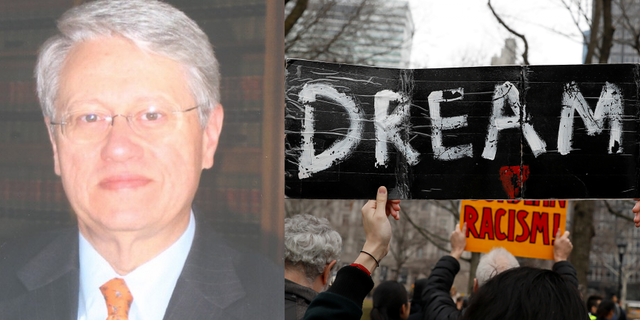 Judge Nicholas Garaufis denied the government's motion to dismiss a
DACA lawsuit, citing President Trump's "bigoted" comments.
(Reuters, FIle)
That judge, U.S. District
Judge Nicholas Garaufis, was appointed to the bench by former President
Bill Clinton. He ruled in March that a lawsuit seeking to preserve the
federal DACA program can continue -- citing candidate Donald Trump's
"racial slurs" and "epithets."
Judge Nicholas Garaufis denied the government's motion to dismiss a
DACA lawsuit, citing President Trump's "bigoted" comments.
(Reuters, FIle)
That judge, U.S. District
Judge Nicholas Garaufis, was appointed to the bench by former President
Bill Clinton. He ruled in March that a lawsuit seeking to preserve the
federal DACA program can continue -- citing candidate Donald Trump's
"racial slurs" and "epithets."


No comments:
Post a Comment