Former NY Times editor rips Trump coverage as biased
Jill Abramson
A
former executive editor of the New York Times says the paper’s news
pages, the home of its straight-news coverage, have become “unmistakably
anti-Trump.”
Jill Abramson, the veteran journalist who led the
newspaper from 2011 to 2014, says the Times has a financial incentive to
bash the president and that the imbalance is helping to erode its
credibility.
In a soon-to-be published book, “Merchants of Truth,”
that casts a skeptical eye on the news business, Abramson defends the
Times in some ways but offers some harsh words for her successor, Dean
Baquet. And Abramson, who was the paper’s only female executive editor
until her firing, invoked Steve Bannon’s slam that in the Trump era the
mainstream media have become the “opposition party.”
“Though
Baquet said publicly he didn’t want the Times to be the opposition
party, his news pages were unmistakably anti-Trump,” Abramson writes,
adding that she believes the same is true of the Washington Post. “Some
headlines contained raw opinion, as did some of the stories that were
labeled as news analysis.”
What’s more, she says, citing legendary
20th century publisher Adolph Ochs, “the more anti-Trump the Times was
perceived to be, the more it was mistrusted for being biased. Ochs’s vow
to cover the news without fear or favor sounded like an impossible
promise in such a polarized environment.”
Abramson describes a
generational split at the Times, with younger staffers, many of them in
digital jobs, favoring an unrestrained assault on the presidency. “The
more ‘woke’ staff thought that urgent times called for urgent measures;
the dangers of Trump’s presidency obviated the old standards,” she
writes.
Trump claims he is keeping the “failing” Times in
business—an obvious exaggeration—but the former editor acknowledges a
“Trump bump” that saw digital subscriptions during his first six months
in office jump by 600,000, to more than 2 million.
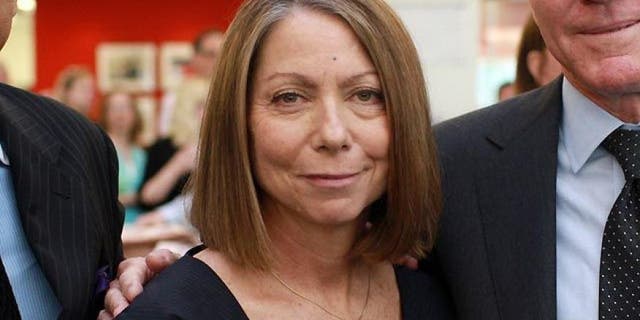
Former executive editor of the New York Times Jill Abramson.
Dean
Baquet 2019 New York Times Editor
“Given its mostly liberal audience, there was an
implicit financial reward for the Times in running lots of Trump
stories, almost all of them negative: they drove big traffic numbers
and, despite the blip of cancellations after the election, inflated
subscription orders to levels no one anticipated.”
The Times has
long faced accusations of liberal bias, even before Trump got into
politics and became its harshest critic. But Abramson’s words carry
special weight because she is also a former Times Washington bureau
chief and Wall Street Journal correspondent specializing in
investigative reporting.
Baquet has said that Trump’s attacks on
the press are “out of control” and that it is important to use the word
“lie” when the president tells a clear untruth.
In “Merchants of
Truth: The Business of News and the Fight for Facts,” Abramson praised
as “brave and right” Baquet’s decision to run this headline when Trump
abandoned his birtherism attacks on Barack Obama: “Trump Gives Up a Lie
But Refuses to Repent.”
Abramson, who had her share of clashes
with Baquet when he was her managing editor, sheds light on a 2016
episode when Baquet held off on publishing a story that would have
linked the Trump campaign with Russian attempts to influence the
election.
Liz Spayd, then the Times public editor, wrote that the
paper, which concluded that more evidence was needed, appeared “too
timid” in not running the piece, produced by a team that included
reporter Eric Lichtblau.
Baquet “seethed” at this scolding, Abramson says, and emailed Lichtblau: “I hope your colleagues rip you a new a*****e.”
Baquet
wrote that “the most disturbing thing” about Spayd’s column “was that
there was information in it that came from very confidential, really
difficult conversations we had about whether or not to publish the back
channel information. I guess I’m disappointed that this ended up in
print.
“It is hard for a journalist to complain when confidential
information goes public. That’s what we do for a living, after all. But
I’ll admit that you may find me less than open, less willing to invite
debate, the next time we have a hard decision to make.”
Lichtblau
soon left the Times for CNN, where he was one of three journalists fired
when the network retracted and apologized for a story making
uncorroborated accusations against Trump confidante Anthony Scaramucci.
And the Times soon abolished the public editor’s column.
Abramson
is critical of Trump as well. She calls his “fake news” attacks a “cheap
way of trying to undermine the credibility of the Times’s reporting as
something to be accepted as truth only by liberals in urban,
cosmopolitan areas.”
The Times, which broke the story of Hillary
Clinton’s private email server, also “made some bad judgment calls and
blew its Clinton coverage out of proportion,” Abramson writes. She says
Clinton “was wary of me,” mishandled the scandal and “was secretive to
the point of being paranoid.”
Abramson is candid in acknowledging
her faults. When then-publisher Arthur Sulzberger Jr. was considering
promoting her to the top job, he told her over lunch at Le Bernadin:
“Everyone knows there’s a good Jill and a bad Jill. The big question for
me is which one we’ll see if you become executive editor.”
She admitted to him that “I could be self-righteous when I felt unheard, I interrupted, I didn’t listen enough.”
It
was a heated battle with Baquet that led to her ouster in 2014. He was
furious upon learning that she was trying to trying to recruit another
top journalist—Abramson says an executive ordered her to keep it
secret—who would share the managing editor’s title.
Sulzberger called her in, fired her, and handed her a press release announcing her resignation.
Abramson
says she replied: “Arthur, I’ve devoted my entire career to telling the
truth, and I won’t agree to this press release. I’m going to say I’ve
been fired.”
Her final judgment: “I was a less than stellar
manager, but I also had been judged by an unfair double standard applied
to many women leaders.”




No comments:
Post a Comment