California sued over law blocking Trump from ballot unless he releases tax returns
Four voters in California, along with the conservative transparency group Judicial Watch, announced Monday they have filed a federal lawsuit against the left-wing state, alleging its new law aimed at strong-arming President Trump into releasing his income tax returns is patently unconstitutional. Democratic Gov. Gavin Newsom signed the law known as the "Presidential Tax Transparency and Accountability Act" last week. Its provisions would
require Trump and other presidential primary candidates to file their
tax returns for the most recent five years to the California secretary
of state by November 26 or be excluded from the March 3,
2020 presidential primary ballot. The law does not apply to the
general election, so Trump would still appear on the November 2020
California presidential ballot if he secured the national Republican
Party nomination. "Within five days of receipt of the candidate’s
tax returns, the Secretary of State shall make redacted versions of the
tax returns available to the public on the Secretary of State’s internet
website," the law states. The measure sailed through the state's Democratic-led
legislature. Former California Gov. Jerry Brown had vetoed a similar
version of the law last year, noting that it "may not be constitutional"
and sets a "slippery slope precedent" that could lead the state to
demand all kinds of documents from candidates. "Today we require
tax returns, but what would be next?" Brown asked. "Five years of health
records? A certified birth certificate? High school report cards? And
will these requirements vary depending on which political party is in
power." But Newsom, a frequent Trump critic who declared in June that the GOP is "finished" and will devolve into a third party, disregarded those concerns. The
Constitution requires only three things of presidents: They have to be a
natural-born U.S. citizen; must be at least 35 and must have lived in
the country for at least 14 years. (Although the precise legal meaning
of the term "natural-born U.S. citizen" is debated, it generally is
taken to apply when someone is either born in the U.S. or born abroad to
a U.S. citizen.)
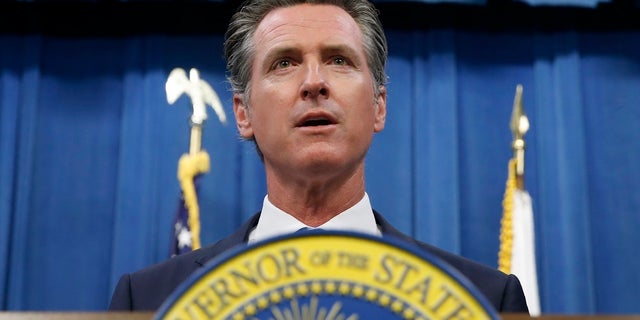
California Gov. Gavin Newsom during a news conference in
Sacramento, Calif. Newsom signed a law Tuesday, July 30, requiring
presidential candidates to release their tax returns to appear on the
state's primary ballot, a move aimed squarely at Republican President
Donald Trump. (AP Photo/Rich Pedroncelli)
The four plaintiffs are two Republicans, one Democrat and one independent. In their federal complaint, the plaintiffs call the law an unprecedented attempt by a state to add additional qualifications for the presidency. "No
state or federal law has ever mandated that presidential candidates
disclose their tax returns to qualify or appear on a ballot," the
complaint says. "The voluntary release of presidential candidates’ tax
returns is a recent, and partial, phenomenon, notwithstanding a current
media narrative suggesting otherwise." In a statement,
Judicial Watch President Tom Fitton said: "This is a nonpartisan
concern about the state running roughshod and attempting to amend the
Constitution on its own." “California politicians, in their zeal
to attack President Trump, passed a law that also unconstitutionally
victimizes California voters," Fitton added. "It is an obvious legal
issue that a state can’t amend the U.S. Constitution by adding
qualifications in order to run for president. The courts can’t stop this
abusive law fast enough.” Attorneys for Judicial Watch argue
California's law effectively alters the Constitution by adding a new
requirement for tax returns, something they say state governments don't
have the authority to do. California's
law says voters need to know details about presidential candidates'
finances to "better estimate the risks of any given Presidential
candidate engaging in corruption." But Judicial Watch argues that
rationale could lead states to demand things like medical and mental
health records and eventually things like Amazon purchases, Google
search histories and Facebook friends. Conservatives, who recognize that
Trump stands no chance of winning California's electoral votes
regardless of the outcome of this dispute, have similarly sounded the
alarm about where these restrictions might go in the future. Judicial
Watch also argues that by limiting the law to primary elections, it
does not apply to independent candidates. Judicial Watch also says the
law violates voters' constitutional rights to associate with
presidential candidates and the voters who support them, rights it says
are guaranteed under the First and 14th amendments. The lawsuit
names Secretary of State Alex Padilla as the defendant because his
office is in charge of enforcing the law. Representatives for Padilla
and Newsom declined to comment on Monday, saying they have not been
officially notified of the lawsuit. When he signed the law last week, Newsom released statements from three lawyers, including the dean of the University of California, Berkeley law school, saying the law is constitutional. "SB
27, which requires that presidential candidates disclose tax returns,
is constitutional. It does not keep any candidate from being on the
ballot so long as he or she complies with a simple requirement that is
meant to provide California voters crucial information," Berkeley
dean Erwin Chemerinsky said. "This
is the state acting to make sure that its voters have information that
might be very important to them when they cast their ballots as to who
they want to be President of the United States." Newsom contends
Congress has changed aspects of the presidency previously, including
limiting presidents to two terms after President Franklin Roosevelt was
elected to four terms, and passing anti-nepotism laws after President
John F. Kennedy appointed his brother, Robert, U.S. attorney general.
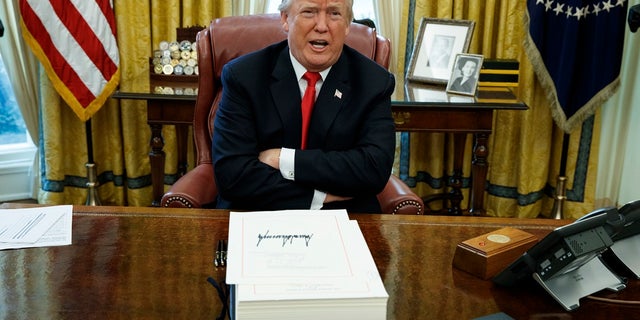
President Trump has said he will not release his tax returns as long as they are under audit. (AP Photo/Evan Vucci, File)
"If the federal government is not going to act, California needs to act. We've always done that," Newsom said in a video posted to his Twitter account. Citizens
have had to pay federal income taxes since 1913, but it wasn't until
1973 when a U.S. president made his personal tax returns public.
Republican Richard Nixon released his tax returns publicly while he was
being audited by the IRS, after an IRS employee leaked a portion of his
returns to the media. Ever
since, U.S. presidents have released at least a summary of their
personal income taxes. That includes most major candidates for
president, with some exceptions. Former California Democratic Gov. Jerry
Brown did not release his tax returns when he ran for president in
1992. In their lawsuit against California, the plaintiffs noted
that "one study found that 7 of 34 'major' candidates for president
since 1976, or about 20 percent, refused to produce their tax returns." The
complaint specifically alleges violations of the Qualifications Clause
of the Constitution, as well as the plaintiff's First Amendment rights
to express their political preferences. Additionally, because the law
only applies to party-affiliated candidates (non-party candidates do not
participate in primaries), the suit also alleges a violation of the
Constitution's Equal Protection Clause and a federal equal protection
statute. Trump has refused to release his tax returns, saying they are being audited by the IRS. Fox News' Louis Casiano and The Associated Press contributed to this report.


 California Gov. Gavin Newsom during a news conference in
Sacramento, Calif. Newsom signed a law Tuesday, July 30, requiring
presidential candidates to release their tax returns to appear on the
state's primary ballot, a move aimed squarely at Republican President
Donald Trump. (AP Photo/Rich Pedroncelli)
California Gov. Gavin Newsom during a news conference in
Sacramento, Calif. Newsom signed a law Tuesday, July 30, requiring
presidential candidates to release their tax returns to appear on the
state's primary ballot, a move aimed squarely at Republican President
Donald Trump. (AP Photo/Rich Pedroncelli)
 President Trump has said he will not release his tax returns as long as they are under audit. (AP Photo/Evan Vucci, File)


No comments:
Post a Comment