Nadler slammed for 'harassment' after fresh Kavanaugh doc requests
The
top Republican on the House Judiciary Committee on Tuesday accused the
panel's Democratic chairman, Rep. Jerry Nadler, of "harassment" and
unethical conduct, after Nadler moved to seek records from Supreme Court
Associate Justice Brett Kavanaugh's time in the George W. Bush administration. Nadler's request came days after a liberal lion of the high court, Associate Justice Ruth Bader Ginsburg, defended Kavanaugh as a "very decent, very smart individual," and long after progressive activists have largely moved on to other matters. Rep.
Doug Collins, R-Ga., said in a statement that Nadler's request is so
"far outside the scope of judicial ethics, it’s harassment." "Senate
Democrats spent months launching false accusations in an attempt to
smear Justice Kavanaugh’s reputation and block his confirmation to the
U.S. Supreme Court, and now House Democrats want to follow suit with yet
another fishing expedition to tarnish his good name," Collins said.
In this July 10, 2018, photo, protesters hold signs supporting
Planned Parenthood in Seattle and against Brett Kavanaugh's nomination
to the Supreme Court.
Nadler, along with Hank Johnson, D-Ga., wrote to the National Archives to seek "certain presidential records related to Justice Brett M. Kavanaugh’s service in the White House from 2001 to 2006." They
cited the Presidential Records Act, which allows congressional
committees to obtain “contain information that is needed for the conduct
of [their] business and that is not otherwise available," subject to
executive privilege and other limitations. Tens
of thousands of documents relating to Kavanaugh's time in the White
House Counsel's Office were withheld during his confirmation process,
the lawmakers said, after they were processed by a private attorney for
potential privilege issues. "As a result of this process, the
Senate Judiciary Committee received only a small fraction of Justice
Kavanaugh’s White House record before voting on his nomination," Nadler
wrote. Nevertheless, some of Kavanuagh's writings in the Bush
administration did play a central role during his confirmation process.
In a dramatic exchange during the hearings, Sen. Cory Booker, D-N.J.,
now a presidential candidate, implied that Kavanaugh had been open to
racial profiling tactics, citing an email exchange between Kavanaugh and
a colleague in the Bush White House. Booker did not provide
Kavanaugh a copy of the emails to review, and claimed Republicans had
tried to hide them. However, Senate Republicans said the documents had
been publicly released earlier in the day, even as Booker suggested he could be expelled from the Senate for releasing them. The emails released later
on during the hearings showed Kavanaugh advocating for race-neutral
security screening policies at airports after 9/11, but said that during
an "interim" period before such policies could be implemented,
administration lawyers would need to "grapple" with the possibility of
factoring in race during screenings in the interest of national
security. In his letter, Nadler sought the new documents on a
"rolling basis," and specifically asked for any "emails sent to or
received by Justice Kavanaugh, including emails on which he was a carbon
copy or blind carbon copy recipient, during the period in which Justice
Kavanaugh served as staff secretary, including any documents attached
to such emails." Additionally, the Democrat requested "the textual
records contained in Justice Kavanaugh’s office files from the period
during which he served as staff secretary." Any successful effort
to remove Kavanaugh from the bench would require a two-thirds vote of
both the House of Representatives and the Senate. Several 2020
Democratic presidential contenders -- including Elizabeth Warren, Kamala
Harris, Kirsten Gillibrand, and Pete Buttigieg -- have said they would
be open to legislation that would expand the size of the Supreme Court,
to effectively dilute the importance of conservative justices' votes.
The size of federal appeals courts, including the Supreme Court, is set
by Congress. "When
are we going to move on from the smear campaigns, and begin working on
real, bipartisan solutions to improve the lives of the Americans we were
elected to represent?” Collins asked.


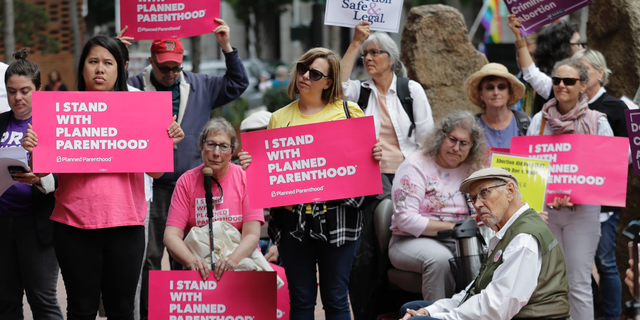 In this July 10, 2018, photo, protesters hold signs supporting
Planned Parenthood in Seattle and against Brett Kavanaugh's nomination
to the Supreme Court.
In this July 10, 2018, photo, protesters hold signs supporting
Planned Parenthood in Seattle and against Brett Kavanaugh's nomination
to the Supreme Court.


No comments:
Post a Comment