Defense Department official says Pentagon received 'phone calls from industry' after hold on Ukraine aid
Deputy Assistant Secretary of Defense Laura Cooper testified last month that Pentagon officials began receiving "phone calls from industry"
-- apparently referring to private companies that supply weapons and
military hardware to the government -- after President Trump initiated a
hold on military aid to Ukraine earlier this year.
The revelation, which came in a transcript of Cooper's closed-door Oct. 23 deposition released Monday by House Democrats as part of their impeachment inquiry, prompted concerns from commentators that the most self-destructive elements of the Russia probe were resurfacing.
"Like Russiagate,
Ukrainegate enrolls liberals in the Cold War designs of dangerous hawks
and neocons," tweeted journalist Aaron Mate.
Additionally, Cooper
testified that the Trump administration had pushed Ukraine to issue a
public statement disavowing any efforts to influence U.S. elections --
but Cooper stopped short of saying that officials wanted to include a
reference to Joe and Hunter Biden's business dealings in the country.
Previous testimony
in the inquiry has suggested that the White House improperly pressured
Ukraine to implicate the Bidens publicly. Former U.S. envoy to Ukraine
Kurt Volker, for example, had remarked that European Union envoy Gordon
Sondland and Trump attorney Rudy Giuliani worked with a top Ukrainian aide to include a reference to the Biden-linked Ukrainian natural gas company Burisma Holdings.
But, Cooper said that on Aug. 20, Volker met with her -- and the idea of mentioning the Bidens apparently didn't come up.
"In
that meeting, he did mention something to me that, you know, was the
first about, somehow, an effort that he was engaged in to see if there
was a statement that the government of Ukraine would make that would
somehow disavow any interference in U.S. elections and would commit to
the prosecution of any individuals involved in election interference,"
Cooper said. "And, that was about as specific as it got."
Cooper's testimony was made public as House Democrats on Monday also released transcripts from their interviews with Christopher Anderson, a career foreign service officer at the State Department, and Catherine Croft,
a Ukraine expert at the State Department. Croft testified that she
speculated Trump would be willing to shift Ukraine policy to hurt a
Biden candidacy, and that news of a holdup of Ukraine aid "blew up" a
State Department meeting.
Croft,
in her remarks, said that the Office of Management and Budget
had "reported that the White House chief of staff, Mick Mulvaney, had
placed an informal hold on security assistance to Ukraine. The only
reason given was that it came at the direction of the president."
Separately,
Cooper testified about Defense Department concerns that Trump's
temporary withholding of military aid to Ukraine may have been illegal.
Deputy Assistant Secretary of Defense Laura Cooper, left, on Capitol Hill on Oct. 30. (AP Photo/Patrick Semansky, File)
"I'm not an expert on the law, but in that meeting
immediately deputies began to raise concerns about how this could be
done in a legal fashion because there was broad understanding in the
meeting that the funding -- the State Department funding related to an
earmark for Ukraine and that the DOD funding was specific to Ukraine
security assistance," Cooper testified, concerning a July 23 meeting of
national security officials. "The comments in the room at the deputies'
level reflected a sense that there was not an understanding of how this
could legally play out, and at that meeting, the deputies agreed to look
into the legalities and to look at what was possible."
The
legalities likely regarded the issue of "impoundment" – the requirement
that the president either had to spend the money or "impound" it. The
White House was coming up against an impoundment deadline when it
released the funds for Ukraine.
Moreover, Cooper said, Defense Department officials were concerned that Trump's decision would weaken a "strategic partner."
"I
mean, so DOD was concerned about the obligation of funds," she
said. "Policy, my team, we were also concerned about any signal that we
would send to Ukraine about a wavering in our commitment. ... They are
trying to negotiate a peace with Russia, and if they are seen as weak,
and if they are seen to lack the backing of the United States for their
Armed Forces, it makes it much more difficult for them to negotiate a
peace on terms that are good for Ukraine."
She added: "My sense is
that all of the senior leaders of the U.S. national security
departments and agencies were all unified in their — in their view that
this assistance was essential, and they were trying to find ways to
engage the president on this."
Croft, meanwhile, told House
investigators, "If this were public in Ukraine it would be seen as a
reversal of our policy and would, just to say sort of candidly and
colloquially, this would be a really big deal, it would be a really big
deal in Ukraine, and an expression of declining U.S. support for
Ukraine."
Ukraine
had satisfied all necessary benchmarks to obtain Ukraine Security
Assistance Initiative funding, Cooper told lawmakers. This past May,
Cooper said, Under Secretary of Defense for Policy John Rood "provided
the certification to Congress, but that was after coordination with the
State Department."
Cooper also told investigators she could make a
"very strong inference" that Ukraine was aware in August that the Trump
administration was holding up the financial assistance, shortly before
the aid was released in September. The Ukraine aid was
suspended temporarily in August -- two weeks before the White
House released it, Politico reported.
"It could have been my
inference, yes, a very strong inference that there was some knowledge on
the part of the Ukrainians," Cooper testified. She called the aid
suspension, which came without an explanation to her knowledge,
"unusual."
Military aid to Ukraine, Cooper further testified, was relevant to U.S. national-security interests.
"Ukraine,
and also Georgia, are the two front-line states facing Russian
aggression," Cooper said. "In order to deter further Russian aggression,
we need to be able to shore up these countries' abilities to defend
themselves. That's, I think, pure and simple, the rationale behind our
strategy of supporting these countries. It's in our interest to deter
Russian aggression elsewhere around the world."
Trump's suggested
in his July call with Ukrainian President Volodymyr Zelensky that the
country investigate Joe and Hunter Biden's business dealings there,
after it emerged that Joe Biden, the former vice president and current
2020 presidential candidate, had pressured Ukraine to fire its top
prosecutor while Hunter Biden held a lucrative role on the board of a
Ukrainian natural gas company. Zelensky has said he felt no improper
pressure during the call.
In a statement, top House Democrats
leading the impeachment inquiry noted that Cooper's testimony indicated
that Trump's Ukraine policy angered some officials in the
administration.


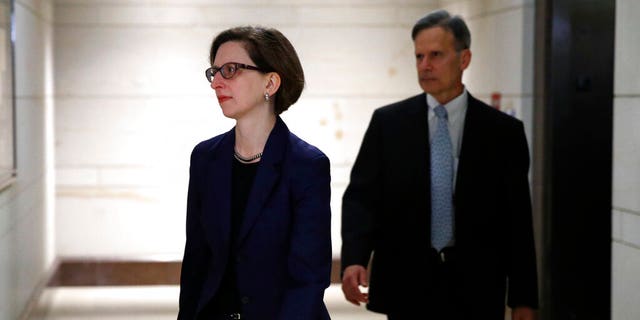 Deputy Assistant Secretary of Defense Laura Cooper, left, on Capitol Hill on Oct. 30. (AP Photo/Patrick Semansky, File)


No comments:
Post a Comment