In
a pillared House chamber at 10 a.m. ET on Wednesday, in the shadow of
the 2020 presidential and congressional elections, House Democrats are
set to host the first public hearing involving the potential impeachment of a president since November 19, 1998 -- and, they insist, they aren't happy about it.
"It’s
a sad day," House Speaker Nancy Pelosi, D-Calif, told Fox News on
Tuesday. "A calm day. A prayerful day." For his part, House Intelligence
Committee Chairman Adam Schiff, D-Calif., called the hearings a "solemn
undertaking" in a letter to colleagues.
Behind the scenes, House
Democrats were predicting a "phenomenal week," Fox News is told. At the
same time, Republicans have been preparing a methodical and vigorous
cross-examination of Democrats' witnesses, whose accounts of President
Trump's alleged wrongdoing have been based largely on hearsay and
intuition.
Capitol Hill security officials told Fox News they're
not anticipating the kinds of organized protests that rocked the Supreme
Court confirmation hearings of Brett Kavanaugh last year, but sources
on both sides of the aisle have cautioned that the day will be
unpredictable. The proceedings are to be held in the cavernous House
Ways and Means Committee hearing room at the Longworth House Office
Building.
With
the bang of a gavel, Schiff will open the impeachment hearings
Wednesday into Trump's alleged pressure on Ukraine to investigate 2020
presidential candidate Joe Biden's dealings in the country. The former
vice president, a Democrat, has boasted about pressuring Ukraine to fire
its top prosecutor, as his son Hunter Biden held a lucrative role board of a Ukrainian natural gas company despite having little relevant expertise.
The Capitol on Tuesday as the House is set to begin public
impeachment inquiry hearings as lawmakers debate whether to remove
President Trump from office. (AP Photo/J. Scott Applewhite)
A whistleblower's complaint about Trump's July 25
telephone call with Ukrainian President Volodymyr Zelensky ignited the
impeachment investigation. During the hearing Wednesday, a key exchange
during that 30-minute call, which has been outlined in a Sept. 24 transcript released by the White House, could take center stage. Zelensky has said he felt no pressure during the call.
"I
would like you to do us a favor though," Trump said at one point in the
call, after a mention of U.S. military aid to Ukraine. Ukraine
apparently was not aware that the U.S. was withholding new military aid
until August, approximately two weeks before the U.S. ultimately
released the aid and well after Trump's phone call with Zelensky.
On
the call, Trump then asked Zelensky to investigate reports that Ukraine
had some involvement in 2016 election interference. Later on in the
conversation, amid a discussion of deep-seated Ukrainian corruption,
Trump mentioned Biden's push to have Ukraine's prosecutor fired, and
suggested the country look into the matter.
Republicans have
pointed out that the U.S. also delayed military aid assistance for
Lebanon and Armenia. The GOP is expected to say the European Union was
not doing its fair share to help root out corruption in Ukraine.
“The Russia invasion of Crimea had more to do with Europe than with the U.S.,” one Republican source told Fox News.
Trump
has said the call was "perfect" and contained no "quid pro quo," or
this for that. Democrats, meanwhile, have said it showed Trump using his
office to pressure a foreign government to help him politically.
Big
questions loomed, including how strongly administration officials
connected Trump's apparent desire for a probe to the question of whether
to provide military aid to Ukraine -- and whether such a probe would
have been inappropriate. At its heart, the GOP argument was that the
impeachment effort was unfair and sparked because "unelected and
anonymous bureaucrats disagreed" with Trump's decisions on Ukraine.
Shortly
after Schiff's gavel, he and ranking Republican Devin Nunes, R-Calif.,
are to begin the questioning. They get 45 minutes each, or can designate
staff attorneys to do so.
Members of the panel will then get five minutes each to ask questions, alternating between Republicans and Democrats.
For
the Democrats, expect to hear from Daniel Goldman and Daniel Noble,
both counsels for the Intelligence Committee. Fox News is told on the
GOP side, Steve Castor, whom Ohio Rep. Jim Jordan brought over from the
Oversight Committee, will be the counsel to pose questions for the
minority.
Republicans recently placed Jordan on the Intelligence
Committee. Though Nunes is the senior Republican, the congressman from
Ohio could act as an especially fierce attacker of the witnesses'
credibility and the Democrats' case for impeachment.
Goldman and
Castor asked the bulk of the questions of witnesses during weeks of
closed-door depositions with current and former administration officials
and diplomats.
"You're going to see a prosecutorial approach,"
said Elie Honig, a former federal prosecutor who worked with Goldman to
successfully prosecute a Genovese family boss and two mob hit men for
racketeering, two murders and an attempted murder. "You will see
somebody who knows every detail of every piece of evidence and will
bring it to bear in his questioning. You'll see someone who knows how to
get right to the point."
Democrats chose Ambassador Bill Taylor and career Foreign Service officer George Kent
to kick off the public hearings. "They both were witness to the full
storyline of the president’s misconduct," a Democratic aide told Fox
News.
The two likely will describe a parallel foreign policy
toward Ukraine led by Trump's personal attorney Rudy Giuliani and other
White House officials.
"I discovered a weird combination of encouraging, confusing and ultimately alarming circumstances," Taylor testified in
an Oct. 22 statement. Taylor, a West Point graduate and Vietnam War
veteran who has served under every presidential administration,
Republican and Democrat, since 1985, also worked for then-Sen. Bill
Bradley, D-N.J.
Demonstrators marching on Pennsylvania Avenue protesting against
climate policies and President Trump, in Washington last week. (AP
Photo/Jose Luis Magana)
Taylor said it was "crazy" that the Trump
administration may have been withholding U.S. military assistance to the
Eastern European ally over the political investigations, with Russian
forces on Ukraine's border on watch for a moment of weakness.
Fox
News is told the Democrats' game plan has been to let the witnesses
"tell their story" on Wednesday. "We need to facilitate and stay out of
the way," one Democrat involved in the questioning said.
Democrats
also told Fox News that Taylor had "the best view of the scheme. He is a
habitual note-taker. He is your worst nightmare. Very prepared."
One
source told Fox News the most important line in all of the previously
released transcripts so far may have come from Taylor: "Irregular policy
channels were running contrary to longstanding goals of U.S. policy,"
Taylor said in his testimony.
But, Republicans have countered that
it's the role of the president -- not unelected career bureaucrats --
to set U.S. foreign policy.
The hearing room where the House is to begin public impeachment
inquiry hearings Wednesday, on Capitol Hill. (AP Photo/Jacquelyn Martin)
And, Taylor wasn’t on the phone call between Trump
and Zelensky. Fox News is told Republicans will cross-examine Taylor
repeatedly over his lack of "first-hand knowledge" about the call.
"Hearsay
puts a lot of people in jail," one Democratic source told Fox News.
"Eyewitness testimony can be tough. Cops will tell you that. Taylor's
deducing all of this."
Republicans, meanwhile, are expected to ask Taylor how and why he thought there was a "linkage" and "who told you that."
Kent,
a career foreign service officer, testified on Oct. 15 there were three
words Trump wanted to hear from the Ukraine president: "Investigations,
Biden and Clinton."
He also told the investigators about the "campaign" of smears against former U.S. ambassador to Ukraine Marie Yovanovitch that he said Giuliani waged, leading to her being recalled from the position.
In this Nov. 19, 1998 file photo, House Judiciary Committee
Chairman Henry Hyde, R-Ill., presided over the committee's impeachment
hearing for President Clinton. (AP Photo/Joe Marquette, File)
Yovanovitch is set to testify Friday. She previously testified on Oct. 11 that she was told people were "looking to hurt" her.
Fox News reported last week
that Yovanovitch, a key witness for Democrats, communicated via her
personal email account with a Democratic congressional staffer
concerning a "quite delicate" and "time-sensitive" matter -- just two
days after the whistleblower complaint that kickstarted the inquiry was
filed, and a month before the complaint became public.
Emails obtained by Fox News appeared to contradict Yovanovitch's deposition on Capitol Hill last
month, in which she told U.S. Rep. Lee Zeldin, R-N.Y., about an email
she received Aug. 14 from the staffer, Laura Carey -- but suggested
under oath that she never responded to it.
Zeldin
told Fox News: "I specifically asked her whether the Democratic staffer
was responded to by Yovanovitch or the State Department. It is greatly
concerning that Ambassador Yovanovitch didn't answer my question as
honestly as she should have, especially while under oath."
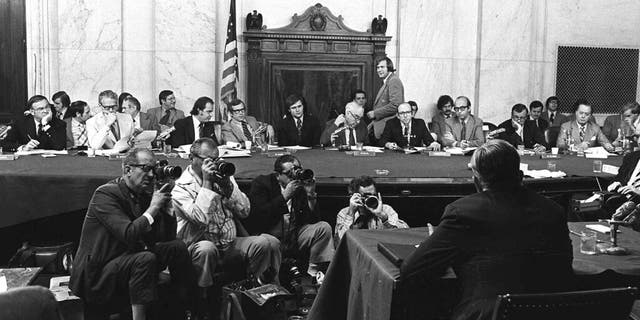
FILE - In this Aug. 3, 1973, file photo, the Senate Watergate
Committee hearings continue on Capitol Hill in Washington. (AP
Photo/File)
Republicans have privately acknowledged to Fox News
that they might have a problem. "How do you counteract Kent and Taylor
when you don’t have a witness to counter them?" one Republican source
asked.
Schiff has approved just three of nine witnesses sought by
the GOP. They were envoy Kurt Volker, State Department official David
Hale and National Security Council aide Timothy Morrison.
Last
week, Schiff rejected a request by Republicans to have the Ukraine phone
call whistleblower testify, saying that their testimony was "redundant
and unnecessary." The GOP witness list, obtained by Fox News this past
Saturday, also included Hunter Biden.
Late Tuesday, Schiff
announced that open hearings will again be held next week from Nov.
19-21. In addition to Volker, Hale and Morrison, the new witness list
included Jennifer Williams, an aide to Vice President Pence; Alexander
Vindman, the director for European affairs at the National Security
Council; U.S. Ambassador to the European Union Gordon Sondland; Deputy
Assistant Secretary of Defense for Russian, Ukrainian, and Eurasian
Affairs Laura Cooper; and former National Security Council
official Fiona Hill.
White
House acting Chief of Staff Mick Mulvaney, for his part, said Tuesday
he no longer plans to sue over the impeachment proceedings and will
instead follow Trump's directions and decline to cooperate.
Aside
from witnesses, there will also be exhibits -- lots and lots of
exhibits. Democrats, at least, are expected to display excerpts from
transcripts, text messages, relevant news articles and social media
posts.
The Democrats reportedly have been wary of Republicans
trying "stunts" and being argumentative in an effort to distract from
the case against the president.
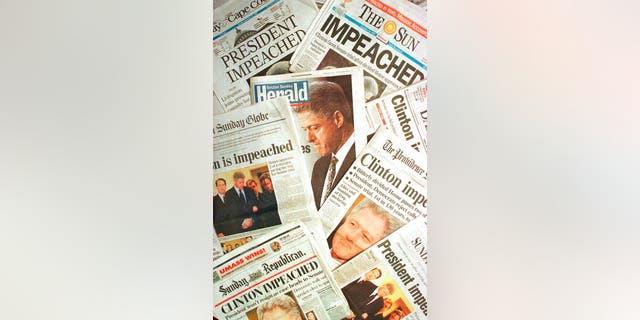
The Dec. 20, 1998 editions of newspapers from Massachusetts and
Rhode Island with headlines of President Clinton's impeachment. (AP
Photo/Peter Lennihan, File)
"By Act II, I suspect the Dancing Bears will enter
the room," one Democratic source said. But, GOP sources downplayed the
idea of guerilla tactics during the hearing.
Schiff, in a memo and
open letter to colleagues on the eve of Wednesday's
proceedings, outlined some of the rules -- including that members not
assigned to the Intelligence Committee were not permitted to make
statements or question witnesses, but were allowed to sit in the
audience.
"It is important to underscore that the House’s
impeachment inquiry, and the committee, will not serve as venues for any
member to further the same sham investigations into the Bidens or into
debunked conspiracies about 2016 U.S. election interference that
President Trump pressed Ukraine to undertake for his personal political
benefit," Schiff wrote.
The goal is to end the hearing by 4:30 p.m.
It's
only the fourth time in American history that Congress has launched
impeachment proceedings against a sitting president. Two of those —
against Andrew Johnson in 1868 and Bill Clinton 130 years later—
resulted in their impeachments, or formal charges approved by the House.
Both
were acquitted by the Senate, which requires a two-thirds vote to
remove a sitting president under the Constitution. The House impeaches
by a majority vote.
Former President Richard Nixon resigned in 1974 before the House could vote to impeach him.
During
Watergate, the Senate held televised hearings that served to turn
public opinion against Nixon. The most sensational moments -- including
the testimony of White House counsel John Dean and Sen. Howard Baker's
famous question, "What did the president know and when did he know it?"
-- occurred not during House impeachment hearings but during special
Watergate hearings in the Senate.
Pelosi initially was reluctant
to launch a formal impeachment inquiry. As Democrats took control of the
House in January, she said impeachment would be "too divisive" for the
country. Trump, she said, was simply "not worth it."
After
former Special Counsel Robert Mueller’s widely panned appearance on
Capitol Hill in July for the end of the Russia probe, the door to
impeachment proceedings seemed closed.
But, the next day, Trump got on the phone with Ukraine's leader. Fox News' Mike Emanuel, Brooke Singman and The Associated Press contributed to this report.


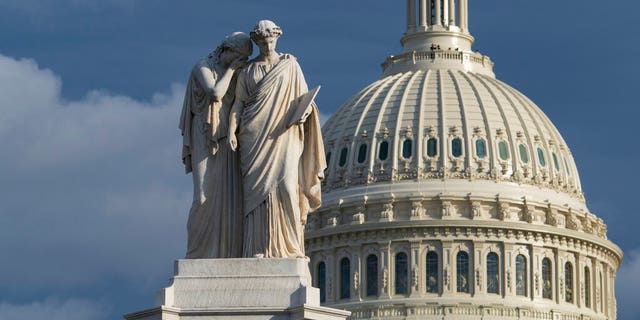 The Capitol on Tuesday as the House is set to begin public
impeachment inquiry hearings as lawmakers debate whether to remove
President Trump from office. (AP Photo/J. Scott Applewhite)
The Capitol on Tuesday as the House is set to begin public
impeachment inquiry hearings as lawmakers debate whether to remove
President Trump from office. (AP Photo/J. Scott Applewhite)
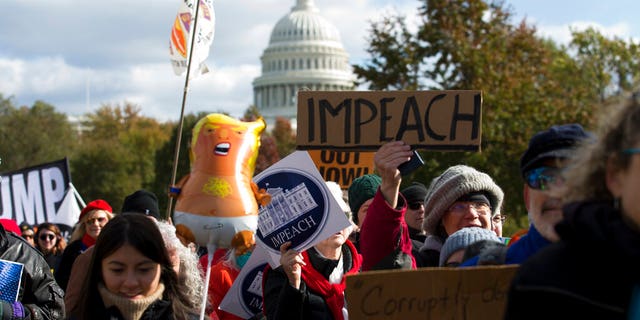 Demonstrators marching on Pennsylvania Avenue protesting against
climate policies and President Trump, in Washington last week. (AP
Photo/Jose Luis Magana)
Demonstrators marching on Pennsylvania Avenue protesting against
climate policies and President Trump, in Washington last week. (AP
Photo/Jose Luis Magana)
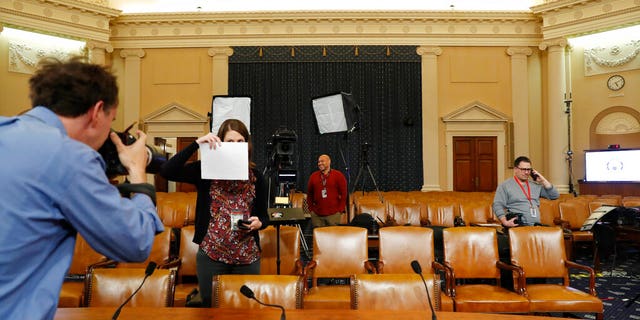 The hearing room where the House is to begin public impeachment
inquiry hearings Wednesday, on Capitol Hill. (AP Photo/Jacquelyn Martin)
The hearing room where the House is to begin public impeachment
inquiry hearings Wednesday, on Capitol Hill. (AP Photo/Jacquelyn Martin)
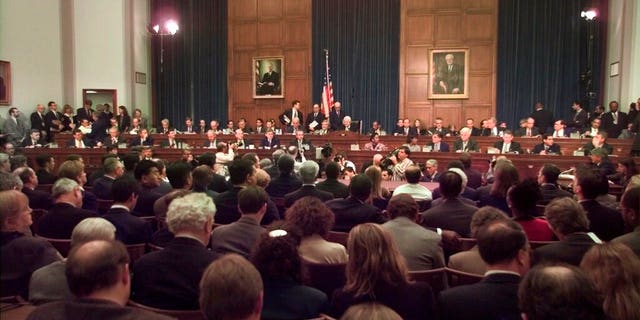 In this Nov. 19, 1998 file photo, House Judiciary Committee
Chairman Henry Hyde, R-Ill., presided over the committee's impeachment
hearing for President Clinton. (AP Photo/Joe Marquette, File)
In this Nov. 19, 1998 file photo, House Judiciary Committee
Chairman Henry Hyde, R-Ill., presided over the committee's impeachment
hearing for President Clinton. (AP Photo/Joe Marquette, File)
 FILE - In this Aug. 3, 1973, file photo, the Senate Watergate
Committee hearings continue on Capitol Hill in Washington. (AP
Photo/File)
FILE - In this Aug. 3, 1973, file photo, the Senate Watergate
Committee hearings continue on Capitol Hill in Washington. (AP
Photo/File)
 The Dec. 20, 1998 editions of newspapers from Massachusetts and
Rhode Island with headlines of President Clinton's impeachment. (AP
Photo/Peter Lennihan, File)
The Dec. 20, 1998 editions of newspapers from Massachusetts and
Rhode Island with headlines of President Clinton's impeachment. (AP
Photo/Peter Lennihan, File)


No comments:
Post a Comment