Carter Page FISA warrant lacked probable cause, DOJ admits in declassified assessment
At
least two of the FBI’s surveillance applications to secretly monitor
former Trump campaign adviser Carter Page lacked probable cause,
according to a newly declassified summary of a Justice Department assessment released Thursday by the Foreign Intelligence Surveillance Court (FISC). The
DOJ's admission essentially means that the Foreign Intelligence
Surveillance Act (FISA) warrant authorizations to surveil Page, when
stripped of the FBI's misinformation, did not meet the necessary legal
threshold and should never have been issued. Democrats, including
California Rep. Adam Schiff, had previously insisted the Page FISA warrants met "rigorous" standards for probable cause, and mocked Republicans for suggesting otherwise. The
June 2017 Page FISA warrant renewal, which was among the two deemed
invalid by the DOJ, was approved by then-Acting FBI Director (and now
CNN contributor) Andrew McCabe, as well as former Deputy Attorney
General Rod Rosenstein. The April 2017 warrant renewal was approved by
then-FBI Director James Comey. “Today’s unprecedented court filing
represents another step on the road to recovery for America’s deeply
damaged judicial system," Page said in a statement to Fox News. "I hope
that this latest admission of guilt for these civil rights abuses by the
Justice Department marks continued progress towards restoring justice
and remedying these reputationally ruinous injuries.” Added Iowa
GOP Sen. Chuck Grassley, who previously chaired the Judiciary Committee:
“It’s about time. It’s about time federal authorities entrusted with
our most powerful and intrusive surveillance tools begin to own up to
their failures and abuses, and take steps to restore public confidence.
... Time will tell if the department will continue working to fix its
errors and restore trust that it won’t disregard Americans’ civil
liberties. Its admission and cooperation with the FISC is a step in the
right direction." FISC Presiding Judge James Boasberg, in the Jan.
7 order that was published for the first time Thursday, further
required the government to explain in a written statement by Jan. 28 the
"FBI's handling of information" obtained through the Page warrants and
subsequent renewals. Boasberg
specifically noted the DOJ found "there was insufficient predication to
establish probable cause to believe that Page was acting as an agent of
a foreign power" because of the "material misstatements and omissions"
in the warrant applications.
Then-FBI acting director Andrew McCabe, now a CNN contributor,
approved one of the now-discredited FISA applications. (AP Photo/Alex
Brandon, File)
Although the DOJ assessment technically only covered
two of the applications to renew the Page FISA warrant, the DOJ
"apparently does not take a position on the validity" on the first two
Page FISA applications, Boasberg said, seemingly indicating that the DOJ
seemingly did not want to defend their legality either. The
government "intends to sequester information acquired pursuant to those"
FISA applications "in the same manner as information acquired pursuant
to the subsequent dockets," the judge said, possibly indicating that
those applications are still under review. Boasberg noted that it
is illegal for the government to intentionally disclose or use
"information obtained under color of law by electronic surveillance,
knowing or having any reason to know that the information was obtained
through electronic surveillance not authorized." A lawful FISA warrant,
when approved by the FISC, allows the FBI to surveil not only the target
of the warrant, but also individuals who communicate with the target
and the target's associates. It was not clear what information, if
any, the FBI gleaned from the Page FISA and then used in subsequent
court arguments; any such evidence would likely be ruled inadmissible,
given the DOJ's admission that the underlying warrants were invalid. The revelations Thursday were yet another embarrassment for the FBI, which DOJ Inspector General Michael Horowitz has found made repeated errors and misrepresentations -- and, in one case, deliberately falsified evidence -- before the FISC as the bureau sought to surveil Page in 2016 and 2017. The
FBI's FISA applications to monitor Page heavily relied, Horowitz
confirmed, on a now-discredited dossier funded by the Hillary Clinton
campaign and Democratic National Committee (DNC), as well as on news reports that secretly relied on the dossier's author. Much of the Steele dossier has been proved unsubstantiated, including the dossier's claims that the Trump campaign was paying hackers in the United States out of a non-existent Russian
consulate in Miami, or that ex-Trump lawyer Michael Cohen traveled to
Prague to conspire with Russians. Special Counsel Robert Mueller also
was unable to substantiate the dossier's claims that Page had received a
large payment relating to the sale of a share of Rosneft, a Russian oil
giant, or that a lurid blackmail tape involving the president existed. Pursuant
to Boasberg's order, the government must also sequester relevant
information and provide further "explanations" concerning the damning
findings of bureau misconduct contained in Horowitz's recent report, as
well as "related investigations and any litigation." That
could be a reference to a variety of outstanding matters concerning the
FBI's apparent mischaracterization of evidence before the FISC. For
example, the FISC has already ordered the bureau to look at all
previous FISA applications involving ex-FBI attorney Kevin Clinesmith,
whom Horowitz found to have doctored an email from the CIA. The FBI had
reached out to the CIA and other intelligence agencies for information
on Page; the CIA responded in an email by telling the FBI that Page had
contacts with Russians from 2008 to 2013, but that Page had reported
them to the CIA and was serving as a CIA operational contact and
informant on Russian business and intelligence interests. Clinesmith
then allegedly doctored the CIA's email about Page to make it seem as
though the agency had said only that Page was not an active source. The
FBI also included Page's contacts with Russians in the warrant
application as evidence he was a foreign "agent," without disclosing to
the secret surveillance court that Page was voluntarily working with the
CIA concerning those foreign contacts.
"Today’s
unprecedented court filing represents another step on the road to
recovery for America’s deeply damaged judicial system." — Former Trump aide Carter Page
Further,
Horowitz found specific evidence of oversights and errors by several
top FBI employees as they sought to obtain a warrant to surveil Page. In
particular, an unidentified FBI supervisory special agent (SSA)
mentioned in the IG report was responsible for ensuring that
the bureau's "Woods Procedures" were followed in the Page warrant
application, but apparently didn't do so. According to the
procedures, factual assertions need to be independently verified, and
information contradicting those assertions must be presented to the
court. Horowitz found several instances in which the procedures were not
followed. Horowitz's report leaves little doubt that the unnamed SSA is Joe Pientka -- a current bureau employee. Pientka briefly appeared on the FBI's website as an "Assistant Special Agent in Charge" of the San Francisco field office late last year, according to the Internet archive Wayback Machine -- although Pientka no longer appears on any FBI website. Pientka was removed shortly after Fox News identified him as the unnamed SSA in the IG report. Twitter user Techno Fog first flagged the Wayback Machine's archive of the page. The
FBI has repeatedly refused to respond to Fox News' request for
clarification on Pientka's status, even as Republicans in Congress have sought to question him. While the FBI has promised corrective action, it apparently has not gone far enough. Earlier this month, David Kris, who has been appointed by the FISC to oversee the FBI's proposed surveillance reforms, alerted the court that the bureau's proposals are "insufficient" and must be dramatically "expanded"
-- even declaring that FBI Director Christopher Wray needs to discuss
the importance of accuracy and transparency before the FISC every time
he "visits a field office in 2020."
In December 2017, then-FBI deputy director Andrew McCabe testified
that “no surveillance warrant would have been sought” from the FISA
court “without the Steele dossier information," according to a House GOP
memo's findings. McCabe is now a CNN contributor.
The unclassified findings were a stark rebuke to Wray, who had filed assurances to
the FISC that the agency was implementing new procedures and training
programs to assure that the FBI presents accurate and thorough
information when it seeks secret warrants from FISC judges. At the same
time, Wray acknowledged the FBI's "unacceptable" failures as it pursued
FISA warrants to monitor Page. Kris is a former Obama administration attorney who has previously defended the FISA process on "The Rachel Maddow Show" and in other left-wing venues,
making his rebuke of Wray something of an unexpected redemptive moment
for Republicans who have long called for more accountability in how the
bureau obtains surveillance warrants. ("You can’t make this up!"
President Trump tweeted on Sunday. "David Kris, a highly controversial
former DOJ official, was just appointed by the FISA Court to oversee
reforms to the FBI’s surveillance procedures. Zero credibility. THE
SWAMP!”) Wray
had specifically promised to change relevant forms to "emphasize the
need to err on the side of disclosure" to the FISC, to create a new
"checklist" to be completed "during the drafting process" for
surveillance warrants that reminds agents to include "relevant
information" about the bias of sources used, and to "formalize" the role
of FBI lawyers in the legal review process of surveillance warrants. Additionally,
Wray said the FBI would now require "agents and supervisors" to confirm
with the DOJ Office of Intelligence that the DOJ has been advised of
relevant information. Wray further indicated that the FBI would
formalize requirements to "reverify facts presented in prior FISA
applications and make any necessary corrections," as well as to make
unspecified "technological improvements." But in a 15-page letter to Judge Boasberg, obtained by Fox News,
Kris declared that the proposed corrective actions "do not go far
enough to provide the Court with the necessary assurance of accuracy,
and therefore must be expanded and improved" -- and he took aim at Wray
himself. "The focus on specific forms, checklists and technology,
while appropriate, should not be allowed to eclipse the more basic need
to improve cooperation between the FBI and DOJ attorneys," Kris said,
noting that the FBI and DOJ have historically not always worked well
together. "A key method of improving organizational culture is
through improved tone at the top, particularly in a hierarchical
organization such as the FBI," Kris said, noting that Wray's public
statements on the matter, while positive, have not gone far enough.
"Director Wray and other FBI leaders, as well as relevant leaders at the
Department of Justice, should include discussions of compliance not
only in one or two messages, but in virtually every significant
communication with the workforce for the foreseeable future." Republican calls for more accountability may not go unanswered for long. Connecticut U.S. Attorney John Durham announced last year that he did not "agree" with
the IG's assessment that the FBI's probes were properly predicated,
highlighting Durham's broader criminal mandate and scope of review. Durham
is focusing on foreign actors, as well as the CIA, while Horowitz
concentrated his attention on the Justice Department and FBI. "Based
on the evidence collected to date, and while our investigation is
ongoing, last month we advised the Inspector General that we do not
agree with some of the report’s conclusions as to predication and how
the FBI case was opened," Durham said in his statement, adding that his
"investigation is not limited to developing information from within
component parts of the Justice Department" and "has included developing
information from other persons and entities, both in the U.S. and
outside of the U.S."


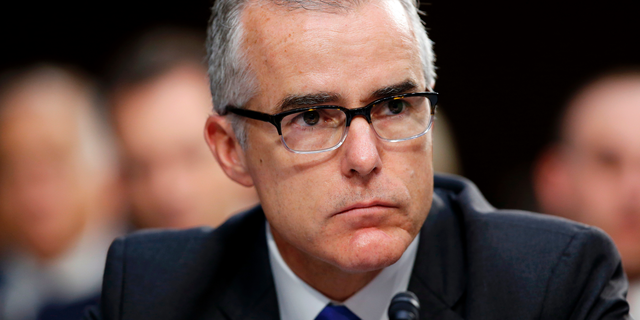 Then-FBI acting director Andrew McCabe, now a CNN contributor,
approved one of the now-discredited FISA applications. (AP Photo/Alex
Brandon, File)
Although the DOJ assessment technically only covered
two of the applications to renew the Page FISA warrant, the DOJ
"apparently does not take a position on the validity" on the first two
Page FISA applications, Boasberg said, seemingly indicating that the DOJ
seemingly did not want to defend their legality either.
Then-FBI acting director Andrew McCabe, now a CNN contributor,
approved one of the now-discredited FISA applications. (AP Photo/Alex
Brandon, File)
Although the DOJ assessment technically only covered
two of the applications to renew the Page FISA warrant, the DOJ
"apparently does not take a position on the validity" on the first two
Page FISA applications, Boasberg said, seemingly indicating that the DOJ
seemingly did not want to defend their legality either.



No comments:
Post a Comment