Senate impeachment trial set to begin as Trump adds last-minute reinforcements to defense team
After an opening salvo of back-and-forth arguments from President Trump's attorneys and Democrats' impeachment managers on Monday, Senate impeachment trial proceedings
are set to begin at 1 p.m. ET on Tuesday with the expectation they will
stretch well into a wild night on Capitol Hill -- even as key
procedural questions, including the timeline for debate and whether
additional witnesses will testify, remain undecided and hotly
contentious. In a surprise move Monday night, a detachment of
high-profile House Republicans announced that they would formally join
the president's legal team, including Reps. Doug Collins, Mike Johnson,
Jim Jordan, Debbie Lesko, Mark Meadows, John Ratcliffe, Elise
Stefanik and Lee Zeldin. The last-minute show of force underscored the
fluid nature of the Senate trial, which is also set to feature
full-throated arguments against impeachment from constitutional scholar
Alan Dershowitz and Bill Clinton independent counsel Ken Starr. “We
are not planning for them to present statements on the Senate floor," a
senior administration official told Fox News, referring to the latest
additions to Trump's defense team, headed up by White House Counsel Pat
Cipollone and Trump's personal attorney Jay Sekulow. "The group will
continue to give critical guidance on the case because of their strong
familiarity with the facts and evidence." Jordan Sekulow told Fox
News' "Hannity" on Monday night that his father and the rest of
Trump's legal team were "champing at the bit and ready to go." He
maintained that executive privilege, a longstanding constitutional
principle protecting executive branch deliberations from disclosure, by
itself defeated the "obstruction of Congress" article of impeachment,
while Democrats had only hearsay evidence and speculation to support
their "abuse of power" charge. Neither "obstruction of Congress" nor
"abuse of power" are federal crimes, and they have no established
definition. Democrats have seethed openly ever since House Speaker Nancy Pelosi, D-Calif., failed in her gambit
to force Senate Majority Leader Mitch McConnell's hand before the House
would turn over the articles of impeachment to the Senate. Pelosi had
sought a commitment allowing Democrats to call witnesses prior to
arguments in the trial -- but, with just hours to go until the
proceedings commenced, McConnell, R-Ky., dashed those hopes. McConnell
specifically revealed Monday that he wanted a condensed, two-day
calendar for each side to give opening statements, at 12 hours per day.
After the four days of opening arguments, senators would be allowed up
to 16 hours for written questions to the prosecution and defense,
followed by four hours of debate. Only then would there be votes on
calling other witnesses, likely next week. At the end of deliberations,
the Senate would then vote on each impeachment article. Utah Republican Sen. Mitt Romney said in a statement
Monday night that McConnell's resolution, overall, "aligns closely with
the rules package approved 100-0 during the Clinton trial. If attempts
are made to vote on witnesses prior to opening arguments, I would oppose
those efforts." Romney was among a small number of Republican senators
who said they wanted to consider witness testimony and documents that
weren't part of the House impeachment investigation. Democrats, however, were incensed by the speedy timeline. Some took to calling McConnell "Midnight Mitch," the latest in a string
of unintentionally flattering nicknames. Senate Minority Leader Chuck
Schumer, D-N.Y., called McConnell's rules package a "national disgrace,"
adding, "it’s clear Sen. McConnell is hell-bent on making it much more
difficult to get witnesses and documents and intent on rushing the trial
through." Even before McConnell's announcement, congressional
Democrats apparently were off-balance: "The House managers have
absolutely no idea what the structure of the trial two days before the
trial begins,” one source with House Democrats working on the
impeachment trial complained to Fox News late Sunday. “It is
completely unfathomable,” fumed another source with the Democrats. “Is
Sen. McConnell going to have 12-hour trial days which run until 2 or 3
in the morning?” McConnell is expected to kick off the afternoon's
proceedings by introducing his proposed resolution for the parameters
for the trial, which he has said will pass with at least 53 votes.
Senators will not be directly speaking out in the debate over
McConnell's resolution, which is slated to last for approximately two
hours -- only members of Trump's defense team, and the seven Democrats
serving as House impeachment managers, are expected to participate. Schumer
likely will then present his counter-proposals to McConnell's motion,
followed by another two hours of debate among the managers and Trump's
counsel. Potential proposals include requests to subpoena specific
witnesses -- including, perhaps, Rudy Giuliani associate Lev Parnas or former National Security Adviser John Bolton -- or to adjust debate time. Then,
at approximately 6 p.m. ET or even later, Fox News is told to expect a
closed Senate session of indeterminate length after the debates. When
the Senate returns to open session, lawmakers -- including two leading
Democratic presidential contenders, Sens. Elizabeth Warren and Bernie
Sanders -- likely will vote in turn on any amendments to McConnell's
proposal, then McConnell's proposal itself. McConnell's proposal also was said to include a so-called "kill switch," allowing Trump's team to move to dismiss the articles of impeachment in the Senate quickly. In
a sign of the prevailing give-no-ground mentality ahead of the trial,
Trump's legal team traded blows with House prosecutors on Monday,
asserting that the president did "absolutely nothing wrong" and
urging the Senate to reject an impeachment case it called “flimsy" and a
"dangerous perversion of the Constitution." House Democrats
impeached the president for "abuse of power" related to his
administration's withholding of U.S. military aid to Ukraine while
he suggested the country investigate rival Joe Biden's dealings in Ukraine. The aid was eventually released, and Ukrainian officials have denied feeling any undue pressure.
The administration's refusal to comply with Democrats' probe, citing
executive privilege, led to the "obstruction of Congress" count.
"It is a constitutional travesty." — President Trump's legal team, on the impeachment proceedings
The 110-page filing from the White House condemned
the "rigged" House impeachment process, calling the majority vote to
impeach there a "brazenly political act ... that must be rejected." The
White House's legal argument hinged in part on Trump’s assertion he did
nothing wrong and did not commit any recognized crime, as well as on
poking holes in the hearsay witness testimony offered by Democrats. For
example, the White House pointed out that EU ambassador Gordon Sondland
had said he "had come to believe" that aid to Ukraine was linked to an
investigation of Biden, "before talking to the president." Additionally,
Trump's lawyers pointed out that Sondland admitted having "no evidence"
other than his "own presumption," and that he was "speculating" based
on hearsay that the Trump administration ever linked a White House
meeting with Ukraine's leaders to the beginning of an investigation. "After focus-group testing
various charges for weeks, House Democrats settled on two flimsy
Articles of Impeachment that allege no crime or violation of law
whatsoever—much less 'high Crimes and Misdemeanors,' as required by the
Constitution," the lawyers wrote. “It is a constitutional travesty." Additionally,
the White House released Justice Department legal opinions meant to
bolster its case that defying subpoenas from Congress did not amount to
"obstruction of Congress." One opinion, dated Sunday, said Trump
administration officials were free to disregard subpoenas sent last fall
before the House of Representatives had formally authorized an
impeachment inquiry. That approval, the memo said, was necessary before
congressional committees could begin their own investigations and issue
subpoenas for documents and testimony.
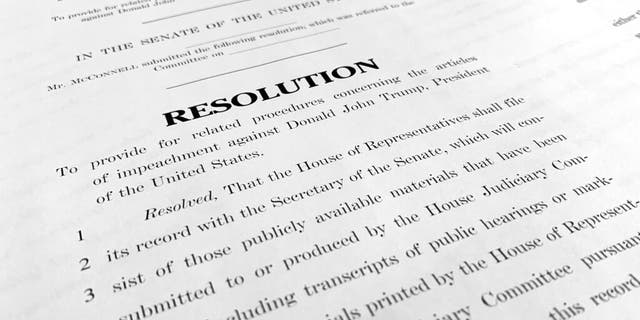
A copy of a Senate draft resolution to be offered by Senate
Majority Leader Mitch McConnell, R-Ky., regarding the procedures during
the impeachment trial of President Trump. (AP Photo/Jon Elswick)
Meanwhile, the prosecution team of House managers was
spending another day on Capitol Hill preparing for the trial, which
will take place under heavy security. The Democrats made their way
through crowds of tourists in the Rotunda to tour the Senate chamber. In
their own filing Monday, House prosecutors replied to Trump's "not
guilty" plea by making fresh demands for a fair trial in the Senate.
"President Trump asserts that his impeachment is a partisan ‘hoax.' He
is wrong," the prosecutors wrote in their reply. They wrote that
the president can't have it both ways -- rejecting the facts of the
House case but also stonewalling congressional subpoenas for witnesses
and testimony. "Senators must honor their own oaths by holding a fair
trial with all relevant evidence," they wrote. No president has
ever been removed by the Senate. The current Senate, with a 53-47
Republican majority, is not expected to mount the two-thirds voted
needed for conviction. Even if it did, the White House team has
argued it would be an "unconstitutional conviction'' because the
articles of impeachment were too broad. Administration officials have argued that similar imprecision applied to the perjury case in Clinton's impeachment trial. The
White House has also suggested the House inquiry was lacking because it
failed to investigate Biden or his son Hunter, who served on the board
of a gas company in Ukraine in a lucrative role while his father was
overseeing Ukraine policy as vice president. Should Democrats insist on
calling witnesses like Parnas and Bolton, Republicans have openly
suggested that they might then push for a subpoena the Bidens. In a
show of confidence, Trump tweeted a video late Monday touting his
achievements in office, including the nation's historically low
unemployment rate, booming stock market and rising wages, with the note:
"THE BEST IS YET TO COME!" Fox News' Caroline McKee, Chad Pergram, John Roberts and The Associated Press contributed to this report.


 A copy of a Senate draft resolution to be offered by Senate
Majority Leader Mitch McConnell, R-Ky., regarding the procedures during
the impeachment trial of President Trump. (AP Photo/Jon Elswick)
A copy of a Senate draft resolution to be offered by Senate
Majority Leader Mitch McConnell, R-Ky., regarding the procedures during
the impeachment trial of President Trump. (AP Photo/Jon Elswick)


No comments:
Post a Comment