Coronavirus: Biotech company ships first batches of vaccine, to be tested on humans: report
Containment measures are being implemented in the U.S. and throughout the globe to limit the spread of coronavirus, but only a vaccine can prevent people from getting sick from the virus. Roughly
35 companies and academic institutions are rushing to create a vaccine
and at least four have tested it on animals. Moderna, a biotech company
in Massachusetts, has already shipped the first batches of its COVID-19
vaccine to the US National Institute of Allergy and Infectious Diseases. It
was said to be ready for human trials in April, but the first patient
will receive an experimental dose on Monday, a government official said. NEW YORK CITY CLOSING MOVIE THEATRES, ENTERTAINMENT VENUES DUE TO CORONAVIRUS
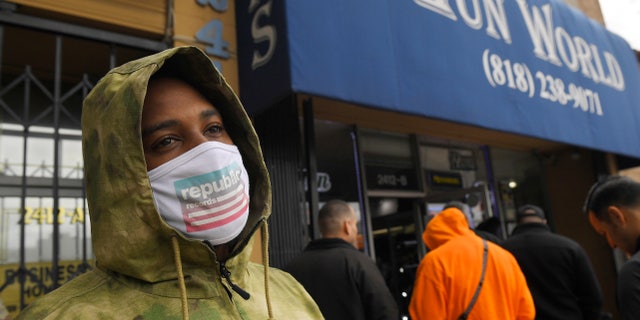
A gun store customer that gave his name only at John waits in
line, Sunday, March 15, 2020, in Burbank, Calif. As consumers are buying
all kinds of goods in large quantities amid coronavirus concerns,
putting pressure on inventories.(AP Photo/Mark J. Terrill)
The trials will be held at Kaiser Permanente
Washington Health Research Institute in Seattle. Testing will involve 45
young, healthy volunteers and it uses Moderna's mRNA-1273 vaccine. "Unlike
a normal vaccine, RNA vaccines work by introducing an mRNA sequence
(the molecule which tells cells what to build) which is coded for a
disease-specific antigen, once produced within the body, the antigen is
recognized by the immune system, preparing it to fight the real thing,"
according to the University of Cambridge. The
goal of the trial is to make sure the vaccines show no worrisome side
effects before researchers begin larger tests. Participants can't get
infected from the shots. The speed in getting to this part of the
process was assisted by scientists in China who were able to uncover the
virus's genome sequence -- called SARS-CoV-2, which they shared back in
early January. That step has allowed researchers to grow the virus and
study how it impacts the body. It was also assisted by the
knowledge that flu is generally considered the biggest pandemic risk,
according to the Guardian. Scientists have been working on "prototype"
pathogens following the SARS and MERS epidemics in previous years. “The
speed with which we have [produced these candidates] builds very much
on the investment in understanding how to develop vaccines for other
coronaviruses,” said Richard Hatchett, the CEO of a Norweigan company
that is leading efforts to finance and coordinate the development of the
COVID-19 vaccine. CORONAVIRUS VACCINE DEVELOPMENT: WHERE DOES IT STAND? Work
to help develop vaccines for those viruses was shelved after their
outbreaks were contained, but it's now being looked at again. The
Moderna vaccine was also built from earlier work on the MERS virus,
according to the paper. Still, clinical trials are a lengthy
process that will take over a year to make sure the virus is safe and
works. The patients who are being tested with the Moderna vaccine during
trials will be closely monitored for about a year. After that, the
distribution of the virus to the necessary populations will take a good
bit of time. "Getting a vaccine that’s proven to be safe and
effective in humans takes one at best about a third of the way to what’s
needed for a global immunization program,” global health
expert Jonathan Quick told the Guardian. “Virus
biology and vaccines technology could be the limiting factors, but
politics and economics are far more likely to be the barrier to
immunization.” While President Trump has vowed a vaccine will be
ready come election time in November, the World Health Organization has
estimated a vaccine will be ready in 18 months. CLICK HERE FOR MORE CORONAVIRUS COVERAGE Even
if initial safety tests go well, “you’re talking about a year to a year
and a half” before any vaccine could be ready for widespread use,
according to Dr. Anthony Fauci, director of NIH’s National Institute of
Allergy and Infectious Diseases. That still would be a
record-setting pace. But manufacturers know the wait — required because
it takes additional studies of thousands of people to tell if a vaccine
truly protects and does no harm — is hard for a frightened public. Fox News' Nick Givas and the Associated Press contributed to this report


 A gun store customer that gave his name only at John waits in
line, Sunday, March 15, 2020, in Burbank, Calif. As consumers are buying
all kinds of goods in large quantities amid coronavirus concerns,
putting pressure on inventories.(AP Photo/Mark J. Terrill)
A gun store customer that gave his name only at John waits in
line, Sunday, March 15, 2020, in Burbank, Calif. As consumers are buying
all kinds of goods in large quantities amid coronavirus concerns,
putting pressure on inventories.(AP Photo/Mark J. Terrill)


No comments:
Post a Comment