Election limbo as coronavirus outbreak delays voting in at least 13 states
ATLANTA — U.S. elections have been upended by the coronavirus pandemic.
At least 13 states have postponed voting and more delays are possible
as health officials warn that social distancing and other measures to
contain the virus might be in place for weeks, if not months. The states that have yet to hold their primaries
find themselves in a seemingly impossible situation as they look to
balance public health concerns with the need to hold elections. While
election officials routinely prepare for natural disasters such as
hurricanes and wildfires, the virus outbreak poses a unique challenge. “Usually
when we are dealing with a crisis in elections, it’s something that
happens and then it’s done,” said Chris Harvey, Georgia's director of
elections. “The difference now is that it’s a spreading threat, a
fast-growing threat. We don’t know where, when or how it is going to
end.”
"It’s a spreading threat, a fast-growing threat. We don’t know where, when or how it is going to end." — Chris Harvey, Georgia's director of elections
Primaries
scheduled for Georgia, Ohio, Maryland, Indiana, Louisiana, Connecticut
and Kentucky have all been postponed to May or June. The Rhode Island
Board of Elections has recommended the primary be delayed to June, while
officials in Wisconsin are debating what to do. Wisconsin
Gov. Tony Evers has insisted the April 7 primary be held as scheduled,
but a state elections commissioner said this past week that doing so
would put people at risk. The state's chief elections official cited a
host of problems Wisconsin could face if it moved forward with the
election: a poll worker shortage, lack of polling places and potential
disruption of absentee voting if mail service in the U.S. were to shut
down. All this comes at the worst possible time for election
officials, in the middle of a major election year. The virus outbreak
erupted halfway through the presidential primary season. Voters in 23
states have yet to cast their ballots. While Arizona, Florida and
Illinois held their elections as scheduled last Tuesday, Ohio halted
voting over public health concerns after federal officials encouraged
people over age 65 to stay home. “We cannot tell people to stay
inside, but also tell them to go out and vote,” Gov. Mike DeWine,
R-Ohio, said on Twitter, in announcing plans to delay. The states
that have opted to press ahead have found themselves dealing with what
one Chicago elections official called a “tsunami” of cancellations by
poll workers, who tend to be older, and a last-minute scramble to
relocate polling places away from nursing homes and senior living
communities. Severe illness and death associated with coronavirus has
been most common in people 65 and older, especially those who have heart
disease or other chronic conditions. In addition to the
presidential race, dozens of congressional and local primaries are in
limbo. Primaries play an important role in deciding which party
candidates will appear on the ballot for the November general election. Runoff
elections in Alabama, Texas and Mississippi were also delayed, as were
local elections in Oklahoma, Missouri and New Jersey. There's no
indication May or June will be any better to hold elections, but
officials say postponing voting even for a few weeks gives them an
opportunity to put in place plans to keep the public safe while voting.
This includes moving polling places, recruiting backup poll workers and
acquiring enough cleaning supplies for voting sites. “At some
point, we have to execute an election,” Harvey said, adding Georgia
planned a major push to expand absentee voting for the May primary. There
have been calls, including from Democratic National Committee Chairman
Tom Perez, for elections to be held mostly by mail. But making this
switch will be difficult for some and impossible for others. In
several states, it would take legislation or even a constitutional
amendment to allow. Even then, election experts say there would be costs
and logistical hurdles. For instance, states would have to decide
whether taxpayers or individual voters would be responsible for return
postage. It would require new machines and software in many places to
track ballots in the mail and process and count them when they’re
returned. All of that could cost billions of dollars, at a time when
state revenues are likely to drop amid increased unemployment and
decreased tax collections.
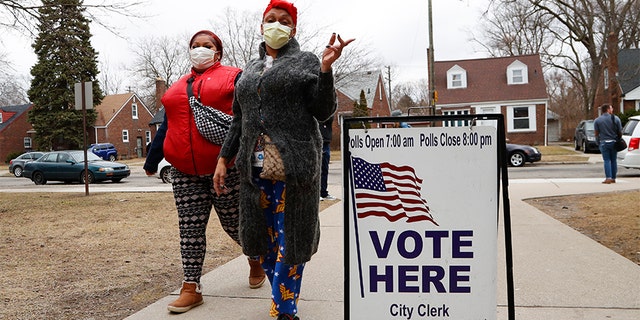
Voters arrive with masks in light of the coronavirus COVID-19
health concern at Warren E. Bow Elementary School in Detroit, Tuesday,
March 10, 2020. (Associated Press)
Further, advocates say not all voters can fill out
ballots by hand and that sending ballots could miss some voters, such as
Native Americans who live on reservations where mail isn’t delivered to
every home. Meanwhile, steps taken — or not taken — to change
aspects of the voting process are being met with lawsuits from political
parties and voting rights advocates. In Ohio, voting rights
groups are suing the state for refusing to reopen the voter registration
window for the state primary, now scheduled for June 2. Under Ohio law,
voters can register up to 30 days before an election. Advocates say the
other states with postponed primaries are allowing voter registration
ahead of rescheduled elections. In Wisconsin, the Democratic Party
has sued to force the state to make it easier to register to vote and
request an absentee ballot. They also have asked for mailed ballots to
count if they are postmarked by Election Day and received within 10 days
after voting. Any increase in absentee voting will surely add to
the workload for election offices already stretched thin and navigating
recommendations that people work from home. The elections office
in Cobb County, Georgia, has sent home most of its temporary and
seasonal employees brought on to help prep for elections. That means
more work for the full-time employees who remain, as they are already
seeing an increase in applications for absentee ballots. “As we
prepare for May, there is still so much to do,” said Janine Eveler,
elections director for the metro Atlanta county. “Many of us are here
when we would like to be home with our families because it’s scary right
now.” Looming over the scramble over the primaries are worries
about the general election in November, a date that is set by federal
law. Federal legislation has been proposed that would have all voters
receive a mail-in ballot for the November election and provide federal
funds to help states cover the costs. The
Brennan Center for Justice at NYU's School of Law is calling for task
forces in every state to implement plans for executing an election amid a
pandemic and urging Congress to provide money to help states. They
estimate their proposals, including universal mail-in voting, could cost
up to $2 billion. “Things will need to change,” said Wendy Weiser, head of the center's democracy program. For
most people, the new coronavirus causes only mild or moderate symptoms,
such as fever and cough. For some, especially older adults and people
with existing health problems, it can cause more severe illness,
including pneumonia. The vast majority of people recover from the new
virus. According to the World Health Organization, people with mild
illness recover in about two weeks, while those with more severe illness
may take three weeks to six weeks to recover. Associated Press writer Geoff Mulvihill in Cherry Hill, New Jersey, contributed to this report.


 Voters arrive with masks in light of the coronavirus COVID-19
health concern at Warren E. Bow Elementary School in Detroit, Tuesday,
March 10, 2020. (Associated Press)
Voters arrive with masks in light of the coronavirus COVID-19
health concern at Warren E. Bow Elementary School in Detroit, Tuesday,
March 10, 2020. (Associated Press)


No comments:
Post a Comment