Stock futures gain ground as Congress moves closer to a stimulus deal
U.S. equity futures are pointing to a higher open when Wall Street begins trading on Tuesday as congressional and White House officials emerged from grueling negotiations at the Capitol over the $2 trillion coronavirus rescue package saying they expected to reach a deal Tuesday. This comes after the Federal Reserve promised support to the struggling economy. The major futures indexes are indicating a gain of more than 4 percent or around 700 Dow points. The Fed promised to buy as many Treasurys and other assets as needed to keep financial markets functioning. That
came as Wall Street fell 3 percent after Congress failed to approve an
economic support package. It would send checks to U.S. households and
offer support for small businesses and the hard-hit travel industry, but
Democrats say it favors companies too heavily at the expense of workers
and public health. In Asia, Japan's Nikkei rose 7 percent, the
Hang Seng in Hong Kong was 4.4 percent higher and China's Shanghai
Composite rose 2.3 percent. In Europe, London's FTSE added 2.9 percent, Germany's DAX rose 4.4 percent and France's CAC was 3.3 percent higher. The Fed's promise goes beyond the $700 billion in purchases announced last week. The
central bank said it will buy a wide range of investments, including
corporate bonds for the first time, to improve trading in markets that
help home buyers purchase houses, state and local governments borrow and
businesses to get enough short-term cash to make payroll.
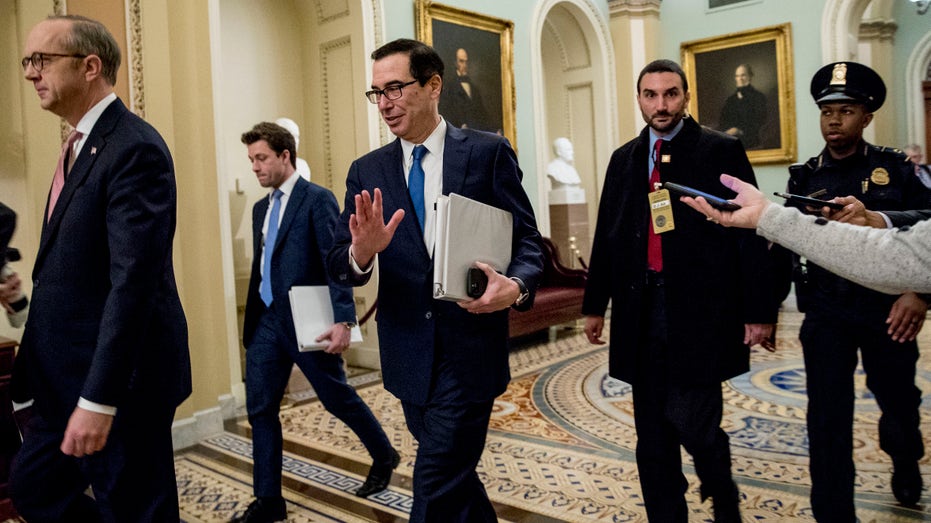
Treasury
Secretary Steven Mnuchin, third from left, and White House Legislative
Affairs Director Eric Ueland, left, walk to a meeting with Senate
Minority Leader Sen. Chuck Schumer of N.Y. in his office on Capitol
Hill, Monday, March 23, 2020, in Was
As Congress was
locked in stalemate, the number of known infections worldwide jumped
past 380,000. After just a few weeks, the United States has more than
46,000 cases and more than 600 deaths. Also Monday, trading on the
New York Stock Exchange went all-electronic for the first time after
the trading floor was temporarily closed as a precaution. The exchange
announced the move last week after two employees tested positive for the
virus. The number of floor traders had dwindled sharply in recent years
as more trading become electronic. Wall Street and some other
stock markets have lost nearly one-third of their value over the past
month as business shutdowns spread and airlines, retailers and other
industries suffer rising losses. Economists increasingly say a
recession seems inevitable. Analysts are slashing their forecasts for
upcoming corporate profits. Forecasters say they cannot project how deep
the downturn might be or how long it will last. Professional traders say investors need to see a decline in numbers of new infections before markets can find a bottom. Congress
debated through the weekend on the rescue plan, but White House
officials and congressional leaders are struggling to finalize it.
Democrats blocked a vote to advance the package Monday. They want to
steer more of the assistance to public health and workers. Even if
the two sides find a compromise, Congress may need to go through more
rounds of similar negotiations if the outbreak isn't brought under
control.
On
Wall Street, the benchmark S&P 500 fell 2.9 percent in another day
of sudden swings. It was down as much as 4.9 percent and as little as
0.2 percent earlier in the day. The Dow Jones Industrial Average
fell 3 percent. The Nasdaq, which is dominated by technology companies,
lost only 0.3 percent as tech shares held up better than the rest of the
market. In
energy markets, benchmark U.S. crude gained $1.06 to $24.43 per barrel
in electronic trading on the New York Mercantile Exchange. The contract
lost $2.59 the previous session to close at $22.63. Brent crude, used to
price international oils, added 84 cents to $27.91 per barrel in
London. It lost $1.49 the previous session to $26.98. The Associated Press contributed to this article.




No comments:
Post a Comment