US coronavirus response ramps up as feds, states mobilize
As the coronavirus outbreak
continued to disrupt American life, numerous actions have been taken –
in Washington, in state capitals and at the local level -- to help get a
grip on a situation that simultaneously threatened to spin out of
control. In Washington, President Trump
said Wednesday he would invoke the Defense Production Act, a move
designed to help private businesses ramp up production and distribution
of medical supplies and equipment needed to combat the virus also known as COVID-19. “If we need to use it we’ll be using it,” the president said. “It’s full speed ahead.” On a day that saw confirmed U.S. cases of the virus surpass 9,300 and deaths top 130, Trump also signed a second coronavirus relief bill that called for providing paid sick leave, unemployment aid and free testing to the public.
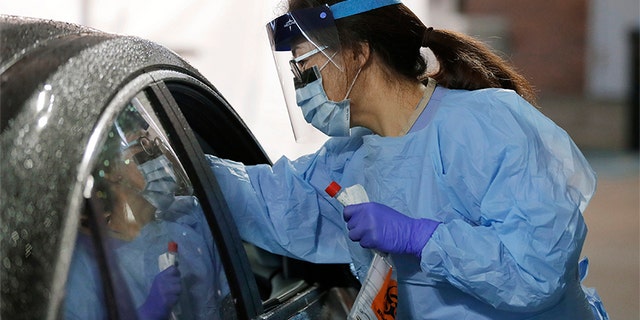
A nurse at a drive-up coronavirus testing station set up by the
University of Washington Medical Center uses a swab to take a sample
from the nose of a person in a car Friday, March 13, 2020, in Seattle.
(Associated Press)
Trump and members of Congress also were considering
providing as much as $300 billion to the airline industry and other
distressed businesses. Total projected government expenditures as high as $1 trillion
– including proposed checks paid directly to the public -- seemed
contrary to everything the Republican Party normally preaches about
fiscal responsibility – but these were unusual circumstances, some party
members menoted. “These are not ordinary times. This is not an
ordinary situation,” Senate Majority Leader Mitch McConnell, R-Ky., told
reporters Tuesday, according to Politico. “So it requires extraordinary measures.”
“These are not ordinary times. This is not an ordinary situation. So it requires extraordinary measures.” — Senate Majority Leader Mitch McConnell, R-Ky.
Border clampdowns
And
just a week after the president announced new restrictions on travel
between the U.S. and Europe, Trump said the U.S. and Canada would
temporarily close their shared border to non-essential traffic. Officials
from Immigration and Customs Enforcement (ICE) said they would focus
only on the most critical cases in a bid to avoid bringing the virus
inside the agency’s detention centers for illegal immigrants. In
New York and California, two states among those hardest hit by the
outbreak, were anticipating the arrival of hospital ships from the U.S.
military in order to expand the number of available beds for people
stricken with the virus. The USNS Mercy hospital ship, based on
the West Coast, was expected to be deployed "in days," military
officials told the AP, while the USNS Comfort, undergoing maintenance in Norfolk, Va., was expected in New York City within two weeks. In
addition, the Defense Department made 1 million respiratory masks
available to the Department of Health and Human Services and planned to
provide 4 million more, Defense Secretary Mark Esper said Wednesday. Other examples of military assistance included the deployment of 23,000 National Guard
members in 23 states to assist at emergency operations centers, provide
transportation to health care providers and collect and deliver test
samples.
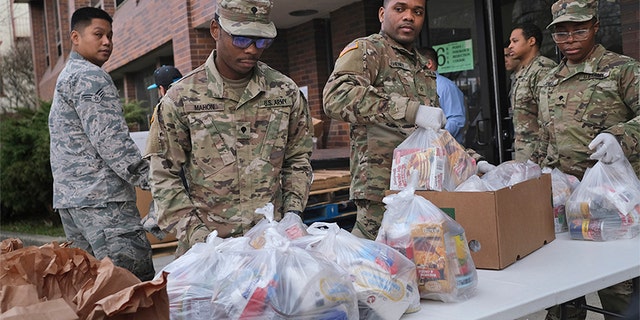
Members of the New York National Guard help to organize and
distribute food to families on free or reduced school lunch programs in
New Rochelle, N.Y., Thursday, March 12, 2020. (Associated Press)
If matters worsen, military personnel can provide a
range of services from "mass casualty" medical treatment to postal
delivery and water and sewer services, the Defense Department said.
'The right thing to do'
In
Ohio, Republican Gov. Mike DeWine was drawing praise for his early
actions to limit public gatherings and acting to postpone the state’s
primary elections, which had been scheduled for Tuesday. “Everybody
has to make their call and what they think is the right thing to do,”
DeWine said Monday, according to the Associated Press. “This is a time
when every governor understands the gravity of what they are doing.” On
the local level, police in cities such as Fort Worth, Texas, and Denver
stopped making arrests for low-level crimes, while courthouses
throughout the country were delaying trials and canceling jury duty –
all efforts to slow the spread of the virus. In Philadelphia and
Chicago, parking officials said they won’t issue tickets except on
extreme cases, like when a vehicle blocks a fire hydrant, the AP
reported. “This pandemic requires us all to think differently,” Philadelphia District Attorney Larry Krasner told the AP.
“This pandemic requires us all to think differently.” — Philadelphia District Attorney Larry Krasner
The various actions came amid some troubling new developments. Wall
Street had another bad day Wednesday, dropping some 1,300 points and
thus losing all the gains it had made since Trump took office.
Jobless claims spike
States across the country also reported a spike in jobless claims as airlines, restaurants and other businesses laid off staff. In
Tennessee, for example, new unemployment claims tripled over the past
week, according to the Associated Press. Michigan reported five times
the normal number of claims and Minnesota reported receiving more than
2,000 claims per hour – far above the usual 40 or 50 per hour. In Michigan, the three major automakers said they planned to lay off a total of about 150,000 workers.
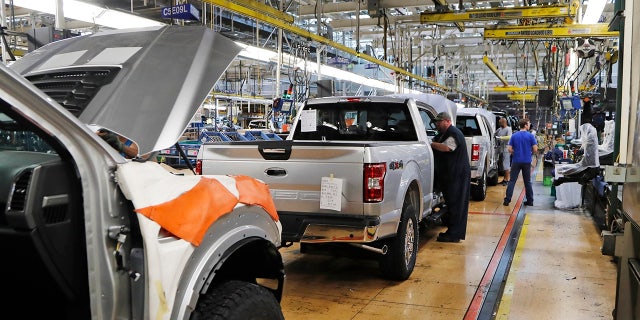
United Auto Workers assembly workers assemble 2018 Ford F-150
trucks at the Ford Rouge assembly plant in Dearborn, Mich., Sept. 27,
2018. (Associated Press)
The United Auto Workers union had been pushing for
plant closures out of concern that workers would come in contact with
the coronavirus – and then infect their families. “That’s the
thing that I was scared the most about, being the one to bring it home
to them,” autoworker Tommy Wolikow, a GM employee and union member, told
the Associated Press.
“That’s the thing that I was scared the most about, being the one to bring it home to them.” — Tommy Wolikow, GM autoworker
And the nation kept hearing heartbreaking tales of the outbreak’s effects on other ordinary American families. In
New Jersey, Grace Fusco, a 73-year-old mother of 11 and grandmother or
27, died of the virus Wednesday night -- just hours after losing a son
and five days after losing a daughter to the outbreak, The New York Times reported. Other members of the family remained quarantined in their homes, unable to gather in remembrance of their lost relatives. “It’s so pitiful,” Paradiso Fodera, a spokeswoman for the family told The Times. “They can’t even mourn the way you would.” The Associated Press contributed to this story.


 A nurse at a drive-up coronavirus testing station set up by the
University of Washington Medical Center uses a swab to take a sample
from the nose of a person in a car Friday, March 13, 2020, in Seattle.
(Associated Press)
A nurse at a drive-up coronavirus testing station set up by the
University of Washington Medical Center uses a swab to take a sample
from the nose of a person in a car Friday, March 13, 2020, in Seattle.
(Associated Press)
 Members of the New York National Guard help to organize and
distribute food to families on free or reduced school lunch programs in
New Rochelle, N.Y., Thursday, March 12, 2020. (Associated Press)
Members of the New York National Guard help to organize and
distribute food to families on free or reduced school lunch programs in
New Rochelle, N.Y., Thursday, March 12, 2020. (Associated Press)
 United Auto Workers assembly workers assemble 2018 Ford F-150
trucks at the Ford Rouge assembly plant in Dearborn, Mich., Sept. 27,
2018. (Associated Press)
United Auto Workers assembly workers assemble 2018 Ford F-150
trucks at the Ford Rouge assembly plant in Dearborn, Mich., Sept. 27,
2018. (Associated Press)


No comments:
Post a Comment