Dems deploying DARPA-funded AI-driven information warfare tool to target pro-Trump accounts
TODAY -- Pictured: Gen. Stanley McChrystal appears on NBC News'
"Today" show -- (Photo by: Peter Kramer/NBC/NBC NewsWire via Getty
Images)
An anti-Trump Democratic-aligned political action committee advised by retired Army Gen. Stanley McChrystal
is planning to deploy an information warfare tool that received initial
funding from DARPA, the Pentagon’s secretive research arm --
transforming technology originally envisioned as a way to fight ISIS
propaganda into a campaign platform to benefit Joe Biden. The Washington Post first reported that the
initiative, called Defeat Disinfo, will utilize "artificial
intelligence and network analysis to map discussion of the president’s
claims on social media," and then attempt to "intervene" by "identifying
the most popular counter-narratives and boosting them through a network
of more than 3.4 million influencers across the country — in some cases
paying users with large followings to take sides against the
president." Social media guru Curtis Hougland is heading up Defeat
Disinfo, and he received the funding from DARPA when his program was
"part of an effort to combat extremism overseas." He explained in an
interview with the Post that he was unhappy that top social media
accounts often supported Trump, and had effectively defended the
president in recent days from claims that he had suggested Americans inject themselves with disinfectant. The
effort raised the question of whether taxpayer funds were being
repurposed for political means, and whether social media platforms have
rules in place that could stymie Hougland's efforts -- if he plays
along. A spokesperson for Facebook told Fox News that
"our policies require creators and publishers to tag business partners
in their branded content posts when there's an exchange of value between
a creator or publisher and a business partner."
Politicians and PACs who are authorized under Facebook's policy entitled “Ads About Social Issues, Elections or Politics” are allowed to use the site's branded content tool, the spokesperson added. As part of the authorization process
for advertisers, Facebook says on its website that it "confirms their
ID and allows them to disclose who is responsible for the ad, which will
appear on the ad itself. The ad and 'Paid for by' disclaimer are placed
in the Ad Library for seven years, along with more information such as
range of spend and impressions, as well as demographics of who saw it." A spokesperson for Twitter did not immediately provide an on-the-record comment to Fox News. In 2018, Twitter launched its Political Campaigning Policy, which promises a degree of "transparency" for paid political communications. The
policy requires "advertisers who want to run political campaigning ads
for Federal elections to self-identify and certify that they are located
in the US Candidates and committees will have to provide their FEC ID,
and non-FEC registered organizations and individuals will have to submit
a notarized form." Additionally, "handles used for political
campaigning advertising will have to comply with stricter requirements,"
Twitter's policy states. "The handle’s profile photo, header photo, and
website must be consistent with its online presence and the Twitter bio
must include a website that provides valid contact information. We will
also be including a visual badge and disclaimer information on promoted
content from certified accounts in the near future. This will allow
users to easily identify political campaigning ads, know who paid for
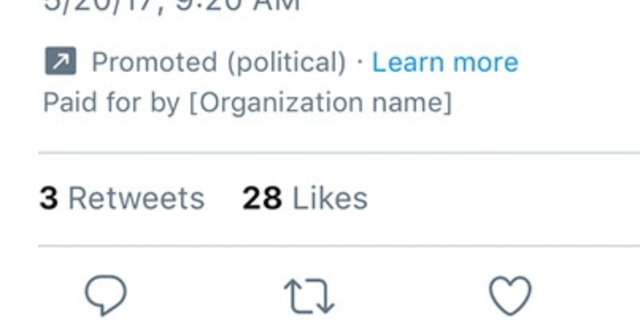
them, and whether it was authorized by a candidate." Twitter provided an image of what promoted political content ideally would look like.
McChrystal, who led U.S. forces in Afghanistan before he was fired by then-President Obama in 2010 for deriding his civilian bosses in a Rolling Stone interview, told the Post that the operation was necessary, even if it might appear unseemly. “Everyone wishes the Pandora’s box was closed and none of this existed, but it does," McChrystal said. McChrystal
has not explicitly endorsed Biden, even though the new information
warfare project is intended to help his candidacy. The former general
has previously gone on the record with a less-than-glowing assessment of
Biden's competence. One
of the tidbits in the Rolling Stone interview by Michael Hastings
recounted how McChrystal had lost confidence in Biden after he had
suggested a counterterrorism strategy. "'Are you asking about Vice
President Biden?" McChrystal said, imagining a way to dismissively mock
Biden if someone were to ask about him during an upcoming
question-and-answer session. 'Who's that?'" "'Biden?" another adviser chimed in, according to Hastings. 'Did you say: Bite Me?'"


 McChrystal, who led U.S. forces in Afghanistan before he was fired by then-President Obama in 2010 for deriding his civilian bosses in a Rolling Stone interview, told the Post that the operation was necessary, even if it might appear unseemly.


No comments:
Post a Comment