Messy Georgia primary raises alarms for November, as Ossoff edges closer to clinching Senate nomination
The
Democratic Senate primary in Georgia was too early to call Wednesday,
as Jon Ossoff held onto approximately 49 percent of the vote with more
ballots coming in -- amid widespread reports of hourslong lines, voting
machine malfunctions, provisional ballot shortages and absentee ballots
failing to arrive in time.
Ossoff, whose defeat in a 2017 special election was a gut-punch to Democrats who flooded his campaign with money,
was leading Sarah Riggs Amico and Teresa Tomlinson. They each have
roughly 13 percent of the counted vote, and candidates need 50 percent
of the vote to avoid a runoff. One of the state’s largest counties, De Kalb in the metro Atlanta area, has yet to report any results as of early Wednesday. As
the night wound on, and races were also held in South Carolina, Nevada
and West Virginia, it became evident that the long-standing nationwide
wrangle over voting rights and election security had come to a head in
Georgia -- where a messy primary and partisan finger-pointing offered an
unsettling preview of a November contest when battleground states could
face potentially record turnout. Joe Biden’s presidential
campaign called the situation “completely unacceptable.” Georgia
Republicans deflected responsibility to metro Atlanta’s heavily minority
and Democratic-controlled counties, while President Donald Trump’s top
campaign attorney decried “the chaos in Georgia.” It raised the
specter of a worst-case November scenario: a decisive state, like
Florida and its “hanging chads” and “butterfly ballots” in 2000,
remaining in dispute long after polls close. Meanwhile, Trump, Biden and
their supporters could offer competing claims of victory or question
the election’s legitimacy, inflaming an already boiling electorate.
Steven Posey checks his phone as he waits in line to vote,
Tuesday, June 9, 2020, at Central Park in Atlanta. Voters reported wait
times of three hours. (AP Photo/John Bazemore)
At Trump’s campaign headquarters, senior counsel
Justin Clark blamed Georgia’s vote-by-mail push amid the COVID-19
pandemic, alluding to the president’s argument that absentee voting
yields widespread fraud. “The American people want to know that
the results of an election accurately reflect the will of the voters,”
Clark said. “The only way to make sure that the American people will
have faith in the results is if people who can, show up and vote in
person.”
Rachana
Desai Martin, a top Biden campaign attorney, called the scenes in
Georgia a “threat” to democracy. “We only have a few months left until
voters around the nation head to the polls again, and efforts should
begin immediately to ensure that every Georgian — and every American —
is able to safely exercise their right to vote,” she said. Martin
stopped short of assigning blame, but two Georgia Democrats on Biden’s
list of potential running mates pointed at Republican Secretary of State
Brad Raffensperger, who led the selection of Georgia’s new voting
machine system and invited every active voter to request an absentee
ballot. Atlanta
Mayor Keisha Lance Bottoms tweeted at Raffensperger about problems in
pockets of metro Atlanta. “Is this happening across the county or just
on the south end,” the Democrat asked, referring to an area with a
heavily black population. Stacey Abrams, the 2018 Democratic
nominee for governor and an Atlanta resident, tweeted that “Georgians
deserve better” and that Raffensperger “owns this disaster.” Abrams
established herself as a voting rights advocate after she refused to
concede her 2018 race because of voting irregularities when her
Republican opponent, now-Gov. Brian Kemp, was secretary of state. Fulton
County, which includes most of Atlanta, has a history of slow vote
tabulation. Its local elections chief, Richard Barron, called Tuesday a
“learning experience" while alluding to the state's role in the primary
process.
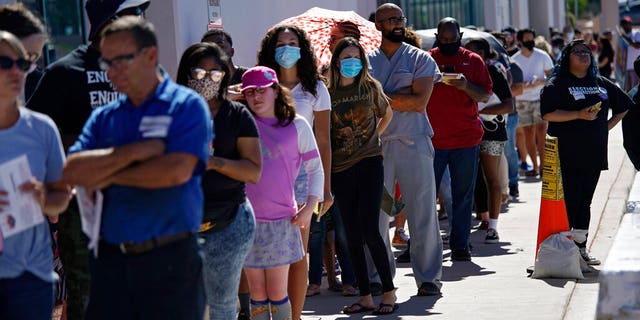
People wait in line at one of a few in person voting places during
a nearly all-mail primary election Tuesday, June 9, 2020, in Las Vegas.
(AP Photo/John Locher)
The finger-pointing goes beyond details of the law.
Raffensperger correctly noted that county officials train poll workers,
including on the use of the new voting machines. But Raffensperger is
the state’s chief elections official who decides how many machines to
send to each county, and his office provides training curriculum for
local officials.
On
absentee ballots, the Republican secretary of state pushed
unprecedented no-fault absentee access, paying to send an application to
every Georgian on the active voter rolls. But, as Barron noted, neither
the secretary of state nor the legislature provided additional money
for local officials to hire staff to process the influx, which dwarfed
the typical primary. History
suggests that both local and state officials, whether in Georgia or
elsewhere, could find themselves in the national crosshairs if their
election tallies leave the presidency in flux. “I know that in
these hyperpartisan times, half the people will be happy, and the other
half will be sad,” Raffensperger said. “But we want to make sure that
100% of people know ... the election was done fairly and we got the
accurate count.” Elsewhere in Tuesday's races, a progressive
candidate featured in a Netflix documentary on politics won the
Democratic Senate primary in West Virginia to face Republican Sen.
Shelly Moore Capito in November.
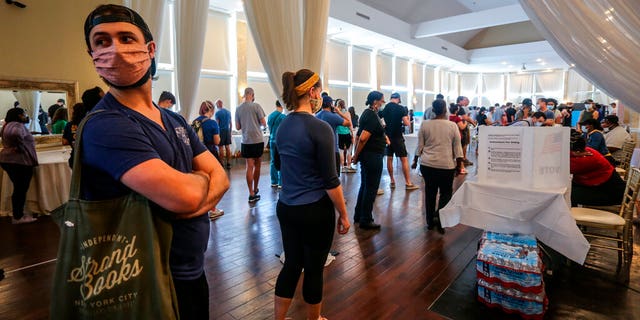
Voters wait in line to cast their ballots in the state's primary
election at a polling place, Tuesday, June 9, 2020, in Atlanta, Ga. Some
voting machines went dark and voters were left standing in long lines
in humid weather as the waiting game played out. (AP Photo/Ron Harris)
Paula Jean Swearengin was featured in the 2019
Netflix political documentary “Knock Down the House.” She accepted only
individual donations during her campaign and outraised one of her two
opponents, former state Sen. Richard Ojeda, by a more than 10-to-1
margin. Also seeking the Democratic nomination was former South
Charleston Mayor Richie Robb. Meanwhile, two incumbents won the Republican nominations for governor in West Virginia and South Dakota.
Gov.
Jim Justice was declared the primary winner in West Virginia on
Tuesday, while Gov. Doug Burgum captured the GOP nomination in South
Dakota. Justice, a billionaire coal and agricultural businessman,
defeated Woody Thrasher, Mike Folk and others to win the GOP nomination.
This week, President Trump tweeted a message of support for the
governor: “Big Jim is doing a tremendous job for West Virginia. Vote for
Big Jim!” Burgum, a former software executive, defeated Michael
Coachman in the election, which was conducted exclusively by mail. He’s
expected to be a heavy favorite in November over Democratic political
newcomer Shelley Lenz, a veterinarian and small-business owner. Kanawha County Commissioner Ben Salango won the Democratic nomination for governor of West Virginia. Two
Republican incumbent senators also won their primaries on Tuesday:
Shelley Moore Capito in West Virginia and Lindsey Graham in South
Carolina. In Nevada, voters were waiting in lines for three hours
and more Tuesday at limited polling places despite Nevada officials
encouraging people to cast their primary election ballots by mail
because of the coronavirus pandemic. Nevada Deputy Secretary of
State for Elections Wayne Thorley said his office had received a report
of a three-hour wait at one Clark County polling place.
Fox News' Tyler Olson and The Associated Press contributed to this report.


 Ossoff, whose defeat in a 2017 special election was a gut-punch to Democrats who flooded his campaign with money,
was leading Sarah Riggs Amico and Teresa Tomlinson. They each have
roughly 13 percent of the counted vote, and candidates need 50 percent
of the vote to avoid a runoff.
Ossoff, whose defeat in a 2017 special election was a gut-punch to Democrats who flooded his campaign with money,
was leading Sarah Riggs Amico and Teresa Tomlinson. They each have
roughly 13 percent of the counted vote, and candidates need 50 percent
of the vote to avoid a runoff.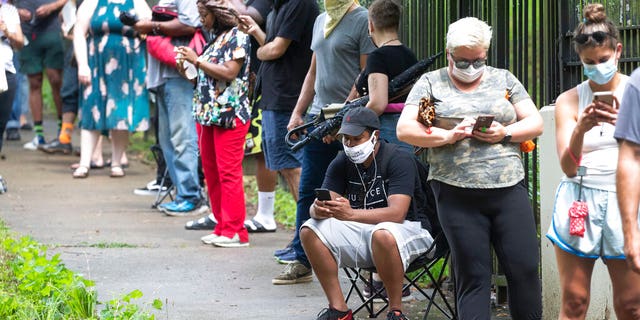


No comments:
Post a Comment