China harboring military-linked biologist fugitive at San Francisco consulate, FBI says
The Chinese consulate in San Francisco
is harboring a biology researcher who falsely denied connections to the
Chinese military to obtain a visa and gain access to the country,
according to court documents filed by the FBI. The filing came as
part of a document that cited a slew of other episodes in which Chinese
nationals allegedly lied on their visa applications by hiding their
military connections. Tang Juan, a researcher at the University of
California, Davis, stated on her J-1 visa application that she "had
never served in the military, but open source investigation revealed
photographs of her in the uniform of the Civilian Cadre of the PLA
[People's Liberation Army], and that she had been employed as a
researcher at the Air Force Military Medical University, which is
another name for FMMU [Fourth Military Medical University]," the FBI
claimed. Then, during an interview with FBI agents on June
20, Tang "denied serving in the Chinese military, claimed she did not
know the meaning of the insignia on her uniform, and that wearing a
military uniform was required for attendance at FMMU because it was a
military school." The
FBI revealed it then executed a search warrant immediately at Tang's
home and found additional evidence of Tang’s PLA affiliation. "The
FBI assesses that, at some point following the search and interview of
Tang on June 20, 2020, Tang went to the Chinese Consulate in San
Francisco, where the FBI assesses she has remained," the bureau
announced. There existed evidence in at least one case "of a
military scientist copying or stealing information from American
institutions at the direction of military superiors in China," the
bureau went on. The court documents contained similar evidence against
several other Chinese scientists. Chen Song, for example, was an
"active duty People's Liberation Army military scientist who lied to get
into the United States, attempted to destroy evidence and lied
extensively to the FBI when interviewed," the government wrote in
charging documents. "Defendant’s case is not an isolated one, but
instead appears to be part of a program conducted by the PLA—and
specifically, FMMU or associated institutions—to send military
scientists to the United States on false pretenses with false covers or
false statements about their true employment," the FBI said, referring
to Chen Song. Another case involves a suspected spy working for UCSF. Meanwhile,
the United States ordered China to close its consulate in Houston,
escalating tensions between the world’s largest economies as President
Trump has ramped up punitive measures against China ahead of the
November U.S. election. Beijing denounced the order Wednesday as
"outrageous" and claimed it would draw a firm response if not reversed. The
physical closure of the consulate, one of China's six missions in the
United States, marked a dramatic step in increasingly contentious
relations that have been strained not only by the coronavirus pandemic
but also by disputes over trade, human rights, Hong Kong and Chinese
assertiveness in the South China Sea. Previous
Trump administration measures against Chinese officials, students and
researchers have included travel bans, registration requirements and
other steps intended to reduce the country's footprint in the United
States. The administration also has announced its outright rejection of
virtually all Chinese maritime claims in the South China Sea. These
actions have come as Trump has sought to blame China for the
coronavirus outbreak in the U.S., where cases have soared. Trump himself
said more closures could be coming if China didn't change its behavior.
"It's always possible," he told reporters at the White House.
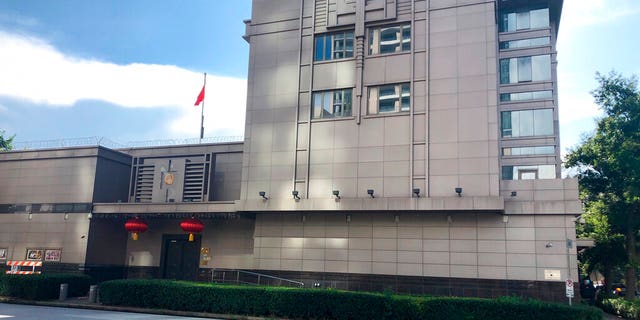
The Chinese Consulate General in Houston. Police and fire
officials there responded to reports that documents were being burned in
the courtyard of the consulate Tuesday night, according to the Houston
Police Department. (AP Photo/John Mone)
The State Department announced it ordered the
consulate closed within 72 hours after alleging that Chinese agents have
tried to steal data from facilities in Texas, including the Texas
A&M medical system statewide and The University of Texas MD Anderson
Cancer Center in Houston. There were indications consulate staff
were preparing to leave: Papers were being burned on the consulate
grounds late Tuesday night — a common practice when a diplomatic post is
being shuttered on short notice. Cai Wei, the Chinese consul
general, told KTRK-TV in Houston the order to shut down was "quite
wrong" and "very damaging" to U.S.-China relations. Asked about
accusations of espionage and stealing data, Cai said, "You have to give
some evidence, say something from the facts. ... Knowing Americans, you
have the rule of law, you are not guilty until you are proved guilty." State
Department spokeswoman Morgan Ortagus said in a statement that the
closure was "to protect American intellectual property and Americans'
private information."
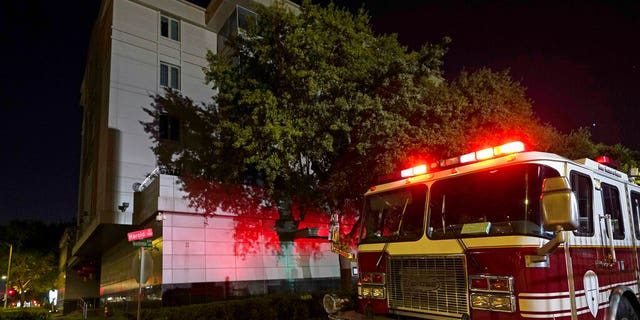
A firetruck outside the Chinese Consulate in Houston on Wednesday. (AP Photo/David J. Phillip)
"The United States will not tolerate (China's)
violations of our sovereignty and intimidation of our people, just as we
have not tolerated (China's) unfair trade practices, theft of American
jobs, and other egregious behavior," she said. Testifying before
Congress on Wednesday, Deputy Secretary of State Stephen Biegun lamented
that relations today have been "weighed down by a growing number of
disputes," including commercial espionage, intellectual property theft
and unequal treatment of diplomats, businesses and journalists. Those factors led to Trump's action, he told the Senate Foreign Relations Committee. The
Justice Department on Tuesday had announced the indictments of two
Chinese hackers on charges of trying to steal pharmaceutical secrets
from U.S. companies related to the COVID-19 pandemic that originated in
China. Although there was no indication the indictments and the
consulate action were related, the U.S. has long alleged China has been
involved in nefarious activity around the country, including from its
Houston consulate. Even before the U.S. announced the closure,
which was conveyed privately to the Chinese ambassador on Tuesday, China
strongly condemned it. "The unilateral closure of China’s
consulate general in Houston within a short period of time is an
unprecedented escalation of its recent actions against China," Foreign
Ministry spokesperson Wang Wenbin said. He warned of firm
countermeasures if the U.S. did not reverse itself. Wang accused
the U.S. of opening Chinese diplomatic pouches without permission
multiple times, confiscating Chinese items for official use and imposing
restrictions on Chinese diplomats beginning last October and again in
June. He also said U.S. diplomats in China engaged in infiltration
activities. In Houston, firefighters responded to reports of
papers being burned on the consulate grounds Tuesday night but were
barred entry. On Wednesday afternoon, consulate staff could be seen
loading cleaning supplies and paper products into a van parked outside
the building. A U-Haul truck was also parked outside the consulate First
responders "were told that people inside the consulate, that they were
burning paperwork because they were in the process of being evacuated
from the building," Houston Mayor Sylvester Turner said. Foreign
diplomatic missions have operated under legal immunities accorded by
international law and may not be entered without permission. However,
the destruction of confidential documents at a facility that has been
ordered or otherwise forced to close on short notice, including U.S.
missions, was not unusual. Most recently in the United States, Russia's
consulate in San Francisco made news for burning large amounts of
material when it was ordered closed in 2017. Aside from the
diplomatic ramifications, the closure of the Houston consulate could
make it more difficult for China to provide assistance to its citizens
in the southern United States and for U.S. nationals seeking visas and
other services there. In addition to its embassy in Washington and
its mission to the United Nations in New York, China has consulates in
New York, Chicago and Los Angeles. In an apparent bid to stave off the
reciprocal closure of an American diplomatic mission in China, the State
Department told the Chinese that it would not reopen its consulate in
Wuhan, two U.S. officials who were not authorized to discuss the matter
publicly told The Associated Press anonymously. The U.S. consulate
in Wuhan was shuttered in late January at the height of the coronavirus
outbreak that started there, but the State Department had informed
Congress in early June that it planned to reopen it, possibly this
summer. Besides
Wuhan, the U.S. has four other consulates in China — in Shanghai,
Guangzhou, Chengdu and Shenyang — along with its embassy in Beijing and a
consulate general in Hong Kong. In a reflection of China’s
economic importance, a Houston business group expressed regret at the
announcement, saying the consulate has been important in building trade,
investment and cultural ties. It noted that the Houston consulate was
China’s first in the U.S. when it opened in 1979. The Associated Press contributed to this report.




No comments:
Post a Comment