House passes $25B in 'emergency' Postal Service funding, White House threatens veto
The House of Representatives on
Saturday passed a $25 billion funding infusion to the U.S. Postal
Service in a bill that also would reverse new cost-cutting measures and
ban any efforts to slow down the mail until at least next year. The vote was 257-150 with 26 Republicans joining the Democrats. Democrats called the rare "emergency" session in the middle of the summer recess because they contend President Trump and new Postmaster General Louis DeJoy are trying to sabotage the 2020 election by delaying service that could compromise mail-in ballots during the coronavirus pandemic. "We are
experiencing a global pandemic and now our U.S. Postal Service is under
attack," said Rep. Rashida Tlaib, D-Mich. "Let it be clear: This
administration is waging an authoritarian campaign to sabotage this
election by manipulating the Postal Service to suppress our votes ...
This is not a conspiracy theory. This is fascism. We will not stand for
this." Rep.
Gerald Connolly, D-Va., said DeJoy is "a crony and major donor of the
president." Together, they have waged a campaign to disrupt the
timeliness of mail delivery and erode public confidence in the Postal
Service that -- if successful -- would be "the largest voter suppression
in American history since Jim Crow," Connolly said. Republicans
dismissed the Democrats' election concerns as "conspiracy theory." GOP
members said the Postal Service is not in a crisis and can handle any
uptick in volume from mail-in ballots, pointing to its $14 billion in
available cash and access to a $10 billion loan from the Treasury. "Like
the Russia hoax and impeachment sham, the Democrats have manufactured
another scandal for political purposes," said Rep. James Comer, R-Ky.
Rep.
Debbie Lesko, R-Ariz., said Democrats are using the Postal Service to
gin up "a new Trump conspiracy theory" even though the president doesn't
control the postmaster general. "Seems insane, but all too typical for the Trump-hating Democrats," Lesko said.
Goofy
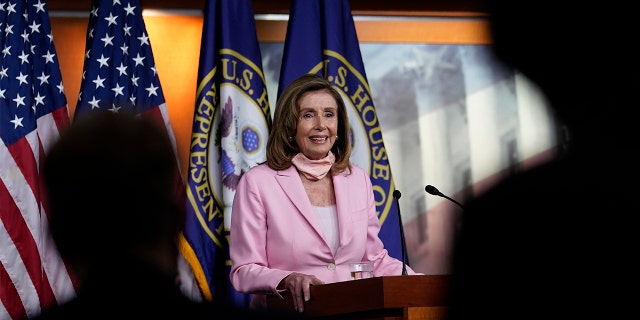
House Speaker Nancy Pelosi, D-Calif., speaks during a news
conference on Capitol Hill in Washington, Aug. 22. The House is set for a
rare Saturday session to pass legislation to halt changes in the Postal
Service and provide $25 billion in emergency funds. (Associated Press)
The legislation is not expected to go anywhere. The GOP-led Senate has no plans to take up the bill and the White House issued a veto threat on Friday saying USPS doesn't need a $25 billion bailout. Trump
tweeted Saturday his opposition to funding for the Postal Service and
linked it to his objections to universal mail-in voting. "Vote NO
to the Pelosi/ Schumer money wasting HOAX which is taking place now,"
Trump tweeted. "Then fight the $51 million unasked for Ballots. Only
ABSENTEE BALLOTS are acceptable!" The Delivering for America Act would
infuse the post office with $25 billion, reverse the service changes
that DeJoy enacted this year and prevent the Postal Service from taking
any measures that could slow down the mail until after the
coronavirus pandemic or Jan. 31, 2021 -- whichever is later. The
legislation specifically bans reducing service hours at postal
facilities, decommissioning mail sorting machines and removing community
mailboxes. The bill would prohibit any limits on overtime pay, hiring
freezes, delaying mail service and treating election mail as anything
less than first-class mail.
Democrats
point to growing concerns from constituents over mail delays coinciding
with postal changes on DeJoy's watch. DeJoy rejected that any political
motives were at play, but told a Senate panel on Friday there has been
a slowdown. “We all feel bad about the dip in our service," DeJoy said, adding that they were working to fix the problems. Under mounting pressure, a noisy protest at his Washington home
and alarm over the removal of blue collection boxes in communities,
DeJoy on Tuesday announced he was putting a pause on any service changes
until after the election. "To avoid even the appearance of any
impact on election mail, I am suspending these initiatives until after
the election is concluded," DeJoy said.
In this image from video, U.S. Postmaster General Louis DeJoy
testifies during a video virtual hearing before the Senate Governmental
Affairs Committee on the U.S. Postal Service during COVID-19 and the
upcoming elections, Aug. 21, on Capitol Hill in Washington. (US Senate
Committee on Homeland Security & Governmental Affairs via AP)
But Democrats said DeJoy paused the changes only because he "was caught red-handed" and argued the emergency legislation was needed to bar him from undermining mail delivery and the 2020 election. Rep. Carolyn Maloney, D-N.Y., chair of the House Oversight Committee, produced a new internal Postal Service document
on the House floor Saturday that she says revealed a significant drop
in service standards at the Postal Service since DeJoy implemented
changes. The document was a presentation prepared for DeJoy on Aug. 12.
"To
those who still claim there are ‘no delays’ and that these reports are
just ‘conspiracy theories,’ I hope this new data causes them to re-think
their position and support our urgent legislation today," Maloney said. Republicans took
a couple of shots at Maloney during the debate, pointing to her primary
race in New York City, which took weeks to call as election officials struggled to count mail-in votes. They said her race should serve as a warning of the dangers of universal mail-in voting for the November election. "If anyone
should know, it should be the chairwoman of this committee who had to
wait six weeks after the Election Day to get the results of her
election," said Rep. Jim Jordan, R-Ohio, who dismissed the House
legislation as a political "charade." "Imagine what the Democrats want to do -- throw live ballots out there to everyone." The Postal Service has lost about $80 billion since 2007 through
a decline of mail volume and a congressional requirement that the
Postal Service pre-fund retiree health benefits. The problems at the
Postal Service have been under the spotlight especially this year with
the pandemic and greater reliance on mail-in services. The Postal
Service board requested the $25 billion in funding from Congress earlier
this year and Democrats agreed. The funding was initially included in
the $3 trillion coronavirus relief bill the House passed in May, but the
HEROES Act died in the GOP-controlled Senate. Republicans
and the White House said the $25 billion isn't needed and they took
special issue with the language that blocks DeJoy from implementing any
reforms at an agency that is losing money.
White
House Chief of Staff Mark Meadows said Trump "at no time has instructed
or directed the Post Office to cut back on overtime, or any other
operational decision that would slow things down." He said the process
of removing blue mail boxes and sorting machines started back in 2011
and the Postal Service has "more than enough money in the bank account."
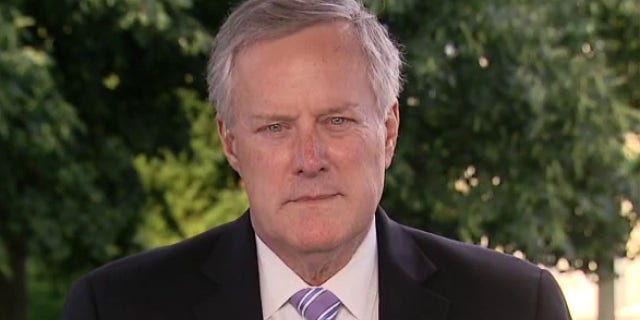
White House Chief of Staff Mark Meadows
The vote Saturday, sandwiched between the Democratic and GOP conventions, got heated at times on the House floor. Rep.
Stephen Lynch, D-Mass., said American democracy is more endangered now
than during the Sept. 11 terrorist attacks because the country is more
divided and the threat is coming from within. "Today the greatest threat to our democracy is the current administration," Lynch said of the Trump White House. Rep.
Jody Hice, R-Ga., shot back that Democrats are doing the damage to
America. "The greatest threat to democracy in the country is the current
majority in the House of Representatives," he said.
House
Speaker Nancy Pelosi, D-Calif., urged Senate Majority Leader Mitch
McConnell, R-Ky., to respond to constituents' concerns on mail delays
and take up the bill. "Public sentiment is everything," Pelosi
said. "They'll be hearing from their constituents because this hits
home. Not receiving your mail in a timely fashion hits home. Not
receiving your prescriptions, especially for our veterans, hits home in a
way that is harmful to our country." The 26 Republicans who
joined with Democrats to approve the $25 billion funding bill were:
Nebraska Reps. Don Bacon and Jeff Fortenberry; Ohio Reps. Troy
Balderson, Steve Stivers, David Joyce and Mike Turner; Illinois Reps.
Michael Bost and Rodney Davis; Rep. Vern Buchanan of Florida, Missouri
Reps. Sam Graves and Ann Wagner; Rep. Brian Fitzpatrick of Pennsylvania;
Rep. Jaime Herrera Beutler of Washington; Texas Reps. Will Hurd and
Michael McCaul; Michigan Rep. Fred Upton, New Jersey Reps. Jeff Van Drew
and Chris Smith; New York Reps. John Katko, Peter King, Elise Stefanik
and Tom Reed; Rep. Doug LaMalfa of California; Rep. David McKinley of
West Virginia; Rep. Pete Stauber of Minnesota and Rep. Don Young of
Alaska.


 Rep.
Debbie Lesko, R-Ariz., said Democrats are using the Postal Service to
gin up "a new Trump conspiracy theory" even though the president doesn't
control the postmaster general.
Rep.
Debbie Lesko, R-Ariz., said Democrats are using the Postal Service to
gin up "a new Trump conspiracy theory" even though the president doesn't
control the postmaster general.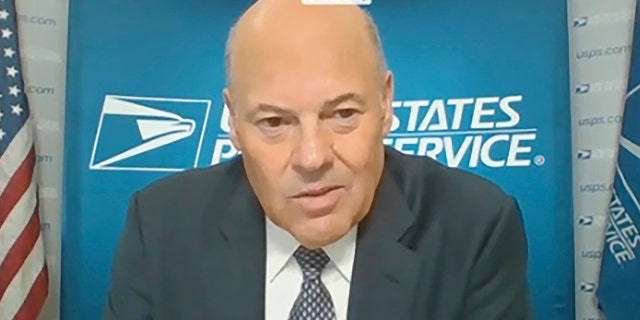



No comments:
Post a Comment