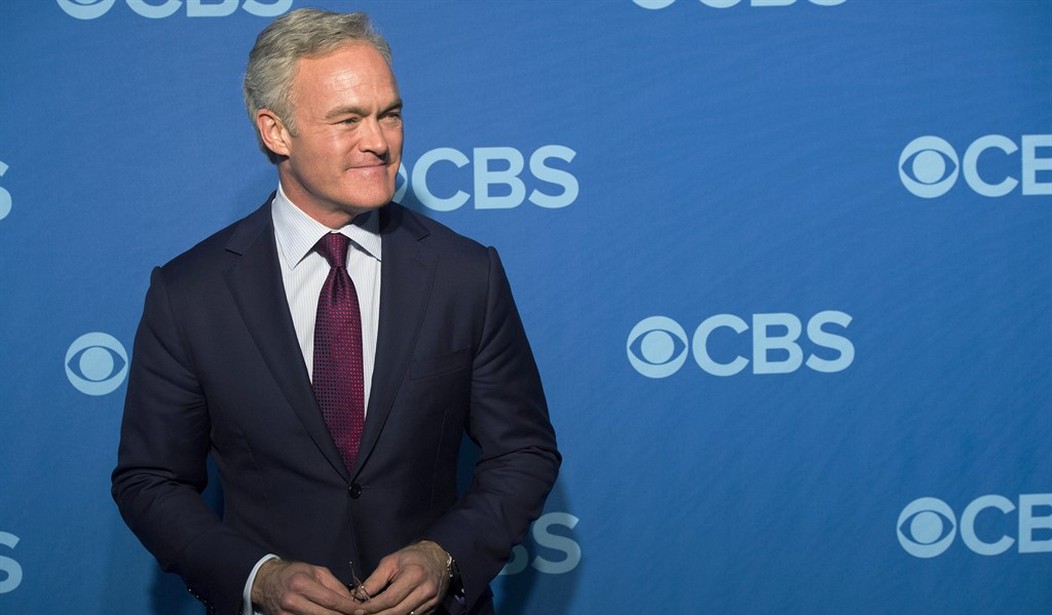
CBS News’ Scott Pelley isn’t Walter Cronkite, nor
will he be remembered as such. He’s the anchor and reporter who was
fired after he couldn’t work with the new boss, Bari Weiss, and the new
production crew she hired for 60 Minutes. He claims the network is on
fire or something. Dude, the outlet will be fine without you. Even
comedian Bill Maher couldn’t care less, adding that a) he wouldn’t
really know about the so-called editorial changes if he didn’t read
about it, and b) being a 60 Minutes correspondent isn’t a hard job.
The program still airs segments that don’t portray the Trump
administration in a good light, but it’s become part of this delusional
censorship narrative pushed by Democrats. Pelley sat down with The New
York Times to talk about his firing, and he was the one soaking up his
15 minutes of fame. Scott, no one will care that you got fired for being
a whiny baby last week at the end of the month. More people are focused
on the New York Knicks’ playoff run right now, where the team is two
wins away from winning its first NBA championship since 1973. The team
hasn’t lost in two months. They play tonight at the Garden with a 2-0
lead over the favored San Antonio Spurs. Trump will be there tonight.
Scott Pelley tells the NYT that when Bari Weiss was hired to run CBS News, he had never heard of her.
How can someone be this out of touch? Seems to justify what critics of the program have been saying. pic.twitter.com/XbcYF6BkDa
Scott
Pelley can choose to be dense if he likes, as many members of the media
do, but there are reams of data showing that Americans think various
outlets and media in general are both biased and untrustworthy.
Scott
Pelley sobs when he argues he’s just like U.S. troops because both go
to war to serve the country and might even be more important because
“there is no democracy without journalism”…
“Don’t care about the country? [CRYING] I’ve never worn the uniform, but I’ve been in… pic.twitter.com/omB9uteXFq
Scott
Pelley says, contrary to what President Trump, Bari Weiss, and others
claim, there's no evidence Renee Good tried to hit ICE officer Jonathan
Ross with her car, but he shot her anyway pic.twitter.com/mSJyYT9idr
Pelley
didn’t know who editor-in-chief Bari Weiss was, which shows he was out
of touch. He also seemed to imply that he doesn’t agree that Renee Good,
who tried to run over a federal agent in Minneapolis, was accurate or
something. He also accused her of tampering with his report on it. The
body cam footage is clear, Scott, unless you’re a biased scum—she
accelerated into him. It doesn’t matter because it was already ruled to
be a justified shooting, so Scott, again, is wrong. Still, Pelley never
heard of Weiss, a former New York Times editorial writer who was forced
out of her job because the news writers were pro-Hamas clowns who hated
Israel. She’s influential enough for CBS to buy her Free Press, Pelley.
That’s no small feat. The guy is just an arrogant ass. Also, he needs to
stop comparing his work to that of those in uniform. We will survive
without Pelley’s nonsense. We cannot do without a military. They’re
indispensable. Scott was much more expendable. The rest of the 60
Minutes reporters, like Lesley Stahl, all decided to stay, so it’s just
Scott whining right now.
The New York Times has more about his termination:
Ellison
then hires Bari Weiss to run CBS News. Weiss is a former opinion writer
at The New York Times who left to start her own publication after
claiming bias in the Times Opinion section. I never worked with her, for
the record. The Free Press, which she launched, is generally pro-Israel
and bills itself as pushing against what it sees as the mainstream
media. What did you make of her appointment? I was not familiar with her
name, so I did some research and discovered those things that you just
outlined. What concerned me was that she had zero television experience
and had never managed a large global operation like CBS News. Those were
red flags to me, but I thought, David Ellison thinks she’s the right
person for the job. We are absolutely going to welcome her, listen to
her, and give her the benefit of the doubt.
[…]
You’ve now
accused Weiss of injecting “falsehoods and bias” into at least one of
your politically sensitive stories. What did she specifically ask for?
What story? That’s February, and my team and I are doing a story about
the protests in Minneapolis against the ICE crackdown there. We’ve
interviewed Senator Rand Paul, Republican, because he’s going to hold
hearings into this, and the fact that a Republican was going to do that
was quite newsworthy. So, we interviewed Senator Paul and then built out
a story about what had happened — the killing of Renee Good, the
killing of Alex Pretti, the protests. I felt it was very important to
identify that the protesters themselves were being very aggressive and
that they were half of these confrontations, and so I instructed my
producers to find images in which we see the protesters acting
aggressively. We found a picture of a protester chest-bumping an
officer. We found a picture of an officer being hit in the head with a
snowball. We culled together a lot of video of protesters screaming in
the faces of officers because we were going to talk about the killing of
Pretti and the killing of Good, and it seemed to me important to tell
the audience about the entire context. I thought we’d done a really good
job with this. We also included a picture of Alex Pretti before he was
killed kicking out a taillight on a police car and made a point of
saying, this is Alex Pretti and this is what he did.
So, the story
goes through screenings. It’s very well received. There are notes as
always and we do rewrites as always. But this is on a very tight
deadline. It’s Sunday; we’re going on the air that night. And in the
case of stories that are, as we say, crashing, our deadline on Sunday is
noon. So, we work on all of these things. We get the piece approved by
everyone. And about four hours after our deadline, Bari Weiss sends an
email to my boss, Tanya Simon. Two of the things in the email include,
can we make the protesters look more violent? Now, I’m paraphrasing. I
don’t have the quote, but that’s what was communicated to me. And the
other thing, Renee Good’s car. You need to describe her as driving
toward the officer.
This is not what you see on the video. On the
video, you see the officer standing slightly off the front of the car.
And you clearly see Ms. Good’s wheels turned completely as far as they
will go, away from the officer. But he shoots her in the head, kills
her, and says something about her that I can’t repeat in polite company.
We
have gone out of our way in our plan from the very beginning to show
the protesters for the responsibility that they had. We had already
scrubbed the video archives, looking for those scenes. Somehow that
wasn’t enough for Ms. Weiss. The video showed that the officer wasn’t
standing in front of the car and she wasn’t driving toward him, but
that’s what the president said about that, and that’s the way she wanted
it described.
Did you do as she asked? I asked my producers, “Did
we leave anything out that’s important? Did we make a mistake here? I
don’t think so, but go back and look.” And then I sat down with a video
editor, and I went over the video of the Renee Good killing over and
over again, and realized that the event was not as the president said
and not the way Bari Weiss remembered it. And it’s late. Our deadline
was noon. It’s now almost 5 o’clock. That’s dangerous as hell. So I
decided that I wouldn’t do those things. I wasn’t going to get in a
debate about it. I wasn’t going to call Bari Weiss about it. I was just
going to refuse to make those changes.
Did you change any language
in the broadcast? Anything? Not that I recall based on her notes, but
as you probably are aware, when you’re doing a story, especially on
deadline, a lot of things happen, there’s a lot of input, and you’re
just scrambling to save everybody’s skin because you’re going to have a
crash, which is what happened.
Next day I didn’t hear anything.
Nobody called, nobody said anything. It occurred to me that maybe Bari
Weiss didn’t see the broadcast and didn’t realize that those changes
hadn’t been made. But that’s how that happened. There was a thumb on the
scale for the president’s version of events that I felt was a level of
political influence that I had never seen in 37 years at CBS News. [When
asked about this incident, a CBS News spokesperson wrote, “In an email,
Bari made four points in the course of editorial back-and-forth. They
had no political motivation and were proposed solely to make the piece
as strong, fair, and accurate as possible. As is frequently the case in
any newsroom that operates with collaboration, not everything she raised
made it into the final piece.”]
Also, the CBS News firings were...murders (via NY Post):
Jobless
news veteran Scott Pelley broke down in tears as he claimed the
hysterical tirade that got him fired from “60 Minutes” was a response to
the “murders” of his “family” in a “Black Thursday massacre” at the
show.
Pelley, 68, broke down several times during an interview
with the New York Times as he discussed for the first time being axed
from CBS News after nearly four decades at the network.
He
conceded that he had been hyperbolic to accuse new network boss Bari
Weiss of murdering “60 Minutes” — just to go even further, claiming it
was the staff themselves that she murdered.
“It’s like your spouse
being murdered,” he said at one point of the rejigging of staff with
newcomers in to take charge at the show.
Sounds like his firing was warranted.
Enjoy the attention, man. It’ll be forgotten soon.



No comments:
Post a Comment