
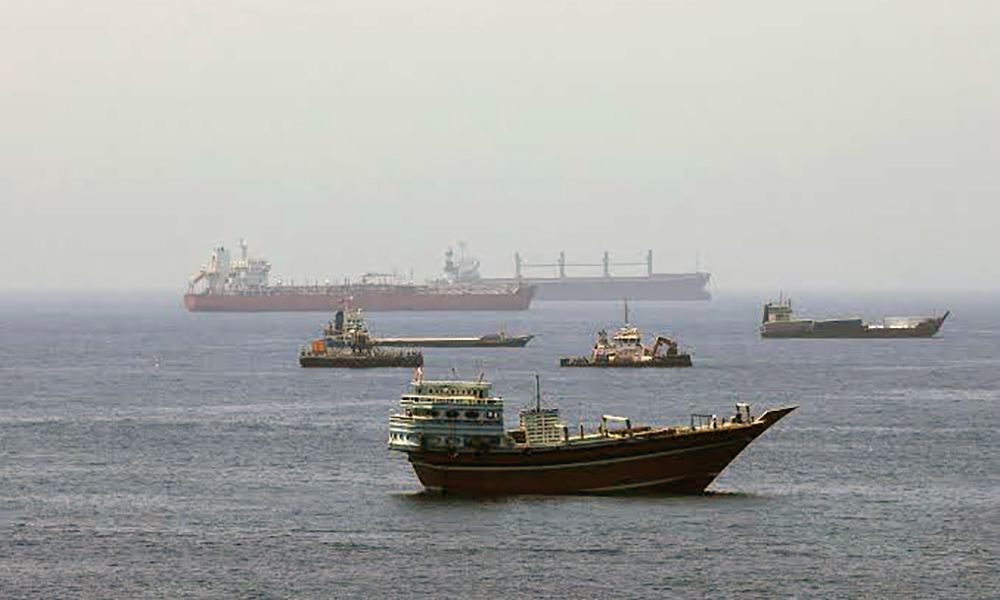
President Donald Trump said Monday that U.S. strikes against Iran were targeting the country's military capabilities tied to the Strait of Hormuz, the strategic waterway Tehran has used for years as leverage against the United States and Israel.
The U.S. military announced new strikes against Iran on Monday, but Trump told reporters at the Oval Office that he had not ruled out a negotiated settlement with Tehran.
"We're attacking their capabilities associated with the Strait of Hormuz," Trump said.
The Strait of Hormuz is one of the world's most important energy chokepoints, with the Congressional Research Service estimating that about one-fifth of global petroleum consumption passes through the narrow waterway connecting the Persian Gulf to the Gulf of Oman.
Iran has spent decades developing military systems aimed at threatening shipping in and around the strait, including anti-ship missiles, naval mines, fast attack boats, coastal defense systems, and unmanned drones, according to the Congressional Research Service.
Those capabilities are central to Iran's asymmetric military strategy, allowing Tehran to threaten a far more powerful adversary by targeting commercial shipping and naval forces in a confined maritime area, according to U.S. military analysts.
Iran has repeatedly threatened to disrupt traffic through the Strait of Hormuz during periods of heightened tensions with Washington, viewing the waterway as one of its most important sources of leverage because of its importance to global energy markets.
The Associated Press reported that the current conflict has increased concerns over Iran's ability to interfere with shipping through the strait, with commercial traffic already affected as the United States and Iran battle over control of the strategic passage.
Trump also said Monday that the United States was investigating whether Iran has military drones in Cuba.
"It could be that there are Iranian drones in Cuba," Trump said. "If they do have that, and they might very well have that, we'll take care of it."
Trump said officials were looking into the matter but provided no evidence to support the claim.
The White House has not publicly confirmed that Iranian drones are deployed or stored in Cuba.
The comments came after former Florida Gov. Jeb Bush warned at a United Against Nuclear Iran event that Cuba may have acquired Iranian-made Shahed drones, which have been used by Iran and its partners in conflicts overseas.
The New York Post reported that Bush raised concerns about the possibility of Iranian drone technology being positioned close to the United States, though the claim has not been independently confirmed by U.S. officials.
The issue has drawn attention because Iran's Shahed drone family has become one of Tehran's most widely exported weapons systems. Iran has supplied Shahed-series drones to Russia for use in Ukraine, and Iranian-backed groups in the Middle East have also used similar unmanned systems in attacks against U.S. and allied targets.
Trump said the administration would respond if Iran had placed military drones in Cuba.
"We're not going to have a problem," Trump said. "We're not going to allow that to happen."


No comments:
Post a Comment